In the high-pressure culinary world, *mise-en-place* translates literally to “everything in its place.” However, this discipline represents more than simple visual tidiness. For a professional chef, it means “working clean” to ensure seamless movement. Similarly, your bathroom serves as the critical staging area for your daily routine. A successful start requires strategic bathroom organization ideas that make essential tools instantly accessible. Without preparation, unnecessary decision fatigue sets in before the day truly begins. We must view the vanity as a functional workstation.
A common misconception suggests that organization starts with a shopping trip. Many homeowners feel an impulse to purchase stacks of matching bins immediately. Experts warn that buying containers first creates “hiding places” instead of solutions. These premature purchases result in rigid systems that fail to support your workflow. You are often left with wasted money and cluttered countertops. Unmeasured bins rarely fit the inventory you actually need. Successful design dictates that shopping must be the final step.
Instead, this guide reveals an authoritative, three-stage methodology to transform your space. First, we address the “purge” to remove expired products. Next, we map your workflow to establish high-efficiency zones based on usage frequency. Finally, we introduce containment tools to maintain these new boundaries. By following this sequence, we move from abstract planning to tangible results. Applying this kitchen-tested logic ensures a calm, efficient morning “service.”
Phase 1: The Foundation – Workflow and Zoning
Before purchasing a single bin, you must establish a plan. Stop viewing the bathroom as one chaotic room. Instead, visualize it as a collection of distinct “activity centers.” For professional designers, these include the Wet Zone, Vanity Zone, and Toilet Zone. Organization becomes about the tasks performed there, such as dental hygiene or skincare. This shift ensures the layout serves your actual habits.

Next, conduct a workflow audit to determine “prime real estate.” Analyze your specific daily routine. If you brush your teeth first, the toothpaste belongs in the most accessible drawer. This concept, known as the “reach radius,” ensures efficiency. Ideally, everything needed for a task sits within arm’s reach of its zone. Conversely, backup supplies belong in harder-to-reach areas.
A sustainable system requires a strict planning hierarchy. First, declutter ruthlessly. You cannot organize items you do not use. Then, map and measure the physical space before buying containers. Consider environmental factors like humidity. The bathroom is structurally poor for storing medicine due to heat fluctuations. Move sensitive items to a cool, dry area. Finally, reserve open shelving for aesthetic touches to maintain a spa-like atmosphere.
1. The ‘Active vs. Archive’ Audit: Separating daily essentials from bulk backstock
The “Active vs. Archive” audit adapts business principles for the home. It distinguishes strictly between daily essentials and long-term inventory. In the context of a bathroom, this is not just about tidiness. Safety is the primary driver for this separation.
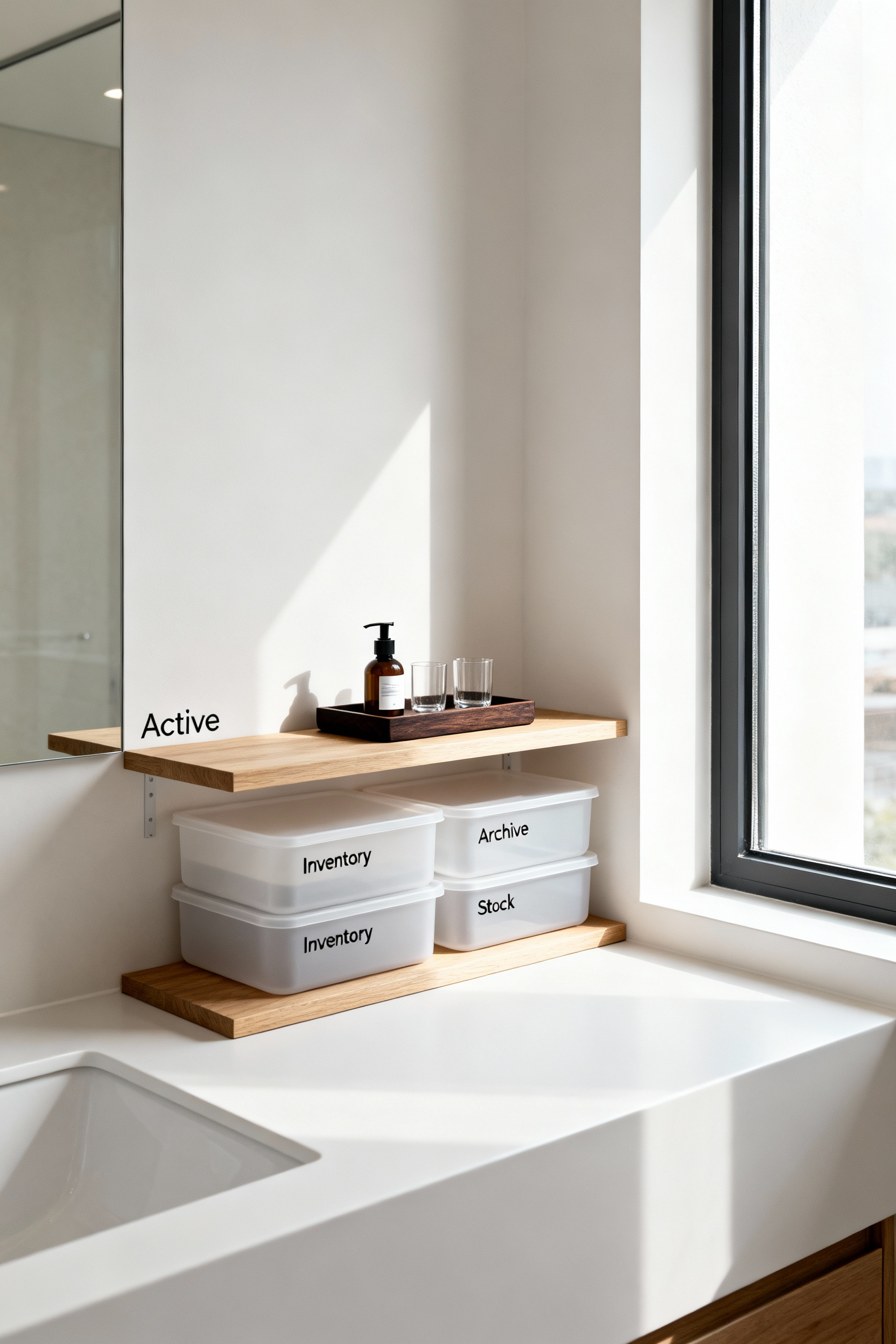
High humidity accelerates chemical hydrolysis. This degrades active ingredients in products. Aspirin can lose significant potency within two months in moist environments. Storing “Archive” medications in a steamy bathroom is a safety risk. Bulk supplies and pharmaceuticals belong in a stable, dry climate like a hallway linen closet.
Professional organizers suggest implementing the “One Backup” rule. Keep one item in use and exactly one backup nearby. Anything beyond that limit is classified as “Archive.” Aim to fill drawers to only 80% capacity. This intentional “breathing room” prevents physical friction during retrieval.
Moreover, rigorous separation reduces psychological stress. Visible clutter acts as an environmental stressor. It triggers cortisol production. The brain wastes energy processing irrelevant “Archive” items. By concealing utilitarian backstock, you protect your mental resources. A clear vanity fosters a calm, focused morning ritual rather than a chaotic search.
2. The Vanity ‘Prep Station’: Adopting the culinary triangle for morning efficiency
The Kitchen Work Triangle, developed in the 1940s, revolutionized home cooking efficiency. It minimizes wasted steps between the refrigerator, sink, and stove. This ergonomic concept isn’t limited to culinary spaces. I adapt this workflow to the master bath, creating a dedicated “Vanity Prep Station.”
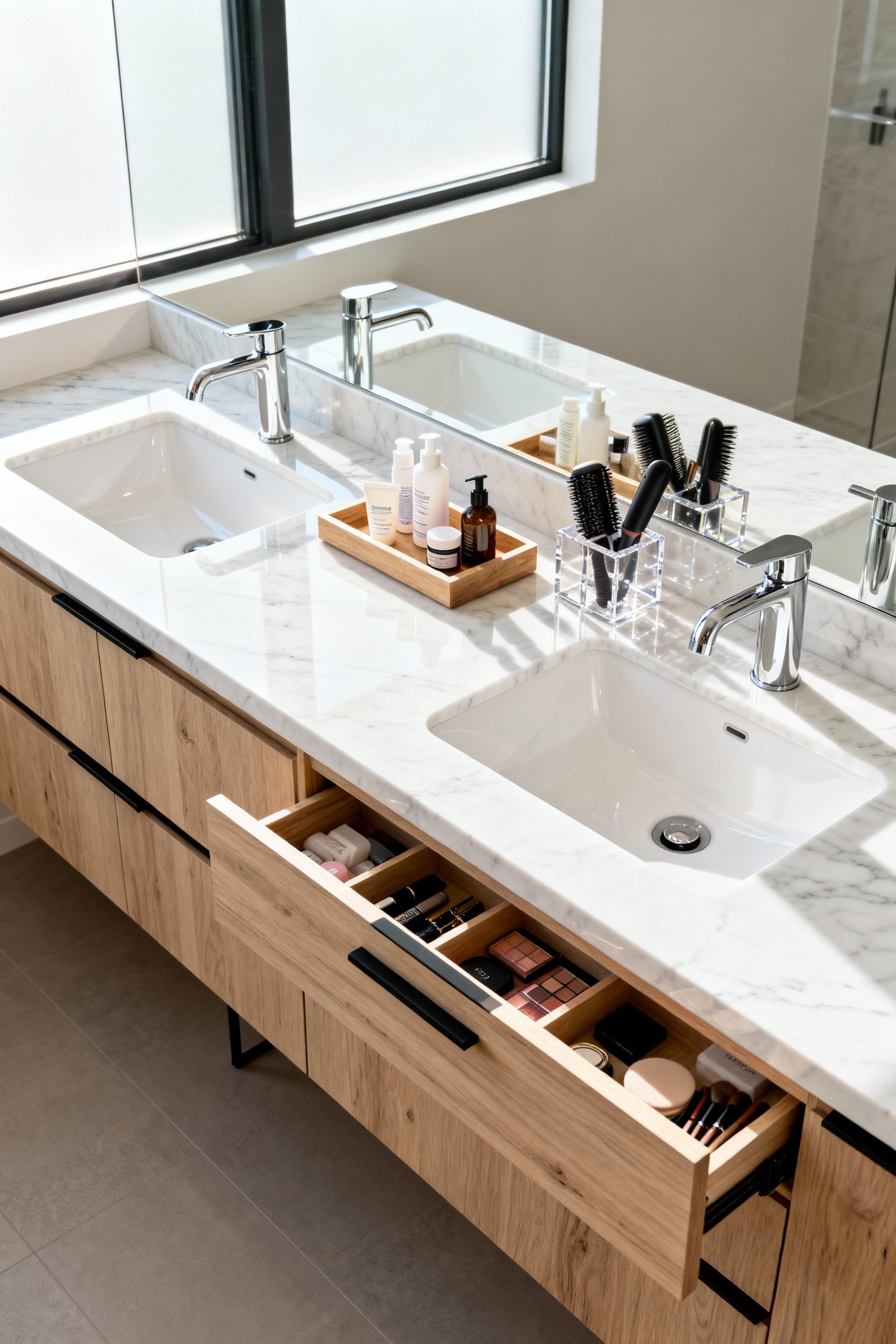
To achieve this, redefine the three kitchen pillars into task-based bathroom zones. First, the kitchen sink parallels the “Wet-Prep Zone.” Here, water-dependent tasks like face washing occur. Keep cleansers strictly within arm’s reach. Next, the stove translates to the “Application Station.” This dry area focuses on detailed grooming, utilizing shadow-free lighting. Finally, the refrigerator becomes the “Inventory Hub.” Deep drawers hold bulk products, keeping the countertop clear.
The goal is eliminating obstruction and minimizing the reach. Efficient design dictates that daily essentials must be accessible without opening multiple drawers. Reducing physical clutter directly improves mental clarity. By mapping the layout to your workflow, the process becomes intuitive. The morning rush transforms into a seamless ritual.
3. Countertop ‘Tray Corrals’: Containing clutter while maintaining visual calm
A tray corral functions as a psychological frame for your vanity. It transforms scattered objects into a single, cohesive vignette. The brain processes the collection as one intentional object rather than disparate clutter. This reduces visual noise without hiding daily essentials. You achieve the effect of a clear, minimalist surface while keeping necessities accessible.
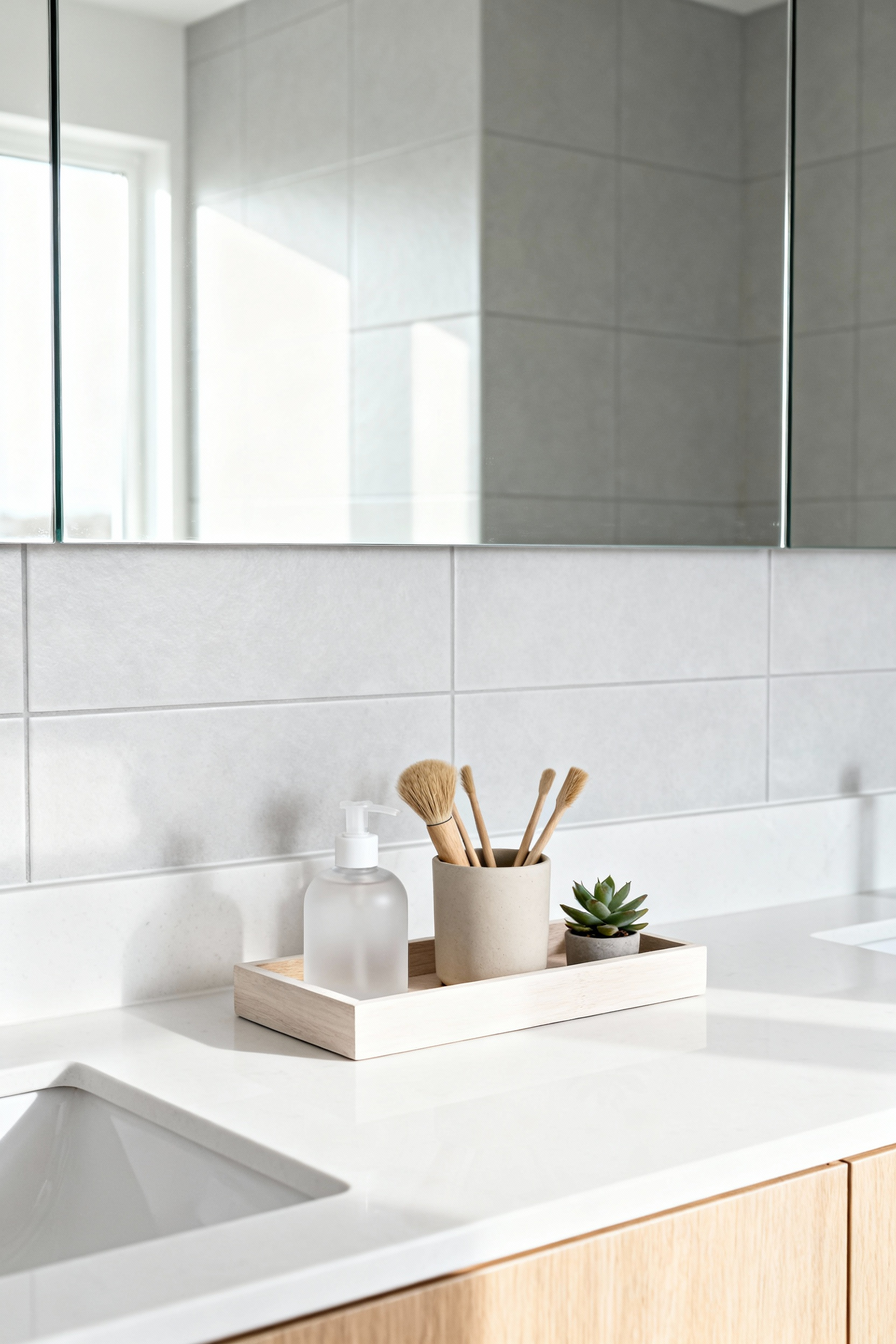
Historically, this mirrors the “salver,” a serving platter designed to prevent slipping. Material choice adds sensory depth. Marble trays offer a cool contrast to humidity. Woven textures introduce biophilic elements, grounding the space with warmth.
Beyond aesthetics, trays serve a practical function. They prevent grime accumulation under individual bottles. Cleaning becomes streamlined. You simply lift the entire corral to wipe the surface underneath. Furthermore, the tray acts as a shield. It protects porous countertops from spills or corrosive rings. This addition bridges the gap between high design and daily utility.
4. The Danger of Deep Drawers: Using acrylic dividers to create dedicated homes for small items
Modern bathroom design often favors deep drawers to maximize storage. However, this depth creates an organizational challenge. Drawers ranging from six to ten inches deep often become “black holes.” Small essentials like contact lens cases inevitably migrate to the bottom. The vertical space above these low-profile items goes to waste. This inefficiency forces you to rummage, increasing cognitive load.
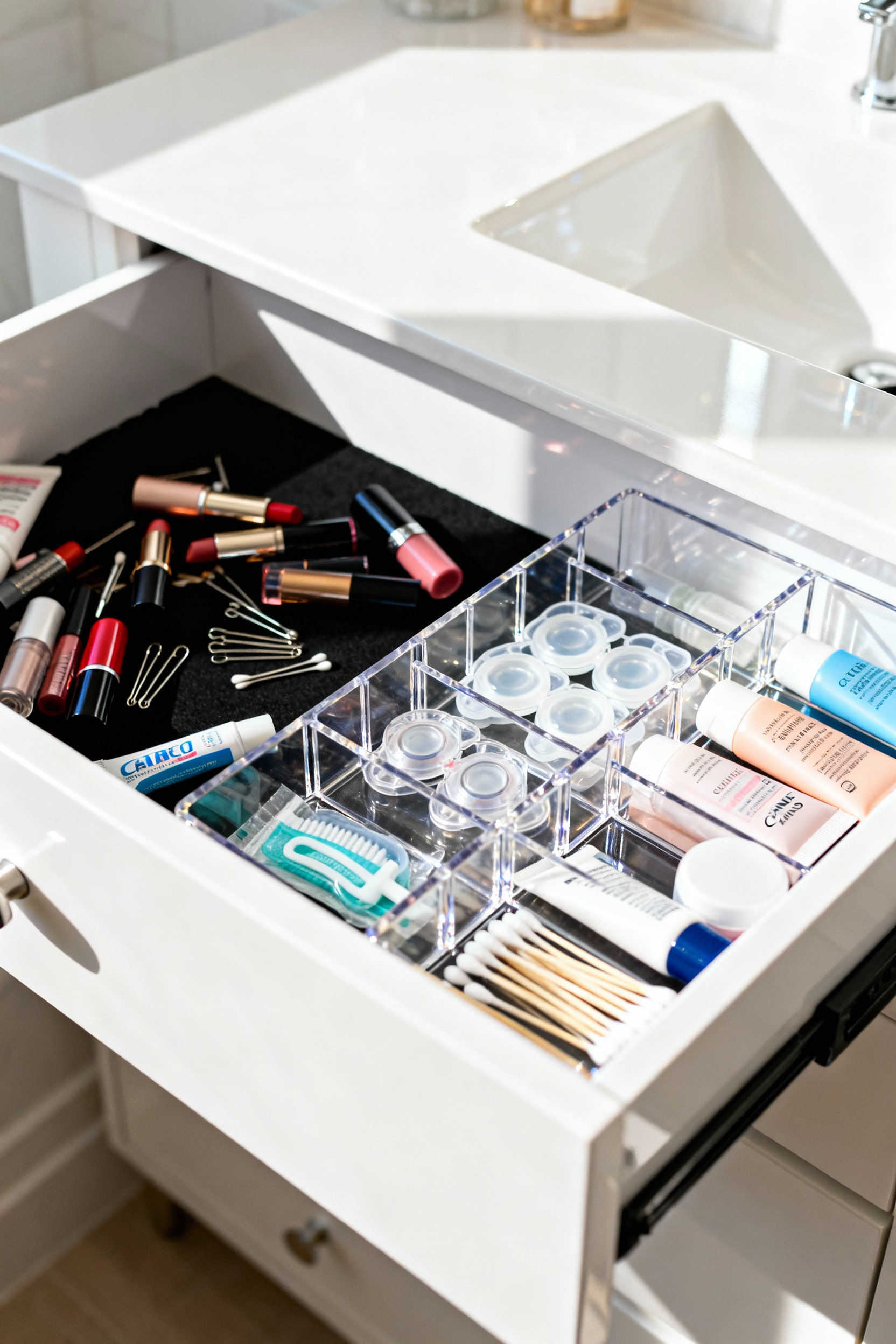
Acrylic dividers offer a sophisticated remedy. Their crystal-clear material ensures instant visual accessibility. You can identify the contents of any compartment at a glance. This clarity streamlines your workflow by creating a visible home for every item. The transparent aesthetic creates a clean, “invisible” look. It blends seamlessly with the drawer’s interior.
Acrylic provides technical advantages in a wet environment. Modular systems allow for a custom-fit configuration. You can interlock different sizes to fill the drawer edge-to-edge. Premium acrylic is inherently durable. Unlike bamboo, it withstands humidity without warping. These dividers maintain hygiene while transforming a chaotic drawer into a workspace.
Phase 2: Intermediate – Maximizing Hidden Space
This phase moves beyond simple decluttering. It focuses on architecturally reclaiming “dead space” within the existing footprint. This approach is critical when dealing with clever small bathroom storage solutions. Consider the toe-kick recess beneath your vanity. Often, this area remains a non-functional void. Installing a shallow, push-to-open drawer here utilizes vertical space efficiently. It creates a perfect staging area for flat items like scales.
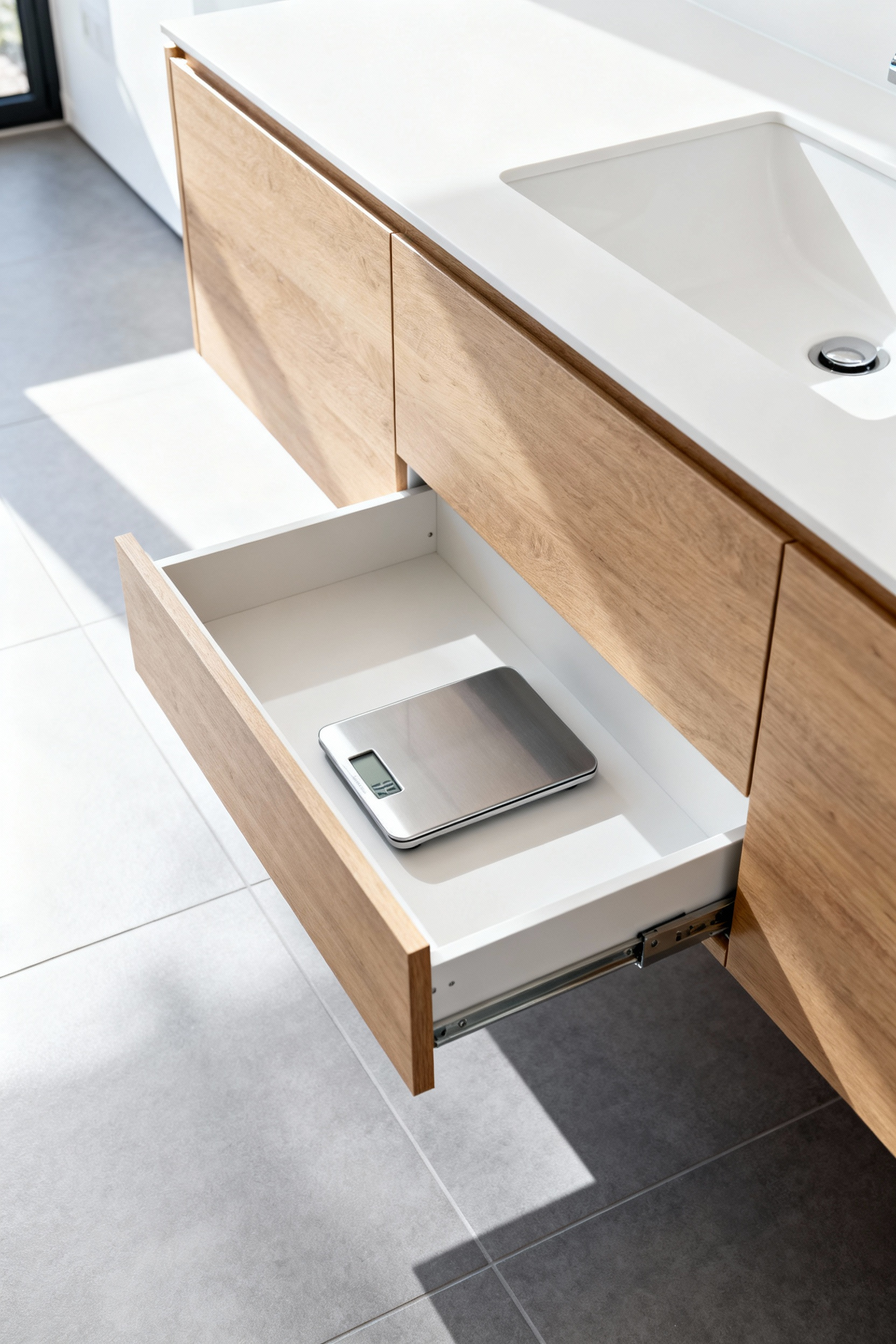
The decorative false panel below the sink also offers potential. Installing a tip-out tray mechanism creates discreet storage. High-frequency tools like tweezers remain accessible yet unseen. Deep under-sink cabinets often become disordered “black holes.” Replace static shelving with full-extension, tiered pull-out drawers. These mechanisms bring back-corner items forward immediately.
Additionally, clever design utilizes the empty cavity between wall studs. Recessed medicine cabinets or shower niches sit flush against the wall. They reduce visual clutter while keeping daily essentials at eye level. This structural approach achieves visual quietude. The room feels expansive, functioning as a true sanctuary.
5. Under-Sink Engineering: Utilizing slide-out tiers to navigate around plumbing pipes
The space beneath the sink creates a unique engineering challenge. The P-trap and water supply lines protrude awkwardly into the cabinet. Generic storage bins often jam against these pipes or waste valuable depth. Specialized slide-out tiers offer a tailored solution to this puzzle.
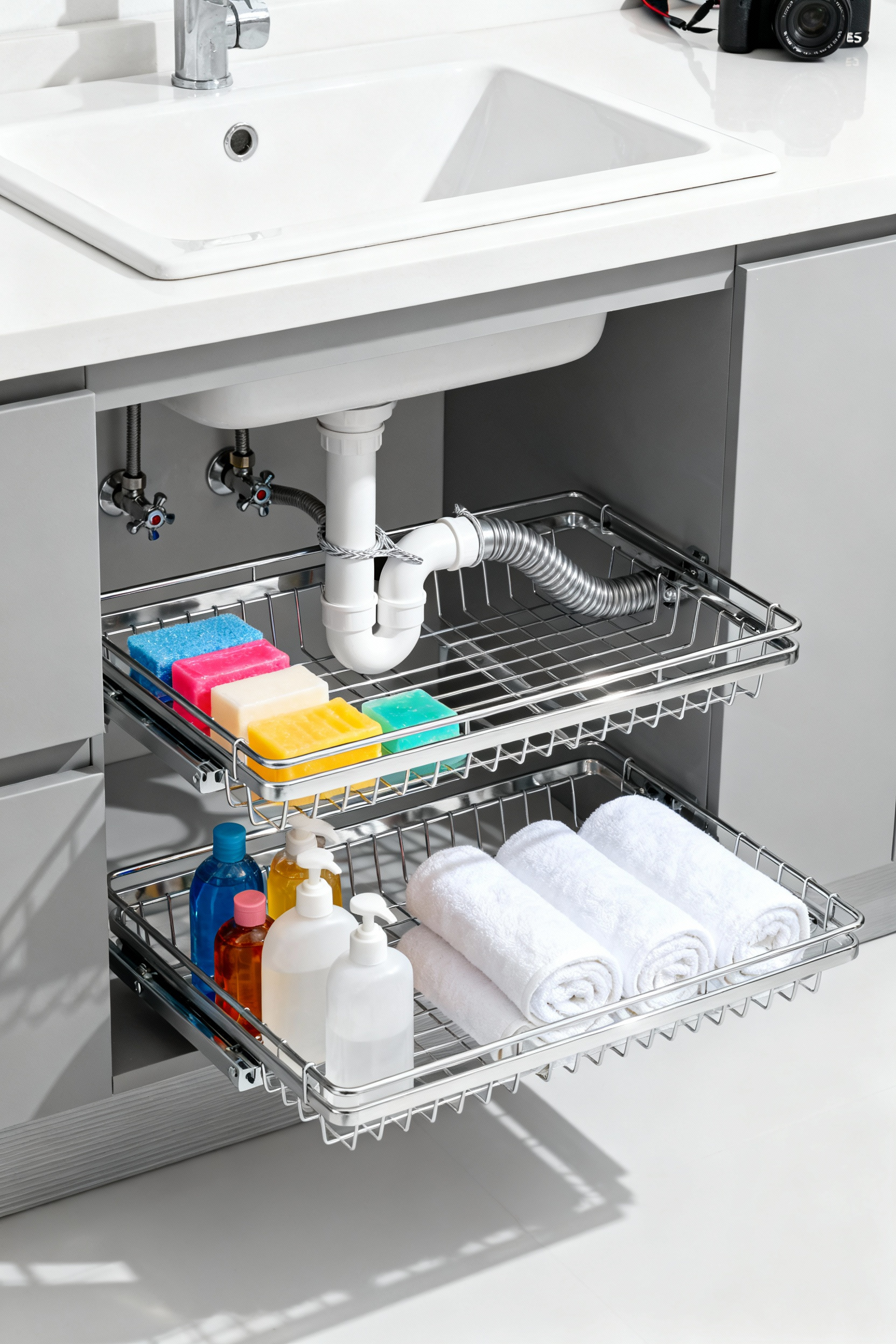
Drawers featuring pre-molded “U” or “L” cutouts wrap perfectly around plumbing obstacles. The organizer sits flush against the back wall, maximizing usable cubic footage. Beyond shape, the mechanical quality defines the user experience. Industrial-grade ball-bearing slides support heavy loads. You can store bulk cleaning supplies without fear of warping hardware.
Premium systems often incorporate soft-close technology. This functional luxury prevents drawers from slamming, ensuring tall bottles remain upright. Durable materials like epoxy-coated steel resist humidity. These engineered systems convert a catch-all into a highly accessible zone. You simply pull a handle, and the entire cabinet content glides outward.
6. Vertical Door Utilization: Adapting pantry rack systems for hair tools and tall bottles
The back of a cabinet door is often overlooked real estate. Borrowing the pantry rack system concept transforms this “dead” zone into a storage wall. These racks are engineered with a shallow 5-to-6-inch depth. They are dimensionally perfect for tall items like hairspray. Adjustable baskets allow you to create custom zones. You can designate specific heights for 12-inch bottles versus smaller jars. For more in-depth techniques on managing enclosed spaces, review our 22 brilliant bathroom cabinet organization tips.
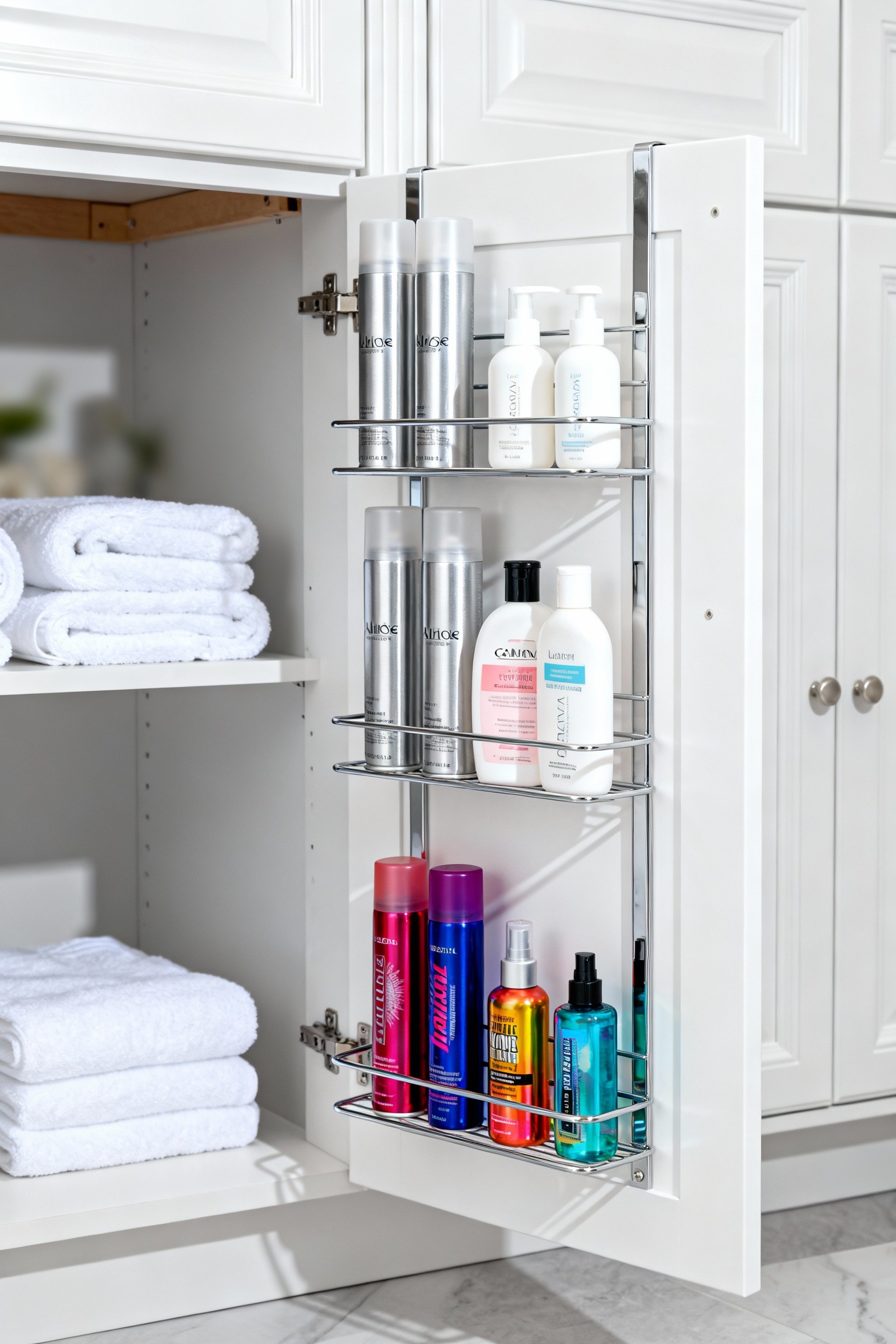
This system adeptly manages hot styling tools. However, you must consider the humid microclimate. Opt for powder-coated or 304-grade stainless steel to resist rust. Integrating a heat-resistant wire grid caddy creates a safe “thermal zone.” This allows tools like flat irons to cool passively without scorching surfaces.
This shallow profile ensures 100% visibility of your supplies. You no longer have to dig through the “dark zone” of a deep shelf. Verify clearance before installation. Ensure you have a 3-to-4-inch gap between the door and the fixed inner shelves. This simple check guarantees the door closes smoothly.
7. The Magnetic Strip Hack: Repurposing knife holders for tweezers, bobby pins, and nail clippers
As a kitchen designer, I value tools that offer over-engineered performance. Magnetic knife strips provide a brilliant solution for managing small bathroom items. These racks utilize powerful rare-earth magnets designed to hold heavy steel cleavers. They offer incredible retention for lightweight tweezers, bobby pins, and nail clippers. These tools remain fixed with military precision, never shifting when a drawer opens.
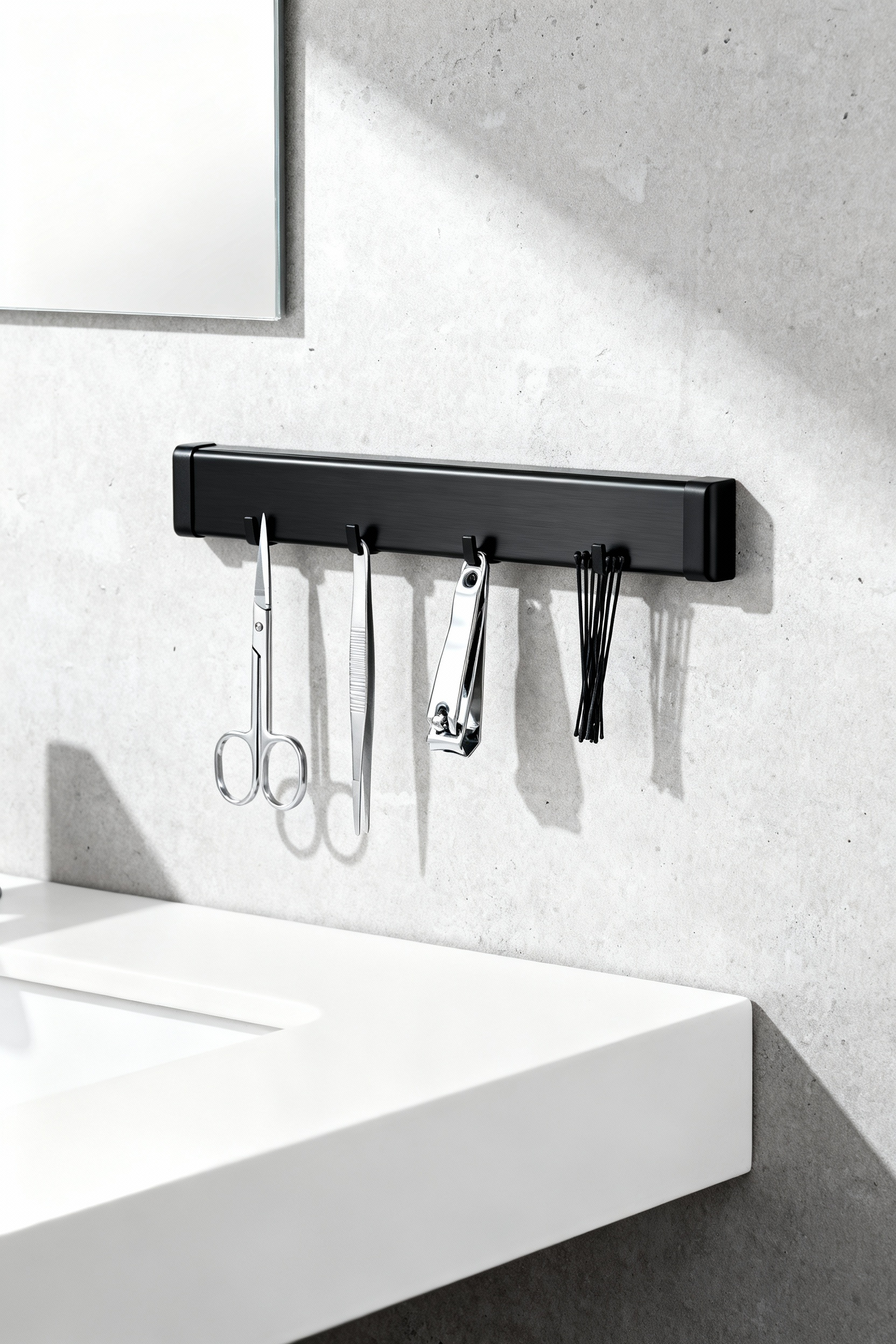
This method masters the art of “invisible organization.” Mount the strip inside a vanity drawer or on a cabinet door’s interior. This placement clears your countertops while keeping essentials within reach. For installation, opt for industrial-grade adhesive tape instead of screws. Tape is often more secure and protects the drawer’s mechanical slides.
Consider the material’s impact on your atmosphere. While stainless steel is common, wooden strips in walnut add warmth. The wood acts as a cushion, silencing the harsh “clang” of metal tools. You achieve a quieter environment. This open design improves hygiene by allowing air circulation. Unlike deep cups, the strip prevents residue buildup.
8. The Lazy Susan Solution: optimizing deep corners in linen closets for skincare products
Deep linen closets often suffer from the “blind corner” effect. Expensive serums and masks get pushed back into dark recesses. Eventually, these hidden products expire before use. To solve this, we borrow from kitchen design: the Lazy Susan. This rotating tray reclaims lost storage space by bringing items to the front with a simple spin.
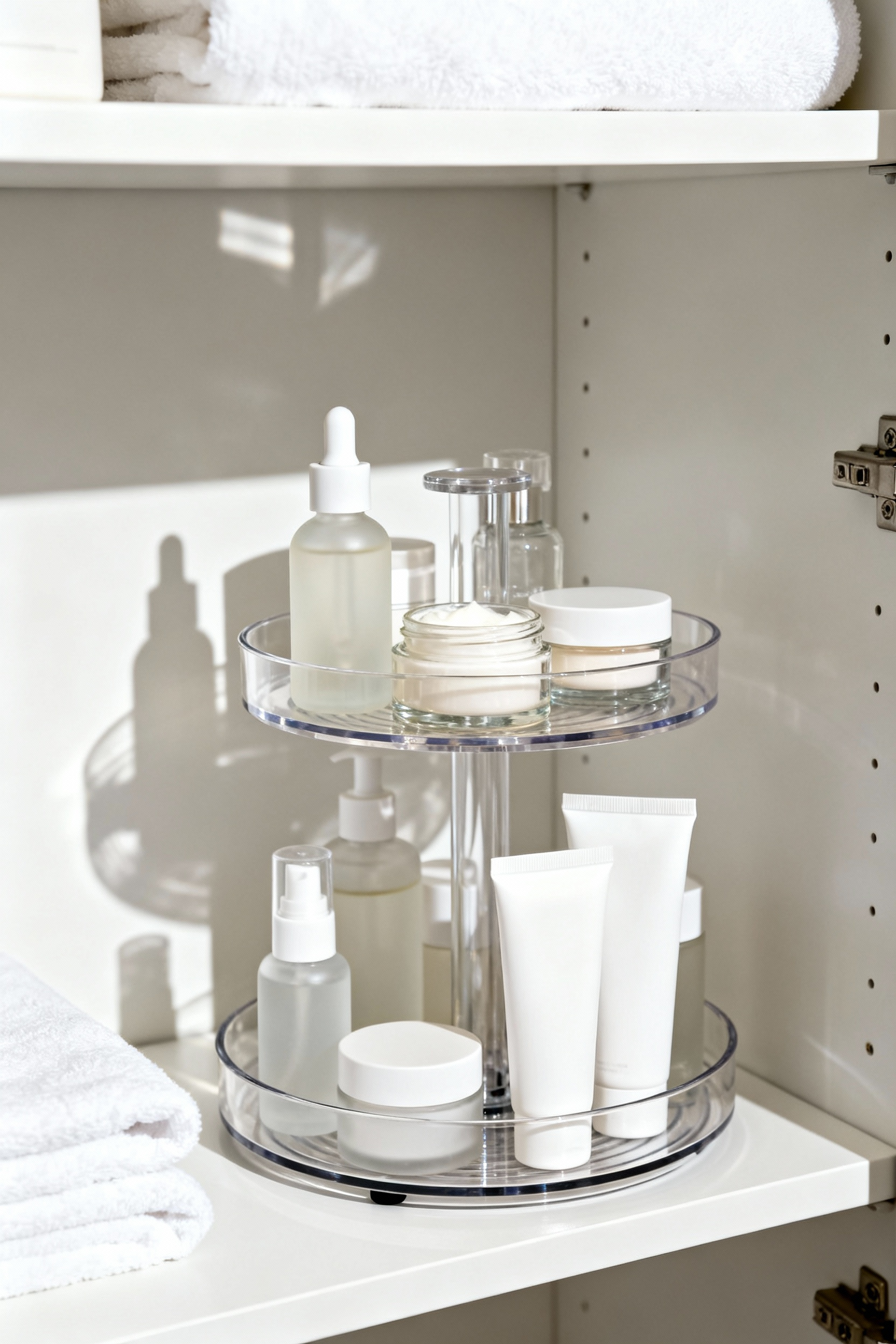
Prioritize multi-tiered turntables for this application. These organizers maximize vertical space typically wasted between shelves. Tiers allow you to separate daily essentials from occasional treatments. Stability is crucial for storing delicate glass bottles. Select a model that features a raised outer lip. This safety measure prevents top-heavy toners from sliding off.
Clear acrylic is the superior choice for bathroom environments. Unlike wood, high-quality plastic is non-porous. It is waterproof against oil spills or leaks. The material’s clarity reduces decision fatigue. You can instantly identify labels without digging through clutter. This shift from chaos to clarity saves time and protects your investment.
9. Decanting Essentials: Why transferring cotton and salts to glass apothecary jars reduces visual noise
Visual noise often dominates functional spaces. Commercial packaging introduces chaos through clashing colors and loud branding. In cognitive science, this clutter creates “Extraneous Cognitive Load.” The brain strains to process these disparate visual cues, causing stress. Decanting essentials into uniform glass apothecary jars resolves this tension.
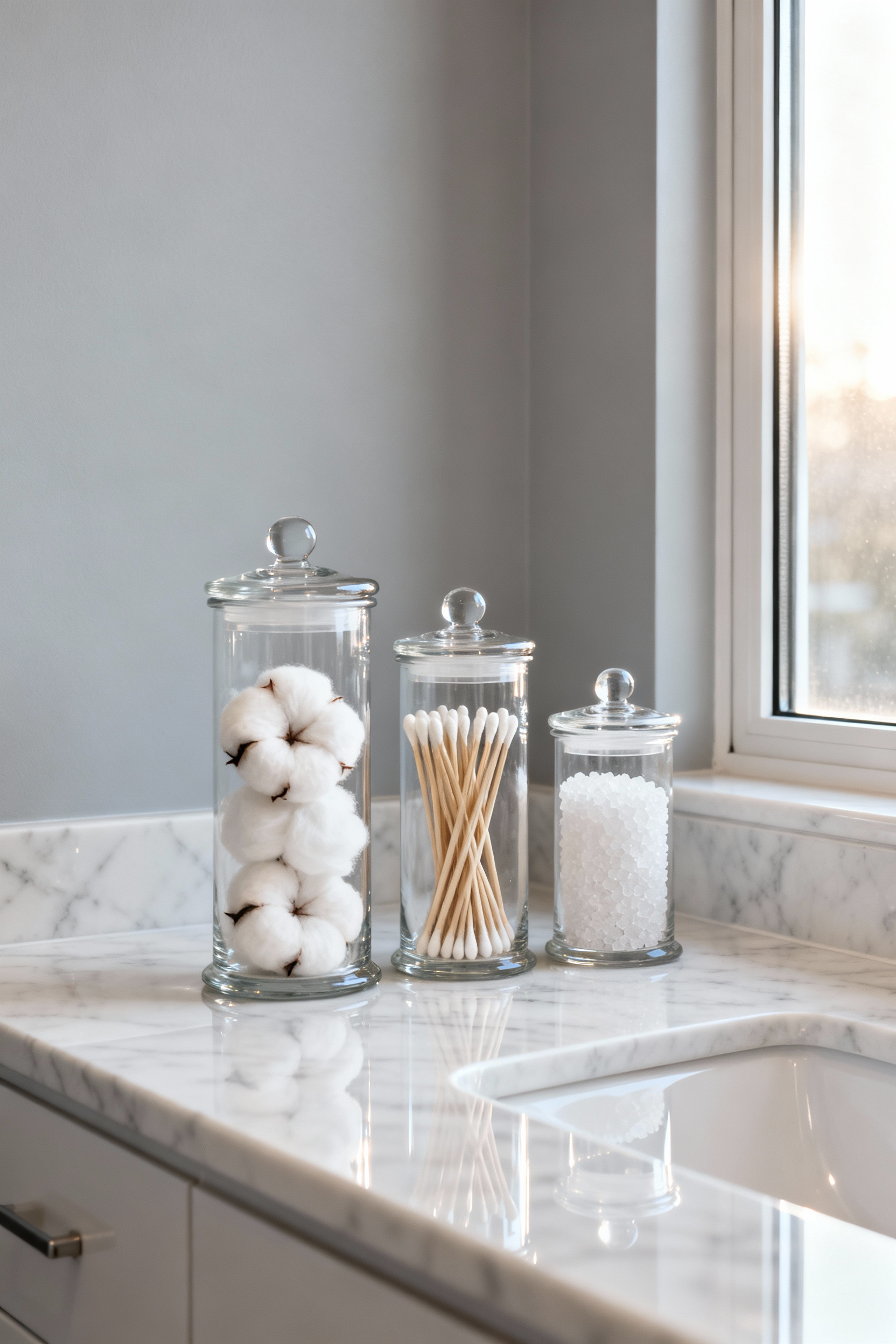
Stripping away aggressive labels reduces mental fatigue. Clear glass allows the mind to rest on a single, unified material. Moreover, the contents transform into textural art. Uncompressed cotton balls communicate softness and cleanliness. Crystalline bath salts catch the light, acting like subtle prisms.
This practice elevates mundane utility items into decor. The apothecary silhouette symbolizes precise, methodical care. Using these traditional vessels suggests that your personal care is a curated ritual. This design choice offers a timeless quality. It creates a calm, restorative sanctuary.
10. Electrical Integration: Creating powered drawers to keep cords and hot tools off the counter
Modern bathrooms thrive on minimalism. However, the grooming routine often clutters vanities with tangled cords. Electrical integration effectively solves this visual chaos. Powered drawers allow hair dryers and flat irons to remain plugged in permanently. The morning ritual transforms into a seamless “open, use, close” motion. This protects cabinetry while maintaining a spa-like aesthetic. For further inspiration, explore 18 minimalistic bathroom design ideas for ultimate calm.
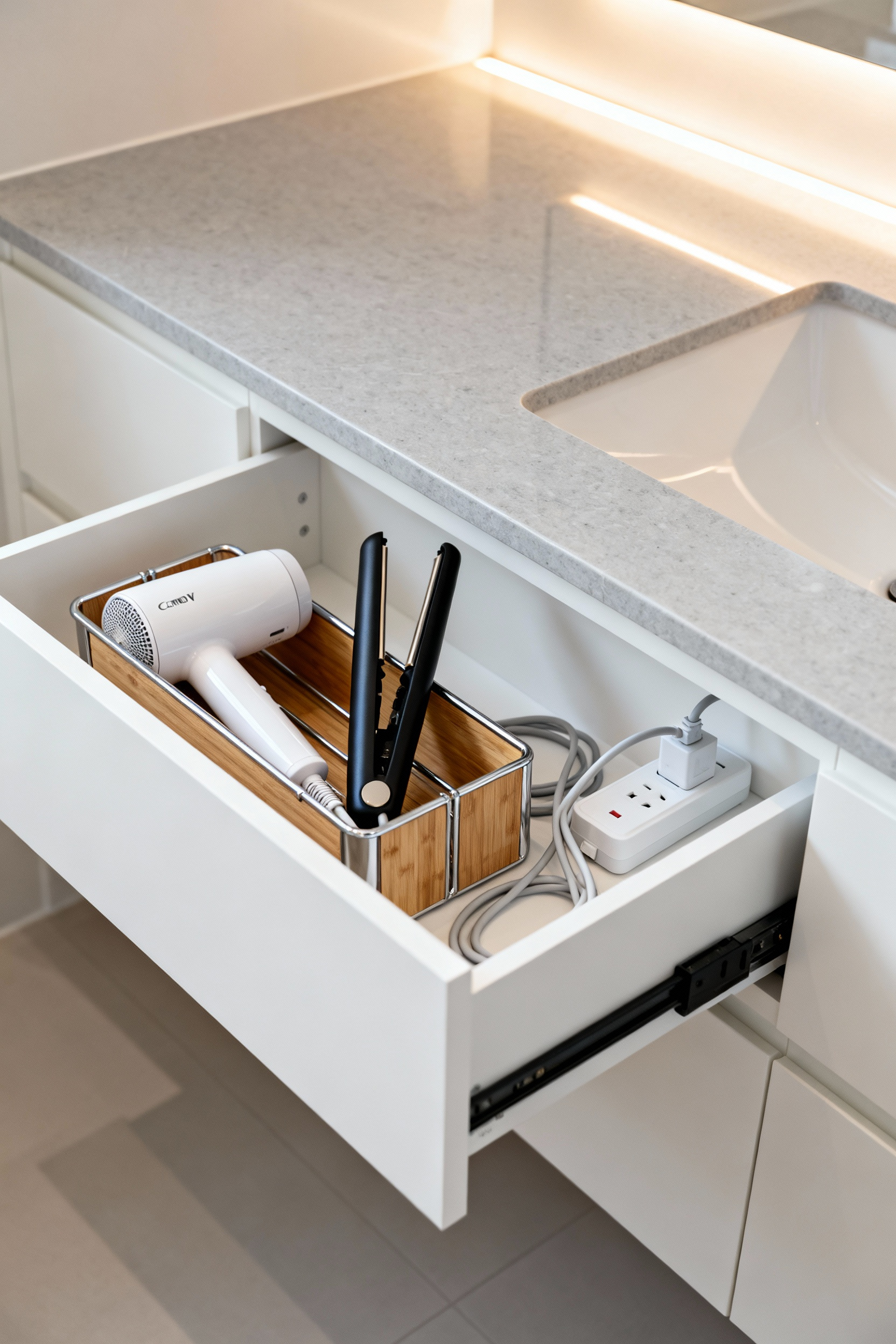
This luxury feature relies on safety engineering. These units differ significantly from standard power strips. High-quality systems employ automatic interlock switches. Power is cut immediately once the drawer closes, eliminating fire risks. Built-in thermostats monitor internal temperatures to prevent overheating.
Functionally, these drawers necessitate specialized organization. Designers install stainless steel canisters directly into the drawer floor. Users can safely stow hot tools without waiting for them to cool. From an installation perspective, professional planning is essential. The circuit requires mandatory GFCI protection. Cable management arms prevent cords from kinking. This integration merges safety with luxury.
Phase 3: Advanced – Structural and Stylistic Elevation
Structural elevation moves beyond purchasing organizers. It embraces architectural integration. Storage becomes a seamless extension of the room’s permanent structure.
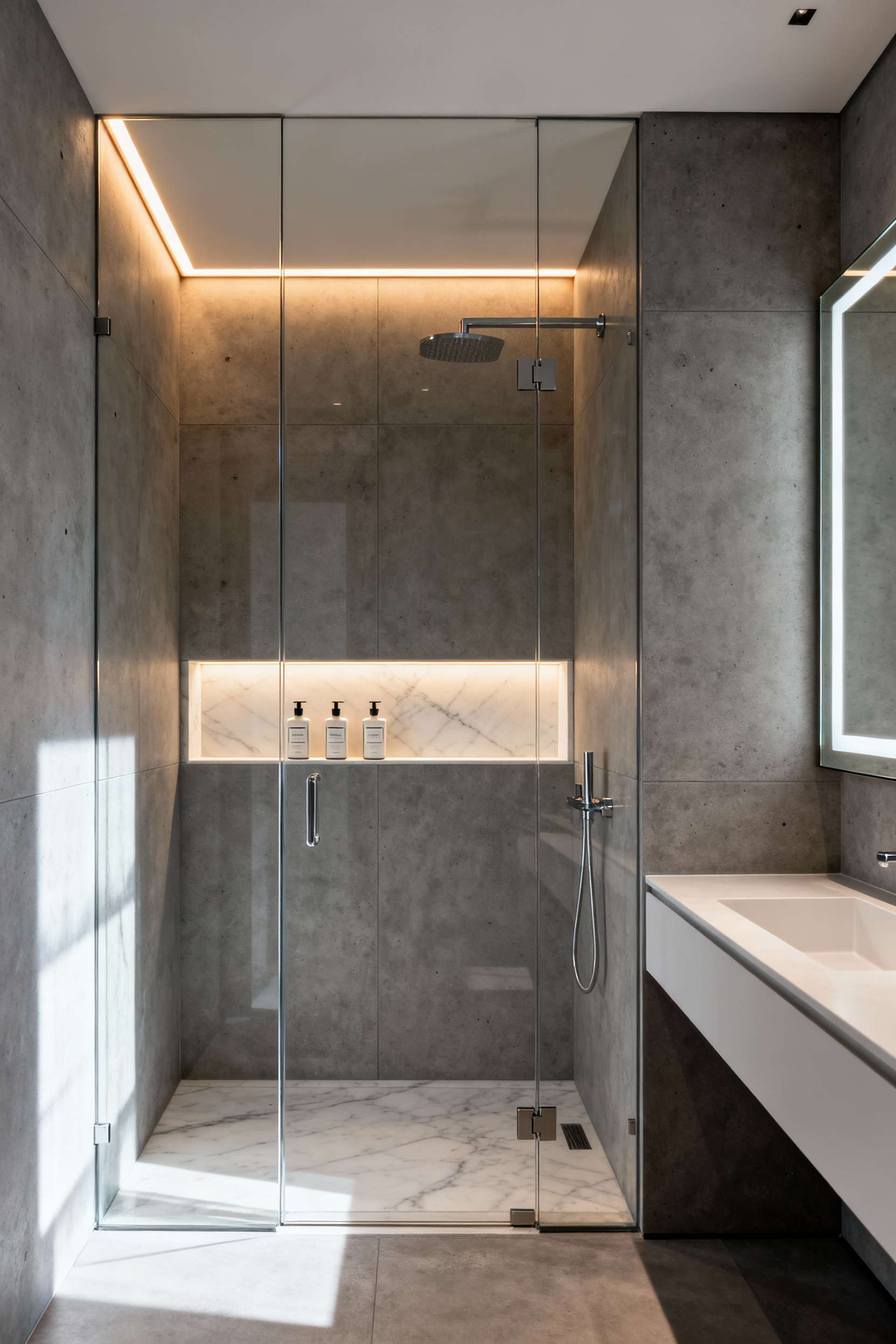
This advanced phase shifts from projecting cabinets to recessed elements. Wall-recessed shower niches replace cluttering caddies. They maintain clean lines. Recessed medicine cabinets maximize wall cavities, keeping the mirror flush.
True functional luxury addresses workflow friction. Integrating electrical outlets inside drawers ensures unsightly cords vanish. Electric toothbrushes stay charged yet hidden. Your visual field remains calm.
Achieving this cohesion requires a choice between custom and modular systems. Custom cabinetry offers superior craftsmanship. Modular systems provide flexibility. A fitted, built-in approach maximizes every inch of space. This investment adds lasting home value.
11. Recessed Niche Optimization: treating shower storage as architectural display
Optimizing a recessed shower niche transforms utility into a miniature architectural feature. This “cubby” functions as a dramatic focal point or a study in seamless integration. The “canvas” approach employs contrasting natural stone to frame products. Conversely, a minimalist strategy uses identical wall tile to blend the niche into the background. This design choice hides potential visual clutter.
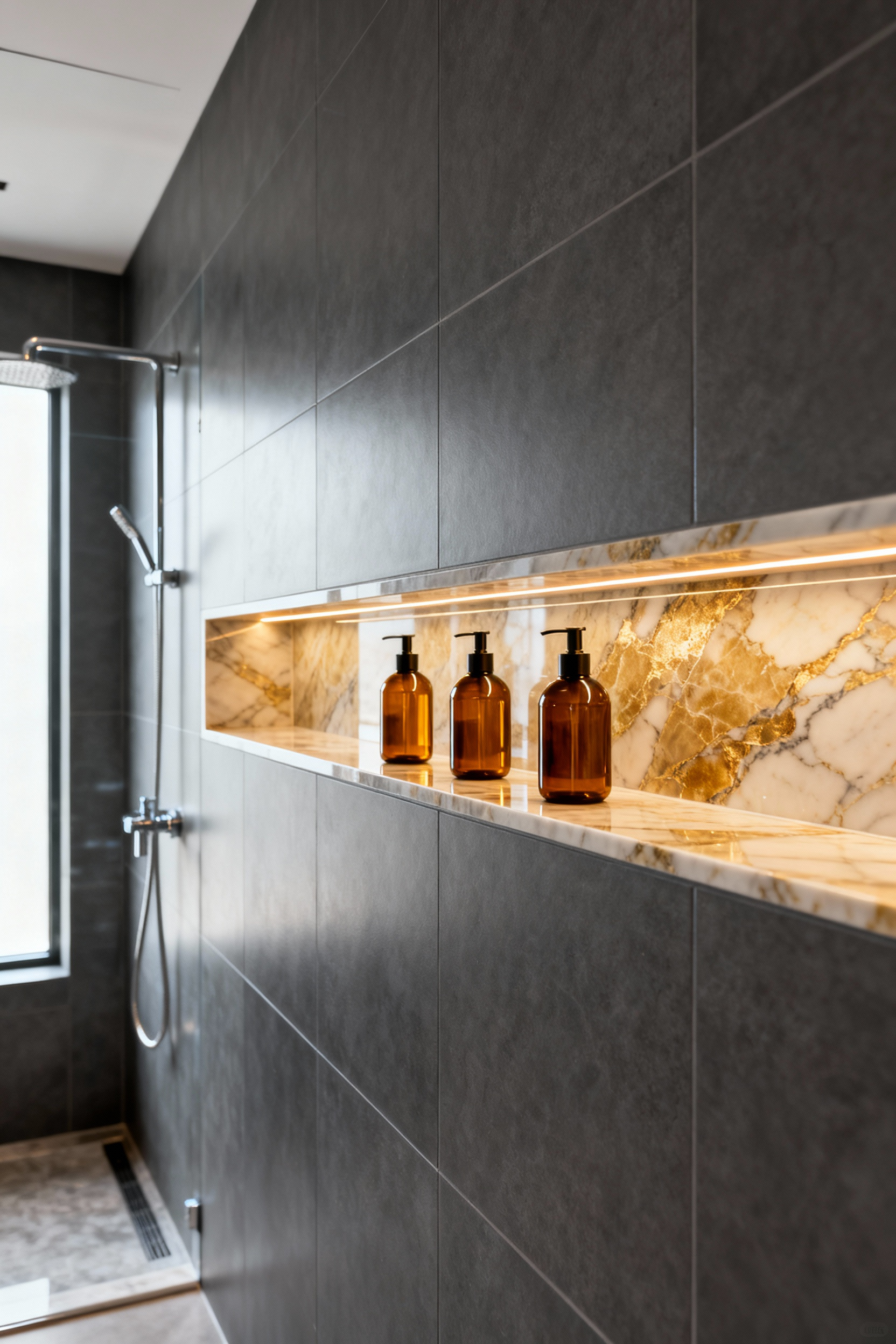
To elevate the experience, incorporate integrated illumination. Waterproof, low-voltage LED strip lighting creates a spa-like atmosphere. Select high CRI lights to maintain the visual integrity of your tilework. However, form must follow function. Ensure the niche is at least 12 to 14 inches high to accommodate tall containers. Plan for a slight, imperceptible slope on the bottom shelf. This precision prevents water pooling.
12. The ‘Hotel Fold’: Towel folding techniques that maximize shelf capacity and aesthetic appeal
The “Hotel Fold” represents a precise classification of folding methods for stability. The classic Trifold variation relies on the “Rule of Thirds.” First, you fold the towel lengthwise into thirds. This creates a uniform footprint regardless of the towel’s size. Next, folding it widthwise forms a dense, nine-layered rectangular block. These blocks stack into a solid column rather than a leaning pile. This safely maximizes vertical shelf capacity.
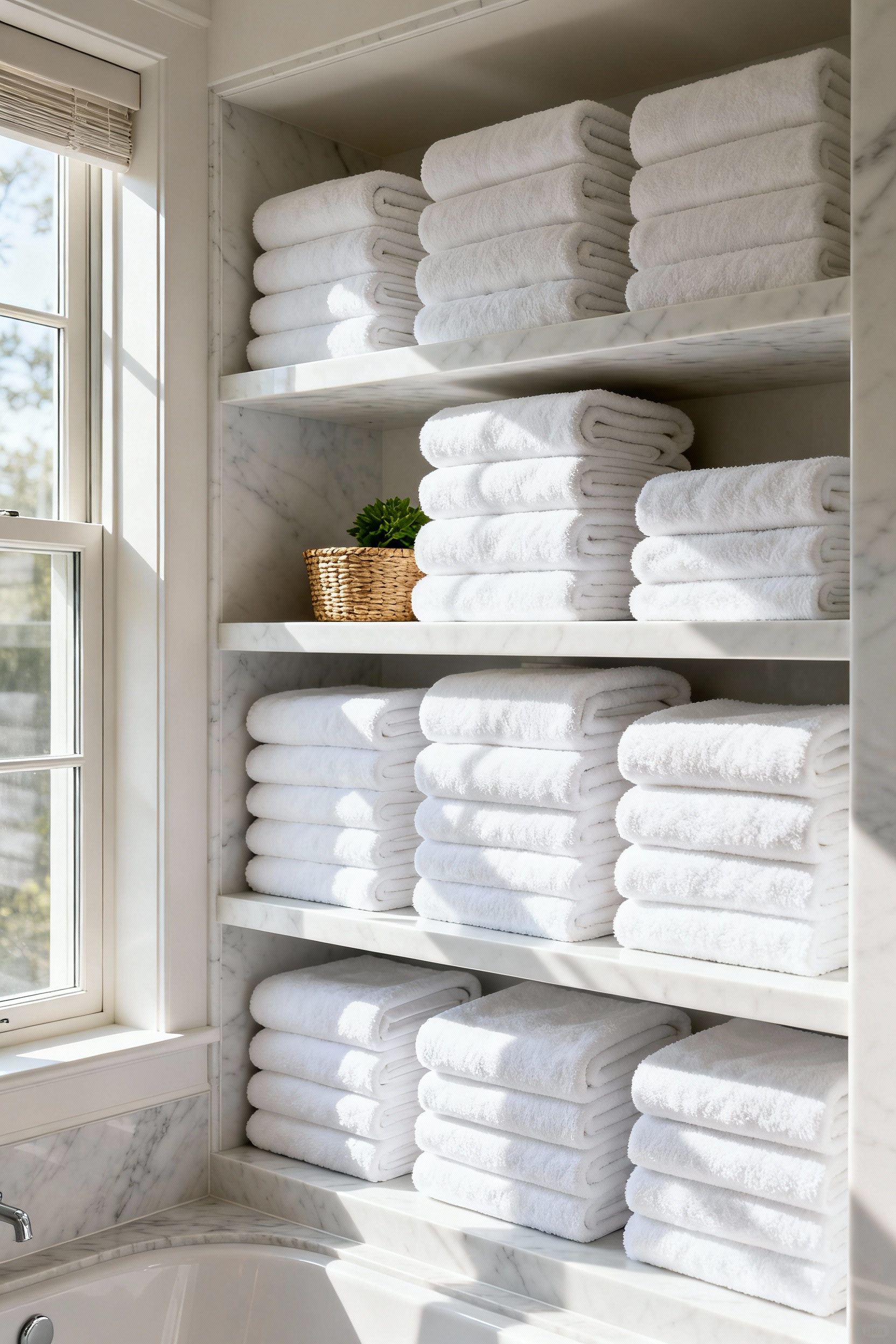
This method prioritizes “visual hygiene.” The folding sequence tucks away raw edges and tags. Only a single, crisp crease faces outward. Psychologically, this uniformity signals meticulous cleanliness. It transforms a standard bathroom into a sanctuary.
Effective organization requires choosing the right method. The Trifold is authoritative for open shelving. The “Spa Roll” creates a rounded aesthetic suited for deep baskets. Unlike the vertical KonMari fold, the Hotel Fold is meant to be seen. It balances structural integrity with luxury.
13. Floating Shelf Strategy: Balancing decorative objects with functional storage baskets
The floating shelf strategy is a method of controlled open-storage curation. It marries utility with a spa-like aesthetic. Experts often recommend a 2:1 ratio. This balances functional items against decorative accents. Storage baskets serve as sophisticated concealment vessels. Woven containers hide visual noise like hair tools and toilet paper.
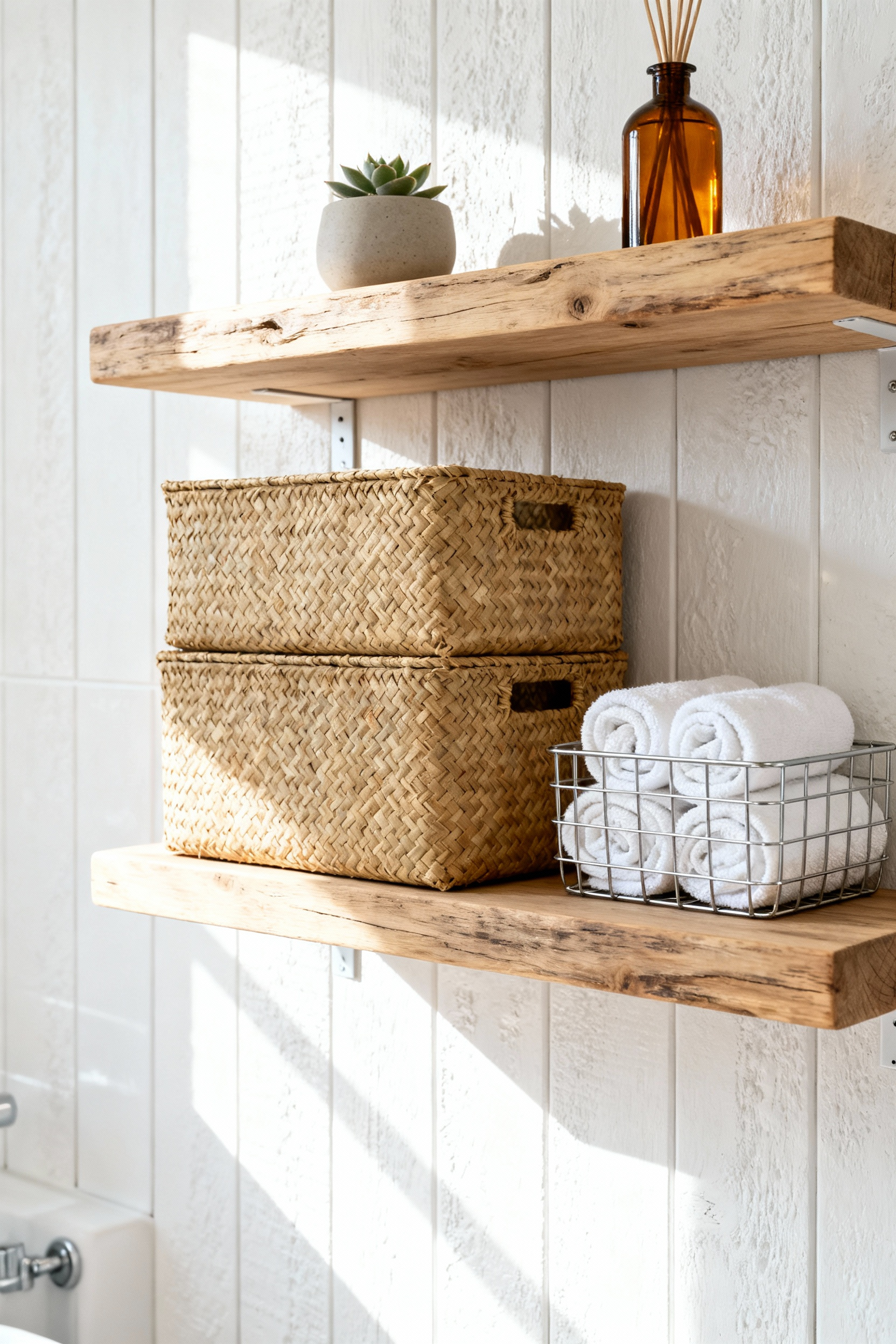
Simultaneously, “decant” smaller essentials into elegant objects. Move items like cotton swabs into glass jars. This approach leverages texture for visual harmony. Pairing sleek shelf finishes with organic wicker injects warmth. Executing this strategy requires architectural foresight. Select shelves with a depth of 10 to 12 inches. This securely holds baskets without them appearing precariously perched.
14. Custom Joinery Inserts: Tailored slots for makeup palettes and specific grooming tools
True luxury lies in effortless workflow. Custom joinery inserts elevate storage into a precision-engineered system. Unlike generic dividers, these solutions use Computer Numerical Control (CNC) technology. Specific items like hair straighteners drop perfectly into dedicated cavities. This ensures a flawless, snug fit.
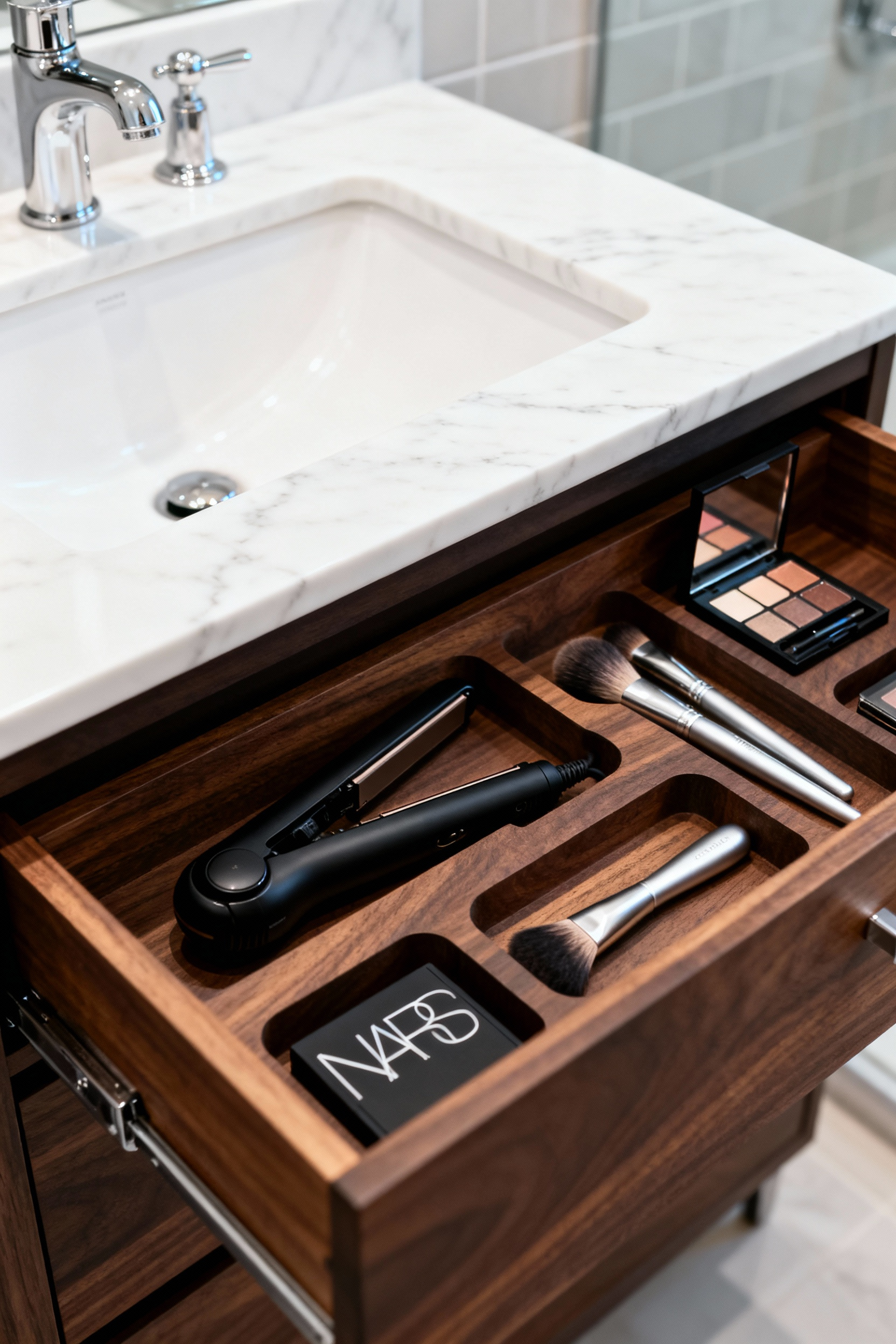
This approach borrows from industrial tool control. “Shadow foaming” uses contrasting colors to signal missing items. The bathroom environment demands refined touches. High-end designs feature flocked velvet surfaces over rigid polymer. Sealed marine-grade plywood resists humidity. These soft textures silence the jarring clink of tools.
Deep customization transforms routines into rituals. By giving every object a permanent home, you reduce decision fatigue. Opening a drawer becomes a moment of calm. This organization creates “visual silence,” allowing you to focus on self-care.
15. Lighting the Void: Installing motion-sensor cabinet lighting to eliminate dark, cluttered corners
Deep, unlit cabinets often become a “clutter-tolerance zone.” We instinctively place items out of sight to avoid disarray. But this darkness contributes to cognitive drain. Installing automatic interior lighting applies the “Visibility Rule” to your storage.
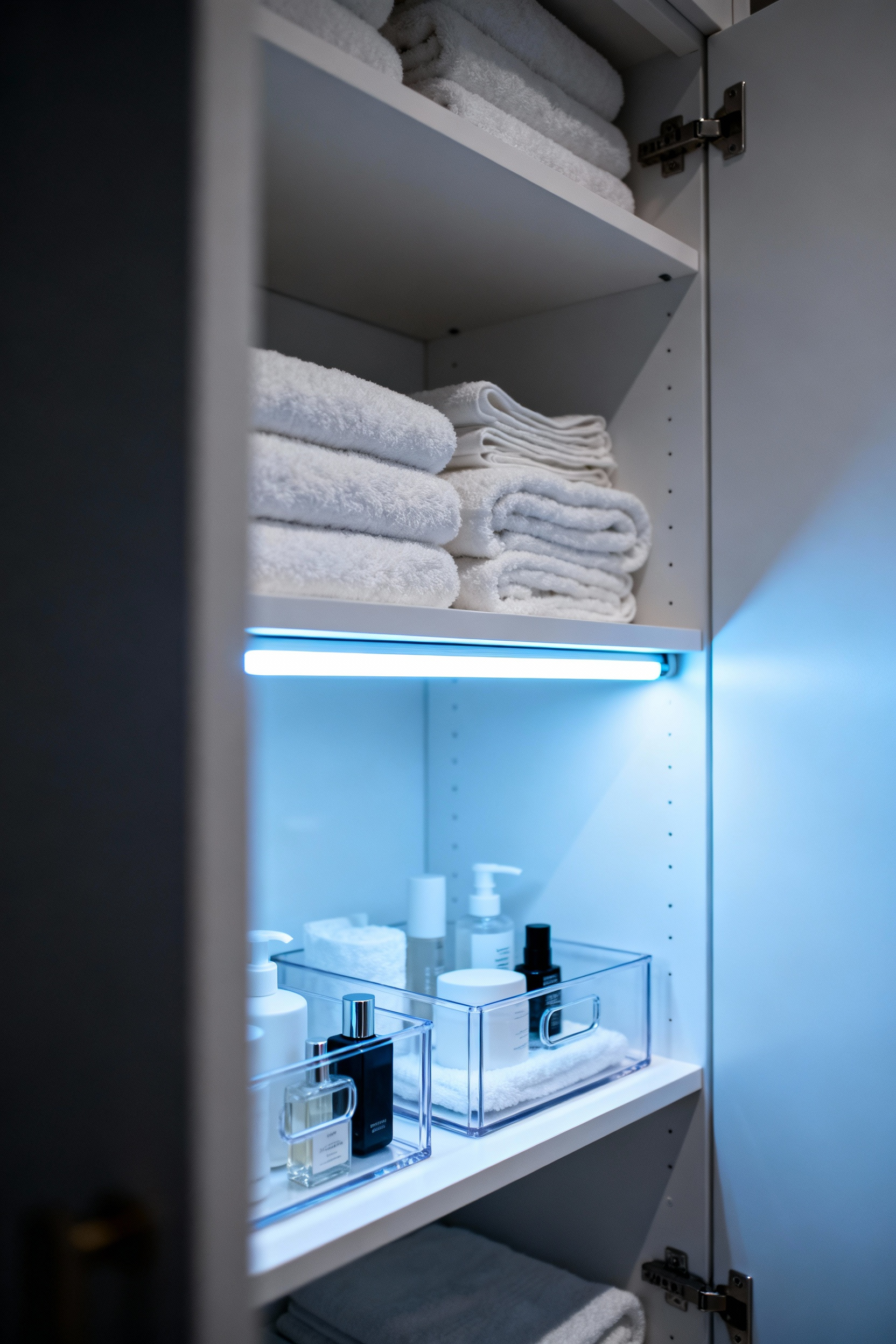
The sudden illumination forces a “moment of truth.” When light floods the shelf, contents are impossible to ignore. This creates psychological momentum for tidiness. The experience adds a layer of modern luxury. The hands-free “reveal” reduces friction when hands are wet.
Technically, hardware choice is critical. Select Passive Infrared (PIR) sensors. These detect heat signatures, making them efficient for enclosed interiors. Color temperature matters immensely. Organizational clarity requires a “daylight” spectrum. Aim for 4000K to 5000K. This cooler light ensures you can distinguish product labels. Ultra-slim, rechargeable LED strips now offer a seamless solution.
16. The Guest Readiness Kit: Creating a dedicated ‘hospitality drawer’ for impromptu visitors
True hospitality anticipates needs. A Guest Readiness Kit alleviates a visitor’s social anxiety. Guests often feel awkward asking for items like feminine hygiene products. Stocking these essentials preemptively removes a barrier to comfort. This preparation acts as a silent language of care. Visitors feel cherished rather than like an imposition.

Designate a specific drawer or labeled basket solely for these items. Clearly labeling the container “Guest” signals that products are fresh. However, avoid overcrowding the area. Preserve empty space for guests to unpack their own toiletries. This gives them a sense of temporary ownership.
Elevate the aesthetic to mimic a boutique hotel. Decant standard liquids into matching dispensers. High-quality textiles signal luxury. Plush white Turkish towels evoke cleanliness. A subtle scent makes the room memorable. These details transform a simple bathroom into a curated sanctuary.
Conclusion: From Chaotic to Curated – How optimized organization changes the tone of your entire day
Transforming your bathroom from chaotic to curated involves more than purchasing new containers. Applying these strategic bathroom organization ideas acts as a deliberate design shift. It effectively quiets visual noise. By establishing clear sightlines, you create a sanctuary for your nervous system. The bathroom becomes a tool for mental clarity rather than a source of fatigue. This streamlined workflow ensures your day begins with intention.
Maintaining this balance requires treating organization as a ritual. The “editing process” serves as the foundation for lasting tranquility. Every item must possess a designated home to prevent future clutter. Start by rigorously auditing your collection for utility. Finally, embrace the 80/20 rule for accessibility, ensuring your space remains both beautiful and functional.
Frequently Asked Questions
H3. What are the best luxury organizers for deep bathroom drawers?
For deep bathroom drawers, the best organizers utilize modular systems and vertical space to prevent items from becoming lost. High-quality, clear acrylic dividers or custom-fitted wooden joinery inserts (often precision-engineered using CNC technology) are preferred. These materials ensure durability, resist moisture, and allow for a tailored fit that maximizes every cubic inch of space while maintaining visual clarity.
H3. How can I organize my toiletries to maintain a clean, uncluttered countertop?
To achieve a minimalist, uncluttered countertop, utilize the “Tray Corral” method, grouping only daily essentials onto a decorative tray (marble or wood). All other items, including styling tools, charging stations, and bulk toiletries, should be stored in drawers using electrical integration (powered drawers) or hidden vertical storage inside cabinets. Decanting essentials like cotton balls and bath salts into uniform apothecary jars also reduces the visual noise created by commercial packaging.
H3. Is it safe to store medicine and pharmaceuticals in the bathroom?
No, professional organizers and health experts strongly advise against storing sensitive medications or pharmaceuticals in the bathroom. The high heat and humidity fluctuations in this environment accelerate chemical degradation, reducing product potency and effectiveness (a process known as hydrolysis). Instead, move medications and bulk backstock (Archive items) to a cool, dry area of the home, such as a hallway linen closet or a bedroom closet.