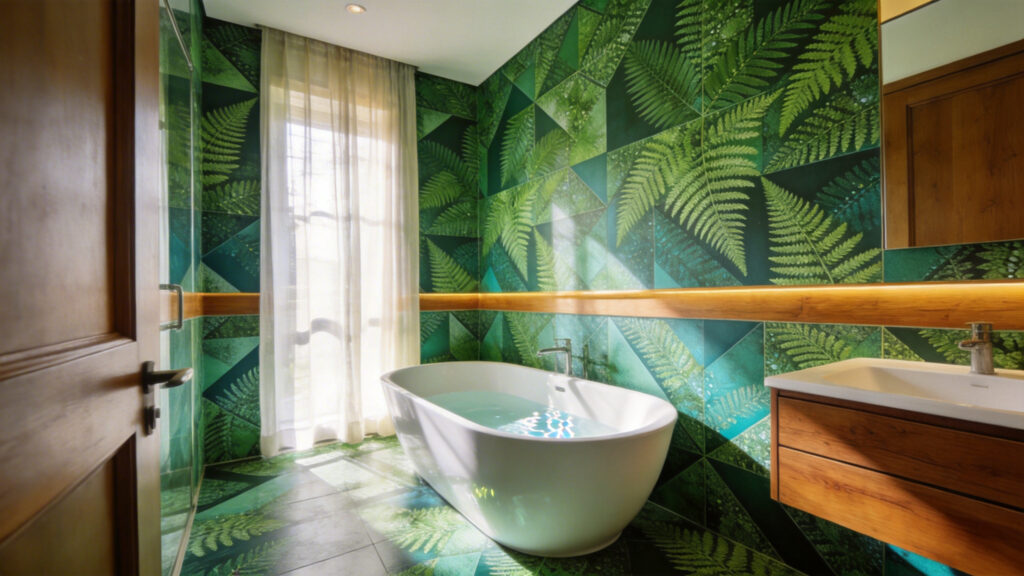
Homeowners often worry that bold bathroom wallpaper is just a fleeting trend. They fear a modern print today guarantees a dated look tomorrow. So, they retreat to sterile, white-washed designs in the name of safety. However, this cautious mindset overlooks the profound impact our environments have on us. A true sanctuary needs emotional resonance, not just clinical hygiene.
Integrating a bathroom wallpaper modern aesthetic bridges the gap between function and high-end art. Therefore, creating a timeless space involves much more than simply avoiding color. Surprisingly, the secret to enduring design lies in environmental psychology. Specifically, the concept of “Fractal Fluency” explains why our brains crave organic complexity.
Patterns that mimic nature induce a state of “soft fascination.” In fact, they actually lower cortisol levels. Furthermore, wallpaper acts as an essential acoustic dampener. It softens the “visual coldness” of tile, transforming the space into a calming retreat. Because bathrooms are “threshold spaces,” they support bolder choices than large living areas.
Fortunately, material science now matches this psychological need. We have moved beyond fragile papers to robust, non-woven textiles. Indeed, these modern substrates withstand humidity. They also allow for deep, matte textures that absorb light. This guide reveals how to blend technical advancements with the “Jewel Box Effect.” Ultimately, a scientifically grounded aesthetic remains beautiful for decades. It serves as the cornerstone for dream luxury modern bathroom ideas that stand the test of time.
Section 1: Biophilic Restoration – Using Nature to Reset the Nervous System
Biophilic restoration turns the bathroom into a vital sanctuary for the nervous system. Fundamentally, this approach goes far beyond simple aesthetics. The human brain is biologically wired to process specific natural geometries known as fractals. These repeating patterns occur naturally in fern branches or leaf veins.
Researchers at the University of Oregon identified a phenomenon called “Fractal Fluency.” When we view wallpaper featuring mid-range complexities, the brain relaxes immediately. Specifically, this “effortless looking” triggers a parasympathetic response. Remarkably, this visual intake can reduce recorded stress levels by up to 60%.
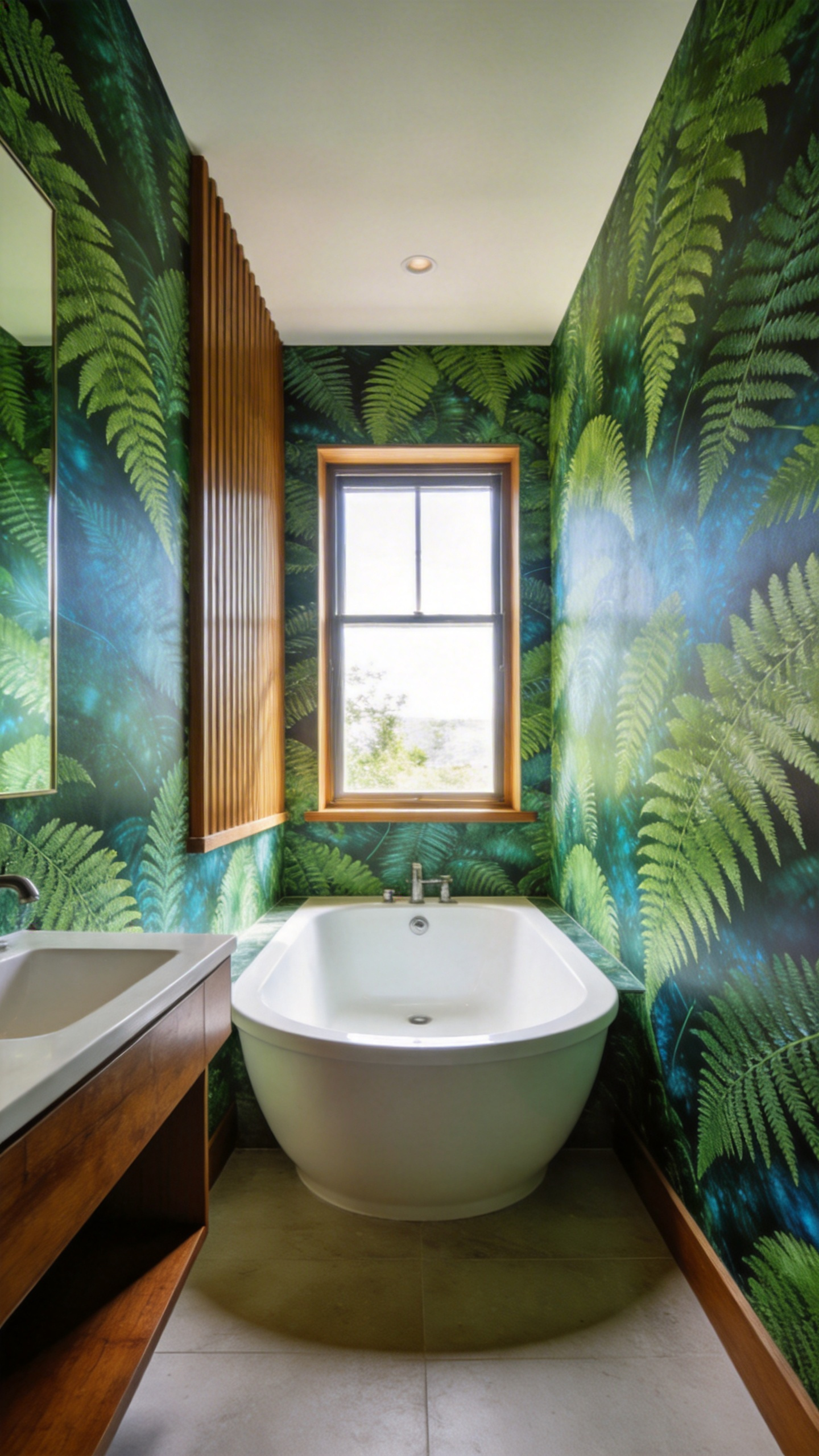
Furthermore, the bathroom serves a unique evolutionary function. According to the Savannah Hypothesis, humans crave a protected “Refuge” with a “Prospect,” or view. Bathrooms provide privacy but often lack a connection to the outdoors. Therefore, modern wallpaper acts as a surrogate “Virtual Window.”
By applying lush botanical designs, you fulfill the subconscious need to see resources. Thus, the brain perceives the space as safe, lowering cortisol levels. Moreover, true restoration requires overcoming visual flatness. In nature, nothing is static. To mimic this, effective wallpapers utilize textured finishes or subtle gradients.
These “non-rhythmic sensory stimuli” provide necessary micro-diversions for the eye. As a result, they prevent cognitive fatigue. Physiologically, the impact is measurable. For instance, viewing biomorphic patterns increases Heart Rate Variability (HRV). Simultaneously, it decreases skin conductance. Ultimately, selecting these designs creates a powerful biological reset.
1. Oversized Tropical Fronds: Creating an immersive ‘green bathing’ experience in windowless spaces
Oversized tropical fronds offer more than a bold aesthetic. Fundamentally, they address the sensory deprivation found in windowless bathrooms. In environmental psychology, this is the “Canopy Effect.” Specifically, large-scale patterns blur the harsh boundaries between walls and ceilings.
Consequently, the room feels less like a box. Instead, it becomes a protective shelter. This calculated “spatial confusion” tricks the brain. It creates an infinity effect that expands small, enclosed spaces.
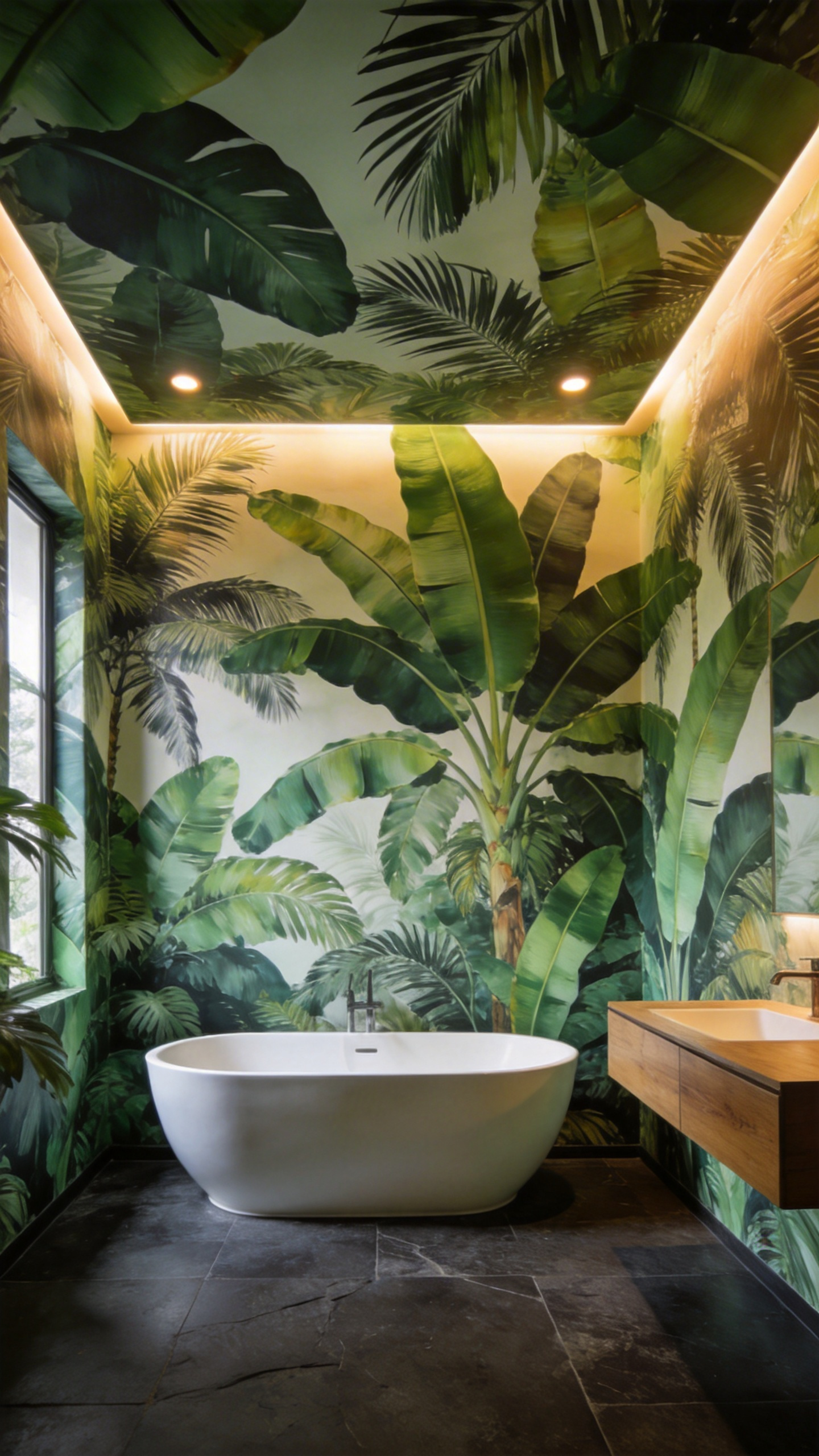
Choosing the right pattern establishes the room’s emotional baseline. Historically, two designs dominate this arena. The classic “Martinique” pattern uses moody olive greens to induce grounded relaxation. In contrast, Dorothy Draper’s “Brazilliance” features bright emeralds for high-energy theatricality.
Furthermore, color temperature dictates spatial perception. Yellow-greens mimic sunlight to add warmth. Conversely, blue-greens create a cooling, spa-like atmosphere. To achieve immersive “green bathing,” you must engage the senses fully. Surprisingly, placing a single live plant against the wallpaper creates a “Halo Effect.”
Thus, the authentic texture validates the printed backdrop. However, practical durability remains essential here. Therefore, select high-quality Type II Vinyl to act as a vapor barrier. Alternatively, use breathable non-woven fibers if ventilation is limited. These choices ensure your sanctuary remains pristine.
2. Misty Forest Murals: Expanding spatial perception through atmospheric perspective
Misty forest murals operate on a sophisticated intersection of art and physics. In fact, they utilize a visual trick known as atmospheric perspective. Specifically, this relies on Rayleigh scattering. Distant objects shift toward cooler, desaturated blues.
The brain interprets these pale tones as significant physical distance. This optical illusion pushes the walls outward. It transforms a box-like bathroom into a boundless sanctuary.
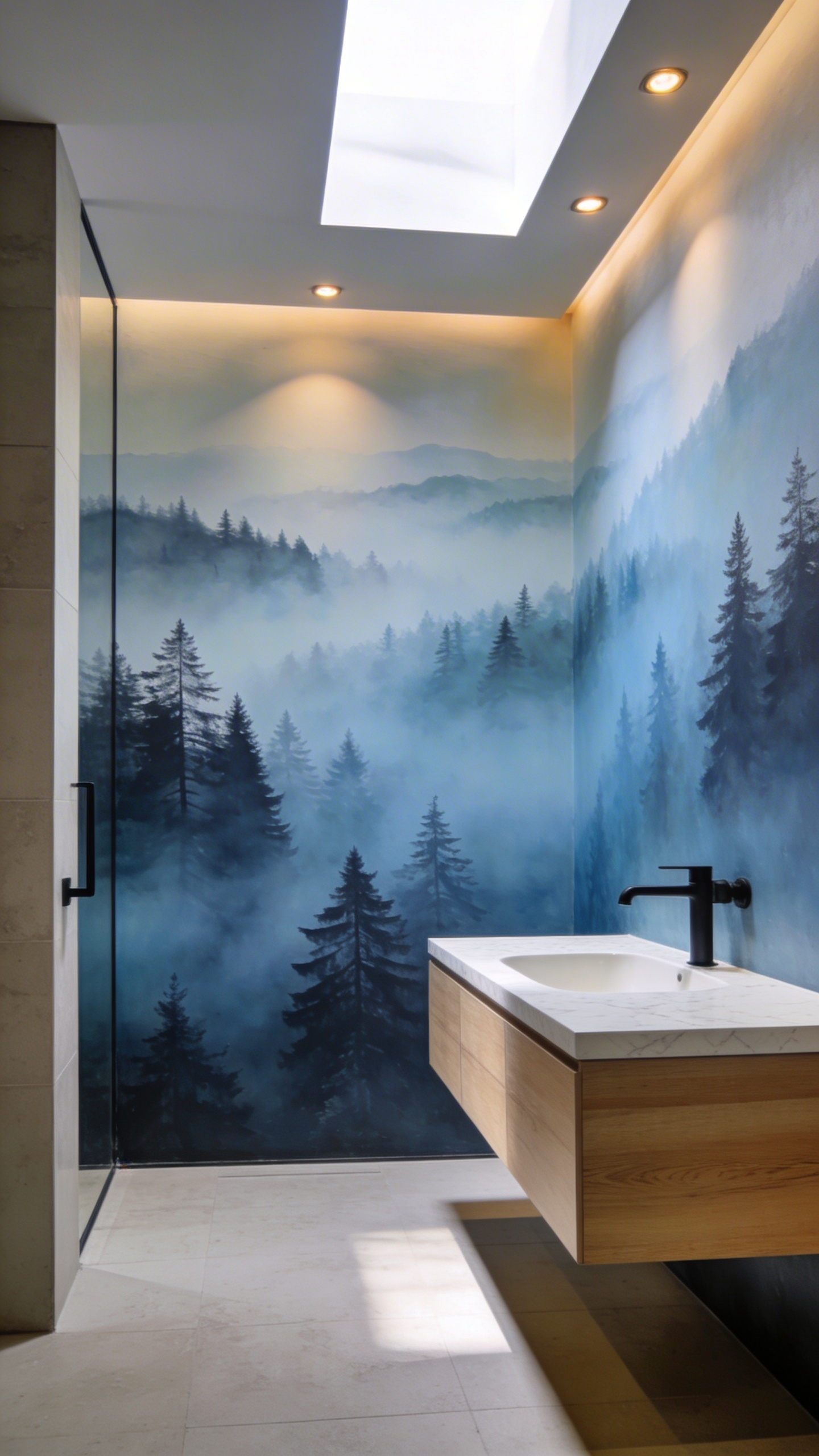
Furthermore, these designs create sensory cohesion. When steam rises from a shower, it interacts with the mural’s painted fog. Therefore, the boundary between the digital image and the room’s atmosphere blurs. Psychologically, this “biophilic immersion” lowers cortisol levels.
It provides a “soft fascination” that allows the mind to wander. However, maintaining this depth requires specific technical choices. For instance, lighting temperature is critical. Experts recommend cool white LEDs between 3500K and 4000K.
Warm lighting turns the delicate mist into “smog,” flattening the depth. Additionally, the finish must be strictly matte. A glossy surface would reflect vanity lights, shattering the illusion. Ultimately, the goal is distinct. You are creating a mental escape, not just covering a wall.
3. Organic River Stone Patterns: Grounding energy with earth-toned repetition
Modern bathroom design moves beyond simple aesthetics to address emotional needs. Specifically, river stone patterns evoke the “bones of the earth.” This grounding motif offers stability in a water-centric space. Consequently, these patterns act as a symbolic anchor.
They prevent the feeling that energy is simply washing away. Furthermore, biology plays a role in this preference. Our brains naturally prefer fractal geometry over rigid angles. Research suggests that organic repetitions help lower cortisol levels and ensure visual cohesion.
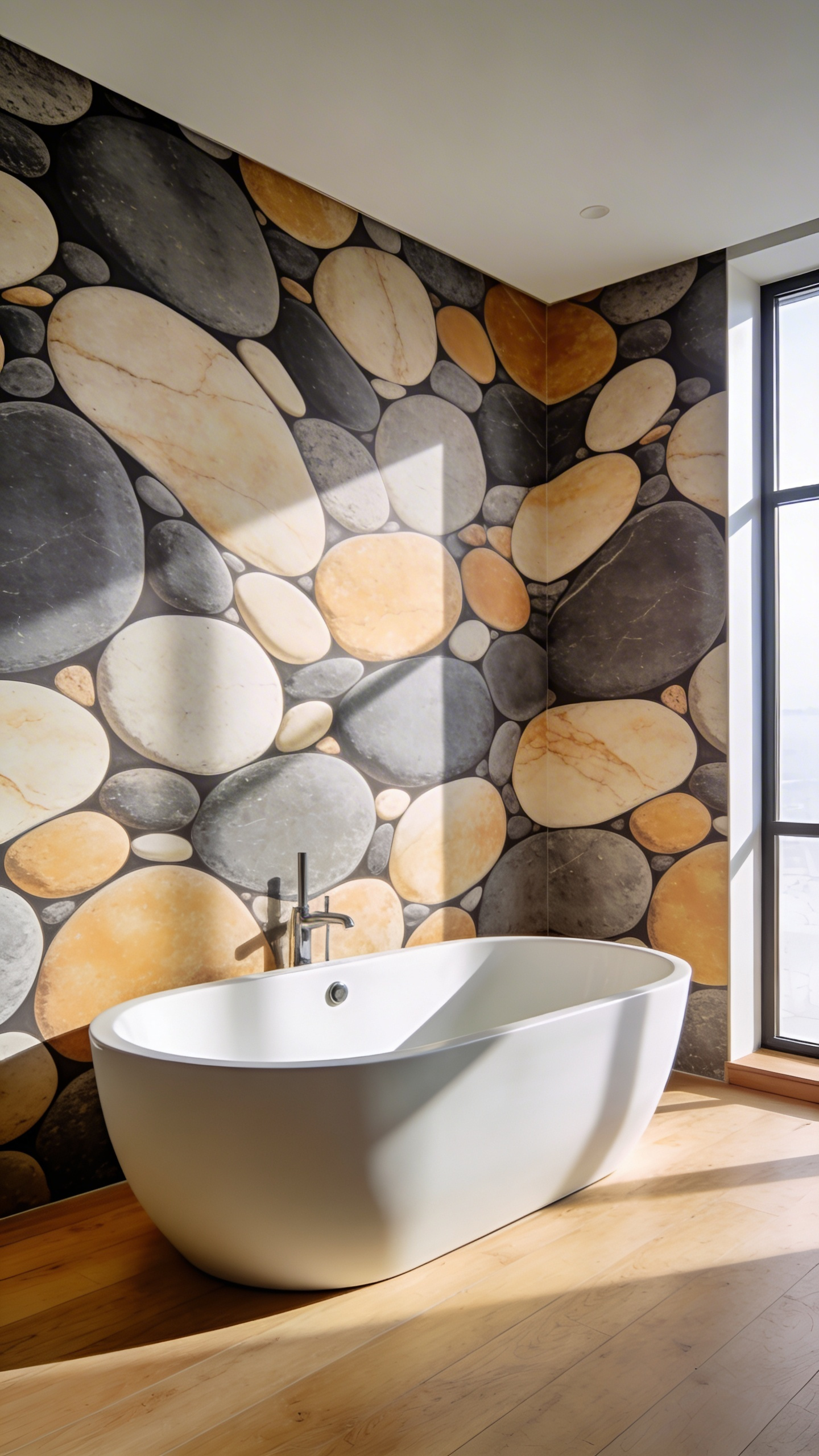
Therefore, the visual rhythm acts like “white noise” for the eyes. This allows the nervous system to shift from alert to rest. Technologically, wallpaper has evolved to support this. For instance, 3D structural inks now create a genuine, tactile relief.
This innovation aligns with the “Japandi” aesthetic, blending Scandinavian order with Japanese nature. Additionally, variable matte finishes mimic the wet-dry duality of real rocks. Ultimately, earth tones like moss or charcoal provide a soothing palette. This bridges the gap between cold porcelain and a warm sanctuary.
4. Abstracted Floral Watercolors: Softening hard ceramic surfaces with fluid movement
Bathrooms naturally feature hard, unyielding materials like porcelain and chrome. Consequently, these spaces often feel emotionally sterile. To combat this, designers utilize “Material Counterpoint.” Specifically, abstracted floral watercolors introduce necessary visual fluidity.
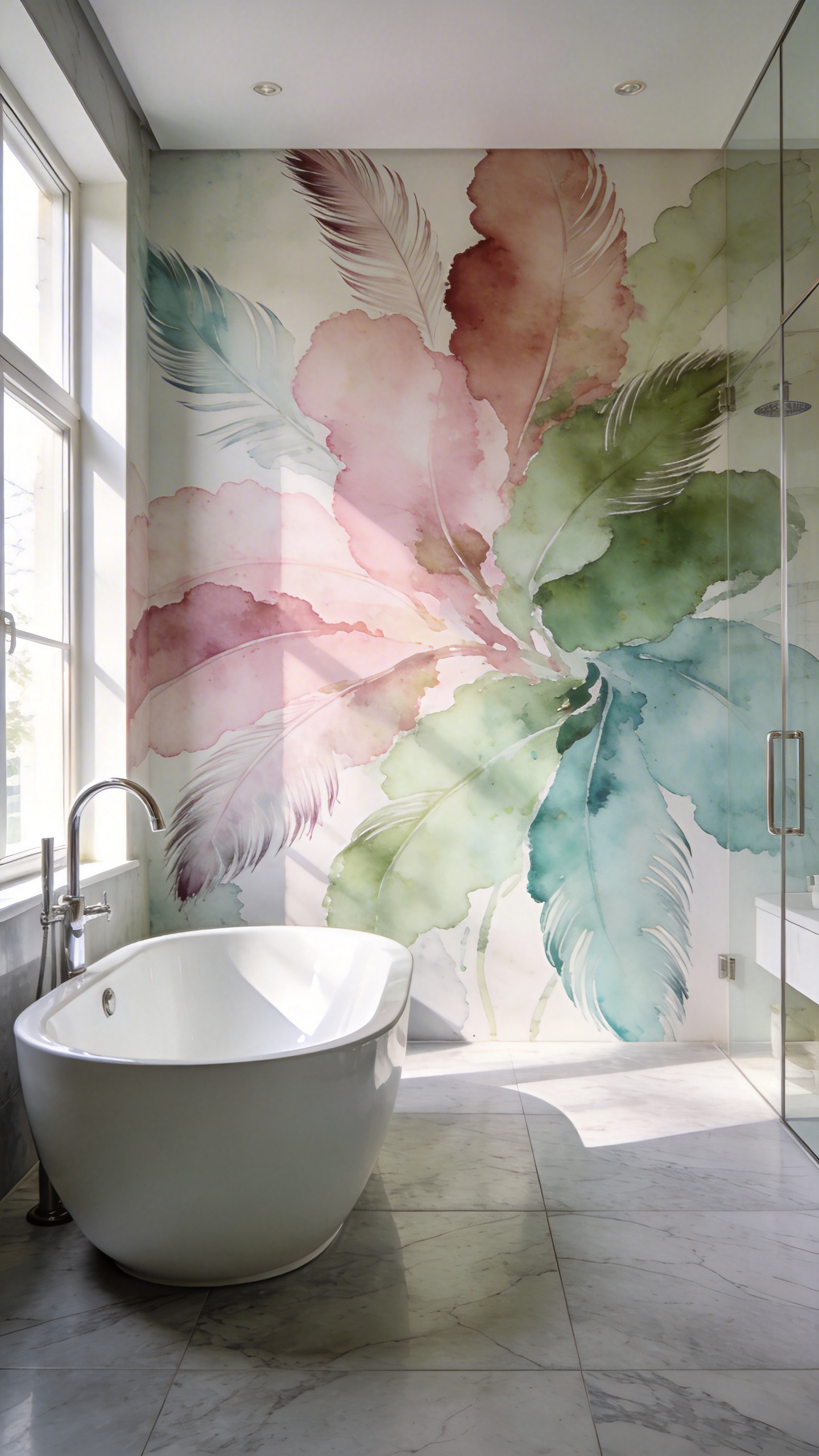
Unlike traditional florals with static borders, modern designs feature soft bleeds. This fluid movement mimics a three-dimensional space. It effectively “cushions” the sharp lines of ceramic tiles. Therefore, the eye perceives a softening of the room’s boundaries.
In fact, this creates a “visual cushion.” Moreover, this effect relies on high-fidelity digital printing. Modern technology replicates watercolor’s unique translucency. The brain perceives a porous, organic texture rather than a flat print.
Furthermore, this aligns with Biophilic Design regarding “Non-Rhythmic Sensual Stimuli.” Similar to swaying grass, these unpredictable patterns reduce stress. Finally, practical application is ensured through non-woven fibers. These “WET” systems allow delicate watercolor aesthetics to withstand humidity.
Section 2: Geometric Clarity – The Modern Aesthetics of Order and Focus
In modern interiors, geometric clarity is more than a stylistic choice. Fundamentally, it acts as an architectural strategy for psychological order. Historically, this is rooted in the “rationalist” Bauhaus legacy. Repeating patterns provide the eye with a visual anchor.
Consequently, the brain experiences “low cognitive load.” Therefore, a precise grid pattern aligns with industrial elements. It creates a “unified machine for living.”
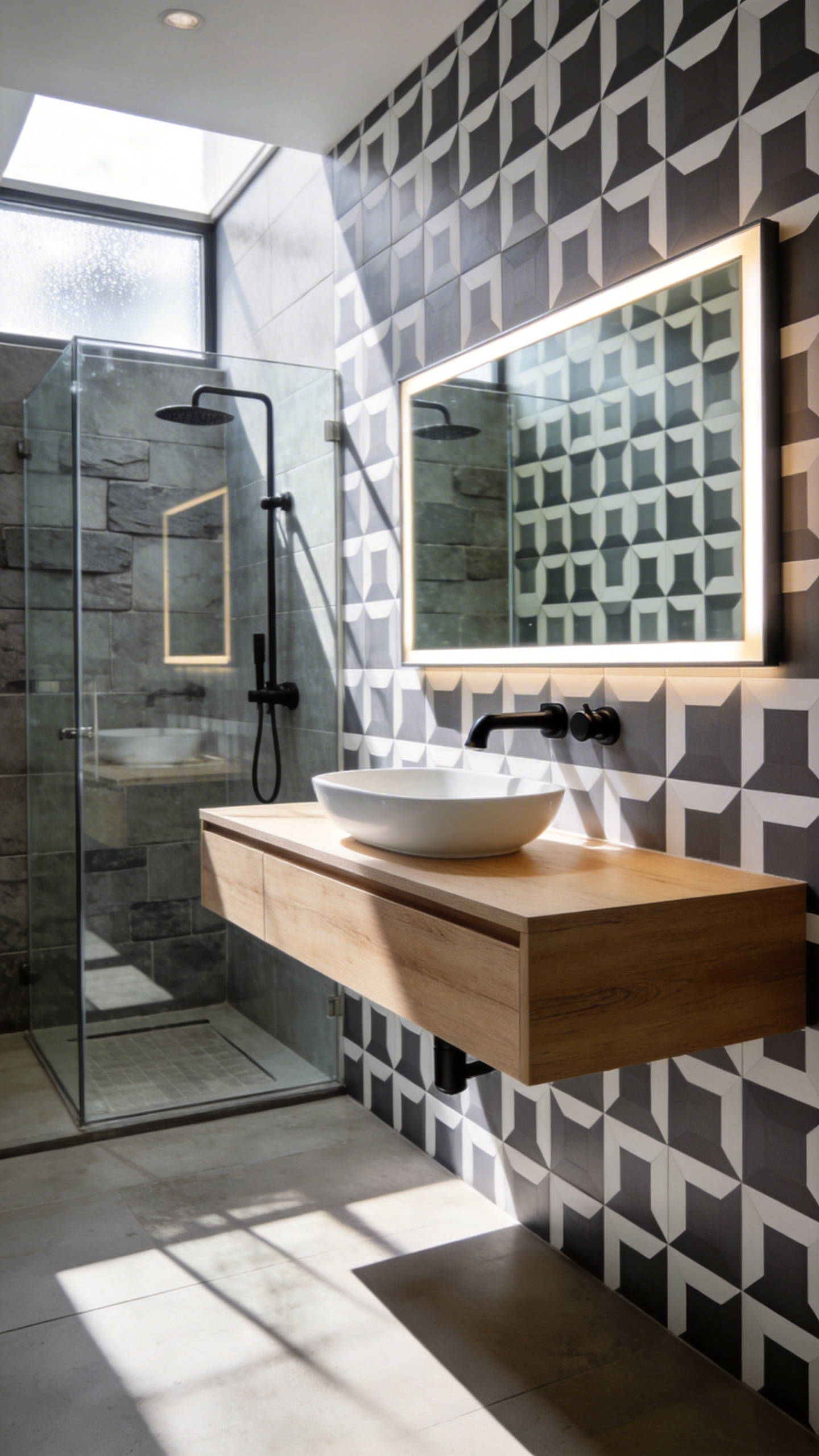
Furthermore, this supports the bathroom’s evolution into a “Spathroom.” Geometric wallpapers offer a necessary “digital detox” for the mind. They reflect minimalistic bathroom design ideas that prioritize clarity. Psychologically, vertical lines evoke aspiration.
Conversely, horizontal lines provide grounding. Thus, minimalist geometrics foster calm, while bold shapes sharpen focus. Additionally, designers use these patterns for “optical engineering.” Counter-intuitively, large-scale motifs often expand small spaces.
Tiny patterns can create visual noise. By using “pattern drenching,” you blur the room’s actual boundaries. As a result, a cramped powder room feels like an infinite architectural statement. Finally, material selection adds a sensory layer. Metallic overlays catch light, turning flat walls into sculptural elements.
5. High-Contrast Art Deco Revival: Bold lines for instilling confidence and structure
The High-Contrast Art Deco Revival is more than a nostalgic trend. It functions as a strategy to transform bathrooms into “sanctuaries of structure.” Specifically, sharp angles act as necessary visual anchors. Unlike organic lines, these rigid patterns provide cognitive order.
Therefore, starting the day here offers a powerful mental “reset.” It builds confidence through symmetry.
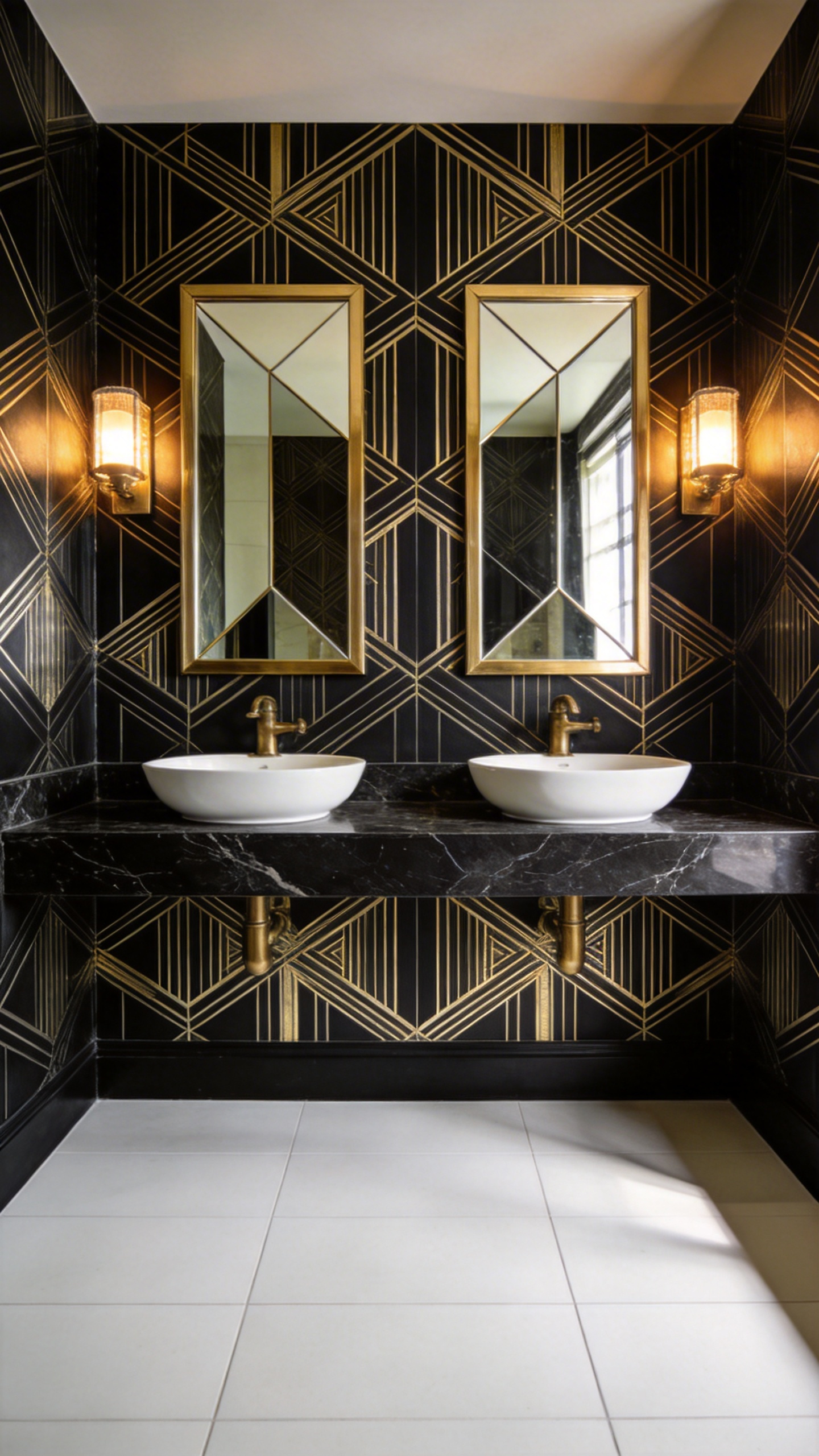
Furthermore, this style rejects the “clinical” spa aesthetic. Instead, it embraces the “Jewel Box” philosophy. To achieve this, designers utilize modern printing techniques. Digital foil stamping creates a textural contrast that reflects light.
Similarly, inks infused with mica flakes add a subtle shimmer. Crucially, these designs often feature vertical sunburst motifs. In tighter quarters, this upward momentum counteracts claustrophobia. Thus, the room feels larger and more aspirational.
Moreover, material innovations now allow this luxury in wet zones. Waterproof fiberglass wallcoverings enable bold patterns to move directly into the shower. Ultimately, blending these papers with natural stone creates a “Soft Deco” look.
6. Micro-Grid Minimalism: The subtle psychology of precision in small powder rooms
In confined powder rooms, visual clutter triggers stress. However, micro-grids offer a powerful psychological antidote. Specifically, these ultra-fine patterns provide a necessary “visual skeleton.” Consequently, the brain stops scanning for boundaries.
Instead, it perceives a unified, stable field. This mathematical consistency reduces the cognitive load. Therefore, guests feel “held” by the design rather than trapped.
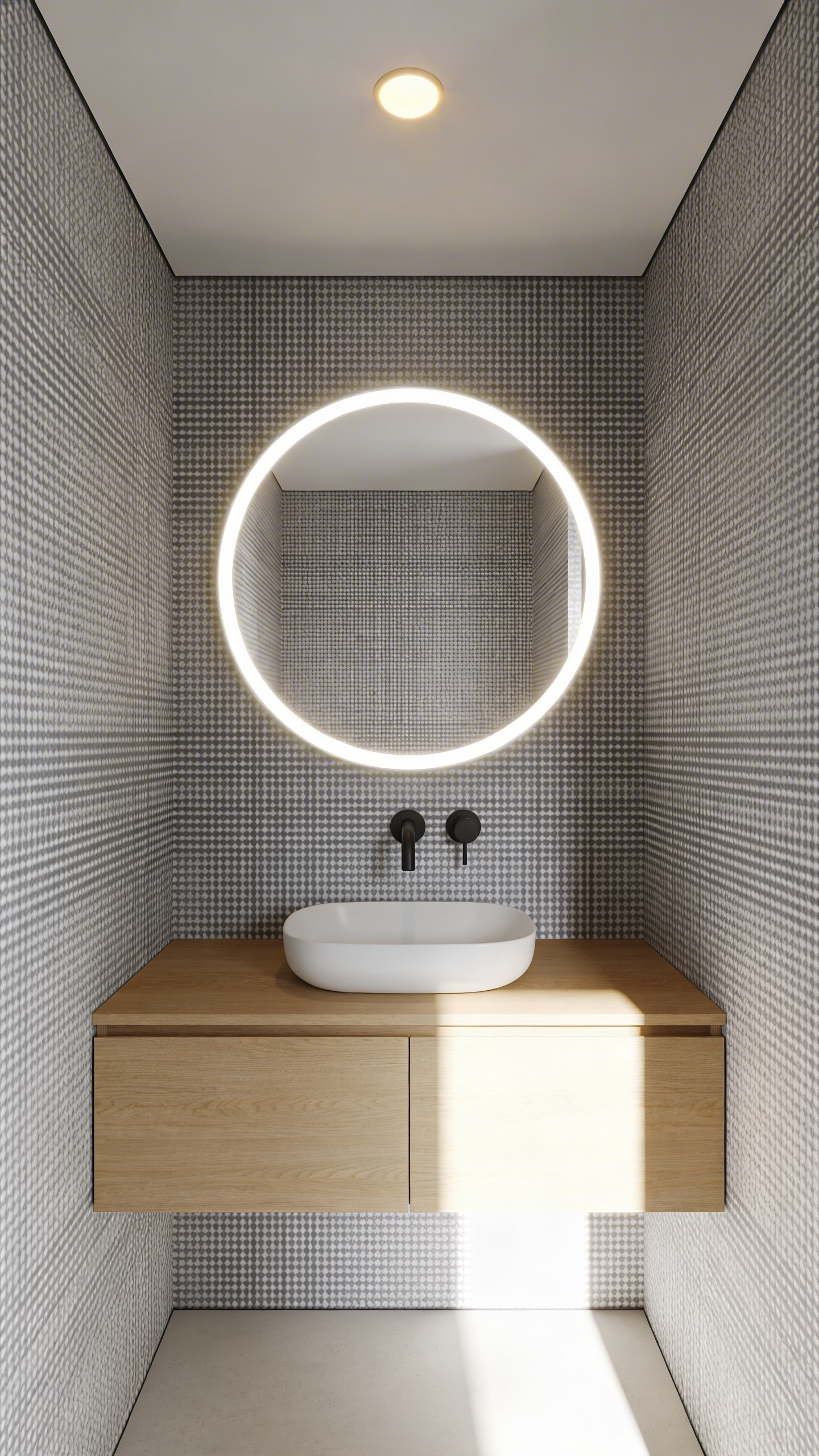
Beyond psychology, this radically alters spatial perception. Traditionally, designers suggest large prints for small rooms. Yet, micro-grids act as a spatial map. When applied to every wall, the grid blurs corners through “pattern drenching.”
Historically, this draws from Bauhaus philosophies. However, modern iterations soften this industrial look. “Warm Minimalism” pairs precise lines with organic tones like terracotta. Ultimately, such precision communicates “Quiet Luxury.”
Because guests stand inches from the wall, print quality matters. Flawless alignment signals obsessive detail. To avoid a sterile effect, prioritize wallpapers with tactile depth. Indeed, current trends favor “Textural Illusions” resembling woven silk.
7. Hexagonal Ombré: Blending rigid shape with color therapy transitions
Modern bathroom design often struggles with a specific paradox. Specifically, it must balance clinical surfaces with a sanctuary atmosphere. Hexagonal ombré wallpaper solves this through “structural serenity.” The hexagon represents stability and mathematical perfection.
However, too much rigidity can feel oppressive. Therefore, overlaying a fluid color ombré softens this geometry. The lines provide a framework, while the color transition mimics vapor. Consequently, the bathroom feels both engineered and organic.
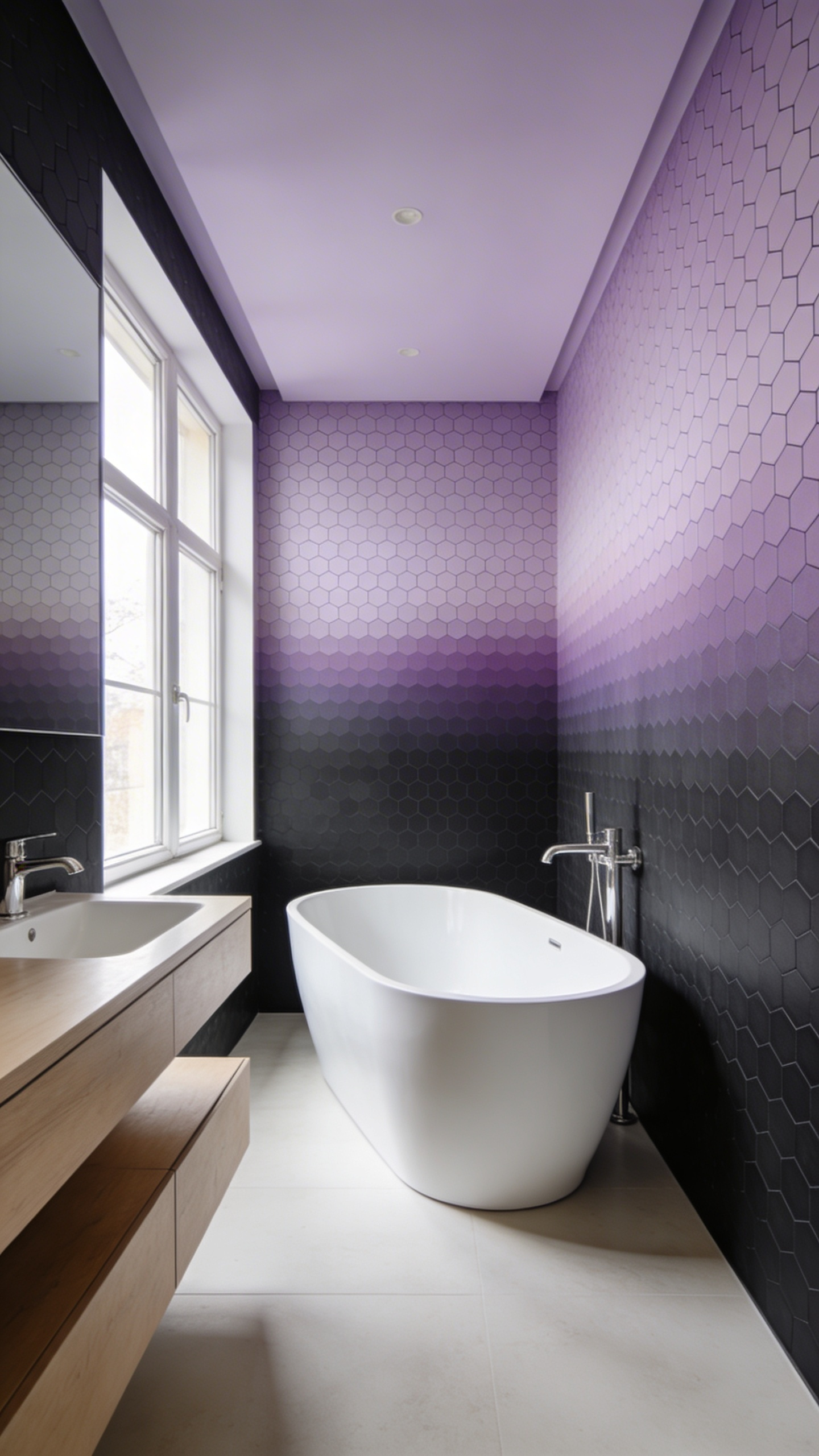
Furthermore, this aesthetic emphasizes transition. Unlike static colors, hexagonal ombré mirrors the “lifting” of a mood. For instance, transitioning from deep navy to misty sky blue triggers a release of tension. In fact, this visual “evaporation” helps the user decompress.
Additionally, high-end designs often utilize a “hexagonal halftone” technique. Instead of blurring colors, the pattern varies line thickness. This creates a 3D pulsating effect. Thus, cramped powder rooms appear infinitely deeper.
Finally, this shape triggers an evolutionary response. Biologically, humans associate the hexagon with the safety of a hive. When paired with a modern gradient, it creates a sense of contained cleanliness.
8. Metallic Linear Accents: Reflecting light to energize morning routines
Incorporating metallic linear accents serves a distinct purpose. Beyond aesthetics, these patterns function as a biological “wake-up call.” Specifically, the science involves “specular reflection.” Unlike matte surfaces, metallic pinstripes break light into a dynamic shimmer.
In fact, this mimics sunlight dancing on water. Consequently, this effect stimulates the brain. It boosts alertness during early morning routines.
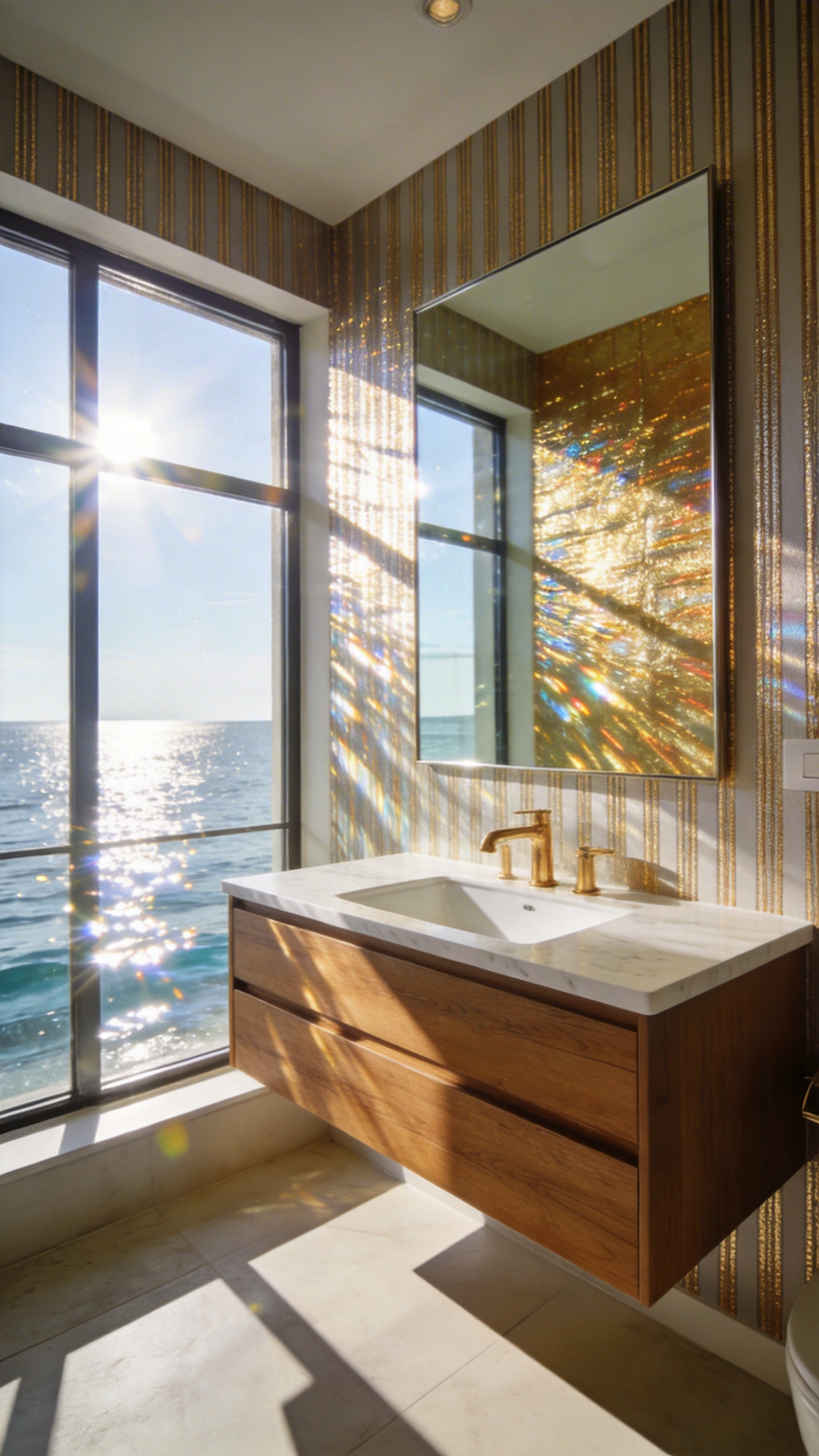
Historically, this channels the “Streamline Moderne” movement. However, today’s approach favors subtle “micro-lines” over heavy chrome. These hairline foils create a sense of quiet luxury. Furthermore, these accents manipulate spatial perception.
Vertical lines generate “visual velocity,” drawing the eye upward. As a result, the room feels significantly more expansive. Additionally, technical advancements ensure these materials perform.
Notably, high-end metallic wallpapers are now engineered to be vapor permeable. Therefore, moisture escapes easily, preventing mold. Ultimately, this blends energizing light with practical durability.
Section 3: Atmospheric Depth – Textural Illusions for Sensory Richness
Modern design is shifting from decoration to curating immersive environments. Specifically, this is achieved through “aerial perspective.” By utilizing misty hues that recede visually, designers create an illusion of infinite distance. Consequently, panoramic murals are replacing repeating patterns.
This prevents the eye from catching seams. Ultimately, the wall seemingly disappears.
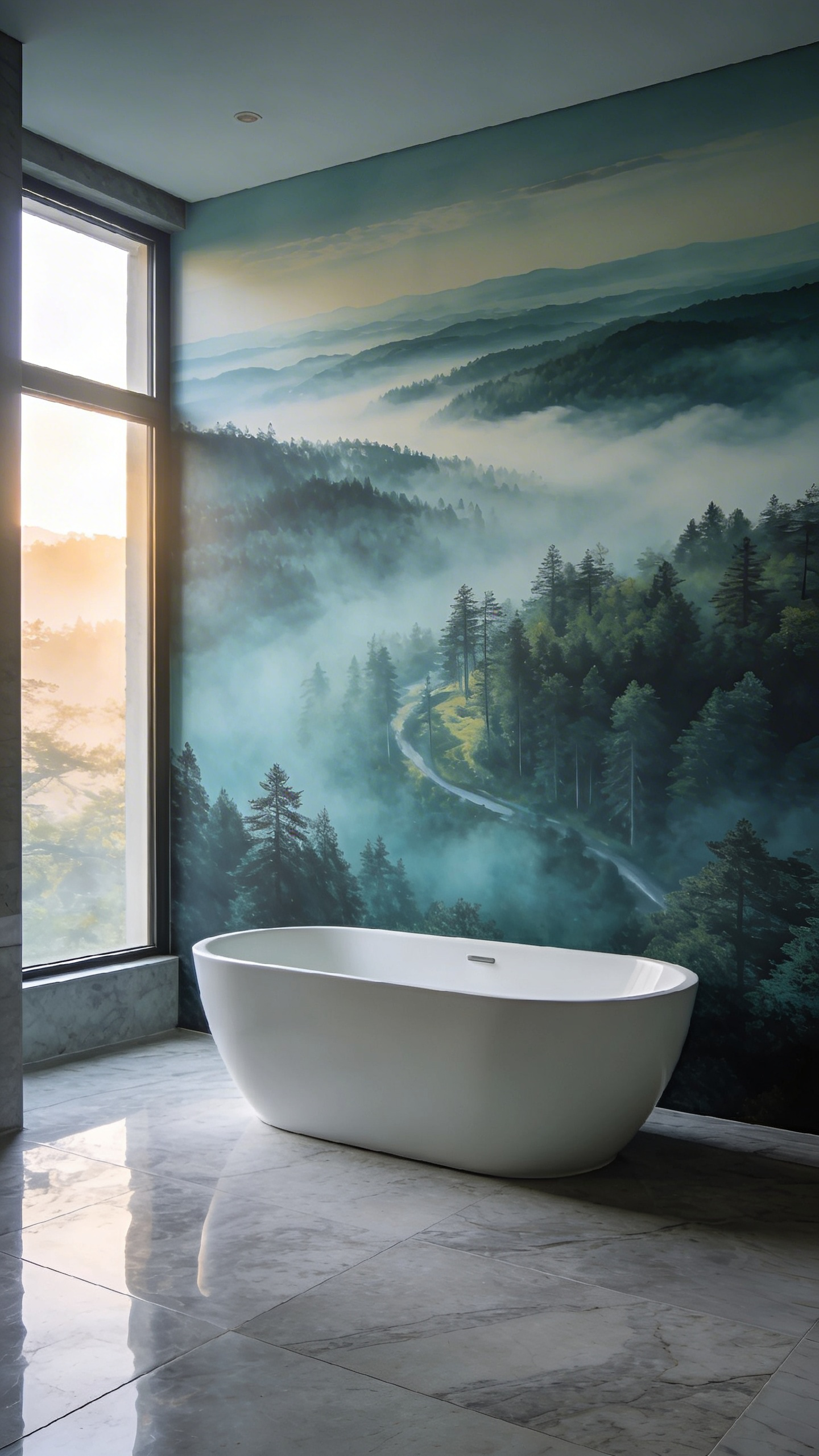
Beyond visual tricks, technology has revolutionized tactile experiences. New “DIMENSE” technology allows for simultaneous printing and deep embossing. Unlike flat vinyl, this synchronizes texture with the image. Therefore, a printed crack actually recedes under your fingertips.
Currently, the trend of “Radical Warmth” utilizes this to mimic organic materials. In fact, these surfaces are often indistinguishable from real plaster. Moreover, texture plays a critical role in sensory architecture.
Advanced acoustic wallcoverings now actively absorb sonic clutter. By reducing noise, these materials transform utilitarian spaces. Surprisingly, fiberglass “wet systems” allow these soft textures inside showers. Finally, specific application depends on scale. In small rooms, “jewel box” designs manipulate light and shadow.
9. Faux Grasscloth Vinyls: Adding warmth and tactile complexity without humidity risks
Modern bathrooms often suffer from a clinical atmosphere. Consequently, achieving a spa aesthetic requires introducing organic texture. Historically, natural grasscloth provided this but rotted in humidity. Fortunately, modern faux grasscloth vinyl uses polymer chemistry to solve this.
Specifically, heat embossing presses deep grooves into the material. Unlike flat paper, these ridges catch light, creating micro-shadows. Therefore, this tactile experience breaks up the visual monotony.
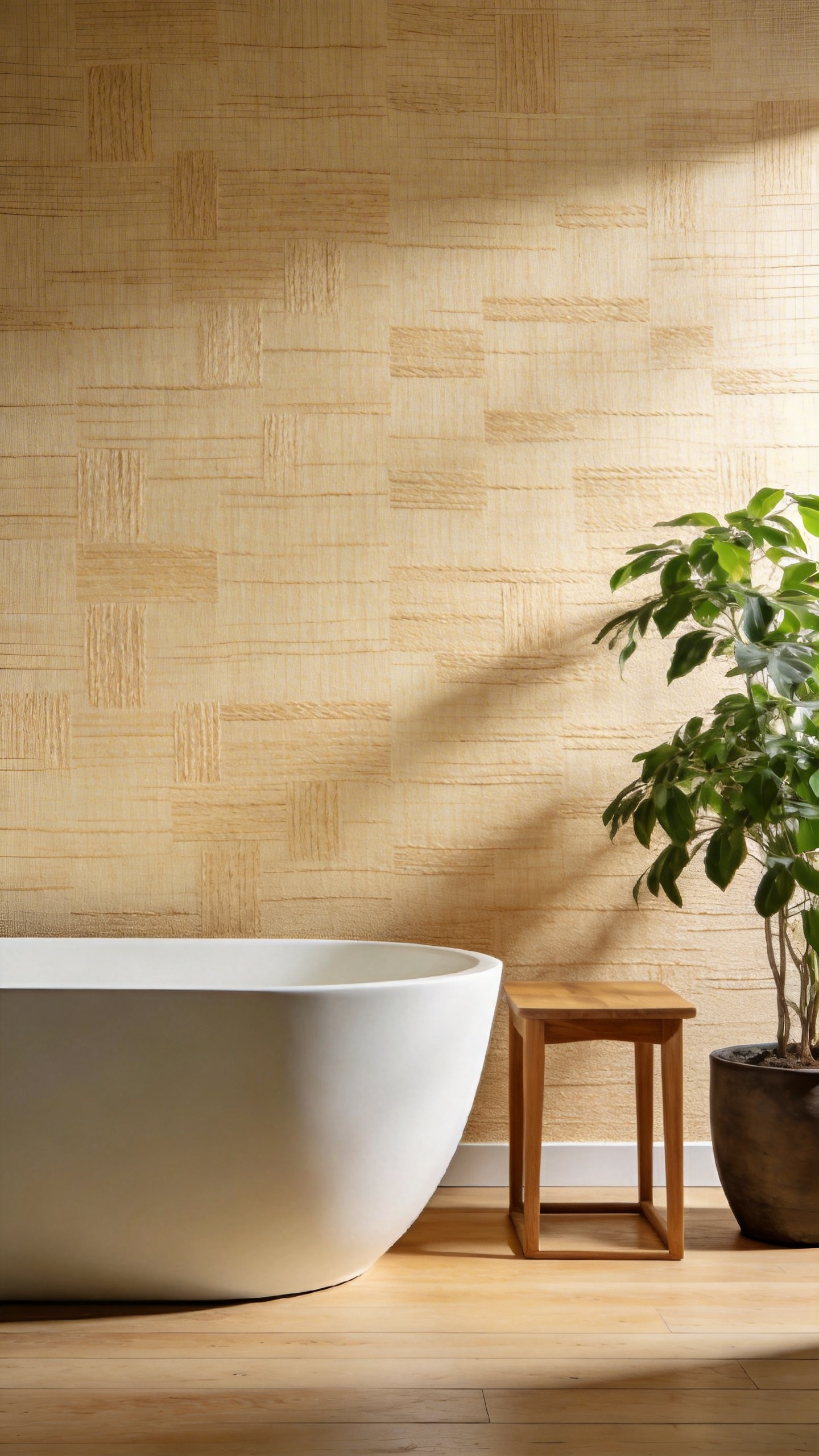
Moreover, this material is engineered for hygiene. Because it features a non-porous construction, it repels steam. Additionally, antimicrobial agents often shield the surface, preventing mold. From a sensory perspective, the heavy vinyl weight dampens sound.
It absorbs vibrations, contributing to a “hushed” atmosphere. Furthermore, the organic texture visually softens sharp metal fixtures. Finally, this choice allows for seamless installation. It avoids the visual clutter of “paneling” often seen with natural fibers.
10. Venetian Plaster Effects: Elevating the mood with Old World sophistication
Venetian plaster offers more than historical charm; it provides a psychological anchor. Originally, Renaissance architects championed this material to reduce weight. Today, modern wallpapers provide this “calculated luxury” without the cost of masonry. Consequently, they bring permanence to contemporary spaces.
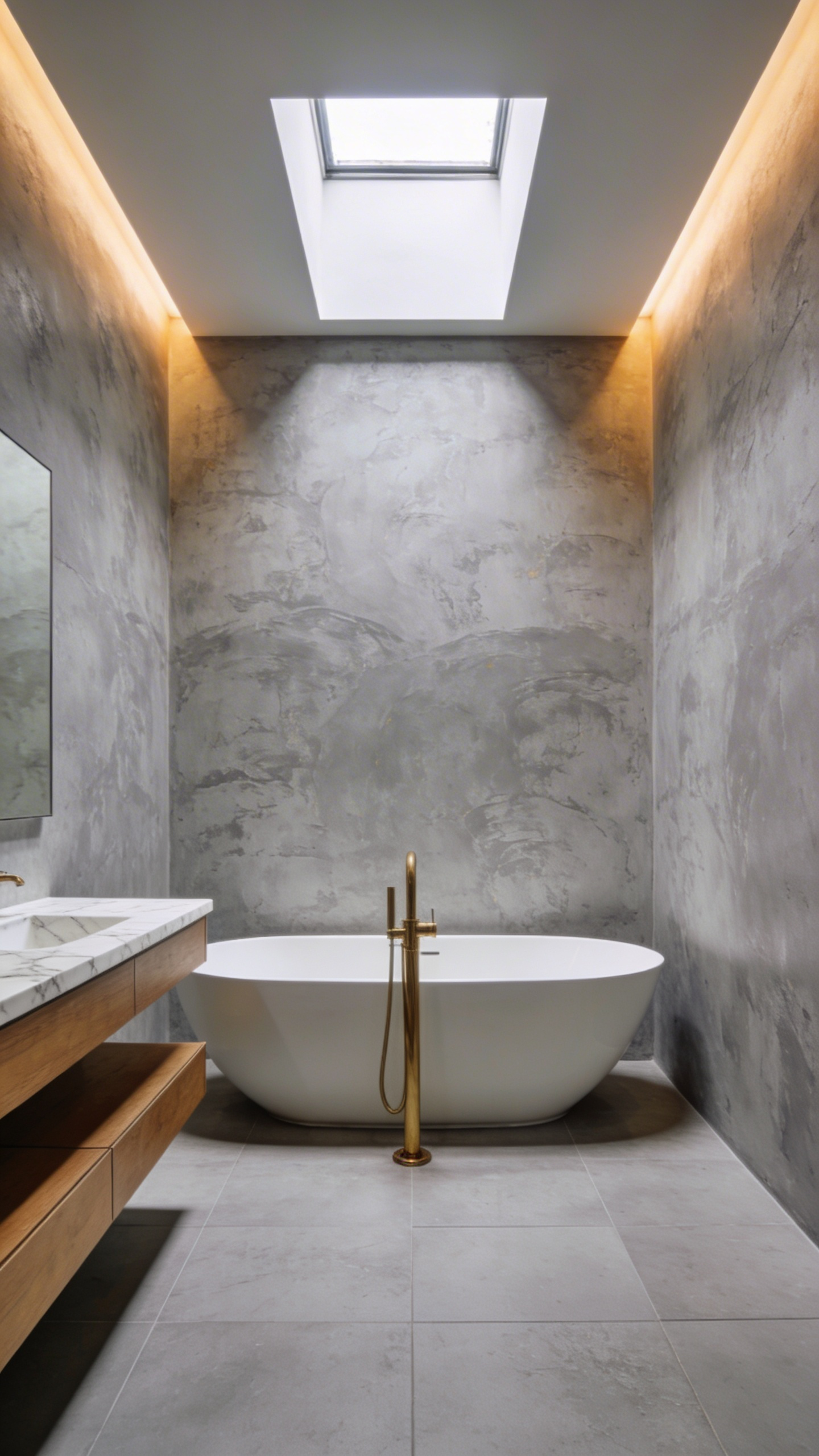
Visually, the sophistication comes from depth. Authentic plaster involves burnishing, which creates a deep glow. Similarly, high-end wallpapers use embossed textures to capture this light diffusion. Psychologically, this impacts your wellbeing.
In fact, research suggests that organic patterns reduce eye strain. Therefore, a plaster-effect wall transforms a bathroom into a retreat. Functionally, this is also practical. Modern wallpaper equivalents use breathable substrates.
Thus, moisture passes through the wall rather than getting trapped. Furthermore, the surface texture helps dampen acoustics. The micro-texture subtly diffuses sound waves. This creates a “quiet luxury” and a hushed atmosphere.
11. Terrazzo Print Motifs: Playful confetti patterns that hide imperfections
Terrazzo has evolved significantly from its Venetian origins. Specifically, modern wallpaper creates a “Macro-Terrazzo” look. Unlike cold stone, this material introduces a “soft stone” paradox. Consequently, you receive the aesthetic of granite without the chilly touch.
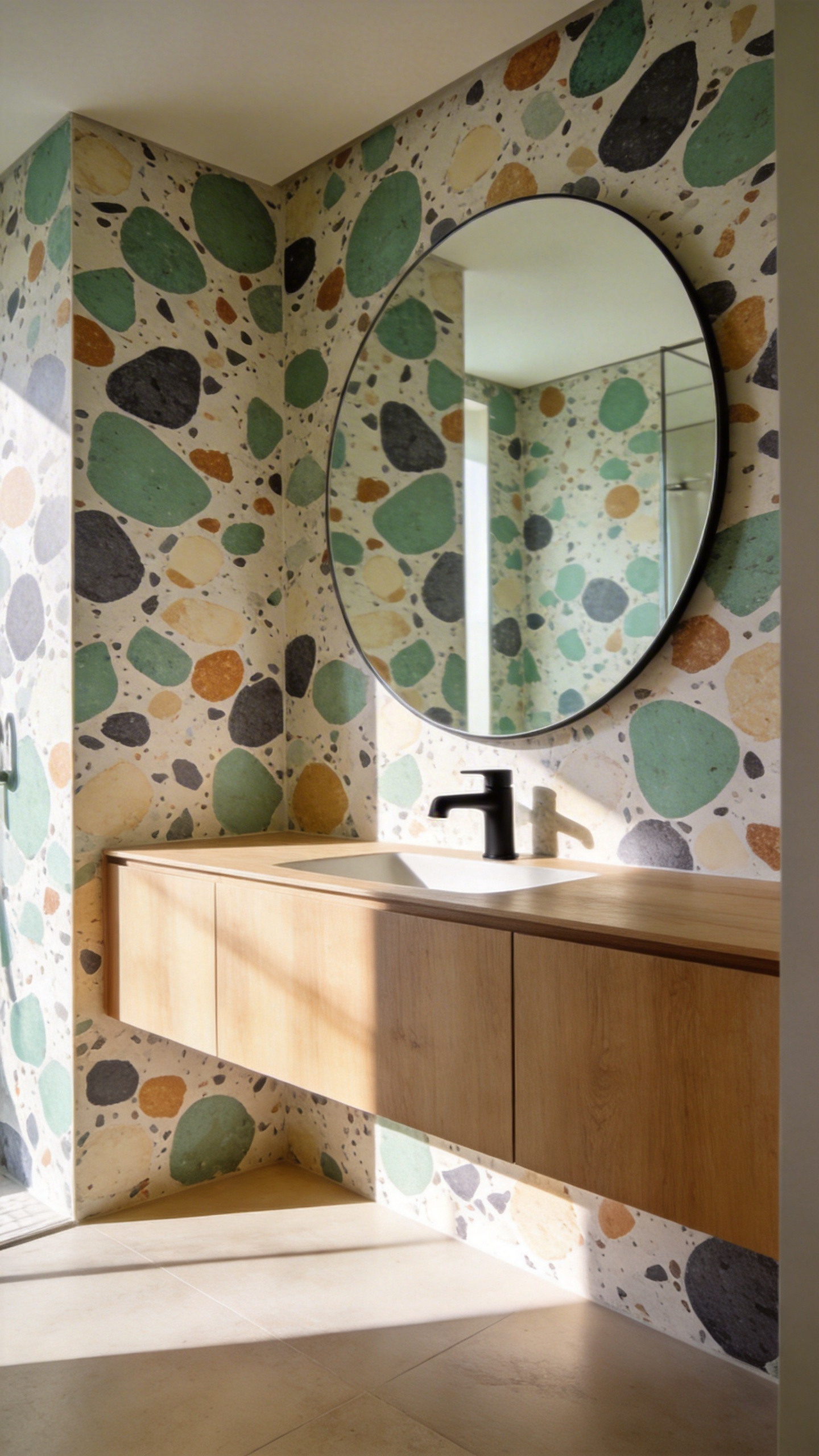
Beyond comfort, this pattern serves a functional purpose. In fact, the scattered “confetti” design creates beneficial visual noise. This naturally camouflages uneven walls or flaws. Therefore, it is incredibly forgiving for renovations.
Because the eye cannot focus on a single defect, imperfections disappear. From a psychological perspective, it offers “organized chaos.” Essentially, the chips act as a versatile “bridge palette.” You can easily coordinate towels with any single speck.
Furthermore, this flexibility allows you to update accessories easily. Finally, modern Type II vinyl ensures these motifs remain scrubbable. Ultimately, Terrazzo balances elegance with joyful expressionism.
12. Dark Tonal Reliefs: The ‘womb-like’ effect of deep charcoal and navy textured prints
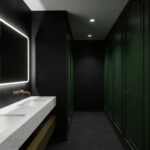
Moving away from clinical white, modern bathrooms increasingly embrace darkness. Deep charcoal and navy create a “womb-like” sanctuary. In psychology, these cool tones lower cognitive load. Consequently, the brain transitions to introspection.
However, dark colors can feel flat without texture. Tonal reliefs solve this through light physics. Tiny peaks catch light, while valleys cast shadows. Therefore, the walls appear to recede, creating depth.
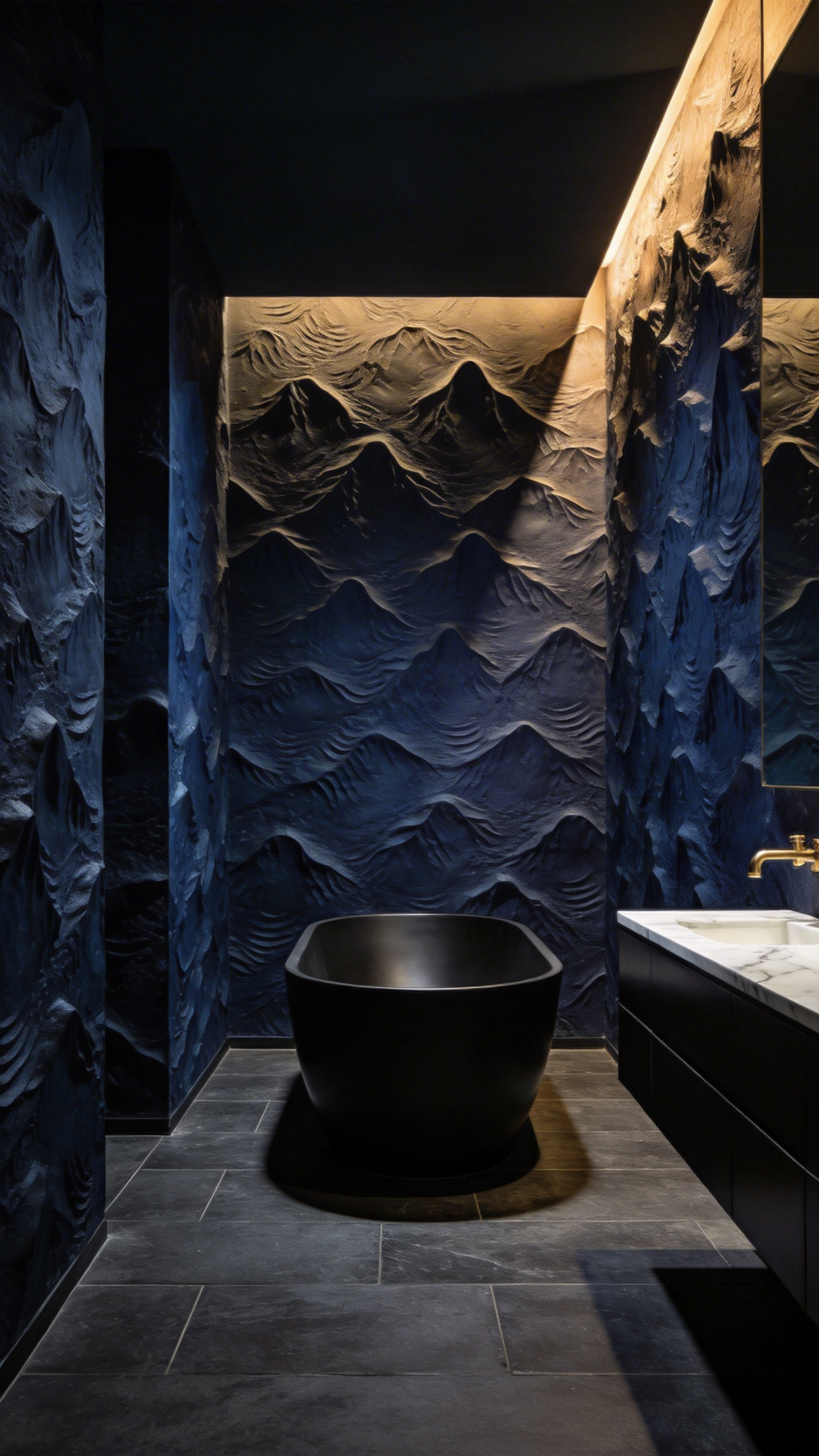
Historically, this traces back to Lincrusta. Today, advanced printing adds necessary dimensionality. For instance, clear-ink layering creates a sophisticated “wet” look. Furthermore, puff agents add physical texture.
Thus, the wall becomes a tactile experience. Designers call this the “Vamp Romantic” aesthetic. Unlike loud patterns, tonal reliefs offer “quiet interest.” Ultimately, this backdrop allows metallic fixtures to shine. It turns a utility room into a protective shell.
Section 4: Narrative Whimsy – Engaging the Mind with Storytelling Elements
Narrative whimsy transforms utilitarian spaces into storytelling environments. Specifically, small powder rooms act as “jewel boxes.” Because these spaces are isolated, the risk of bold patterns decreases. Consequently, designers use this freedom to create “sanctuary architecture.”
They draw from bathroom inspiration modern concepts that embrace universal design. Here, walls serve as a boundary between the mundane world and an imaginative retreat.
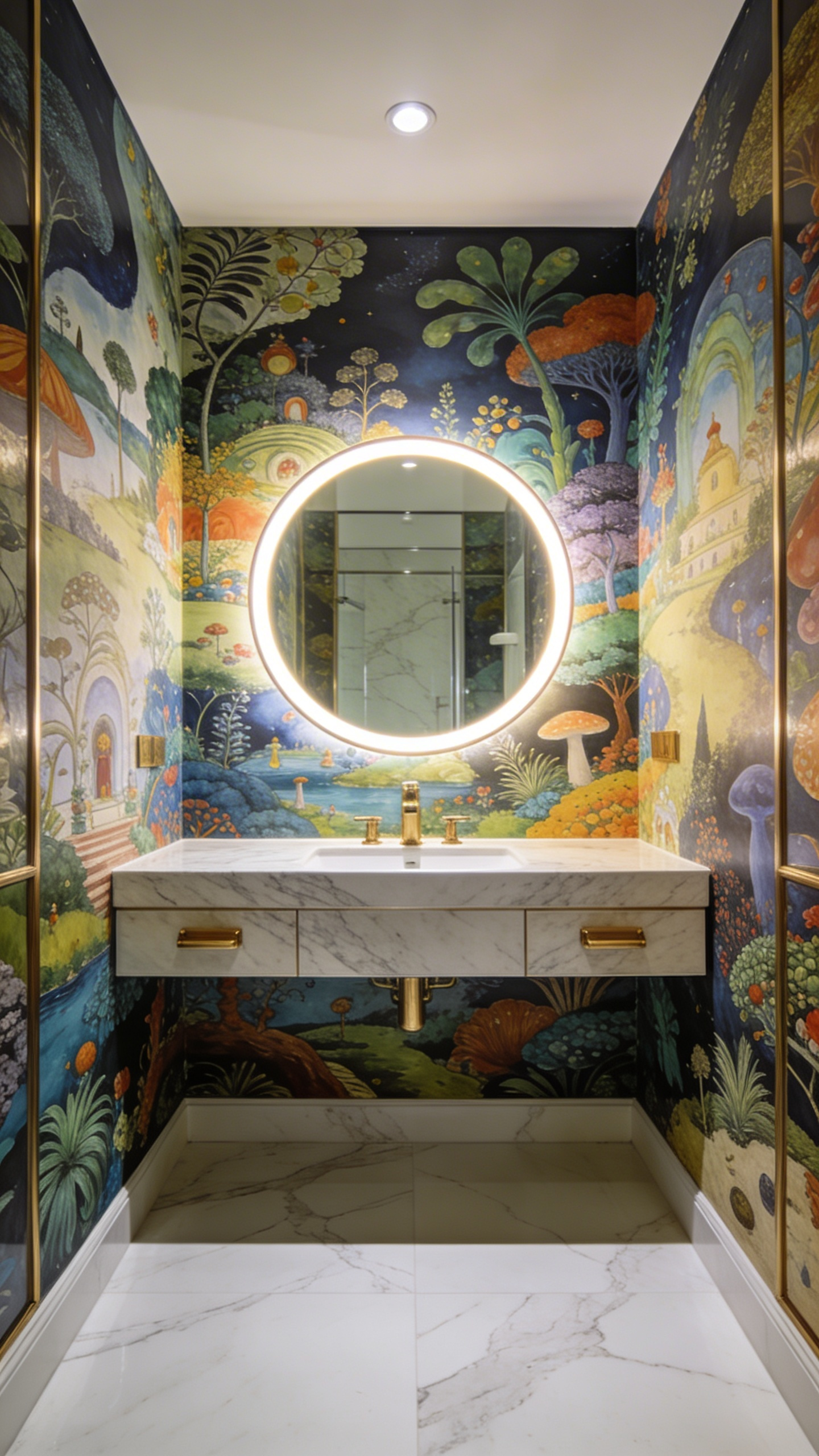
Furthermore, modern trends subvert historical styles. The “New Toile” reinvents traditional scenes. Brands like Timorous Beasties replace classic imagery with surreal narratives. Therefore, the experience shifts from passive viewing to active deciphering.
Guests discover complex stories, turning the wall into a conversation piece. Beyond visuals, contemporary wallpaper introduces tactile dimensions. Magnetic wallpaper allows users to move characters. Additionally, textured papers invite physical touch.
Technically, innovations like the WET System allow narratives to flow into the shower. Thus, the story continues uninterrupted. Ultimately, this offers a counterpoint to minimalism. Proponents argue that detailed patterns provide orderly complexity.
13. Modernized Toile de Jouy: Subverting tradition with contemporary cultural scenes
Traditionally, Toile de Jouy evoked pastoral bliss. However, contemporary designers are radically subverting these narratives. Specifically, this trend transforms the powder room into a space of discovery. At a distance, the pattern mimics 18th-century landscapes.
But upon closer inspection, it reveals a complex, modern story. This “double-take” effect works perfectly in bathrooms where guests are a captive audience.
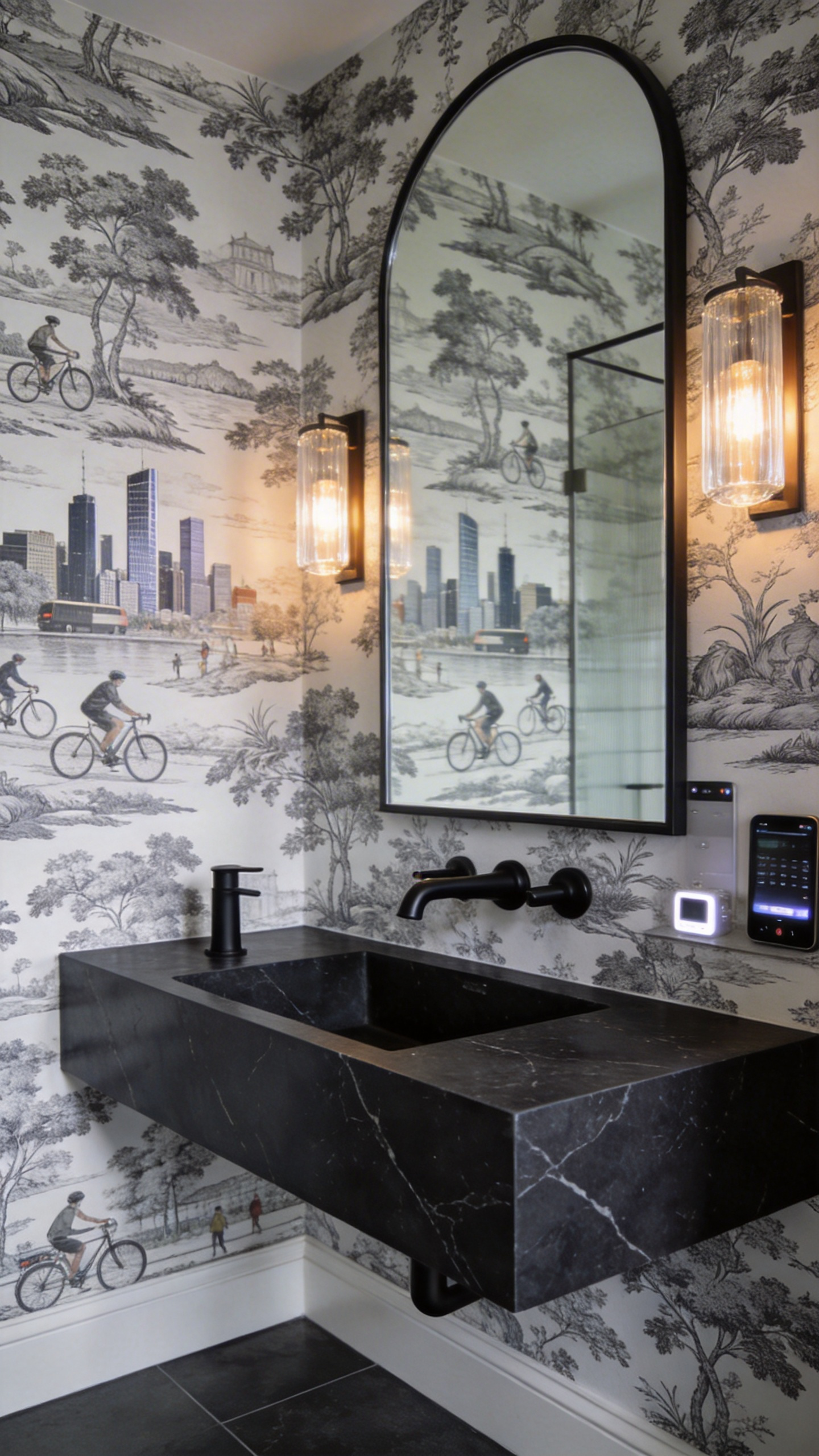
For instance, Sheila Bridges’ Harlem Toile depicts scenes of modern African American life. Similarly, studios depict gritty urban realities. Psychologically, this contrast stimulates the mind. In fact, this approach reclaims the medium’s journalistic roots.
Technically, applying these papers in damp environments requires preparation. Therefore, professionals often use a dead-flat varnish. This creates an invisible, moisture-resistant shield. Furthermore, selecting a breathable non-woven base reduces mildew risk. Ultimately, modernized Toile allows homeowners to showcase wit.
14. Conversational Curiosities: Detailed fauna and flora prints that invite closer inspection
“Conversational Curiosities” transform bathrooms into immersive environments. Specifically, these intricate designs prioritize narrative-driven prints. Historically, this style descends from the *Cabinet of Curiosities*. However, modern iterations function as “visual puzzles.”
Consequently, they shift wallpaper from a background texture to an active storyteller.
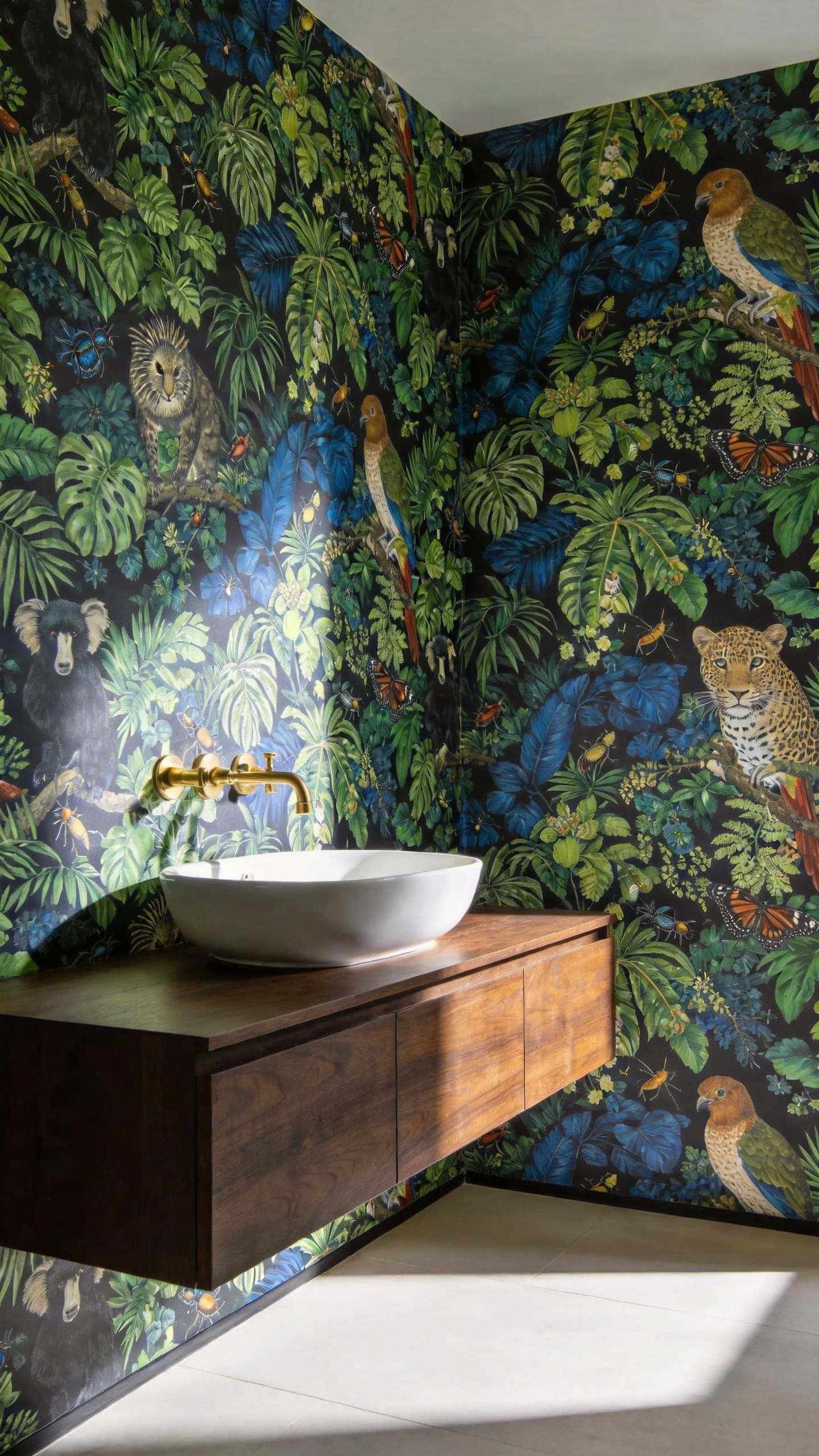
Psychologically, this works well in small powder rooms. Designers refer to these spaces as “jewel boxes.” Surprisingly, dense prints can make a small room feel larger. Essentially, the brain becomes occupied with exploring hidden “Easter eggs.”
Therefore, the viewer stops focusing on boundaries. Furthermore, *Trompe-l’œil* techniques create perceived distance. Two distinct styles dominate here. The Scientific Naturalist style focuses on botanical accuracy. Conversely, the Whimsical Surrealist approach blends realism with wit.
Regardless of style, technical mastery remains crucial. Manufacturers now capture hyper-realistic details like parchment grain. Moreover, high-performance grounds ensure durability. Ultimately, the goal is “Balanced Maximalism.”
15. Celestial and Zodiac Maps: Connecting personal rituals to cosmic themes
In modern design, the bathroom serves as a distinct “liminal space.” It acts as a threshold between stress and rest. Therefore, celestial wallpaper functions as a psychological anchor. By utilizing cosmic themes, you create a “Circadian Bathing” environment.
For instance, deep indigos reinforce the body’s natural rhythm. Effectively, these “Midnight Palettes” signal the brain to decompress. Thus, the user shifts to reflection.
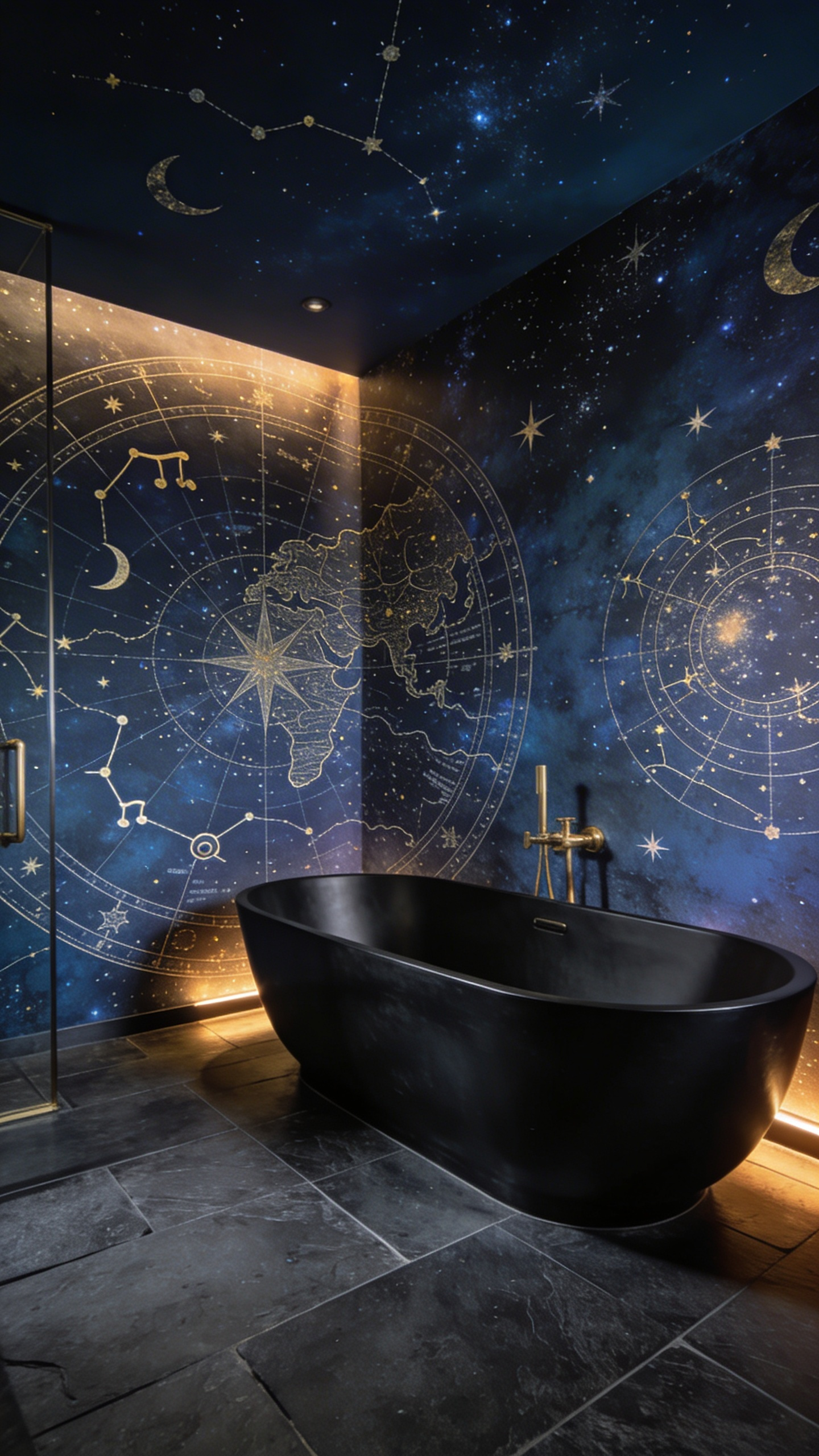
Furthermore, small bathrooms benefit from the “Jewel Box” effect. Manufacturers use gold foil to represent orbits. Under warm lighting, these elements mimic starlight. Surprisingly, humidity enhances this shimmer.
This turns a functional room into a sanctuary. Beyond aesthetics, this supports “Astro-interiors.” Decor aligns with zodiac signs for storytelling. Consequently, morning rituals become moments of calibration.
You are not just preparing; you are connecting with a larger order. Finally, these designs offer architectural grounding. Rigid star charts balance the chaotic nature of water. Modern maps favor clean geometry.
16. Architectural Sketchlines: Adding intellectual depth to stark modern fixtures
Modern bathrooms often feature high-gloss ceramics. Consequently, these surfaces can feel emotionally cold. To counter this, architectural sketchline wallpaper introduces “the thinking hand.” Specifically, this emphasizes human intent through visible graphite textures.
Therefore, the raw aesthetic acts as a foil to monolithic vanities.
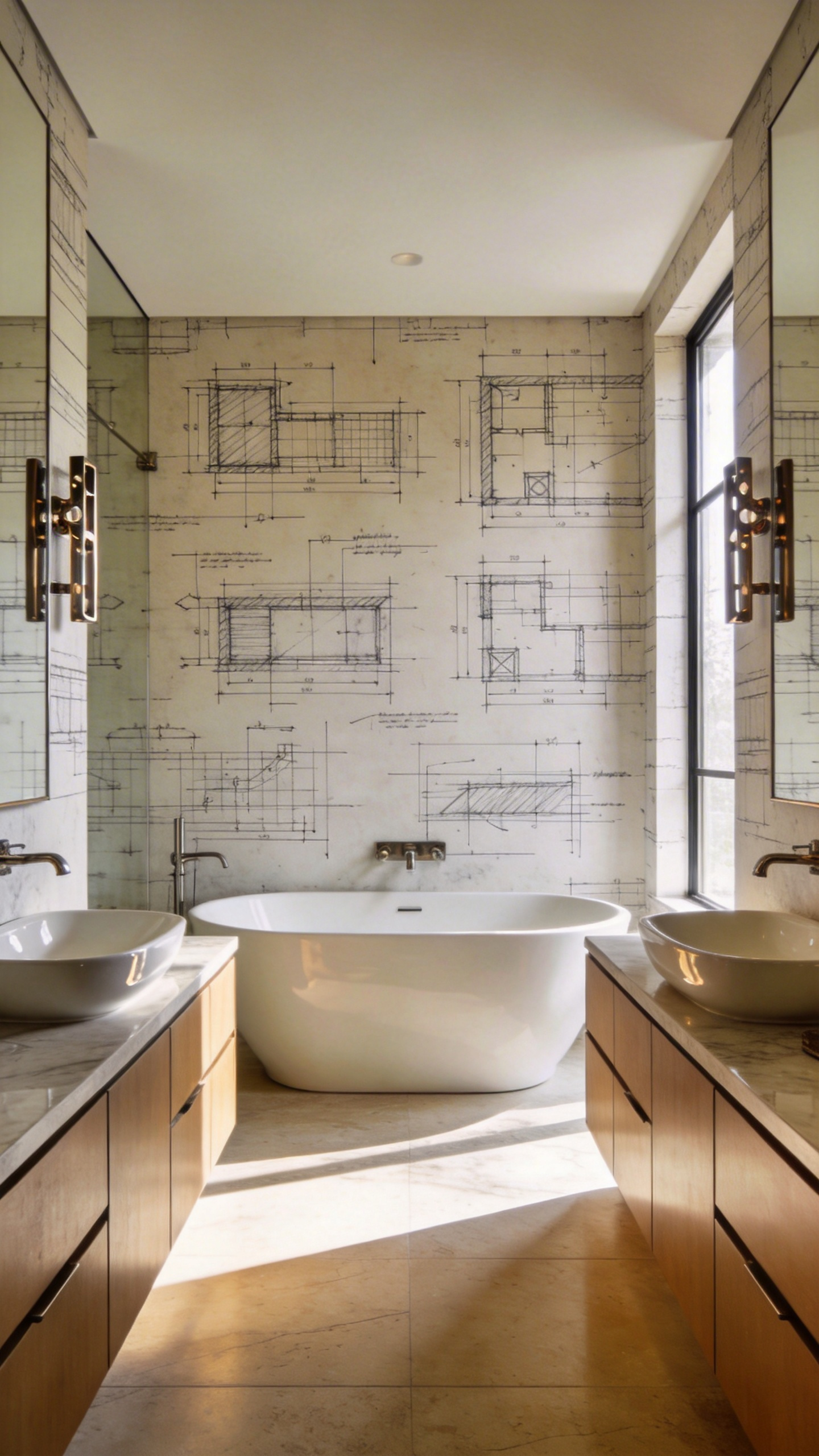
Furthermore, this adds intellectual curiosity. Unlike static prints, sketchlines suggest a “work in progress.” In fact, surrounding a shower with cross-sections creates a “Collector’s Study” atmosphere. Thus, the narrative shifts to a contemplation of function.
Additionally, these patterns perform a psychological trick. Hand-drawn vanishing points give the eye a path. As a result, small bathrooms avoid feeling boxy. Moreover, the palette of blueprint blue mimics professional tools.
This association fosters mental clarity. Ultimately, this visual dialogue transforms a decorated bathroom into a curated sanctuary.
Essential Considerations: Moisture Resistance and the Psychology of Color in Humid Zones
Selecting modern bathroom wallpaper requires balancing science with psychology. Initially, one must address moisture management. Historically, homeowners relied on impermeable vinyl. However, modern science favors “breathable” non-woven substrates.
Unlike vinyl, these materials allow moisture to evaporate. Consequently, this prevents the hidden mold growth common with older papers.
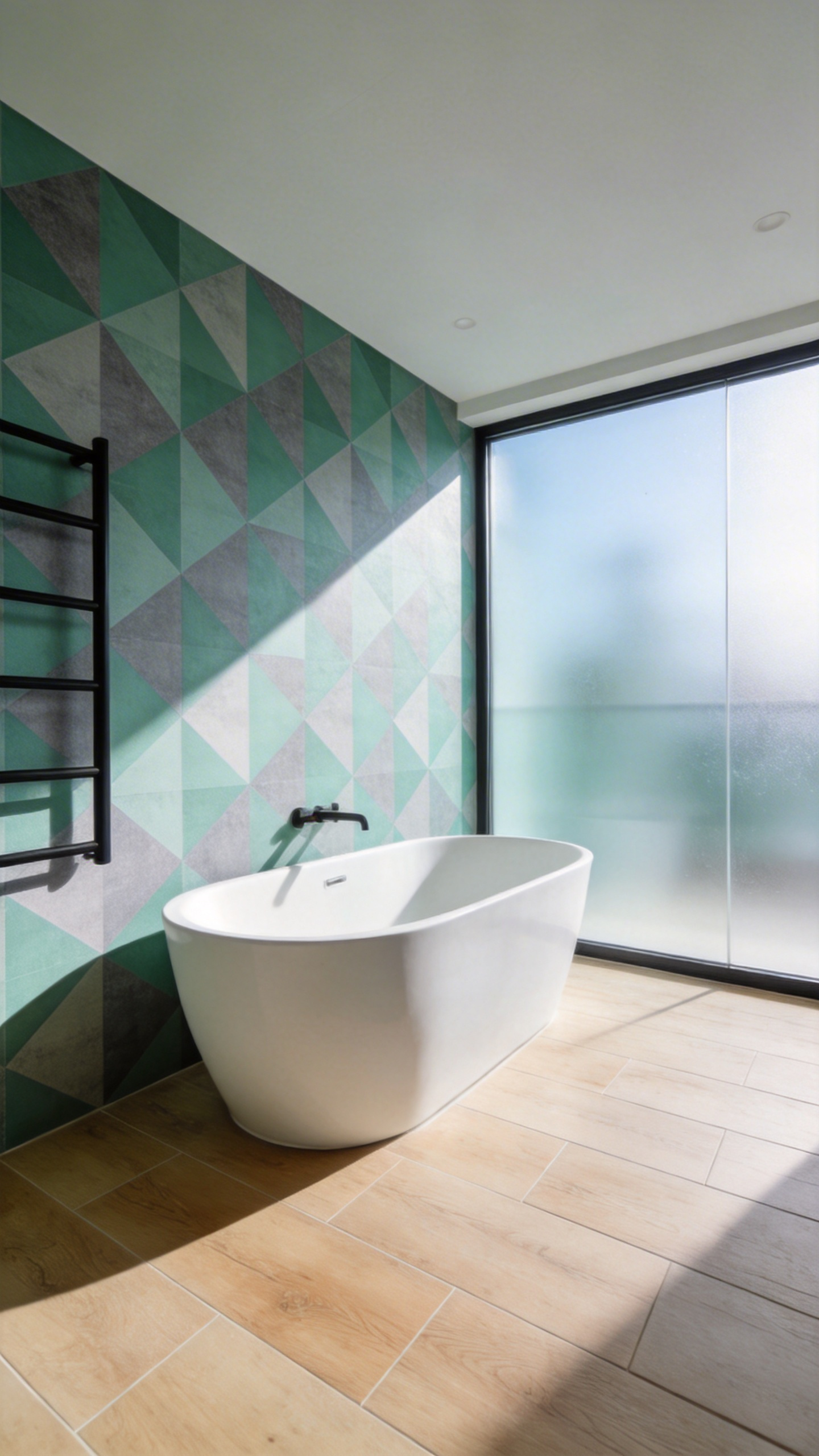
Once the material is secured, color choice becomes critical. Specifically, steam alters how we perceive light. In a mist-filled room, soft colors often appear “muddy.” Therefore, look toward deep jewel tones.
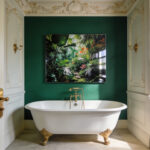
Colors like emerald absorb the harsh glare from tile. As a result, they create a psychological “cocoon.” Furthermore, wallpaper helps counteract “hard-surface fatigue.” Bathrooms are filled with cold textures.
Thus, the brain craves softness. Wallpaper that mimics linen provides a “haptic illusion.” This trick makes the room feel warmer. Finally, consider biophilic patterns. Botanical prints trigger a primal relaxation response. Ultimately, this turns a functional space into a restorative sanctuary.
Frequently Asked Questions
Is wallpaper in a bathroom a good idea for modern homes?
Yes, provided you choose the right materials. Modern non-woven textiles and Type II vinyls are specifically engineered to withstand the humidity and temperature fluctuations of a bathroom, unlike traditional paper-based wallcoverings.
What is the most durable type of modern wallpaper for bathrooms?
High-quality Type II Vinyl or fiberglass “wet system” wallpapers are the most durable. These substrates act as vapor barriers or are fully waterproof, making them suitable even for direct contact with water in shower enclosures.
How do you choose the right pattern for a small modern bathroom?
In small spaces, consider using “pattern drenching” with a micro-grid or a large-scale mural. These choices can trick the eye into seeing more depth, effectively pushing the walls outward and making a compact powder room feel more expansive.
Conclusion: Selecting a Pattern That Aligns with Your Morning Intentions
Selecting bathroom wallpaper modern designs establishes the psychological foundation for your day. It acts as more than a decorative backdrop; in fact, it serves as a vital cognitive tool. Whether you choose sharp geometry for alertness or “Quiet Biophilia” for calm, the pattern shapes your mood. Furthermore, this decision merges aesthetic narrative with essential durability.
Consequently, your bathroom evolves from a utility space into a sanctuary. Looking ahead, your choices should reflect intentional self-expression. Therefore, prioritizing quality materials like breathable paper ensures peace of mind. Indeed, the future of home wellness lies in these holistic environments. To begin, audit your morning ritual. Finally, identify your desired emotional state, then select the pattern that anchors that intention.