Many homeowners mistakenly equate rustic style with “farmhouse kitsch.” They fill rooms with distressed signs, excessive burlap, and heavy, untreated wood. As a result, these spaces often feel cluttered rather than cozy. The textures compete for attention, creating visual noise instead of serenity. However, selecting the right rustic living room decorations requires a shift from simple accessorizing. You must adopt the Curatorial Confidence Framework. This approach mirrors the precise intentionality of a gallery curator. It utilizes “Productive Tension” to balance the rugged with the refined for a truly sophisticated atmosphere.
True sophistication requires more than just decorating. Indeed, a polished minimalist sofa acts as a precise frame for rough-hewn ceiling beams. By pairing them, we create a deliberate study in opposites known as the “Polished-Primitive” dialectic. Furthermore, this method relies heavily on “Strategic Restraint.” You must leave breathing room to highlight specific, significant pieces.
This guide reveals the secrets behind “Selection over Saturation” in domestic spaces. First, we examine how to select a singular “Anchor” piece that dictates the room’s narrative. Next, we explore “Layered Illumination” to treat furniture and textures as sculptural art. Additionally, we discuss replacing synthetic blends with tactile, living finishes. Ultimately, you will learn to curate a home that feels both historically grounded and unapologetically modern.
Phase 1: Materiality as the Canvas
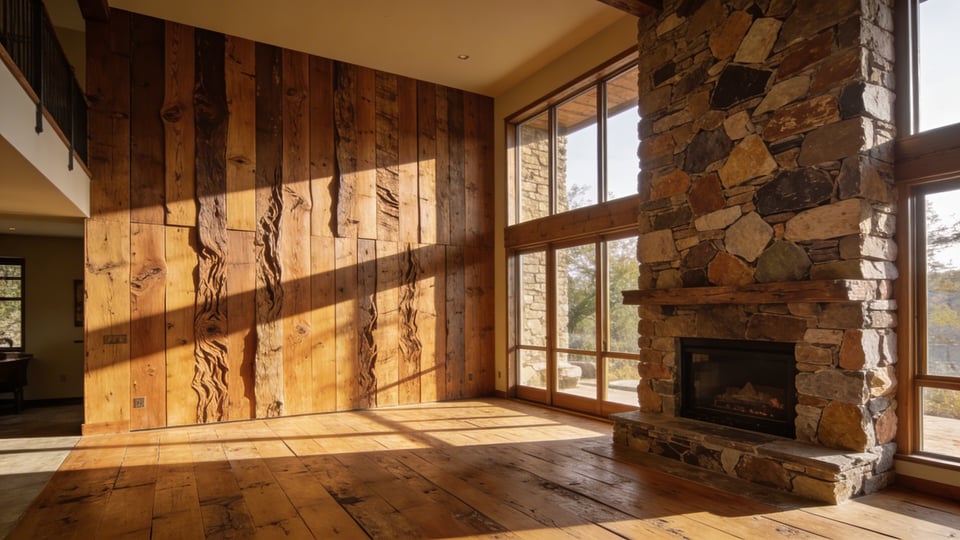
In rustic design, the “canvas” is never a blank, passive wall. Instead, it is a tactile layer of raw materials. This foundation dictates every subsequent choice of furniture and lighting. Primarily, this approach engages in “Biophilic Priming.” This concept creates professional rustic living room design strategies that prioritize natural well-being. Research indicates that visible wood grain significantly reduces the body’s stress response. The brain processes these natural, fractal patterns as safe and predictable.
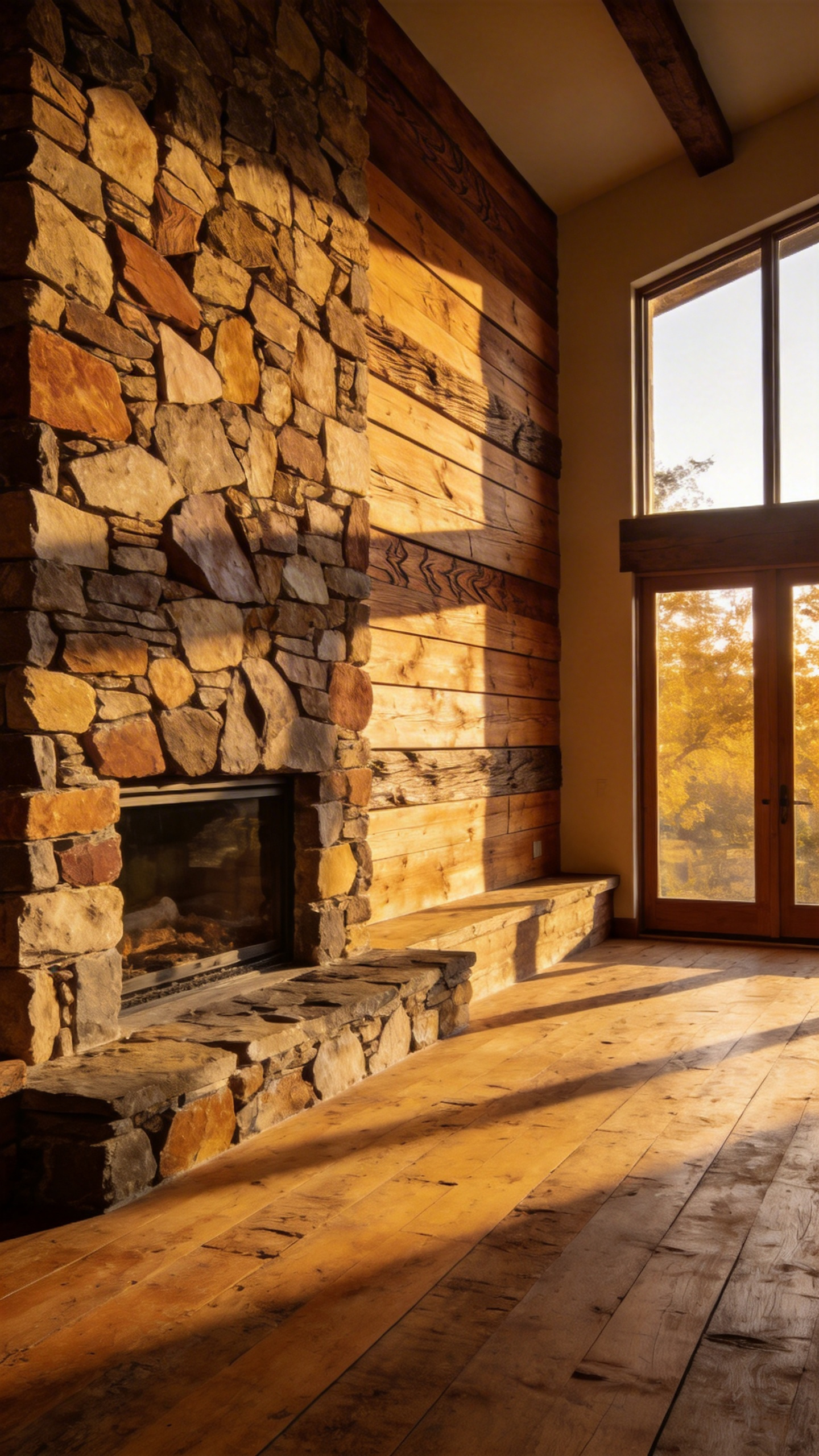
Furthermore, the rustic canvas creates a specific bio-acoustic environment. Modern minimalist rooms often suffer from harsh, bouncing echoes. Conversely, rustic materials use density to sculpt the soundscape. Specifically, porous reclaimed wood acts as a broadband absorber. Simultaneously, the uneven surface of stone diffuses sound waves. Thus, the room achieves a distinct auditory warmth.
Moreover, this phase introduces a “ghost narrative” through material provenance. We often source “Old Growth” timbers featuring dense rings and hand-hewn tool marks. Essentially, you are “underpainting” the space with recorded labor and history. Finally, these “living” surfaces provide thermal buffering. Stone absorbs heat to stabilize the room’s micro-climate. Additionally, unsealed materials develop a complex patina over time. You are choosing a foundation that effectively self-decorates for decades.
1. Reclaimed Wood as Sculpture: Treating structural beams as artistic installations
In modern rustic design, reclaimed beams have evolved beyond architectural necessity. Now, they function as distinct pieces of “Architectural Art.” This “Post-Utilitarian” shift treats timber as a curated sculpture. Consequently, these installations provide essential rhythm and scale to a living space. They feature “marks of use,” like original bolt holes. These “accidental sculptures” ground the room in history.
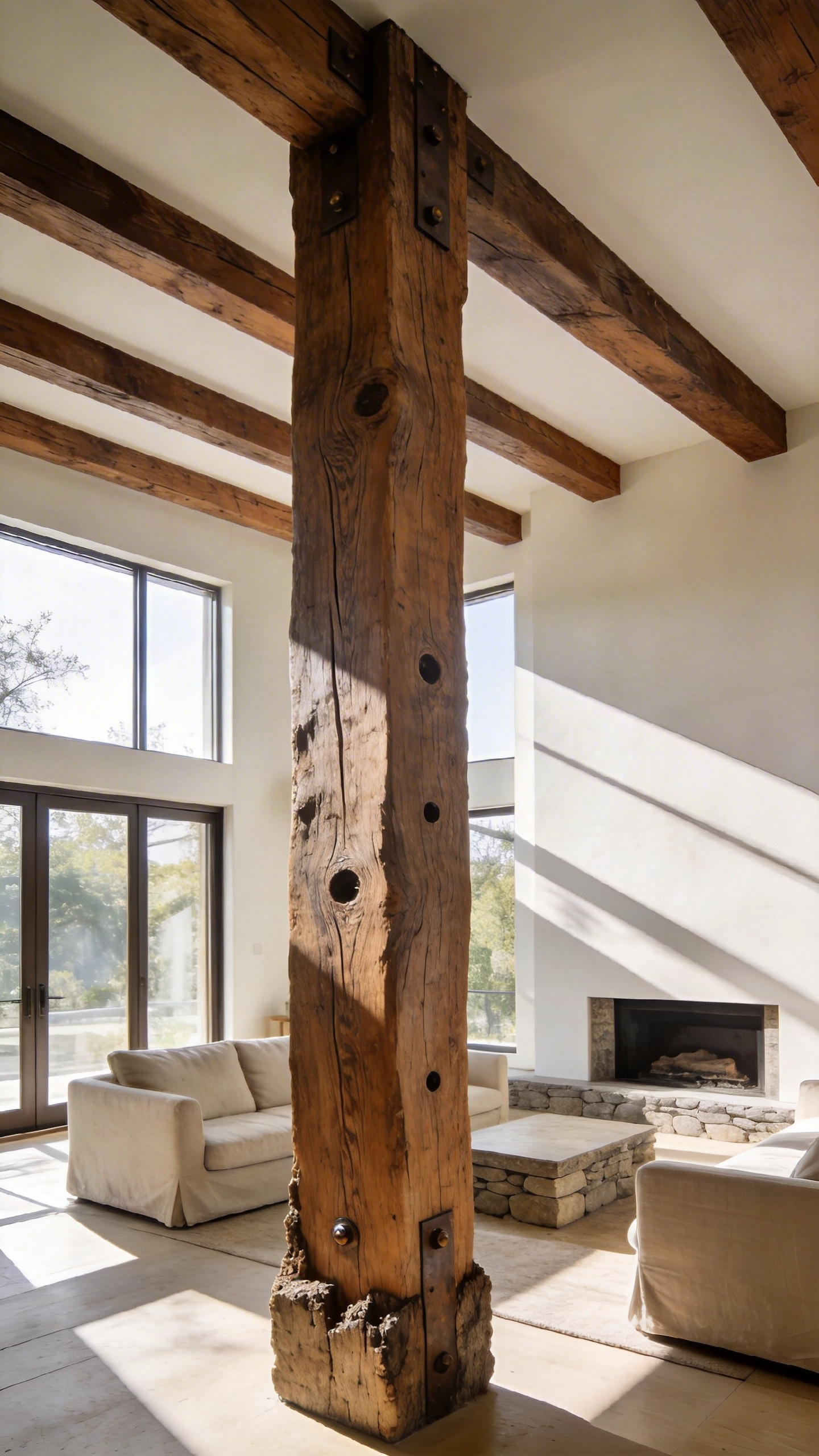
However, treating a beam as art requires technical finesse. Professional artisans avoid high-gloss varnishes. Instead, they favor burnishing with linseed or tung oils. This technique enhances “tactile warmth.” Layered sanding helps the surface catch shifting daylight. As a result, the wood appears to glow from within, much like a gallery piece.
Beyond aesthetics, these sculptures influence the room’s psychology. Specifically, the complex grain patterns offer natural fractals. In fact, research shows these patterns significantly lower stress levels. Additionally, large-scale wood acts as an acoustic diffuser. Beams create a “forest-floor hush” that absorbs echoes to foster intimacy.
Finally, consider placement beyond the ceiling. Vertical installations “wrap” a room like a protective shell. Alternatively, techniques like *Shou Sugi Ban* create deep, charred textures. These finishes provide stark, sculptural contrast against soft textiles.
2. The Stone Hearth: Anchoring the room with geological texture rather than decoration
In high-end rustic design, the hearth is not merely a shelf for decorations. Instead, it functions as a geological anchor. The stone itself becomes the room’s primary protagonist. Ideally, the material should reflect the local vernacular architecture. For instance, using indigenous fieldstone creates a sense of “terroir.” This connects the home to its unique environment. Therefore, the room feels as though it grew naturally from the ground.
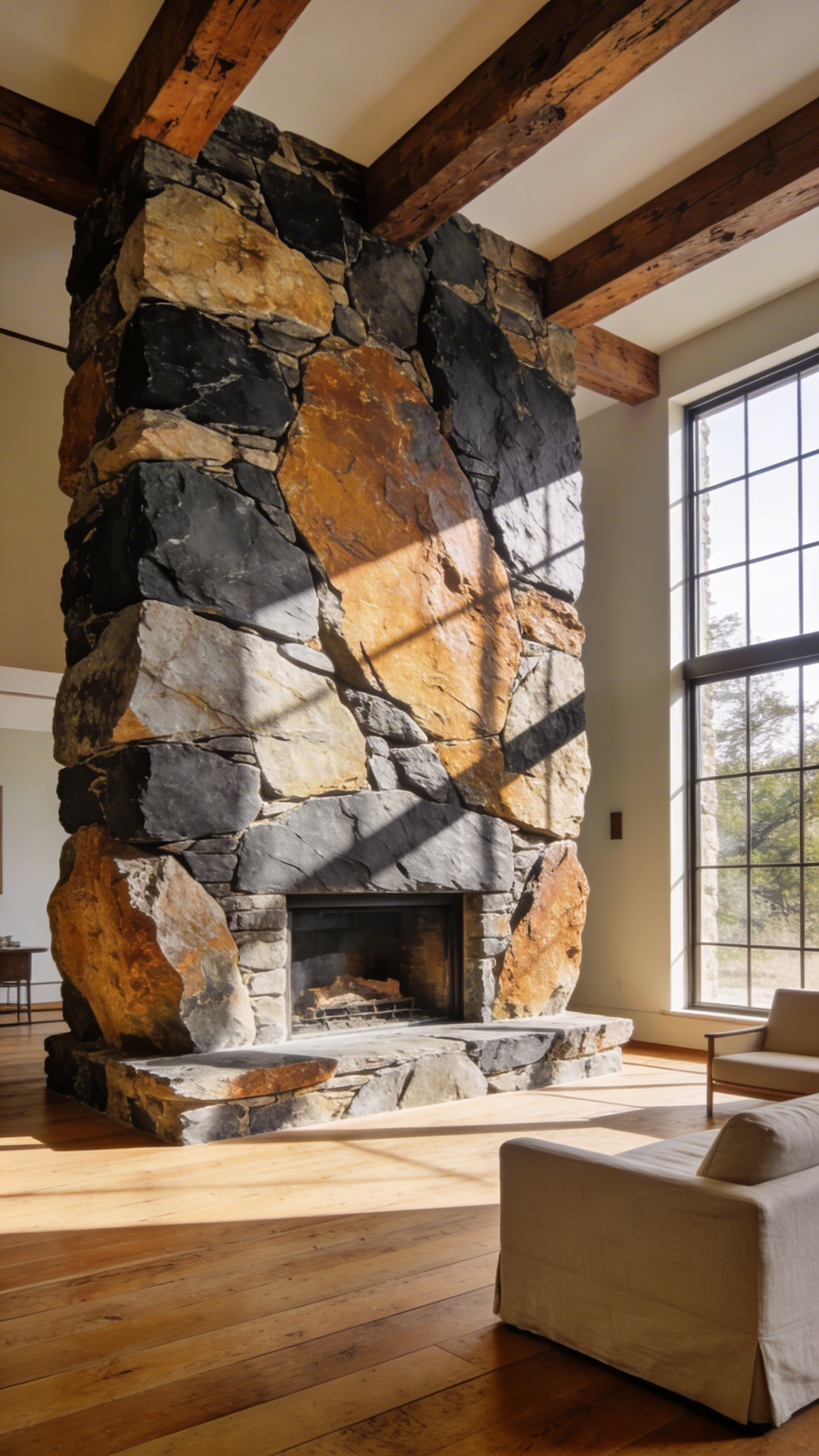
Furthermore, a floor-to-ceiling installation establishes necessary “visual gravity.” Psychologically, it acts as an Axis Mundi, or the center of the home. To enhance this depth, designers often utilize deep-recessed pointing. Shifting sunlight creates a dynamic display of chiaroscuro. This play of light and shadow replaces the need for framed art.
Additionally, the method of construction matters immensely. Specifically, the dry-stack aesthetic offers a look of ancient permanence. Here, stones appear held together only by gravity and craftsmanship. This technique highlights the material rather than the masonry. Moreover, real stone provides a thermal mass that synthetic veneers cannot replicate.
Finally, allow the stone to develop a living texture. In fact, slight darkening above the firebox creates a beautiful, natural gradient. This “patina of utility” draws the eye toward the fire. The hearth serves as decoration through observation, not addition.
3. Flooring with History: Why wide-plank oak provides the gallery foundation
Wide-plank oak serves as the true “gallery foundation” for a rustic living room. Unlike standard strip flooring, wide planks offer an expansive, uninterrupted canvas. This creates a necessary sense of “quietness” that prevents visual clutter. By reducing seam lines by nearly 300%, the floor frames your furniture rather than competing with it.
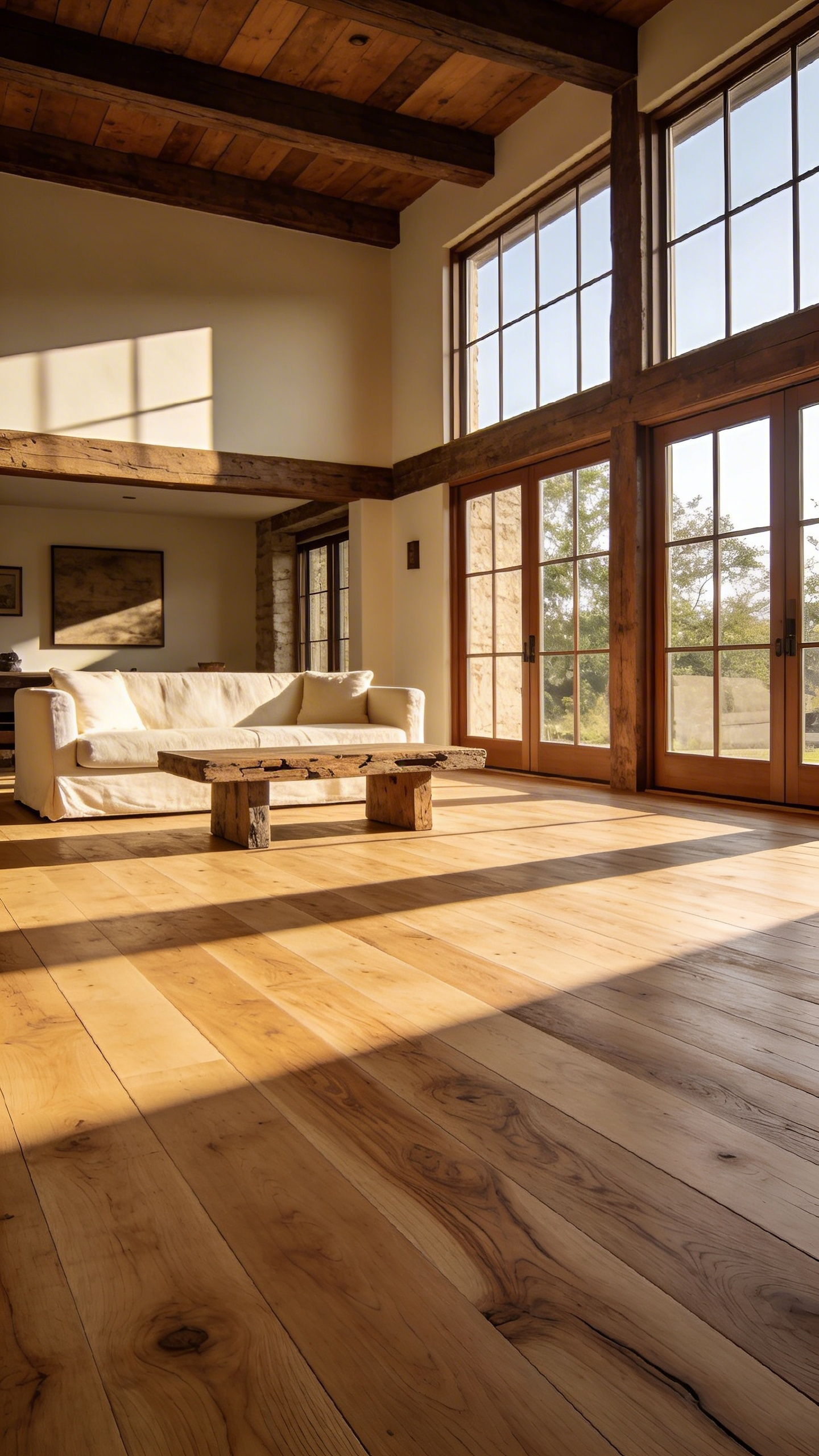
Historically, using wide timber was a symbol of defiance against the Royal Navy’s resource claims. Today, however, that historical weight translates into an immediate air of permanence. Therefore, the room feels grounded in heritage rather than 20th-century mass production.
Beyond history, oak possesses a unique chemical advantage. Specifically, its high tannin content allows the wood to mature like a fine photograph. Over time, tannins react with light to develop a deep, metallic-like patina. Modern designers often use reactive stains to accelerate this process. As a result, the floor gains a multi-tonal depth that makes simple rustic decor appear more deliberate.
The experience is also tactile. For instance, authentic wide planks are often wire-brushed to remove soft wood. This technique leaves the harder grain intact, creating a warm, non-slip surface. Additionally, the density of these planks produces a low-frequency acoustic “thud.” This sound contributes to the heavy, sanctuary-like atmosphere essential for a gallery-style space.
Finally, the choice between reclaimed and live-sawn oak defines the floor’s character. Reclaimed wood offers superior stability against humidity. Conversely, live-sawn new growth captures “cathedral peaks” and knots. Ultimately, both options provide the scale required to balance heavy rustic textures.
Phase 2: The Curator’s Approach to Textiles
Moving beyond simple decoration involves assembling a “living library” of fibers. Consequently, a curator prioritizes conservation over restoration. Instead of “fixing” an antique to look new, we preserve its current state. This approach safeguards the item’s history, a principle echoed in living room decor ideas that prioritize heritage over mass-market trends. For instance, we accept “shattered” silk or the patina on organic fibers. Technically, curators follow the “reversibility” rule. Therefore, any intervention must be undoable without damaging the original material.
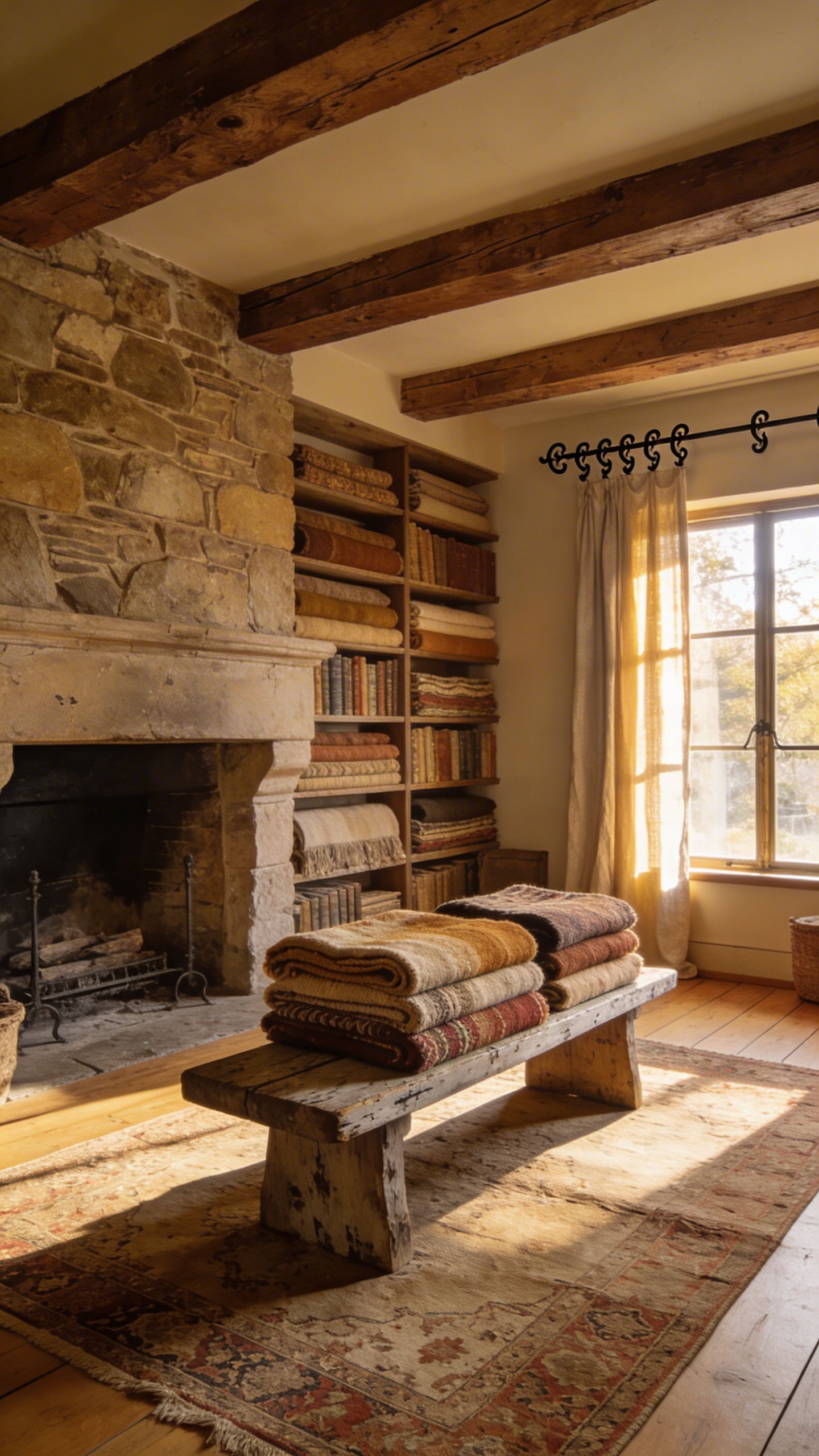
Furthermore, this mindset embraces an “archaeology of memory.” Consider Japanese *Boro* textiles, where visible patches represent moments of survival. Rather than hiding wear, we highlight it. Similarly, provenance transforms upholstery into fine art. Notably, authentic Harris Tweed is protected by an Act of Parliament. Thus, it represents a specific cultural heritage. By selecting these pieces, you introduce a narrative of labor and time.
Finally, evaluate the textile’s “hand,” or tactile feel. High “slub” counts create a textured landscape that catches low-angled light. This interaction casts micro-shadows, making flat surfaces appear three-dimensional. Moreover, dense weaves like heavy hemp act as acoustic absorbers. Ultimately, these choices create a serene, curated atmosphere.
4. Patinated Leather: Investing in seating that carries a visual narrative
Unlike mass-produced synthetics, true patinated leather acts as a living record of a home’s history. Specifically, this chemical transformation requires high-quality, full-grain, vegetable-tanned leather. Unlike “static” chrome-tanned alternatives, this material utilizes natural tannins found in tree bark. This keeps the pores open. As a result, the surface absorbs ambient moisture, UV light, and natural oils from daily use. Over time, these fibers darken to reveal a marble-like sheen known simply as the “glow.”
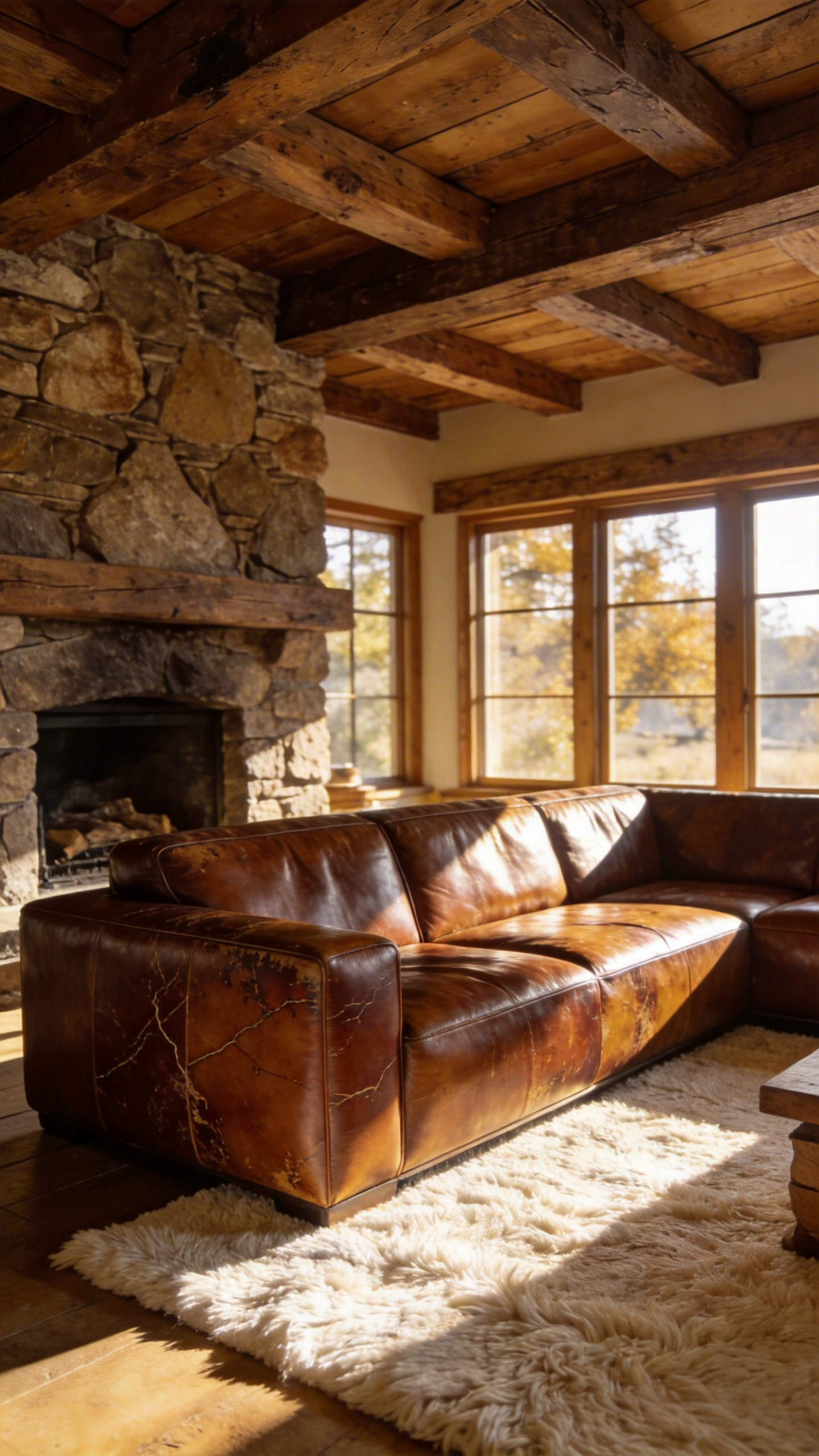
Philosophically, this material embodies the Japanese aesthetic of Wabi-Sabi by celebrating the passage of time. In fact, leather serves as a bridge between organic elements and man-made structures within a rustic room. Scratches or sun-fading are not considered flaws here; instead, they become essential character marks. For instance, the darkening on armrests transforms a mere chair into a distinct “visual diary” of the owner’s habits. This unsealed finish removes the anxiety of the first scratch, creating an atmosphere that invites genuine interaction.
From an investment standpoint, full-grain leather lasts nearly four times longer than standard fabric upholstery. Therefore, it creates an asset that appreciates in aesthetic value even as it ages. To balance this warmth, experts suggest pairing these pieces with “cold” materials like hand-forged iron or raw stone. This textural contrast prevents the rustic style from feeling cliché or overly themed. Ultimately, purchasing patinated leather is a sustainable commitment to “heirloom” luxury.
5. Sculptural Softness: Incorporating bouclé and sheepskin for tactile contrast
Modern rustic design is currently evolving beyond the “rough-hewn” aesthetic of the past. Specifically, it is shifting toward a style known as “sculptural softness.” This approach prioritizes architectural form alongside deep sensory indulgence. Central to this look is the intentional tension between two distinct textures: bouclé and sheepskin.
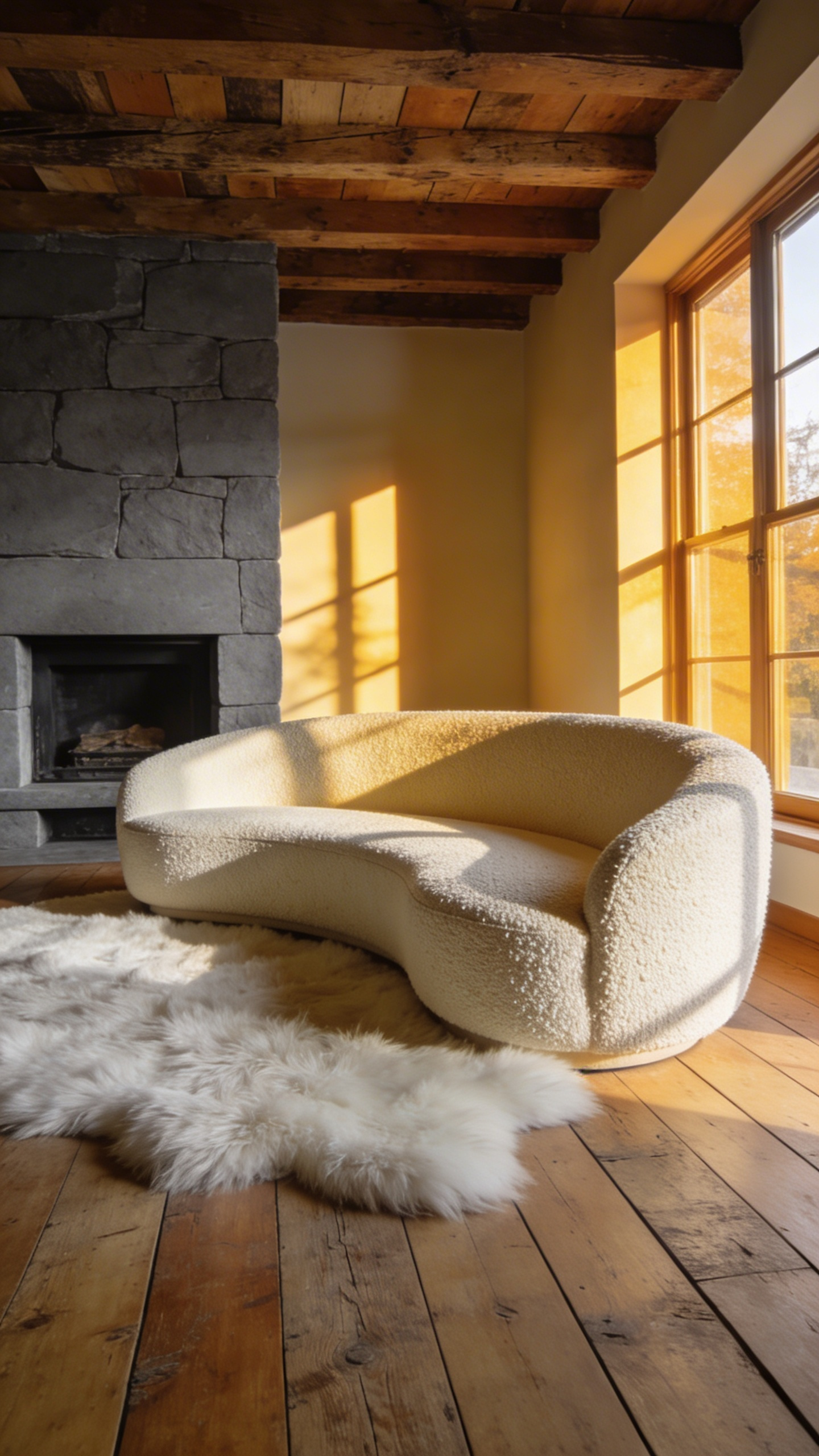
Bouclé serves as the room’s “soft structure.” Derived from the French word for “curl,” its tight, knotted loops allow fabric to cling to furniture curves. Consequently, it emphasizes a sofa’s silhouette without the distraction of a pattern. Conversely, sheepskin introduces organic fluidity. Its shaggy, irregular pile breaks up clean lines, offering a moment of visual chaos. When layered, these materials create a sophisticated architectural interplay.
From a curatorial perspective, this combination also regulates the “visual temperature” of a room. Unlike polished wood or metal, which reflect light, these raised textures absorb it. This absorption creates micro-shadows that make furniture appear visually heavier and grounded. It contributes to a sense of psychological stability, essential for a sanctuary atmosphere.
To master this look, prioritize material authenticity. Ideally, select natural wool bouclé over synthetic polyester. The natural fiber has a “toothy” grit that complements raw timber beams perfectly. Furthermore, apply the “30/70 rule” to maintain balance. Use bouclé for 70% of your soft furnishings, acting as the matte anchor. Then, introduce sheepskin for the remaining 30% as a volatile accent. This ratio ensures the space feels curated and serene.
6. The Art of Rug Layering: Mixing vintage kilims with natural jute foundations
Treating your floor like a gallery wall significantly elevates a rustic interior. Specifically, layering a vintage Kilim over a jute rug creates a sophisticated “double-anchor” effect. This design strategy bridges ancient nomadic traditions with modern ecological sensibilities. First, consider the sensory architecture of the materials. Jute offers a chunky, nubby texture reminiscent of raw earth and stone. Conversely, a vintage Kilim provides a smooth, lanolin-rich wool surface. The contrast between the “crunchy” base and the soft overlay adds profound tactile depth.
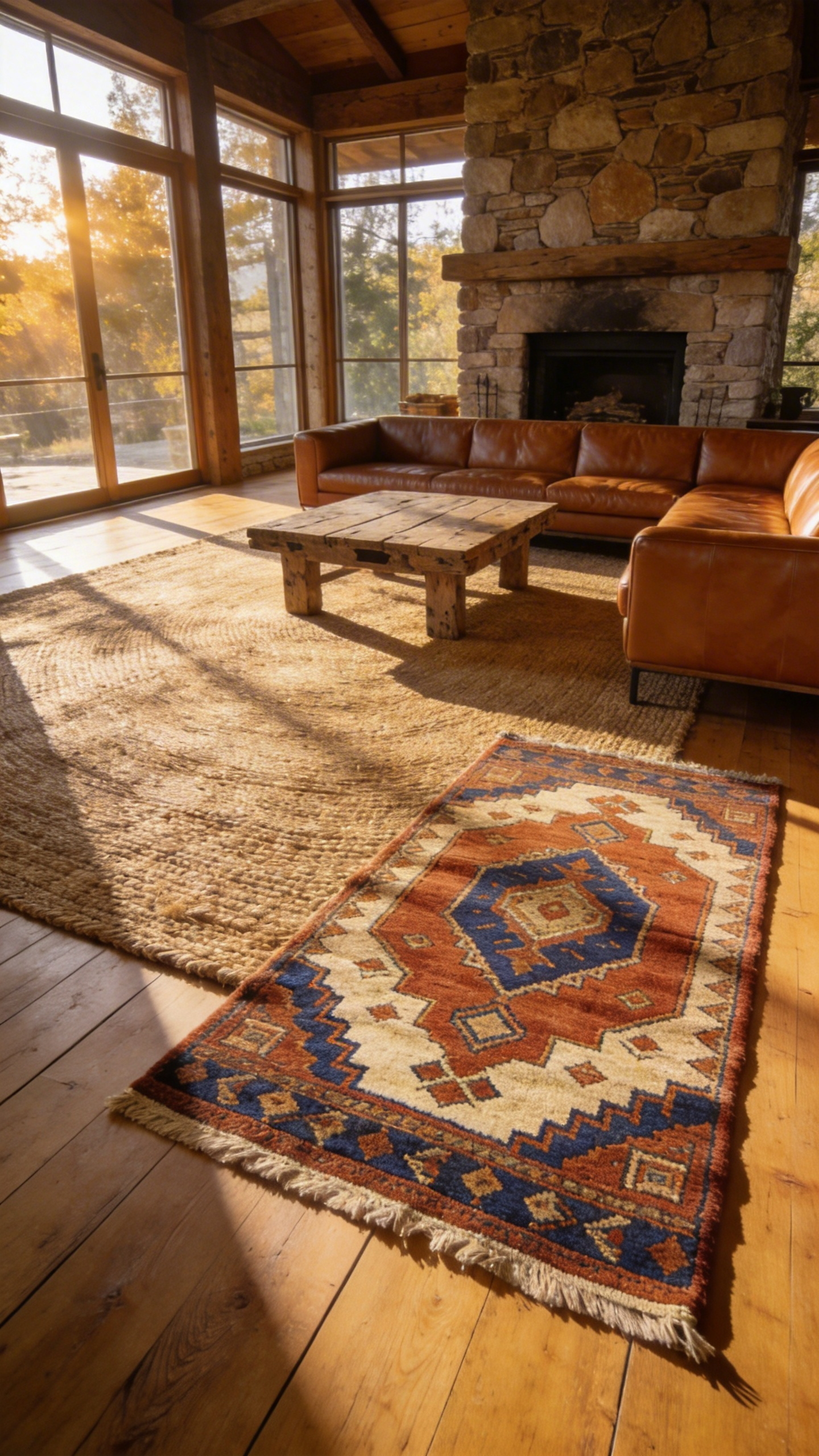
Furthermore, this technique relies on precise visual mathematics. Designers often use affordable jute as a “mat” to frame smaller, precious textiles. Ideally, the jute foundation should extend 12 to 18 inches beyond the Kilim’s edges on all sides. This creates a balanced border that draws the eye directly to the Kilim’s artistry. Additionally, this method effectively solves the “floating furniture” problem. The large neutral base tucks under heavy sofas, grounding the space. Meanwhile, the delicate vintage piece sits in the center, showcased like a painting.
In fact, there is a functional benefit to this aesthetic choice. The durable jute acts as a sacrificial shield. It absorbs the friction of foot traffic and furniture weight. Thus, it preserves the delicate structure of the antique weave, which may be decades old. Ultimately, this pairing allows bold tribal patterns to shine without overwhelming the room’s rustic palette.
7. Organic Drapery: Filtering natural light to protect and enhance your collection
Window treatments are often the unsung heroes of art preservation. Organic drapery functions as a sophisticated filter for your collection. Conversely, synthetic curtains can actively harm your pieces through off-gassing. These heat-triggered chemical vapors accelerate the yellowing of paper-based art. Therefore, choosing chemically neutral fabrics like linen or hemp is crucial.
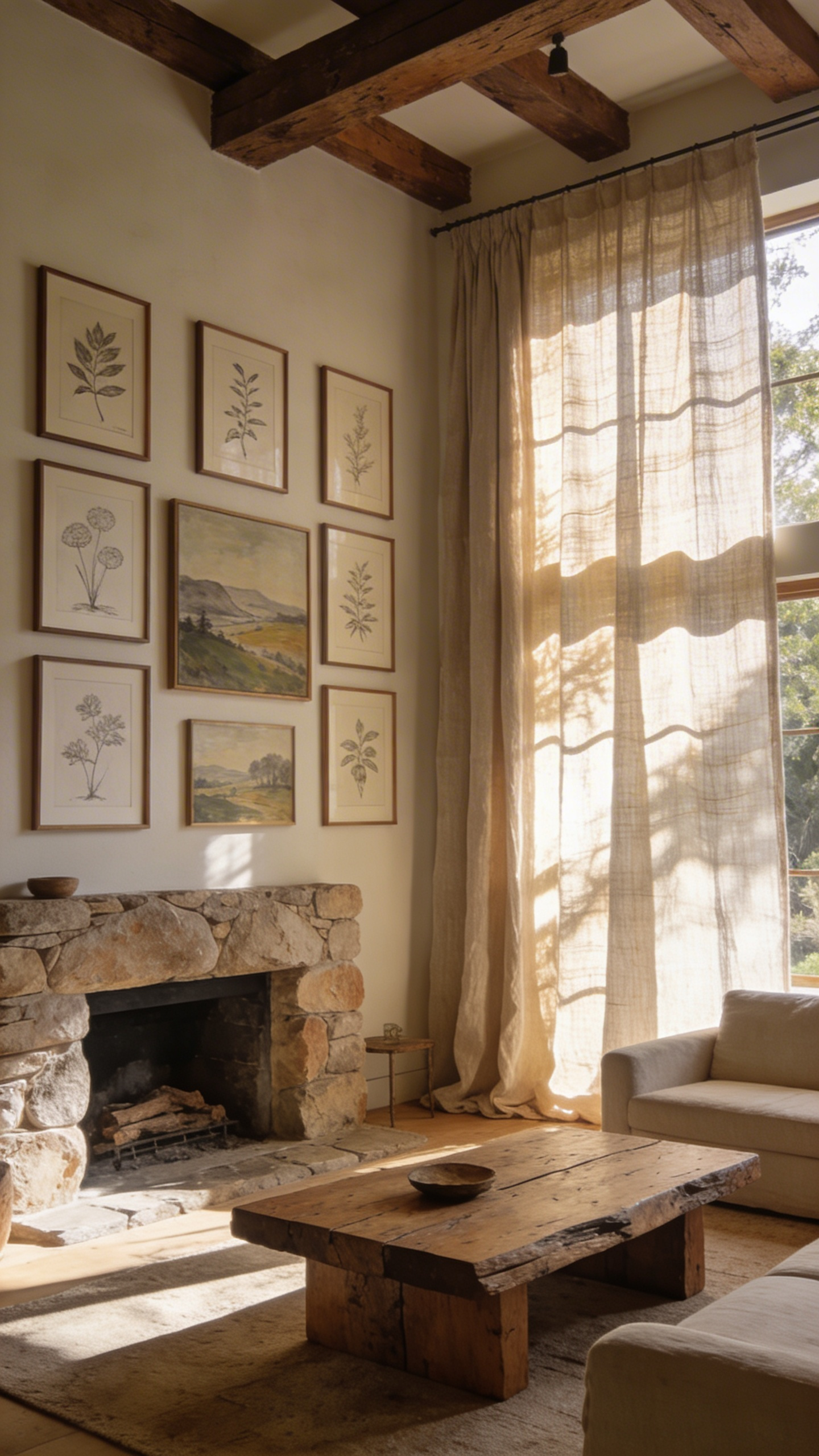
Beyond safety, organic fibers drastically improve light quality. Linen’s irregular weave scatters sunlight instead of just blocking it. This creates a soft, diffused glow without clinical gray tints. This natural illumination maintains a high Color Rendering Index (CRI). Thus, the deep ochres in your paintings remain rich and accurate.
Furthermore, industrial hemp offers superior ultraviolet protection. In fact, dense hemp weaves naturally block up to 95% of damaging UV rays. Meanwhile, these breathable fibers help regulate the room’s thermal stability. This prevents the dangerous “greenhouse effect” common with heavy synthetic backings. Ultimately, organic drapery balances aesthetic warmth with professional-grade conservation.
Phase 3: Wall Decor & Art Integration (Alex’s Specialist Insight)
Wall decor in rustic spaces functions as a neurological anchor. Specifically, research into texture psychology reveals that our brains actively “feel” rough surfaces. Viewing natural fractal patterns, like wood grain, reduces physiological stress significantly. This creates a refined ruggedness rather than accidental clutter, a principle that elevates standard living room decorating ideas into the realm of fine art. Therefore, choose “relief art” or woven textiles over flat prints to create a restorative exhale.
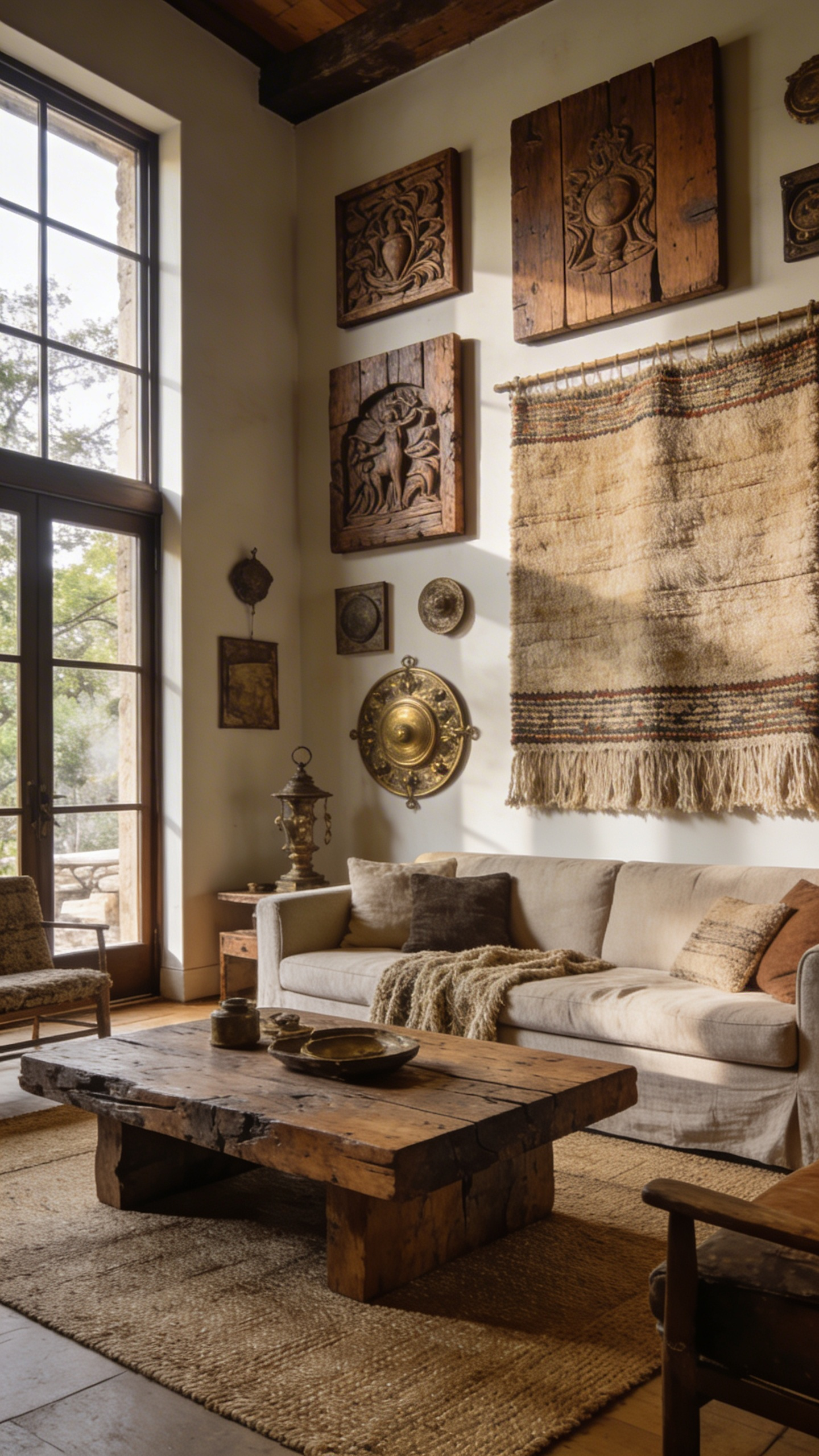
In fact, the modern “Memento Wall” replaces generic gallery layouts with curated personal history. For instance, mounting a vintage copper tool honors the historical narrative of functional beauty. To maintain cohesion, unify these disparate objects with a consistent color story, like weathered oak frames. However, avoid a “cluttered barn” look by introducing negative space through wide matting.
Additionally, proper scaling prevents “floating art syndrome” against heavy stone features. As a rule, always maintain the optical center at 57 inches from the floor. Furthermore, keep art width within the fireplace opening to ground the visual weight. Finally, anchor vaulted ceilings by hanging art below the roof’s “break point.” This industrial-organic fusion transforms a room from simple shelter to emotional storytelling.
8. The Juxtaposition Technique: Displaying sharp contemporary abstracts against rough-hewn walls
The “Juxtaposition Technique” pairs surgical contemporary art with primal, irregular surfaces. This design philosophy bridges the ancient and the avant-garde to create a sophisticated “Wabi-Modern” aesthetic. Fundamentally, this strategy relies on a psychological concept known as “Tension and Release.” Because rough textures like fieldstone or distressed plaster create visual noise, the room feels busy. Therefore, a hard-edge abstract painting acts as a necessary “reset button” for the eye.
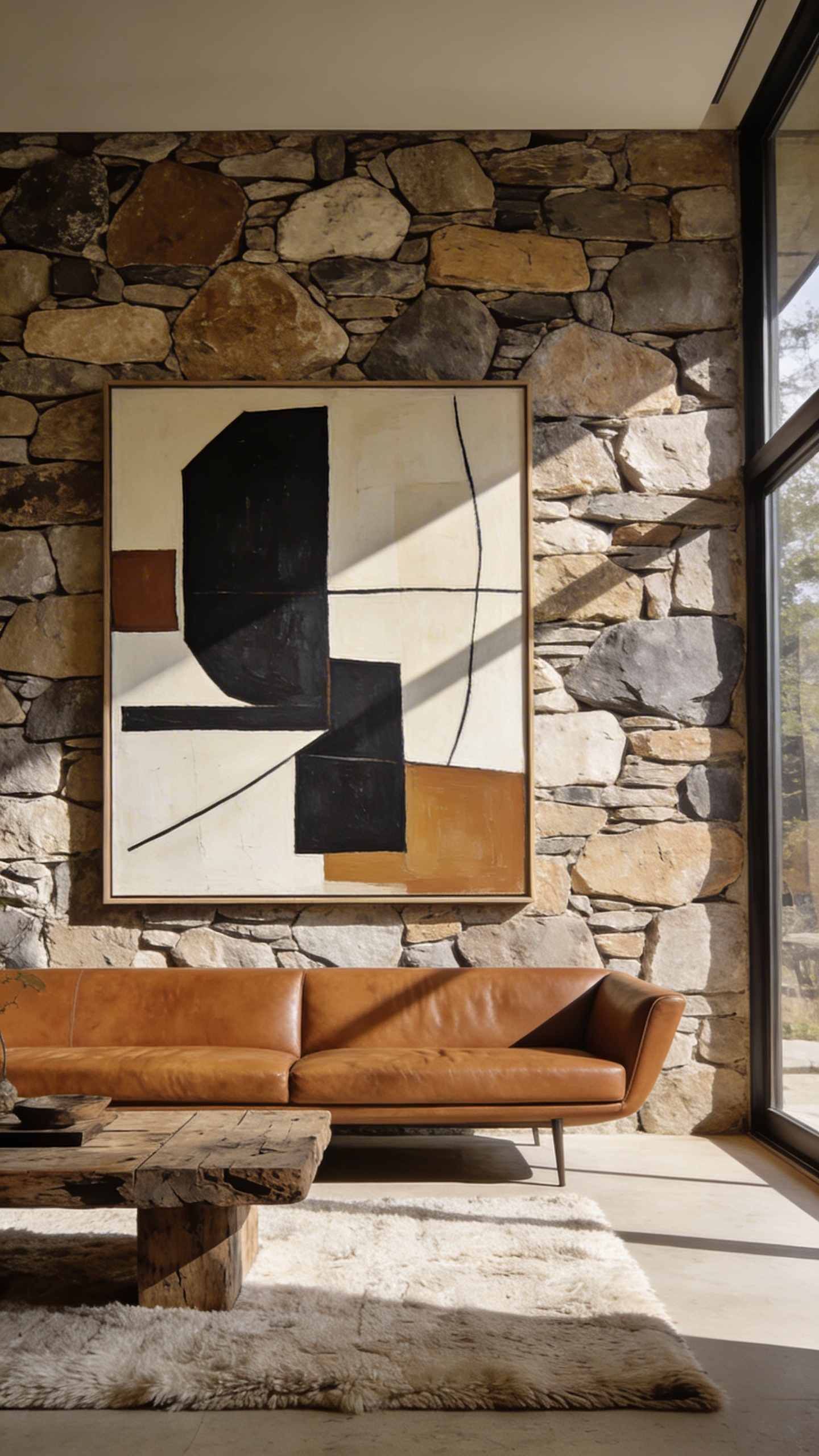
This contrast utilizes “lateral inhibition,” a biological process where the brain exaggerates boundaries. As a result, smooth, high-sheen canvases appear to vibrate against jagged stone, effectively creating a three-dimensional effect. However, proper execution requires technical precision regarding installation. To achieve this, professional installers utilize a “floating” mount with French cleats or metal standoffs. This hardware creates a crucial shadow gap, ensuring the art hangs plumb despite the wall’s undulating surface.
Furthermore, lighting plays a pivotal role in reconciling these opposing styles. While wall grazing highlights the deep relief of the stone, wall washing creates a soft halo around the artwork. The light isolates the sharp lines of the painting from the chaos of the background. Ultimately, this high intentionality validates the rustic wall as a luxury texture rather than a structural necessity. By placing a finished object against an unfinished one, you highlight the craftsmanship of both.
9. Large-Scale Nature Photography: Black-and-white prints as modern windows
In modern rustic interiors, large-scale black-and-white photography serves a vital structural purpose. These massive prints act as “modern windows,” balancing heavy materials like reclaimed wood with visual breathing room. Consequently, they function differently than standard gallery walls or busy decor.
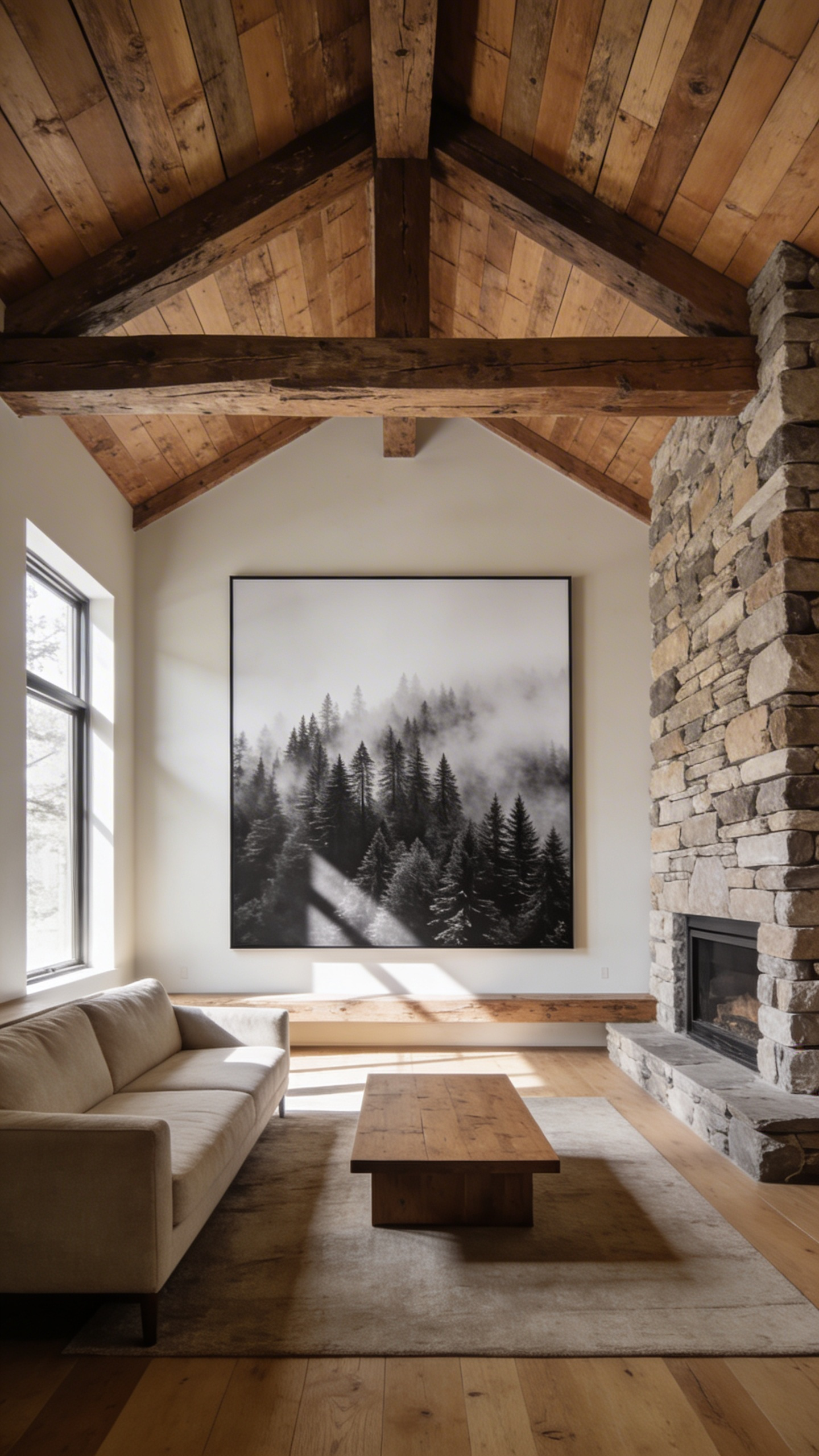
Historically, mid-century architecture utilized picture windows to frame the outdoors. Similarly, a 72-inch monochrome landscape creates a “static view.” This focal point triggers “soft fascination,” allowing the mind to rest amidst busy stone and timber textures. Therefore, the art becomes a calm anchor within the space.
Furthermore, these prints effectively solve the common “monotone” risk of wood-heavy rooms. By stripping away color, monochrome images emphasize form and jagged lines. They provide a sharp, sophisticated counter-note to organic, amber timber. The grayscale tones highlight natural textures without competing for warmth.
To fully achieve this effect, technical scale and depth are critical. For instance, prints utilizing Ansel Adams’ “Zone System” maintain incredible detail in both shadows and highlights. This high dynamic range creates a distinct “portal effect,” effectively pushing the walls back. Additionally, framing choices amplify this architectural illusion. Minimalist metal frames or “float” mounts minimize the object itself, mimicking a literal opening.
Finally, lighting dramatically transforms the artwork’s atmospheric mood. Silver halide prints often catch warm firelight, mimicking moonlight hitting a landscape. Conversely, deep matte finishes absorb shadows, creating a mysterious opening into a forest. Ultimately, these curatorial choices turn a solid wall into an expansive view.
10. Architectural Salvage: Mounting antique farm tools with museum-grade hardware
Mounting antique farm tools transforms rustic objects into sophisticated architectural salvage. However, achieving a true gallery aesthetic requires more than simple nails. You must engage in “curatorial storytelling” using museum-grade hardware to preserve these artifacts.
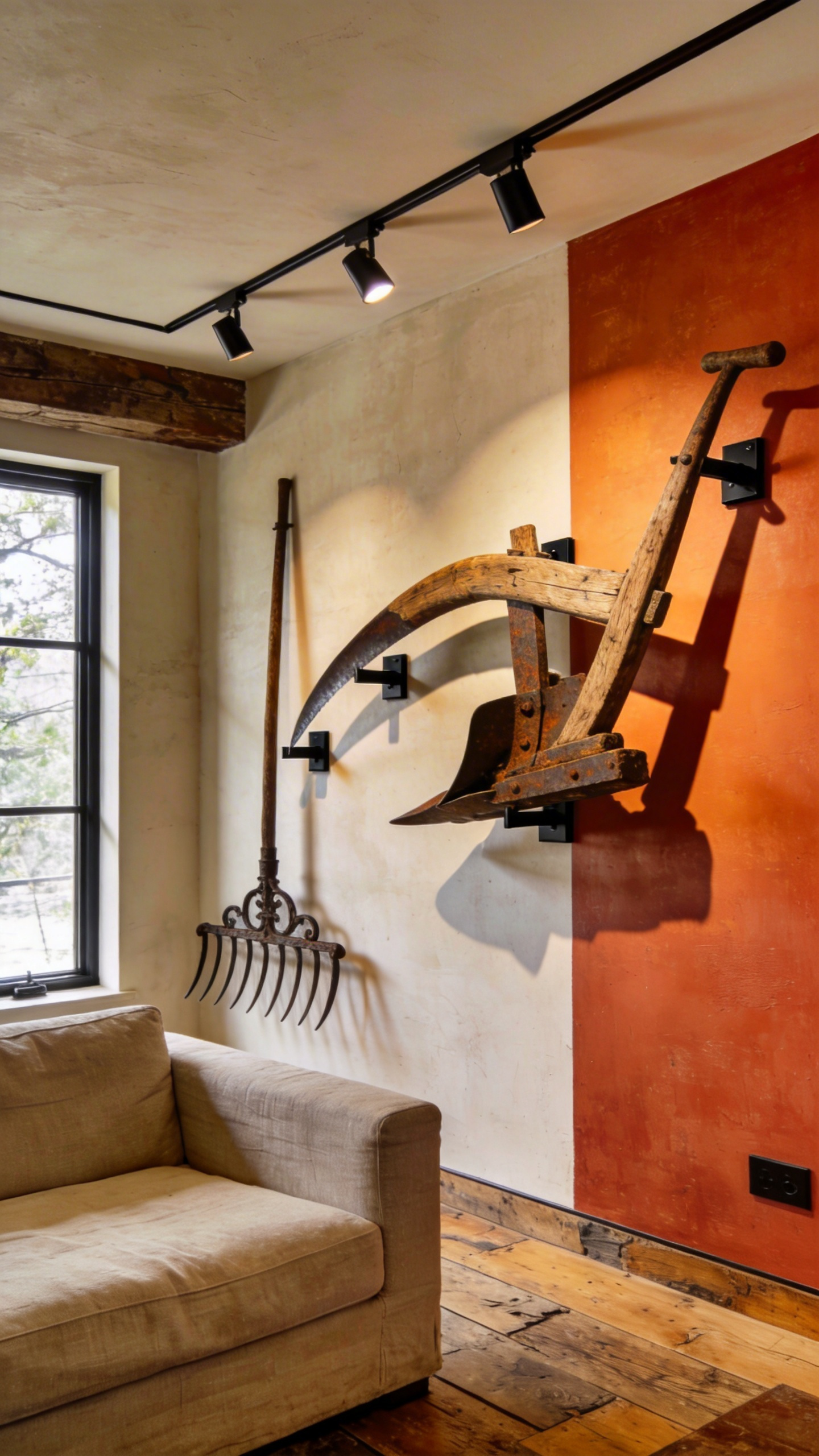
First, consider the complex material interaction known as the “acid dance.” Authentic 19th-century tools often combine high-tannin woods with wrought iron. Unfortunately, these components chemically react and degrade over time. Therefore, professional curators apply a microcrystalline wax, such as Renaissance Wax. This seals the patina without creating an artificial shine. Additionally, place inert barriers like Mylar between the mount and the object to arrest corrosion.
Next, focus on the display mechanics. Ideally, the artifact should appear to “float” off the wall. To achieve this, use custom-bent brass armatures. These rods are annealed to follow the tool’s specific contours perfectly. Furthermore, cover the hardware tips with Volara foam to prevent abrasion on soft wood. For heavier items, strictly avoid adhesives or drilling. Instead, utilize a reversible two-point mechanical support system. The bottom mount bears the weight, while the top acts simply as a “keeper.”
Finally, consider the visual layout. Do not arrange items randomly. Rather, organize them in a functional “Plough to Pantry” timeline. Start with timber clearing axes and end with harvest scythes. This approach highlights ergonomic innovations, turning a simple wall into a historical narrative.
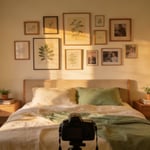
11. The Mixed-Media Gallery Wall: Balancing vintage botanical prints with modern minimalism
A mixed-media gallery wall functions as a sophisticated bridge between eras. It connects the analytical precision of 19th-century naturalists with the intentional restraint of modern minimalism. In a minimalist room defined by silent lines, vintage botanical prints offer necessary visual depth. Artists like Pierre-Joseph Redouté documented plant species with obsessive detail. This “controlled complexity” gives the eye a focal point to decode without overwhelming the space.
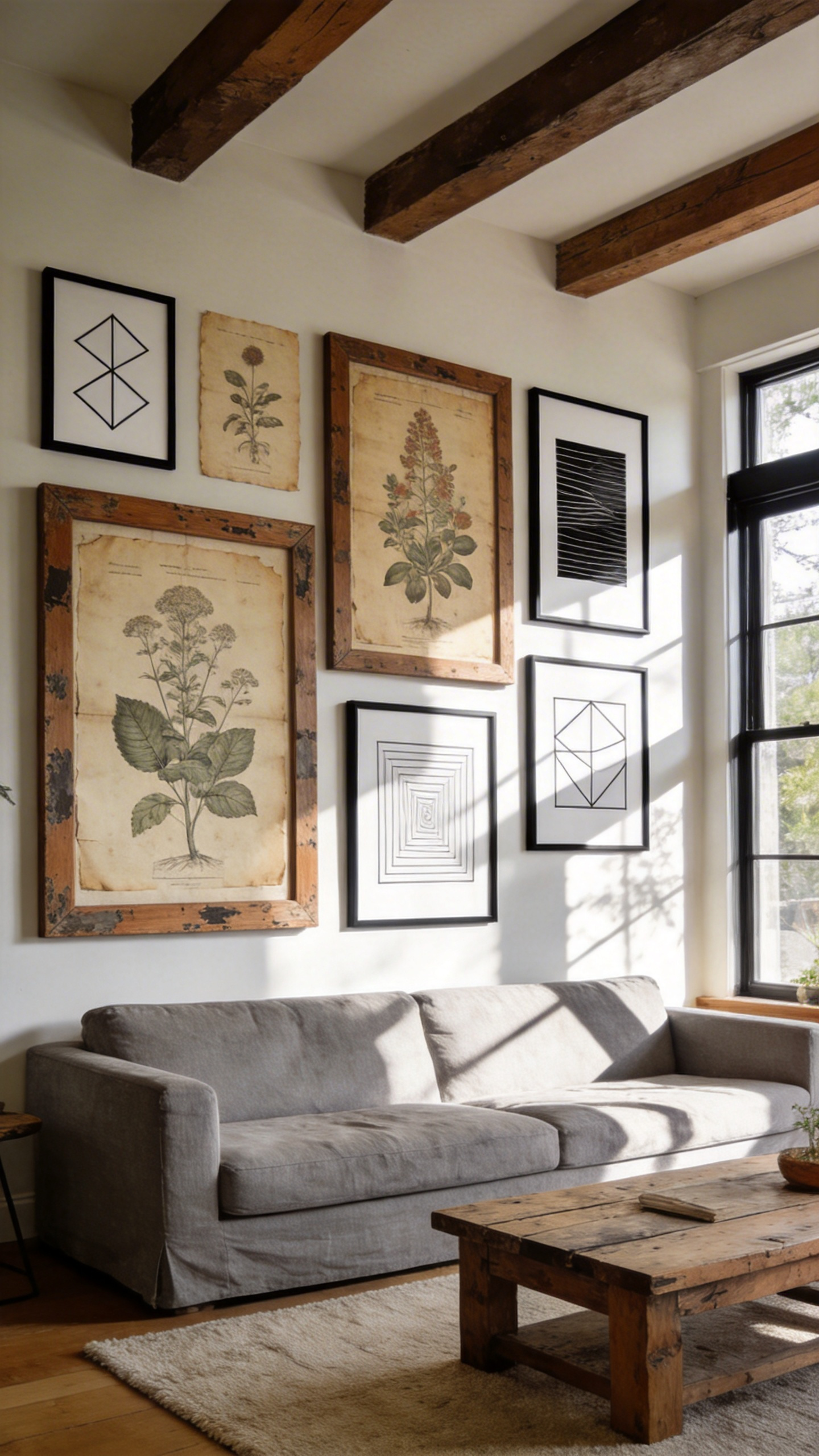
Frame selection is where the rustic and minimalist worlds officially shake hands. Instead of matching every piece perfectly, curate a tonal storyline with consistent finishes but varied profiles. For instance, raw white oak frames echo exposed beams, while slim metal profiles satisfy modern aesthetics. Furthermore, the layout relies heavily on negative space. Experts suggest leaving a two-to-four-inch gap between pieces to allow the art to breathe. This spacing prevents the arrangement from feeling claustrophobic amidst heavy textures like wool or leather.
Modern design has evolved beyond simple grids of flat paper. Therefore, consider incorporating tactile, three-dimensional elements to break the wall’s flat plane. Try interspersing floating glass frames containing real pressed flowers or small wooden specimen boxes. Ultimately, this approach shifts the narrative from mere decoration to curating a private museum.
12. Framing Philosophy: Using sleek metal frames to elevate rustic subject matter
In interior design, a frame is never a neutral border. Instead, it functions as distinct “emotional engineering.” This philosophy leverages the “Halo Effect.” Specifically, the perceived value of a sleek frame transfers directly to the object within. A humble, weathered sketch becomes a protected “specimen.” The metal signals importance, transforming “debris” into curated history.
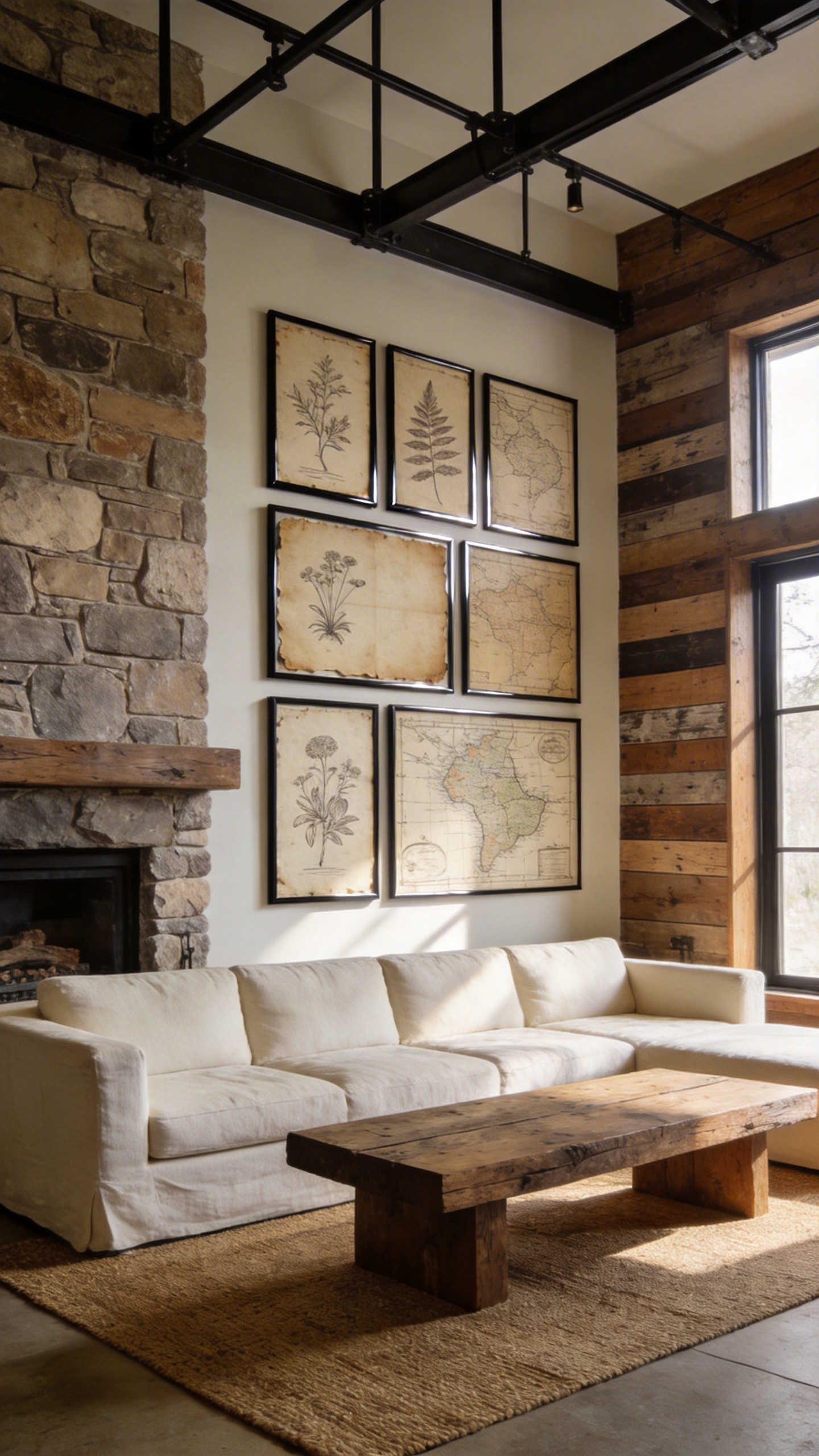
Furthermore, this pairing creates necessary aesthetic tension. Rustic art often features organic, irregular shapes. In contrast, sleek metal frames provide a “geometric anchor.” These thin, unwavering lines visually contain the “messiness” of the texture. Additionally, this creates a sophisticated dialogue between matte and metallic surfaces.
Moreover, this approach prevents “textural fatigue” in cozy spaces. Living rooms often suffer from too much heavy wood. However, a metal frame introduces a clean, cool “shadow line.” Thus, the art appears to float, effectively “Modernizing the Heritage” of the piece.
Finally, successful implementation relies on the 60/30/10 rule. Allow the organic subject to dominate sixty percent of the visual weight. Then, use matting for thirty percent to provide breathing room. Ultimately, the metal frame serves as the final ten percent, acting as the piece’s “jewelry.”
Phase 4: Lighting & Atmosphere
True rustic atmosphere relies on invisible architecture, not just decor. Achieving this requires precise control over color temperature. While standard bulbs sit at 3000K, authentic rustic spaces demand the 2200K to 2400K range. This lower temperature mimics the biological “wind-down” response of firelight. Furthermore, a Color Rendering Index (CRI) above 90 is essential. Without this high fidelity, rich textures like cognac leather appear muddy. In fact, low-quality LEDs often make natural wood tones look gray.
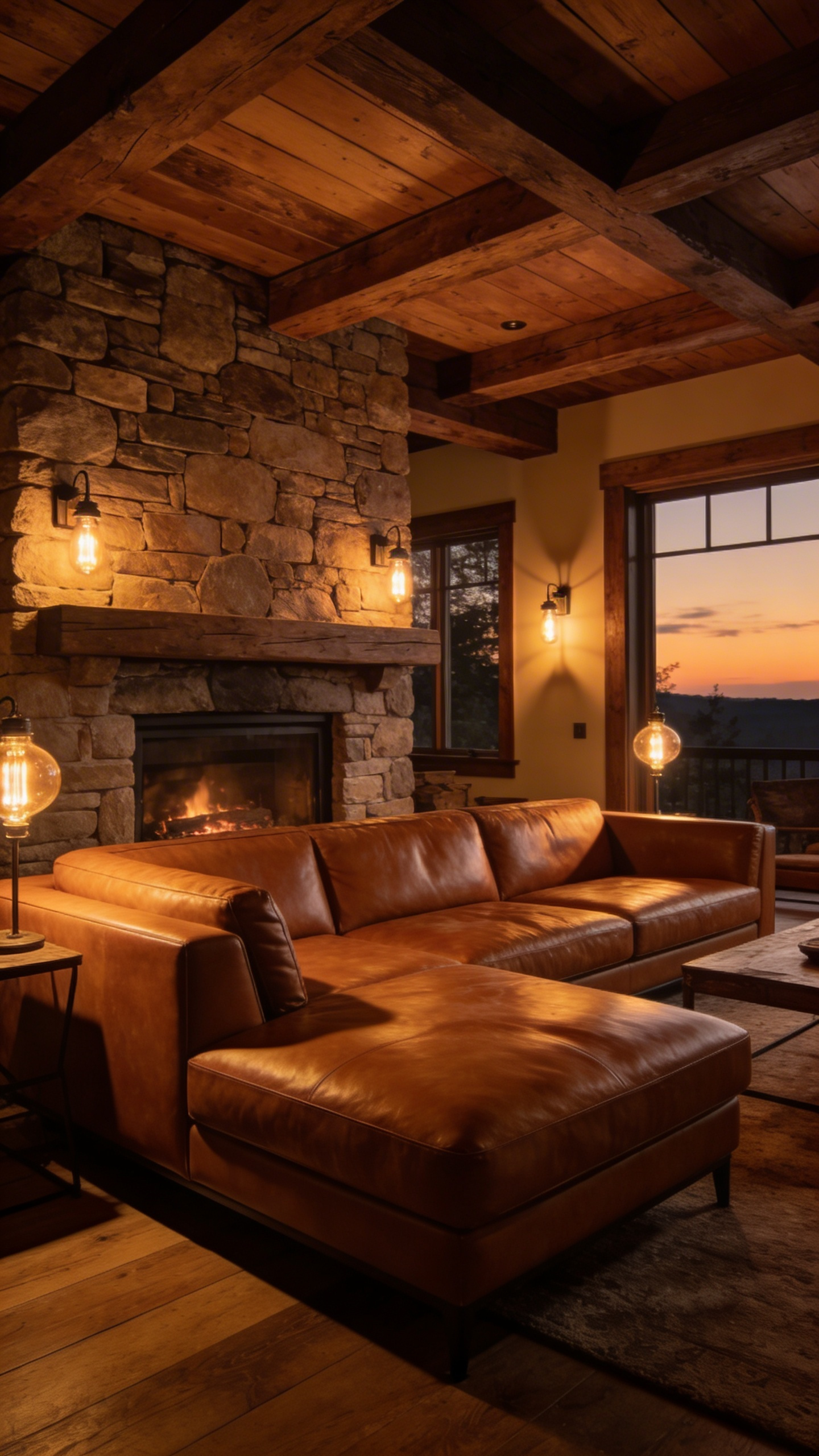
Next, consider how light interacts with your materials. For example, seeded glass fixtures act as primitive diffusers. They scatter light into soft, speckled patterns that mimic 19th-century lanterns. Similarly, wrought iron hardware absorbs light to create dramatic silhouettes. To highlight architectural features, borrow the “grazing” technique from art galleries. By placing lights flush against a stone wall, you create deep, dramatic shadows.
Finally, move away from the “Big Light” overhead. Instead, practice “lampscaping” by layering five to seven different light sources. Psychologically, keeping light at eye level feels significantly more grounding. Therefore, prioritize table lamps and hearth lights over bright ceiling fixtures. This approach transforms a room from a showroom into a sanctuary.
13. Sculptural Iron Lighting: Pendants that bridge the gap between industrial and rustic
Sculptural iron pendants act as vital connective tissue in modern rustic living rooms. Fundamentally, these fixtures bridge the gap between industrial grit and rural warmth. This artistic connection begins in the blacksmith’s forge. Unlike mass-produced industrial pieces, sculptural iron is often hand-forged. Consequently, the metal displays a narrative of human labor. Authentic pendants feature “remnant marks” like hammer scale. These details reveal the intense heat required to shape the iron. The resulting form offers a compelling visual tension. The material remains cold and strong, yet the shape mimics organic vines or fluid loops.
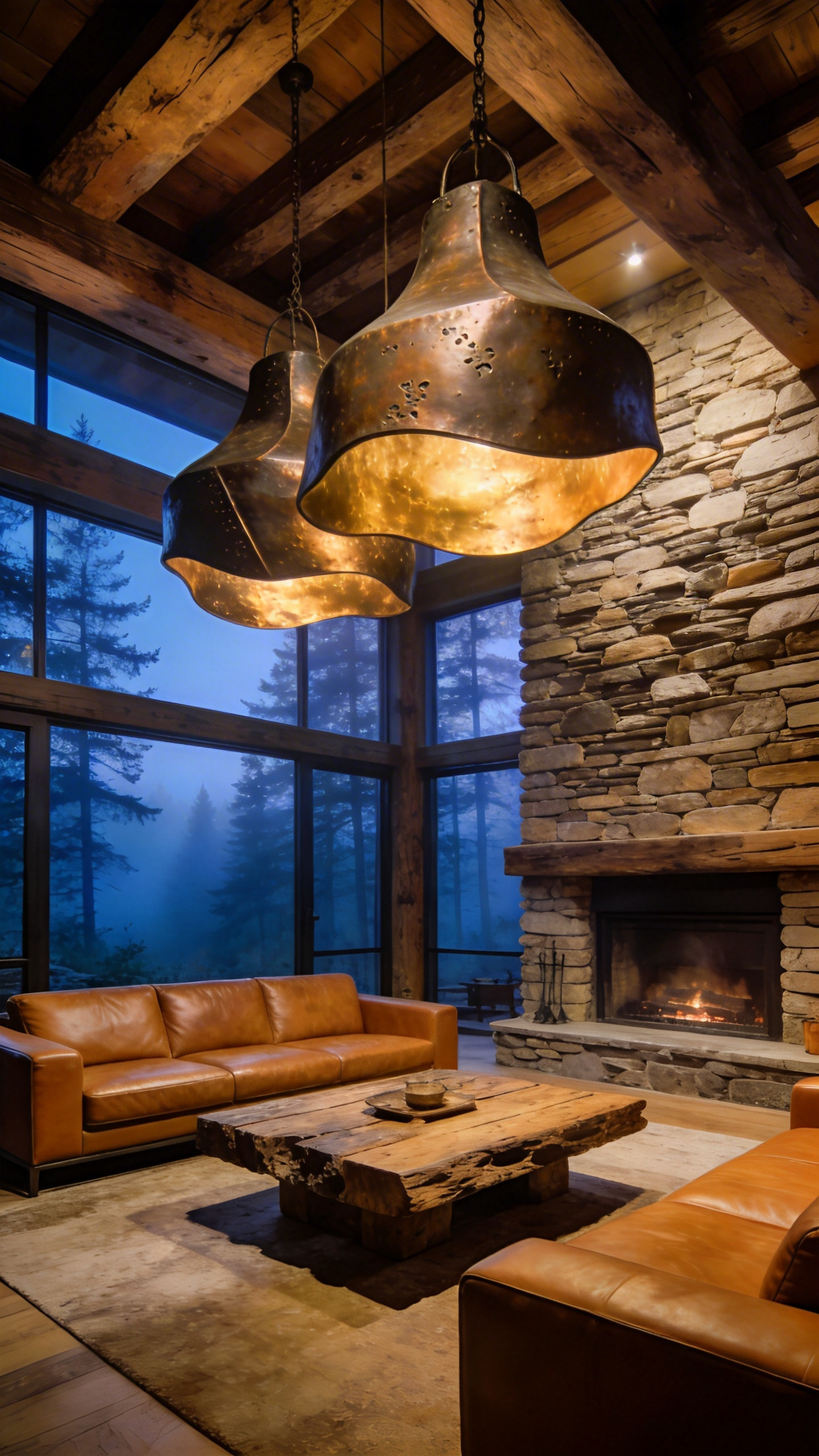
Furthermore, these fixtures function as “skeletons” for light. Their open-frame designs utilize negative space to balance heavy rustic textures like stone or chunky wool. They provide a massive focal point without blocking architectural views. When illuminated, the intricate ironwork casts architectural shadows. Thus, these transient patterns act as temporary wallpaper against plain plaster or shiplap. Additionally, the finish serves as a sensory bridge. A matte black finish leans industrial, while oil-rubbed bronze echoes the warmth of walnut. To soften the steel, designers often rely on amber-tinted Edison bulbs. Ultimately, this warm glow transforms a utilitarian cage into an intimate island of light.
14. Specialized Art Lighting: Using picture lights to highlight stone textures and canvas depth
In rustic design, lighting serves as a strategic architectural tool. Standard overhead lights often flatten irregular surfaces like fieldstone. Therefore, designers utilize picture lights to create a specific “grazing” effect. When mounted six to ten inches from the wall, the beam hits protruding facets at an oblique angle. This produces a dramatic *chiaroscuro*, creating deep shadows and brilliant peaks. This technique adds essential visual volume, transforming flat walls into three-dimensional features.
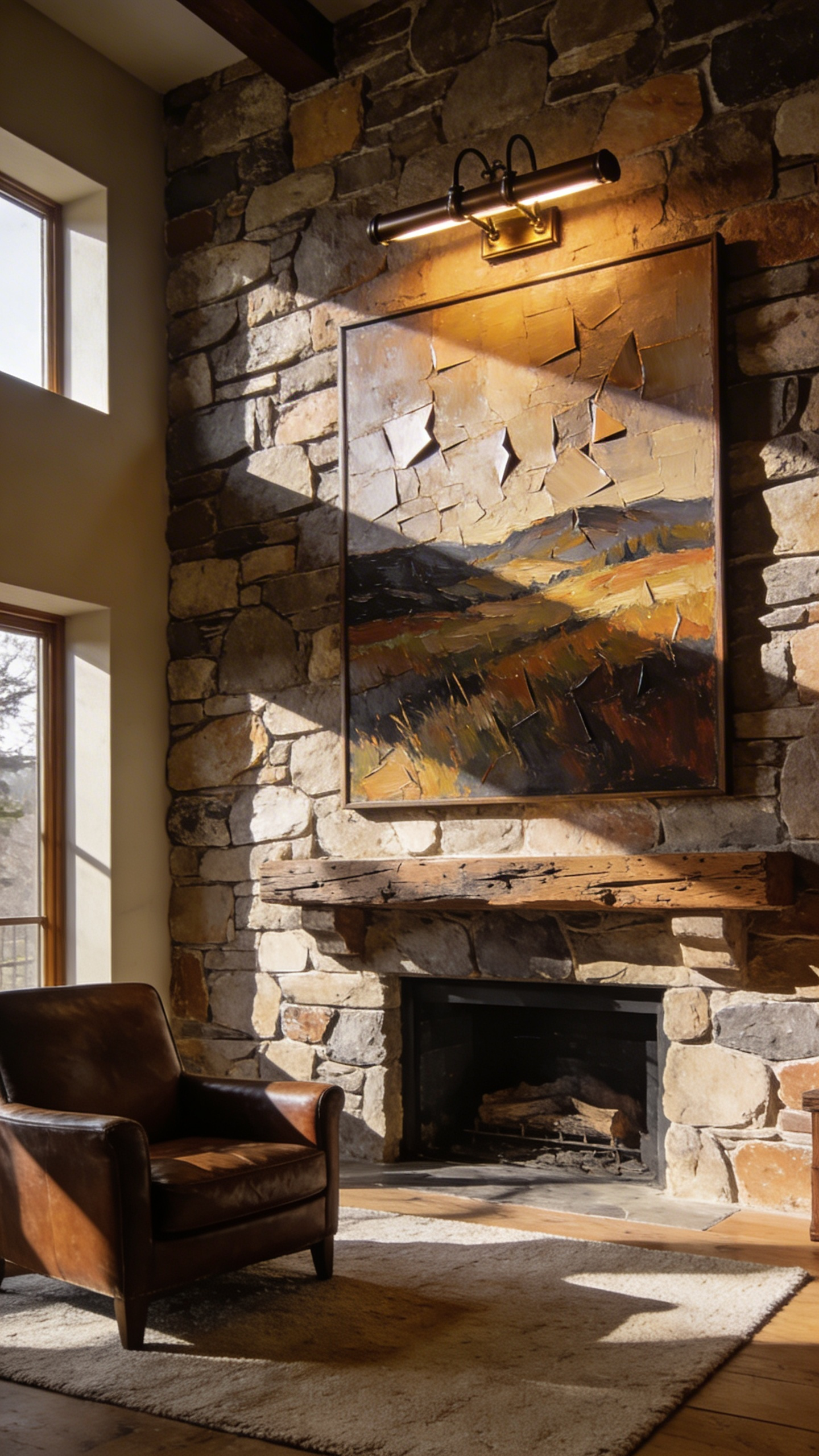
Similarly, this focused beam highlights the “sculptural” quality of oil paintings. For example, light catches the ridges of thick impasto brushstrokes, revealing the artist’s hand through micro-shadows. To maintain warmth, the industry gold standard is a color temperature of 2700K. This amber glow intensifies earthy ochres and siennas, preventing natural stone from appearing clinical or cold. In fact, this warmth harmonizes perfectly with the flicker of a nearby fireplace.
Furthermore, the fixture itself contributes to the decor. Designers often select “living finishes” like unlacquered brass, which develop a patina over time. This echoes the aging process of the surrounding wood and stone. Finally, modern fixtures utilize UV-free LEDs. These provide gallery-level preservation, ensuring heat does not damage delicate oils or wood frames. Thus, the light protects the art while enhancing the room’s atmosphere.
15. Ambient Zoning: Creating intimate conversation circles in cavernous rustic spaces
In cavernous rustic spaces, the sheer volume can trigger a subtle biological unease. Jay Appleton’s Prospect-Refuge Theory explains this phenomenon. We naturally crave open views but require protection from behind. Therefore, you must create a psychological “fortress” for sitters. High-back wingback chairs effectively establish this secure boundary against the open room.
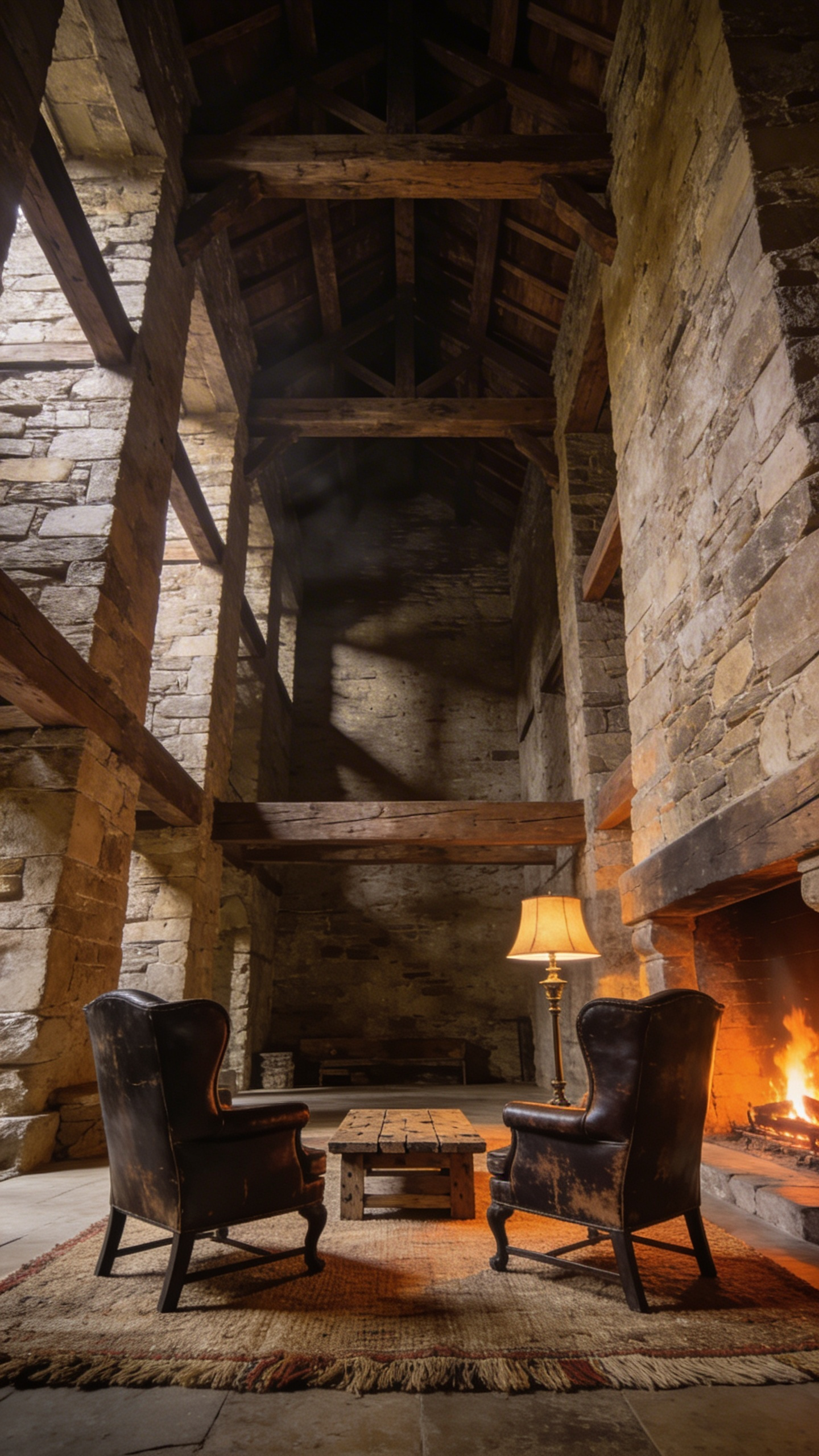
Furthermore, lighting plays a pivotal role in controlling vertical scale. If light originates twenty feet up, the room feels clinical. Instead, you must create a “secondary ceiling” of illumination. Hang large-scale rustic fixtures significantly lower than standard height. This strategy effectively creates a localized “pool” of warmth using the 2700K “Golden Hour” rule. Everything outside this illuminated circle falls into soft shadow, visually shrinking the room.
Additionally, hard surfaces often create a harsh “acoustic bounce.” To counter this, employ “Decibel Decorating.” For instance, layer a thick wool rug over flat-weave jute. This acts as an acoustic sponge, instantly lowering the reverberation time. Finally, ensure your layout encourages true intimacy. Ideally, position seating between four and eight feet apart. A heavy, live-edge coffee table acts as a visual gravity point, grounding the arrangement. These sensory cues transform a vast hall into a series of intimate enclaves.
Phase 5: Finishing Touches
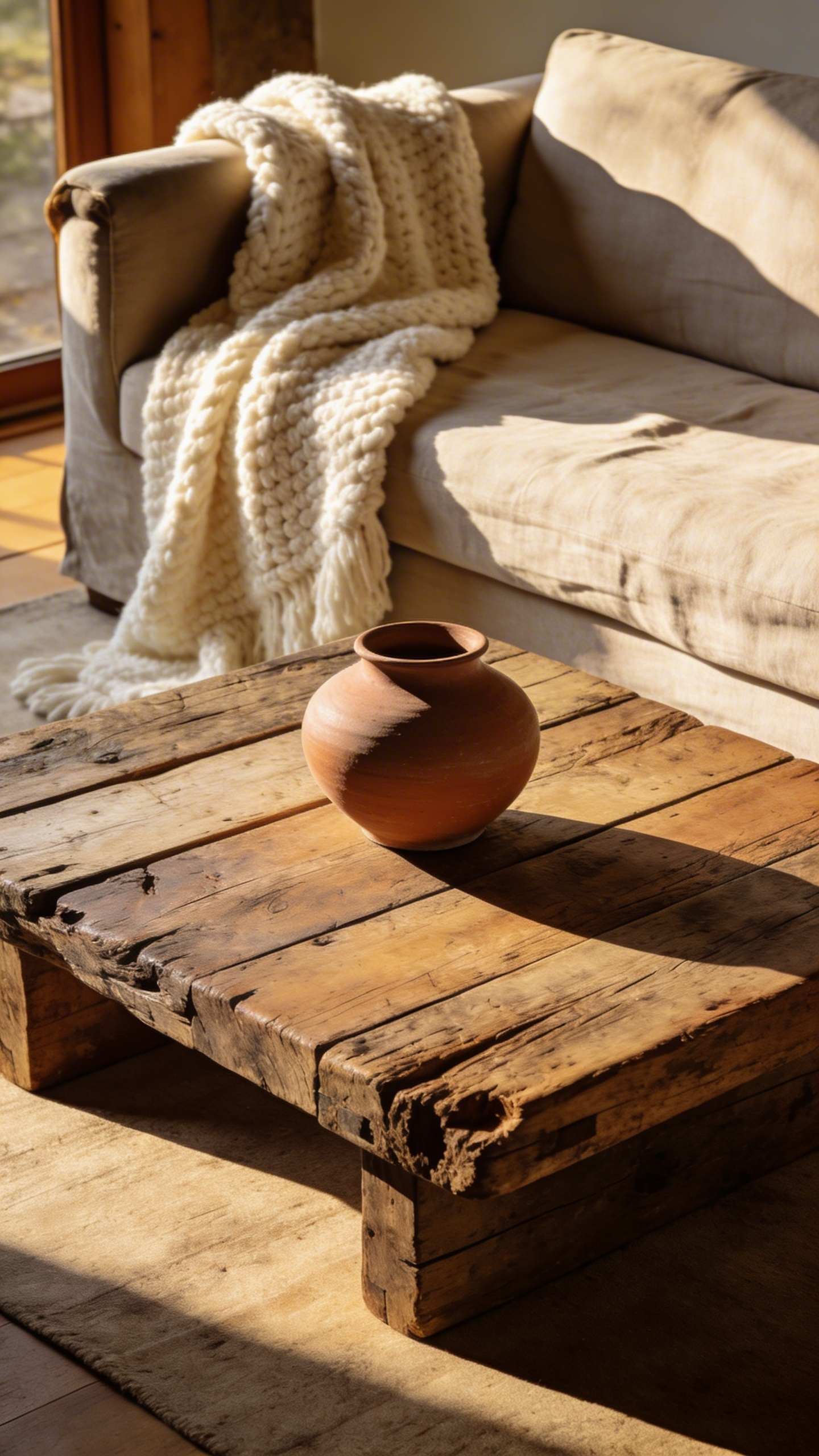
Phase 5 marks the critical transition from a staged room to a lived-in sanctuary. Primarily, this phase focuses on sensory curation rather than simply adding clutter. To achieve balance, designers often employ the “Rule of Three” for tactile layering. A successful rustic space requires a distinct “Rough, Soft, Matte” ratio. For instance, you might pair a rough reclaimed wood table with a soft, chunky wool throw. Then, ground these elements with a matte, hand-thrown ceramic vase. This variety creates “sensory congruence,” ensuring the room feels harmonious rather than flat.
Historically, this finishing style draws from the “Great Camp” aesthetic of the 19th century. In this context, patina serves as the ultimate finish. Therefore, prioritize items that show evidence of use, such as scuffed leather or oxidized copper. These textures imply that the space has evolved over decades. Furthermore, when arranging these objects, utilize the “Mountain Display” profile. Start with a tall “anchor” item, like a vintage trunk, and cascade down to smaller, organic elements.
Finally, true curation requires a “visual autobiography.” Instead of generic catalog items, incorporate personal heirlooms or “found objects” from nature. Moreover, embrace the concept of *Wabi-Sabi* by displaying imperfect or repaired items. Ultimately, these finishing touches, combined with grounding scents like cedar, transform a visual design into a personal narrative.
16. Hand-Thrown Ceramics: Displaying pottery collections with negative space
Integrating hand-thrown ceramics into a rustic living room requires a delicate balance of heavy textures. Therefore, negative space becomes a vital “visual lubricant.” It allows rugged stone and wood to coexist with the delicate, organic soul of pottery. This approach mirrors the Japanese concept of *Ma*, or the intentional void. Unlike simple emptiness, *Ma* treats space as an active ingredient in your composition.
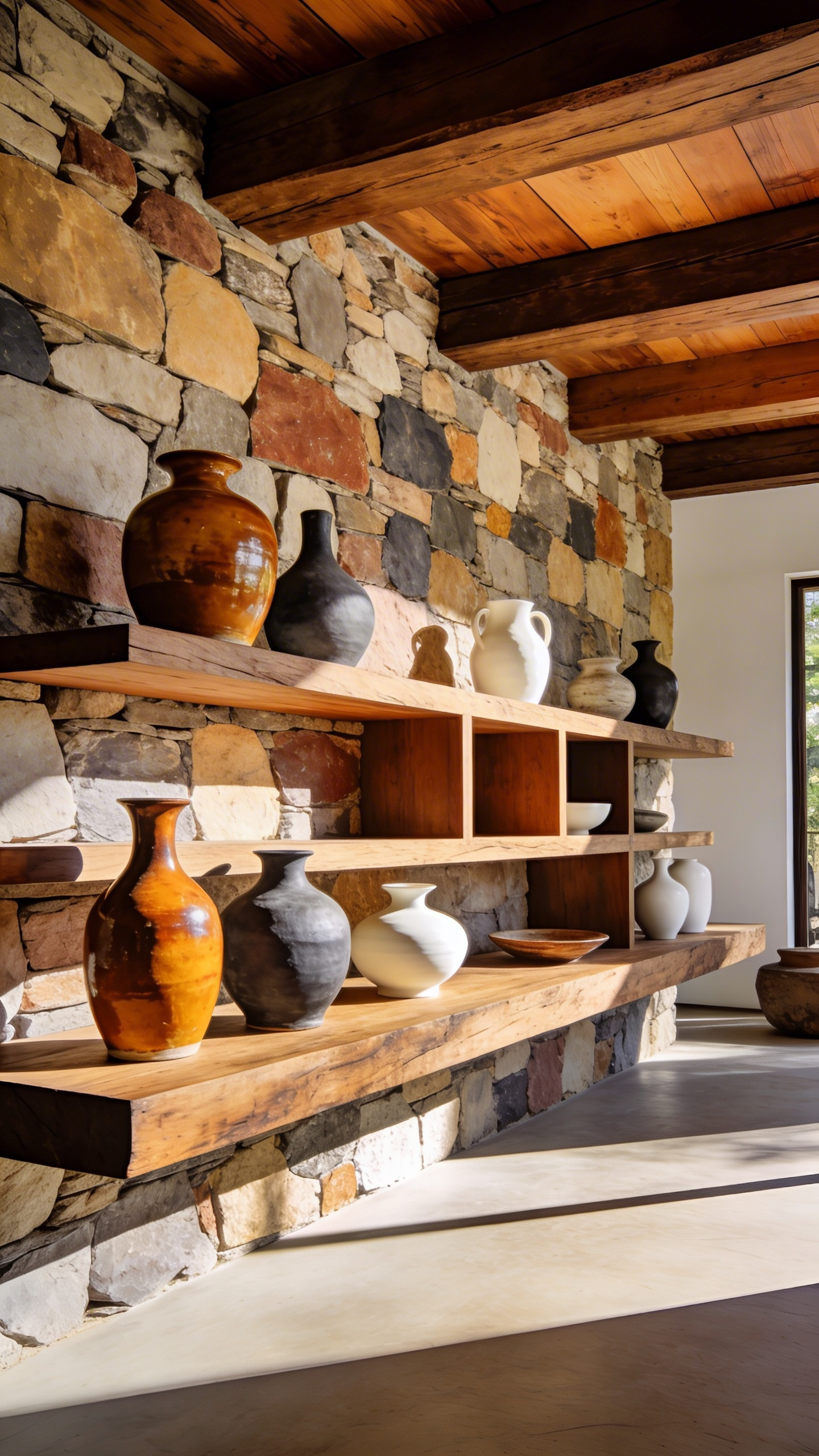
Consequently, this spatial silence is essential for gallery-quality presentation. Rustic materials like grain-heavy oak are visually “loud.” Thus, significant gaps between vessels provide a necessary resting place for the eye. To achieve this, apply the “rule of odds” by grouping pieces in threes or fives. However, avoid rigid symmetry, which often feels too formal. Instead, ensure the distance between groups exceeds the width of the objects themselves. For example, imagine a matte-glazed moon jar placed off-center on a reclaimed timber mantle.
Furthermore, the surrounding air acts as a magnifying glass for *Wabi-Sabi* imperfections. A “crawling” glaze or rough stoneware body can easily get lost in a cluttered room. By isolating a vessel, you force the viewer to notice tactile micro-details. Suddenly, the light hitting a subtle drip or throwing ring becomes a primary focal point. Finally, consider the room’s architecture. Position a tall floor vase to utilize the vertical negative space of an empty corner. Use soft lighting to cast long shadows. This creates “dark negative space,” effectively adding mystery and depth to the display.
17. The Coffee Table Narrative: Styling oversized art books with organic artifacts
In the realm of rustic design, the coffee table serves as a curated stage. This “Coffee Table Narrative” moves beyond simple accessorizing to create a multi-sensory story. Interestingly, this concept traces back to a 1960s cultural shift spearheaded by David Brower. He introduced oversized art books as “conservation catalysts,” effectively bringing the ethics of the wilderness into the living room. Today, styling these books is an homage to that visual activism.
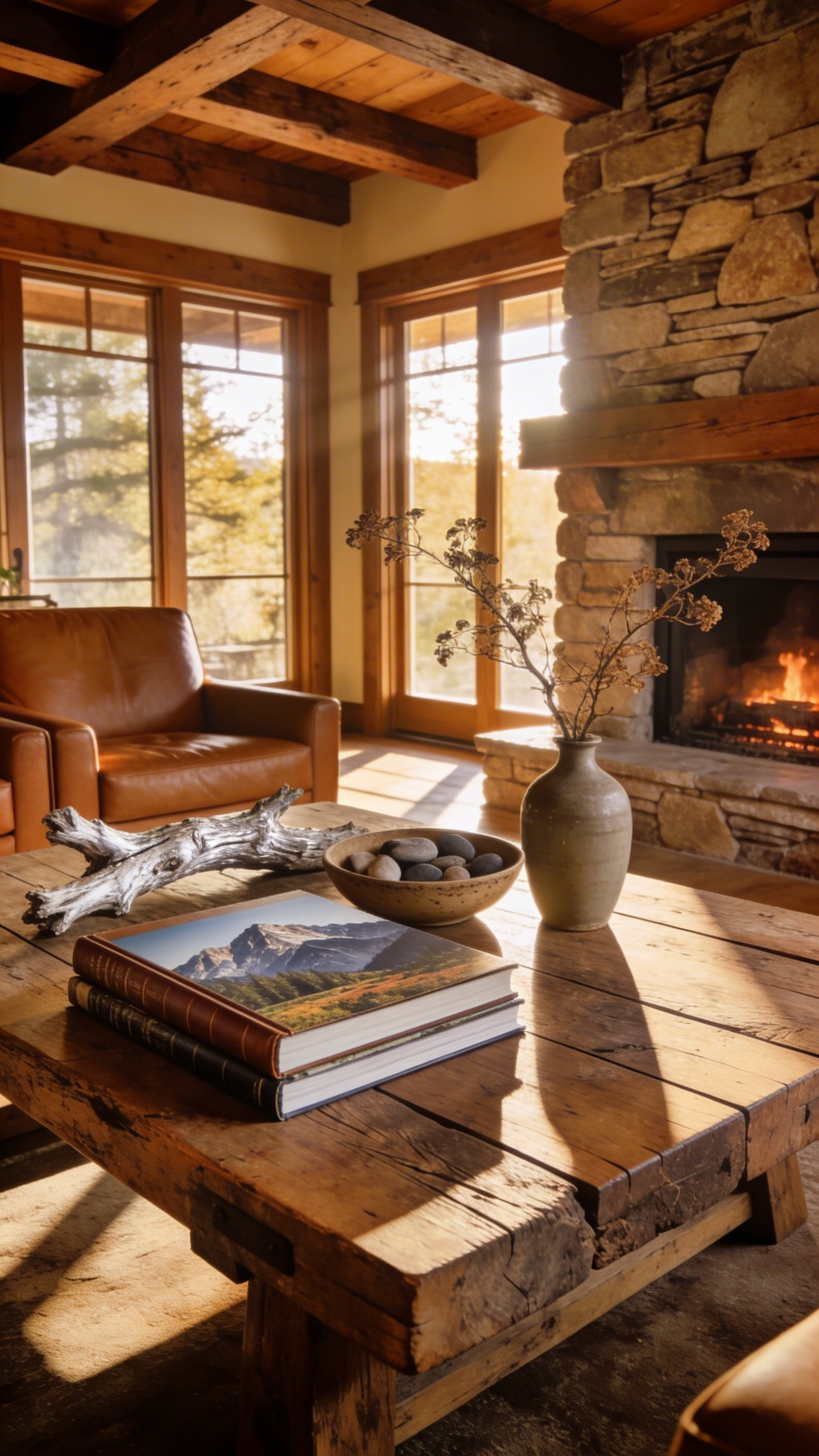
Selecting the right volume involves more than just the cover image. For a truly authentic narrative, look for high-weight cotton rag paper or uncoated matte finishes. These textures absorb light, effectively mirroring the non-glare surfaces of weathered wood or slate. Furthermore, bindings like Coptic stitching allow books to lie flat, revealing raw, handcrafted spines that complement rustic joinery.
Beyond the binding, the narrative relies on a deliberate dialogue between the book and organic artifacts. For instance, pair a volume on alpine flora with a slice of petrified wood. Here, the artifact physically grounds the book’s intellectual content in geological reality. Similarly, a book on Japanese architecture finds its match in a Kintsugi-repaired bowl, emphasizing the beauty of age.
However, restraint is crucial to maintain a “visual hum” rather than clutter. Therefore, start with a neutral “foundation book” and always leave negative space to expose the table’s raw grain. Finally, top the stack with a tactile object, like a river-washed stone. This approach transforms simple decor into a meaningful, tactile discovery.
Frequently Asked Questions
How do you make a rustic living room look expensive?
To elevate a rustic space for the luxury market, focus on the “Juxtaposition Technique.” Pair primal, rough textures like fieldstone with high-end, contemporary elements such as sleek metal frames and custom bouclé upholstery. Prioritize “Selection over Saturation” by investing in fewer, museum-grade pieces of architectural salvage rather than multiple mass-produced rustic accessories.
What are the essential elements of modern rustic decor?
Essential elements include a focus on raw materiality (reclaimed wood, stone, and leather), a neutral and earthy color palette, and the use of natural light. Modern rustic design specifically incorporates “Sculptural Softness” through organic fibers like sheepskin and linen to balance the hard edges of structural timber and masonry.
How can I incorporate rustic decorations without cluttering my space?
Apply the “Curatorial Confidence Framework” by using negative space as an active design element. Instead of grouping many small items, select a single “Anchor” piece—like a large-scale nature photograph or a hand-forged iron pendant—to define the room’s narrative. This approach ensures each piece has “breathing room,” allowing the beauty of the materials to shine without visual noise.
Conclusion: The Curated Cabin – Where Nature Meets High Art
The “Curated Cabin” transcends mere shelter to become a sanctuary for both art and nature. In fact, we have moved beyond survivalism toward a sophisticated form of “Parkitecture.” Your living room should no longer feel like a cluttered lodge filled with kitsch. Instead, it functions as a quiet gallery where “material honesty” defines the aesthetic. By embracing negative space and high-quality rustic living room decorations, you allow raw textures and architectural views to truly breathe. The focus shifts from filling corners to selecting objects with deliberate narrative power.
Looking ahead, this design philosophy invites a deeper, more sensory engagement with your environment. Ideally, your home will evolve into a living biography, engaging sight, sound, and scent. True luxury lies in the careful curation of meaningful experiences rather than abundance. To begin, I recommend auditing your current space with a curator’s critical eye. Remove items that lack a clear provenance or strong emotional connection. Finally, let the remaining negative space frame your window’s view as the ultimate masterpiece.