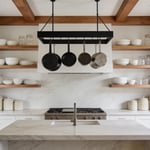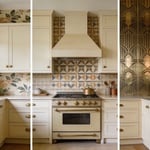
Many homeowners view the kitchen table simply as a utilitarian surface for dining. Commonly, people focus on the finish or style merely to match a current trend. However, finding the right kitchen table inspiration involves more than following a fad. You must understand that this centerpiece serves a far more critical role. In reality, the table operates as the home’s true emotional anchor. Indeed, it represents a complex intersection of evolutionary history and neurobiology.
Historically, the shift to open-plan living forced families into the kitchen’s working heart. Consequently, the table became the “domestic nucleus” for everything from administrative tasks to emotional bonding. Furthermore, sitting face-to-face triggers “autonomic co-regulation.” This process releases oxytocin to reduce anxiety. Thus, the table acts as a biological “safe harbor” where family members lower their defenses. Moreover, it serves as a “micro-stage” where essential family narratives are performed and solidified daily.
Therefore, successful design must prioritize this psychological function over pure aesthetics. Instead of just analyzing wood grains, we must consider the “architecture of proximity” and bespoke design principles. This guide reveals how to combine tactile grounding with optimal workflow patterns. Additionally, we will explore methods to soften acoustics for better connection. Ultimately, we will define how to reclaim the hearth as a sanctuary for the analog self.
Personal Anecdote: The silent witness to morning coffees and midnight confessions
The kitchen table serves as more than simple furniture. In reality, it acts as a psychological anchor for our most vulnerable exchanges. Specifically, the physical shape of the table dictates the flow of conversation. For instance, round tables effectively neutralize power hierarchies. Without a distinct “head,” the seating arrangement promotes equality and limitless connection. However, design ergonomics suggest a limit. Once a table exceeds a sixty-inch diameter, the intimate “curve” breaks. Therefore, maintaining eye contact becomes strained. This often kills the quiet atmosphere needed for deep talk.
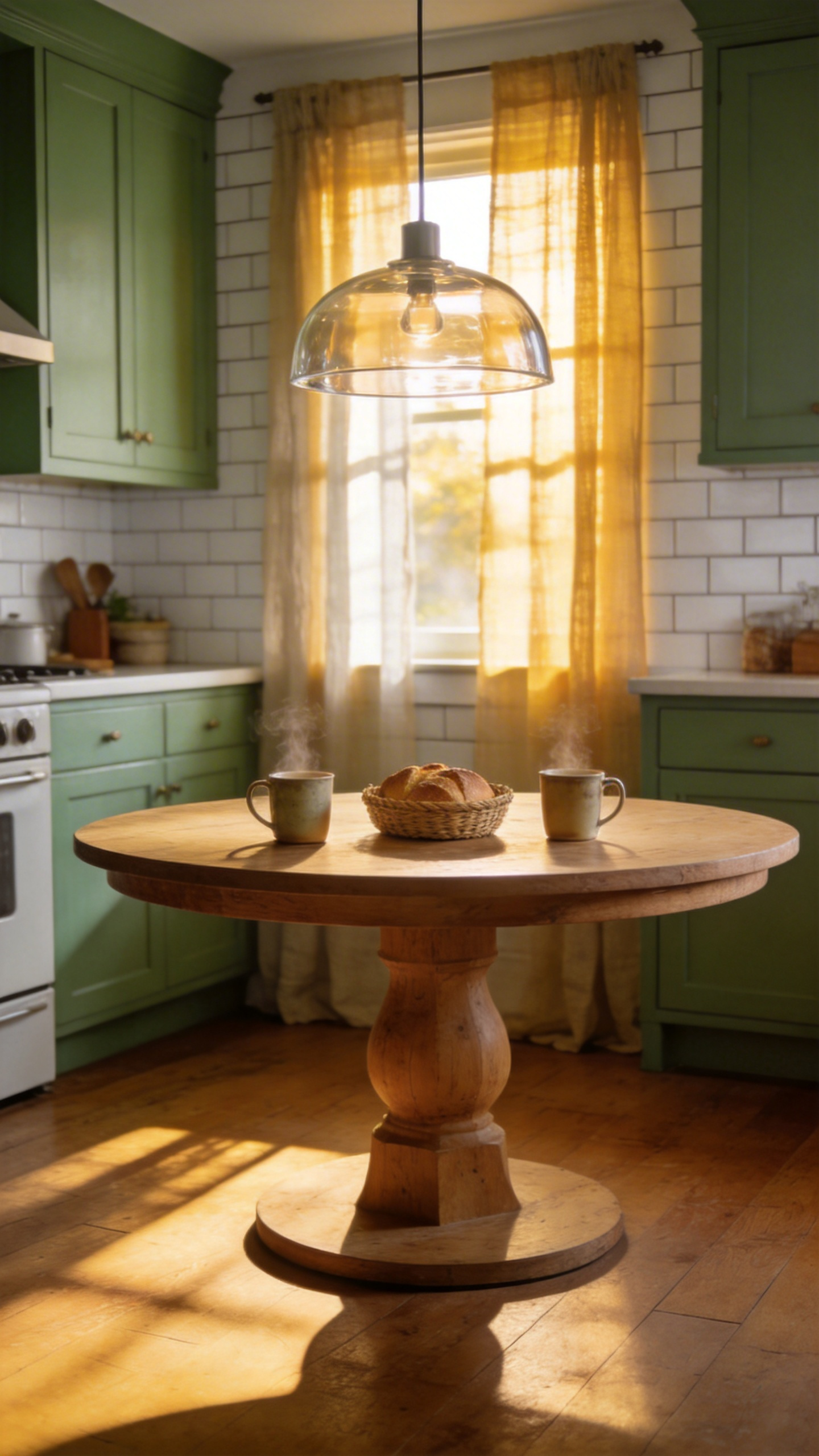
Context alters the table’s function as well. Biologically, the “Night Kitchen” effect transforms the space into a confessional. As cortisol levels drop late at night, our executive filters naturally lower. Consequently, fatigue acts as a mild disinhibitor. In this state of suspended time, we share truths we might hide during the day. Conversely, the morning hours focus on sensory grounding. Simply clutching a warm mug provides tactile stability during high-stakes planning.
Unfortunately, modern trends often threaten this dynamic. Specifically, kitchen islands frequently force linear, bar-style seating. This setup discourages the face-to-face “communal gaze” necessary for connection. Ultimately, the traditional table remains the true literary hearth. It witnesses everything from first sips to final goodbyes.
Thesis: Why the best kitchen tables balance culinary utility with social gravity
Fundamentally, the most enduring kitchen table designs serve two masters. Specifically, they must function as high-performance culinary workstations while acting as psychological anchors for connection. We define this dual purpose as the delicate balance between “culinary utility” and “social gravity.” To master this, homeowners should elevate your home with essential strategies for modern kitchen tables that prioritize both form and function.
Historically, the kitchen table was merely a utilitarian “prep-horse” hidden in service quarters. However, modern lifestyles have shifted this piece to the very center of the floor plan. Therefore, successful designs today must bridge the gap between hard labor and soft leisure. For instance, surface materials require the resilience to withstand a chef’s knife or hot pot. Yet, they must also possess the “haptic warmth” that invites guests to lean in comfortably during conversation.
Ideally, designers favor “living finishes” like honed soapstone or reclaimed hardwoods to achieve this synthesis. Over time, these materials develop a patina that acts as a visual record of family history. Furthermore, lighting plays a critical role in shifting the mood from work to rest. By utilizing low-hanging pendants, you create a “visual campfire effect.” This pulls people into an intimate, illuminated circle. Ultimately, the table becomes a neutral “Third Space” where life happens unpolished. Thus, true inspiration views the table not just as furniture, but as a stage for daily life.
Phase 1: Spatial Dynamics & Architectural Flow
The kitchen table functions as a sophisticated spatial anchor. In architectural terms, it dictates the room’s social gravity. Specifically, we must consider proxemics, the study of human spatial interaction. For instance, round tables are “sociopetal,” meaning they draw people inward. Consequently, they ensure every participant remains equidistant from the center. This maximizes eye contact and eliminates hierarchy. Conversely, islands often force linear seating. This facilitates “parallel play” over interaction. Therefore, prioritizing a radial table effectively restores “radial sociability.”

Furthermore, the table creates a “room within a room.” Historically, architects like Frank Lloyd Wright used furniture to define intimate boundaries. To achieve this, homeowners often seek ways to find authentic modern kitchen inspiration that ensure major walkways do not bisect the dining zone. Otherwise, the space feels transient rather than grounded. Additionally, consider the acoustic flow. Hard surfaces like stone and tile create a noisy “ping-pong” effect. Thus, introducing “soft zoning” with upholstered chairs absorbs reverberation. This invites hushed conversation.
Finally, strictly observe the 48-inch rule. You need 42 to 48 inches of clearance between the table and counters. This psychological buffer allows guests to linger without blocking the kitchen’s workflow. Ultimately, this approach rejects the sterile “efficiency lab” model. Instead, it prioritizes commensality, placing social connection above pure utility.
1. The Banquette Revolution: Maximizing Corners with Boutique Hotel Flair
The “Banquette Revolution” signifies a dramatic shift from utilitarian seating to curated luxury. Historically, banquettes served as space-saving solutions in cramped Parisian bistros. However, modern interpretations prioritize a “destination dining” experience reminiscent of boutique hotels. Consequently, designers now treat these corners as architectural zones rather than mere furniture. Ideally, this creates a distinct “room within a room” that anchors the kitchen.
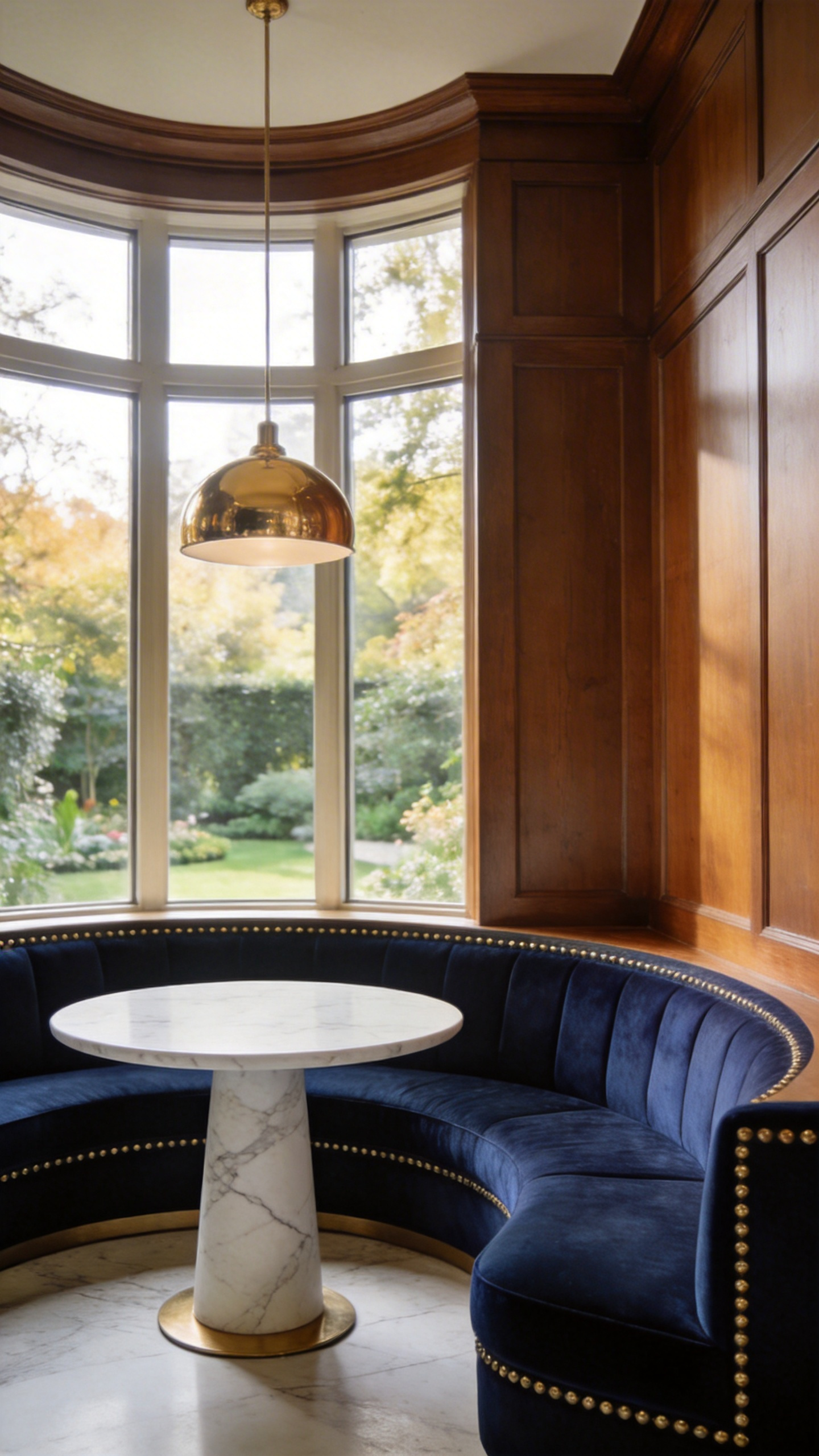
To achieve this level of comfort, precise ergonomics are essential. Specifically, a 98-degree back pitch provides the gold standard for upright dining. Unlike lounge seating, this angle supports posture while eating. Furthermore, a recessed toe kick is critical for function. By creating a three-inch overhang, you allow for heel clearance and a sleek aesthetic.
Beyond structure, material selection defines the sensory experience. For instance, mohair velvet serves as a “diamond fiber” due to its immense durability. It effectively withstands daily use while offering a soft, tactile touch. Additionally, incorporating fluted upholstery introduces an architectural rhythm to the space. Practically, this soft surface also absorbs sound in hard-surfaced kitchens.
Finally, lighting elevates the nook into a sanctuary. Installing warm LED strips in the toe-kick creates an ethereal, floating effect. Moreover, wall-mounted sconces offer a “pool of intimacy” directly over the table. Ultimately, this combination creates a “cocooning” effect. It gives homeowners the best seat in the house.
2. The Curvilinear Approach: Softening Angular Kitchens with Round Pedestals
Modern kitchens are often defined by a rigid Cartesian grid. Specifically, they rely on rectangular cabinetry and sharp 90-degree angles. Consequently, this creates a high-friction visual environment that can feel clinical. To soften this, we look to Eero Saarinen’s mid-century design philosophy. He famously sought to eliminate the “slum of legs” found under traditional tables. Therefore, utilizing a round pedestal creates a necessary “visual clearing.” By condensing support to a single central trunk, you effectively open up the floor plane.
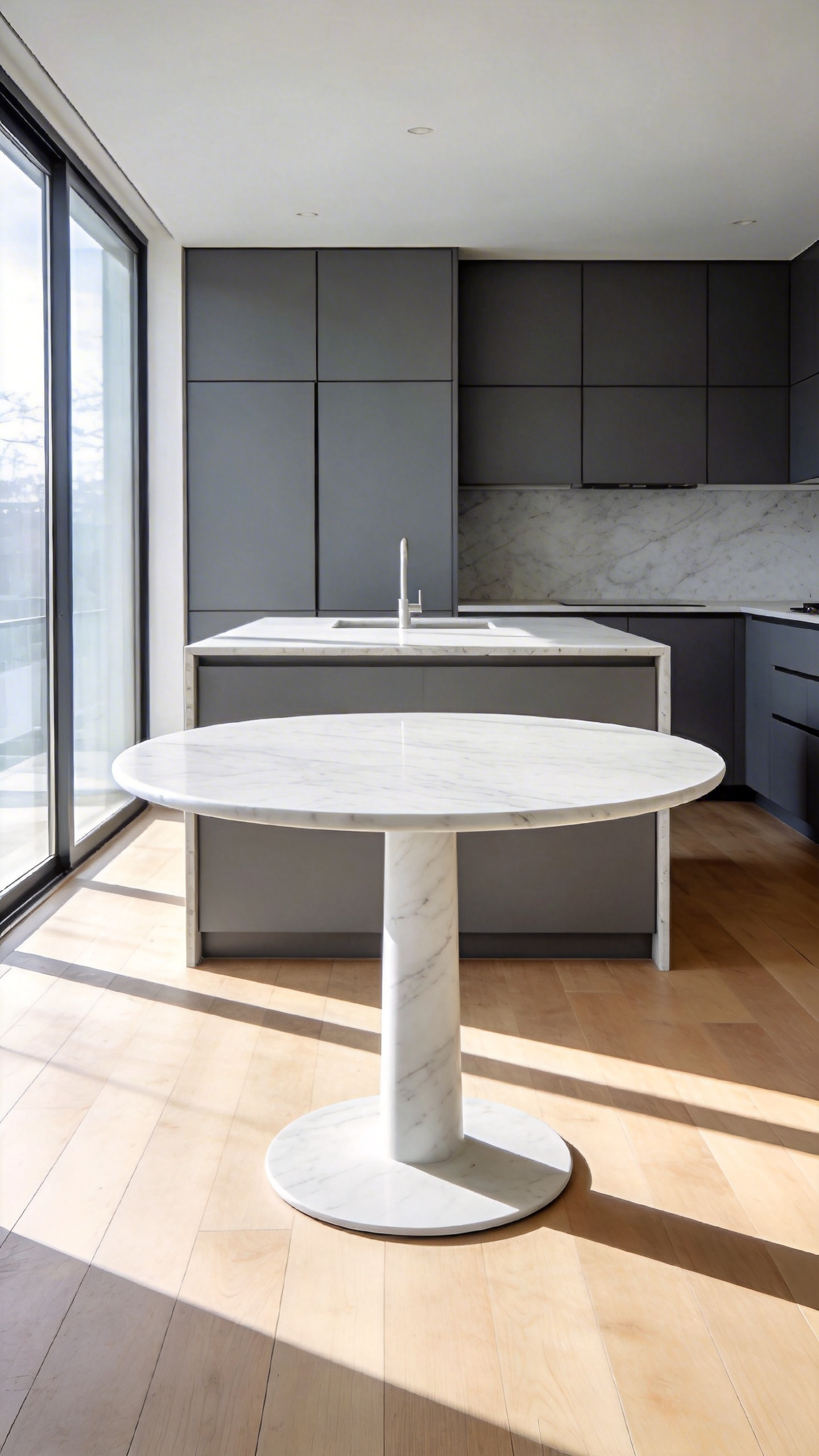
This shift is not merely aesthetic; it is also psychological. In fact, curves signal safety and comfort to the human brain. Thus, a round table acts as a “neutral zone” amidst the culinary work zones. Moving your hand from a cold granite edge to a smooth, curved arc signals a transition. Specifically, it shifts the mindset from intense food prep to relaxed social connection.
Functionally, this shape reconfigures the room’s kinetic energy. In high-traffic cooking zones, sharp corners act as physical “points of conflict.” Conversely, a round pedestal serves as an ergonomic pivot point. Household members can “orbit” the dining area without diversion. Furthermore, the circle removes the hierarchy of a “head” seat. Because there are no perimeter legs to dodge, guest capacity becomes fluid. Ultimately, a heavy, architectural pedestal anchors the room. It effectively balances the stark, linear nature of stainless steel appliances.
3. Island Extensions: The Modern Bridge Between Prep and Socializing
Historically, the kitchen island was merely a utilitarian “cook’s table.” However, modern design has transformed it into the home’s psychological center. Specifically, island extensions act as a vital bridge between solitary prep work and communal dining. This architectural shift effectively replaces the formal dining room. It allows the cook to transition effortlessly into a host without leaving the workspace.
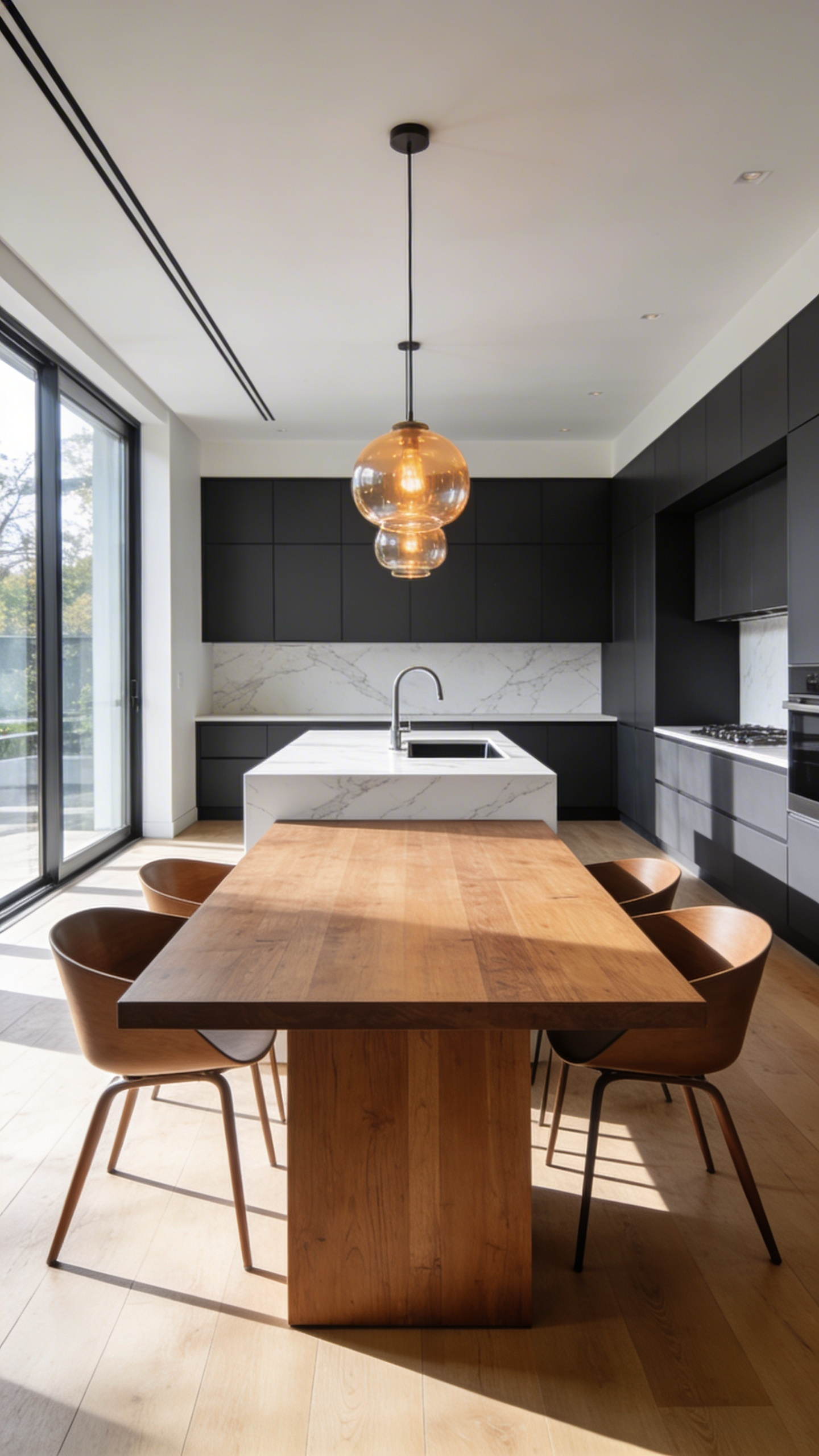
Functionally, this layout relies on specific “proxemic zones.” Traditional bar seating often forces guests into an awkward, single-file line. In contrast, an L-shaped extension fosters a “democratic space.” Here, guests face each other rather than just the cook. Consequently, this arrangement promotes psychological equality and encourages deeper conversation.
Moreover, this transition is often defined by materials. Designers frequently use a “material bridge” to signal a change in function. For instance, the active prep zone might feature sterile, durable marble. Conversely, the social extension transitions into warm, live-edge wood. Tactilely, wood feels warmer and encourages guests to rest their arms and linger.
Finally, height dynamics play a crucial role in comfort. Specifically, dropping the extension to a standard 30-inch dining height is essential. Therefore, homeowners can use upholstered chairs instead of temporary backless stools. This creates a genuine “stay-and-linger” atmosphere. Ultimately, hidden cantilevered supports maintain an airy aesthetic. This prevents visual clutter from bulky table legs.
4. Visual Zoning: Using Rugs to Define the ‘Room Within a Room’
In the fluidity of open-concept living, a dining table often feels like a floating object. Consequently, it creates a sense of impermanence amidst the high traffic of a kitchen. A rug serves as a powerful psychological anchor known as the “Islanding Effect.” Effectively, this establishes “implied architecture.” It creates a distinct room within a room without the cost of physical walls. Therefore, it transforms a transitional space into a dedicated destination for connection.
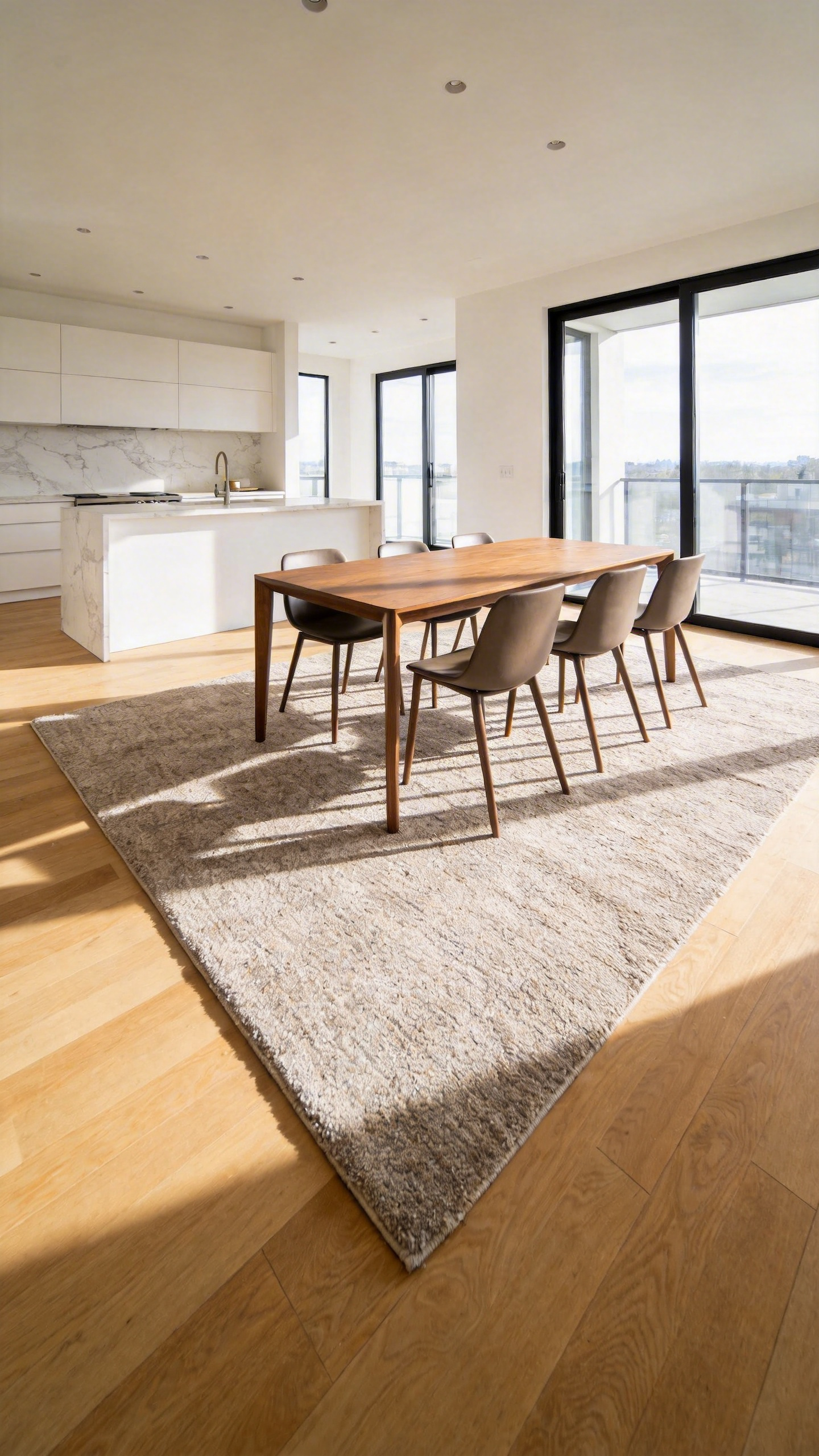
However, proper execution relies heavily on technical precision. Specifically, designers adhere to the “Rule of the 24-Inch Perimeter.” The rug must extend 24 to 36 inches beyond the table on all sides. Ideally, this ensures that chairs glide smoothly on a single plane. Otherwise, a chair leg catching on the edge creates a subconscious feeling of instability.
Furthermore, kitchens are inherently loud environments dominated by hard surfaces. Materials like quartz, tile, and stainless steel bounce sound relentlessly. Fortunately, a rug acts as an essential acoustic sponge. It absorbs the clatter of silverware and the hum of appliances. Thus, it creates a “quiet zone” that lowers the vocal effort required for conversation.
Finally, material selection must balance luxury with culinary reality. For instance, wool is a heritage choice because its natural lanolin repels stains. Alternatively, flatweaves are practical because they lack a deep pile where crumbs can disappear. Ultimately, this visual boundary directs household traffic around the dining area. It creates a soft, tactile signal that the work of cooking is finished.
Phase 2: Material Integrity & Culinary Function
The modern kitchen table functions as more than a static piece of furniture. In reality, it serves as a “performative surface” where artisanal craftsmanship meets utility. Therefore, selecting the right material effectively bridges a home’s aesthetic narrative with its culinary output. When planning your kitchen design decor to transform your culinary canvas, consider how the tabletop material influences both baking and social gathering.

Specifically, material integrity often relies on thermal mastery. For instance, expert bakers favor the crystalline structure of marble because it acts as a natural heat sink. Consequently, the stone remains consistently below room temperature. This “chill” prevents butter in laminated doughs from melting during preparation. Thus, a stone top tells a story of precision. It offers tactile feedback that laminates cannot replicate.
Conversely, wood offers a narrative of friction and moisture management. Unlike smooth quartz, raw woods like maple possess a microscopic grain. This porosity effectively “grabs” dough during kneading. In fact, Italian tradition suggests this texture creates a specific “tooth” on pasta. As a result, sauces cling more effectively to the finished product. Furthermore, the construction of these tables often includes “breadboard ends.” This allows the wood to breathe alongside the cook.
Beyond mechanics, material choice engages with the psychology of wear. High-gloss synthetic surfaces often create cognitive dissonance because they never change. However, materials like zinc or unsealed oak develop a rich patina over time. Ideally, these marks act as a physical record of culinary life. While stainless steel offers clinical sterility, natural materials prioritize warmth. Ultimately, choosing lived-in textures over industrial perfection frames the kitchen as a soulful sanctuary.
5. Raw & Refined: The Enduring Warmth of Live-Edge Walnut
In the landscape of kitchen design, live-edge walnut stands apart as the pinnacle of “Organic Modernism.” Specifically, it offers a necessary “tectonic bridge” within the room. Kitchens are often defined by hard, cold surfaces like quartz and stainless steel. Therefore, introducing irregular, biological geometry creates a vital visual balance. George Nakashima famously called this approach the tree’s “second life.” Consequently, the table becomes a functional sculpture rather than just a piece of furniture.

Visually, walnut provides a distinct internal color story. For instance, the deep espresso “heartwood” contrasts beautifully with the creamy “sapwood” edge. This pale outer band acts as a natural frame for the table’s silhouette. Furthermore, high-end applications often utilize a technique called “bookmatching.” In this process, a log is sliced and opened like a book. Thus, the grain creates a symmetrical, Rorschach-like pattern. It effectively transforms raw nature into refined art.
Structurally, these pieces often feature the “butterfly joint.” This inlay is not merely decorative. In fact, it stabilizes the massive slab against humidity changes common in busy cooking environments. Ideally, this engineering creates a sophisticated “Raw & Refined” tension. Moreover, the tactile experience is grounding for guests. Unlike cold stone, walnut possesses low thermal conductivity. Therefore, it feels physically warm to the touch. Ultimately, this heirloom surface gains character with every meal. It serves as an enduring archive of your home’s history.
6. Stone Resilience: Integrating Marble and Quartz for Pastry-Ready Surfaces
True stone resilience blends natural marble with engineered quartz to create a high-performance workspace. Specifically, this “Pastry-Ready” approach relies heavily on marble’s unique thermal properties. Because marble acts as a natural heat sink, it efficiently wicks warmth away from ingredients. Consequently, sensitive fats in laminated doughs remain solid during handling. Without this cooling effect, butter layers merge. This results in bread-like textures rather than flaky perfection.

However, the finish matters just as much as the material itself. Professional pastry chefs generally prefer a honed, matte surface over a high-gloss polish. Ideally, this “velvety” texture provides a microscopic “tooth” for the dough to grip. Furthermore, a honed finish embraces the inevitable patina of use. It masks the scratches that tell a kitchen’s story.
To maximize daily durability, modern designs often utilize “Hybrid Zoning.” Here, designers inlay a dedicated marble slab directly into a larger field of resilient quartz. Therefore, the surrounding quartz handles acidic prep and hot pans, effectively protecting the sensitive stone. Additionally, we often install “thermal breaks,” such as brass strips, to physically separate these temperature zones. Ultimately, this combination offers a tactile stability. It is marked by the distinct, solid thud of a rolling pin against cool stone.
7. The Glass Advantage: Creating Visual Lightness in Compact Footprints
Transparency acts as a calculated strategy in compact kitchen design rather than a mere aesthetic choice. Specifically, designers utilize the “Ghost Effect,” or “vanishing furniture,” to manipulate spatial perception. Unlike solid cabinetry, transparent glass allows sightlines to travel uninterrupted to the flooring below. Consequently, the room’s perceived square footage remains intact rather than being visually cut short. This reduction in visual noise significantly lowers the feeling of claustrophobia in tight footprints.
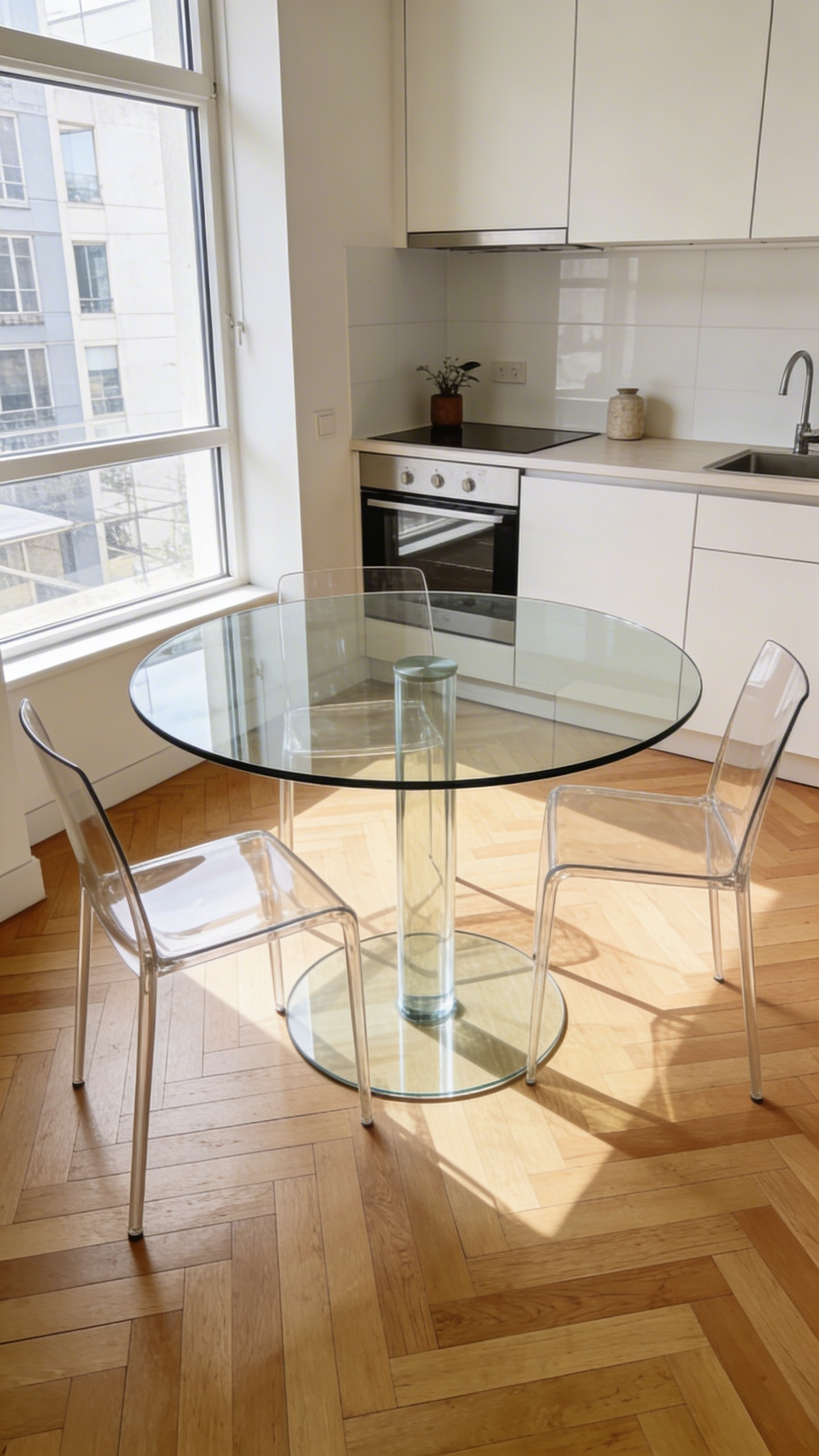
However, glass can sometimes feel clinically cold or utilitarian. Therefore, successful designs often pair a tempered glass top with a warm, organic wood base. This material dialogue creates a “hovering” effect, blending modern lightness with grounded texture. Additionally, glass possesses a high refractive index that effectively diffuses natural light. In fact, placing a table near a window amplifies brightness in darker corners.
Beyond aesthetics, the “Size-Weight Illusion” plays a critical psychological role here. Essentially, humans perceive transparent objects as significantly lighter than solid ones of identical volume. For optimal workflow, choose a round, tempered glass top. Ultimately, this shape softens traffic patterns while maintaining the heavy-duty durability required for daily dining.
8. Mixed Media Moments: Pairing Industrial Metal Bases with Heirloom Woods
Merging industrial metal with heirloom wood creates a compelling sensory dialogue within a kitchen. Specifically, this pairing balances the “cold” sterility of steel with the organic warmth of timber. Consequently, the room feels grounded yet modern, offering a distinct tactile experience. In fact, the heavy wood top offers thermal comfort for diners’ arms during long meals. Conversely, the metal base provides a clean, uncluttered visual that reflects light. This keeps the space airy.
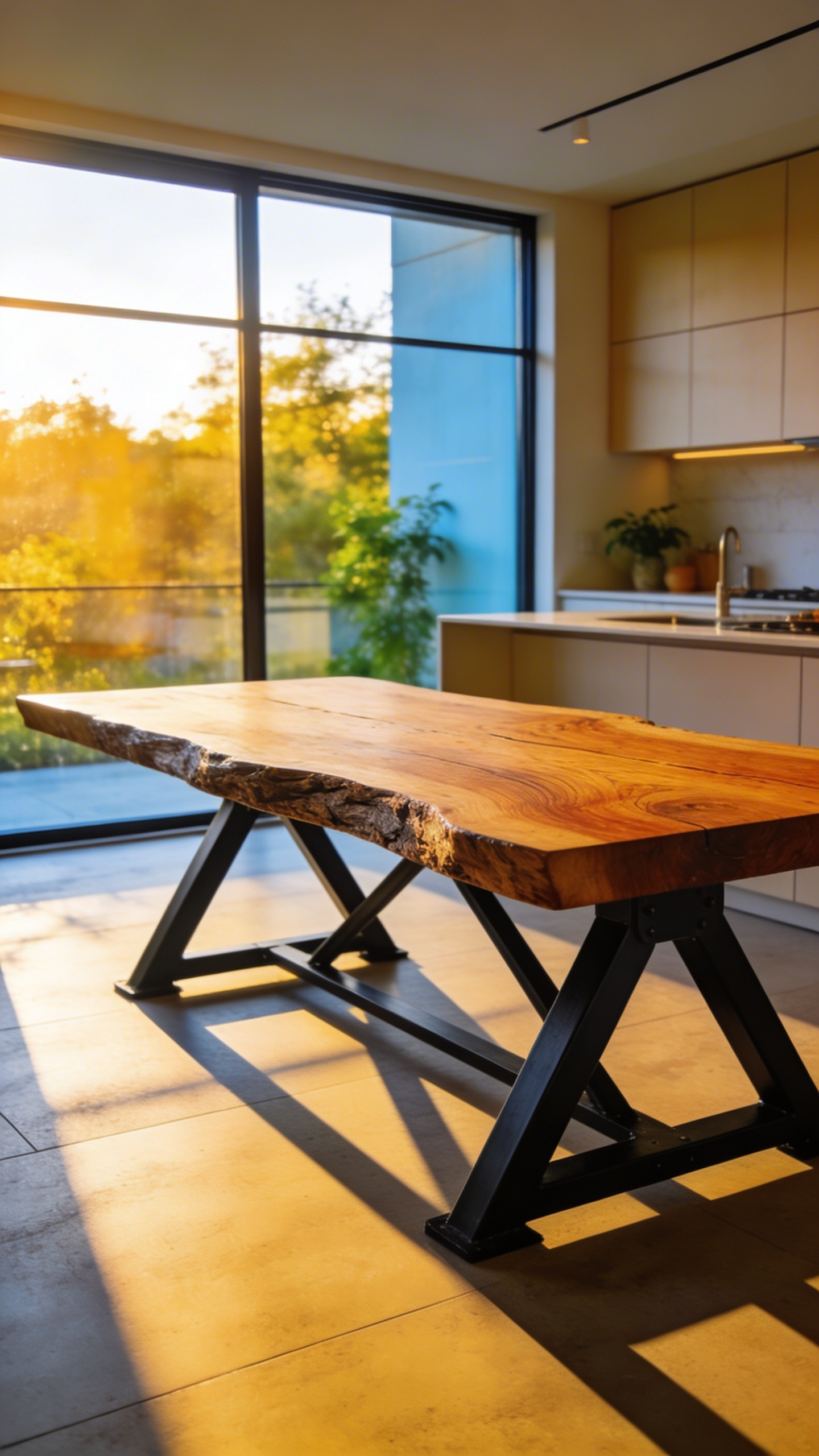
However, successful design requires smart engineering to marry these contrasting materials. Because solid wood expands with kitchen humidity, rigid connections eventually invite cracking. Therefore, authoritative designs utilize hidden “spider” brackets or oval screw holes underneath. These mechanisms allow the wood to move seasonally without damaging the table’s structural integrity.
Furthermore, the choice of base shape directly dictates your kitchen’s social flow. For instance, a central metal trestle supports heavy slabs while maximizing legroom. This setup eliminates corner legs, making it perfect for sliding easily onto dining benches. Alternatively, a “U-base” offers unobstructed sightlines beneath the table. This helps smaller dining nooks feel significantly more spacious.
Ultimately, materials like Black Walnut or Quarter-Sawn White Oak serve as the ideal anchor for these pieces. As the metal base develops a unique patina alongside the aging wood, the table becomes a living biography of family life. Thus, the piece evolves from simple furniture into a durable, functional heirloom.
Phase 3: Social Configurations & Seating
Ideally, the kitchen table serves as a “sociopetal” anchor, actively drawing people together. However, structural barriers often impede this social flow. Specifically, traditional four-legged tables can create what architect Eero Saarinen famously termed a “slum of legs.” Therefore, selecting a pedestal base removes these territorial markers completely. Consequently, the seating plan becomes fluid. It effectively democratizes the circle for spontaneous gatherings.
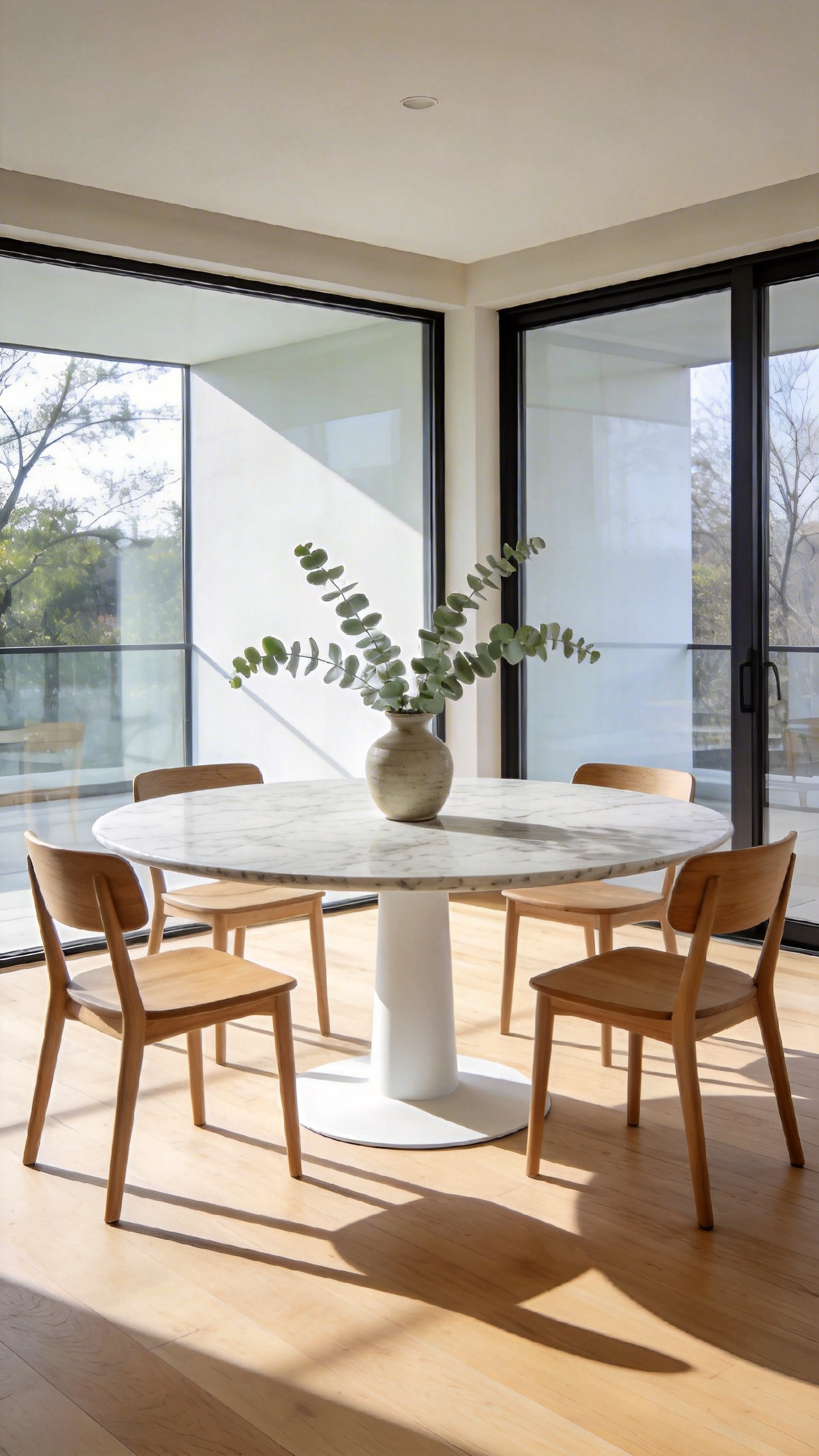
Beyond the base, the angle of interaction matters significantly. In fact, environmental psychology favors a 120-degree seating angle over direct, confrontational positioning. Thus, banquettes offer a unique advantage by creating a protected “social nook.” The soft upholstery absorbs kitchen noise, while the configuration encourages guests to relax into the conversation.
Simultaneously, we must consider the specific dimensions of “proxemics.” Specifically, tables wider than 42 inches often discourage intimate disclosure. Instead, they create a “sociofugal” effect where conversation fragments into small clusters. Therefore, narrower widths are preferable because they encourage the natural “leaning-in” phenomenon.
Finally, the height of your seating sets the room’s energy. Standard height encourages long, lingering meals suitable for deep discussion. Conversely, counter-height stools facilitate a dynamic “grazing” atmosphere. This alignment places seated guests at eye level with the standing cook. Ultimately, this configuration supports the modern “Social Triangle.” It allows the host to cook without turning their back on the fun.
9. The Curated Mismatch: Mastering the Art of Eclectic Chair Pairings
The era of the rigid dining suite is effectively over. Specifically, the “curated mismatch” transforms your kitchen table into a dynamic narrative. Instead of a static showroom, this approach creates visual rhythm. Consequently, the eye moves freely, making small spaces feel more expansive. However, avoiding a chaotic “furniture graveyard” requires a unifying element.

For instance, employ the “Single Thread” theory to maintain structural harmony. Often, this means using a chromatic anchor. Simply paint disparate vintage and modern frames the exact same shade to unify silhouettes. Alternatively, align the top-rail heights to create a consistent visual horizon line. Crucially, functional comfort remains paramount in a working kitchen. Therefore, verify the seat-to-apron clearance regardless of style. Ideally, maintain 10 to 12 inches so every guest sits at an equal height.
Furthermore, utilize material tension to engage the senses. For example, pair the cold industrial feel of metal stools with warm, organic wood. In fact, this “hard vs. soft” contrast mirrors the kitchen’s own mix of steel and heat. Ultimately, this intentional juxtaposition lowers the barrier to entry. Thus, the space feels unpretentious, welcoming guests to truly relax.
10. Bench Logic: Streamlining Sightlines in Open Concept Spaces
In open-concept design, maintaining a sense of boundless space is paramount. However, standard dining chairs often interrupt this visual flow. Specifically, high chair backs act like a vertical “picket fence” bisecting the room. Conversely, a bench focuses on the horizontal axis. Because it sits below the table surface, the seating effectively disappears when unused. Consequently, this preserves the room’s “horizon line.” It allows the eye to travel uninterrupted across the space.

Furthermore, benches mitigate the visual chaos known as “leg jitter.” A standard chair set introduces nearly two dozen vertical lines into the room. In contrast, a bench reduces this visual static by roughly 75%. Thus, the dining area feels grounded and calm rather than cluttered with scattered objects. This reduction in vertical lines allows statement tables to truly shine.
Beyond aesthetics, “bench logic” offers critical spatial benefits. For instance, benches tuck completely under the table, reclaiming valuable floor space. This is vital in high-traffic zones, preventing the “chair-back shuffle” near the kitchen work triangle. Additionally, benches alter the social dynamic. Historically rooted in communal dining, they encourage a fluid, shared experience. Ultimately, the bench transforms from simple furniture into a functional architectural tool.
11. Performance Velvet: bringing Luxury Upholstery into the Breakfast Zone
Historically, velvet was viewed as a fragile luxury, strictly banned from family eating areas. However, modern performance velvet has fundamentally changed this narrative. Specifically, it transforms the breakfast zone from a utility space into a comfortable lounge. Unlike traditional textiles, these fabrics are engineered at the fiber level for extreme durability. Consequently, liquids like maple syrup simply bead up rather than soaking into the pile.
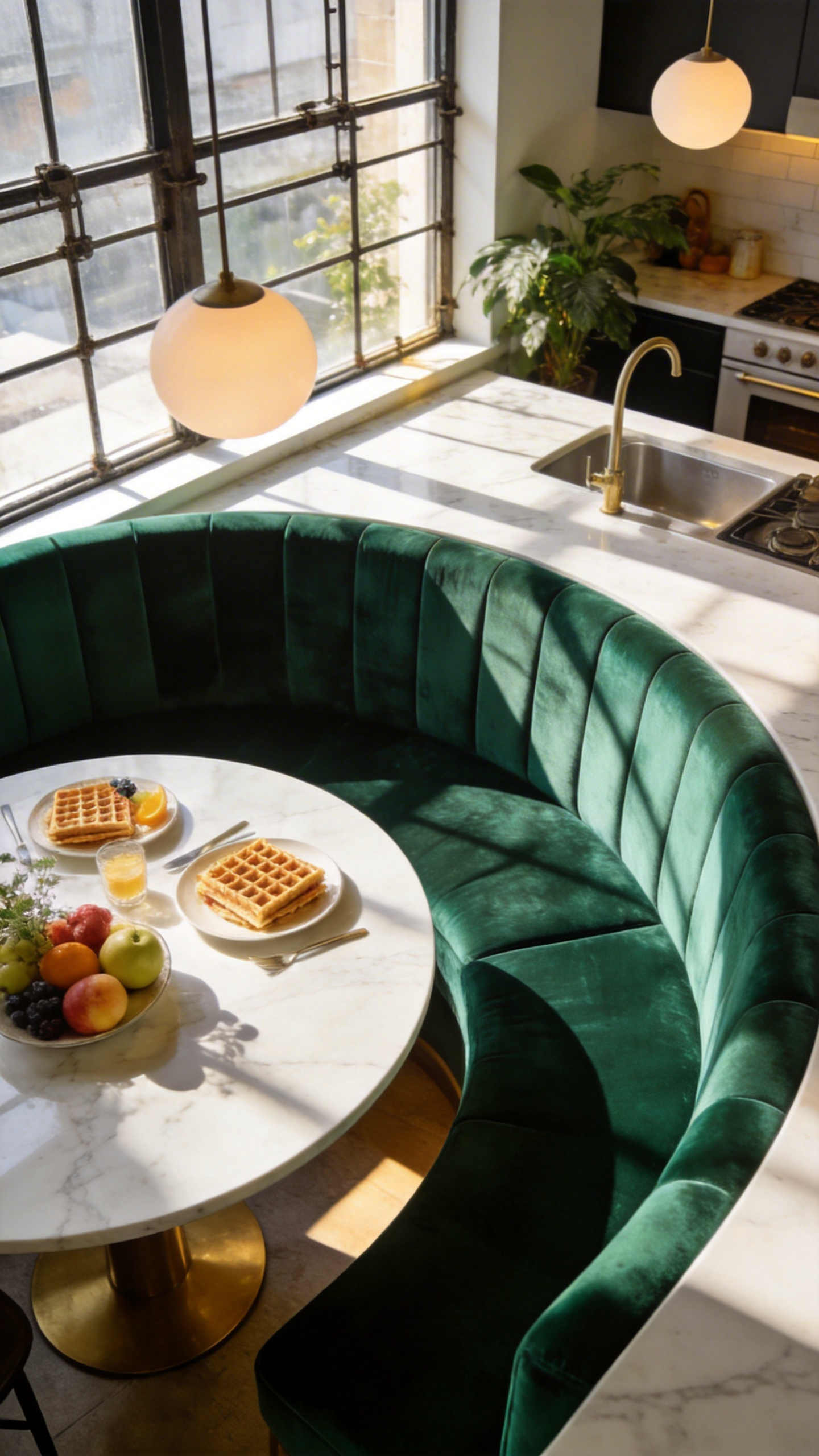
Moreover, this material solves a specific sensory challenge in modern culinary spaces. Typically, kitchens are dominated by hard, echoing surfaces like stone countertops and stainless steel. Therefore, introducing a plush velvet banquette offers necessary acoustic dampening. In fact, the dense, three-dimensional fibers reduce the clatter of silverware significantly.
Additionally, the aesthetic benefits are particularly potent during early morning hours. Because the fabric possesses a directional “nap,” it catches low-angled sunlight to create visual depth. Furthermore, advanced polyester fibers are highly resistant to UV fading. Thus, designers can confidently use deep jewel tones even in sunny, south-facing windows. To keep the look grounded, simply pair the sheen with raw, matte woods. Ultimately, this combination balances high style with the messy realities of daily life.
12. High-Low Dynamics: Integrating Bar Stools with Standard Dining Heights
Integrating high-low dynamics transforms a kitchen from a utility space into a social theater. Specifically, this design strategy reconciles the gap between a standing chef and seated guests. By incorporating bar-height seating, we create an “egalitarian eye-level.” Consequently, the cook feels like a participant in the conversation rather than a servant.

However, true functionality requires addressing physical comfort alongside social flow. Research suggests that diners actually perceive taste differently based on their seating support. Therefore, a standard dining height of 30 inches is crucial for enjoying complex, long-form meals. In contrast, high stools are ideal for high-energy, quick social interactions.
To achieve this balance, modern designers often utilize a “waterfall” connection. This technique seamlessly drops a stone or wood slab from the high prep counter to a lower table. Furthermore, this “integrated table” approach supports universal design principles. For example, elderly family members or small children can safely participate without climbing dangerous high stools. Thus, the lower section becomes a safe “landing zone” for multi-generational gathering.
Additionally, this dual-height setup accommodates modern work-from-home needs. While the bar works for morning espresso, the lower table offers ergonomic luxury and support for laptop use. Ultimately, balancing these heights offers both the excitement of a cocktail bar and the restorative comfort of a dining room.
Phase 4: Atmospheric Layering & Styling
True atmospheric styling transcends simple decoration. It essentially engineers a specific mood through sensory cues. Primarily, this process begins with lighting. During meal prep, you need neutral white light for safety and focus. However, dining requires a shift to a warmer 2700K temperature to trigger relaxation. In fact, modern “smart scenes” handle this transition best. Specifically, dim your ambient lights while keeping the pendant at 50% intensity. This creates a glowing “horizon line” that visually anchors the table.
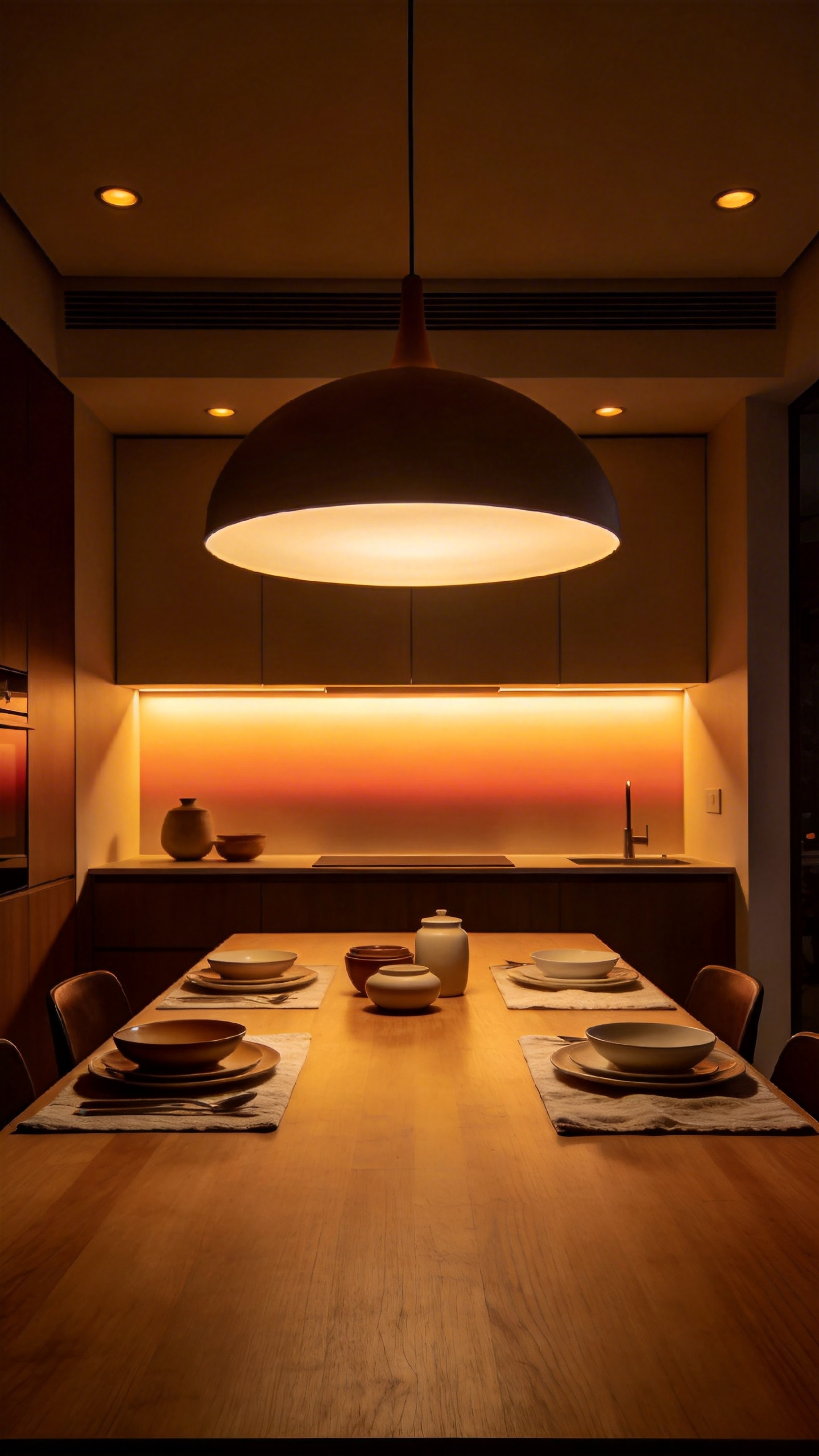
Next, focus on the tactile topography of the surface. Do not clutter every inch of the table. Instead, employ the concept of “Ma,” or intentional negative space. This highlights the beauty of the table’s raw material. Furthermore, you must layer soft elements over cold surfaces. You might look for unexpected kitchen table centerpiece ideas that utilize linen runners or upholstered chairs to invite touch. Consequently, these layers also act as acoustic absorbers, dampening the noise in open-plan kitchens.
Additionally, consider the olfactory experience carefully. Never place strong, artificial scents directly on the dining table. Rather, position a citrus candle near the entrance as a sensory “palate cleanser.” Finally, maintain a functional workflow. Use a curated tray system to contain daily clutter. Therefore, you can swap daily mail for evening candles in seconds. Ultimately, this “ritual of the swap” bridges the gap between daily utility and elegant entertaining.
13. The Statement Pendant: Anchoring the Conversation form Above
In the hierarchy of kitchen design, the statement pendant acts as an architectural anchor. Consequently, it solves the “boundary-less” anxiety often found in modern open-concept plans. Specifically, designers use this fixture for vertical zoning to create a distinct “invisible room.” By lowering the perceived ceiling, you establish a cozy envelope for interaction. To achieve this, hang the fixture 30 to 36 inches above the table surface. This height creates a canopy that maintains clear sightlines for conversation. Simultaneously, it physically separates the dining area from the high-traffic work zones of the kitchen.

However, proper placement requires the right scale. You must considering proportional authority to truly ground the space. According to the “2/3 Rule,” a pendant’s diameter should measure roughly two-thirds of the table’s width. Anything smaller often feels accidental rather than intentional. Therefore, choose a fixture with significant visual mass to act as a tether for the furniture below.
Beyond dimensions, the quality of light defines the social atmosphere. Ideally, select opaque shades made of materials like hammered brass or matte ceramic. These direct light downward, effectively creating a psychological “campfire effect.” In this soft twilight, the room’s energy focuses inward toward the table. In contrast, exposed bulbs can cause visual fatigue, subtly encouraging guests to leave early. Ultimately, a glare-free glow softens facial features and encourages lingering. Finally, let the material narrative set the tempo. Heavy steel suggests permanence, while hand-blown glass offers a casual airiness. Thus, you define exactly where your family’s stories are told.
14. Dimmable Drama: Transitioning form Homework Station to Dinner Party
In modern design, the kitchen table serves as a “chameleon surface.” Specifically, it must facilitate two opposing states of mind. First, it hosts the sharp focus of a homework station. Later, it shifts to the relaxation of a dinner party. To achieve this, designers utilize “Warm-Dim” technology. Unlike standard LEDs, which often turn a muddy grey, these fixtures physically shift color temperature. As you reduce voltage, the light moves from a cool, focus-enhancing 3000K to a sunset-like 1800K. Consequently, this warm glow triggers the parasympathetic nervous system, signaling guests that it is safe to linger.

However, lighting is only half the equation. You also need a physical “Boundary Ritual.” Research suggests that leaving a laptop in sight creates a mental spillover that prevents relaxation. Therefore, utilize “transformer” tables with hidden, felt-lined drawers to literally banish technology. Furthermore, introduce a sensory reset by replacing hard surfaces with a soft linen runner. This simple act dampens acoustics. It signals a transition from “earthly labor” to social nourishment.
Finally, employ the “Three-Tier” lighting rule to create depth. While overhead pendants handle tasks, you must incorporate low-level accent lights. Specifically, cordless lamps at eye level foster intimacy and eye contact. Ultimately, this combination allows you to reclaim the atmosphere of a formal dining room within a functional open-plan kitchen.
15. Sconce Solutions: Wall-Mounted Illumination for Tight Nooks
Wall-mounted sconces serve as a strategic design intervention for “dead” spaces in tight kitchen corners. Unlike overhead recessed lighting, which often flattens a room, a sconce casts focused pools of light. Consequently, this creates a “light island” that psychologically anchors the nook as a distinct destination. Designers often refer to this effect as a “visual hug.” Specifically, mounting fixtures at eye level, typically 60–66 inches high, mimics a fireplace’s lateral glow. Thus, this warm atmosphere encourages diners to linger rather than rush through meals.

Functionally, the swing-arm sconce operates as a stylish workhorse. In fact, adjustable arms allow for dynamic task lighting in multi-use spaces. You can pull the light over a bowl of oatmeal or push it flush against the wall. Furthermore, this mechanical flexibility accommodates both intimate dining and laptop work. Technically, maintaining proper proportion is vital for success. Therefore, select a fixture roughly one-third the width of your table to avoid overwhelming the diner.
Additionally, the quality of light directly impacts the culinary experience. Experts insist on 2700K warm white bulbs for these intimate zones. This specific temperature enhances appetite appeal, making food colors appear more vibrant. Conversely, exposed industrial bulbs often cause retinal fatigue in small nooks. Instead, utilize frosted glass globes or fabric shades to diffuse light evenly. Finally, modern plug-in options have democratized this look, allowing renters to treat cords as vertical architectural details.
16. The Functional Centerpiece: Tray Coralling for Everyday Clutter
To master the kitchen table, you must view the tray as a sophisticated psychological tool. Fundamentally, a tray utilizes the Gestalt Principle of Common Region. Without a boundary, a candle, salt shaker, and napkins appear as separate visual noise. However, placing them on a tray tricks the brain into perceiving a single unit. Consequently, this unitization reduces cognitive load and creates a sense of calm. Interestingly, this evolves from historical “salvers” used to present royal food. Today, we use them not to test for poison, but to establish intentionality.
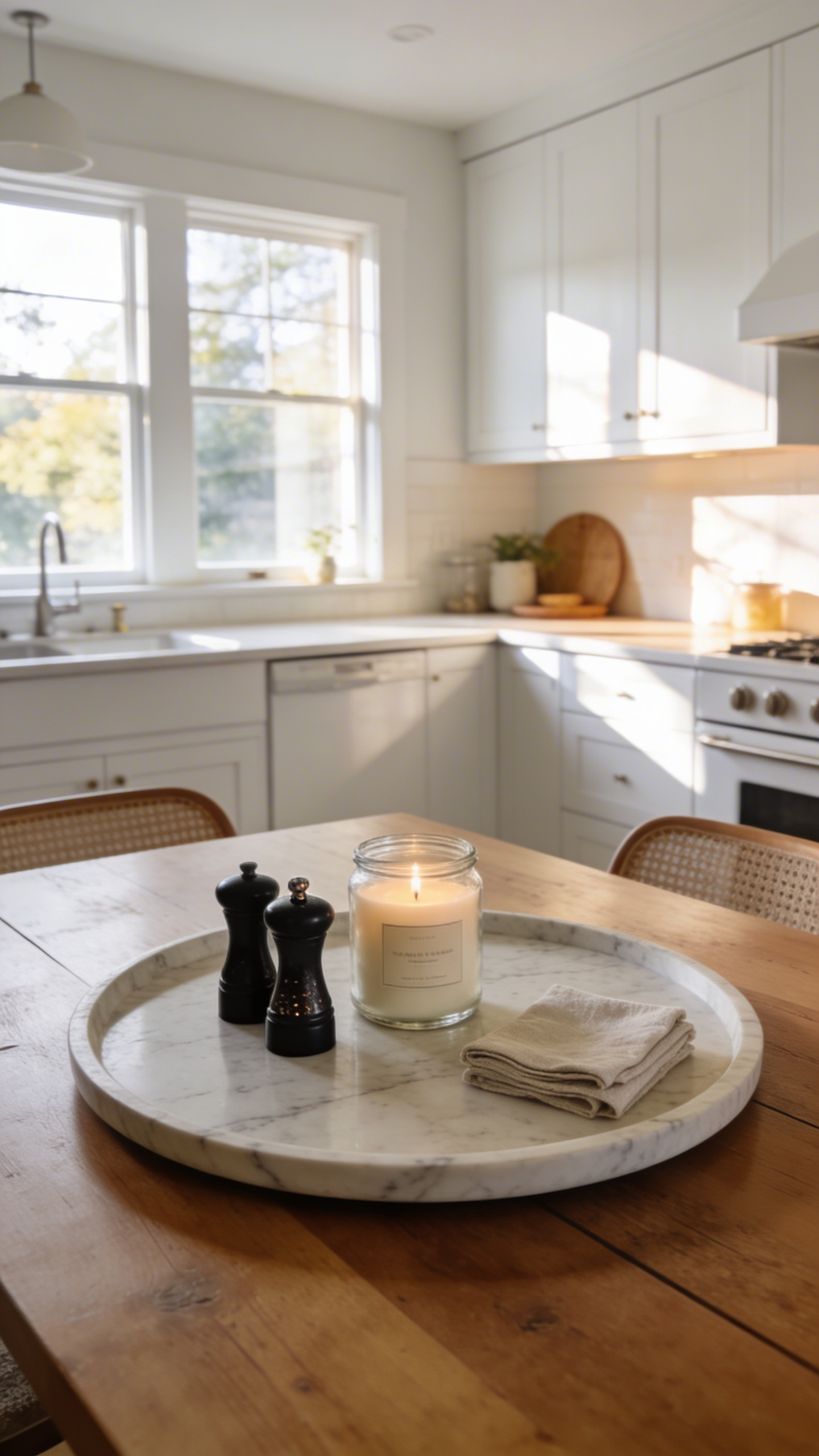
Furthermore, your choice of material dictates the room’s sensory experience. For instance, woven rattan provides an acoustic buffer for early mornings. Specifically, it replaces the jarring clink of glass with a soft, comforting thud. Conversely, marble trays offer thermal grounding and remain cool to the touch. Alternatively, wood adds a humanizing texture that warms sterile kitchen surfaces.
Functionally, this centerpiece facilitates a concept known as the “Portable Reset.” In high-traffic zones, you can clear the table for homework in one motion. Therefore, the tray transforms a ten-minute cleanup into a two-second lift. Moreover, it creates a “Zone 1” reaching distance for high-use items like seasonings. To style this professionally, apply the “3-5-8 Rule.” Ideally, anchor the arrangement with three heights: a vertical vase, medium carafe, and low bowl. Finally, include a scent, a salt, and a stem to merge beauty with utility.
17. Seasonal Rotation: Textiles that Shift the Mood without Changing Furniture
Seasonal rotation through textiles functions as sophisticated “environmental tuning.” Indeed, the kitchen table is often the home’s noisiest surface. Therefore, fabrics serve as the primary tool for manipulating the room’s atmosphere. Specifically, consider the acoustic architecture of dining. Hard surfaces naturally create a “live” room full of reverberation. However, introducing heavy-weight textiles, like boiled wool runners, acts as an acoustic absorber. Consequently, this dampens the clatter of silverware. It physically lowers the volume to foster intimate conversation.
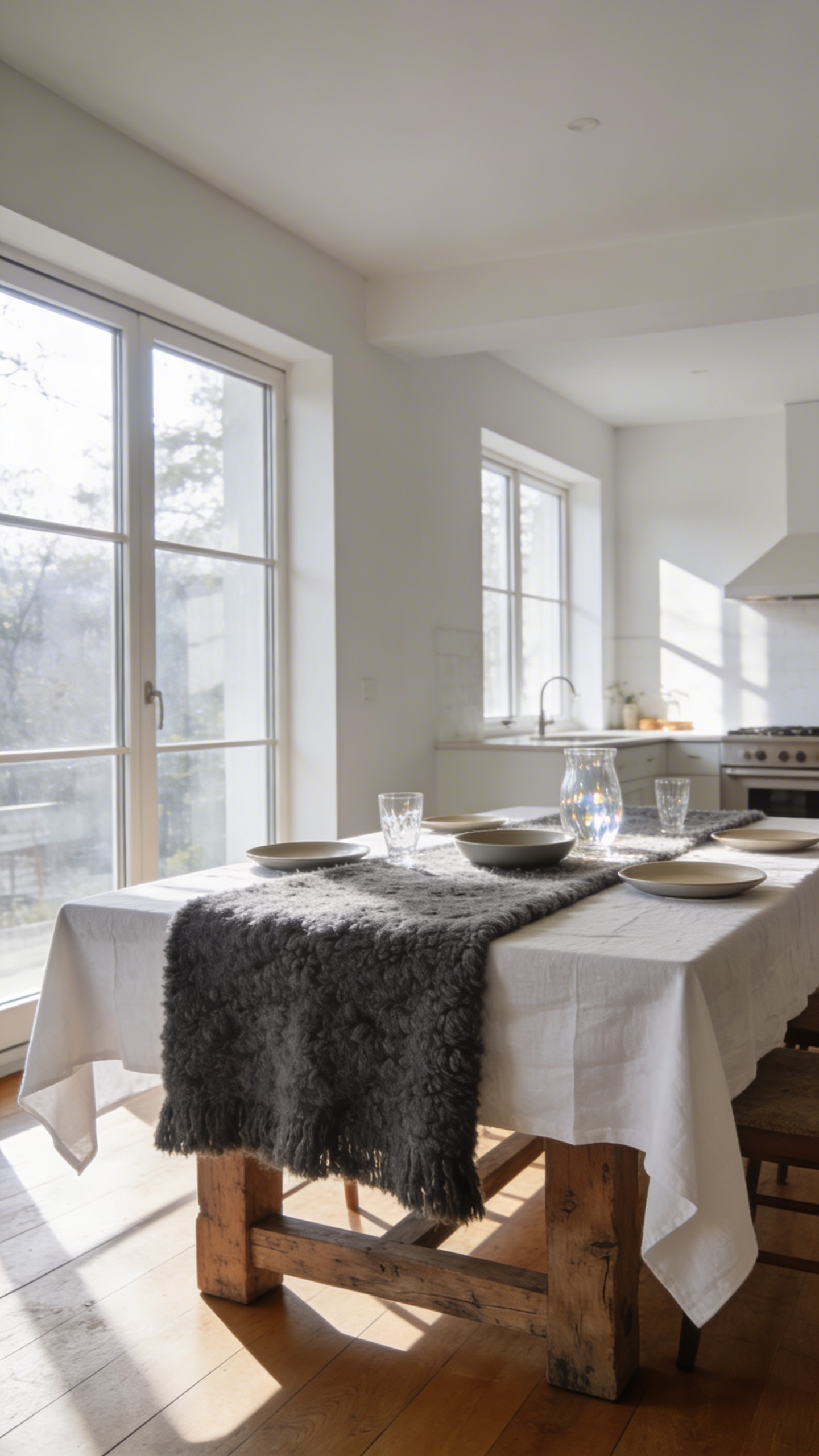
Beyond sound, these shifts address “thermal effusivity,” or how a material feels to the touch. For example, linen conducts heat away rapidly, feeling cool during humid summers. Conversely, a chunky knit throw creates a necessary thermal buffer against cold furniture in winter. Ideally, you should focus these changes on contact points where the body meets the table.
Furthermore, textiles dictate how a room interacts with available light. Crisp cottons possess high reflectance, bouncing morning sun to make the space feel airy. In contrast, matte velvets absorb light, creating a cozy “pooling” effect around candlelight. Finally, adopt a layered approach to build visual weight. Simply stacking a canvas base with a velvet runner acts as a temporal signal. Ultimately, this ritual transforms a static piece of furniture into a seasonal anchor.
18. The Hybrid Solution: Concealed Storage for the Work-From-Kitchen Era
The modern kitchen table is no longer a static surface. Instead, it has evolved into a sophisticated “transformer” piece. Historically, this concept mirrors the 18th-century *Secrétaire à Abattant*, which was designed specifically to conceal work clutter. Today, however, the primary motivation is psychological.
Experts suggest that visible laptops create “Visual Noise.” This prevents the brain from relaxing. Consequently, the kitchen cannot function as a recovery zone if it constantly resembles an office. Therefore, high-end kitchen table inspiration now focuses on “stealth furniture” designs and biophilic elements that soften the workspace.
Specifically, designers are integrating “apron drawers” directly into the table’s frame. Notably, these shallow, felt-lined compartments utilize push-to-open magnets rather than visible hardware. Thus, the piece maintains the illusion of a pure dining surface. This allows the household to transition from “Spreadsheet Mode” to “Dinner Mode” in under sixty seconds.
Furthermore, authoritative design now establishes a “Digital Triangle” of surface, storage, and power. Rather than unsightly power strips, new tables feature invisible inductive charging. Technically, the wood or stone is CNC-milled so thinly that devices charge directly through the tabletop.
Finally, materials play a crucial role in bridging the comfort gap. Because stone is cold for typing, some hybrid tables feature warmer walnut inlays or linoleum sections. Ultimately, these hidden functional elements ensure the workday disappears completely when the meal begins.
Frequently Asked Questions
How do I choose the right kitchen table for a small luxury space?
In compact luxury environments, prioritize transparency and pedestal bases. A round glass table with a sculptural base creates visual lightness. This allows sightlines to pass through the furniture. It makes the room feel more expansive while maintaining high-end aesthetic appeal.
What is the best material for a high-end, functional kitchen table?
The “best” material depends on your lifestyle. Natural marble is ideal for baking due to its thermal properties. However, live-edge walnut offers unmatched organic warmth and a rich patina. For maximum durability with a luxury look, consider high-performance quartz or mixed-media designs that pair heirloom wood with industrial metal.
How does table shape affect social interaction during meals?
Shape dictates “sociopetal” flow. Round and square tables are more egalitarian because they eliminate the “head of the table” hierarchy. This makes all guests feel equal and encourages communal conversation. Rectangular tables are better suited for large, formal gatherings where a sense of traditional order is desired.
Conclusion: Curating a Space for Nourishment and Connection
Ultimately, the kitchen table transcends its role as a static piece of furniture. Instead, it functions as the modern anchor for genuine connection, providing the ultimate kitchen table inspiration for those seeking a space that is as beautiful as it is functional. By blending practical workflows with sensory details, we create a true sanctuary. Consequently, thoughtful lighting and soft acoustics transform a stark workspace into an intimate setting. In fact, embracing the patina of daily use honors your family’s unique history. Thus, the space offers both biological nourishment and deep emotional grounding.
Looking ahead, your dining area must serve as a flexible “Domestic Third Place.” Therefore, the daily transition from production to presence becomes a vital ritual. Intentional design ensures this shift feels seamless rather than chaotic. To begin, audit your current lighting to create a focused, inviting “pool of light.” Then, establish a clearing routine to signal that the workday has officially ended. Finally, allow your table to evolve into a durable stage for shared memories.