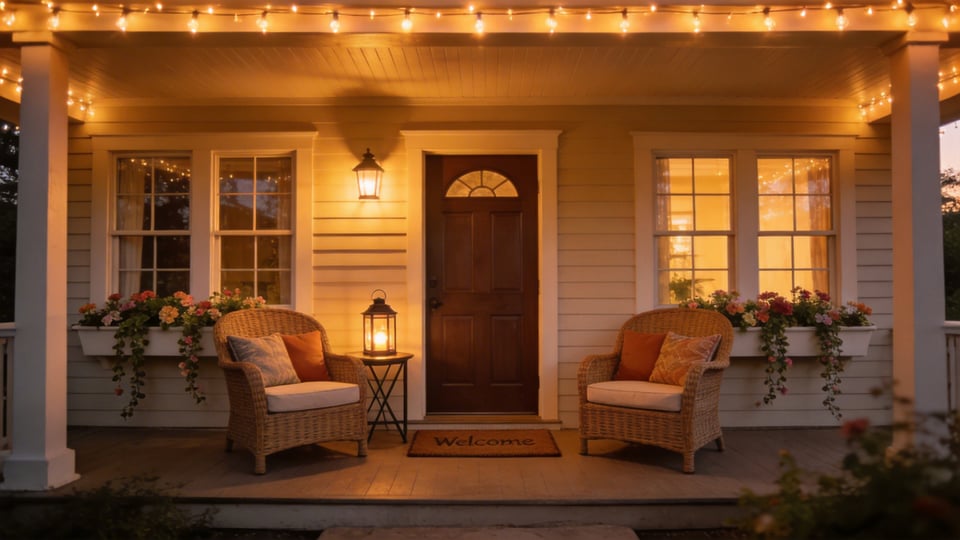
Picture the porch you actually want to have. It’s early evening. The string lights are on. There are people in every seat — drinks within reach, conversation flowing easily, nobody getting up to go back inside. That porch exists. But for most homes, the actual porch is a few chairs that don’t match, a rug that’s seen better days, and a string of lights drooping between two hooks. The good news is that porch decor doesn’t require a renovation budget or a design degree. It requires knowing which changes do the most work — and which ones to do first. These 15 ideas run from the elements that define the space to the finishing details that tie it together. Start at the beginning if you’re starting from scratch. Jump in wherever you need to if you’re working with what you’ve got.
1. String Lights That Actually Look Intentional
Most homes have string lights on the porch. Very few look like they were put there on purpose. The difference almost always comes down to bulb shape and mounting approach — not budget.
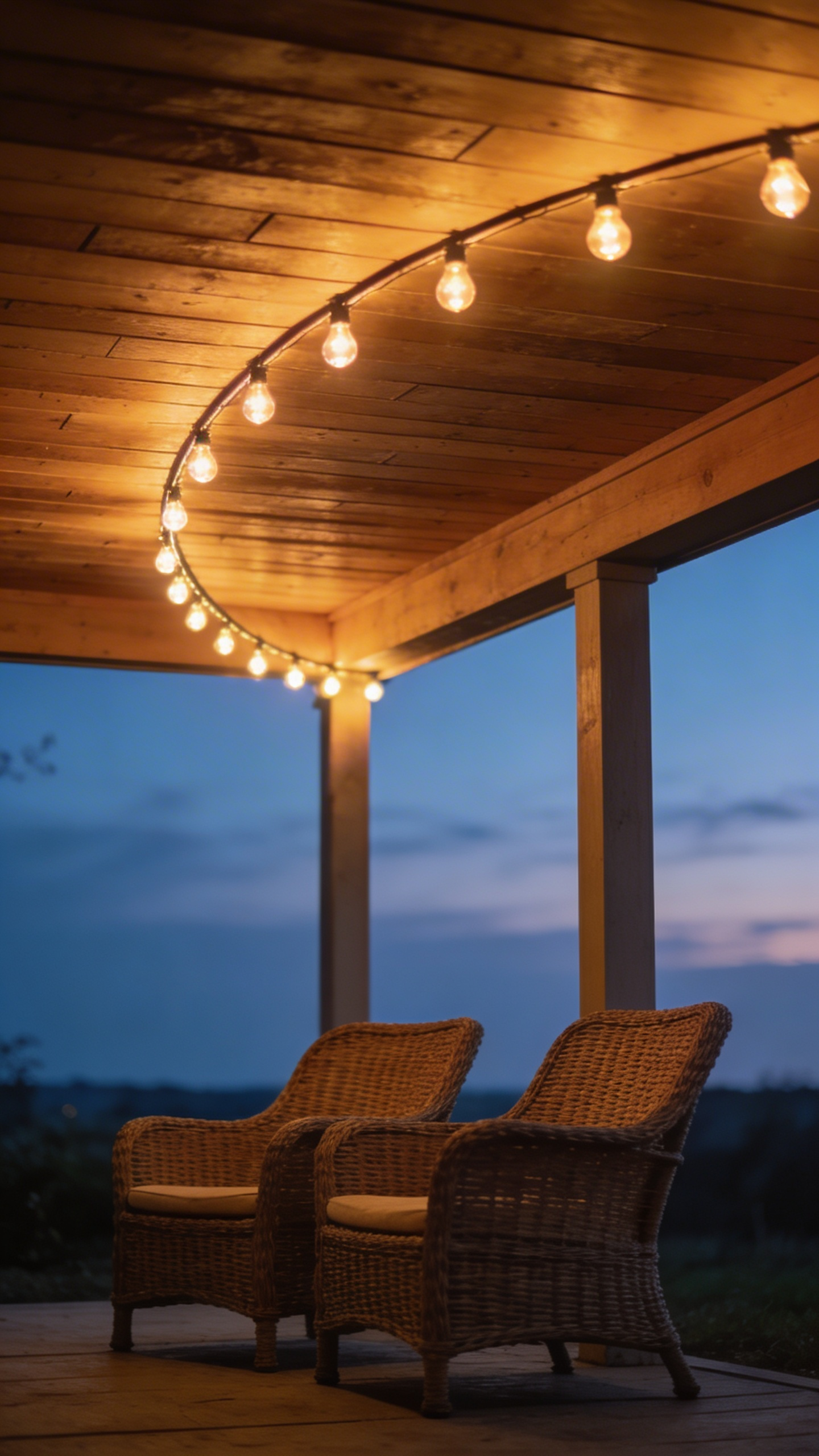
The bulbs to look for are G40 globes or S14 vintage Edison shapes. You want a 2200K–2700K colour temperature. That warm amber quality is what separates porch lighting that feels designed from the cool-white commercial strings that feel more like a car park. Brightech’s Ambience Pro line ($35–$50 for 25 feet) uses a rubber-coated cord that lasts years. The bulbs are also replaceable — that matters when one fails eighteen months in.
How You Mount Them Matters as Much as the Lights Themselves
The catenary installation is what you see in every outdoor restaurant that looks good. The string dips slightly between two anchor points rather than being pulled taut. It’s not difficult: two cup hooks screwed into structural timber (not fascia board), and the strand hangs naturally between them. For a 10×12 porch, two 25-foot strands running along the ceiling perimeter do the job.
Black cord disappears against a dark ceiling or open sky. White cord only works on pale-painted porch ceilings. If you can only find white, a quick coat of spray paint on the cord while it’s unplugged solves it. Run lights along the ceiling perimeter rather than down the centre. The perimeter installation feels like a room; a centre strip feels like a tent.
For porches without a ceiling, solar strands rated at 200 lumens or higher will do the work. That said, I’d still run power if you have an outdoor outlet available. The reliability difference on cloudy days is noticeable.
2. An Outdoor Rug That Defines the Space
The rug is doing more work than any piece of furniture in your porch decor arrangement. It draws a border around the seating area, signals to everyone’s feet where they’re meant to sit, and ties pieces together that might otherwise have nothing to do with each other.
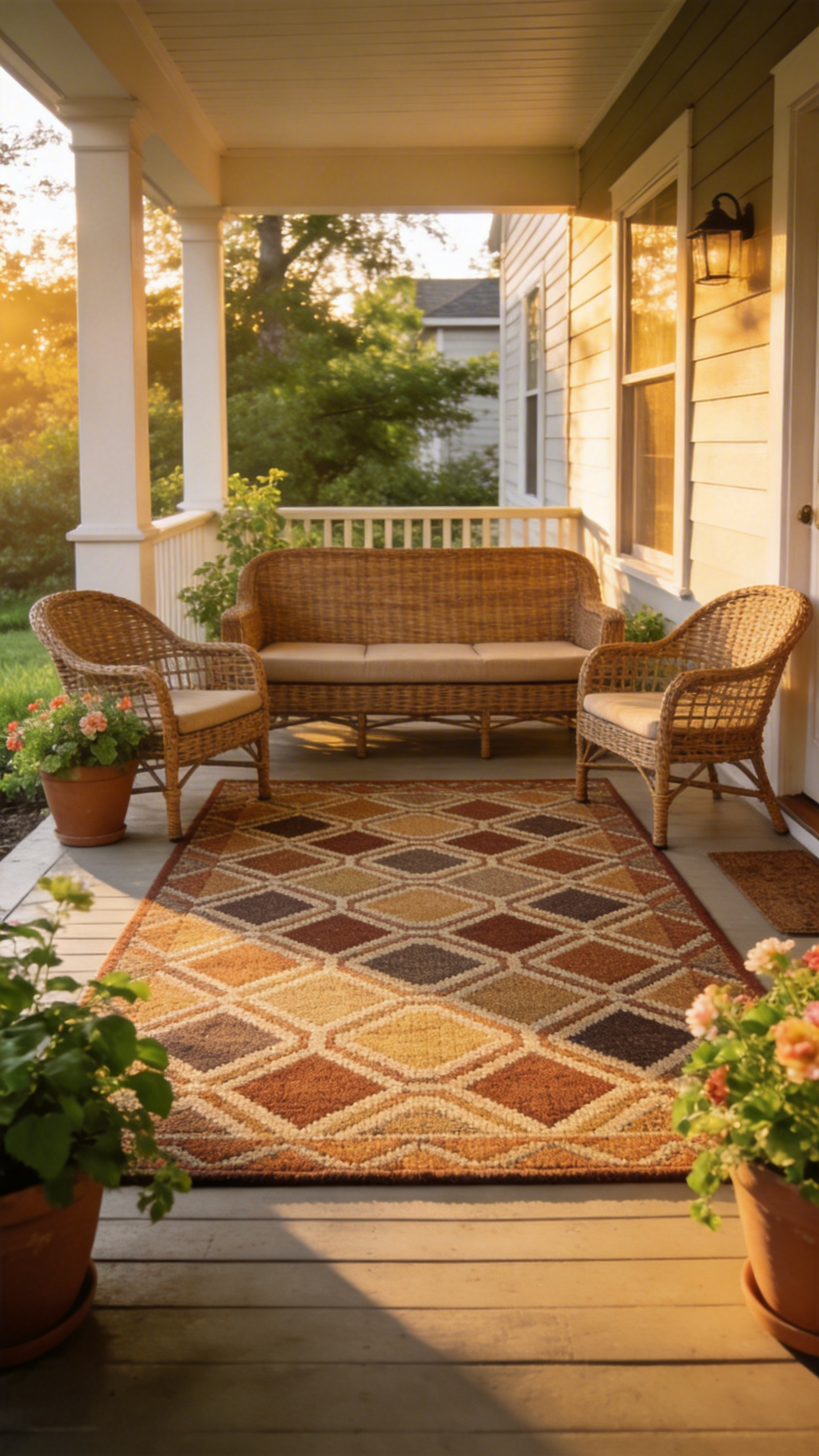
The undersized rug is the most common mistake in porch decor. If your furniture is floating above the rug rather than sitting on or near it, the rug is too small. For a sofa-and-chairs arrangement, you want at least an 8×10 with the front legs of everything resting on it. For a dining table setup, a 9×12 works — with the chair legs on the rug even when pulled out. The Safavieh Courtyard Collection ($45–$120 depending on size) is the standard recommendation for a reason. The polypropylene construction resists mildew, cleans with a hose, and the geometric patterns read as designed rather than practically-selected.
Material Is Everything for Outdoor Rugs
Polypropylene (also labelled olefin) is the right material for outdoor use. Natural fibres like jute and sisal degrade quickly with repeated moisture exposure. Even products labelled “indoor/outdoor jute” typically fail within one season in a wet climate. The appeal is understandable; jute looks great in photos. But so does a mouldy rug, briefly.
Low-pile rugs (under half an inch) are easier to keep clean. They don’t trap debris as badly as higher-pile options. A non-slip rug pad is worth adding even outdoors — Gorilla Grip makes versions that hold up well on exterior surfaces. Place the rug first, then arrange the furniture around it. That order matters.
3. Porch Decor Pillows That Hold Up to the Weather
Throw pillows are how you introduce colour and pattern into porch decor without committing to furniture in a specific shade. They’re also where most people lose money. Cheap polyester pillows go flat or mouldy in a single season. Then you replace them every year.
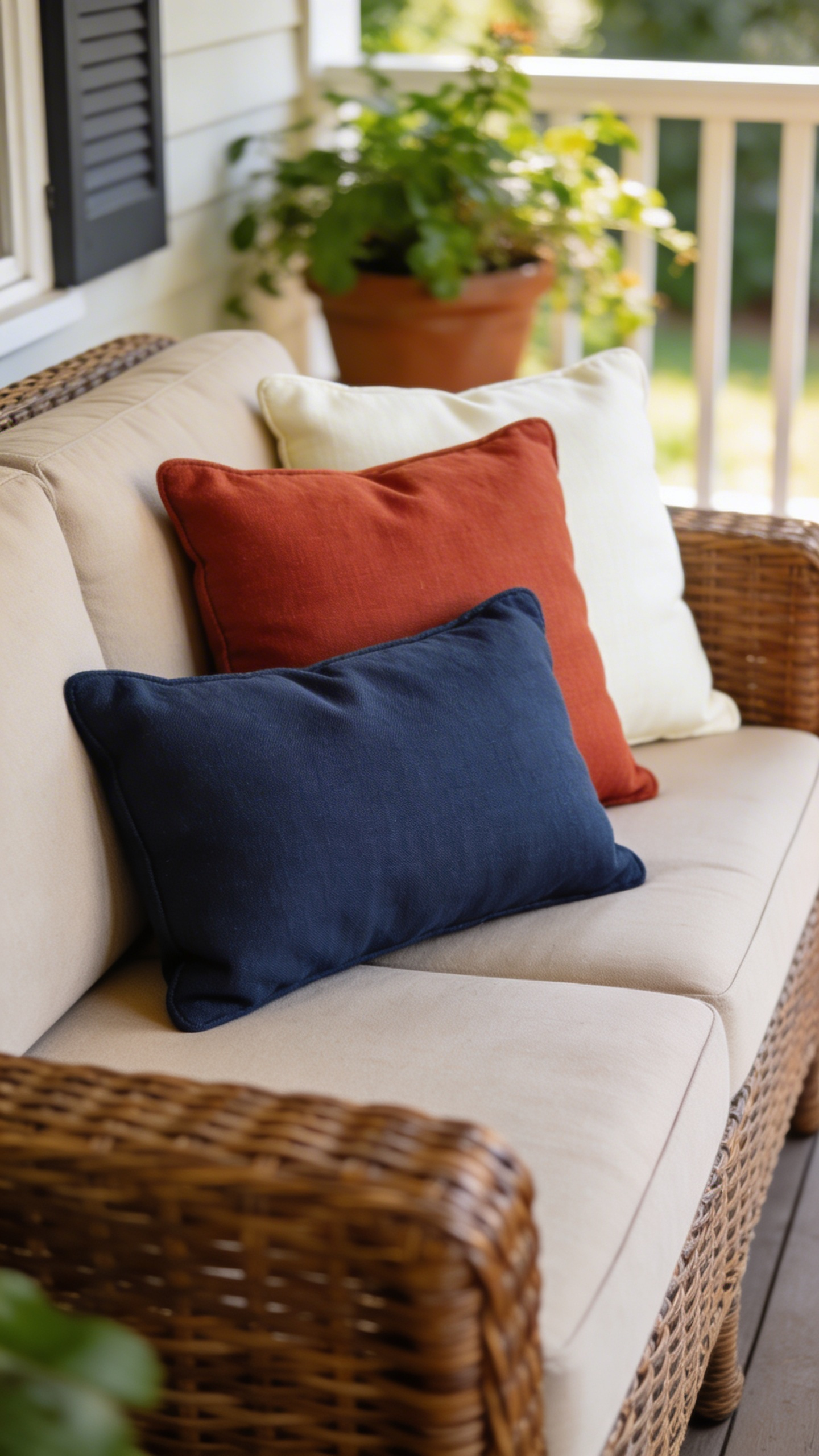
Sunbrella acrylic is the standard in outdoor fabrics. It’s solution-dyed, meaning the colour runs through the entire fibre rather than being printed on the surface. That’s what gives it a Grade 8 lightfastness rating. It retains over 90% of its colour after 2,000 hours of direct sun. Standard polyester starts visibly fading after 400–600 hours. For anyone doing the maths on a summer of daily use, that’s the difference between one season and five.
What You Actually Need to Buy
Sunbrella pillows from Pottery Barn’s outdoor line run $35–$55 each — not cheap, but they genuinely last. If budget is a concern, Pillow Perfect’s outdoor range ($20–$40 each) uses spun polyester with Trupedic fill. It holds up well for 2–3 seasons. The key is getting inserts in the right sizes: 18×18 for chairs, 20×20 or 22×22 for sofas. Buy covers you can swap seasonally rather than full pillows.
Colour coordination is where porch decor either comes together or falls apart. Two or three colours maximum across all the pillows. Pull those colours from somewhere else on the porch — the door colour, the rug pattern, the planter glaze. That repetition is what makes it look like a room rather than a clearance aisle.
4. A Focal Point Plant or Planter Arrangement
Every well-designed porch has a plant moment — something that gives the eye a place to land and introduces the kind of organic texture that furniture and rugs alone can’t provide.
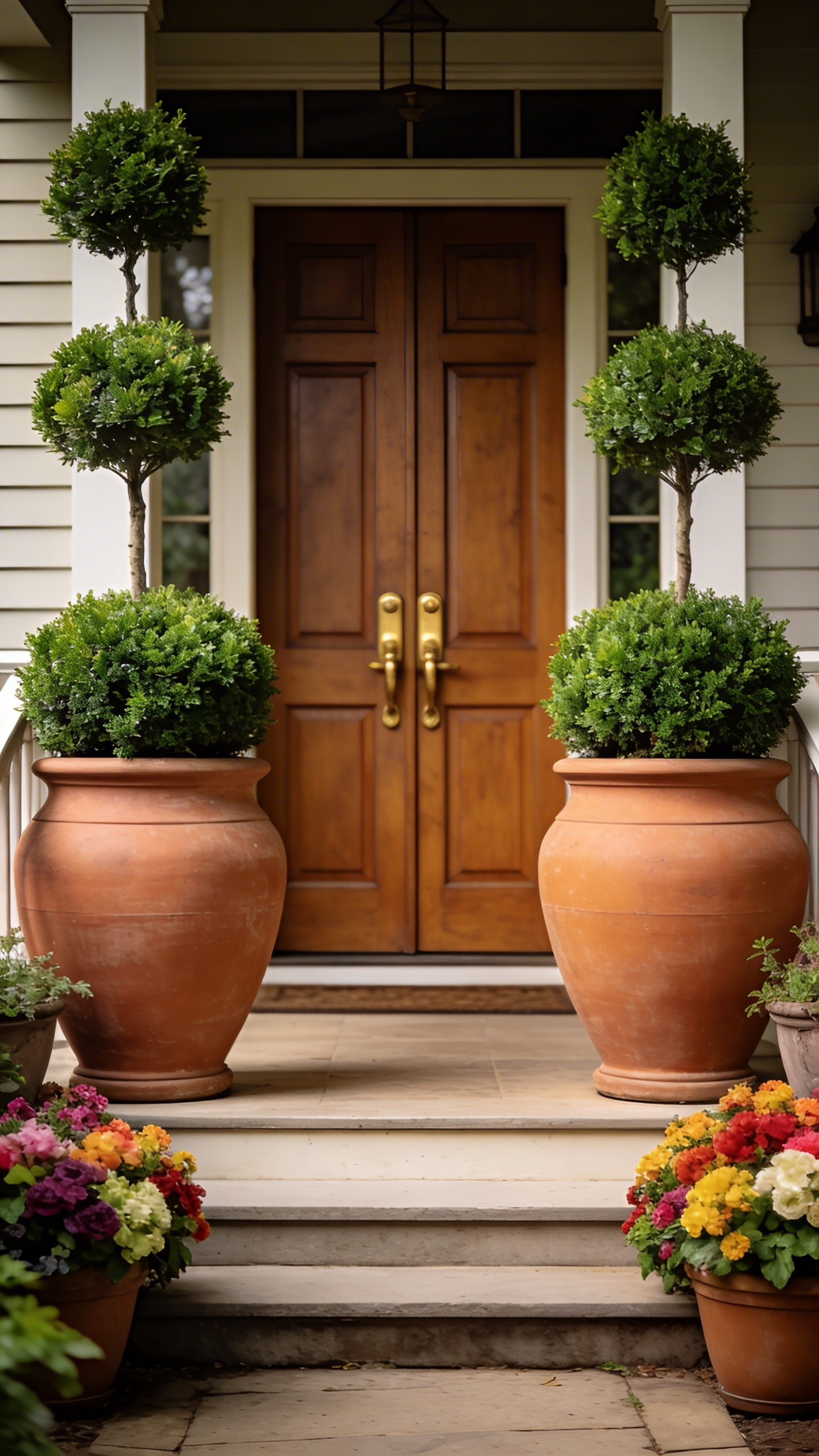
The easiest starting point for a focal planter is also one of the oldest. Two matching urns flank the front door, each with a standard topiary or a simple evergreen. Boxwood is the standard choice here — slow growing, evergreen, and tolerant of container life and partial shade. Pre-shaped standards are available from most nurseries for $30–$60 each. It looks intentional from day one and needs almost no maintenance beyond an occasional trim. That said, I’ve also seen this look done well with olive trees, bay standards, and tall ornamental grasses. The symmetry and scale matter more than the specific plant.
Building a Statement Planter
For a single large feature planter (24 inches diameter or larger), use the thriller/filler/spiller formula. One tall dramatic element like an ornamental grass or canna lily is the thriller. Medium bushy plants — petunias, calibrachoa — are the fillers. A trailing plant like sweet potato vine or bacopa is the spiller. Southern Patio’s glazed terracotta planters ($25–$75) look significantly more expensive than they are. The frost-resistant glaze means they survive most winters without cracking.
Weight is a real consideration outdoors. A 24-inch terracotta pot filled with soil runs 60–80 lbs when wet. Resin pots (Crescent Garden makes good ones for $45–$90) give you the look without the structural concerns. Drainage holes are not optional — standing water kills most plants within 48–72 hours. If a pot you love doesn’t have them, drill them before planting.
5. A Side Table That Doubles as Storage
The rule borrowed from good interior design is that every seat needs a surface within 18 inches. On a porch, where people bring drinks, phones, and books outside, this matters even more. Yet it’s one of the most overlooked elements in porch setups. People buy a sofa and chairs and then have nowhere to put anything.
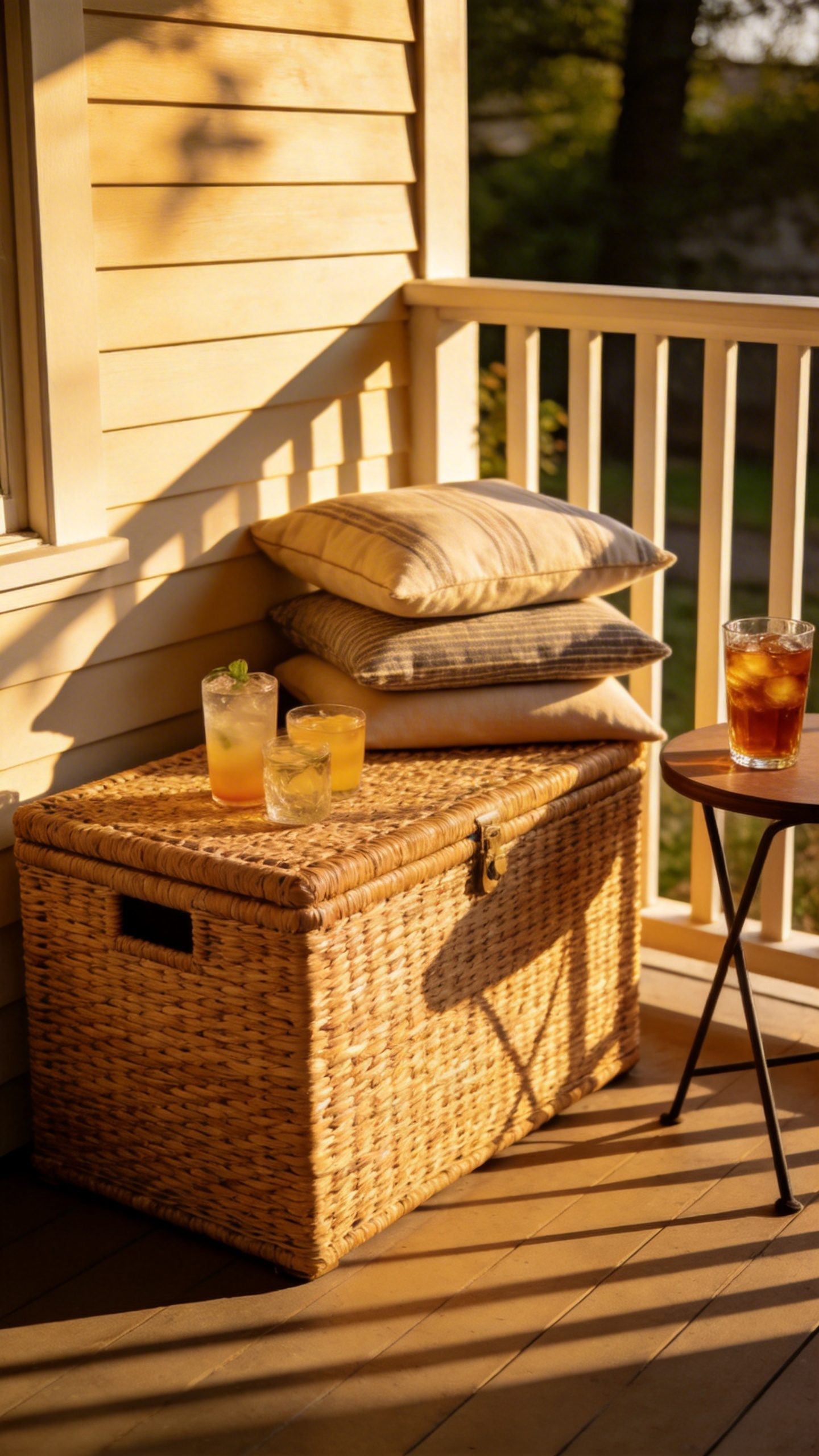
The storage ottoman is the most efficient piece of porch furniture you can buy. At coffee-table height (18–20 inches), it works as a surface, doubles as extra seating for a crowd, and stores cushions and blankets overnight. The Keter Unity XL ($95–$130) is a good option — resin construction, flat top rated to 485 lbs, and a 35-gallon capacity that holds a full set of sofa cushions. It doesn’t look particularly glamorous on its own, but the right cushion cover changes that quickly.
Side Tables for Tighter Spaces
For a smaller porch where a full storage ottoman is too large, a 16-inch diameter side table at 22–26 inches height is the practical solution. That height range aligns with most outdoor chair arms. The Glitzhome acacia and powder-coated steel option ($55–$75) is proportional for tight spaces and holds up to regular outdoor use. The wood-and-metal combination also works with wicker, teak, or painted metal furniture.
Also worth checking: the weight rating on anything with a decorative appearance. Some outdoor accent tables support only 50–75 lbs. If someone’s going to put a full drink tray on it, make sure the specs support that. For a more comprehensive look at furniture layout, these back porch ideas cover that topic in much more depth.
6. Vertical Wall Decor for Dead Porch Wall Space
Porch walls are some of the most underused surfaces in home design. An 8-foot porch wall with nothing on it doesn’t read as minimal — it reads as unfinished. Vertical porch decor anchors the space visually. It adds a layer that distinguishes a designed porch from one that’s just had furniture placed in it.
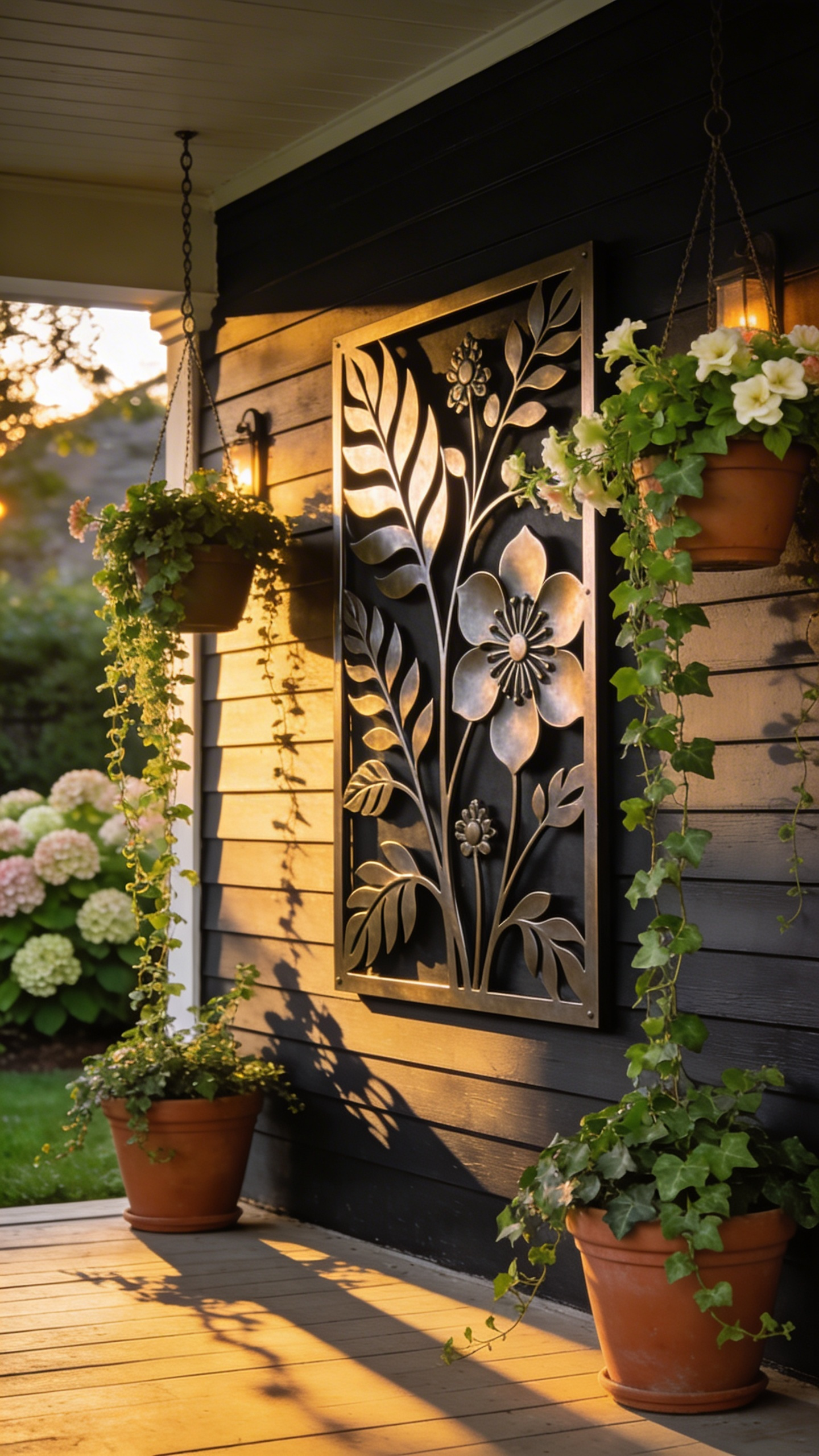
The most important rule for outdoor wall art is scale. A 12-inch piece that would look fine indoors disappears on an 8-foot exterior wall. The minimum size for anything on a full porch wall is 24 inches in the widest dimension. For a wall over 6 feet wide, a single 30–48 inch piece is more effective than a cluster of small items. Stratton Home Decor’s metal outdoor line ($40–$120) uses powder-coated iron in botanical and geometric designs. The oven-cured coating holds up without rust or paint degradation — that’s what separates outdoor metal art that lasts from the kind that leaves rust streaks on your wall after the first winter.
Making a Gallery Wall Work Outdoors
If you want a gallery arrangement, treat it as a single large installation rather than a scattered collection. Keep the gap between pieces to a maximum of 3 inches. Align them on a shared horizontal centreline — that gives you the collected feel without the cluttered look that happens when pieces are placed independently. For hanging, use stainless steel or coated screws only. Standard steel screws rust and streak light-coloured walls faster than you’d expect.
A living wall — wall-mounted planters with trailing plants — is also worth considering. Umbra’s Trigg wall planters ($30–$60 for a set of three) are powder-coated steel and create a strong visual moment with minimal installation. String vines or draping petunias from the planters and the effect is immediate.
7. A Welcome Mat With Real Design Intent
The welcome mat is the smallest piece of porch decor and one of the most frequently replaced. It’s also an opportunity that most people waste by defaulting to a coir mat with “HOME” printed on it.
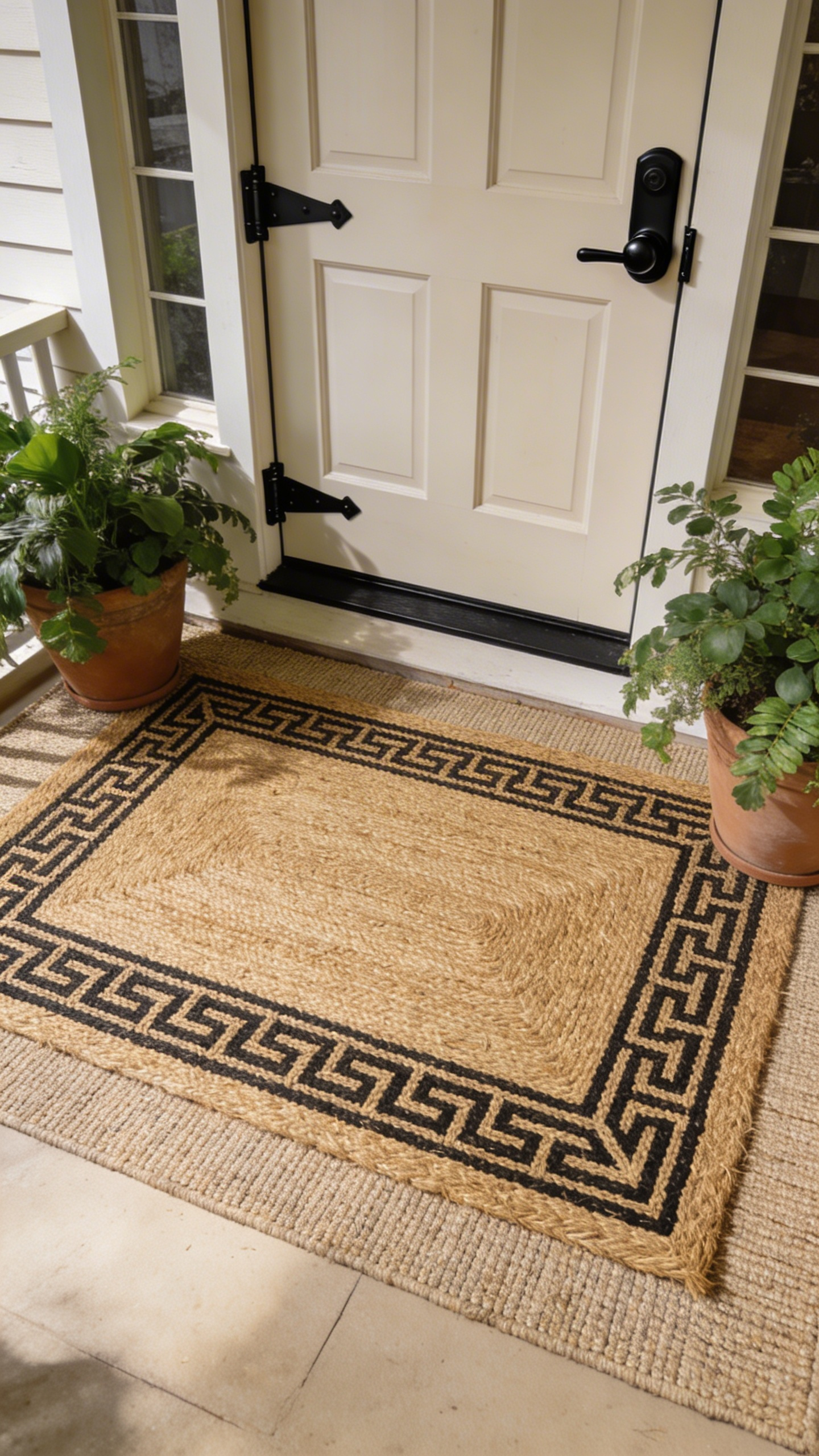
Scale is the issue most often. A standard 24×36 mat is undersized for most modern front doors — it looks like a postage stamp in front of a 36-inch door. The mat should be at least 80% of the door width. For a standard 36-inch door, that means a 30-inch or wider mat. Crate & Barrel’s oversized coir mats ($35–$55) come in 28×46 and 30×48. They work in a plain or simple border design that reads as deliberate rather than chosen-by-default.
The Layering Technique
The layering approach puts a flatweave outdoor rug as a base, with a coir or rubber mat on top. It does two things: it adds visual depth, and it keeps the primary rug significantly cleaner. The mat catches the worst of the dirt before anyone reaches the rug. DII’s braided polypropylene mats ($18–$35) work well as a layering base. The flat, low-profile construction doesn’t create a trip hazard under the top mat.
A note on rubber-backed mats: some backings can stain concrete and composite decking surfaces over time. Use a mat specifically rated safe for your porch surface, or put a thin barrier underneath. The Waterhog-style mats — commercial grade with a waffle pattern that traps water in channels — are worth the higher price ($60–$95) for porches that see heavy rain or muddy foot traffic. They’re what hospitality designers specify for covered entrances because they genuinely work.
8. A Porch Swing: The Porch Decor Investment Worth Making
If there is one piece of porch decor that gets more use than any other, it’s a swing or hanging chair. People are drawn to them the way they’re drawn to a fireplace indoors. It becomes the natural gathering point — the spot everyone wants to sit first.
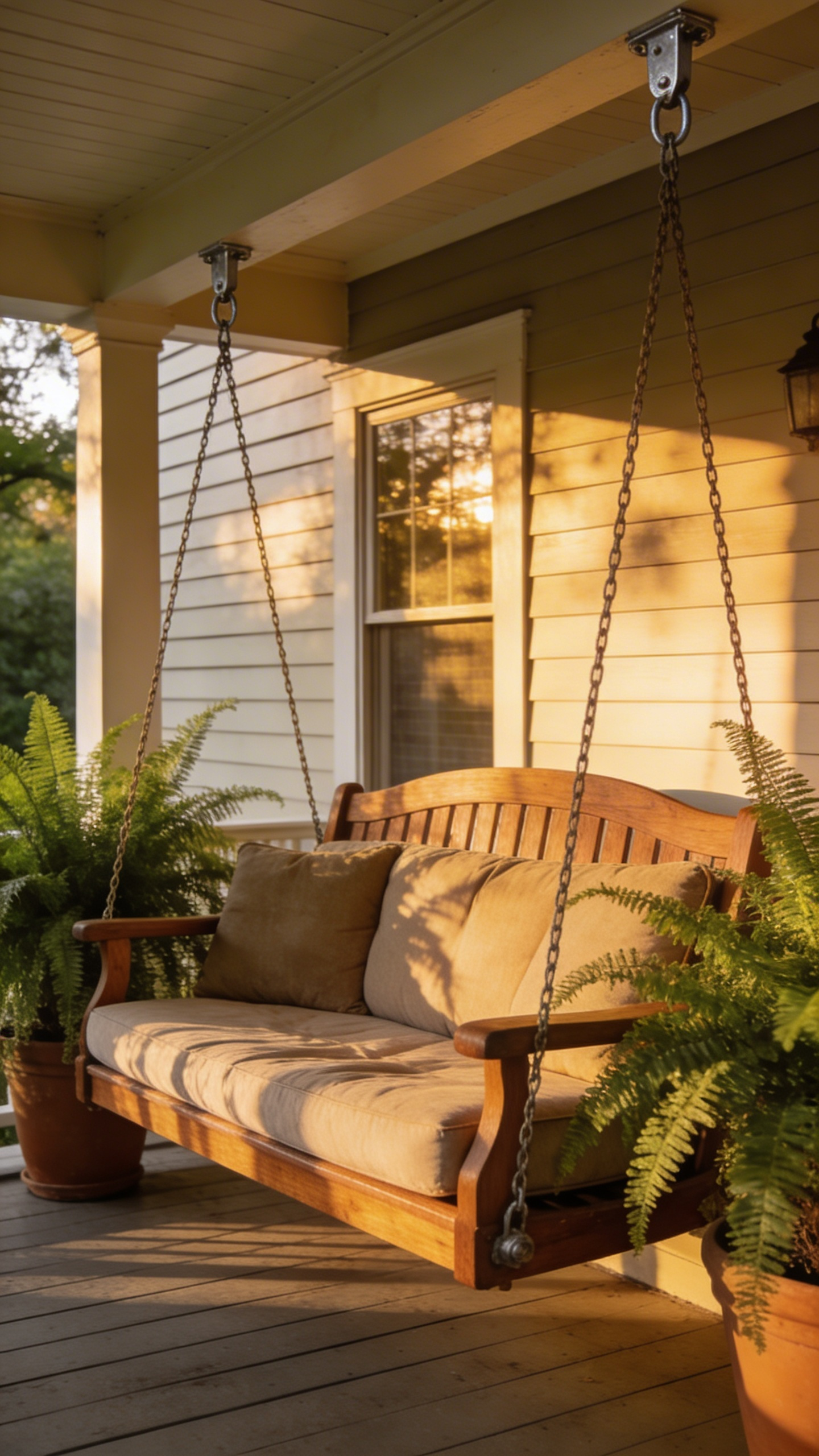
Before buying, check three things. First, ceiling beam depth — you need at least 6 feet for a standard 2-person swing with 4 inches of clearance on each side. Second, structural capacity — the installation point needs to support 500 lbs minimum for dynamic swing load. That means anchoring into a structural joist, not a decorative beam or fascia. Third, swing length relative to the porch depth. A 4-foot swing on a 6-foot deep porch leaves no room for anything else. The Tortuga Outdoor Bayview teak swing ($499–$699) is the premium recommendation. Teak lasts 20+ years with minimal maintenance, and the hardware is included.
Hanging Chair as an Alternative
For a smaller porch where a full swing is impractical, a hanging egg chair needs only one anchor point. Look for one rated for 300–500 lbs depending on the chair and its occupant capacity — and use a swivel hook between the ceiling mount and the chain. That prevents cord twisting and extends the hardware lifespan considerably. The Outsunny hanging swing chair ($120–$180) uses resin wicker construction and includes a cushion.
Cushion depth matters for comfort: a 4-inch cushion is the minimum for lounging; 5 inches is noticeably better. A swing with a 2-inch cushion is technically a swing but practically more uncomfortable than a park bench. The 40% increase in swing and hanging chair sales since 2020 reflects a genuine shift in thinking — more people treating the porch as a room rather than a storage area for garden chairs.
9. Layered Lantern Lighting: Essential Porch Decor After Dark
String lights handle the overhead level. But porch decor that relies on a single light source always looks flat — regardless of how good that source is. Layering light from the ceiling down to surface level is the technique that makes a covered porch feel as warm as an interior room after dark.
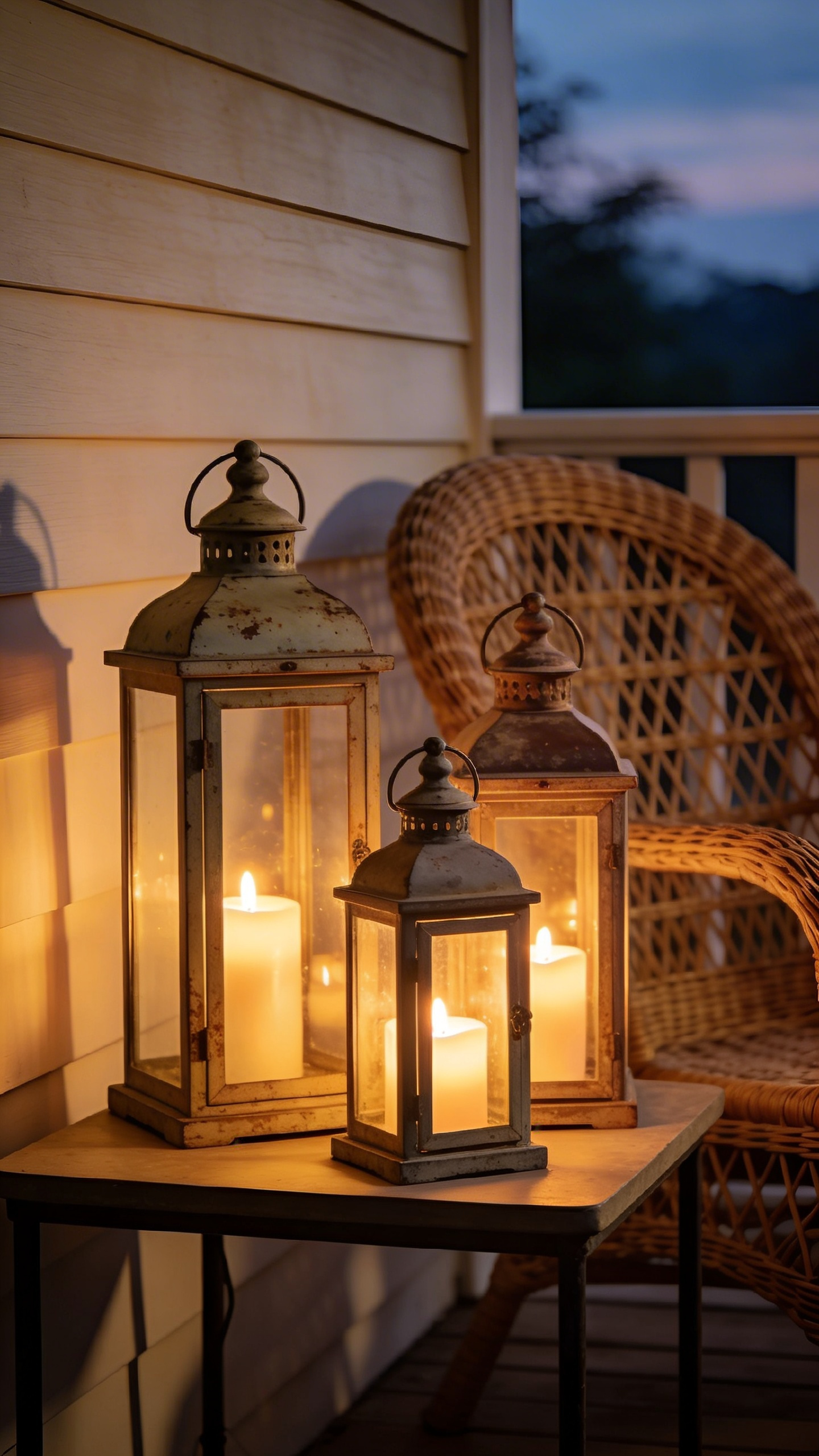
The principle is simple: overhead light for ambience, and low surface light (lanterns and candle groupings) for warmth. On a porch, you can usually skip the table lamp tier and go straight from string lights overhead to lanterns at surface level. It creates the effect without the complexity. A cluster of three lanterns at staggered heights (6, 10, and 14 inches) in a corner that would otherwise be dead space does exactly this.
Material and Battery-Powered Options
Galvanised steel and powder-coated iron hold up to outdoor conditions well. Cast aluminium is lighter and doesn’t rust. The Better Homes & Gardens 14-inch lantern ($22–$35) is genuinely good for the price — powder-coated steel in matte black or antique bronze, proportional to most porch spaces. The Threshold line at Target ($35–$60) is also worth looking at for anyone wanting cleaner, more modern lines.
Battery-operated LED candles have improved significantly in the last five years. The Luminara Outdoor Flameless Candle ($20–$55) uses a wax-like exterior with a convincing flicker mode. It has an auto-timer and is IP44 waterproof. Honestly, I use these outdoors rather than real candles. Wind extinguishes an open flame quickly, and relighting undercuts the whole relaxed mood you’re trying to create. For small porch applications, the layered lantern approach from balcony decor uses the same logic and is worth reading.
10. A Coordinated Seating Arrangement for Conversation
The arrangement of furniture on a porch matters more than the furniture itself. Two mismatched chairs angled toward each other with a shared side table between them is a better conversation space than a matching three-piece set pushed against the walls.
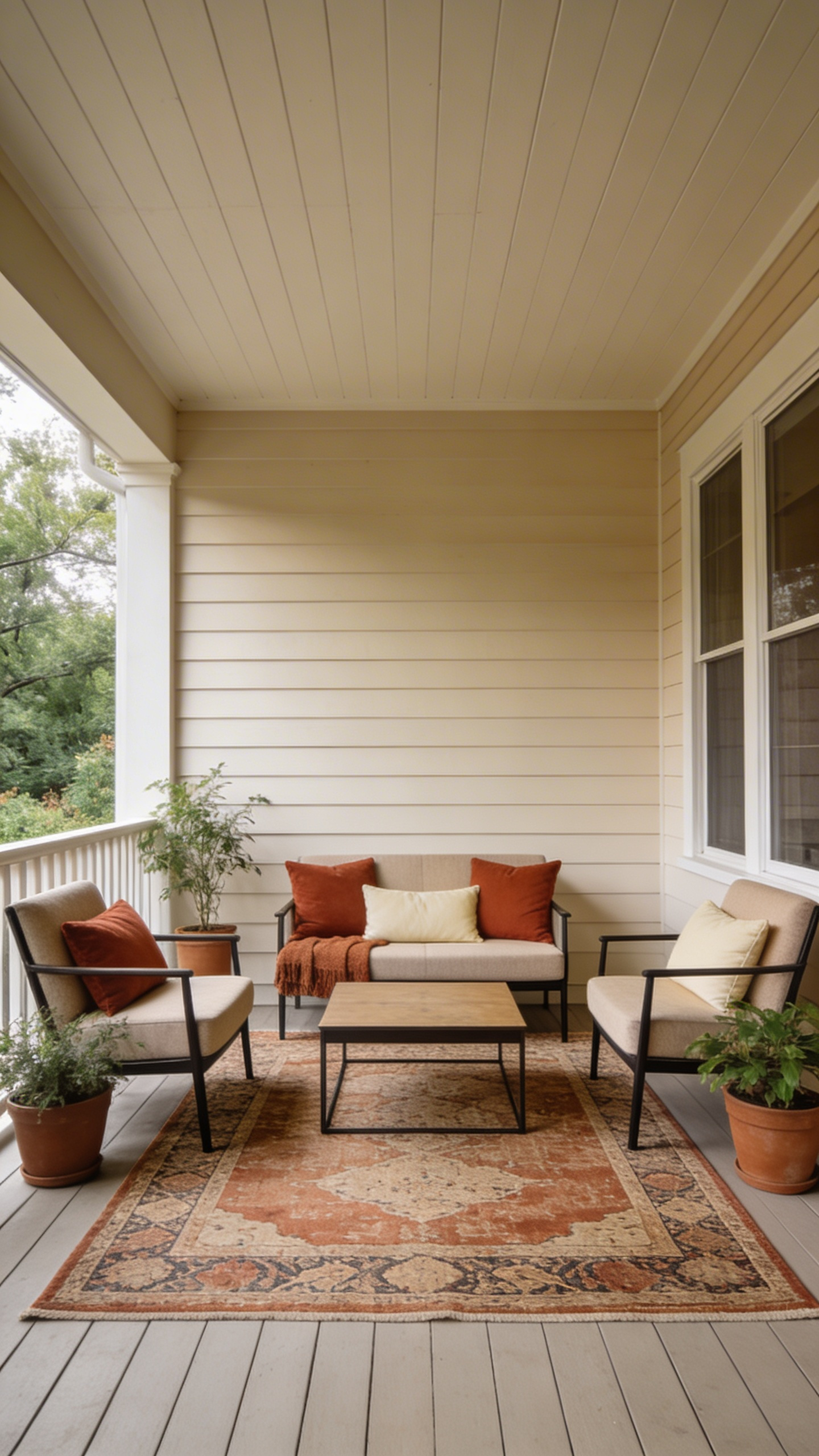
The conversation circle principle is borrowed from interior design. All seats should face each other within a 6–8 foot diameter for comfortable interaction without needing to raise your voice. On a porch, this often means angling chairs 30–45 degrees toward the centre of the space rather than pushing them flush with the walls. That simple adjustment changes a porch from a waiting area into a room.
For mismatched furniture (which many of us have), the fastest unity fix is identical cushion fabric across all the pieces. If the sofa has a navy stripe cushion and the two chairs have solid rust cushions, those three pieces now share a colour family. That’s often enough to make a collected-from-various-sources assortment read as curated. A 5-piece PE rattan set like the Devoko ($280–$380) handles the coordination problem at the source — sofa plus two chairs plus two side tables in one matched set.
When Space Is Limited
For a porch under 100 square feet, two Adirondack chairs angled toward each other with a shared side table is one of the best two-person arrangements you can build. The chairs recline, there’s a surface for drinks, and the angle naturally puts you facing the other person rather than the street. Allow 18 inches of clearance between any seat and the coffee table for comfortable legroom. That’s the measurement most porch setups get wrong. Research in environmental psychology shows that circular or semi-circular seating arrangements lead to 30–40% longer social interactions compared to side-by-side or row arrangements. Good porch decor isn’t just aesthetic — it’s functional design.
11. Window Boxes or Rail Planters for Instant Charm
If you want the fastest change in how a home’s front looks from the street, window boxes do it. Even two boxes under the front windows — filled simply and kept well-watered — shift the character of a house’s exterior in a way that no coat of paint fully replicates.
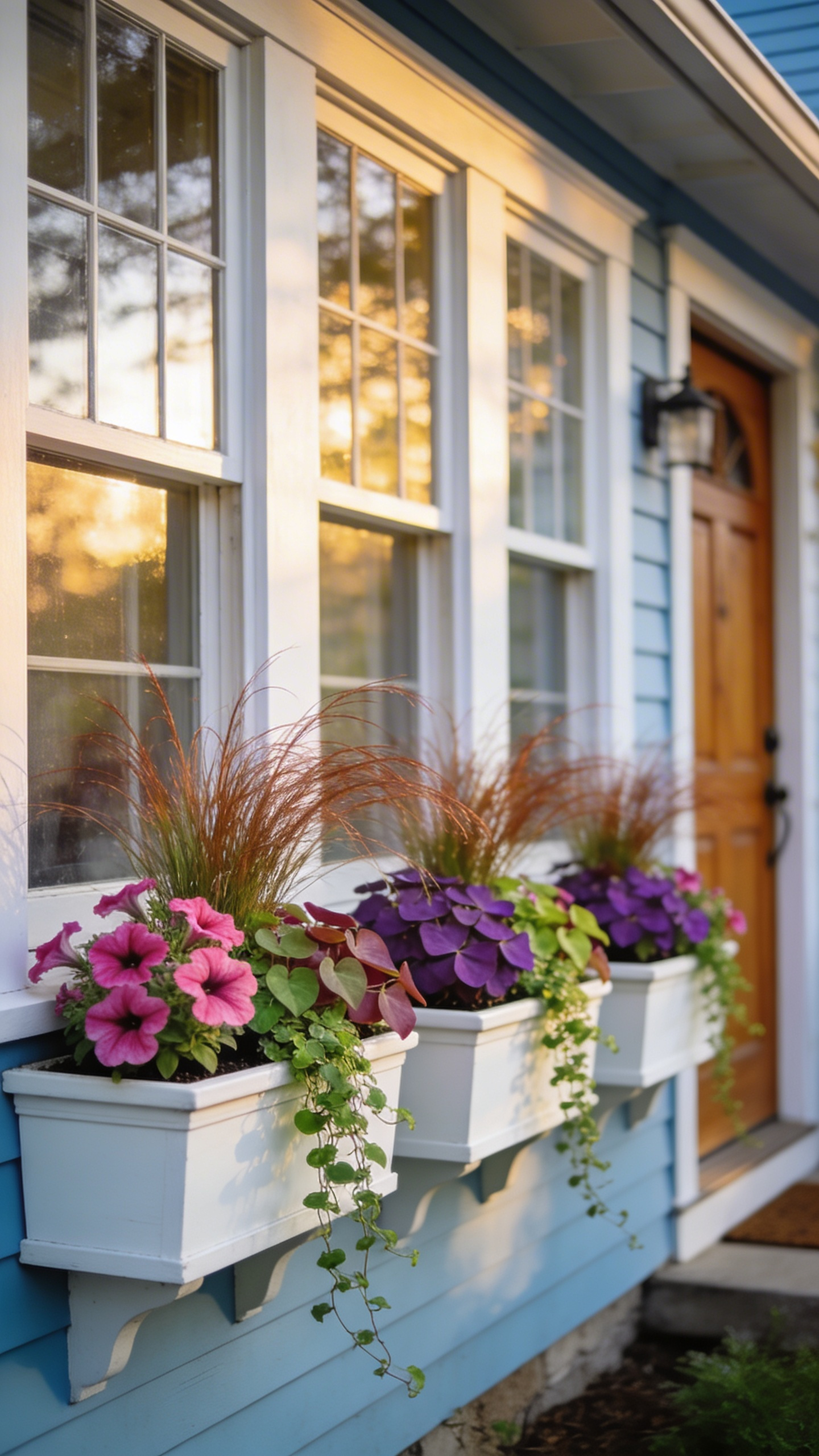
The thriller/filler/spiller formula translates directly to window boxes. One tall element provides height and drama (ornamental grass, an upright spike plant). Medium bushy plants fill the middle layer — petunias, calibrachoa, alyssum. A trailing plant hangs over the front edge — sweet potato vine, lobelia, bacopa. Mayne’s Fairfield 30-inch boxes ($45–$65) are a practical middle-ground option. They’re polyethylene resin that looks like painted wood, with drainage holes and sizes from 24 to 36 inches. For a self-watering option, the LECHUZA BALCONERA ($60–$90) includes a sub-irrigation reservoir. It can go 3–7 days between refills — genuinely useful for busy households.
Installation and Plant Density
Brackets are the part of window box installation that most people underestimate. A 30-inch box full of soil and plants weighs 25–35 lbs when wet. The brackets must be rated accordingly and anchored into studs or masonry, not just siding. One drainage hole per 12 linear inches is the minimum. Good drainage is non-negotiable for container plants.
Plant density is where most people are too conservative. For seasonal annuals in a window box, you want it to look full within 2–3 weeks. That means spacing plants at 4–6 inches rather than the 12 inches most spacing guides suggest for garden beds. The box length should stay within 2 inches of the window width for visual proportion. Slightly too small and it looks like an afterthought. Slightly too wide and it fights the window frame.
12. Outdoor Curtains for Privacy and Style
Curtains do something that every other element in porch decor cannot: they define the edge of the space. When open, they frame the view and give the porch a beginning and an end. When closed, they create genuine privacy — the most-cited functional concern for people who own front porches and don’t use them as often as they’d like.
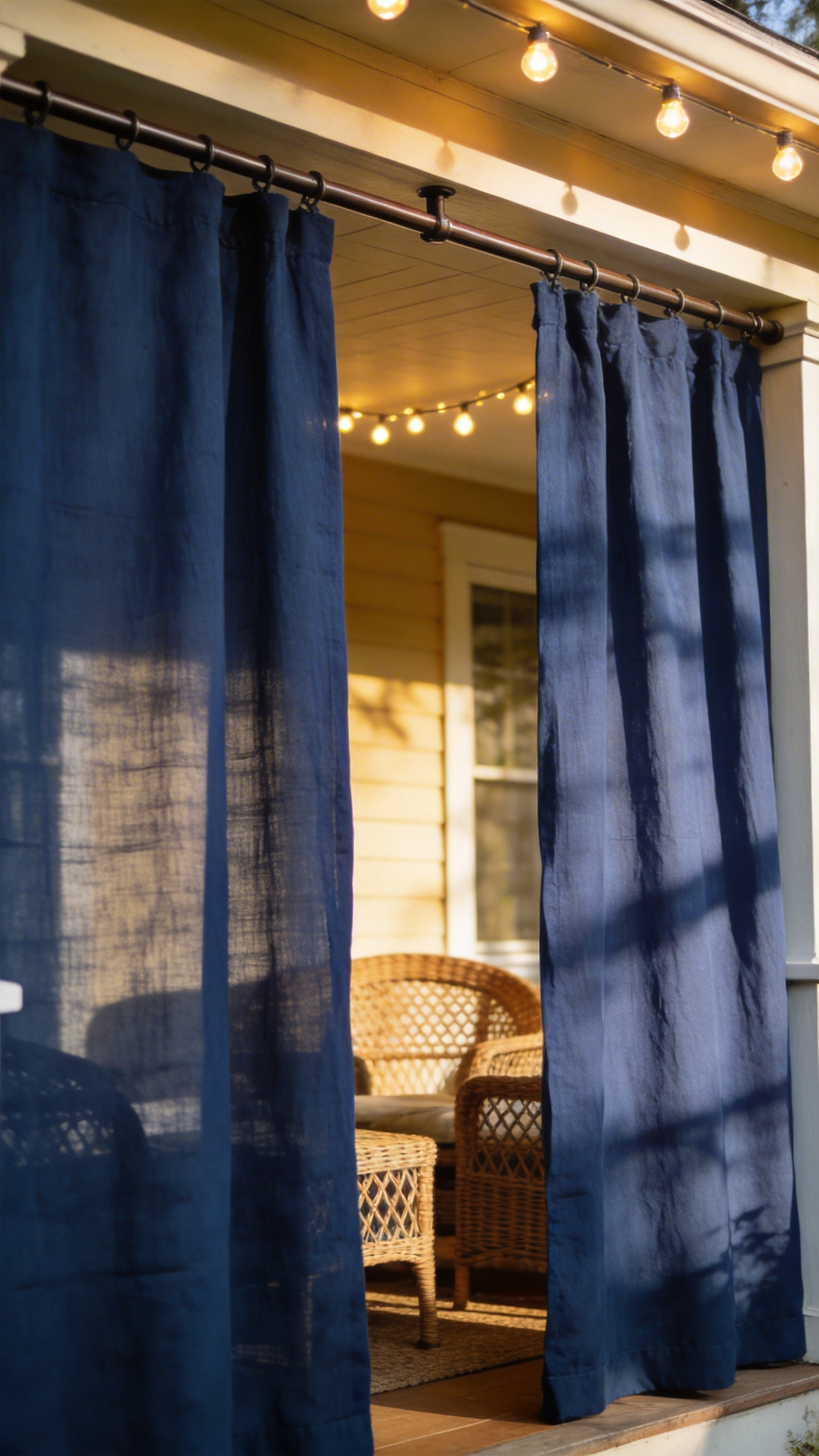
The fabric needs to be solution-dyed, not surface-printed, to hold its colour outdoors. Sunbrella’s outdoor curtain panels ($79–$149 each from Pottery Barn) use solution-dyed acrylic that genuinely resists UV fading over multiple seasons. The budget option — NICETOWN thermal outdoor panels at $28–$55 per pair — uses a polyester with reasonable UV resistance. It’s also machine washable, which matters because outdoor curtains collect pollen and dust quickly. White and off-white outdoor curtains are the most popular but show environmental grime fastest. Linen-look grey, navy, or sage hold their appearance significantly better between washes.
Rod Systems and Length
For a covered porch without existing rod hardware, a tension rod system or clip system attached to screw-in hooks avoids drilling into structural members. Curtain rod placement should be 6–8 inches above the top of the opening for standard hanging. Or go all the way to ceiling level if you want the maximum height-drama effect. Running a curtain from ceiling to floor makes a porch with 8-foot ceilings feel like a room with 10-foot ceilings. Outdoor curtain rods should be powder-coated aluminium or galvanised steel — standard steel rusts visibly within a season in most climates.
Curtain length should reach the floor or puddle slightly. Anything shorter than floor-length looks unfinished outdoors. If you’re working with front porch ideas for a full front porch redesign, curtains are one of the most-recommended finishing steps for framing the seating area.
13. A Beverage Station or Bar Cart on the Porch
A drink station on the porch changes how gatherings work. When refreshments are accessible outside without requiring anyone to go back in, people stay. That’s not a design theory — hospitality research shows outdoor gathering duration increases by an average of 45 minutes when drinks are available outside.
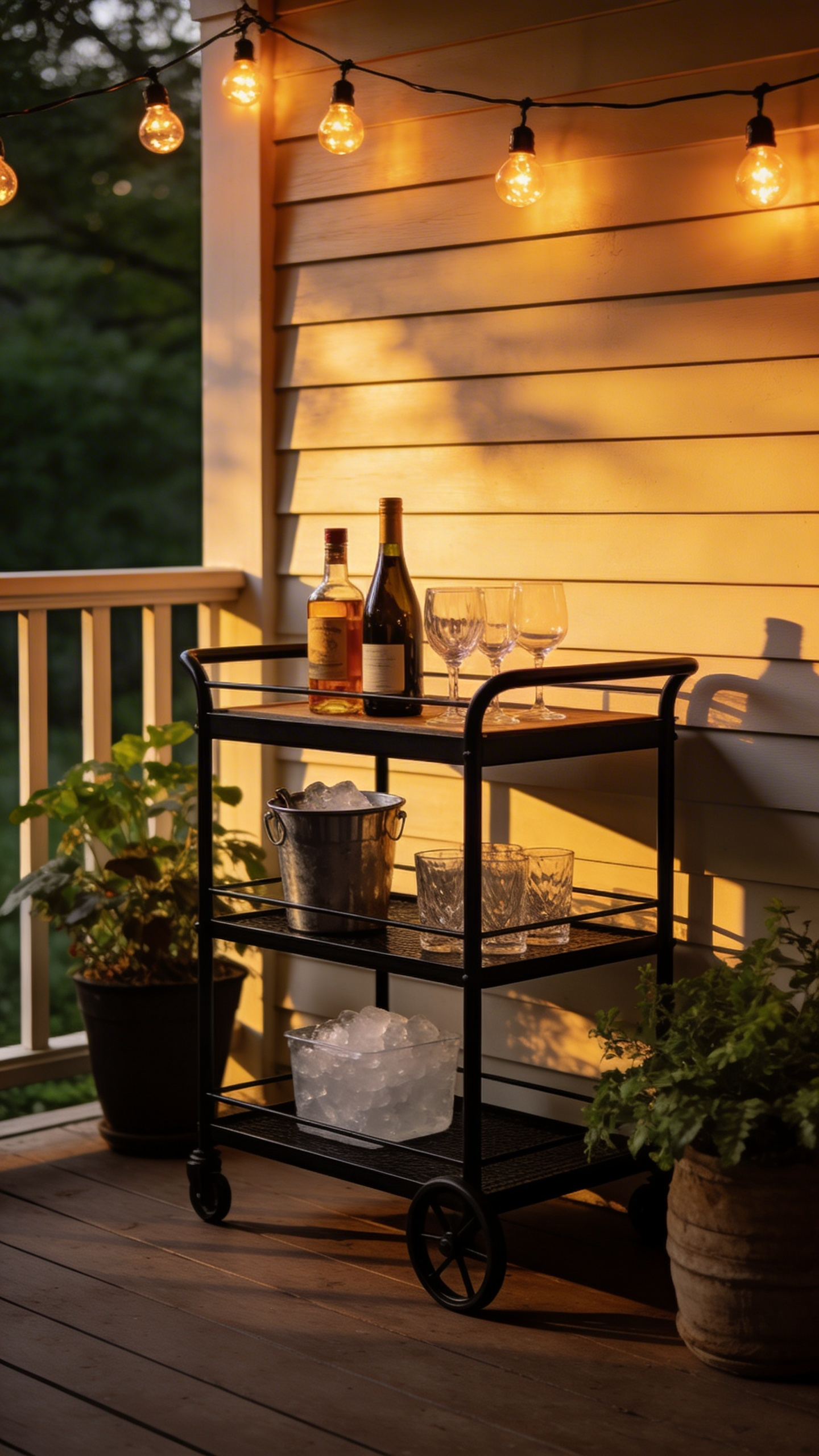
The simplest version is a galvanised bucket filled with ice and drinks on a folding table. For a casual gathering, it works just as well as a full bar cart. The goal is accessible drinks outside, not a specific furniture piece. But if you’re styling a porch for regular use, a powder-coated aluminium or steel cart is worth having. The Best Choice Products 2-tier bar cart ($65–$90) uses powder-coated steel with a wine glass rack and bottle storage on four wheels. It moves inside easily before a rainstorm and lives outside the rest of the time.
Keeping It Practical
A small insulated cooler at the base of the setup handles ice and cold drinks without requiring power. The YETI Roadie 48 ($250–$280) is a significant investment. However, its three-day ice retention and flat top (which doubles as a serving surface) make it genuinely multifunctional. If that’s outside budget, any well-insulated hard cooler in the $50–$80 range works for an evening. The Suncast Outdoor Beverage Center ($150–$200) is a middle option — a freestanding cabinet designed for beverage storage with a lockable door, though it lacks the mobility of a cart.
If you’re using an outdoor mini-fridge, it needs a GFCI-protected outlet and placement under a covered area. Shade placement also matters for efficiency. A mini-fridge in direct sun works significantly harder and fails sooner than one in a covered, shaded spot. This is the kind of practical porch decor detail that doesn’t show up in the photos but affects whether the setup actually works.
14. Seasonal Porch Decor Swaps That Don’t Require a Total Redo
The most manageable approach to keeping porch decor feeling current year-round is a two-layer system: a permanent base layer that stays through all seasons, and a swap kit of seasonal accent pieces that takes 30 minutes to exchange.
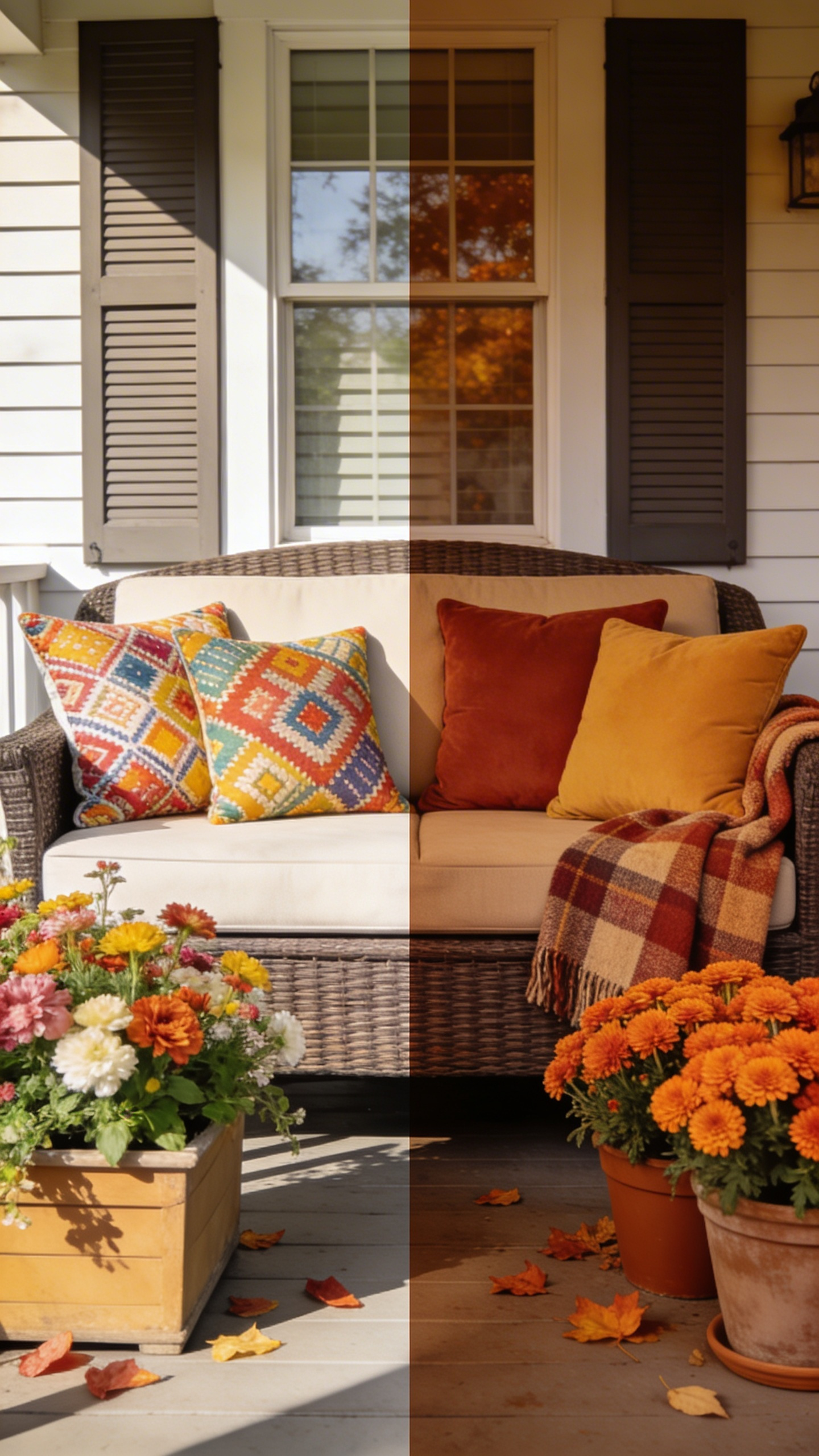
The permanent base layer is the furniture, the rug, and the overhead lights. None of those change. The seasonal kit works across pillows and pillow covers, planter contents, the front door wreath, and any accent throws. Spring/summer swaps lean toward bright solids — coral, yellow, white — with annual flowers in the planters and a citrus or botanical wreath. Autumn/winter swaps shift to harvest tones — rust, ochre, deep green — with mums and ornamental kale in the planters, a dried eucalyptus wreath, and a plaid throw on the swing.
Storage Makes the System Work
The limiting factor is always storage. Designate a weatherproof bin for each season’s swap items. A Sterilite WeatherTight box ($18–$30) seals out moisture and fits neatly in a garage or hall closet. So the swap becomes a 30-minute task rather than a two-hour excavation. The most cost-efficient move: buy one good set of outdoor pillow inserts and rotate covers rather than full pillows. Target’s Threshold seasonal pillow covers run $10–$20 each. Four seasonal covers cost less than two replacement pillows. Wreath sizing follows a proportion rule — approximately 75% of the door width. A 36-inch door works best with a 24–28-inch wreath. Larger overwhelms the door; smaller disappears against it.
15. Address Numbers and Front-Door Hardware as Porch Decor
Address numbers and door hardware are the most-overlooked elements in porch decor. They’re also among the cheapest to upgrade and among the highest in visible impact per dollar spent.
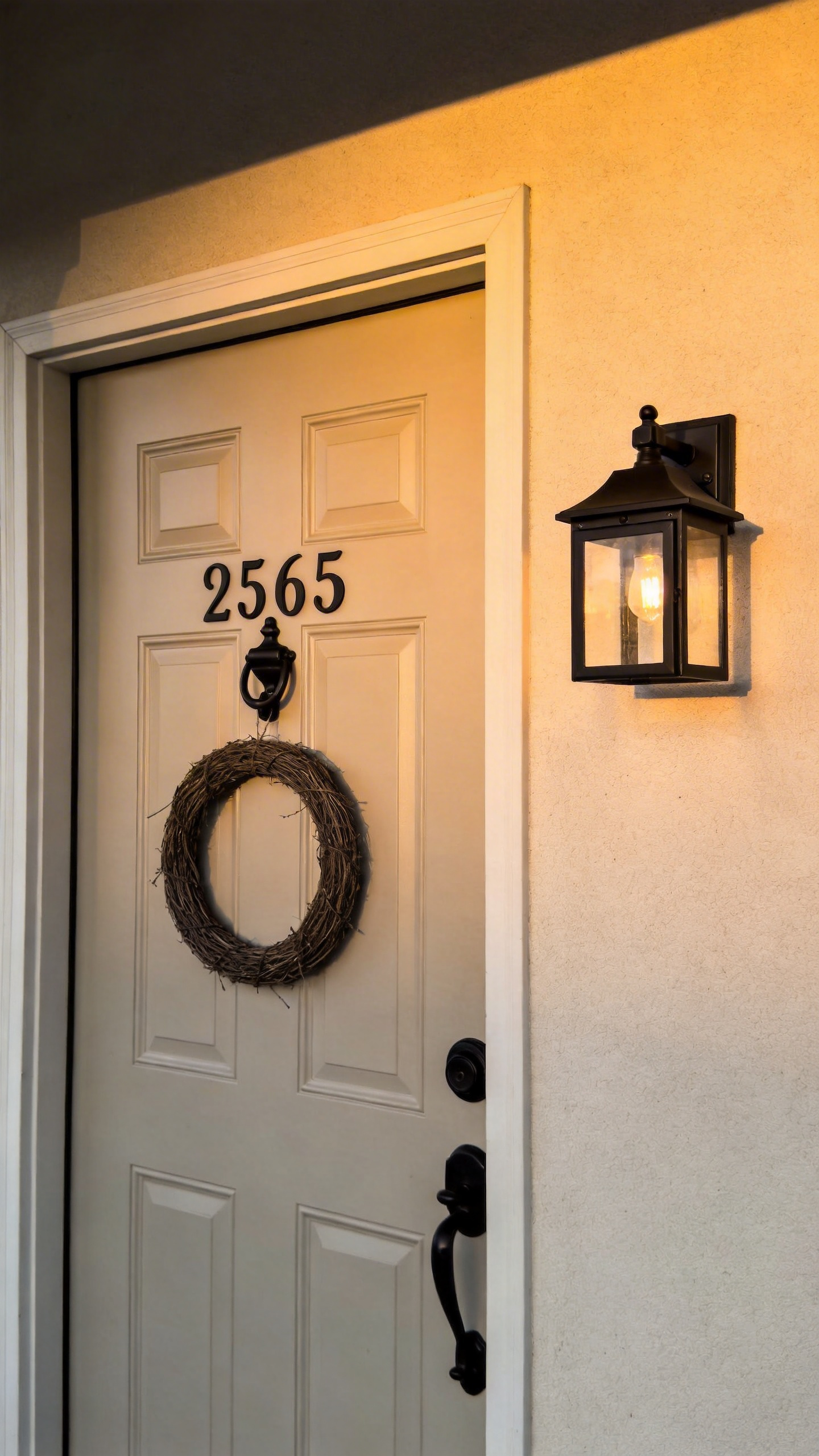
All the metal elements on the porch facade should share a finish family. Matte black, brushed brass, and antique bronze are the three current choices that coordinate well. The key is that the address numbers, the door knocker (if present), the knob or handle, and the nearby light fixture all belong to the same finish. Mixing them reads as oversight rather than a deliberate choice. Neutype’s modern house numbers ($25–$45 per set) come in brushed aluminium with a clean sans-serif typeface. They’re proportional, readable from the street, and finish-compatible with most modern door hardware. Installation takes about 20 minutes.
Visibility and Specification
Emergency services require minimum character heights for address numbers. Most local codes specify 4-inch minimum height visible from the street. Standard numbers at most hardware stores are 3–3.5 inches. Neutype and most speciality suppliers offer 5-inch numerals, which meet code and read more confidently from the kerb. For a higher-impact option, backlit house number plaques cost $80–$140. They’re LED-lit acrylic faces that glow at night and are visible from the street without any additional lighting. They look considerably more expensive than they are.
Replacing tarnished brass or faded painted hardware with a coordinated matte-black set takes about two hours and $80–$150 in materials. Real estate agents and home stagers consistently rate this as among the highest ROI exterior updates — with an estimated return of 3–5x the investment in buyer perception. Even if you’re not selling, a front door that looks finished makes everything else on the porch read as more intentional. If you’re updating front door decorations alongside the hardware, coordinating the wreath or seasonal greenery with the hardware finish is what pulls the whole entrance together.
Bringing It All Together: Where to Start With Porch Decor
The 15 ideas in this list don’t all need to happen at once. In fact, the most effective approach is to start with the two or three elements that do the most structural work and build from there.
For most porches, those are the rug, the lighting, and the seating arrangement. The rug defines the space. The lighting determines whether the porch gets used in the evenings. The seating arrangement determines whether people actually sit and stay. Get those three right and the rest of the list is finishing work — the kind of additions that make a functional porch feel considered and comfortable rather than purely practical. For anyone tackling a larger deck decorating project that extends beyond the porch itself, the same principles apply. Define the space first, light it properly, and arrange seating for conversation rather than for visual symmetry.
The porch that gets used isn’t necessarily the one with the most things on it. It’s the one where the furniture arrangement invites sitting, the lighting makes it feel good after dark, and the details — the pillows, the plants, the mat, the hardware — signal that someone thought about the space as a room. Start with one idea from this list and build. The most-used porch I’ve ever designed started with two chairs, a $45 rug, and a set of string lights. Everything else came later.