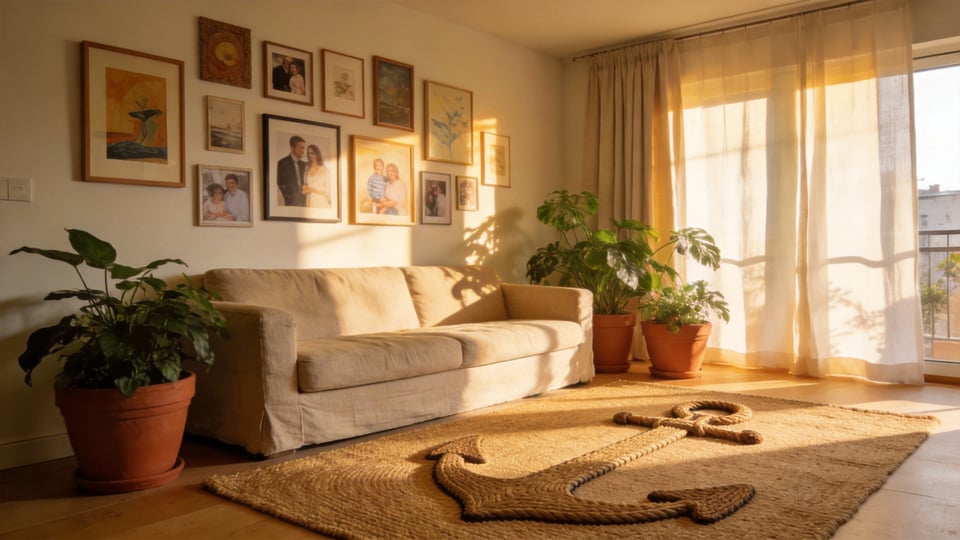
There’s a moment most apartment renters know well. You’ve just moved in and the boxes are unpacked. You’re standing in the living room staring at a sofa that looks lost on bare floors, blank white walls, and a window that somehow looks completely unfinished. That feeling — part excitement, part mild panic — is exactly where apartment living room decoration begins. The good news is that it rarely requires a big budget or a designer’s eye. What it needs is a sequence of deliberate decisions that build on each other, because each well-chosen element makes the next one easier. These 15 ideas cover the specific moves — from rug sizing to colour logic — that turn a rental box into a space that feels genuinely yours.
1. The Anchor Rug: A Foundation Rule for Apartment Living Room Decoration
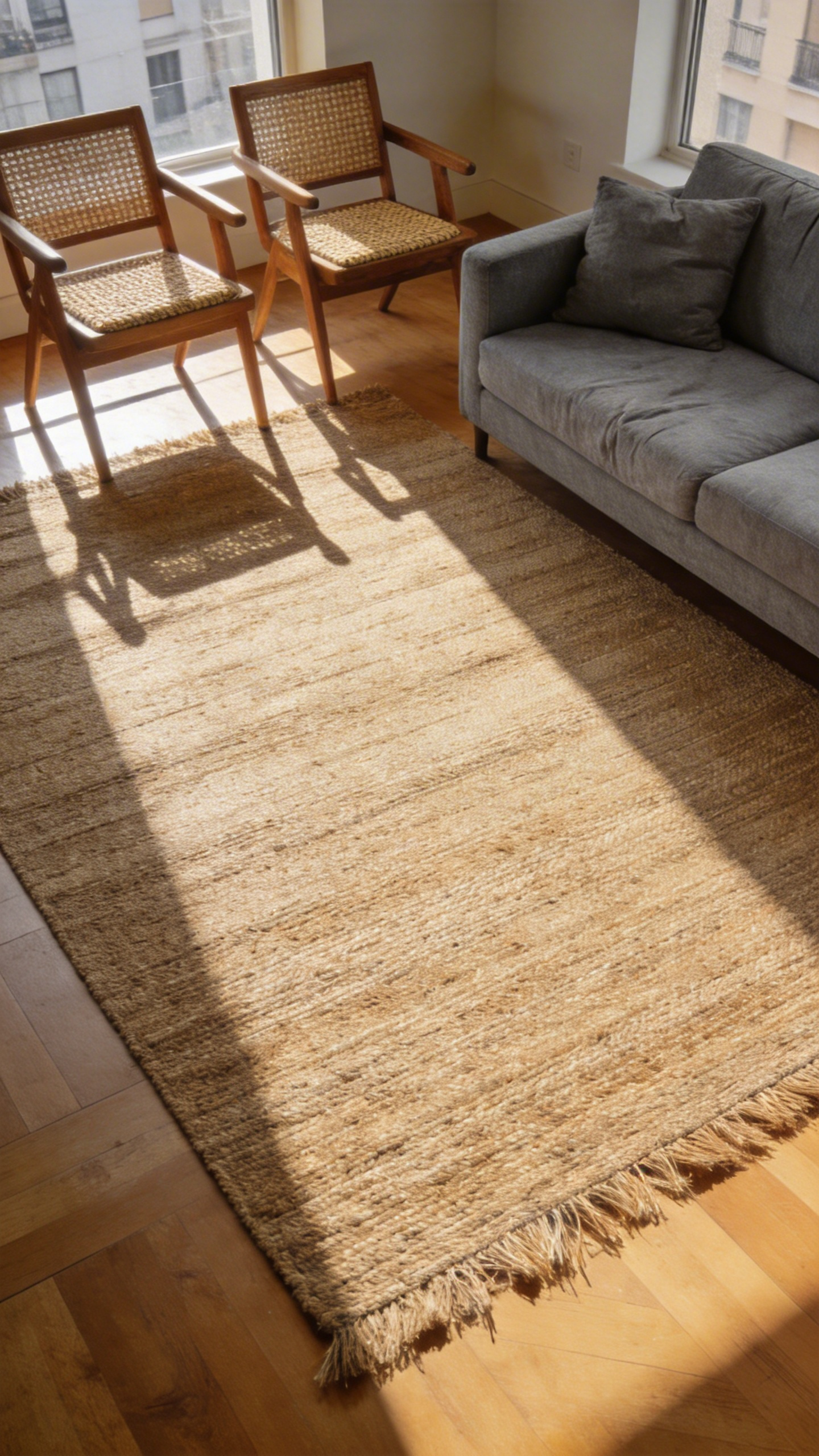
Here’s the one rule worth tattooing on your hand: buy a bigger rug than you think you need. Most people instinctively reach for a 5×7 or 5×8 because it looks about right in the store. But once it’s under a full sofa-and-chairs arrangement, it floats in the middle of the room like a postage stamp. The correct approach — the one interior designers use — is the “front legs on” rule. Every major seating piece should have at least its front two legs resting on the rug. That means an 8×10 is typically the minimum for a standard living room.
Why the Right Rug Size Changes Everything
The visual effect of a correctly-sized rug is surprisingly dramatic. When furniture legs rest on the rug, the seating arrangement reads as a single composed zone rather than a collection of isolated pieces. Also, the rug defines the boundary of the living area. This matters most in open-plan apartments, where the living room can bleed into a dining area with nothing between them.
For most standard apartments, an 8×10 ft rug is the sweet spot. However, if your living room is on the larger side, a 9×12 works proportionally better. Low-pile rugs are the practical choice under furniture — they don’t bunch, and chair legs slide across them easily.
What to Buy and What to Avoid
Budget-friendly picks include the Ruggable washable rug (8×10, around $299–$429 USD). It’s a genuine rental apartment revelation — machine washable, which handles the inevitable wine spill without drama. The IKEA STOENSE at $179 is the budget standout; the Ruggable’s washable feature makes it worth the premium for most renters.
One practical step before buying: tape the dimensions on your floor with painter’s tape. Even a 10-minute mock-up reveals whether a size is right and avoids an expensive return.
2. Layered Lighting: The Apartment Living Room Decoration Upgrade You Are Missing
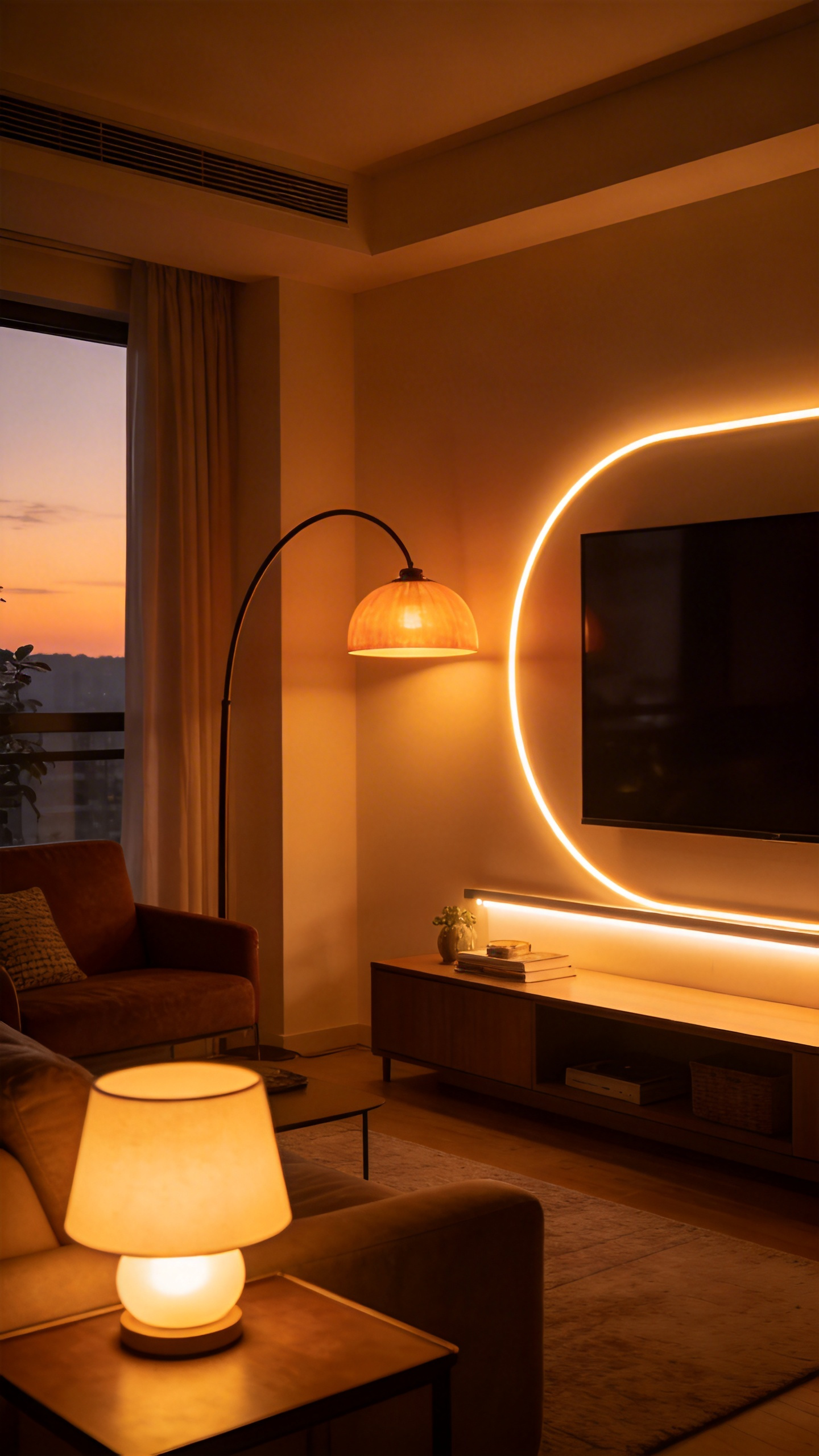
The overhead light in most apartment living rooms is, bluntly, a design problem. It produces flat, even illumination from directly above — which is perfectly functional for finding your keys but does nothing for atmosphere. In fact, it actively works against the warm, layered feel that good rental decorating is built around. So, the simplest upgrade you can make in any rental is to stop using the overhead light in the evenings. Build your lighting plan from the floor up instead.
The Three Layers That Work Together
Lighting designers describe three layers in any good residential scheme: ambient, task, and accent. In an apartment, your overhead fixture covers ambient. Everything else — floor lamps, table lamps, LED strips — handles accent.
Because rental overhead fixtures are rarely dimmable, a Lutron Caséta dimmer ($25–$45) for a floor lamp gives you the control you actually need. It requires no rewiring. Arc floor lamps are particularly useful in apartments. They swing out over a reading chair or sofa without touching the wall. Also, they cast light in a wide, diffuse pool rather than a harsh beam. The Brightech Sparq arc lamp ($89–$129 USD) and the IKEA RANARP ($79) are both reliable options that don’t look cheap.
The Colour Temperature Detail Most People Overlook
Bulb colour temperature matters as much as placement. Warm white at 2700K–3000K produces the golden, residential glow associated with well-designed spaces. Cooler bulbs at 4000K+ look clinical. Check the Kelvin number on the packaging — this single adjustment changes the entire feel of an apartment living room at night.
LED strip lighting behind the TV costs $20–$50 for a standard kit, or $79–$99 for the Philips Hue Gradient version. It serves two functions: reducing eye strain in dark rooms and creating a soft ambient halo. That halo transforms the TV wall from a utilitarian surface into an atmospheric focal point.
3. The Statement Sofa: How Your Couch Sets Every Other Decorating Decision
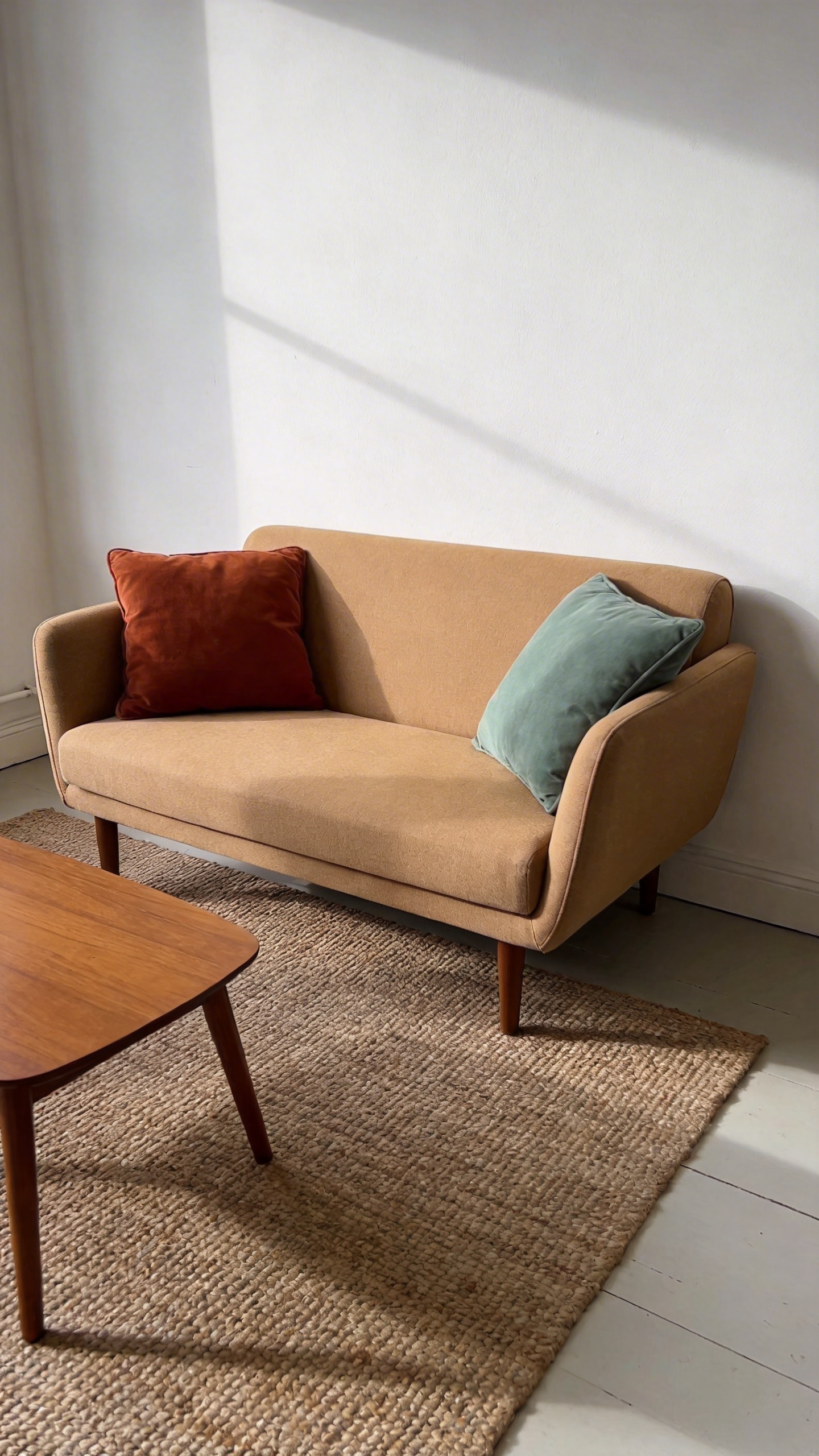
Everything in apartment living room decoration radiates outward from the sofa. Its colour determines which accent colours will work. Its scale determines how much floor space is left. Its fabric sets the formality level of the whole room. So, getting the sofa decision right — particularly in terms of size — is the single most consequential choice in the entire project.
The Scale Problem Most Renters Get Wrong
Standard three-seater sofas run 84–96 inches wide. That’s fine in a large living room. But in a typical one-bedroom apartment with a 12×14-foot living room, a 96-inch sofa can consume the entire wall and leave almost no breathing room. A better benchmark: the sofa should take up no more than two-thirds of the wall it sits against. For many apartments, that means a loveseat (60–72 inches wide) or a compact two-seater sofa in the 75–85 inch range.
The Article Sven Sofa (85 inches, $1,299–$1,799) is a near-perfect apartment sofa: its mid-century silhouette with exposed legs feels lighter than the boxy alternatives. The Burrow Block Nomad ($1,295–$1,595) ships in sections — a practical advantage for tight elevator buildings.
The Fabric Decision That Will Follow You for Years
Performance fabrics — Crypton, Sunbrella, or brand-proprietary equivalents — are worth the slight cost premium for apartment sofas. They resist staining, repel pet hair, and clean up without professional treatment. In a rented space where the lease end means movers and transit, a fabric that can handle a bit of real life is a practical advantage.
Also, if you choose a neutral sofa — warm grey, cream, or linen beige — you can change the room’s entire personality with cushion swaps alone. A bold or colourful sofa is a longer commitment — everything else has to work around it.
4. Gallery Wall on a Budget: Framing and Arrangement Strategies That Look Intentional
Blank walls are the single most common marker of a living space that hasn’t been fully decorated. Yet the barrier for most apartment renters isn’t inspiration — it’s the fear of getting it wrong. Gallery walls, in particular, look effortlessly curated when they work and conspicuously thrown-together when they don’t. The difference between the two is almost entirely in the arrangement logic, not the price of the art.
The Arrangement Method That Actually Works
Start on the floor, not the wall. Lay out your frames in the arrangement you’re considering, photograph it on your phone, and adjust. Then use the paper bag template technique: trace each frame onto brown paper, cut the shapes, tape them to the wall, nail through the templates, and tear away.
The most important spacing rule: keep gaps between frames consistent at 2–3 inches throughout. Mixed sizes and finishes work well together. Black frames, natural wood, and a couple of gold frames can coexist. However, one finish should dominate — roughly 60% of frames — while others accent. Gaps that vary wildly or frames too similar in size are the two most common culprits behind a gallery wall that looks accidental.
Affordable Art Sources That Don’t Look Cheap
Art doesn’t have to cost a lot. Sites like Society6 and Desenio sell downloadable prints for $8–$40 USD — print at a copy shop and you end up with original-looking art for under $50. Pages from old books and travel photographs also frame beautifully.
IKEA’s RIBBA frame series is a reliable gallery wall staple — consistent depth across sizes, matte finish, affordable. For renters, 3M Command Picture Hanging Strips (up to 16 lbs per pair) eliminate the need for nails, which matters if your lease has a no-holes clause.
5. Mirrors as Space Multipliers: Placement Tricks That Actually Work
A mirror placed right does two things: it reflects light, and it creates a visual sense of depth that makes a room feel larger. But many apartment living rooms have mirrors that do neither. They’re hung too high, positioned where they reflect only ceiling, or sized too small to register as anything more than a practical accessory. Good decorating in a rental uses mirrors more deliberately.
Where to Put It for Maximum Effect
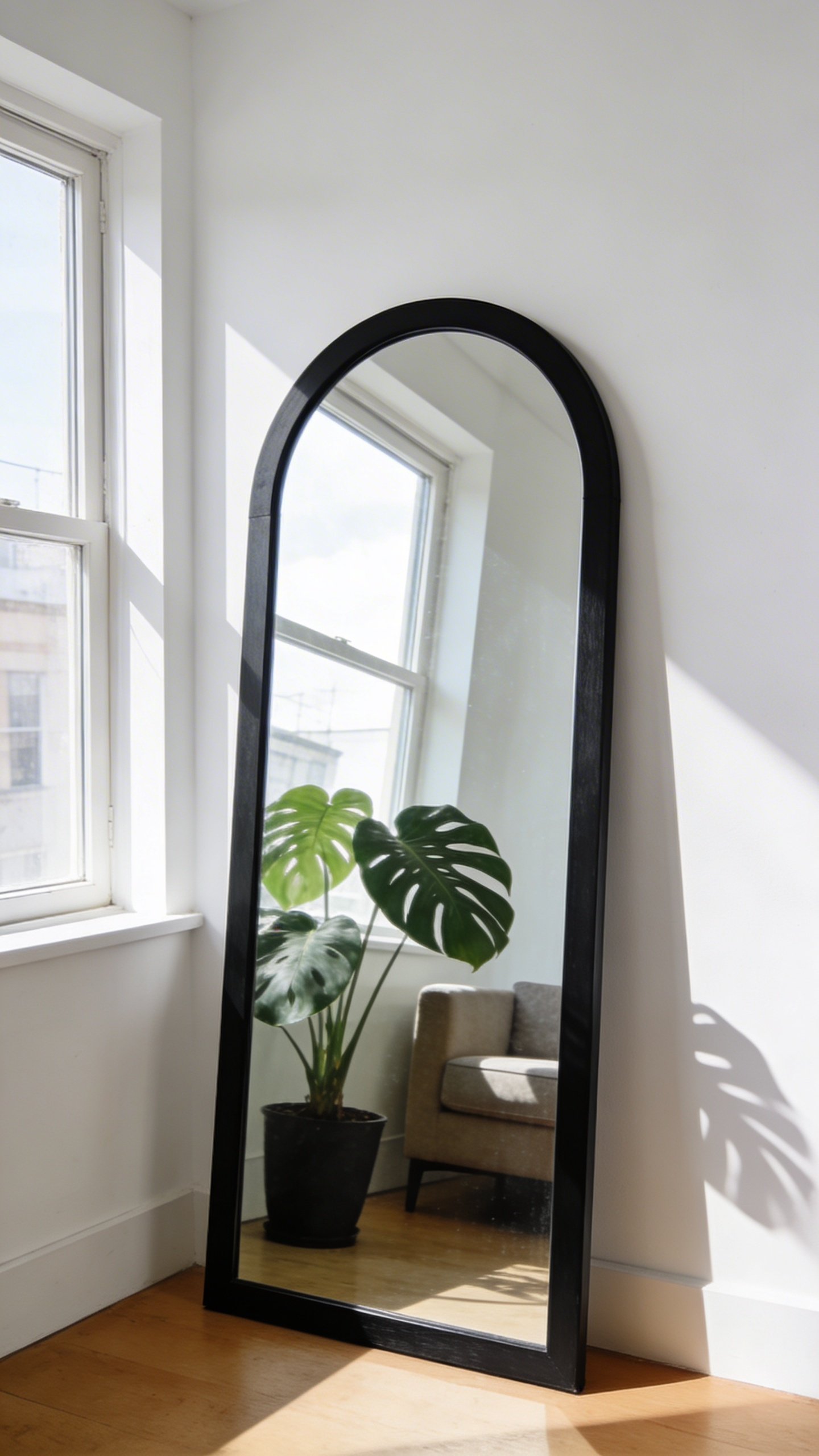
The most effective position for a mirror is on the wall opposite or adjacent to the main window, where it captures natural light and bounces it back into the room. A mirror placed on a wall with no light source to reflect has far less effect.
Size matters significantly. A small decorative mirror (under 24 inches) reads as a decorative object rather than a space-expanding tool. For genuine light multiplication, aim for 36 inches or larger. The Umbra Hub Round Mirror at 36 inches ($129–$179 USD) is consistently well-rated for apartments. The IKEA HOVET full-length mirror (30×77 inches, $199) leaned against a wall makes a dramatic impact for its price. It creates the illusion of depth from across the room and needs no wall mounting at all.
The Height Rule That Most People Get Wrong
Mirrors are almost universally hung too high in apartments. The centre point of a mirror should sit at eye level — approximately 57–60 inches from the floor. When a mirror is hung near the ceiling, it reflects ceiling rather than the room, defeating its purpose entirely. For leaning mirrors, secure the base with non-slip furniture pads and consider a low-tack anchor hook at the top if you have children or pets.
In smaller rooms, a grouping of three or four mirrors can fill a wall with visual interest while also multiplying light.
6. The TV Wall Problem and How to Solve It Stylishly
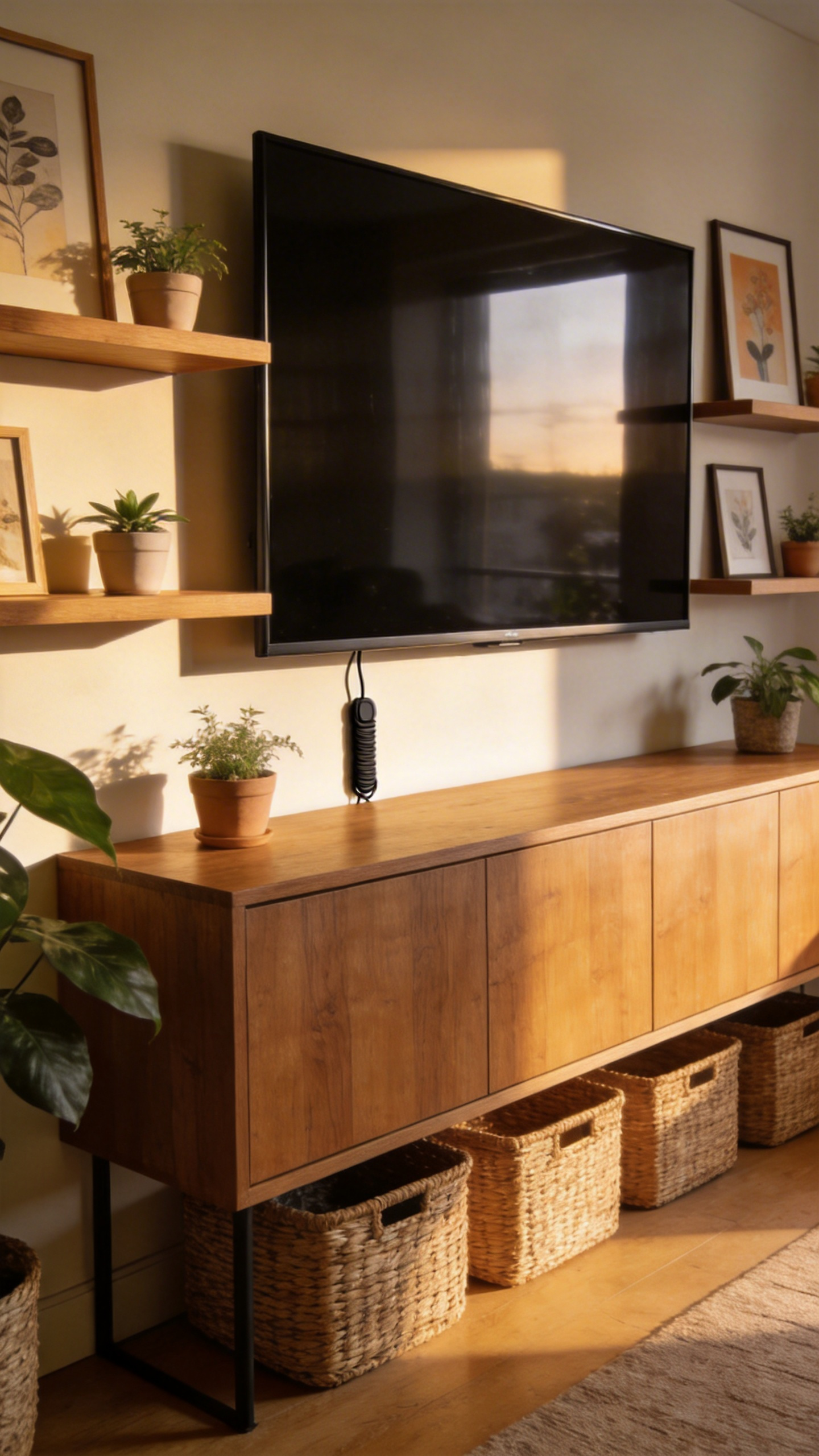
A flat-screen TV mounted alone on a white apartment wall is one of the most visually deflating apartment living room decoration situations. The TV is necessary but aesthetically challenging: a large black rectangle that commands attention when off and dominates the room when on. The solution isn’t to hide it — that rarely works. Instead, give it context so it reads as part of a composed wall rather than a utility appliance bolted to plaster.
The Console Width Rule
The console or media unit below the TV should be as wide as the TV or wider — never narrower. A narrow console under a wide TV looks ungrounded, as if the TV is floating unsupported. Ideally, the console extends the full visual width of the wall zone you’re working with, giving the TV a stable visual base. The IKEA BESTA system ($279–$650 depending on configuration) is the apartment renter’s most-used solution here: it’s affordable, modular, and the door versions hide cables and equipment cleanly.
Adding elements at equal height on either side — a shelf with plants, a framed print, a sconce — breaks the TV’s isolation and integrates it into a composed wall. This works in almost any apartment style.
Cord Management: The Detail That Sells Everything
Even a beautifully styled TV wall falls apart when cables dangle loose from the screen to the floor. A paintable cord cover kit (Wiremold, $18) channels cables into a slim channel painted to match the wall colour — a 20-minute project that transforms the whole wall. For renters who can’t mount at all, a floor-standing TV easel is a clean alternative.
7. Floating Shelves: Decorative Storage That Does Two Jobs at Once
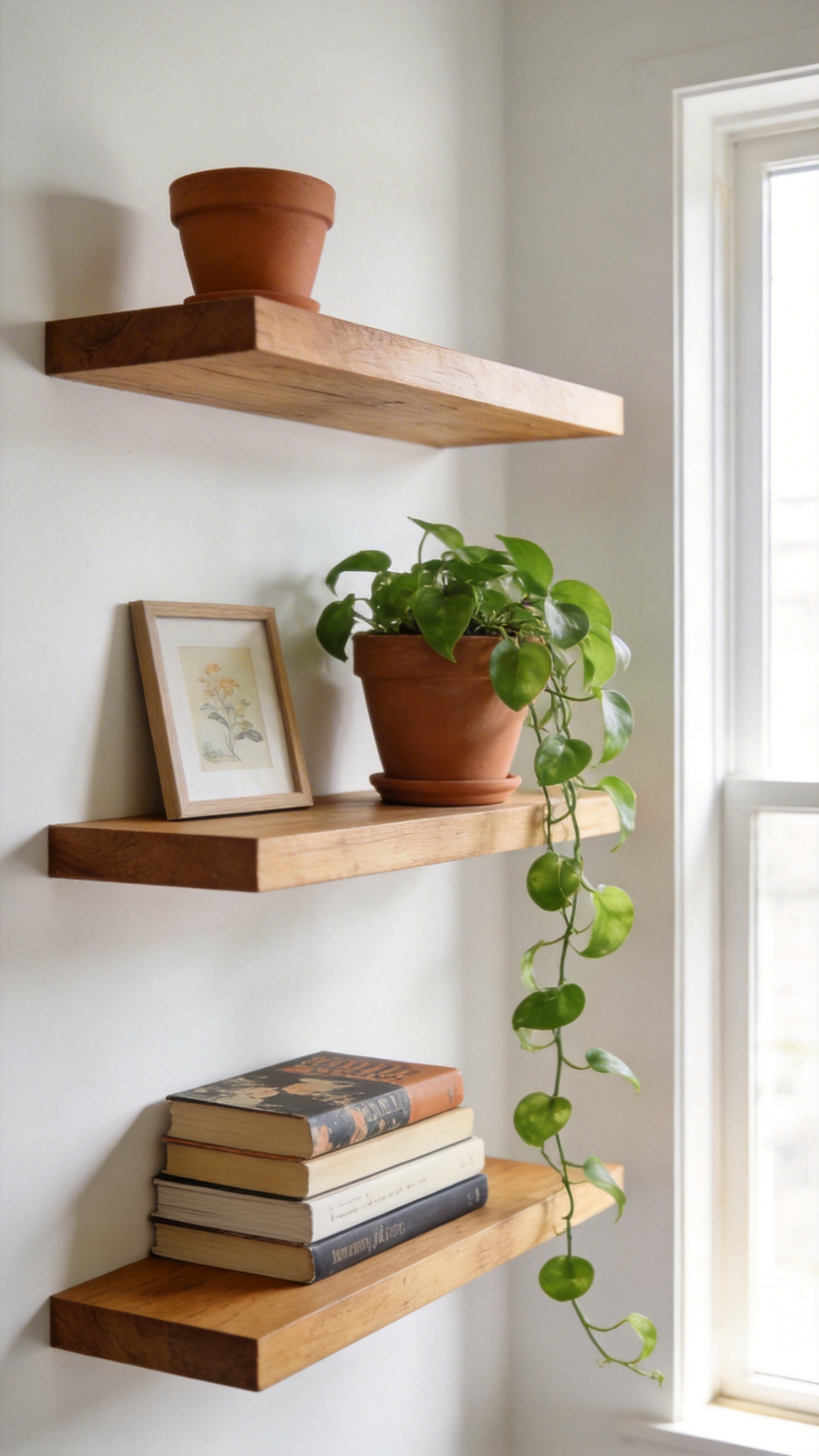
Floating shelves are among the most versatile elements in apartment living room decoration. They serve both storage and display functions without using any floor space. In small apartments where every square foot of floor area counts, that dual function is particularly valuable. But — and this is worth emphasising — a floating shelf covered entirely in books reads as storage. A shelf that mixes books with objects and one plant reads as design.
The Styling Principles That Keep Shelves Curated
The fundamental rule for shelf styling: group objects in odd numbers (three or five items per shelf zone), and vary their heights deliberately. The same logic that applies to any living room accents — varying scale and height creates rhythm. A tall candle, a small plant, and a short stack of books — that combination has visual rhythm. Nothing is at the same height. Even distribution kills the effect entirely.
For renters concerned about wall damage, adhesive-mounted shelves are a practical solution for light objects. The IKEA LACK shelf ($13 each) can be mounted with heavy-duty Command strips for objects under 15 lbs. Books, small ceramics, and plants in lightweight nursery pots all qualify. For heavier loads (large plant pots, book collections), stud-mounted shelves are the right approach. A standard stud-mounted shelf holds 80 or more pounds — far more than most apartment styling needs.
Cluster Placement Over Single Shelves
One shelf alone on a wall looks like an afterthought. A cluster of two or three shelves at staggered heights reads as a designed element. The stagger doesn’t need to be dramatic. An offset of 6–8 inches between shelf heights is enough to break the visual monotony of a perfectly horizontal row. For a standard 8-foot ceiling, three shelves between 48 and 72 inches from the floor work well proportionally.
8. Coffee Table Vignettes: The Art of the Styled Surface
The coffee table is visible from almost every angle in the room. Yet most renters leave it either bare or covered with a chaotic mix of books, remotes, and snacks. Good decorating treats the coffee table as a styled surface, even if only loosely.
The Rule of Three That Keeps Tables From Looking Cluttered
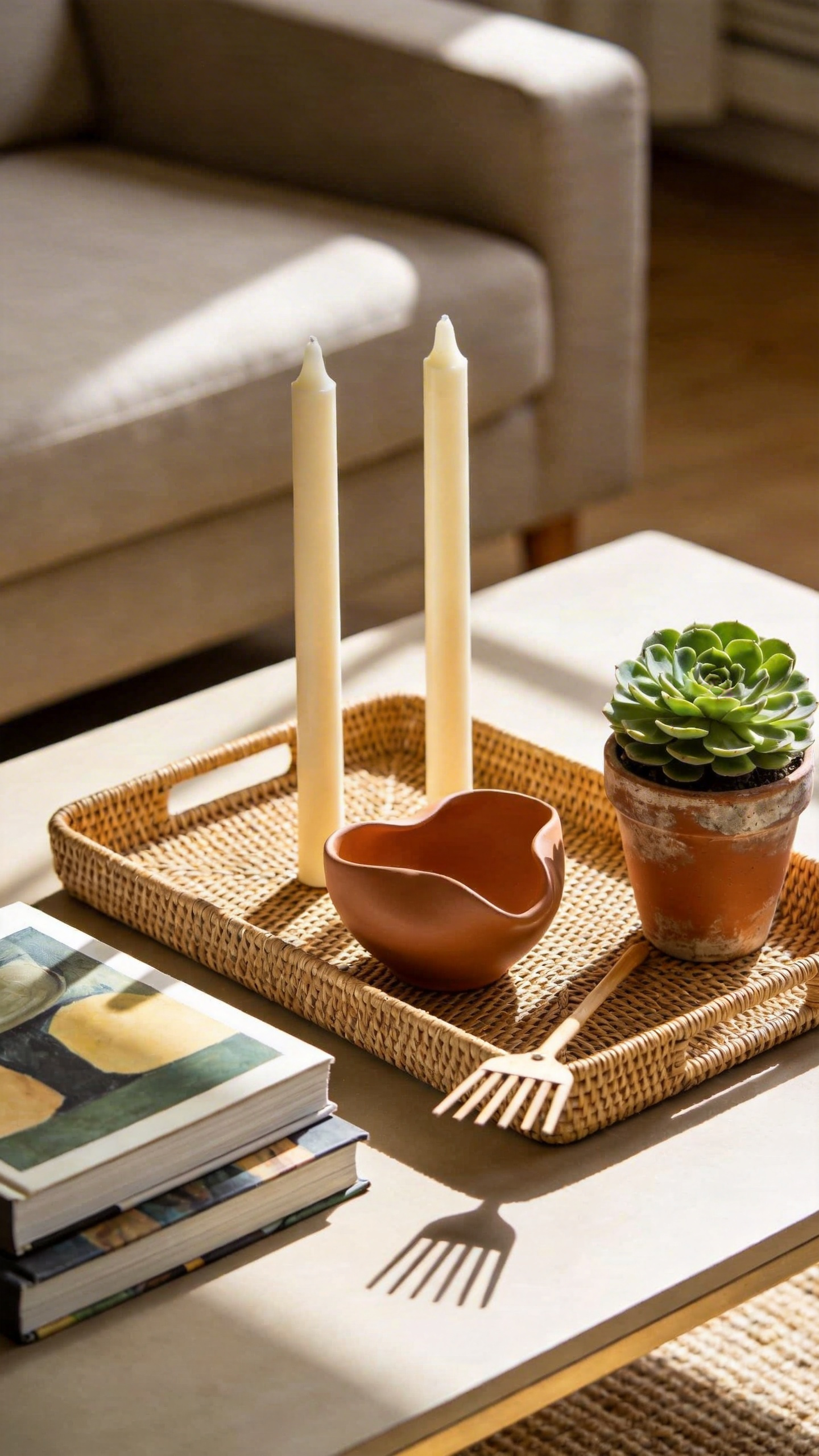
The most reliable formula for a coffee table vignette: something tall, something low, something organic. The tall element might be a pair of pillar candles or a small vase. The low element is often a tray or a flat stack of coffee table books. The organic element is a plant cutting in a small vessel, a bowl of stones, or even a piece of driftwood. This combination works because it creates height variation — without which a coffee table looks like a flat surface covered with things rather than a curated display.
A tray is particularly useful as the “low” element — it corrals smaller objects so clutter appears intentional. Natural seagrass or woven trays (around $25–$35 at Target) add texture without competing with what’s inside them.
The Editing Step Most People Skip
After building a coffee table vignette, remove one item. Almost always, the edited version is better than the original. The instinct is to fill space, but breathing room on a styled surface communicates confidence and intention. Leave roughly 30% of the table surface clear — it’s both aesthetically better and practically necessary for actual use of the table.
Scented candles belong on a coffee table because they engage a second sense. In a social space, the olfactory dimension is part of the apartment decor inspiration experience. A good candle signals that the host has thought about the experience — and that deliberateness is the point of apartment living room decoration at its most complete.
9. Accent Walls for Apartment Living Room Decoration Without Paint Permission
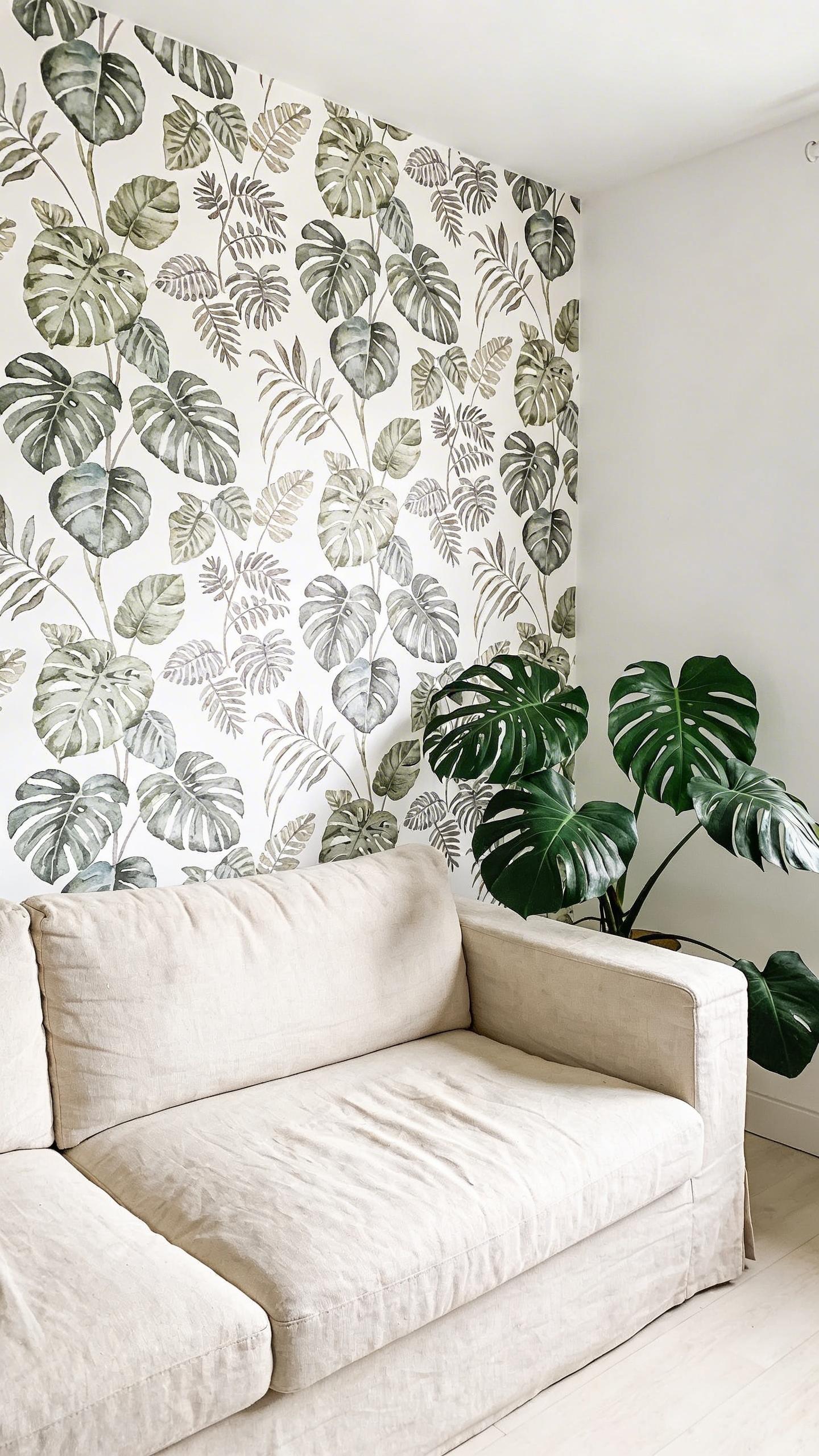
Most apartment leases prohibit painting the walls. But that restriction, frustrating as it is, doesn’t prevent one of the most impactful techniques in apartment living room decoration — the accent wall. It just requires a different toolkit. Renter-friendly options have improved dramatically in the last few years. The results from quality peel-and-stick wallpaper, large art panels, and fabric hangings are now genuinely hard to distinguish from permanent installations at a glance.
Removable Wallpaper: The Most Versatile Option
Peel-and-stick wallpaper from brands like Tempaper ($85–$135 per roll) and Chasing Paper ($75–$115 per roll) uses a repositionable adhesive. It removes cleanly from most painted surfaces. A single feature wall (8 ft high by 10 ft wide) needs 3–4 rolls depending on pattern repeat — budget accordingly. Before committing to a full wall, test the product on a small, inconspicuous section like the inside of a wardrobe door. Different paint finishes react differently: eggshell holds adhesive better than matte, and semi-gloss can reject it entirely.
For a lower-cost alternative, one oversized art print (24×35 inches or larger) in a simple frame creates a comparable feature wall effect.
Fabric Hangings and Tapestries
Fabric wall hangings — macramé, woven tapestries, printed fabric panels — add texture and softness that no hard wall treatment can replicate. Society6 sells printed tapestries (51×60 inches) for $45–$65 USD in hundreds of patterns, and they hang from a simple wooden rod with no damage whatsoever. In a rental apartment, this no-commitment approach to apartment living room decoration is extremely practical. It moves with you, doesn’t damage the deposit, and can be changed when your taste evolves.
10. Indoor Plants as Living Decoration: Which Varieties Work Best in Small Spaces
Plants are the apartment living room decoration element that no inanimate object can replicate. They add texture, movement, and an organic quality that makes a space feel genuinely inhabited — as opposed to staged. But apartment conditions are genuinely challenging for many plant varieties. Limited natural light, dry air from central heating, and irregular watering are the real obstacles. So, choosing the right varieties is important.
The Varieties That Actually Survive Apartment Conditions
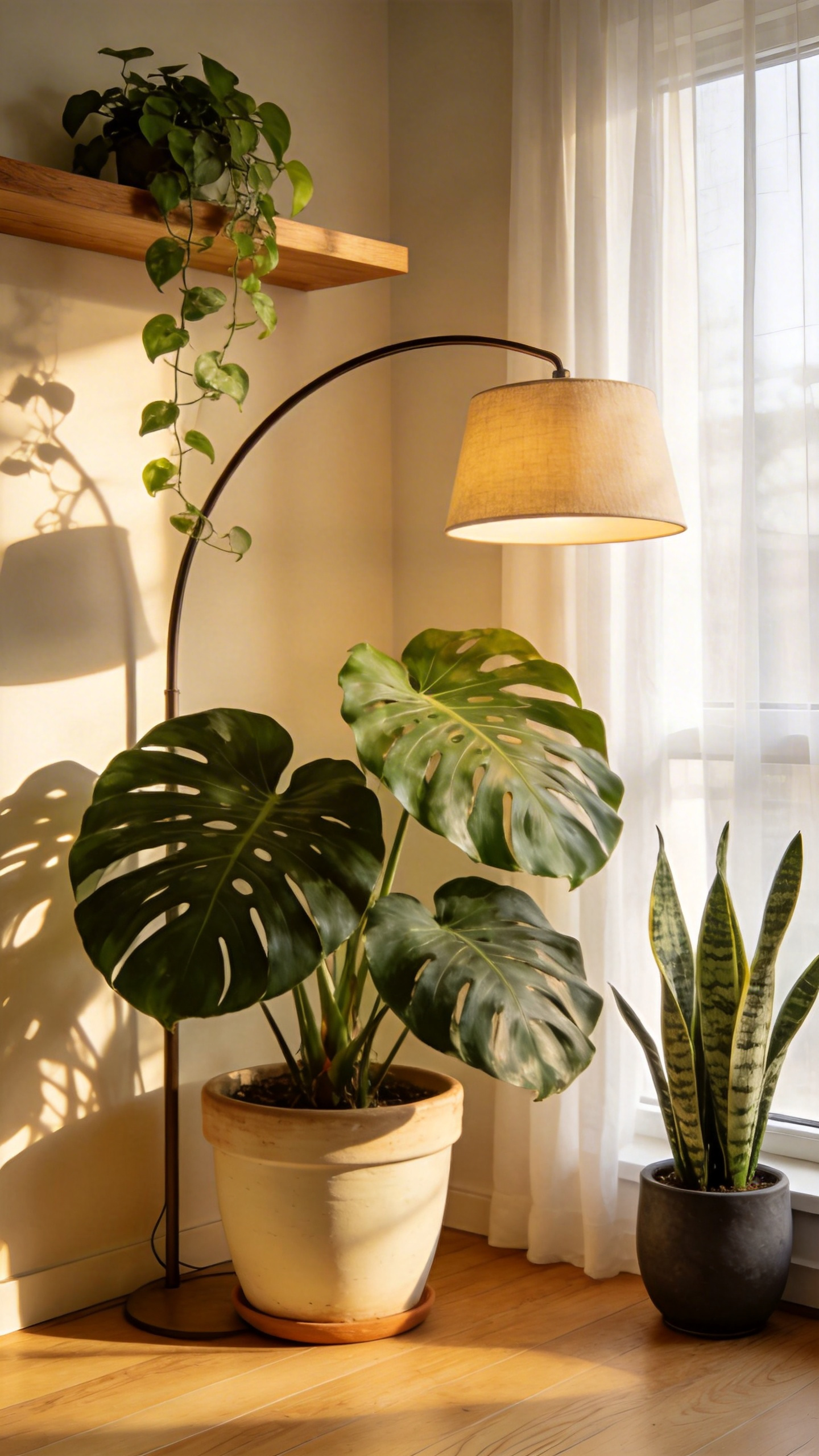
The snake plant (Dracaena trifasciata, formerly Sansevieria) is the closest thing to an unkillable indoor plant. It tolerates low light, irregular watering, and the dry air produced by apartment radiators and air conditioning. A mature snake plant in an interesting pot is a statement piece by itself. Similarly, pothos is extraordinary for trailing applications — draped from a floating shelf, it adds a softness and living room wall decor ideas dimension that no printed art can.
The monstera deliciosa is the statement plant for living rooms. A single large specimen ($25–$80) fills a corner with the same visual weight as a floor lamp, but with organic warmth no lighting fixture offers. It grows in medium indirect light and doesn’t require constant attention.
Pot Choice Matters as Much as Plant Choice
In apartment living room decoration, the planter is as visible as the plant. Terracotta is the most versatile material — it works with warm neutrals, earthy palettes, and Scandinavian interiors alike. The IKEA terracotta range ($3–$10) is hard to beat for price.
A moisture meter ($10–$15) is a small investment that dramatically improves indoor plant survival rates. The number one cause of indoor plant death is overwatering, and a meter removes the guesswork. For apartment renters who travel often, self-watering inserts in terracotta pots maintain moisture for 1–2 weeks without attention.
11. Throw Pillows and Blankets: Layering Colour and Texture Without Clutter
Cushions and throws are the quickest, cheapest way to change the character of a sofa. But there’s a ceiling. Too many crosses from layered-and-inviting into cluttered-and-uncomfortable.
The Number and the Mix
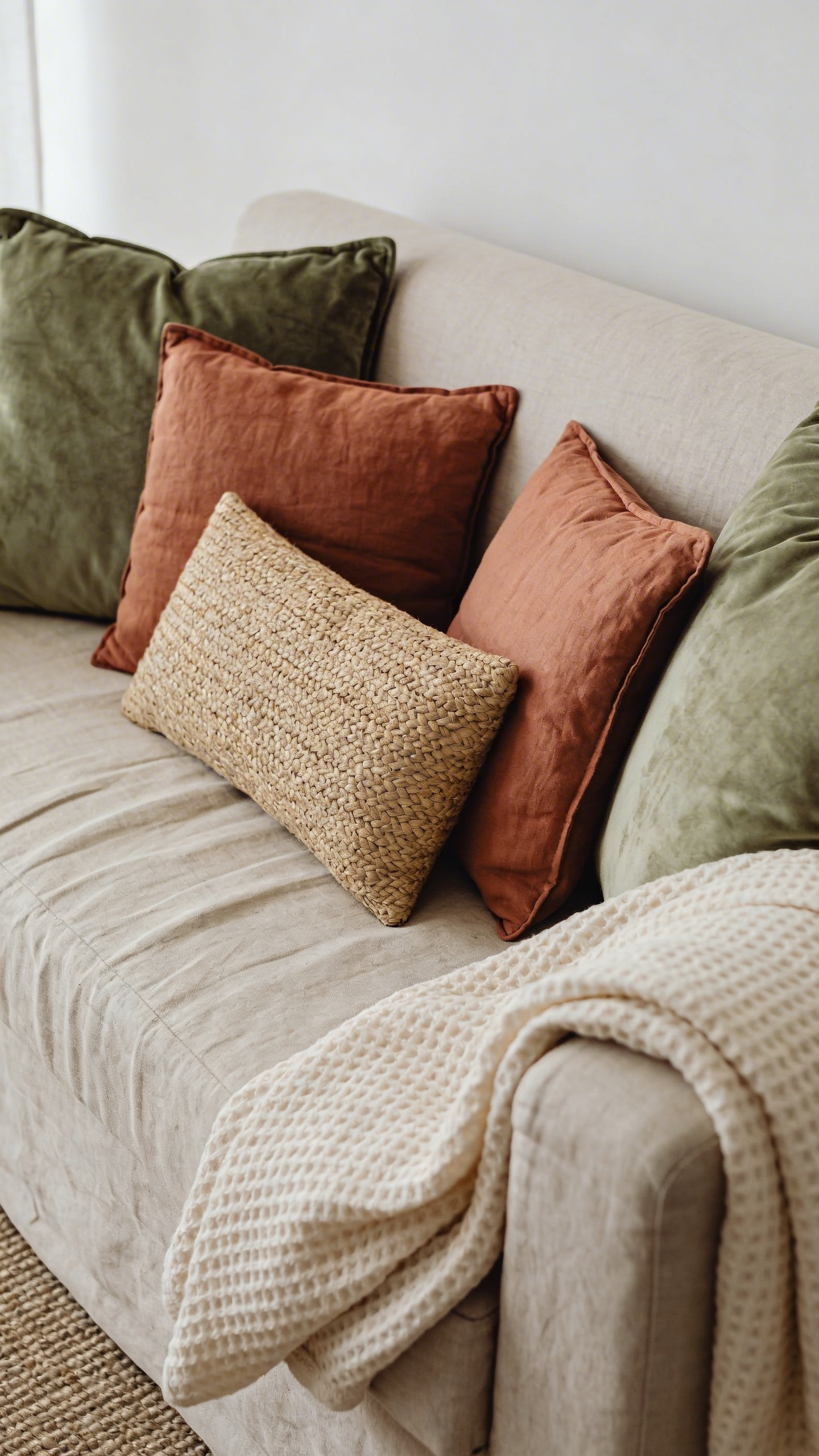
Three or five cushions reads as designed. Four or six often looks too sparse or formulaic. A working combination for a standard three-seater uses five cushions total. Start with two large squares (22 inches) in your main accent colour and two smaller squares (18 inches) in a secondary texture. Add one lumbar cushion (14×22 inches) in the centre. This creates size variation, texture variation, and a clear visual focal point.
Also, texture variation is as important as colour variation. Velvet and linen side by side read as intentionally layered; three cushions in the same cotton twill look like a matching set from a pack. The contrast between a smooth velvet and a rough woven surface is what creates the richness associated with well-designed living rooms.
Seasonal Swaps and the Cost of Staying Fresh
Swapping cushion covers seasonally refreshes the apartment decor living room ideas feel of a space without replacing any furniture. Summer calls for linen and cotton in lighter tones. Autumn and winter work better with velvet and wool in deeper, warmer colours. Cover swaps cost $15–$30 per piece (H&M Home and IKEA are the best budget sources), while the inserts remain the same. Buy inserts two inches larger than the cover for a full, plump look.
A single throw blanket draped casually over one sofa arm completes the picture. “Casually” is doing work here — a neatly folded blanket on an arm looks like it’s waiting to be used. A loosely draped one looks like it was just used. That sense of lived-in ease is exactly what good apartment living room decoration aims for.
12. Window Treatments: The Finishing Touch in Apartment Living Room Decoration
Bare windows are the fastest way to identify an apartment living room that hasn’t been fully decorated. They let in light. But they also expose the room to the street, create glare on screens during the day, and produce the unmistakable feeling of living in a fish tank. Window treatments solve all of that — and they do significant decorative work beyond the practical.
The Height and Width Rules That Change Everything
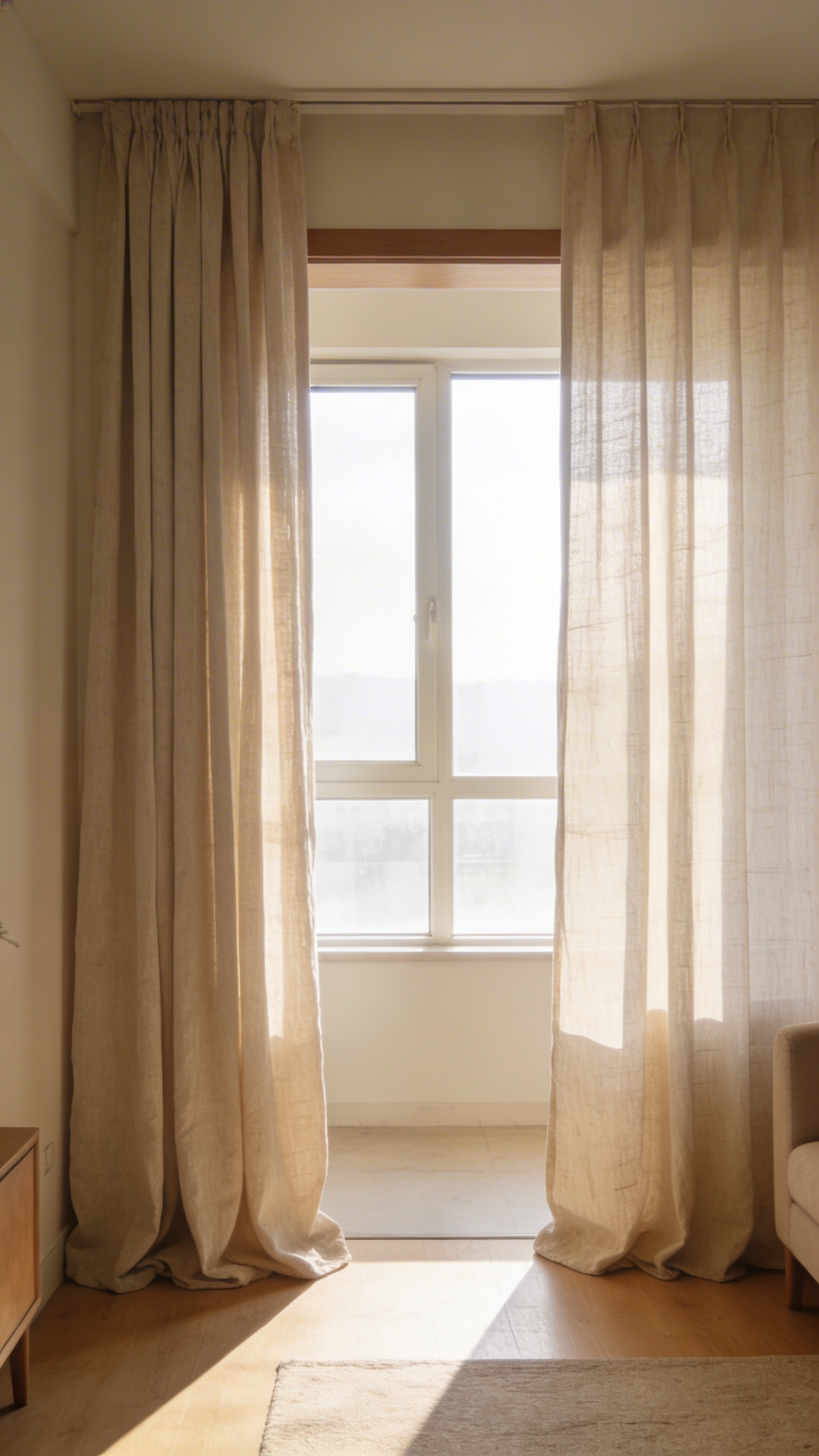
Curtains hung at ceiling height — rather than just above the window frame — make ceilings feel higher and windows feel more architecturally significant. This single adjustment, which costs nothing extra (just buy longer curtain panels), transforms the proportion of the room. For apartments with standard 8-foot ceilings, 96-inch panels hung 2–4 inches below the ceiling read beautifully. For 9-foot ceilings, 108-inch panels are proportionally better.
Curtains should be two to two-and-a-half times the window’s width when gathered. Skimpy curtains look like afterthoughts; full panels that bunch when open add a luxurious quality even in cheap fabric.
For renters who can’t drill, tension rods handle narrower windows up to 48 inches. For wider windows, 3M Command curtain rod hooks ($8–$12 for a four-pack) support standard lightweight rods without leaving visible damage. The IKEA MAJGULL blackout curtain panels ($29 per pair) block light effectively and come in a neutral linen tone — order two pairs per window for the correct gathered fullness.
The Blackout Case for Urban Apartment Renters
Blackout lining isn’t just for bedrooms. In urban apartments, blackout curtains reduce the orange street-lighting glow that degrades evening television viewing and prevent early morning light from brightening the room before you’re ready. Less ambient glare means a warmer, better atmosphere after dark.
13. Bookshelf Styling: Mixing Objects, Books, and Plants for a Layered Look
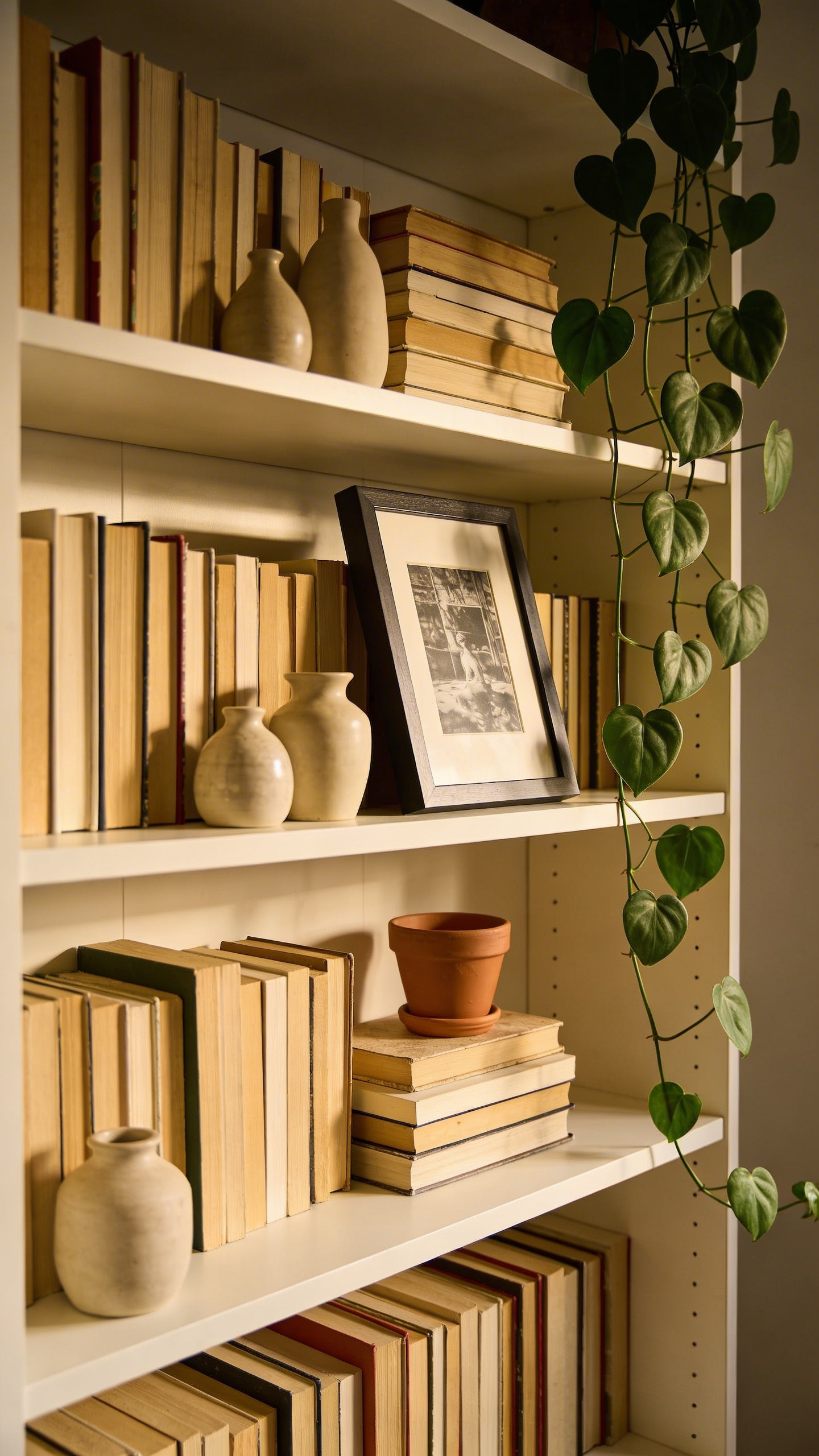
A bookshelf filled spine-out with books to maximum capacity looks like storage. It’s functional, even satisfying in a librarian’s-sense, but it doesn’t contribute to apartment living room decoration in any meaningful way. The same shelf with books grouped horizontally, interspersed with ceramics, a trailing plant, and a framed print, looks like something designed by someone who lives deliberately. The moves that produce that transformation are specific and repeatable.
The Specific Moves That Work
First, remove roughly one-quarter of the books from each shelf — this creates the breathing room that lets objects register as objects rather than filler. For every few vertical groupings, create a horizontal stack. Lay two or three books flat and place a small sculptural object on top. This creates a platform within the shelf and introduces height variation in both directions.
Also, objects for shelf styling work best when they have weight and presence: ceramics, candles, small framed prints, woven baskets, or sculptural pieces. Avoid too many tiny things — they create visual noise. One notable piece per shelf zone is far more effective than five small ones — a single ceramic vase or handmade piece reads as intentional, while a cluster of small objects just fights for attention.
The Plant Element
One living plant per shelf — or a single trailing plant that cascades across two or three shelves — adds a dimension that no object matches. For shelves in lower-light positions, a pothos is ideal. It trails enthusiastically, tolerates neglect, and produces the soft, leafy quality that makes a bookshelf feel like part of a home rather than a filing system. Where light is genuinely too low for live plants, the IKEA FEJKA artificial trailing plant ($8) is a convincing option. It clearly isn’t the real thing. However, it contributes the visual texture of a living plant without any maintenance.
14. Accent Chairs and Side Tables: The Supporting Cast That Finishes the Room
A sofa alone — even a beautiful one on a perfectly-sized rug — doesn’t constitute a finished living room. It’s a starting point. The accent chair transforms a sofa-in-a-room into a seating arrangement. It introduces a second design voice, adds another viewpoint for conversation, and signals that the apartment living room decoration project was completed rather than just started. Yet many apartment renters skip it because they assume their space isn’t large enough.
Why One Chair Changes the Whole Room
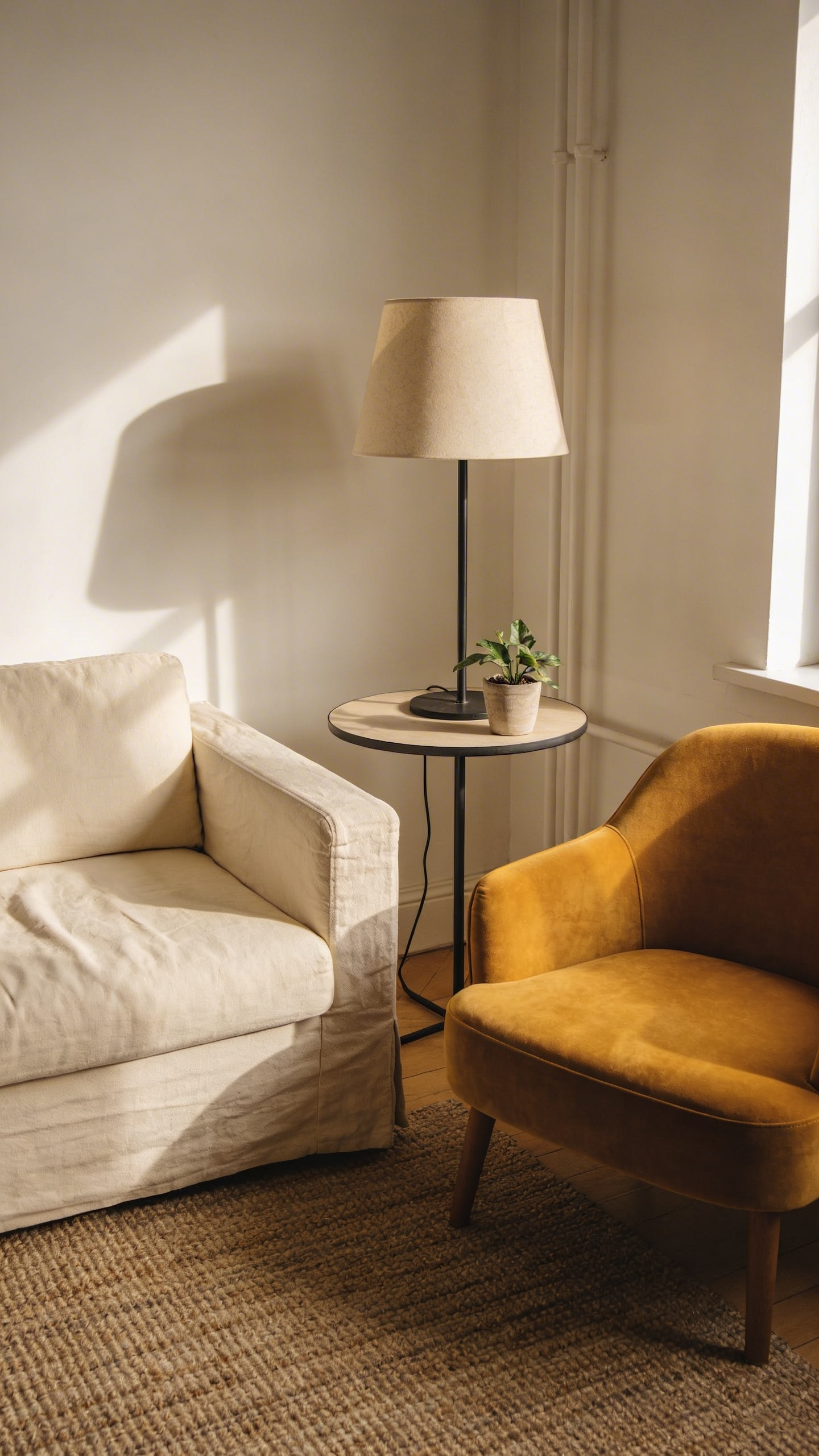
The accent chair doesn’t need to match the sofa. In fact, contrast is often better — it shows intention rather than a matching-set purchase. But the chair and sofa should share at least one element: a colour, a material, a leg finish. A linen sofa with a mustard velvet chair works because velvet and linen are both natural fabrics with similar warmth. A minimalist sofa with an Art Deco accent chair works if they share a metal finish on their legs.
For apartment living room decoration specifically, compact accent chairs are the right choice. Go under 30 inches wide for small rooms, or up to 35 inches for standard-sized spaces. The West Elm Swivel Base Chair ($599–$799) is popular precisely because its 360-degree swivel adapts to a conversation or a television view without moving the furniture. The Article Hygge Chair ($449–$599) has a lower profile that feels casual and approachable — well-suited to the living room styling tips that prioritise comfort over formality.
Side Tables: Practical But Not Boring
The side table next to an accent chair should be within two inches of the chair arm height for comfortable use. It signals: this is a complete seating position. The CB2 Terrace Side Table ($149, 16 inches diameter) is an ideal scale. Nesting tables — like the IKEA KRAGSTA set ($130) — offer flexibility: separate them for use, stack them when floor space is needed.
15. Apartment Living Room Decoration: Color Cohesion Through Accessories
In a rental apartment with white or beige walls, a neutral sofa, and floor-toned wood floors, the accessories are doing almost all the colour work. Which makes the accessory decision much more consequential than it looks. The reason some apartment living rooms feel designed and others feel assembled is usually this: the designed ones have a deliberate colour story. That story repeats across cushions, throws, art, plants, and objects. The assembled ones have a mix of things picked at different times with no connecting logic.
The 60-30-10 Logic Adapted for Rentals
In a white-walled apartment with neutral furniture, the 60% colour is already decided by the landlord. Your decorating choices determine the remaining 40%: the rug, curtains, and larger objects at 30%, and cushions, throws, and accessories at 10%. Choose those colours deliberately and stick to them.
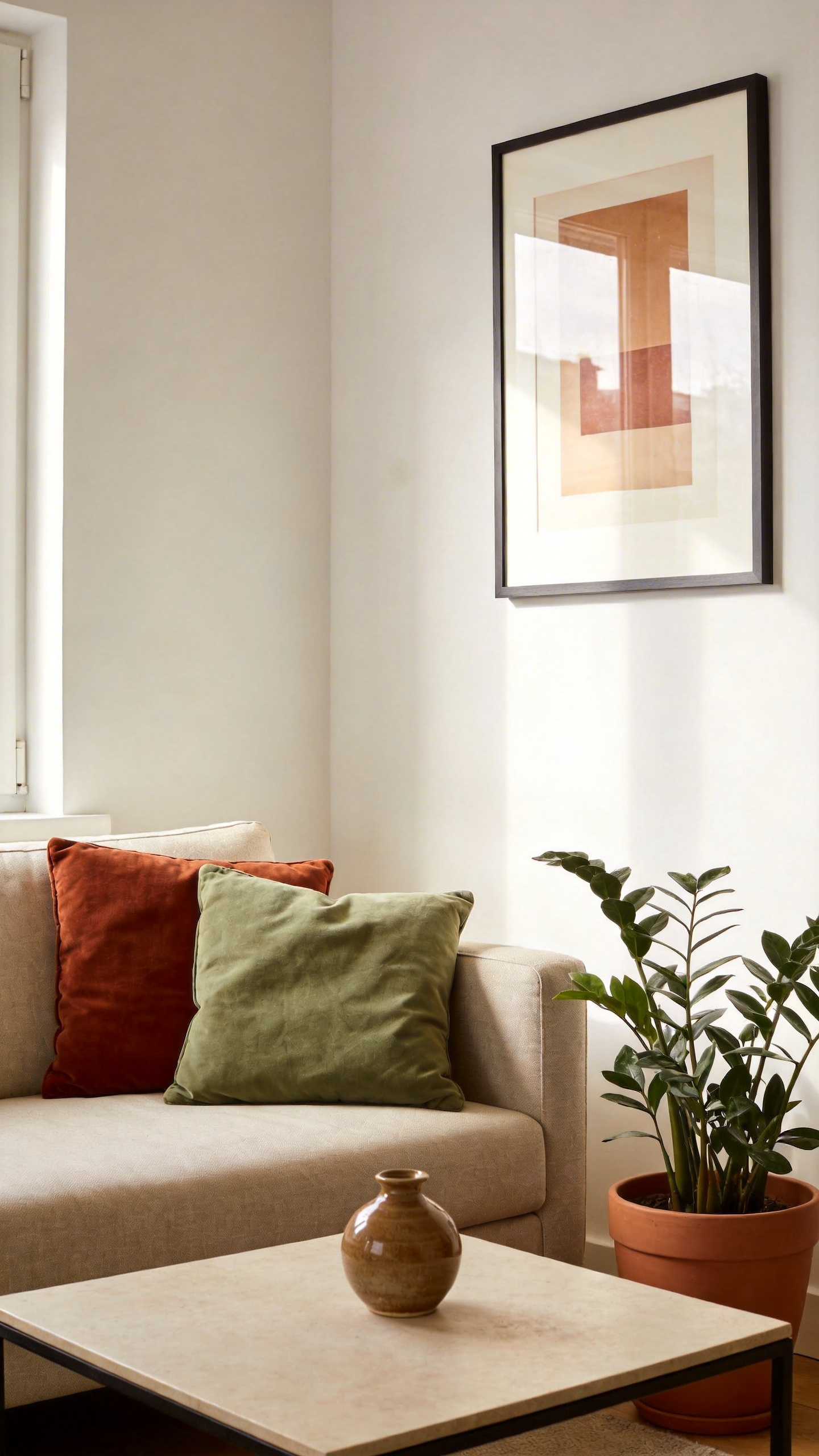
Two to three accent colours is the practical limit for a small apartment living room. Beyond that, the room starts to read as busy rather than layered. A warm terracotta combined with sage green and natural wood tones works across almost all neutral-walled rentals. It’s grounded, warm, and cohesive without being stark.
The Rug-First Strategy
The easiest way to build colour cohesion: buy the rug first, choose it for love, then pull two or three colours from it. Those become your palette. Everything else follows the rug’s lead. That’s also why making a living room feel genuinely cozy starts with that foundational layer.
Research by Benjamin Moore found that 70% of renters who reported dissatisfaction with their living room cited “no clear colour story” as the primary issue. Clutter, budget limitations, and furniture quality all ranked lower. Cohesion, it turns out, is what separates a finished apartment living room from a collection of things in the same room.
Where to Start With Apartment Living Room Decoration
These 15 ideas work individually, but they compound when applied in sequence. Start with the rug — it defines the space and sets your palette. Then add light layers, because the right lamps change how every other element is perceived after dark. From there, address the walls: a gallery wall, a mirror, or an accent treatment gives the room visual anchors. The finishing layers — cushions, plants, shelving, a chair — fill the space with personality rather than just furniture.
The most important principle across all of these is deliberateness. Apartment living room decoration at its best isn’t about spending a lot of money or following a particular style. It’s about making each decision with intention — size, proportion, colour, placement. Trust that a series of considered choices adds up to a space that feels genuinely yours. If you’re looking for living room decor ideas beyond these basics, a gallery wall and layered lighting are almost always the highest-return starting points. Tackle those two first, and the rest of the room will start to click into place.