There’s a specific kind of defeat that happens when you open the pantry to start dinner and something tumbles out at you. It’s the tin of chickpeas you’ve now bought three times because they kept getting swallowed by the back of the shelf. The baking powder you find six months expired, hiding behind an unopened bag of lentils. The moment you realize you have four different half-used bags of pasta and no idea which opened first.
A well-organized kitchen storage pantry doesn’t just look good — it changes the way you cook. Meal prep gets faster when ingredients are visible and accessible. You waste less food. Sunday grocery shopping gets easier when you can see exactly what’s running low. In a well-designed kitchen storage pantry, even a busy weeknight dinner feels manageable.
I’ve spent twelve years helping families redesign their kitchens and dining spaces, and the pantry is consistently the most underserved room in the home. It’s also the one where small, practical changes have the biggest daily impact. These 16 ideas range from a weekend afternoon project to a simple clip that takes thirty seconds to install. Start wherever makes sense for your space — and watch how quickly a more organized pantry changes the rhythm of cooking at home.
1. Pull-Out Wire Baskets for Deep Pantry Shelves
Let me tell you about dead zones. That’s what the back half of a deep pantry shelf becomes the moment you can’t see it clearly — a graveyard for tinned goods, forgotten spices, and the occasional stock cube you were convinced you’d run out of. Pull-out wire baskets solve this in one move, and they’re the single upgrade I’d prioritize first in any kitchen storage pantry.
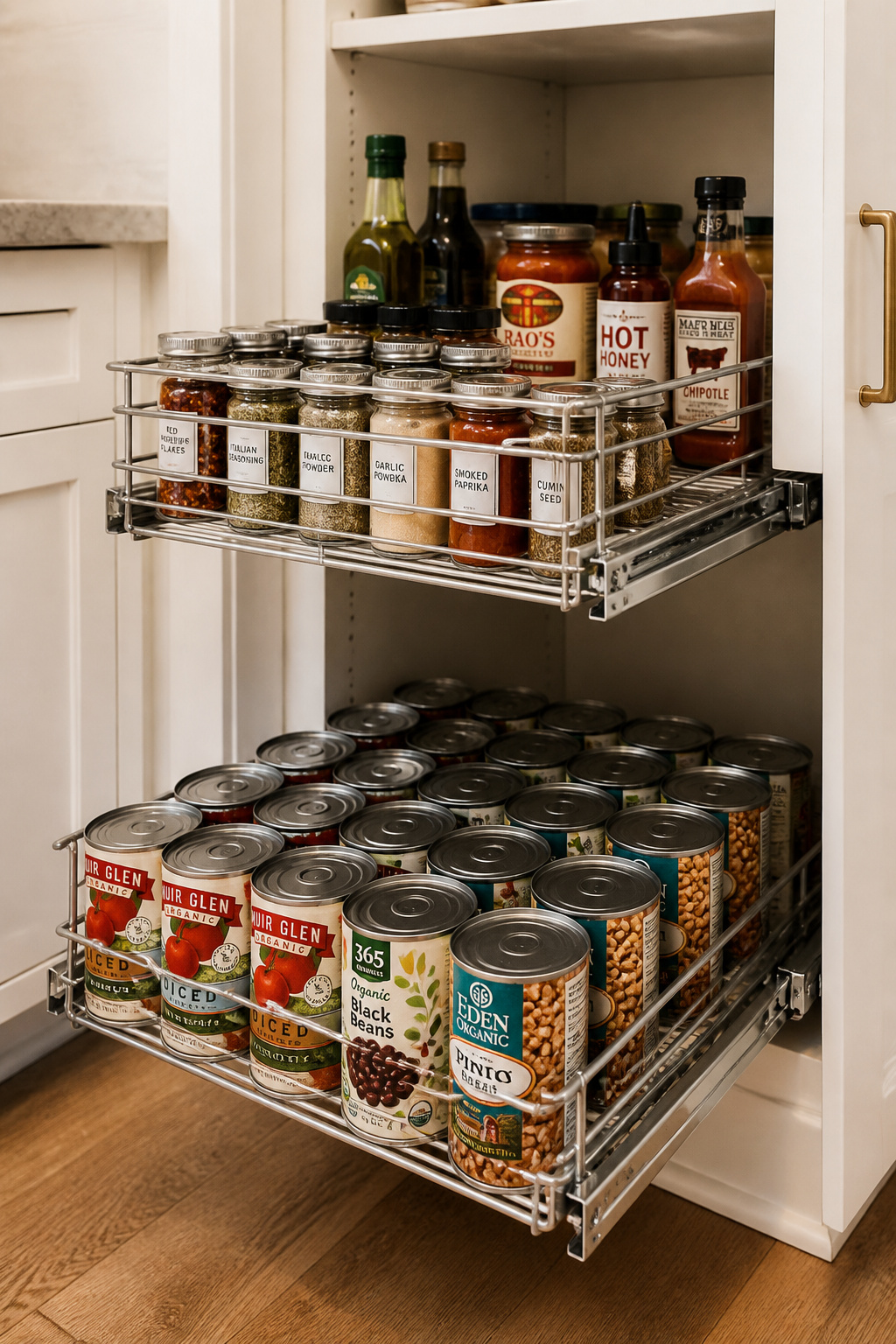
Instead of reaching blindly into a 20-inch-deep shelf, you pull the whole thing toward you. Everything is visible, accessible, and front-to-back rather than front-only. For anyone serious about reducing food waste and actually using what they buy, these small kitchen storage solutions belong at the top of the list.
Rev-A-Shelf’s 5700 Series is the benchmark. The slide system is rated to 250 lbs with soft-close mechanisms at both the top and bottom — substantial enough to hold a heavily stocked pantry shelf without straining. The wire baskets adjust in height, and the whole unit mounts to the cabinet floor and ceiling with wood screws.
The installation caveat: measure before you order. You need three numbers — cabinet width, depth, and height. The basket must clear the full cabinet opening when extended, which means accounting for hinges, plumbing, and any face-frame lip. In face-frame cabinets, the top slide needs a spacer board to align flush with the frame — it’s not difficult, but worth knowing before you start.
If you’re not ready to commit to a pull-out system for the whole pantry, start with just the deepest shelf. A single pull-out often changes the entire dynamic of how you use the space.
2. Over-Door Spice Rack to Free Up Prime Shelf Space
The inside of a pantry door is some of the most valuable real estate in your kitchen — and most of us are wasting it entirely. That flat surface, typically 18-24 inches wide and 60 to 80 inches tall, is equivalent to a full shelf’s worth of storage sitting unused on the back of a door that swings open twice a day.
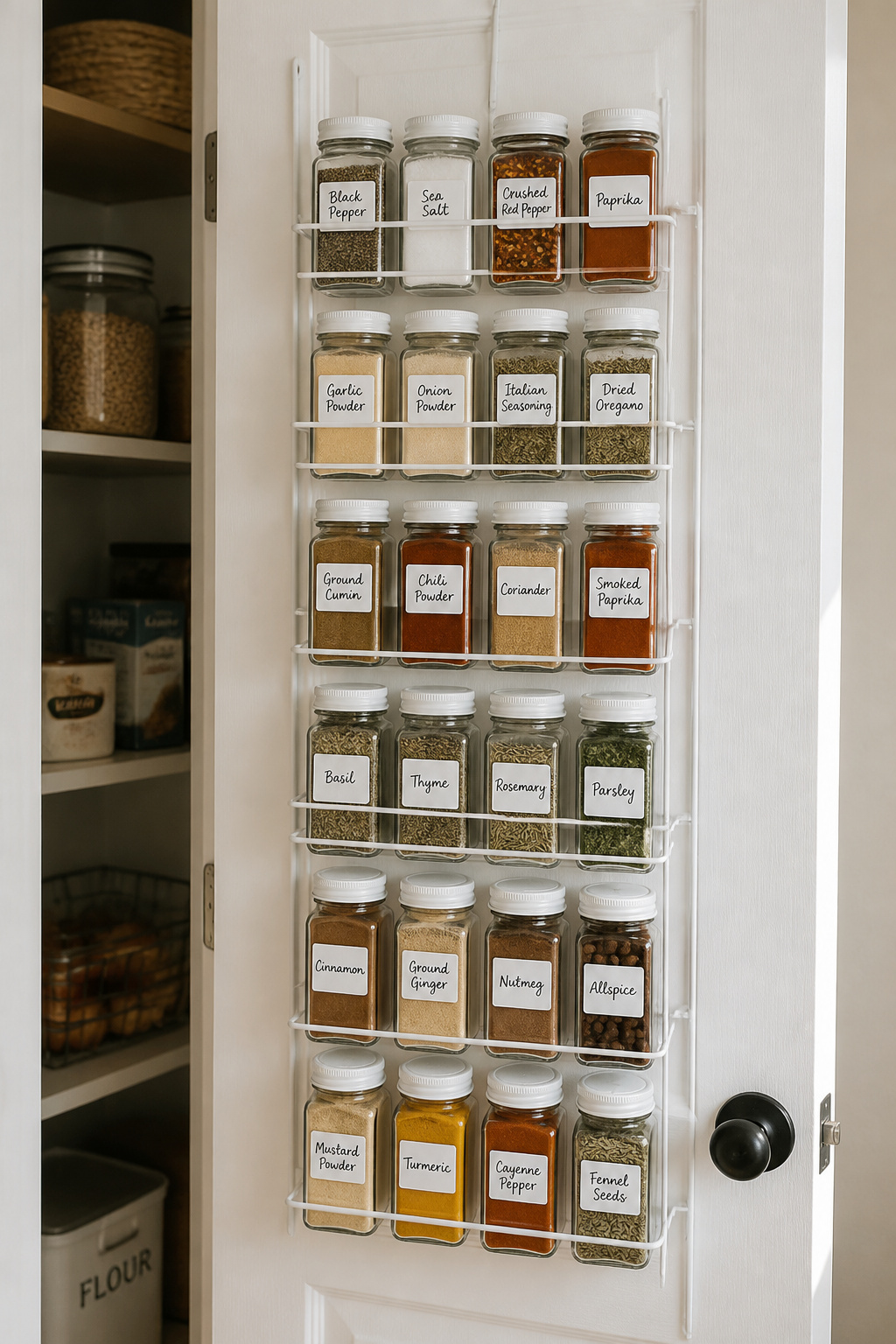
Over-door spice racks mount directly onto the door’s top edge with no drilling required. Load them with the spices, sauces, and condiments you reach for most, and you’ve freed up an entire internal shelf for bulkier items. More than that — daily-use spices at eye level on the door means no more opening, scanning, and rummaging through shelf contents just to find the cumin.
Before you buy, check two things. First, the clearance gap: the distance between your closed door surface and the nearest shelf. You need at least 5.5 inches for a standard rack. If your clearance is under five inches, look at slim-profile options like the Moforoco, which needs as little as three inches. Second, check your door type. Hollow-core doors — the majority of interior doors built since 1970 — have a maximum safe weight of 15-20 pounds, including the rack itself. A steel 6-tier rack weighs 3-5 lbs empty, so your actual storage capacity is roughly 10-15 lbs total.
For heavy-duty setups, the Mefirt 9-Tier handles 225 lbs total — but that requires a solid-core door. On hollow-core, keep the heavier jars at the bottom and lighter packets on the upper tiers.
3. Clear Stackable Bins for a See-at-a-Glance Pantry System
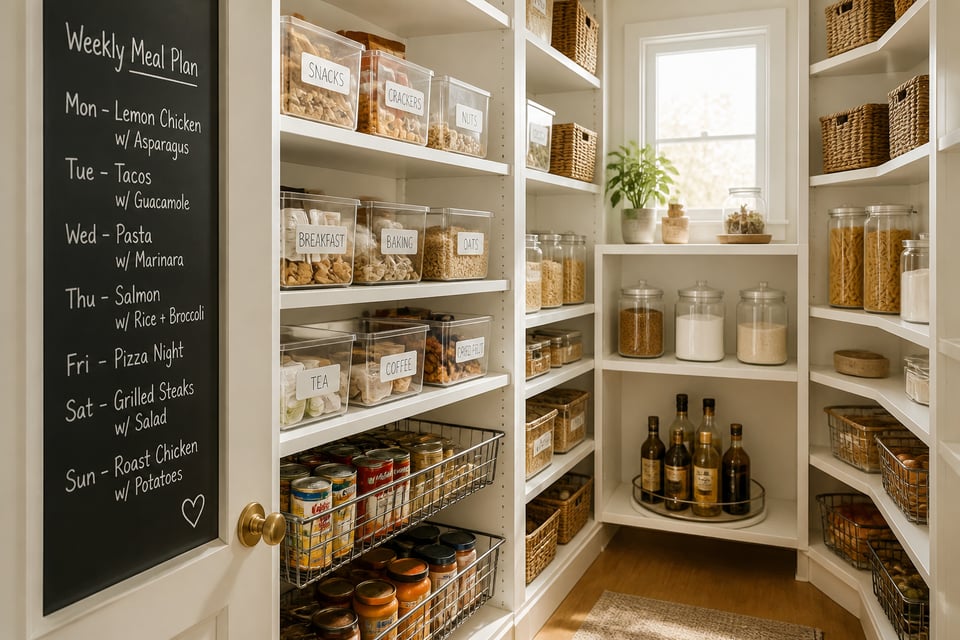
The most effective pantry organization strategy I’ve ever used comes down to one rule: if you can see it, you’ll use it. Clear bins make this happen at the category level — instead of fishing through bags and boxes to remember what you have, you scan a shelf in three seconds and know exactly what needs replenishing. They’re also the practical foundation of any kitchen storage pantry system that actually holds up over time.
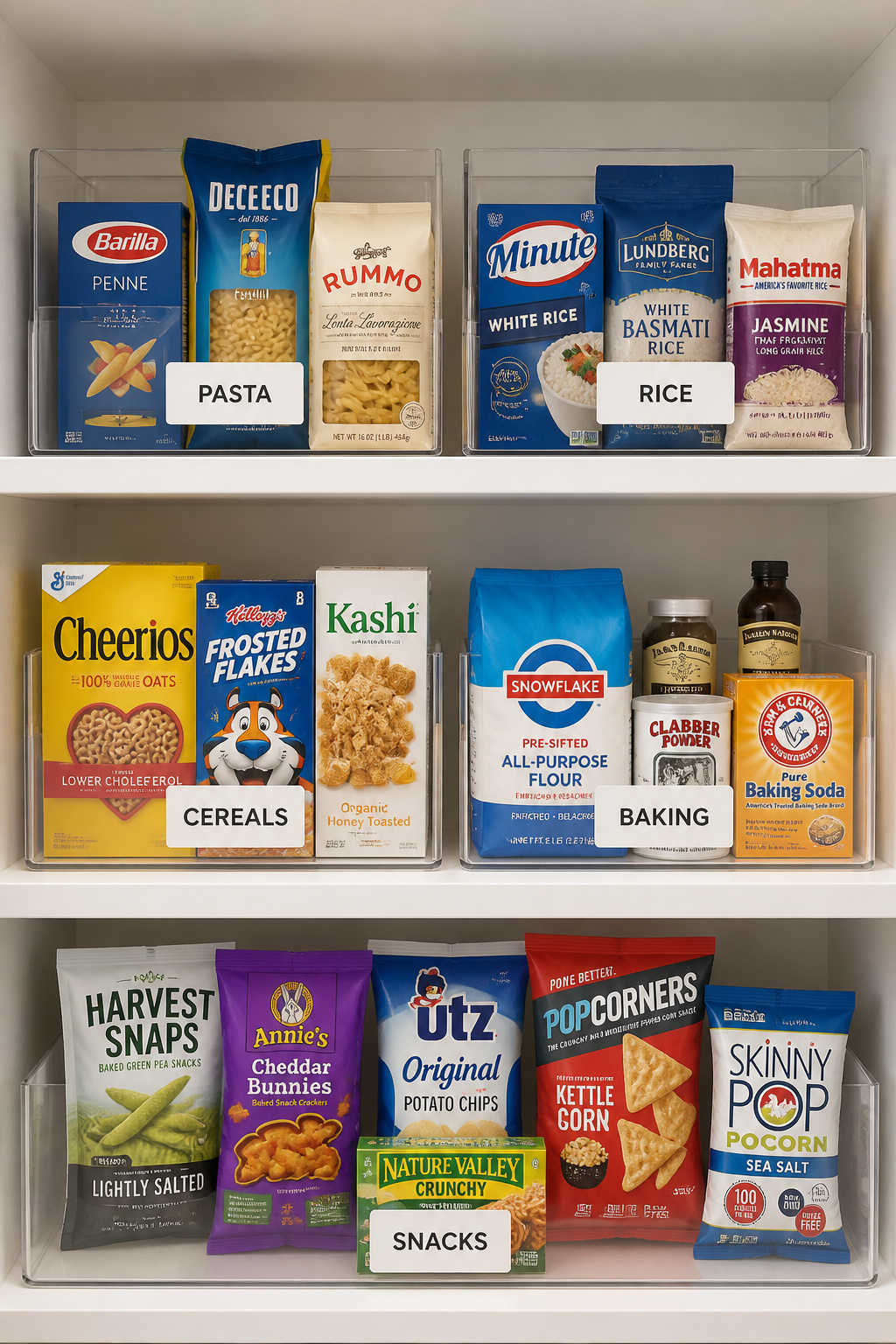
Items buried inside opaque packaging get forgotten, expire, and create the duplicate-purchase cycle that quietly empties your wallet over time. Clear containers break that cycle entirely. iDesign’s stackable open-front bins are the practical everyday choice: BPA-free, shatter-resistant, made in the USA, and available in several widths to fit your shelf depth. The integrated handles mean you can pull a whole category forward to access what’s behind it.
For dry goods needing an airtight seal, the OXO POP series is worth the step up — one press of the round knob on the lid engages the silicone seal. The medium OXO POP holds a full 5-lb bag of flour or sugar; the short holds 4 lbs of rice. Both are fully dishwasher-safe.
When organizing: group by how you cook, not how the grocery store categorizes things. Breakfast (cereals, oats, granola), Baking (flour, sugars, baking powder), Grains (rice, pasta, lentils), Snacks, Canned Goods. Place zone labels on the shelf or bin front so the system stays legible even when bins are temporarily removed.
4. Lazy Susan Turntables for Corner Pantry Accessibility
Corner shelves are where good ingredients go to be forgotten. The physics are simple and frustrating: you can reach the front of the shelf easily, but anything pushed past 12 inches into a corner is functionally inaccessible. Oils migrate to the back. Canned tomatoes stack and tip. A lazy Susan keeps your kitchen storage pantry corner working at full capacity with a single spin.
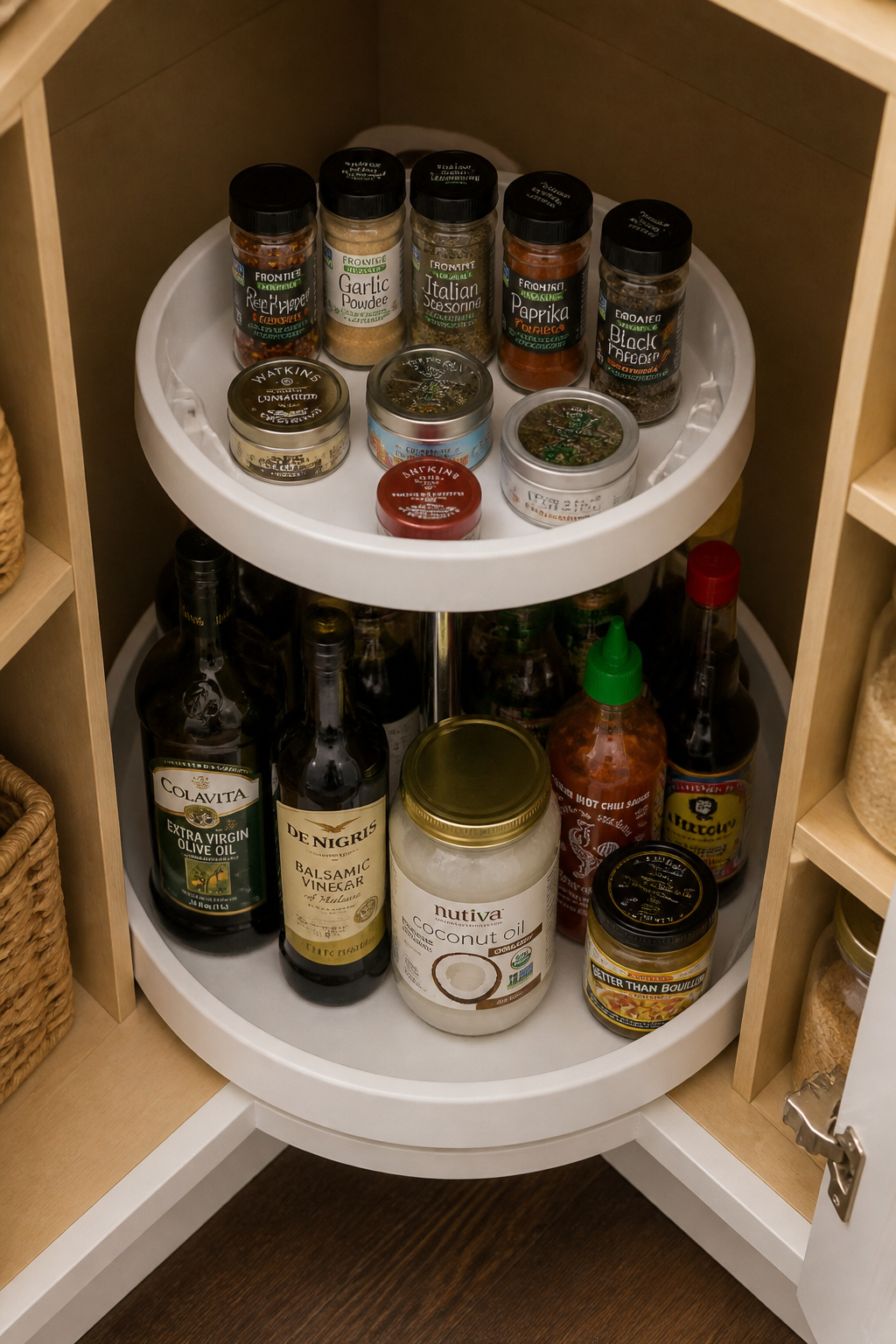
A lazy Susan gives you 360° access to everything on the turntable, effectively doubling the usable area of a corner shelf. For corner wall cabinets, the Rev-A-Shelf full-circle polymer series (18\” diameter, 2-shelf) is the standard choice. The telescoping post adjusts from 26 to 31 inches, accommodating different cabinet heights. For standalone pantry shelves, a single-tier 12\” turntable works well for tall oils and condiment bottles that roll or tip on a flat shelf. Use a double-tier 18\” for canned goods or baking supplies — the extra tier multiplies capacity without adding footprint.
The best lazy Susan categories: oils and vinegars, condiment jars, and canned goods. These are all cylindrical containers that rotate cleanly without tipping. Avoid boxes — they prevent full spin and eventually fall over. Also look for clever cabinet hacks to maximize space if you want to pair turntables with other corner solutions.
Non-slip bases are non-negotiable. Cheaper turntables slide rather than pivot, defeating the whole point of the upgrade.
5. Tiered Can Organizers That Rotate Your Stock Automatically
Every time you buy a tin of tomatoes and stack it in front of the one already on the shelf, you’ve reset the expiry-date clock. The can at the back grows older while you work through the new ones. This is how a tidy-looking pantry still produces expired food — static shelving has no rotation built in.
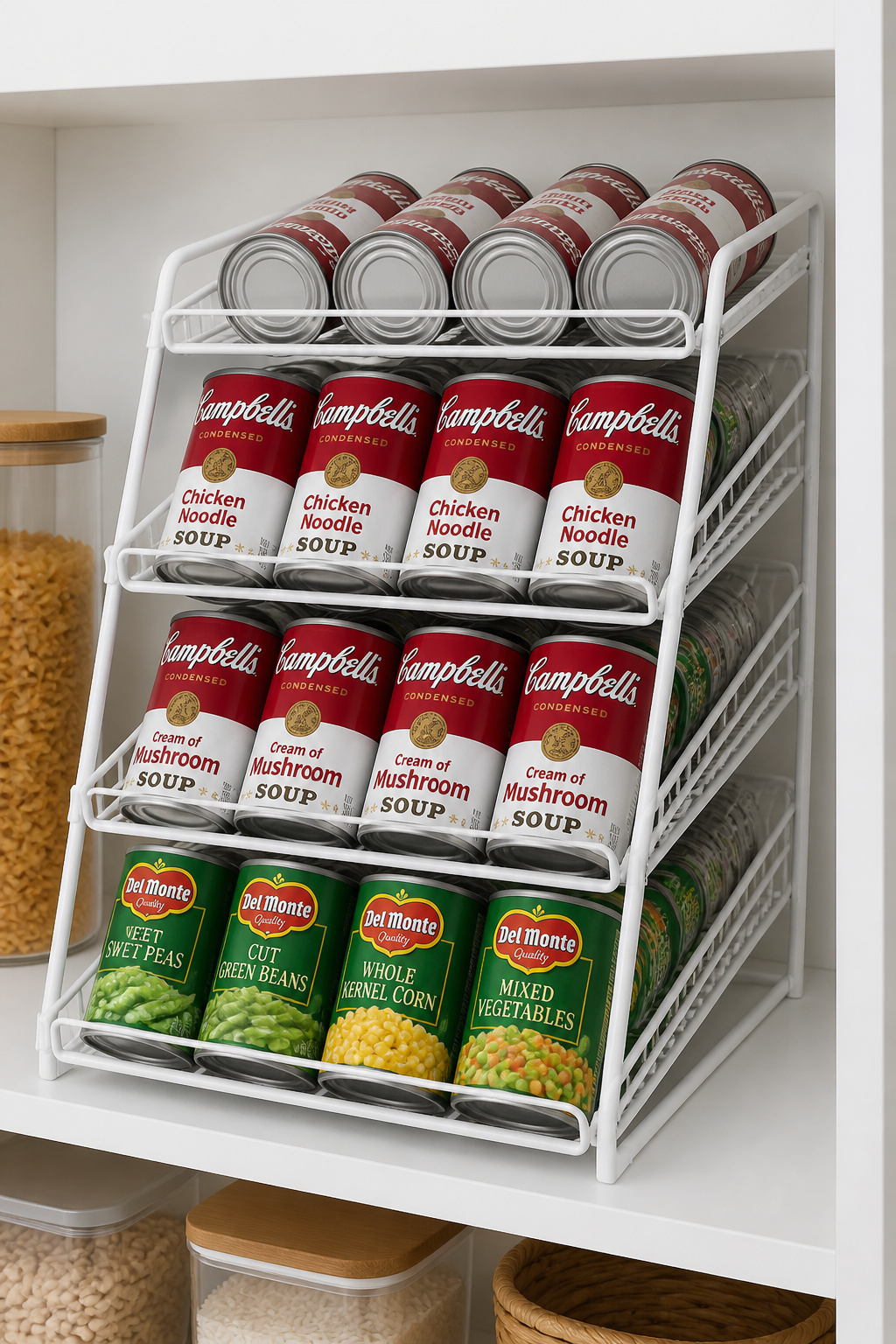
FIFO can organizers (First In, First Out) build the rotation into the structure itself. New cans load from the top; the oldest roll forward automatically to be grabbed first. It’s the same system used in commercial kitchens and grocery stores. You load it, and it maintains itself — no re-sorting, no date checking, no expired soup surprise. Combined with broader kitchen storage and organizer hacks, a FIFO system makes your pantry actively work for you rather than requiring constant manual maintenance.
Shelf Reliance’s FIFO Mini Can Tracker (12\”H x 16\”W x 16\”D) holds 30 standard cans with three dowel sizes — A for family soup cans, B for chunky soup and fruit, C for standard vegetable cans. The 4-pack version expands this to 54 cans and connects to additional units side by side.
Before buying, check can size compatibility. These systems are designed around the most common grocery-store sizes: #300 (3\” diameter, 14-16 oz), #303 (3 3/16\” diameter, standard vegetables), and #2 (18-20 oz). Also, a fully loaded 54-can unit is heavy — confirm your shelf can handle the weight and position it on a lower shelf for stability.
6. A Label-Everything System for a Truly Organized Kitchen Pantry
Here’s something I’ve seen consistently after helping hundreds of families reorganize their kitchens: they all start with the bins and the baskets, and they rarely buy labels. Three months later, the system has quietly drifted back to chaos. Not because the products failed — because without labels, the system relies on memory. And memory, in a busy household, is not a storage solution.
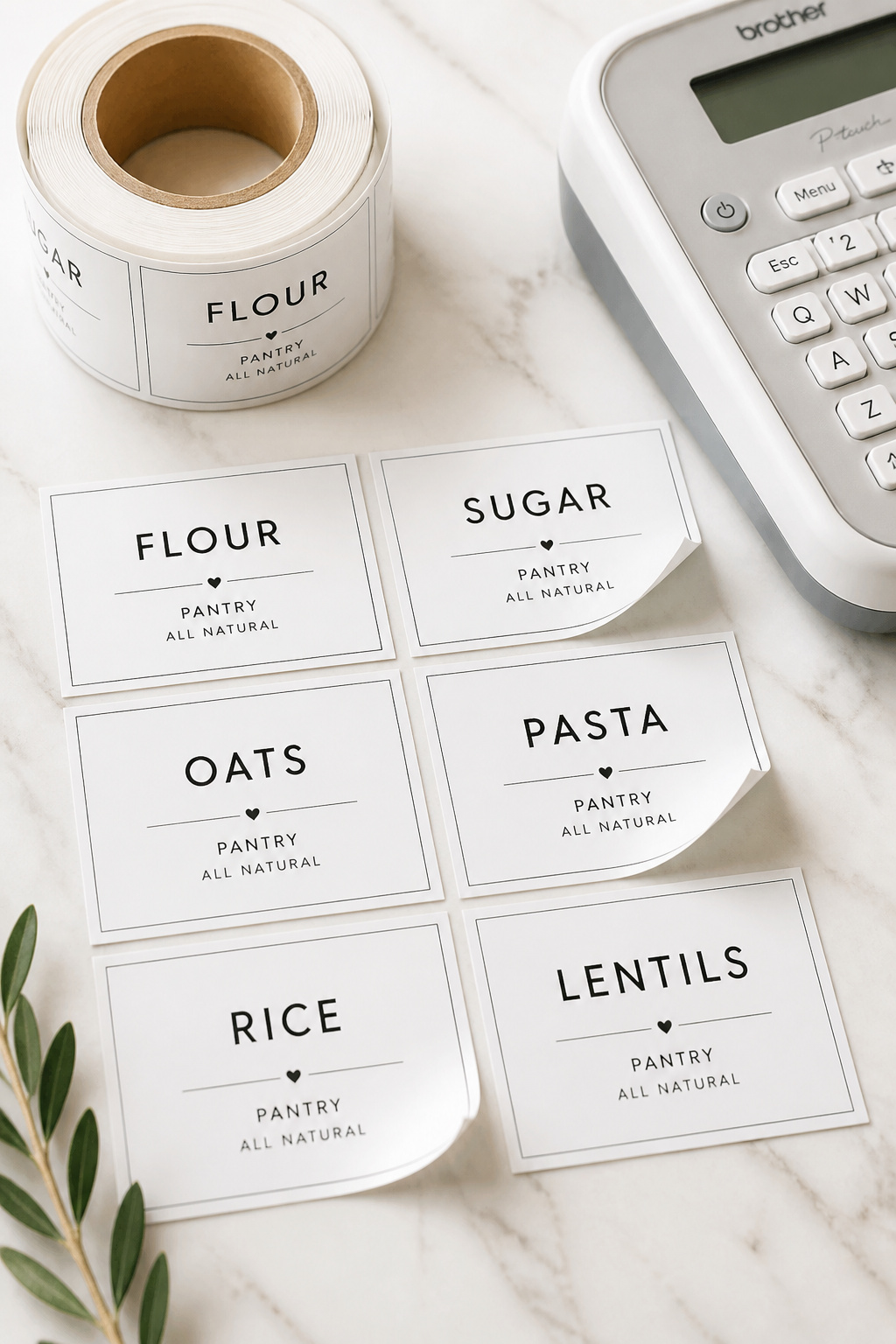
Labels are the maintenance mechanism of a kitchen pantry. They make the system self-explanatory to every member of the household regardless of who put the groceries away last. A labelled bin returns to the right shelf. An unlabelled bin goes wherever seems reasonable at the time.
For a permanent pantry you’re setting up to last, preprinted waterproof labels are the better long-term choice over chalkboard labels. Kitchen humidity causes chalk writing to smudge and fade within months. Preprinted labels are waterproof, oil-resistant, and need no maintenance beyond occasional wiping. If categories in your pantry rotate seasonally, a small removable chalkboard label works well as a flexible complement to the permanent system elsewhere.
Label both the container and the shelf or bin zone it lives in. The shelf label survives when the container is removed — it keeps the system legible during restocking and tells any household member exactly where things go. Also: always label before filling. All-purpose flour, bread flour, and cake flour look completely identical once they’re decanted into clear jars. Ask me how I know.
7. Under-Shelf Clip-On Baskets for Extra Vertical Storage
There’s a specific kind of wasted space hiding in plain sight in almost every pantry: the gap between what’s stored on each shelf and the underside of the shelf above. For lightweight categories like spice packets, foil rolls, cling wrap, and tea towels, only 4-6 inches of that 12-16 inch gap is actually being used. The rest is air — and clip-on baskets let you recover it.
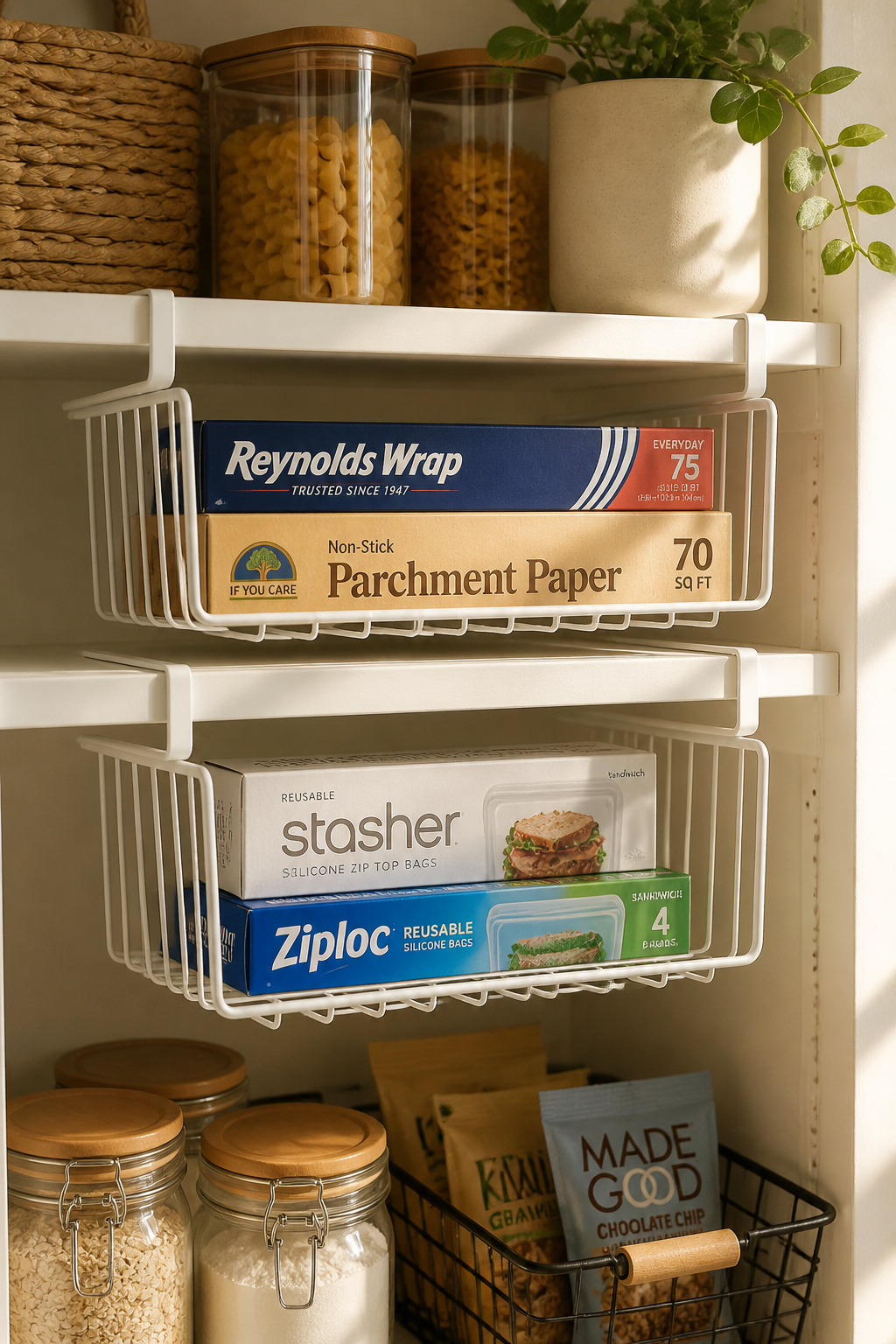
IKEA’s PÅLYCKE is the most widely recommended version: 14⅛\” long by 10¼\” wide by 5½\” high, with a maximum load of 4 lbs. The clips fit most standard wood shelves between ⅝\” and ¾\” thick. No tools needed. The basket clips over the shelf edge and hangs in the gap below, creating a second tier of storage in space that was previously just air — and in a kitchen storage pantry, that kind of reclaimed space adds up fast.
The 4-lb limit means this isn’t for heavy storage — and it shouldn’t be. The best candidates are lightweight, awkward-shaped items that are hard to store efficiently on a flat shelf: aluminium foil boxes, cling wrap rolls, parchment paper, reusable zip-top bags stored flat, and tea towels. These are far easier to find hanging here than lost sideways in a deep bin.
The one critical check before buying: measure the shelf edge thickness. Most clip-on baskets fit shelves between ⅝\” and ¾\” thick. Thicker shelves prevent the clips from closing. Ten seconds of measurement saves a return trip.
8. Adjustable Shelving That Adapts to Your Kitchen Storage Needs
Fixed pantry shelves are, in my view, the single biggest structural mistake in pantry design. They commit you to one configuration for the life of the cabinet — one that was designed for an average pantry rather than yours. Cereal boxes need 14 inches of clearance; spice jars need 6. A fixed shelf at 10 inches wastes space for cereal and crowds spices. It’s the first thing I fix when designing any kitchen storage pantry.
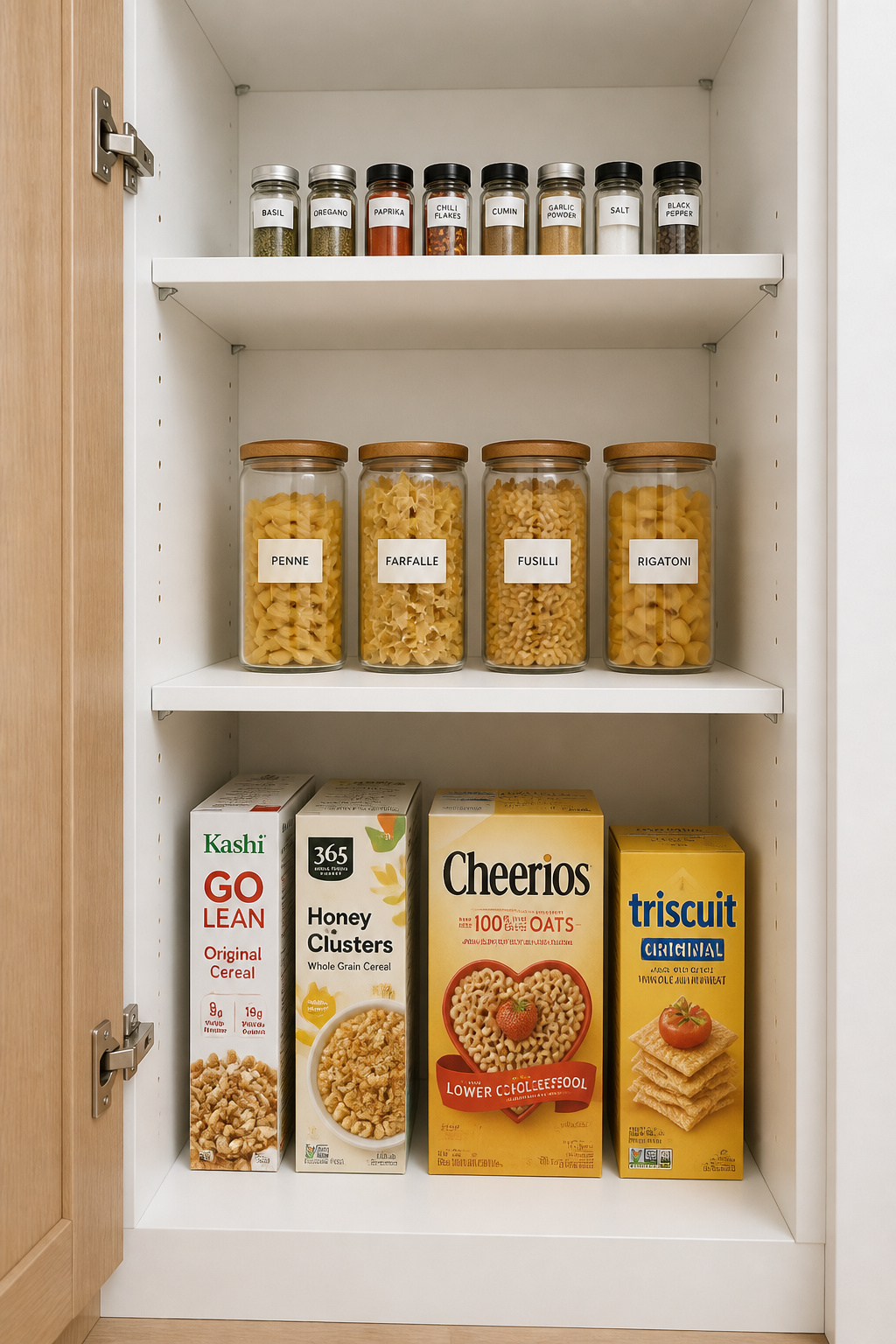
Adjustable shelving on 1-inch pin spacing lets shelf heights fit the actual contents, not the other way around. It’s one of the most important principles in maximizing kitchen cabinet space, and it costs nothing to implement if your cabinet already has pin holes drilled — which most builder-grade pantries do.
Check your cabinet side walls. If there are rows of small holes spaced approximately 1 inch apart, your shelves are already adjustable. Move the pins to new heights, reset the shelves. Done. No tools, no cost, five minutes.
For cabinets without pin holes, the Elfa track system from the Container Store installs via a single top track — the only structural fastening required. Hanging standards and shelf brackets then slot in at any height and can be repositioned at any time. It’s particularly good for a reach-in pantry where you want the flexibility to add components over time.
Start with the basics before investing in pull-outs or custom hardware. Get the shelf heights right first. You’ll be surprised how much of the apparent clutter problem disappears when the shelves simply fit what they’re holding.
9. Decanted Dry Goods in Glass Jars for Beautiful Kitchen Pantry Appeal
Every serious home cook I know arrives at the same conclusion eventually: glass jars are worth it. Not just for the way a shelf of uniform labelled jars transforms a kitchen pantry into something you actually want to look at — but because decanting into airtight containers is genuinely better for ingredients, visibility, and the daily experience of cooking.
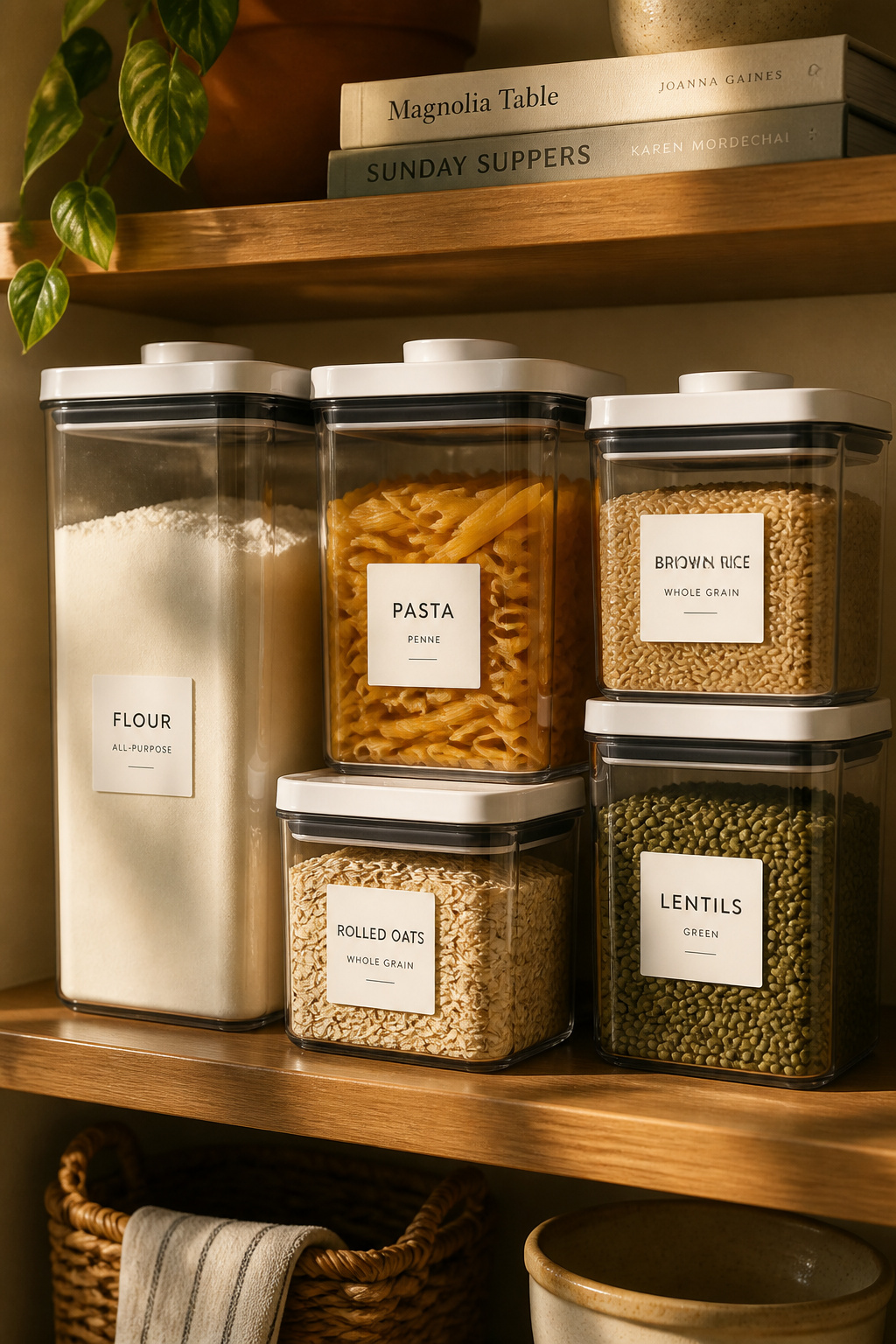
Open bags of flour and pasta take up significantly more space than their actual contents. Packaging adds bulk without adding storage; it also lets in moisture, odours, and pests over time. A sealed jar does none of these things. Because you can see how much you have at a glance, your relationship with your pantry stock changes entirely. These smart kitchen storage organization ideas work best when paired with good containers.
The OXO POP series is the most versatile starting point. The medium (4.4 quarts) holds a full 5-lb bag of flour or sugar — OXO specifically designed these containers to match standard grocery bag sizes. The short holds 4 lbs of rice; the tall (6 quarts) handles crackers, large pasta shapes like rigatoni, and cereal. One press of the round knob engages the silicone airtight seal. All pieces are dishwasher-safe.
For a more visual aesthetic, Kilner clip-top glass jars are a beautiful alternative. Their 2.2-litre facetted jar is sized specifically for spaghetti and long-strand pasta. The wire bail and rubber gasket create a tight compression seal.
The non-negotiable rule: label every jar before you fill it. All-purpose flour, bread flour, and cake flour are completely indistinguishable once in clear glass.
10. Pull-Out Trash and Recycling Cabinet Built Into the Pantry
One of the upgrades that consistently surprises people with how much it changes the kitchen experience is moving the bin off the floor and into a cabinet. A pull-out trash and recycling system integrated into the pantry keeps waste out of sight, out of the way, and exactly where it’s most useful — positioned at the cooking zone rather than wherever a freestanding bin happened to fit.
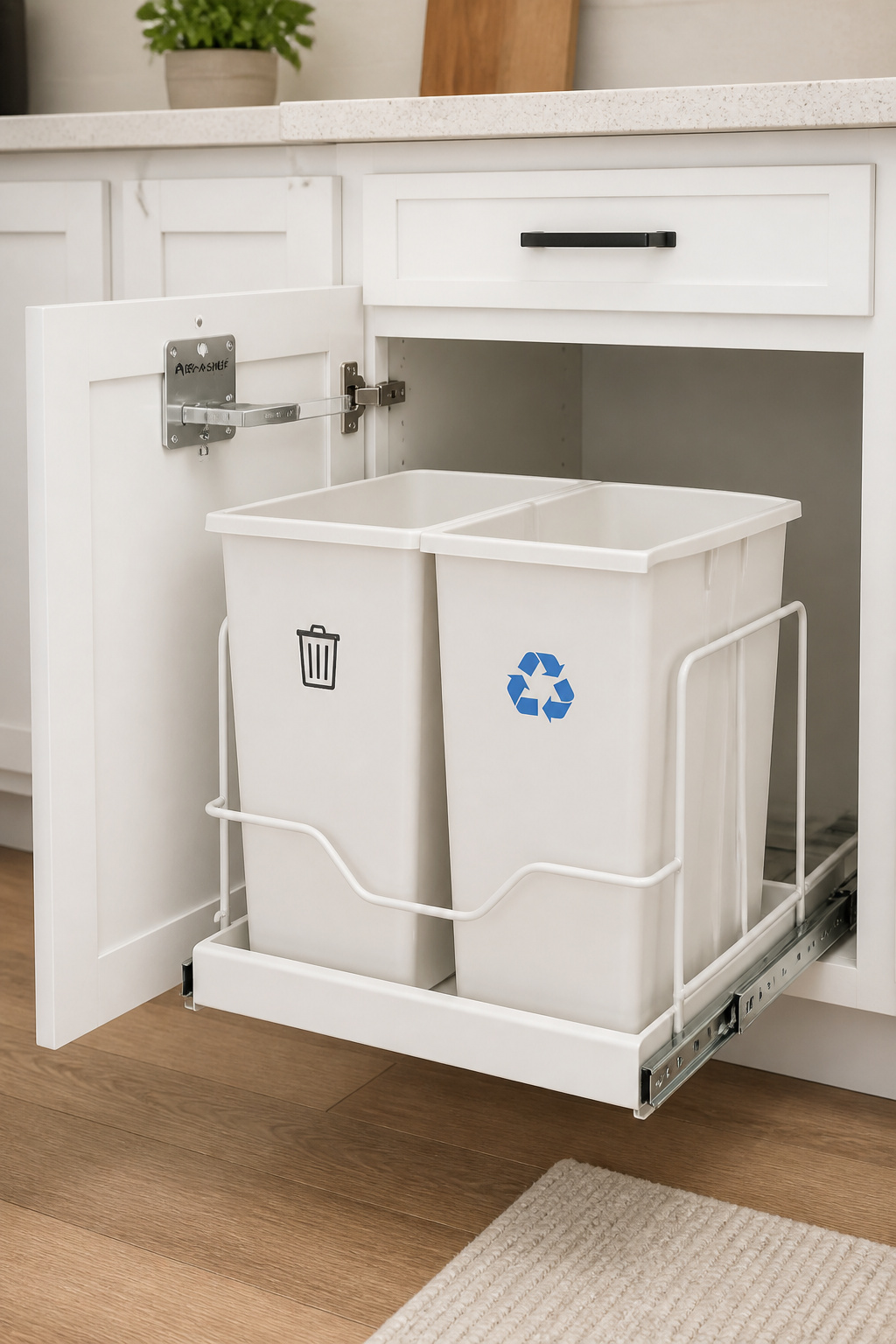
The practical benefit is real. Vegetable peels, packaging, eggshells from breakfast — disposing of them without crossing the kitchen keeps prep faster and the work surface cleaner. For a serious home cook, proximity to waste disposal isn’t a minor detail; it’s part of kitchen workflow.
Rev-A-Shelf makes two systems worth knowing about. The 4WCSC series uses solid wood construction with BLUM drawer slides and adjustable door-mount brackets — it’s the most specified pull-out waste system among kitchen designers because the dovetail frame holds up to years of daily use. The 4WCBM series upgrades this with the Rev-A-Motion mechanism: a gas spring-assisted soft-open that pulls the bin unit out smoothly even when fully loaded, and a soft-close damper for quiet closing. For households that compost, the 4WCWM adds an 8-litre compost bin alongside waste and recycling in one pull-out unit.
For sizing: Häfele’s KV double-bin system fits cabinets as narrow as 14¾\” (face-frame width) with 35 qt per bin. The installation detail people most often miss: the door-mount bracket. Without it, the cabinet door and bin unit open separately. With it, pulling the door opens the whole system.
11. Pegboard Panels for Wall-Mounted Flexible Pantry Organisation
There is almost no lower-cost, higher-flexibility pantry storage upgrade than pegboard. A 2×4-foot hardboard panel costs under $20 at any hardware store. Painted, sealed, and fitted with hooks and baskets, it turns an unused pantry wall into a completely customizable storage system that can be reorganized in minutes without drilling a single new hole.
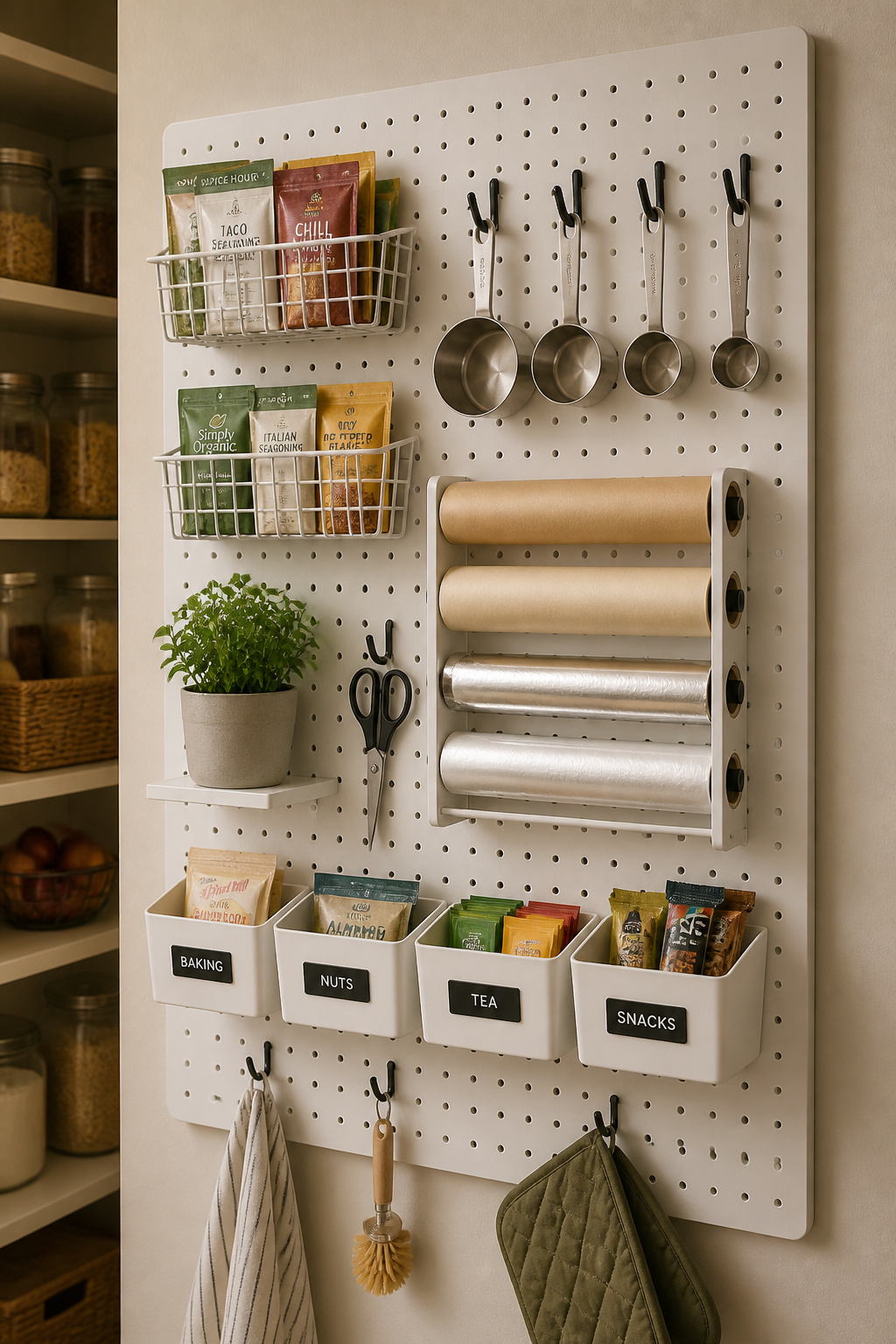
Julia Child famously mounted pegboard for her pots and pans, outlining each tool’s shape so it always returned to exactly the right spot. The same approach works in a kitchen pantry for measuring cups, spice bags, cooking twine, ladles, and cling wrap rolls. Open shelving and rail systems follow the same logic: make things visible and accessible rather than buried.
Pegboard comes in two hole sizes: 3/16\” for lighter-duty hanging (packets, small clips, spice bags) and 1/4\” for heavier hooks that hold cast-iron or bulky items. Mix and match hooks freely — v-hooks and u-hooks cover most pantry needs; bin hooks hold small wire baskets; 6-ring holders are perfect for rolls of foil, cling wrap, and parchment.
The critical installation point: pegboard must be mounted with at least ½\” of space between the back of the board and the wall surface — without this gap, no hook can engage the holes at all. Frame the board with 1×2 lumber strips screwed into wall studs, then attach the pegboard to the frame. Before mounting, coat the board front and back with clear polyurethane and let it cure for 24 hours — hardboard absorbs kitchen moisture and will warp or bubble if left unsealed.
12. A Dedicated Snack Zone for Smarter Family Kitchen Storage
If you cook for a family with children, you know the particular chaos of the afternoon snack request: the half-opened bag that didn’t get resealed, the crackers mixed with dried fruit, the child who’s opened three different bins looking for one specific granola bar and left all three lids off. A dedicated snack zone resolves most of this in one structural decision.
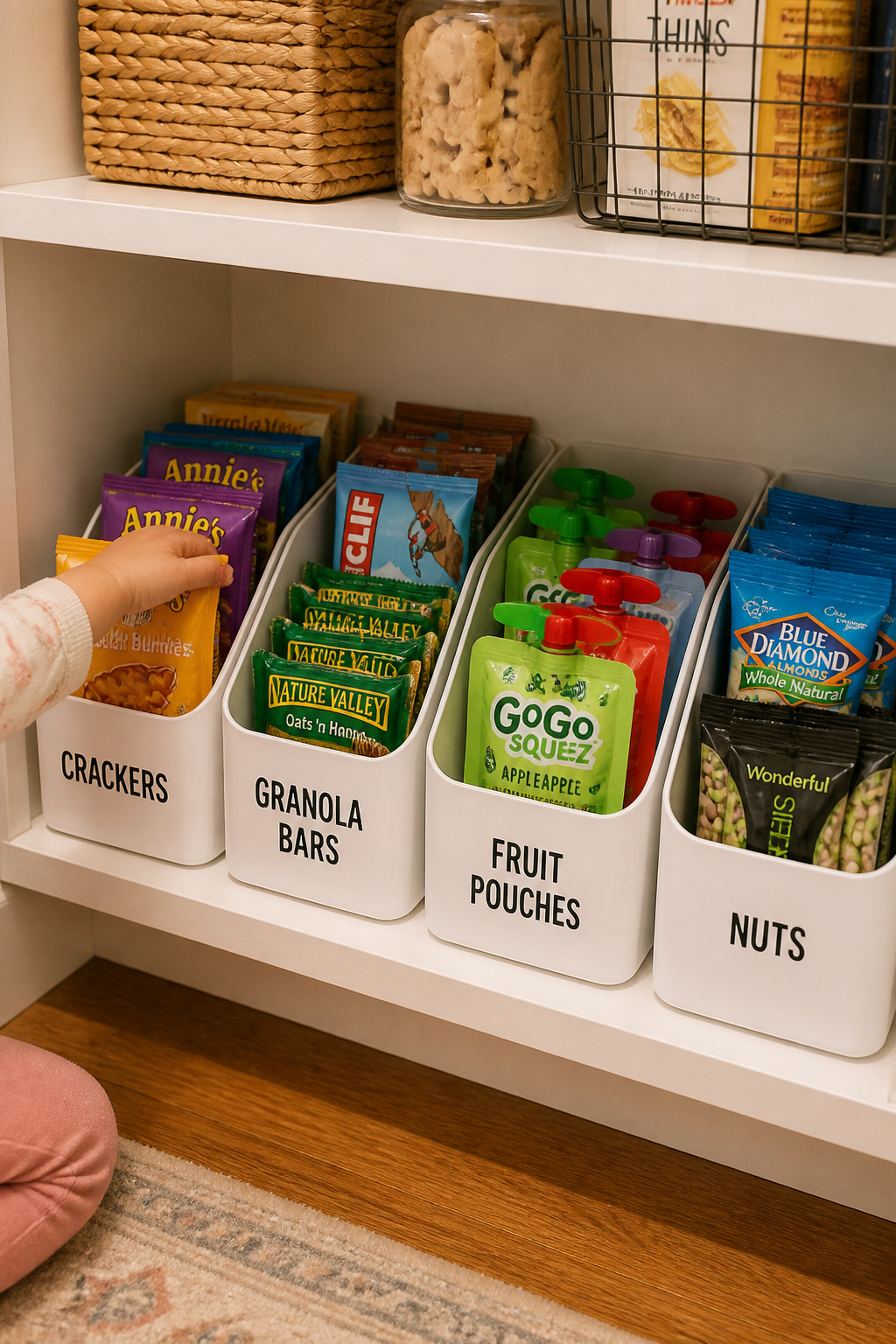
The idea is straightforward: a defined section of the pantry — a shelf or section of a shelf — stocked with approved snack options in clearly labelled open-front bins. Children help themselves without assistance. Parents stop playing intermediary for every afternoon snack. And the system creates natural portion awareness: when a bin is empty, it’s empty.
Shelf height matters. For toddlers, 24 inches from the floor allows reach-up access with both hands. For school-age children, 36 inches is approximately eye level and within comfortable reach. The snack zone doesn’t need to be the most accessible shelf in the pantry — it just needs to be reachable by the people using it most.
Open-front bins work better here than lidded containers. Children can grab what they want without struggling with lids, and the open top gives parents a quick visual inventory at restock time. Keep individual category bins rather than a single communal bin: one for crackers, one for fruit pouches, one for granola bars. Set aside ten minutes on Sunday evenings for restocking. Without that weekly reset, the snack zone turns into a general storage area within a month.
13. Bread and Baking Station in a Converted Lower Pantry Cabinet
Most home bakers have the same unacknowledged problem: their baking supplies are stored in three or four different places. Flour in one cabinet, vanilla in the spice rack, baking sheets in a drawer, the stand mixer shoved to the back of a lower cabinet. Every Saturday morning bake starts with a ten-minute archaeological dig before a single ingredient is measured.
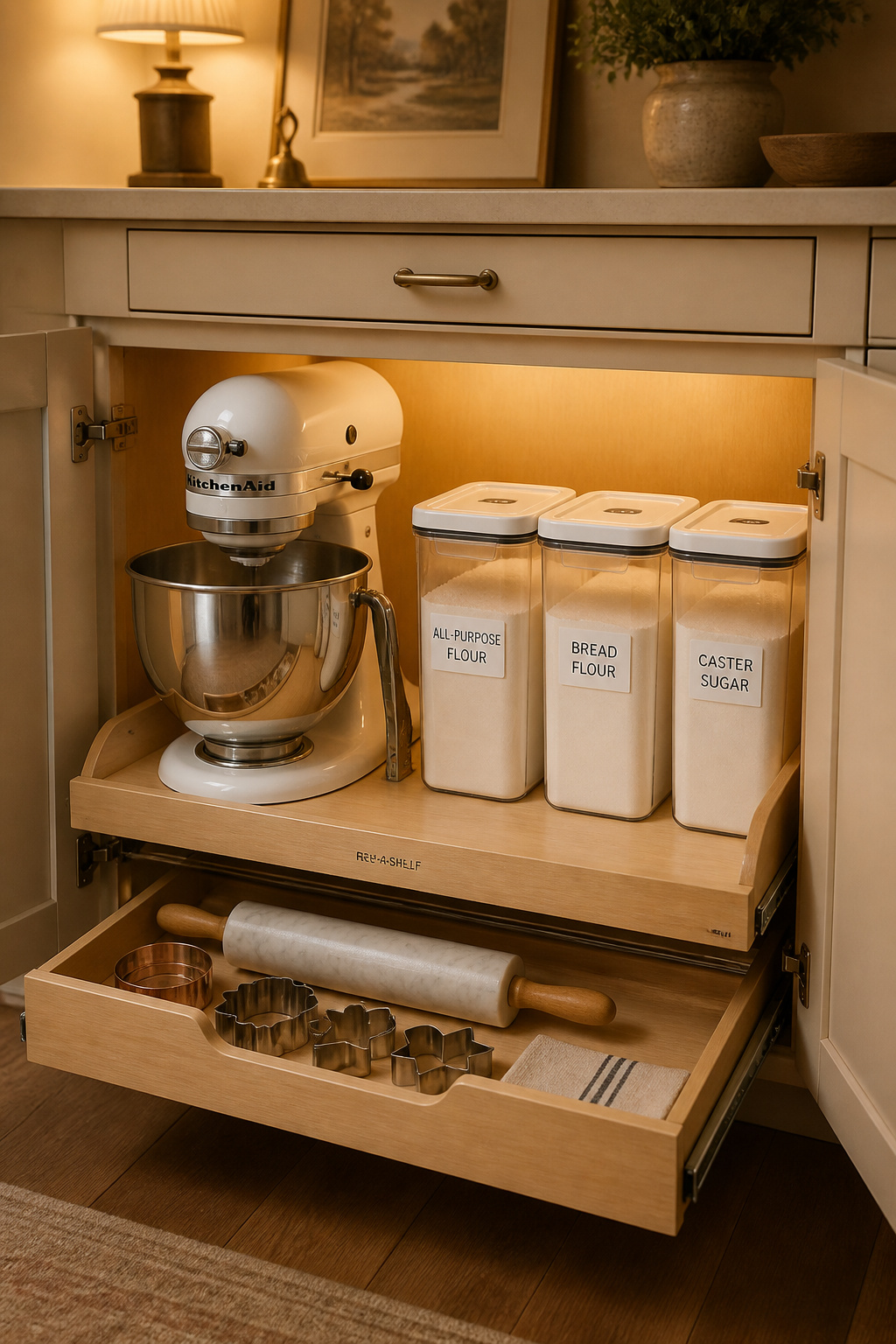
A dedicated kitchen pantry baking station changes this entirely. Everything lives in one zone: the mixer, the dry ingredients, the bowls, the measuring tools, the baking sheets. Open the cabinet doors and you’re ready to bake. Close them and the kitchen looks completely tidy.
The Mixer Lift
The centerpiece of a functional baking station is a mixer lift. KraftMaid’s base mixer lift raises a heavy stand mixer — a KitchenAid Artisan is 25 lbs — from below-counter storage to working height with a glide-in, soft-close mechanism. Dura Supreme’s version integrates a roll-out tray beneath the lift for rolling pins, cookie cutters, and small tools. The lift solves the one problem that eventually convinces people to leave their mixer on the counter permanently: the back strain of hoisting it up from a deep lower cabinet.
The Dry Ingredient Setup
For the dry ingredient side, OXO POP containers are the right vessel. The medium (4.4 qt) holds a 5-lb flour bag exactly. If you bake broadly, use separate containers for all-purpose, bread, and cake flour — they look completely identical in clear glass, so label before filling. Dura Supreme’s roll-out tray inserts come in four depths (flat, 2\”, 4\”, and 8\”) to accommodate baking sheets flat and cookie cutters in a shallow tray. Also, if you’re building or renovating: consider lowering the baking station counter by 2 inches, to 34\” rather than the standard 36\”. The difference is meaningful for rolling and kneading, especially if you’re shorter or have wrist sensitivity. Even a broader kitchen refresh can be timed to incorporate this kind of practical counter adjustment.
14. A Wine and Beverage Corner in Your Kitchen Pantry
The drink station is an underrated pantry idea — one that the kitchen designers I most admire treat as a standard feature rather than a luxury. It keeps bottles off the main refrigerator shelves, clears the counter of a sprawling bar setup, and puts wine, sparkling water, and entertaining essentials in one logical, accessible location.
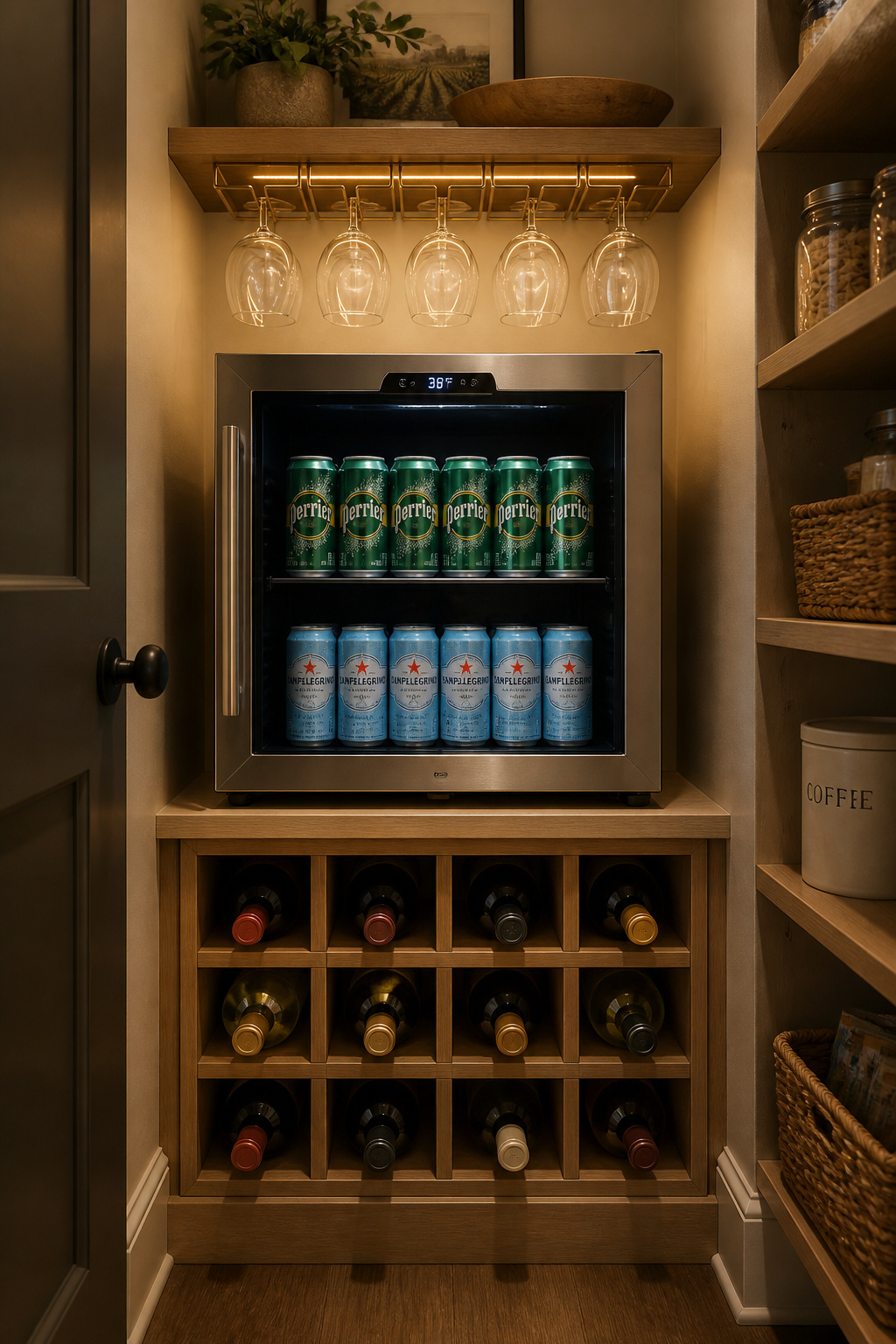
It doesn’t require a dedicated bar cabinet. The outer or least-used section of a reach-in pantry works well: a wine rack on the lower shelf, a beverage fridge slide-in below a work surface if the space allows, and a dedicated upper shelf for glasses and a small selection of spirits.
For the wine rack: standard Bordeaux bottles measure 11.5-13 inches long by 3-3.25 inches in diameter, and most standard pantry wine racks are built around these dimensions. Burgundy/Pinot bottles run slightly wider at 3.2-3.5\”; Champagne is wider still at 3.5-3.75\” — so check rack opening dimensions before buying if your collection includes sparkling wine. A 12-bottle freestanding rack occupies approximately 10\”W x 10\”D x 18\”H — compact enough for most pantry corners.
If you’re adding a beverage fridge, choose a front-vented model. Front-vented fridges require no rear clearance gap; rear-vented models need at least 6 inches of space behind them and cannot be fully enclosed. Installing a rear-vented unit in a closed kitchen pantry cabinet will cause the compressor to overheat within months.
One practical note: keep wine storage away from onions and garlic. Strong food odours can penetrate cork over extended storage. A small detail, but worth planning for when positioning the zone.
15. Chalkboard Door Panel for Grocery Tracking and Meal Planning
The inside of a pantry door is useful two ways: hold over-door storage (see item 2), or hold a chalkboard panel. Both are excellent. The chalkboard version turns the door into a live household planning tool — a grocery list that writes itself as the family uses things up, a weekly meal plan visible at the heart of cooking, and a small “use this week” section for ingredients approaching their best-before date.
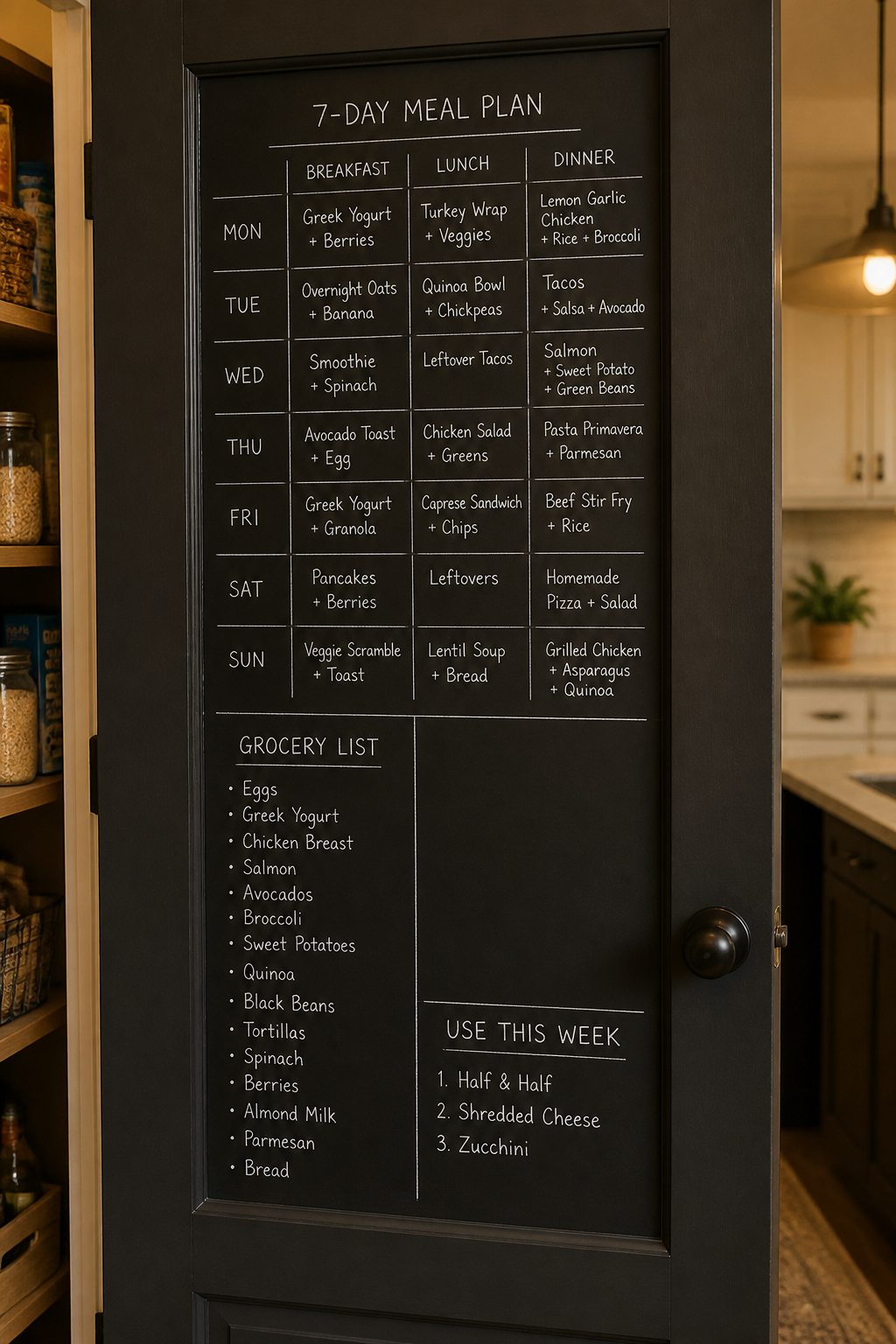
The impact on food waste is practical, not aspirational. Near-expiry items that are visible in a dedicated reminder zone get used. They don’t resurface six weeks later when you’re reorganizing the back of the shelf.
Choosing Your Surface
For a pantry door, adhesive chalkboard vinyl (Con-Tact, Fadeless) is the easiest starting point — it applies without surface prep, removes without damage, and works well enough for daily use. For a more permanent result, chalkboard paint on a properly primed MDF door gives a smoother writing surface. The process matters: sand the door, apply a bonding primer, then 2-3 coats of chalkboard paint (Rust-Oleum Chalk Board Spray is the most widely available). Let it cure for at least 72 hours before writing on it. Rushing the cure produces ghosting that never fully erases.
The Right Marking Tool
Use chalk markers rather than chalk sticks. Molotow AQUA and Posca markers write cleanly, resist smudging from incidental door contact, and wipe off completely with a damp cloth. Standard chalk sticks smudge every time the door is touched in any well-used kitchen pantry. Divide the panel into three sections: a 7-day meal plan grid across the top, a grocery list column on one side, and a small “finish this week” reminder box at the bottom. Season the surface before first use: rub the side of a chalk stick across the entire panel, then wipe it off. This prevents first-write ghosting from permanently marking the surface.
16. Hanging Basket Systems to Double Your Kitchen Storage Pantry Capacity
Look up in your pantry. There’s almost certainly 18-24 inches of wall space between the top shelf and the ceiling doing absolutely nothing. In most kitchens, this is the biggest unrealized storage opportunity in the whole kitchen storage pantry — vertical space that requires no new shelf, no cabinet construction, and minimal installation effort. A wall-mounted rail with hanging baskets converts this dead zone into active storage for produce and kitchen essentials that actually store better hanging than on a flat shelf.
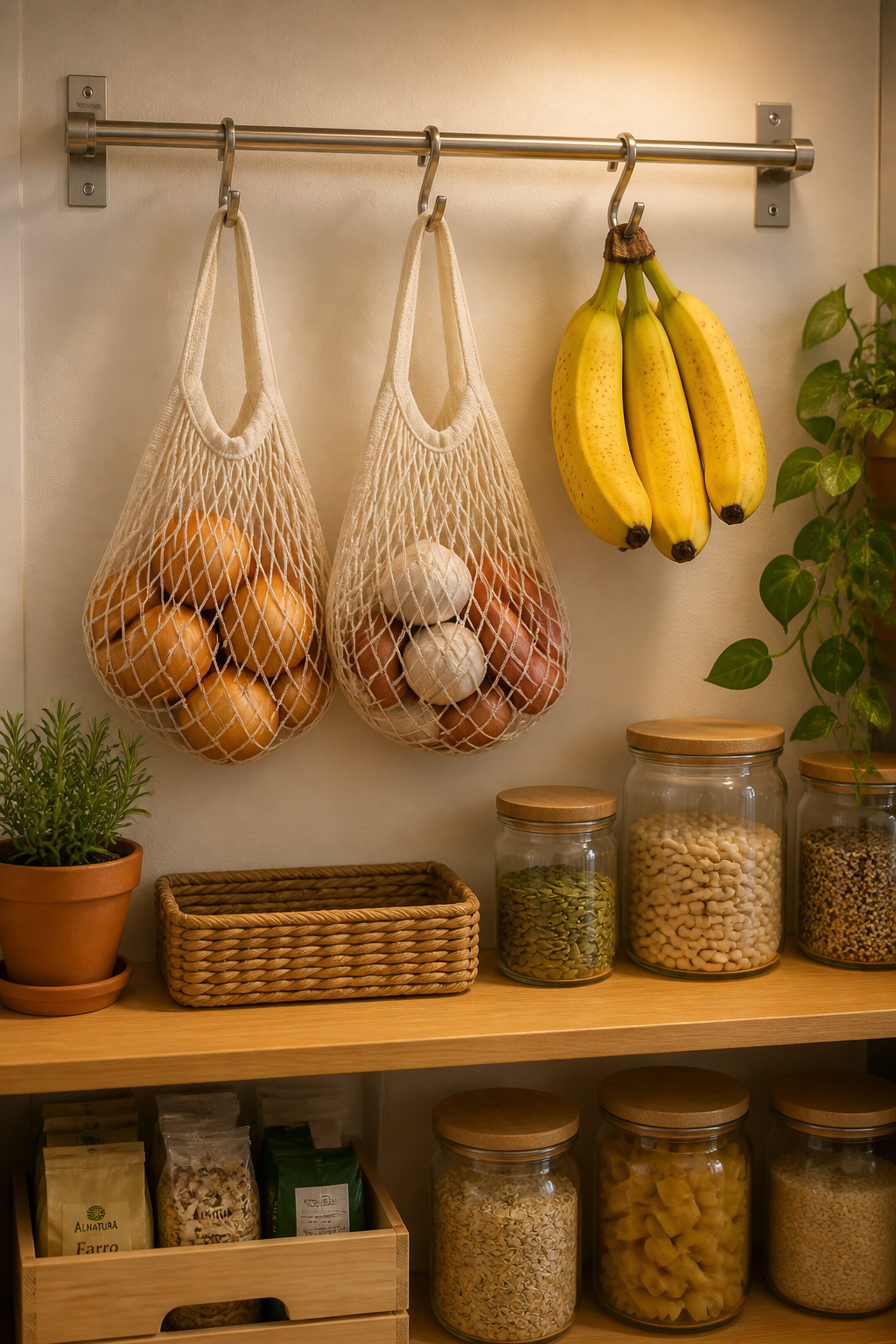
IKEA’s KUNGSFORS stainless rail system is the most accessible starting point. Rails come in 22\”, 55\”, and 79\” lengths and mount to the wall via screws; hooks, mesh bags, and small shelves all slide along the rail and reposition without additional drilling. For space-saving hacks for small kitchens, a KUNGSFORS rail above the top pantry shelf unlocks a storage tier that most people never think to use.
What to Hang (and What Not To)
The KUNGSFORS mesh bags (100% cotton) are designed for hanging produce storage. The woven mesh allows air to circulate through the contents — and this matters more than most people realize. Onions, garlic, shallots, and ginger root all keep significantly longer in well-aired hanging storage than in closed shelves, where moisture accumulation accelerates sprouting and rot. Also consider: bananas (a banana hook prevents the bruising that comes from resting on a hard surface), avocados left to ripen at room temperature, and citrus you’ll use within the week.
One practical rule: don’t store garlic and onions in the same hanging bag. Their respective gases accelerate each other’s deterioration over time. Use separate bags on separate hooks.
For heavier ceiling-mounted setups, find the ceiling joists before installing — a stud-mounted hook carries 100+ lbs; a toggle bolt in plasterboard carries about 50 lbs. A loaded rail coming down from a plasterboard ceiling is a serious hazard.
Choosing the Right Kitchen Pantry System for Your Household
Before you buy anything, spend twenty minutes in the kitchen storage pantry doing an audit. Empty one section at a time, check expiry dates, and categorize what remains: grains, canned goods, baking, snacks, oils and sauces, spices, back-stock. Then measure. Shelf spacing, gap heights between shelves, door clearance, shelf depth. These measurements cost nothing and will prevent at least one product return.
Place things strategically once you’re ready to put the pantry back together: heavy items on the lowest shelves (flour bags, canned goods, oil bottles), daily-use items at eye level (the pasta and rice you cook most, the spices you reach for every day), and back-stock on upper shelves out of immediate reach.
The highest-impact starting changes are adjustable shelf heights and clear labelled bins. These two upgrades alone — no pull-outs, no custom hardware, no significant expense — transform a disorganized pantry into one that works reliably. Door-mounted storage and under-shelf baskets are the next layer: both install quickly, cost little, and recover space that’s been wasted for years.
Pull-out wire baskets, FIFO can organizers, integrated waste bins, and dedicated stations for baking and beverages are the tier above that — genuinely life-improving, but worth implementing once the foundation is solid. The kitchen storage pantry that works best isn’t necessarily the most elaborate one. It’s the one where everything is visible, labelled, and returned to the same place every time. That’s the kitchen worth cooking in.