If your bathroom counter is always a mess and the cabinet under the sink is a place you avoid opening, you’re not alone. Small bathroom organization is one of those problems that feels endless — the space never changes, but the clutter somehow always grows. I’ve spent years thinking about how to make storage work harder in tight spaces, and what I’ve found is that a small bathroom doesn’t need more room. It needs smarter systems.
These 17 small bathroom organization ideas cover every zone: walls, doors, corners, under the sink, inside the vanity, and the shower itself. Some cost almost nothing. A few require a drill and an afternoon. All of them genuinely work.
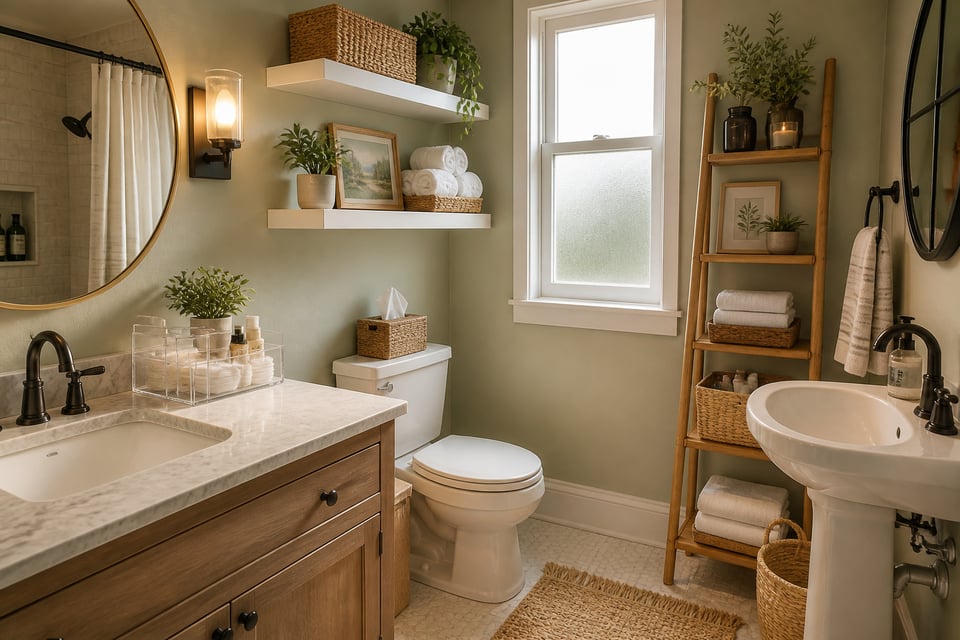
1. Floating Shelves for Small Bathroom Organization Above the Toilet
The wall above your toilet is almost certainly empty right now. It’s also the most reliable unoccupied wall in the room — no towel bar, no medicine cabinet, no door competing for space. Adding floating shelves here is the single highest-return small bathroom storage move you can make without touching the floor plan.
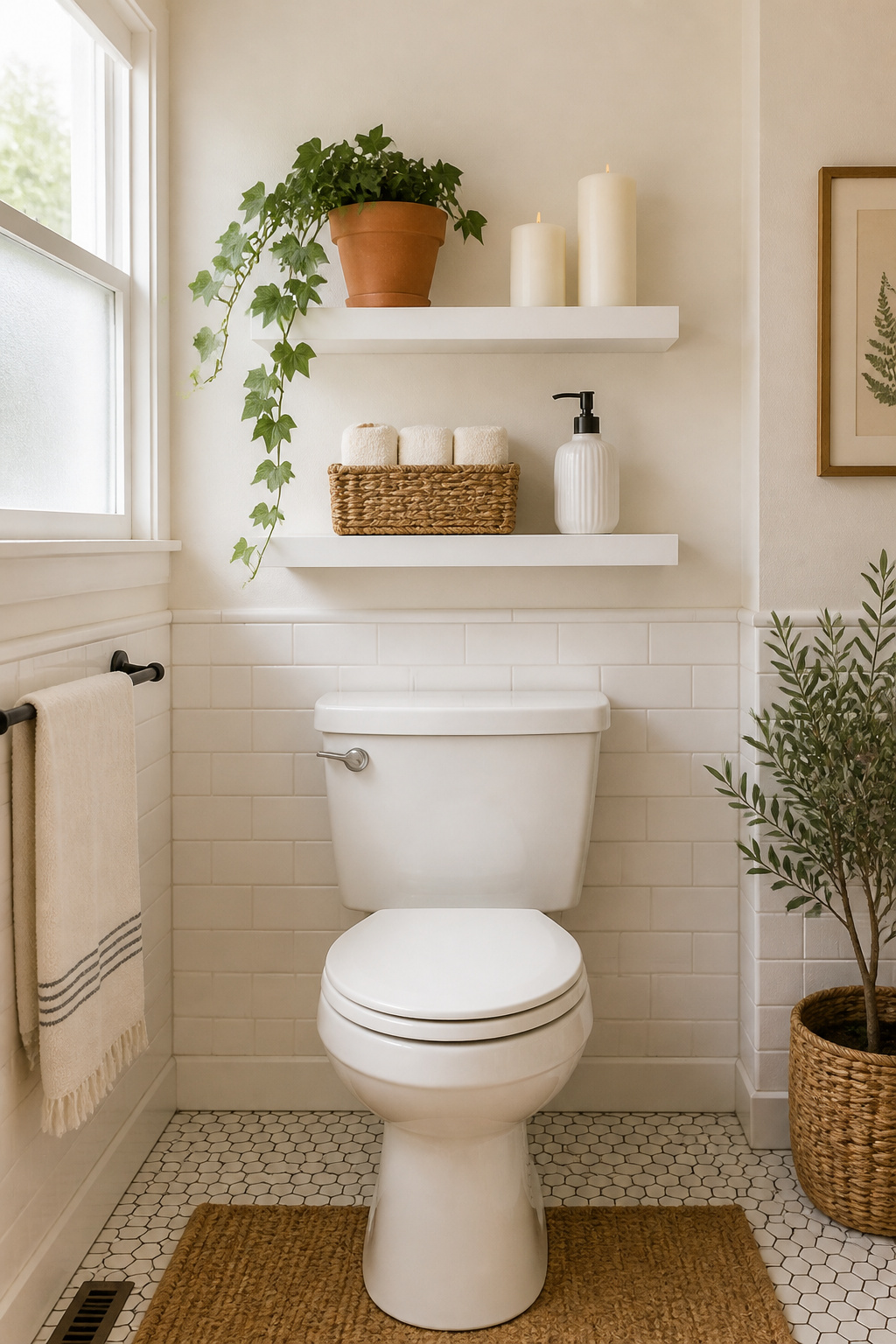
Mount the bottom shelf 12–18 inches above the tank top. That clearance matters: go lower and you can’t remove the tank lid for maintenance. For depth, 10–12 inches is the practical sweet spot — enough to hold a basket of toiletries or a row of rolled towels without feeling like the shelves are looming over you.
If you’re installing into drywall without convenient studs, snap-toggle anchors are your best option. They expand behind the drywall cavity and hold 25–50 lbs per anchor point — far more than a shelf of bathroom products will ever ask of them. Skip standard plastic anchors for anything holding glass bottles. For small bathroom storage ideas that use vertical space even more creatively, that’s worth a separate look.
Styling: keep the bottom shelf functional (extra toilet rolls, backup hand soap) and the top shelf decorative. A tall candle, a small plant, and one basket together on a shelf look composed. A row of mismatched bottles does not.
2. Under-Sink Pull-Out Drawers to Claim Every Inch of Cabinet Space
The under-sink cabinet in most bathrooms is a black hole. Drain pipes claim the centre, supply lines hang on the sides, and anything stored inside migrates toward the back where it’s never seen again. Standard rectangular bins don’t work here. You need something designed specifically around plumbing.
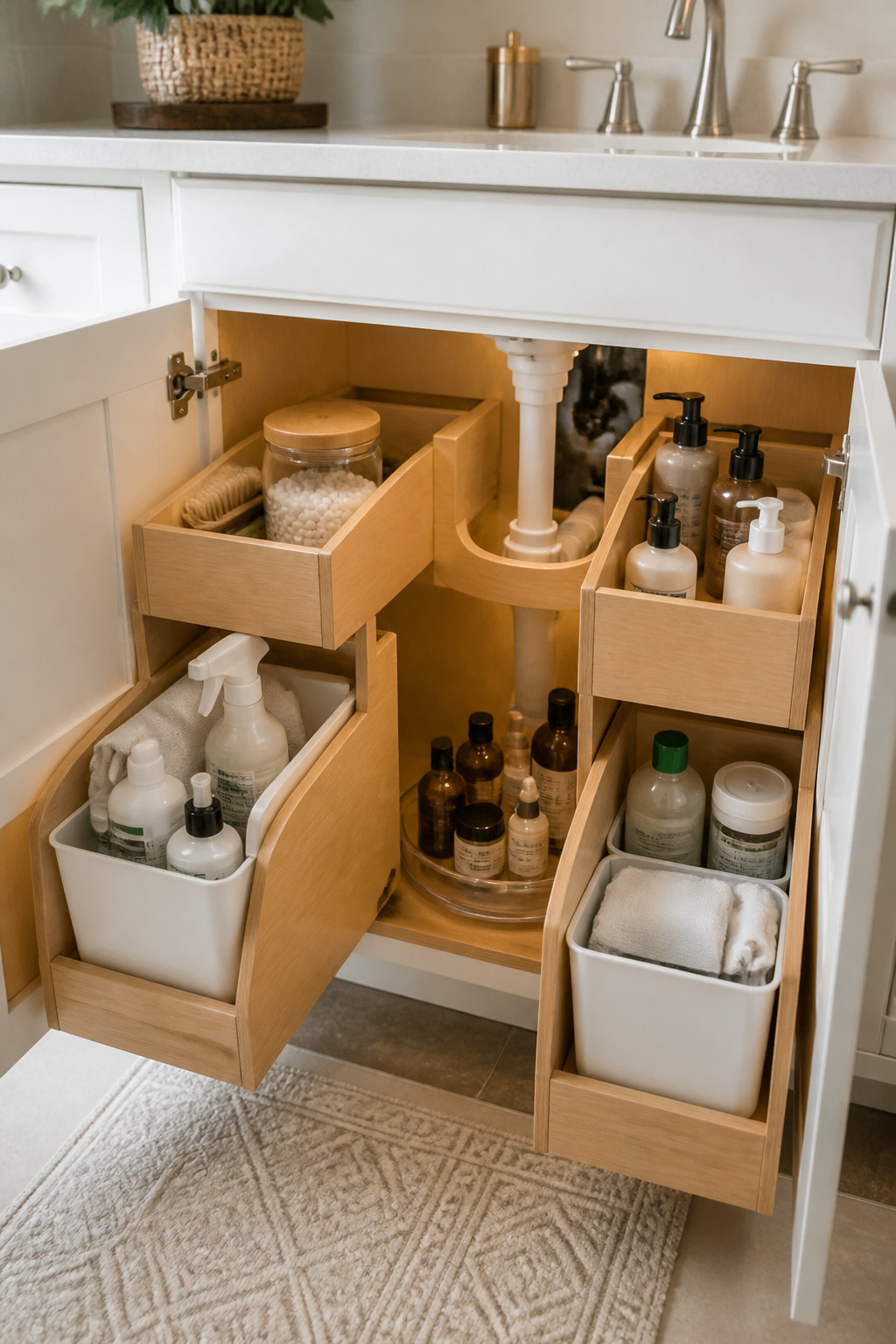
Rev-A-Shelf makes two products worth knowing: the 441 L-shaped reversible organiser for 24-inch vanity bases, and the 486 Series U-shaped maple organiser for 30-inch cabinets. The U-shape straddles drain plumbing entirely; the L-shape flips left or right depending on where your pipes run. Both ride on 90-lb rated soft-close slides — they glide open with one finger and don’t crash shut. The 486 series runs $100–180 depending on finish.
If you’d rather spend $15, the tension rod trick works: a spring-loaded rod installed 4–6 inches below the cabinet ceiling lets spray bottles hang by their trigger handles, creating a second storage level and freeing up the entire cabinet floor. It’s one of the best cheap bathroom cabinet organisation tips that genuinely changes how the space functions.
Measure the gap between the cabinet floor and the drain pipe before ordering anything. That number tells you the maximum bin height you can use.
3. Over-Door Rack: The Bathroom Storage Hack Renters Should Know
If you’re renting, an over-door rack sidesteps the no-drilling rule entirely. The hooks slot over the door edge, and the whole thing comes off in thirty seconds when you move out. For bathroom storage in a rental, it’s hard to beat.
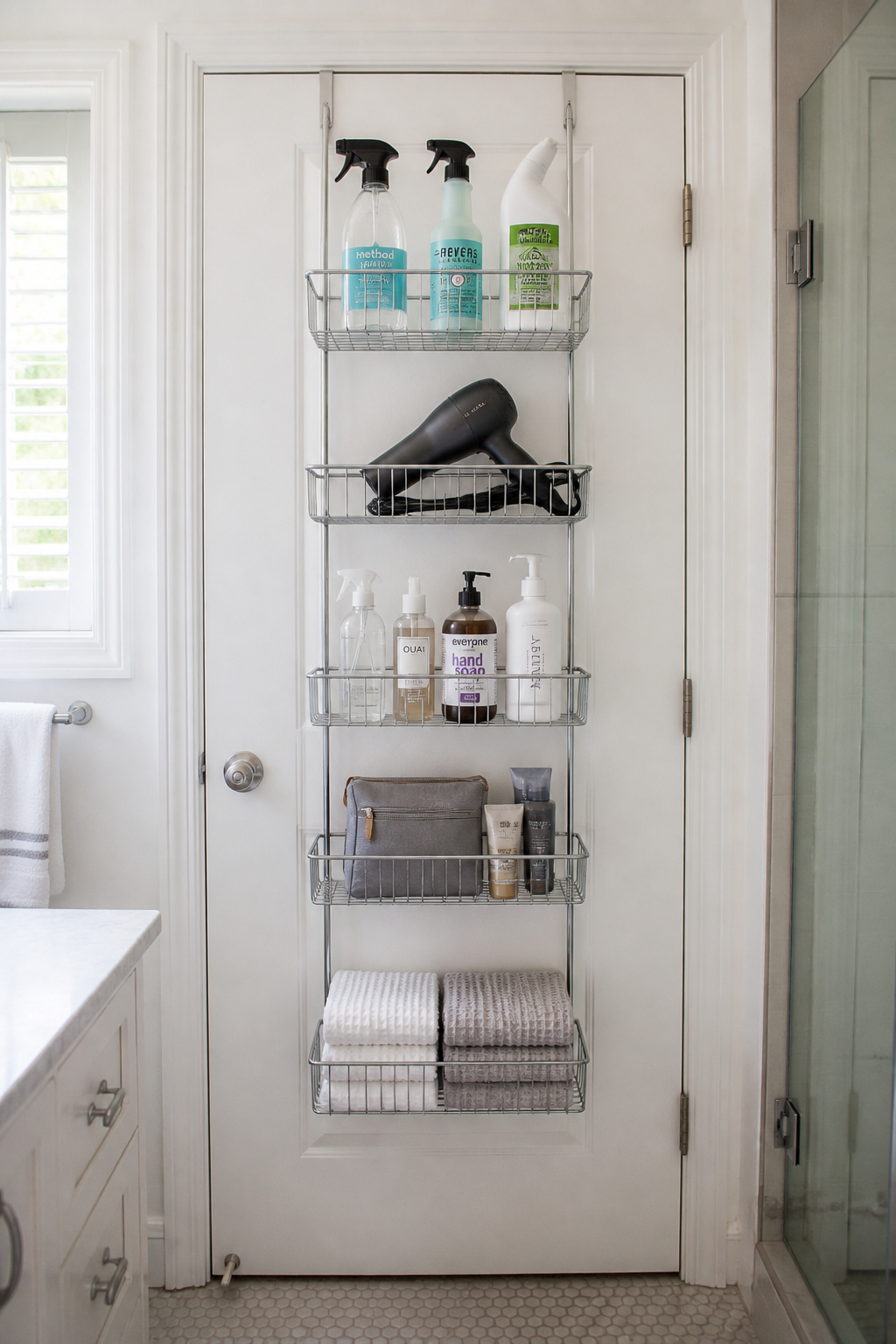
The main types: fabric pocket organisers (5-tier models with 8–12 inch deep pockets for everything from cleaning sprays to hair tools), metal basket shelf units for heavier items, and single hook rails that convert the back of the door into a towel hanger. Weight capacity ranges from 44 to 80 lbs — more than enough for most bathroom contents.
Two things separate a good over-door organiser from one that scratches the door: padding and door thickness. Add foam or felt to any hard surface contacting the door face. Standard interior doors are 1-3/8 inches, but older homes and some apartment doors have moulded edges that run thicker — check before ordering.
Distribute weight low. Top-heavy loading causes the organiser to tilt away from the door and create pressure marks. Lighter items at the top, heavier bottles at the bottom.
4. Tension Rod Shelf System Inside the Vanity Cabinet
Here’s one of the best cheap small bathroom organization hacks: a spring-loaded tension rod installed horizontally inside the under-sink cabinet, 4–6 inches below the cabinet ceiling. Spray bottles hang from it by their trigger handles. The entire cabinet floor opens up. Total cost: around $7.
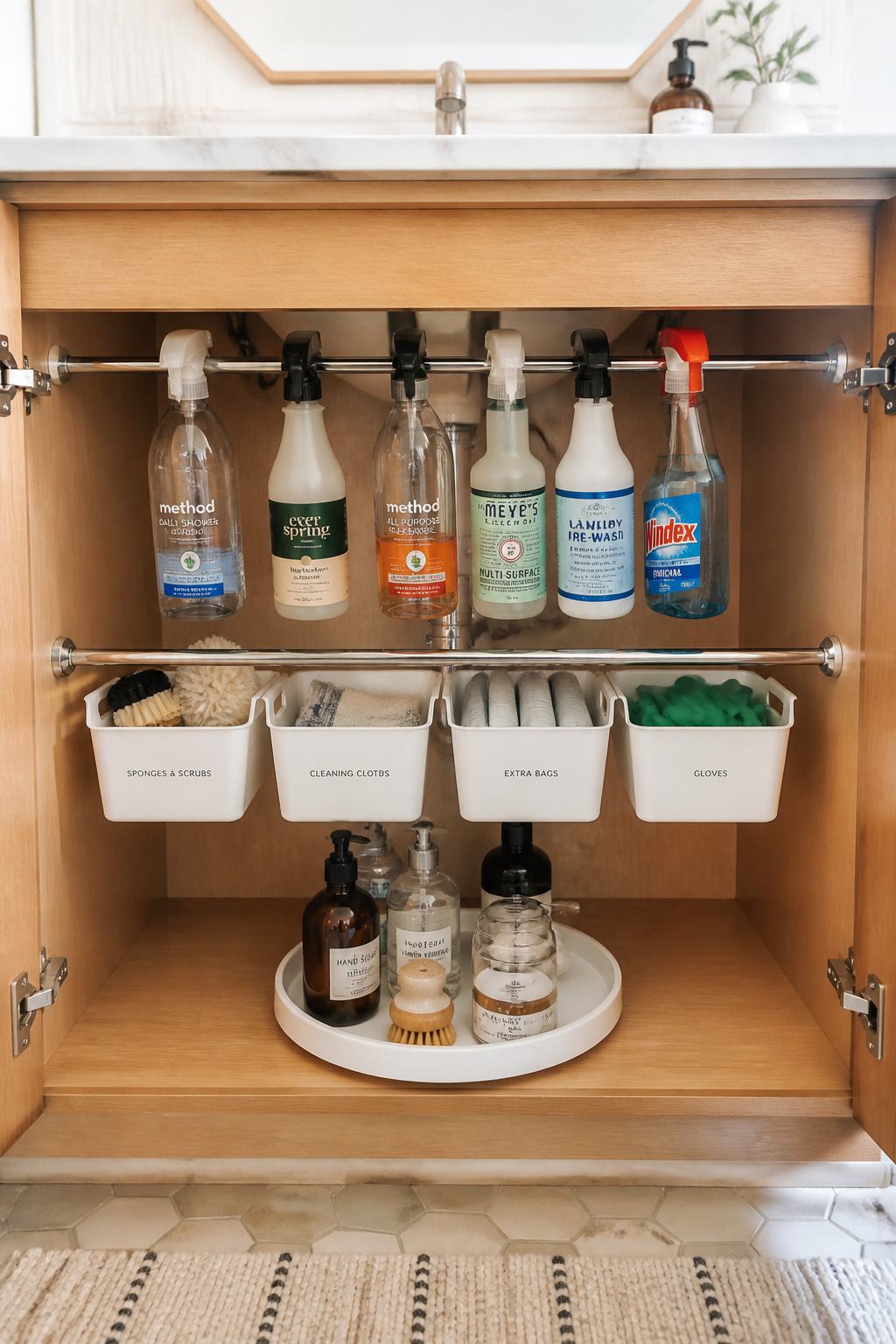
Worth doing even if you already have a pull-out organiser for bins — the hanging rod tackles spray bottles that bins can’t contain without creating an overcrowded floor. Add S-hooks if the rod diameter is larger than your bottles’ trigger openings. A second rod installed 6–8 inches below the first creates a double-tier system: bins rest on the lower rod, bottles hang from the upper.
Tension rods have more applications in the bathroom than most people realise. A vertical rod wedged in the cabinet corner keeps the hair dryer and curling iron upright and separated. Use a rod with at least a 1/2-inch diameter — a thin rod bows in the centre under a full row of spray bottles.
5. Corner Tiered Shelves That Convert Dead Angles Into Display Space
Most bathrooms have two or more corners, and most of those corners are empty from floor to ceiling. A corner shelf unit occupies a footprint smaller than a dinner plate — roughly 12×12 inches at the base — but a 4-tier bamboo freestanding model holds as much storage surface as two full wall shelves.
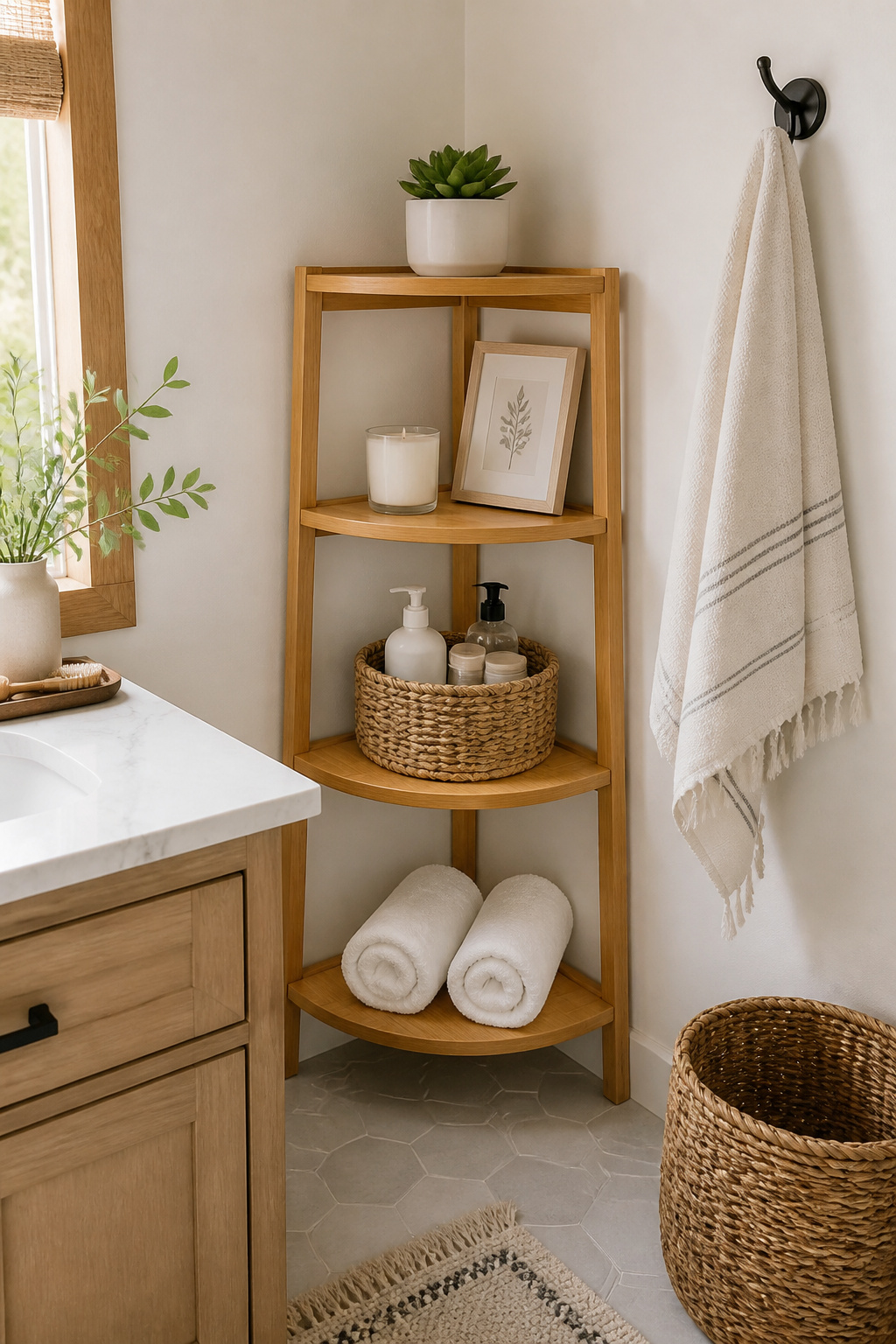
Freestanding units require no mounting hardware. They’re renter-friendly, moveable, and surprisingly stable. A 4-tier bamboo corner shelf runs 31.5 inches tall; some go to 63 inches for floor-to-ceiling presence. The trade-off: freestanding units can tip if you overload the upper tiers. Wall-mounted corner brackets fix that but require studs or anchors.
For more ideas on what a single zone change does to a small space, small bathroom ideas covers approaches beyond just shelving.
Use the tiers logically: top (hardest to reach) for rarely used items, middle tiers for daily-use products, bottom for heavier or less attractive items. One basket per tier maximum — more than that and the corner starts to feel crowded rather than organised.
6. Magnetic Strip Organizer: One of the Best Small Bathroom Organization Tricks
Bobby pins are one of those items that exist everywhere in a bathroom except where you need them. The fix that actually works: a magnetic strip. It borrows the kitchen knife block concept — a magnetised surface that holds metal objects flush without hooks, bins, or gravity doing anything except keeping the strip on the wall.
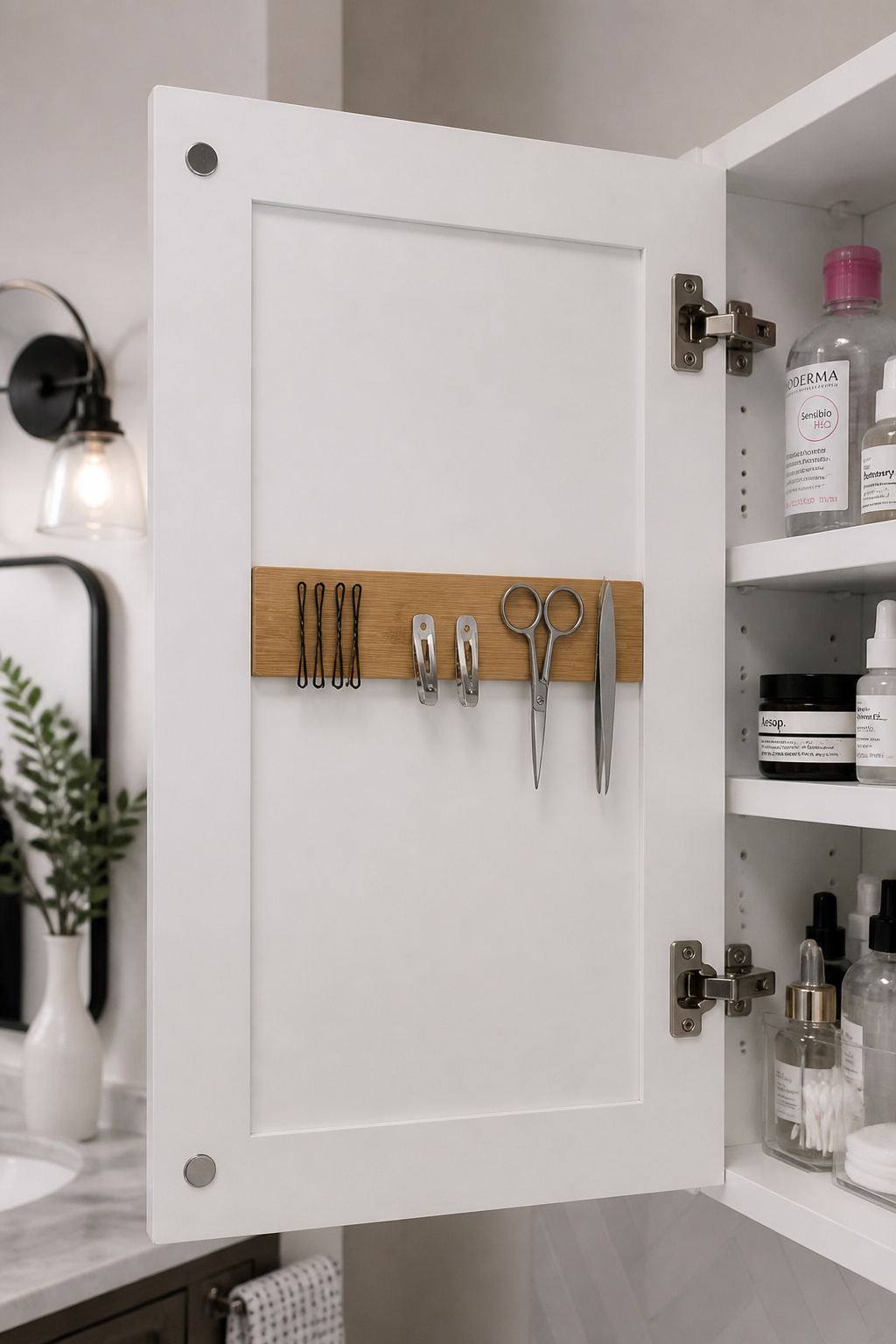
Mount one inside your medicine cabinet door or on the interior wall of a vanity cabinet. Arrange by category: bobby pins clustered in one zone, small scissors and tweezers in another, metal nail polish caps if you use them. A 12-inch strip holds 20–30 bobby pins, 2–3 pairs of scissors, and a collection of clips with room left over.
For installation, the cabinet door interior is the most reliable surface. Clean and fully dry the surface before applying adhesive-backed strips — any residue and the adhesive will fail within weeks in a humid bathroom. For tile walls, adhesive-only strips are riskier because grout lines create uneven contact. Medium-strength strips work for most grooming tools; go heavy-duty if you’re mounting scissors.
7. Slim Rolling Cart Fit Between the Sink and the Wall
There’s almost always a gap beside a bathroom vanity that nothing seems to fit — 5 inches, sometimes 6. Whatever the measurement, it’s been dead space since the bathroom was built. A slim rolling cart is one of the most practical small bathroom organization solutions for that gap, because it uses space that was previously wasted entirely.
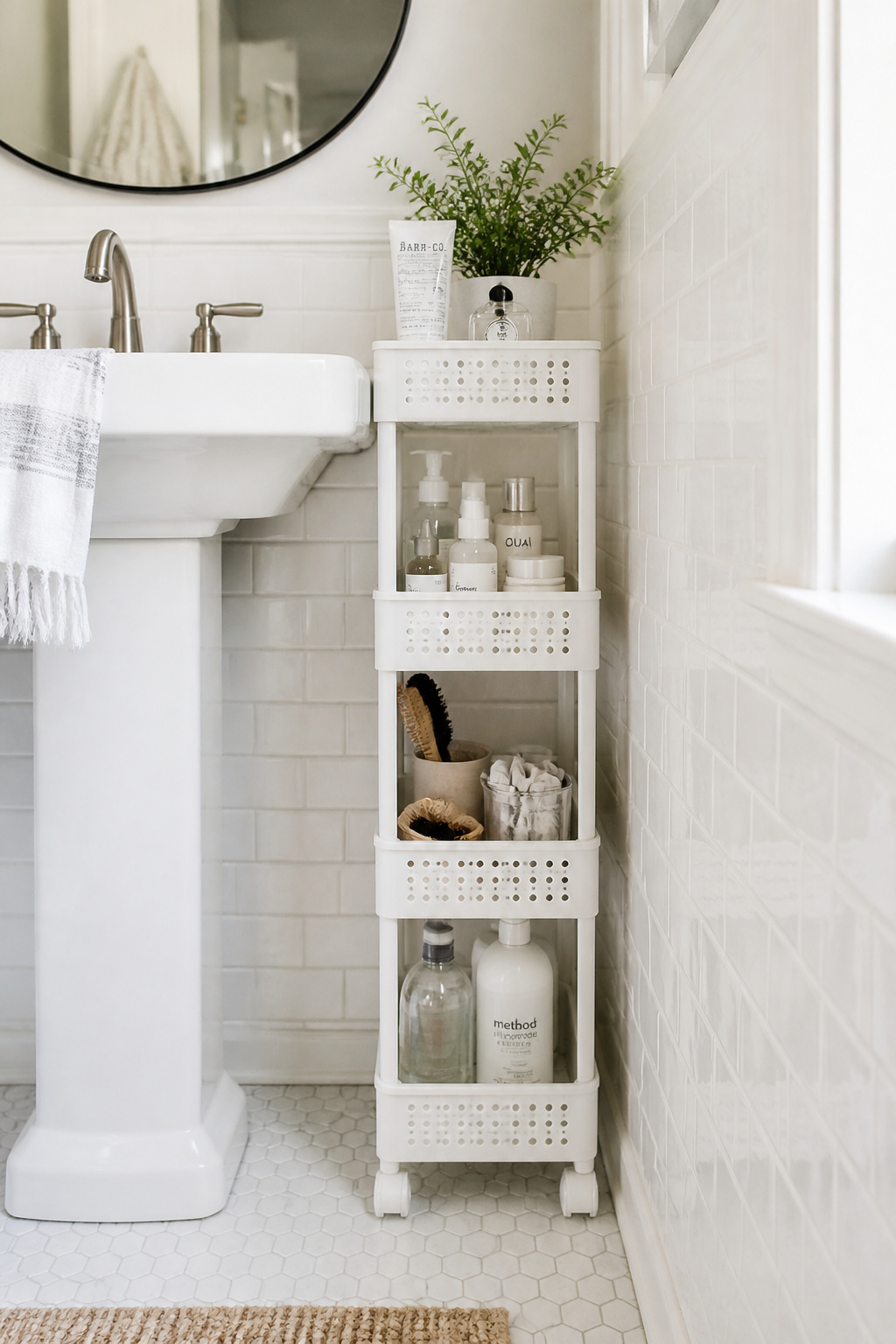
Measure the gap at the narrowest point, which is often the baseboard rather than the wall itself. The slimmest bathroom carts available are 4.7–4.9 inches wide (12 cm) — the SPACEKEEPER model at 4.9 x 15.3 x 26 inches fits most bathroom gaps. For larger gaps, 6–7 inch models offer deeper baskets.
Waterproof polypropylene plastic is the best material: it doesn’t warp, doesn’t rust, and wipes clean easily. Put the cart on swivel lockable casters — lock it when parked so it doesn’t roll out every time someone passes. Logic the tiers from top to bottom: daily-reach items at elbow height, backups and less-used items lower.
8. Wall-Mounted Baskets for Open Bathroom Storage With a Styled Look
Open shelving with baskets works in a bathroom for the same reason it works in a well-designed pantry: everything visible forces you to keep only what’s actually used. A set of three matching baskets arranged vertically on a blank wall section can store rolled towels, skincare products, and small toiletries with a look that feels collected rather than cluttered. For broader bathroom organisation ideas that lean into a spa-like aesthetic, open basket storage is a recurring theme.
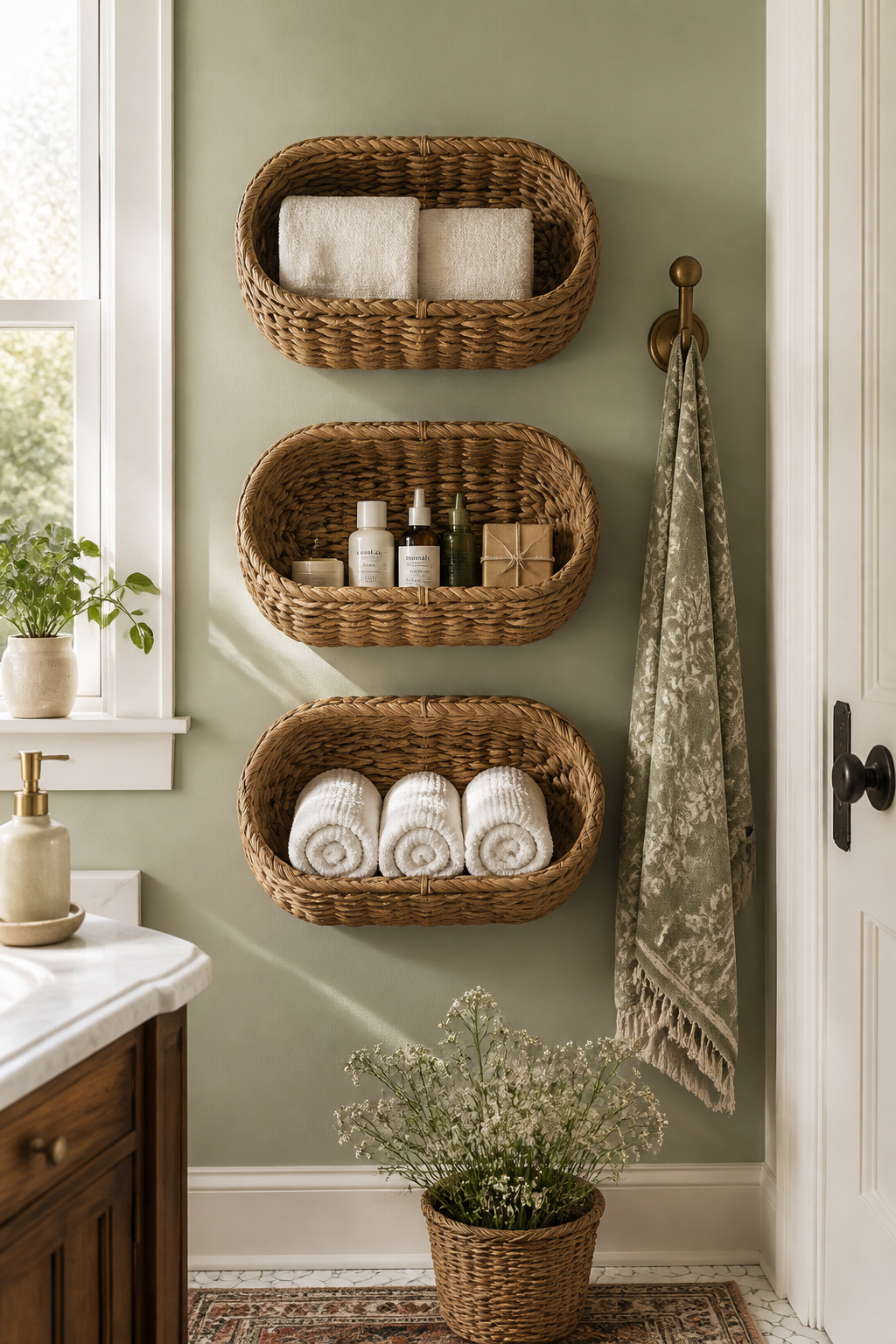
Material matters more in a bathroom than anywhere else. Coated wire baskets are the most durable choice in humid conditions — they won’t mould, warp, or absorb steam. Seagrass is attractive and reasonably moisture-resistant, but needs good ventilation and periodic wiping to prevent mustiness. Natural wicker in an unventilated bathroom goes moldy. If you’re committed to a natural fibre, seal it with water-resistant varnish before mounting.
Sizing: small baskets (under 8 inches wide) for cotton rounds and small soaps; medium (8–14 inches) for rolled towels and skincare; larger for toilet rolls and cleaning supply backups. Keep the visual palette consistent — the same material throughout, or at minimum the same finish. One rogue wicker basket in a row of chrome wire baskets breaks the whole effect.
9. Built-In Shower Niche for a Products-Off-the-Floor Look
A shower niche is the most permanent, most satisfying small bathroom storage upgrade available. It’s a recessed shelf built between two studs in the shower wall, tiled flush with the surrounding surface. Products sit inside it, flush with the wall. No caddy hanging over the shower arm. No bottles lined up on the tub ledge. Nothing on the floor.
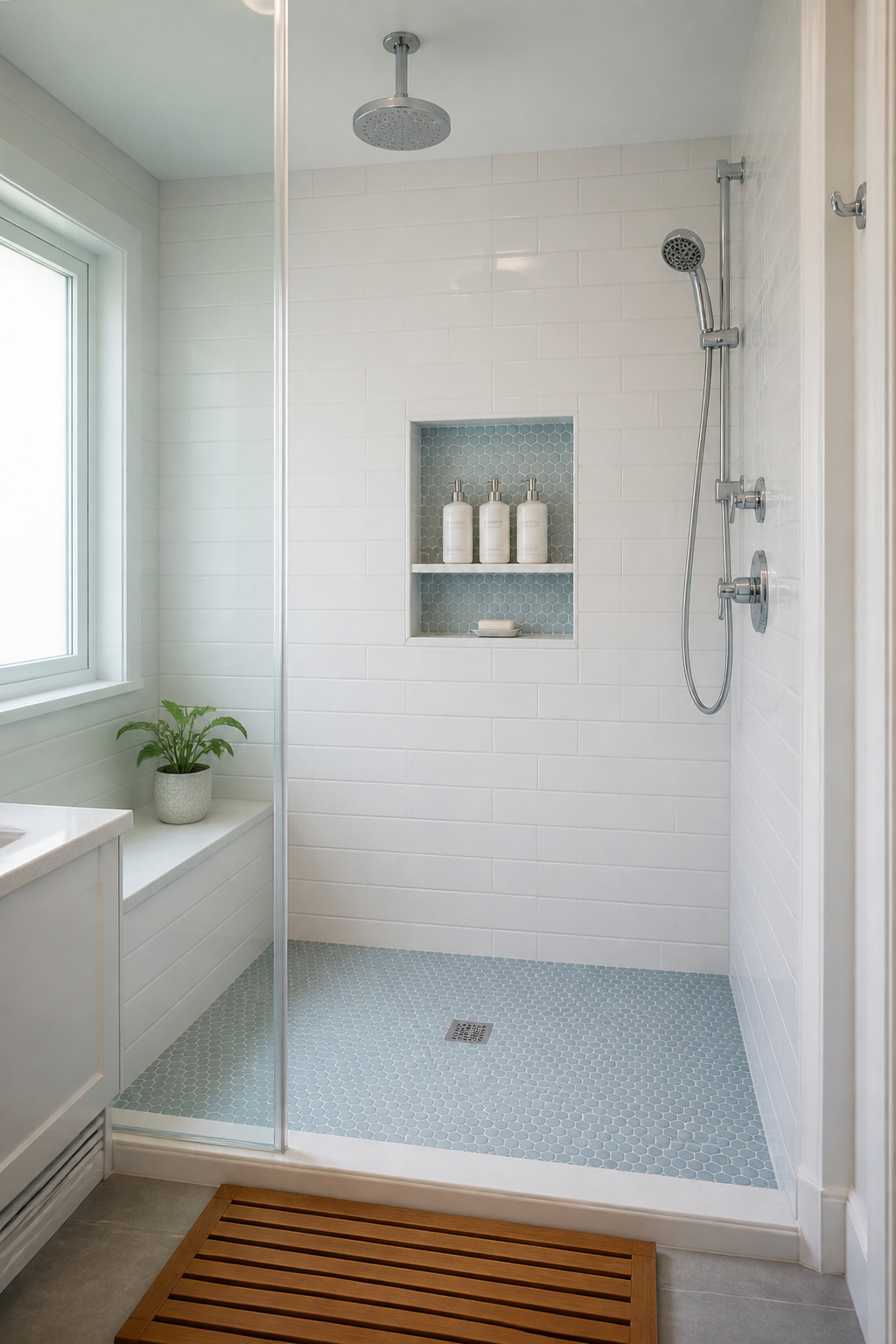
The standard width is 12 inches — matching standard 16-inch stud spacing. Heights vary: 6, 12, 20, and 28 inches are the common options. The 12×20-inch format is the most useful for shampoo and conditioner bottles, which typically run 8–10 inches tall. Schluter KERDI-BOARD-SN prefabricated niche inserts cost $45–65 at Floor & Decor, come fully waterproofed with an integrated KERDI-BAND frame, and are designed to be tiled over exactly like the surrounding wall.
Niches are most practical during a shower remodel — opening a finished tile wall to retrofit one requires a contractor and re-tiling. For more ideas on transforming the shower beyond organisation, bathroom shower ideas covers what the space can become.
One firm rule: never position a niche on an exterior wall. Plumbing lines and insulation run there. Use an interior partition wall, and confirm there’s no electrical in the cavity before cutting.
10. Mirrored Medicine Cabinet That Hides a World of Storage Behind Its Face
The mirrored medicine cabinet is one of the most underappreciated fixtures in bathroom design. It does two jobs at once: it works as a mirror (which makes the room feel larger) and it adds 3–5 shelves of organised storage behind the glass. For a tight bathroom, replacing a flat mirror with a medicine cabinet is one of the few upgrades that adds functional storage without claiming any new floor or wall surface.
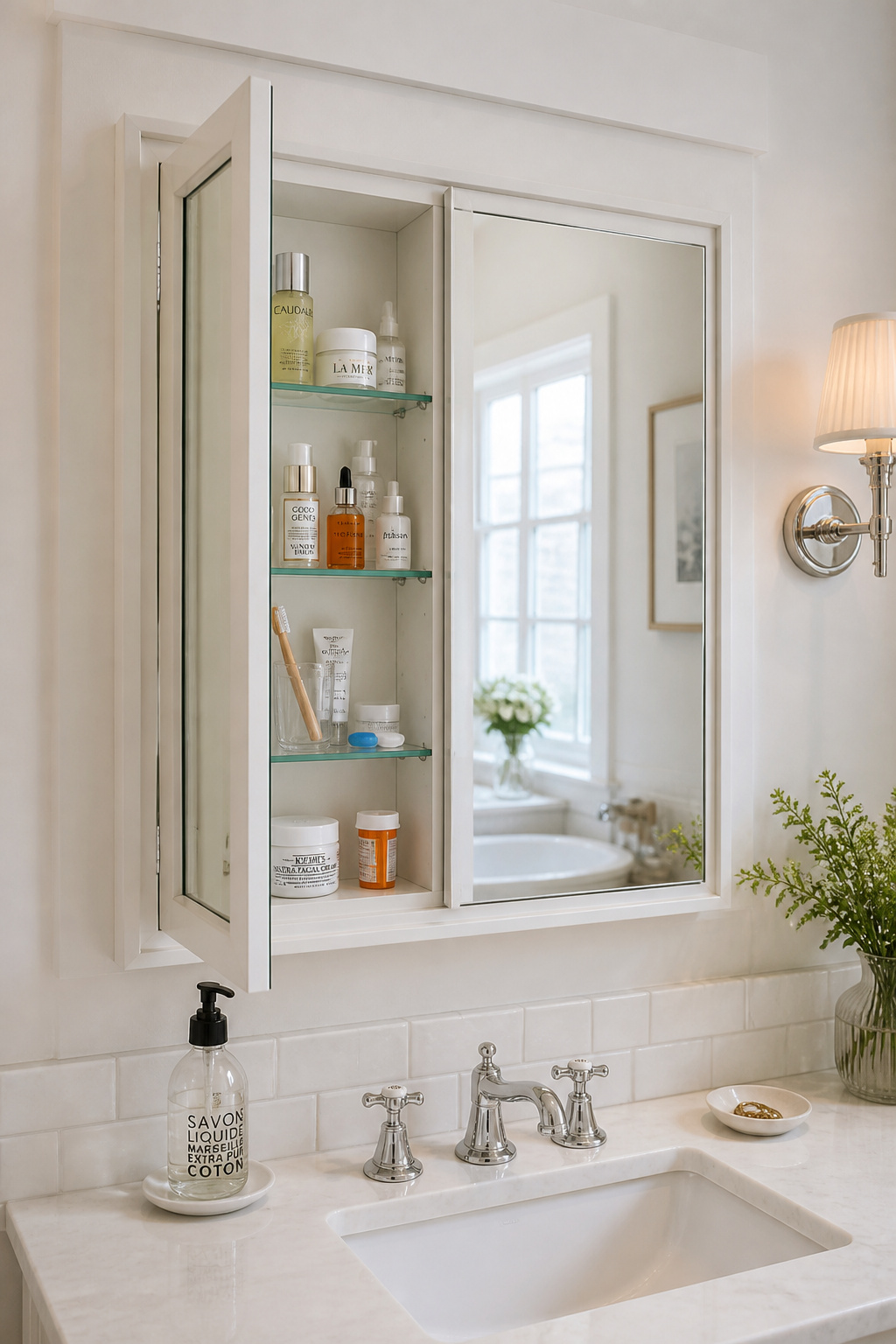
Interior depth runs 3–5 inches with 2–4 adjustable shelves — enough for prescription bottles (typically 2.5–4 inches tall), contact lens cases, daily-use skincare, razor heads, and small grooming tools. Everything hidden, immediately accessible.
Recessed installation is the better option for a bathroom that already feels tight. The cabinet sits inside the wall cavity, projecting zero inches into the room. You need a 3.5–4 inch wall cavity and no plumbing or wiring in the way. Most recessed cabinets are 14.5 or 22.5 inches wide to fit between studs spaced 16 inches on centre.
Surface-mount installation skips the wall-opening but projects 4–8 inches into the bathroom. In a 5×7 bathroom, that projection can feel intrusive. If your walls are lathe and plaster (common in older homes), a semi-recessed design — projecting 2–3 inches — is often the workable compromise.
11. Clear Acrylic Containers for Small Bathroom Organization on the Countertop
The countertop is the most visible storage zone in a bathroom, and usually the most chaotic. Clear acrylic containers fix this directly: when everything shows through the sides of a matching container set, you can see what’s running low, find what you need instantly, and the counter reads as organised even when it’s fully loaded.
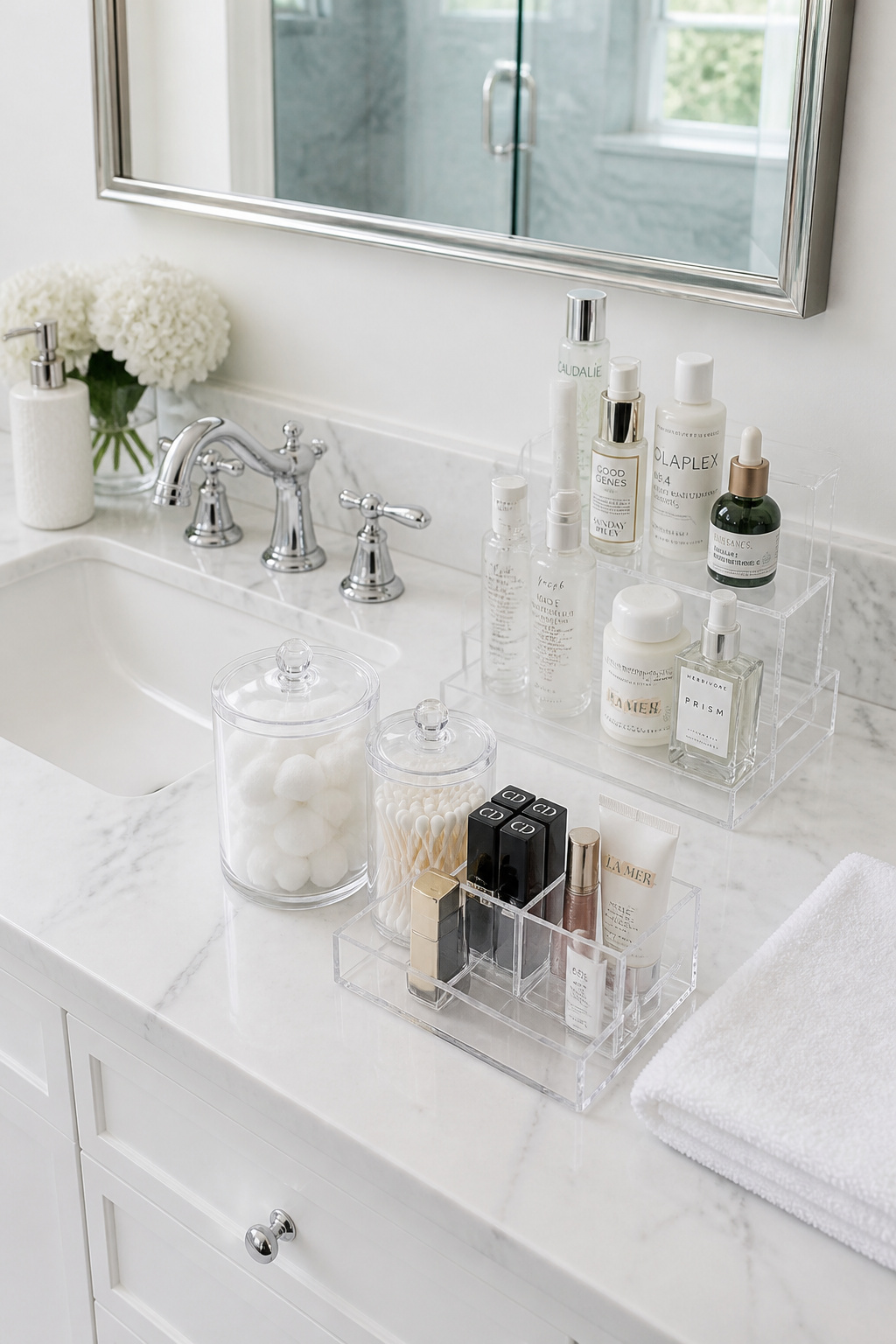
Acrylic outperforms glass for a bathroom: it’s shatter-resistant, won’t corrode in humidity, and wipes clean in seconds. The AOZITA 4-pack cotton round and swab holder set is a good reference point — individual canisters with removable lids, sized to hold up to 250 Q-tips each, stackable, and genuinely bathroom-safe.
The container types worth having: a Q-tip canister (roughly 3.5 x 2.75 x 3.75 inches), a cotton round holder (slightly wider), a multi-compartment tray for lipsticks and small tubes, and a skincare organiser tower if your morning routine involves more than a few products.
Matching Set vs. Mix-and-Match
The matching-set approach — same brand, same material, same finish — looks the most intentional. Mix-and-match works if everything is at minimum the same material (all clear acrylic, not some acrylic and some frosted plastic). The rule is one material per countertop zone. Mixing materials creates visual noise even if each individual piece is attractive.
Audit the countertop before buying containers. Know exactly what you’re storing and how much of it — then buy the minimum number that holds everything. Unused containers on the counter don’t solve any small bathroom organization problem; they add to the visual load.
12. Drawer Dividers That Bring Order to the Vanity Interior
Open a bathroom vanity drawer that’s been used for a month without dividers and you’ll find toothbrushes under nail clippers, hair ties wrapped around a razor, and the floss you swore you were out of. It happens because every time the drawer opens, everything slides to the front. Dividers create fixed compartments that items actually stay in — which is what real bathroom organization looks like inside the vanity.
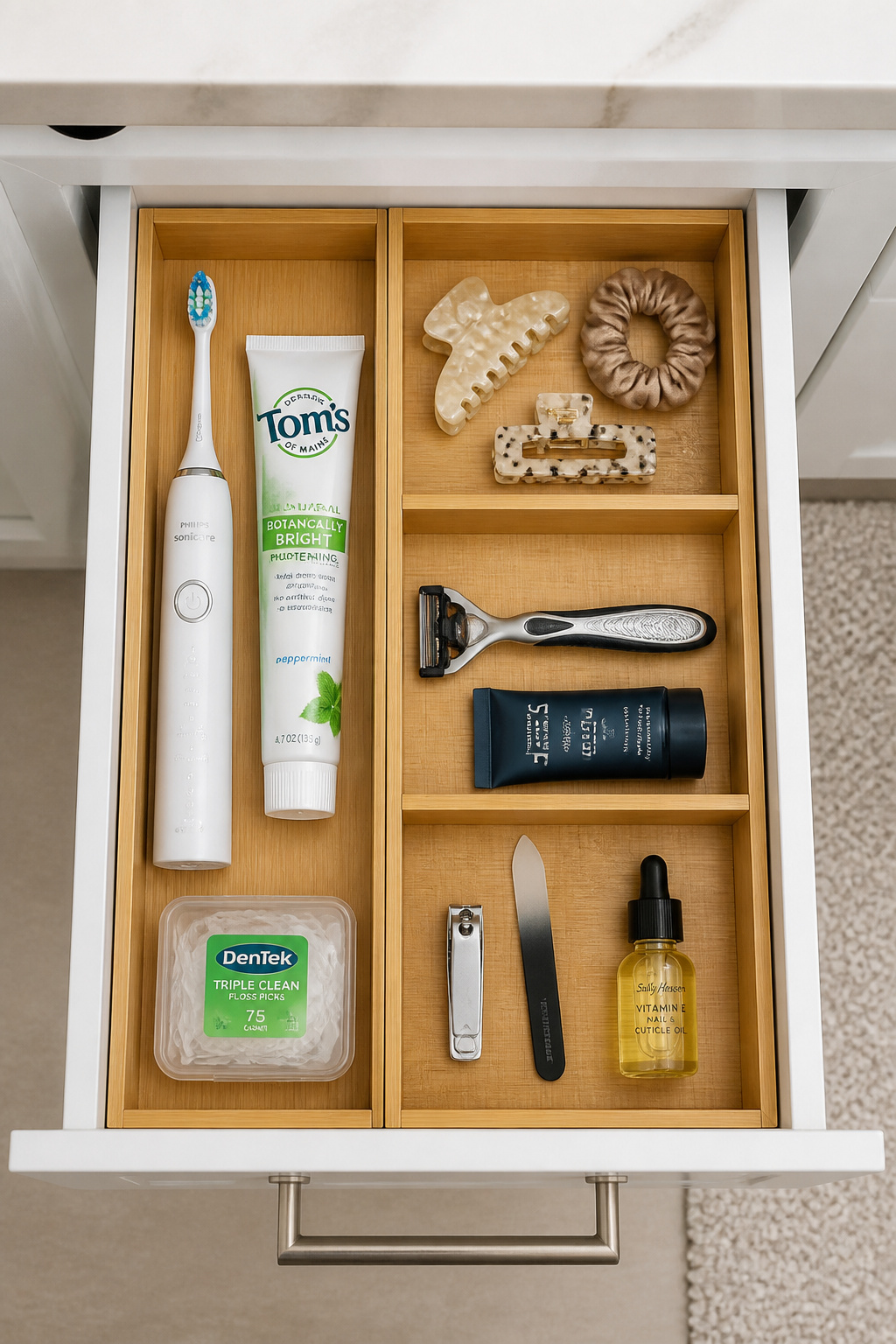
Expandable bamboo dividers are the best option for most bathroom drawers. SpaceAid’s dividers expand from 17 to 22 inches — fitting the majority of vanity drawer widths, which typically run 14–24 inches. The spring-loaded ends grip the drawer sides without screws or adhesive, and rubber feet protect the drawer finish. A six-pack runs $20–25, enough to divide two or three drawers fully.
A logical category breakdown for most bathroom drawers: Section 1 holds daily grooming tools — toothbrush, toothpaste, floss, razor. Section 2 is hair accessories. Section 3 is skincare essentials (backup bottles live in the cabinet below, not here). Section 4 is nail care. If you moved the bobby pins to a magnetic strip on the cabinet door, Section 2 either collapses or gets repurposed for something else without a home. That’s the right kind of problem to have.
Four sections is the maximum a standard 18-inch drawer handles before compartments become too small to be useful. If you have more categories than sections, move the less-used ones to the cabinet below.
13. Hanging Shower Caddy for Shampoo, Conditioner, and Soap Clutter
A shower floor lined with product bottles is a common problem and an easy fix — but the fix has to be the right caddy, not just any caddy. The difference between a good shower organiser and a frustrating one almost always comes down to two things: rust resistance and drainage.
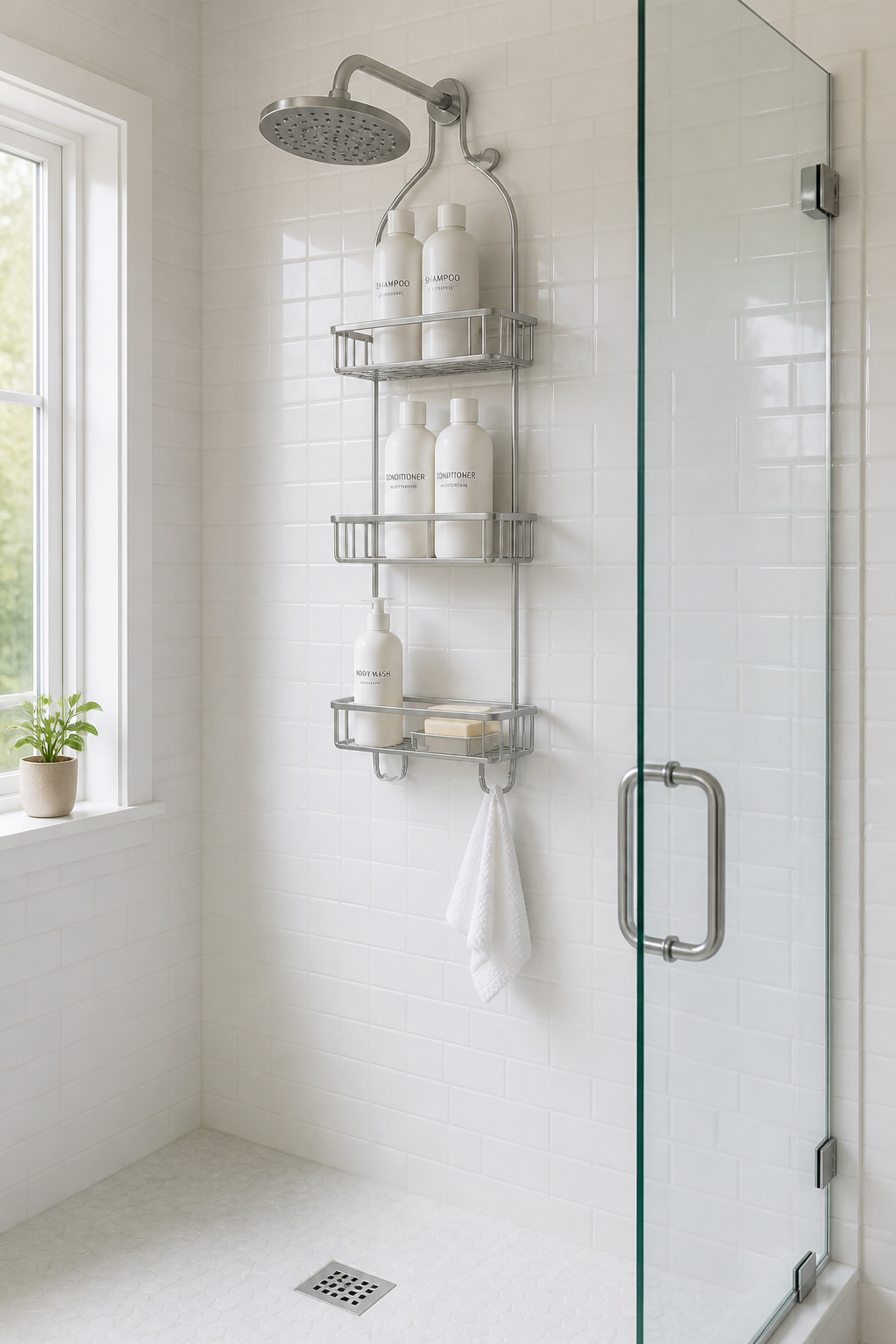
Chrome-plated steel caddies are the most common and cheapest type. They’re also the ones that look like rust rings after a year because the chrome plating chips at welded joints and moisture infiltrates. Anodised aluminium and solid stainless steel are the only metals that reliably survive a daily shower. The OXO Good Grips 3-Tier Aluminium Caddy and Simplehuman’s adjustable stainless steel models have earned their reputations specifically because they don’t rust. The price premium ($30–80 vs $10–20 for chrome-plated alternatives) pays for itself in the first year.
For installation: shower arm-mounted caddies hook over the fixed shower arm pipe and hold most bottles easily. Tension pole caddies stand floor-to-ceiling on spring pressure and work in any shower, but wobble slightly when you reach into them. Always check for drainage holes in every shelf — water pools under shampoo bottles within hours and grows mould without drainage.
14. Pegboard Wall Panel for Customizable Bathroom Storage in Any Configuration
Pegboard is one of those materials most people associate with garages and workshops — which is exactly why it surprises people when it works well in a bathroom. A 2×4 foot panel provides customisable bathroom storage for an entire morning routine: hair dryer, round brush, flat iron, product bottles, a small mirror, and accessories — all visible, all reachable, all off every other surface.
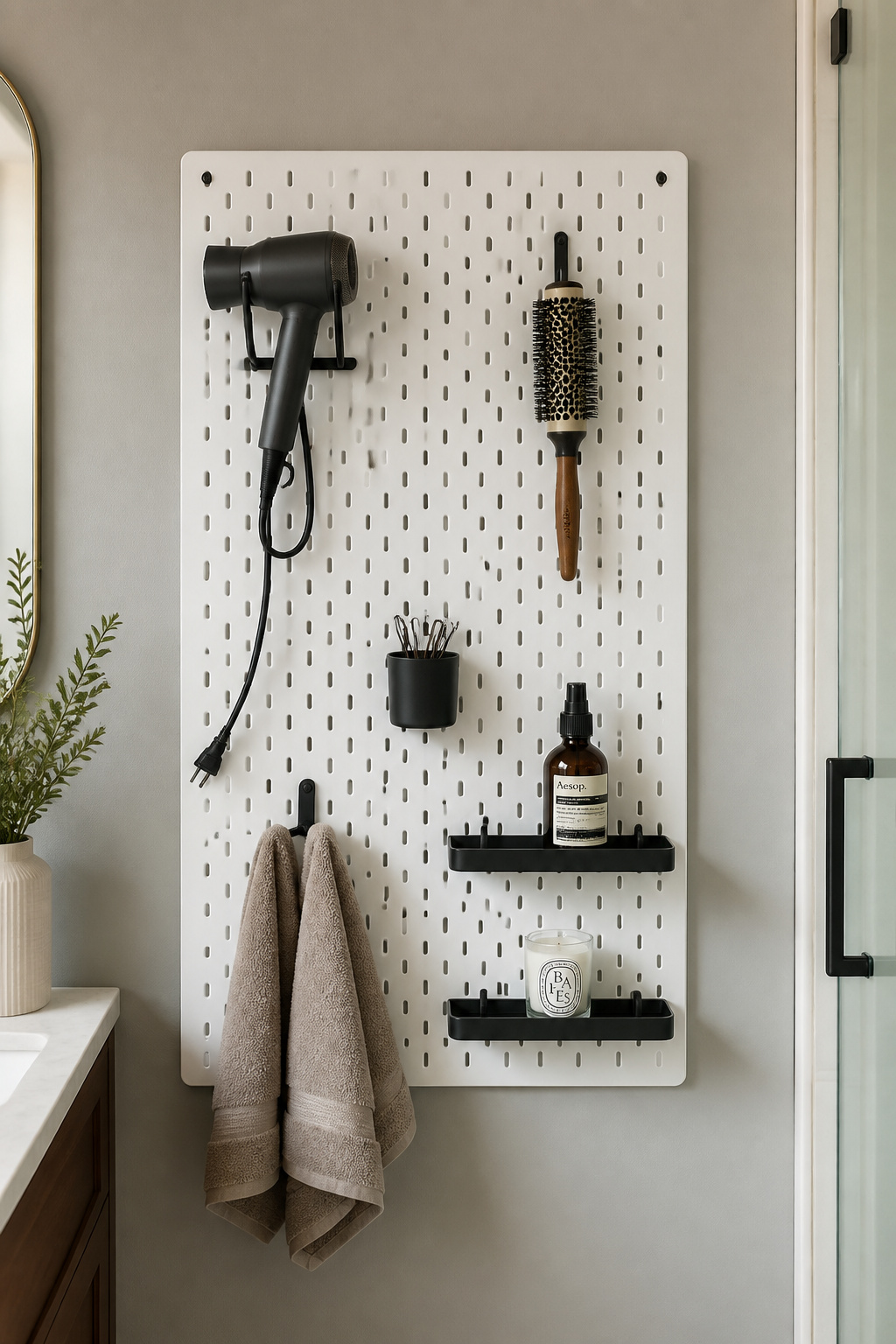
The key in a bathroom is moisture protection. Standard hardboard MDF pegboard absorbs moisture and will swell or warp in a steamy bathroom unless both sides are sealed with primer and exterior-grade paint before installation. Metal pegboard (available from Wall Control and similar brands) skips this problem entirely — naturally moisture-resistant and won’t warp.
Installation requires one step that many first-timers miss: the board must sit at least 1/2 inch away from the wall so hooks can seat into the holes properly. Attach 1×2 furring strips to studs, then mount the pegboard to the furring strips. On tile walls, use a carbide-tipped drill bit at slow speed to avoid cracking — drill into grout lines rather than tile faces where possible.
Use consistent hook finishes — all black or all chrome. Short J-hooks for small items, double hooks for a hair dryer loop or towel ring, cup attachments for bobby pins or cotton swabs, and small peg shelves for bottles. A good starting kit costs $15–30 in hooks at any hardware store.
15. Fold-Down Wall Shelf for Bathrooms With Almost No Counter Space
Some bathrooms have almost no counter space. Powder rooms with pedestal sinks have none at all. Bathroom organization in this situation calls for a different approach — and a fold-down wall shelf solves it in the most efficient way possible: it creates a usable surface when you need one and disappears when you don’t. Folded flat, it projects less than 1.5 inches from the wall. Open, it functions like a counter extension, a makeup shelf, or a shaving station.
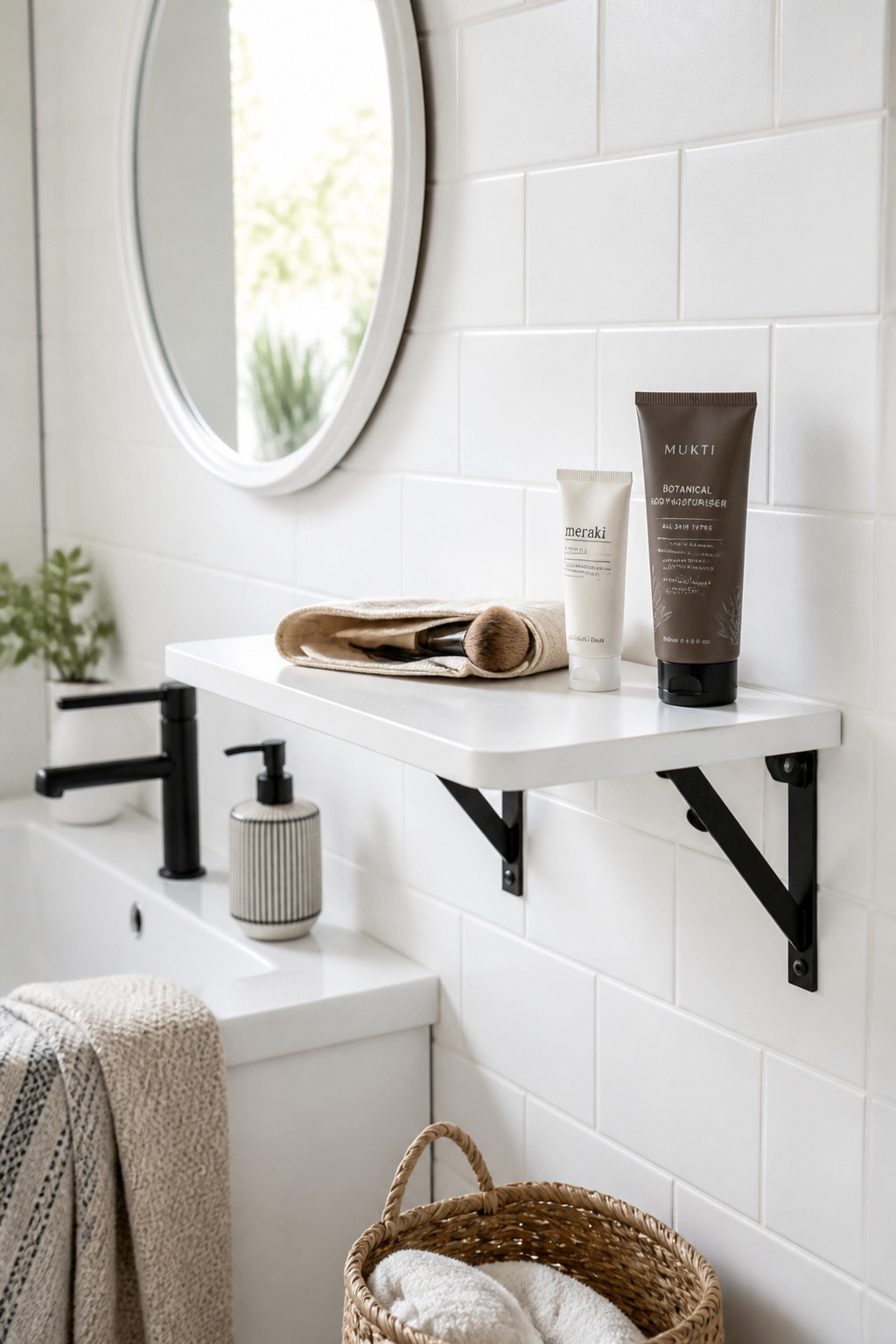
Self-locking folding brackets engage automatically when the shelf opens, so you don’t need to hold the surface steady while placing items on it. Weight capacities for self-locking brackets typically run 20–50 lbs — more than sufficient for bathroom use. For heavier loads or wider shelves, piano hinge designs (continuous hinges along the full back edge of the shelf) distribute weight more evenly.
Mount into studs. The most common failure of fold-down shelves is fastener pull-out from drywall when the wrong hardware is used. If studs aren’t where you need them, toggle bolts through drywall are the backup. Standard plastic drywall screws are not adequate for a cantilevered shelf with any real weight on it.
Height placement determines the use case. At 60–66 inches from the floor: a standing makeup station beside the mirror. At chest height (45–50 inches): a shaving shelf. At counter height (32–36 inches): a counter extension beside the sink.
16. Woven Basket Under the Sink for a Warm, Styled Storage Look
A pedestal sink is one of the most common fixtures in older homes and apartments — and one of the most frustrating for storage. There’s no cabinet underneath, just open floor with exposed plumbing. The usual result: cleaning products shoved under there in a pile that nobody wants to look at.
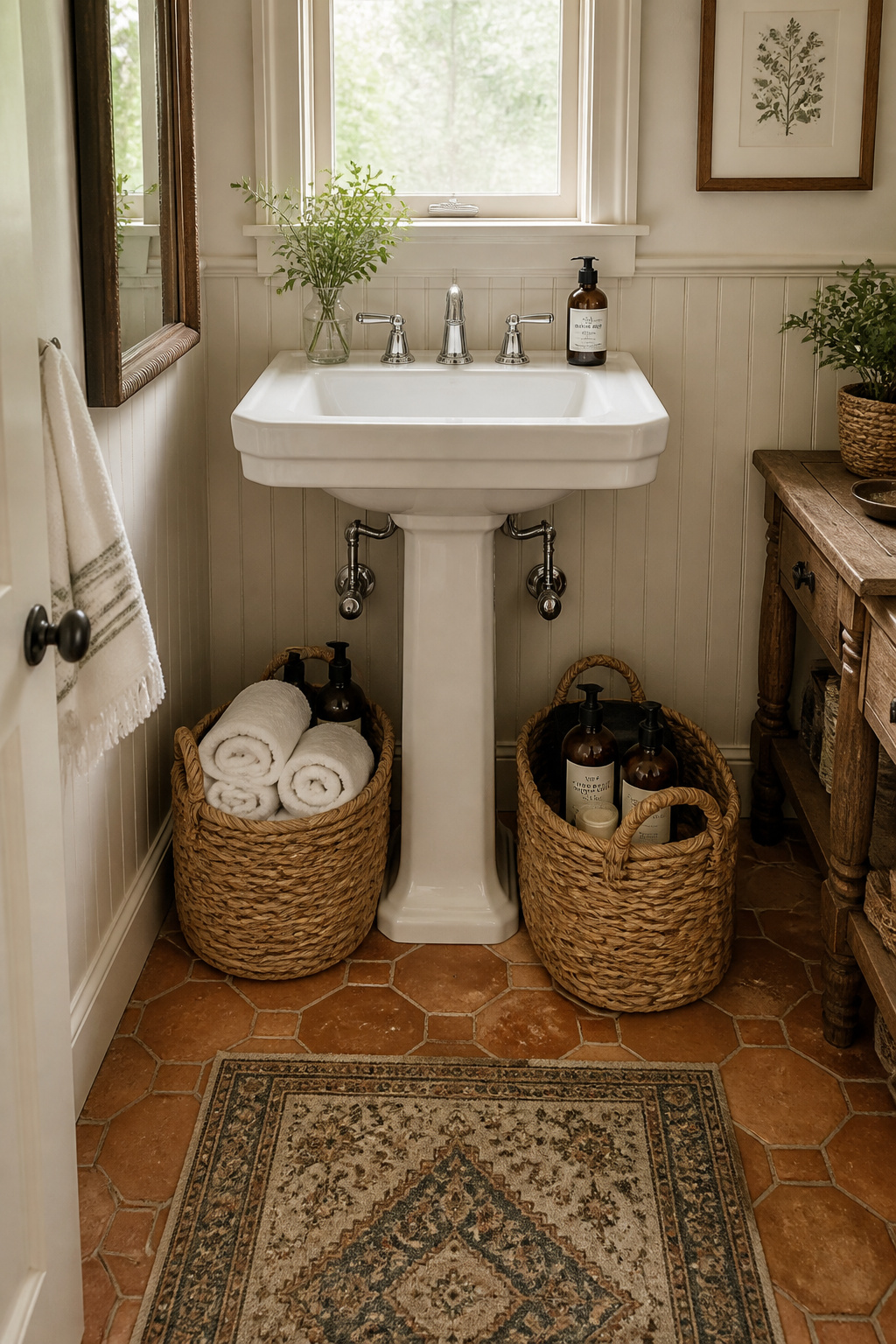
Two woven baskets placed symmetrically on either side of the pedestal turn this from an eyesore into a deliberate design feature. The baskets contain the clutter, the symmetry reads as intentional, and the natural material adds warmth to what’s often a cold, hard-surfaced room. Seagrass baskets with an inner wire frame — like VonHaus options, rated to 26 lbs each — combine the natural look with practical durability.
Sizing is specific here. Measure the gap between the floor and the drain P-trap, which typically sits 12–15 inches from the floor. Baskets need to be shorter than that. Most pedestal sinks are 20–24 inches across, so baskets of 10–14 inches wide fit one on each side with clearance around the pedestal base.
What to store: keep visually appealing items in the front of each basket — rolled white towels, neutral-packaged refill soaps. Less attractive items (cleaning products, backup supplies) go behind the front layer, out of the sightline. Avoid uncoated natural wicker on a bathroom floor — it wicks up moisture from the tile and molds quickly.
17. Repurposed Ladder Shelf That Adds Small Bathroom Organization and Character
A ladder shelf is one of the few storage solutions that looks better than its practical justification. It’s a leaning frame that provides 4–5 tiers of open storage, requires no wall mounting, and occupies a floor footprint smaller than most floor lamps. For a bathroom without obvious wall space or room for a freestanding cabinet, it’s often the most elegant small bathroom organization answer available.
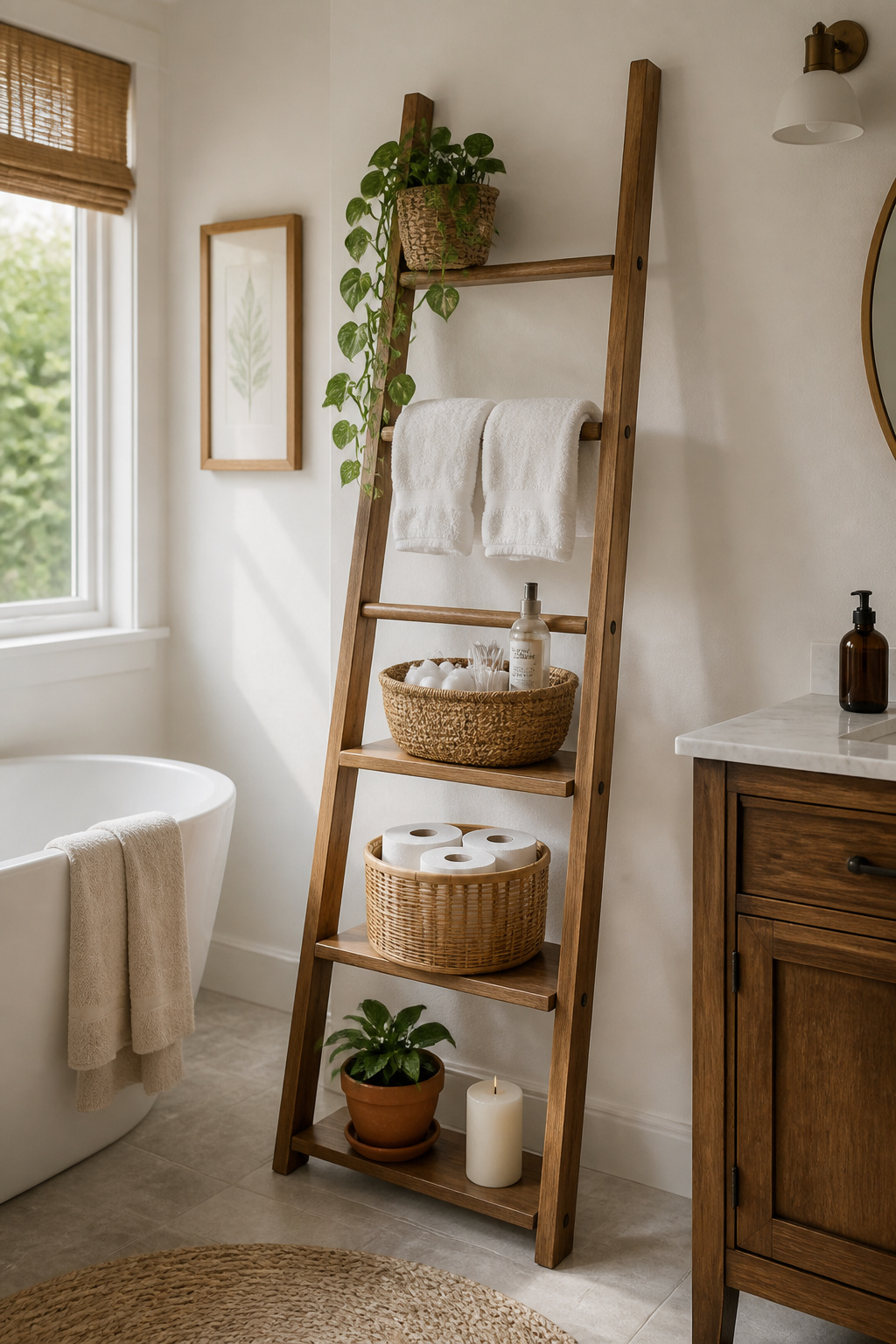
A 5-rung bamboo or wood ladder at 63–70 inches tall gives four usable shelves — rungs spaced about 10 inches apart and widening toward the base, which adds natural stability. Bamboo is popular, but it can mold in high-humidity, steam-adjacent bathrooms with poor ventilation. Teak is the better choice if your bathroom gets seriously steamy — its internal oils resist moisture without chemical treatment, and it naturally discourages mildew. For a well-ventilated bathroom, bamboo performs well and is widely available for $35–80.
Use the tiers intentionally from top to bottom. Top rung: a small trailing plant or a single folded hand towel — something decorative visible from the doorway. Second rung: rolled bath towels (rolling rather than folding doubles what fits on one rung). Third rung: a woven basket holding cotton products or small skincare. Fourth rung: a larger basket for extra toilet paper or backup items. Floor-level: a candle lantern or a small potted plant that grounds the whole arrangement.
The ladder shelf is also one of the easiest additions to move, repurpose, or take with you. In a rental, it requires no commitment whatsoever.
Finding Your Small Bathroom Organization System: Where to Begin
The worst approach to small bathroom organization is buying a cart full of baskets and bins before knowing what you’re trying to store. The best approach is the opposite: empty everything out first. Pull out every item from every cabinet, drawer, and corner of the bathroom. This is the step most people skip because it looks like a lot of work — but it’s the step that prevents buying the wrong organiser twice.
Throw away expired products (check dates on sunscreen, prescription medications, and skincare). Donate anything unused but still good. Relocate things that don’t actually belong in a bathroom. Once you’re working only with what you genuinely need to keep there, measure every space: the cabinet interior, the wall above the toilet, the gap beside the vanity. Then, and only then, buy.
Match solutions to your bathroom type. Renters and no-drill situations: over-door racks, tension rod hacks, freestanding corner units, rolling carts, and ladder shelves work without any permanent modification. Pedestal sink bathrooms: baskets flank the sink, a corner shelf or ladder shelf picks up the storage slack, and floating shelves above the toilet substitute for the counter you don’t have. No-counter bathrooms: a fold-down shelf plus medicine cabinet upgrade is the combination that fixes it most completely. If you’re planning a remodel, add a shower niche and floating shelf blocking during the build — far simpler to do before tile than after.
Small bathroom organization doesn’t require a renovation. It requires looking at the space honestly — identifying what’s missing, what’s underused, and what would genuinely change how the room functions every morning. Start with one idea. Get it right. Then move to the next.