I was halfway through a recipe last week, hands covered in flour, timer running. The one sheet pan I needed was buried under four others. So I sat there, half-climbing into a cabinet just to reach it. That kind of moment is exactly why storage matters more than almost any other design decision in this room. After all, good cooking grinds to a halt the second your kitchen stops cooperating. I’ve spent twelve years designing kitchens that hold up under real, daily cooking, not just look good in photos. Along the way, I’ve learned something simple. The difference between a kitchen that works and one that fights you usually comes down to a handful of smart kitchen storage solutions, not a full remodel.
It’s rarely one big fix, either. More often it’s a pull-out shelf here, a relocated knife block there. Or it’s a pantry that finally has a system instead of a pile. Some of what follows costs twenty dollars and an afternoon. Other projects, though, are worth planning into a bigger renovation, especially if you’re already opening up cabinetry. Still, all sixteen are things I’d actually put in a client’s kitchen. I’ve tried to be honest about the cost and the install difficulty. Likewise, I’ve flagged the mistakes that turn a good idea into a wasted purchase.
1. Pull-Out Pantry Shelves That Turn Deep Cabinets into Real Storage Solutions
Every kitchen has one: the cabinet so deep that anything stored past the front row might as well not exist. Pull-out shelving fixes that. Instead of asking you to reach and crawl into the dark, it brings the entire shelf to you.
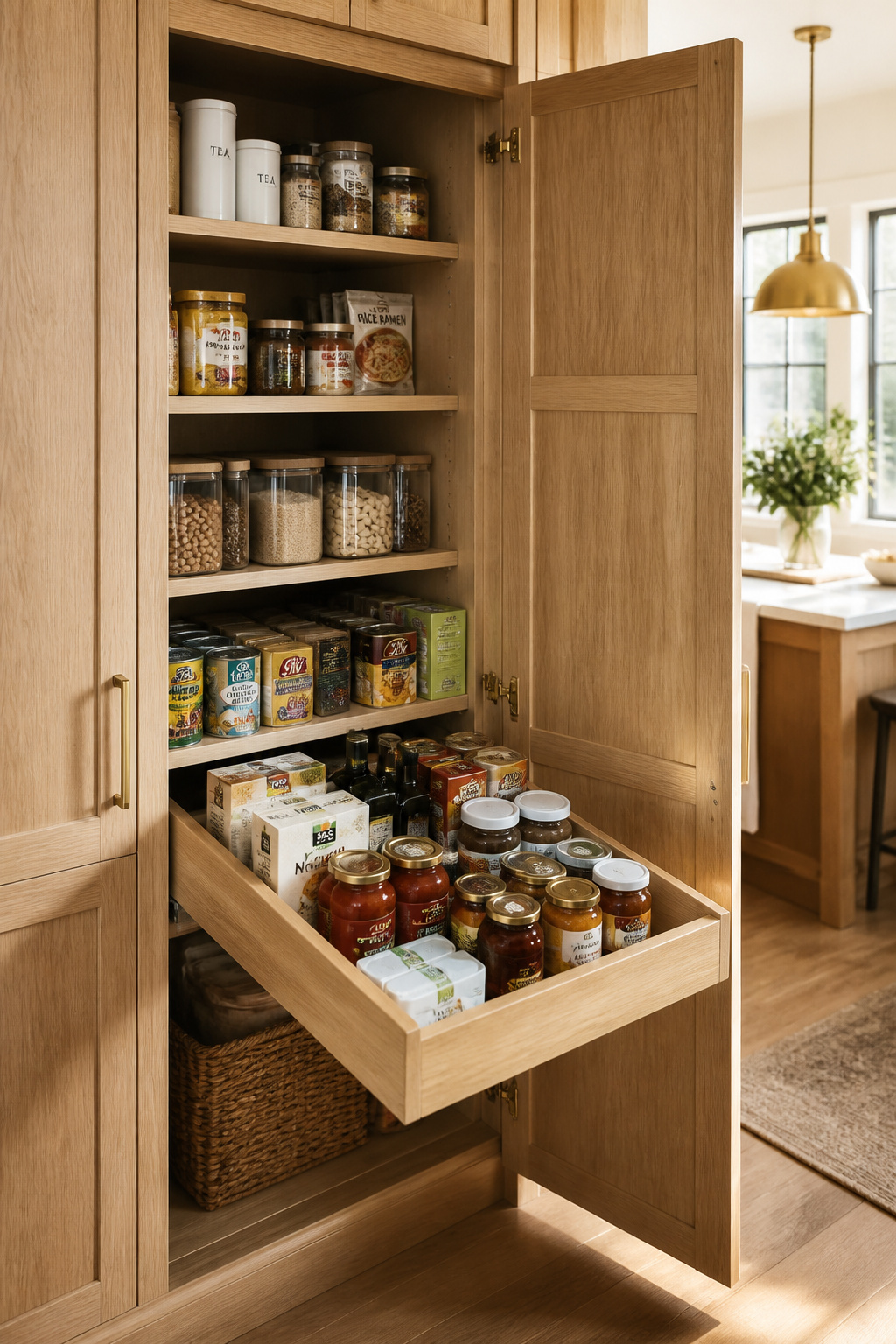
Standard pantry cabinets run 12 to 14 inches deep, though custom builds stretch to 24 inches. Anything beyond that first foot tends to become a graveyard for forgotten spices and half-used bags. So shallow shelves around 12 inches suit canned goods and jars best. Deeper shelves, up to 24 inches, handle bulk items or small appliances better. Installed pull-outs average $245, typically landing between $140 and $350 per shelf. Meanwhile, a full pantry cabinet retrofit with several shelves runs closer to $1,000. If you’re comfortable with a drill, DIY kits cut that labor cost substantially. They also fit the standard 15- to 36-inch-wide, 84- to 96-inch-tall cabinets most kitchens already have. Once the shelves themselves are sorted, dedicated pantry organization strategies are worth a separate look.
One detail worth paying for: ball-bearing glides instead of roller slides. They hold up far better once you’ve loaded a shelf with canned goods. Of course, soft-close hardware costs a little more up front. Still, it’s the difference between a shelf that glides smoothly in five years and one that’s already sagging.
2. Vertical Tray Dividers for Baking Sheets and Cutting Boards
Flat items are the worst offenders in kitchen storage. Stack four baking sheets and you’ve effectively locked away three of them. After all, reaching the bottom one means unstacking the whole pile.
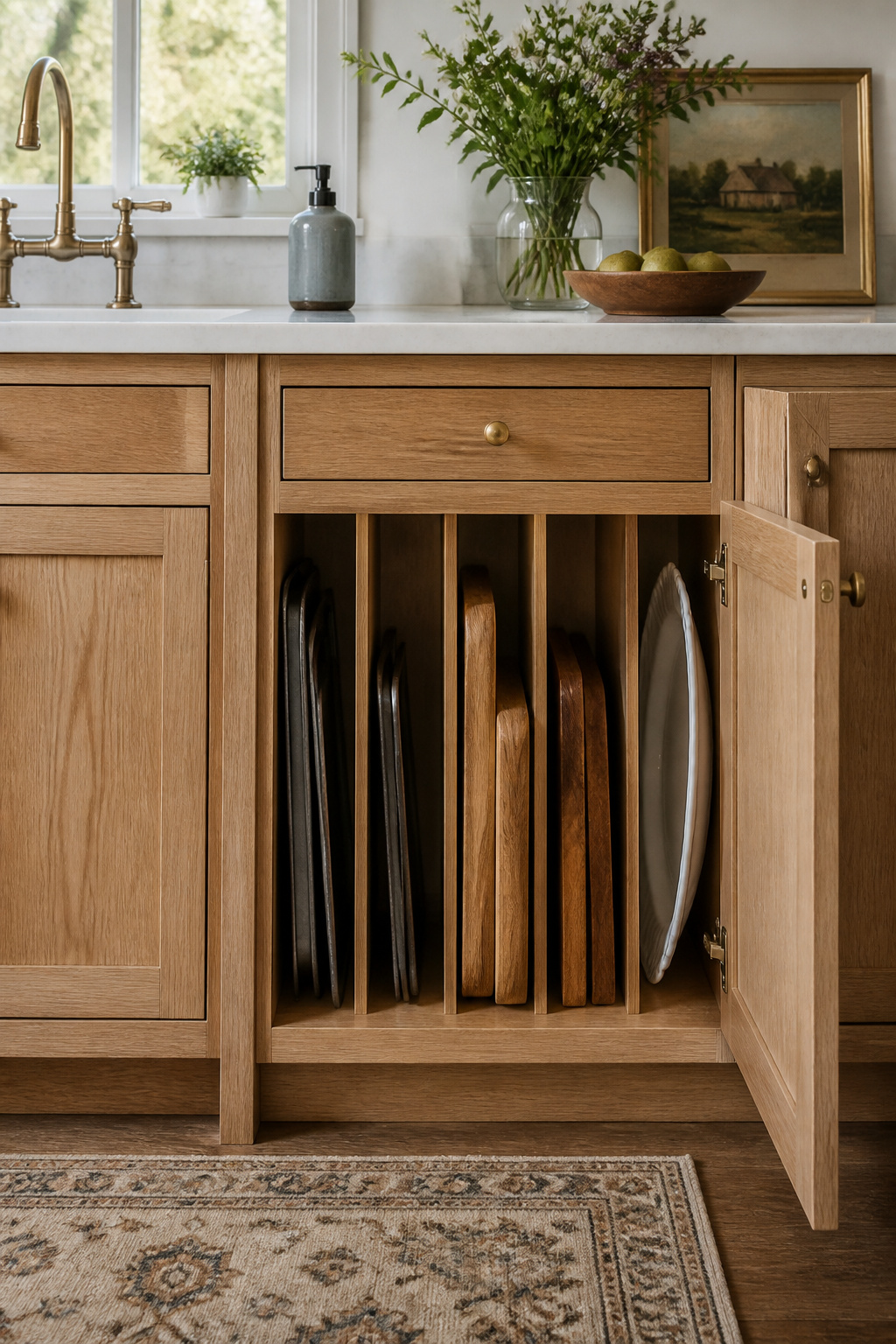
Vertical dividers solve this by giving each sheet, board, or platter its own slot. As a result, anything slides out independently. Like several kitchen storage solutions on this list, this one fits into a standard base cabinet or a wall cabinet. Most units include anywhere from one to five dividers, depending on cabinet width. Tall oven cabinets, for instance, come standard with five to maximize the segmenting. Also, pre-slotted tracks let you set the spacing yourself. That flexibility matters if you’re mixing thin cookie sheets with a thick butcher block. There’s a quieter benefit here too. Since separating wooden cutting boards lets them air out properly, it cuts down on the moisture buildup that warps them over time.
If your collection of bakeware tends to grow, look for adjustable-track dividers rather than fixed slots. That way you’re not stuck redoing the whole system when a new roasting pan arrives. Of course, most of these units come in either premium wood or a durable chrome finish. So the choice really comes down to which finish matches your existing cabinetry.
3. Toe-Kick Drawers That Add Hidden Kitchen Storage Below Your Cabinets
Here’s a space you’ve never once thought about using: the recessed strip at the base of your cabinets. It’s usually just 3.5 to 4 inches tall. Even so, it sits completely empty in nearly every kitchen.
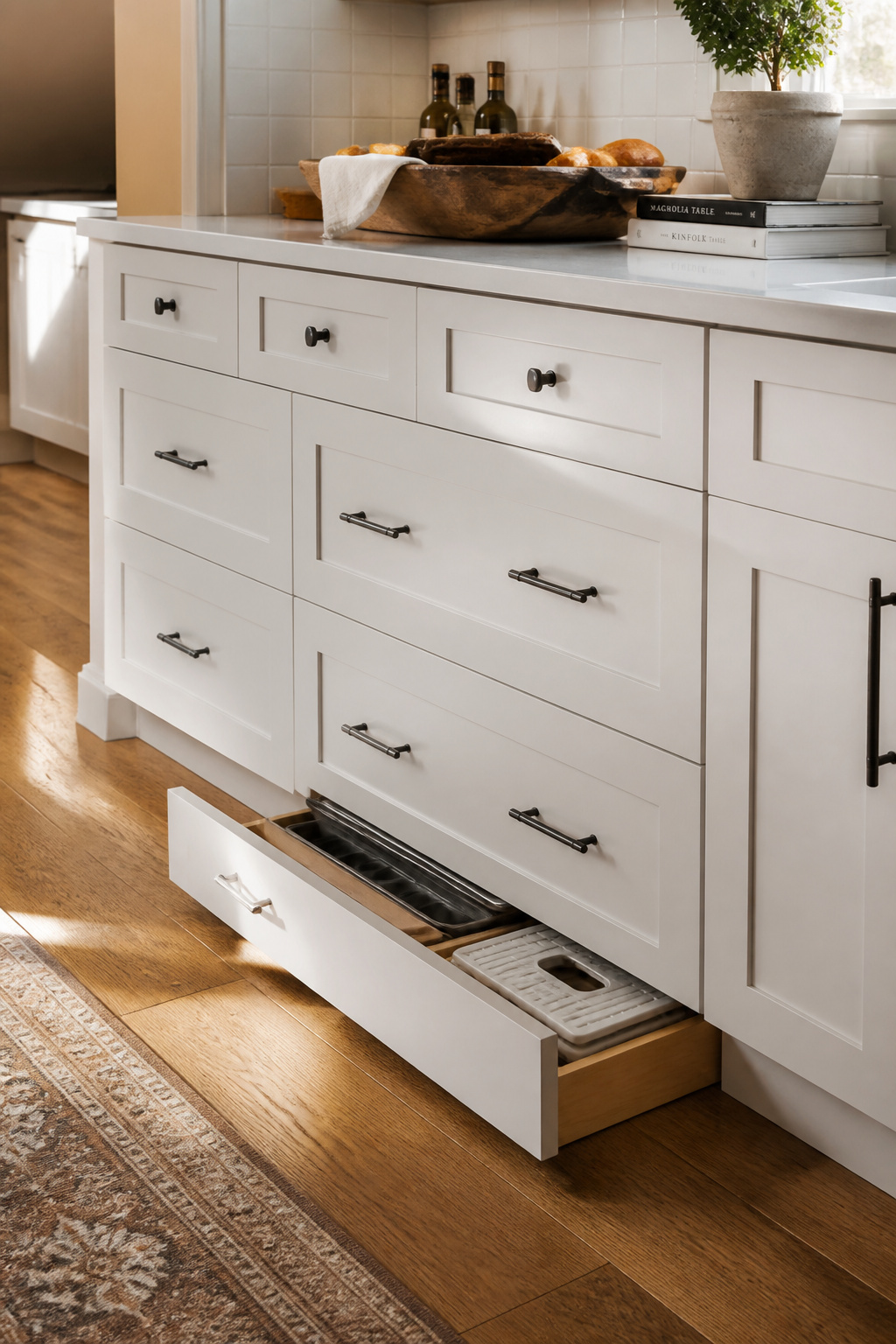
Among kitchen storage solutions, this one is refreshingly simple. It turns that gap into a slim, functional drawer, activated by, essentially, a tap of your foot. Ordering them with new cabinetry runs about $175 to $225 per drawer. Retrofitting an existing cabinet base, on the other hand, costs roughly $150 per drawer for installation. That’s because it involves prying off the toe-kick panel, usually held on by just a few small nails. Blum’s Movento hardware is the slide most professionals reach for here. It’s rated to hold 90 to 150 pounds, which matters for hardware mounted this close to the floor. So these drawers are best suited to flat, occasional-use items. Think baking sheets, serving platters, a folding step stool, even pet food bins.
If you’re planning a remodel anyway, build these in from the start. Retrofitting later is doable, but it’s more disruptive than designing for it up front. So confirm there’s no ductwork hiding in that space first. The easiest and most reliable route is still ordering the drawer with new cabinetry, since the manufacturer has already accounted for the depth and slide clearance.
4. A Corner Lazy Susan for Storage Solutions in Awkward Cabinet Corners
Corner cabinets are the most frustrating real estate in any kitchen. They’re deep, dark, and nearly impossible to use fully without some kind of rotating mechanism.
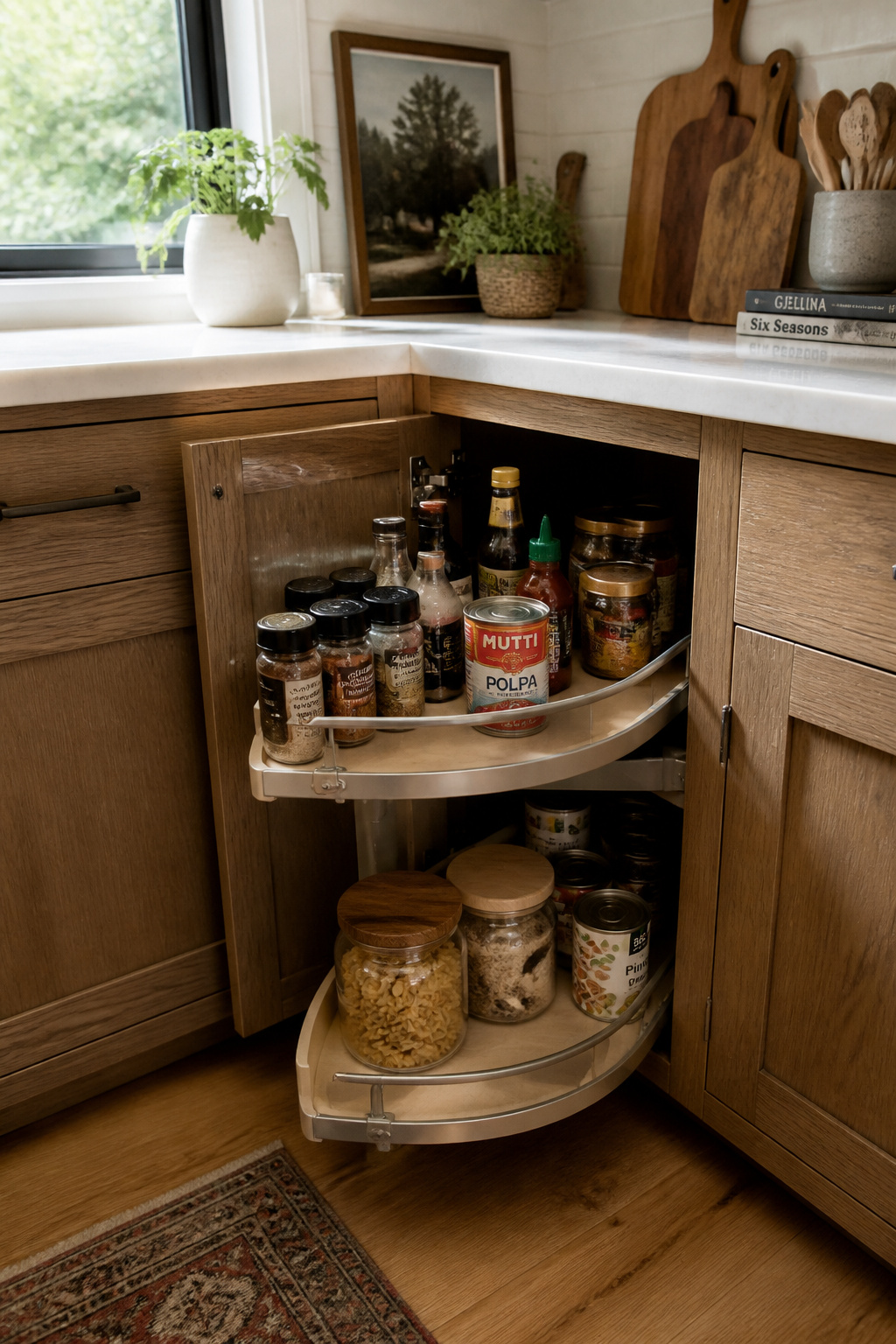
The right lazy susan depends entirely on your cabinet’s configuration. Pie-cut trays attach directly to the cabinet doors at a 90-degree angle. So opening one door swings the whole shelf system out with it. Kidney-shaped trays, by contrast, swivel independently of the doors, and work well in standard L-shaped corners. Full-circle versions are the most adaptable, fitting any cabinet with enough room. Half-moon styles, meanwhile, are built specifically for blind corner cabinets. That’s the kind with one door and a hidden pocket of space behind the wall. If you’re remodeling, it’s worth planning storage-smart kitchen island cabinetry at the same time, since the two pair well together.
Measure your cabinet’s actual interior angle before ordering anything. Most kits assume a true 90-degree corner. So a pie-cut tray simply won’t work in a blind corner cabinet that lacks a second door to attach to. Instead, a D-shaped tray, with one flat side, is the better middle-ground choice for a standard or 45-degree corner.
5. Ceiling-Mounted Pot Racks That Free Up Cabinet Storage Space
Pots and pans are almost always the bulkiest things competing for space in your lower cabinets. Move them overhead, though, and you’ve solved a bottleneck that no amount of clever stacking ever really fixes.
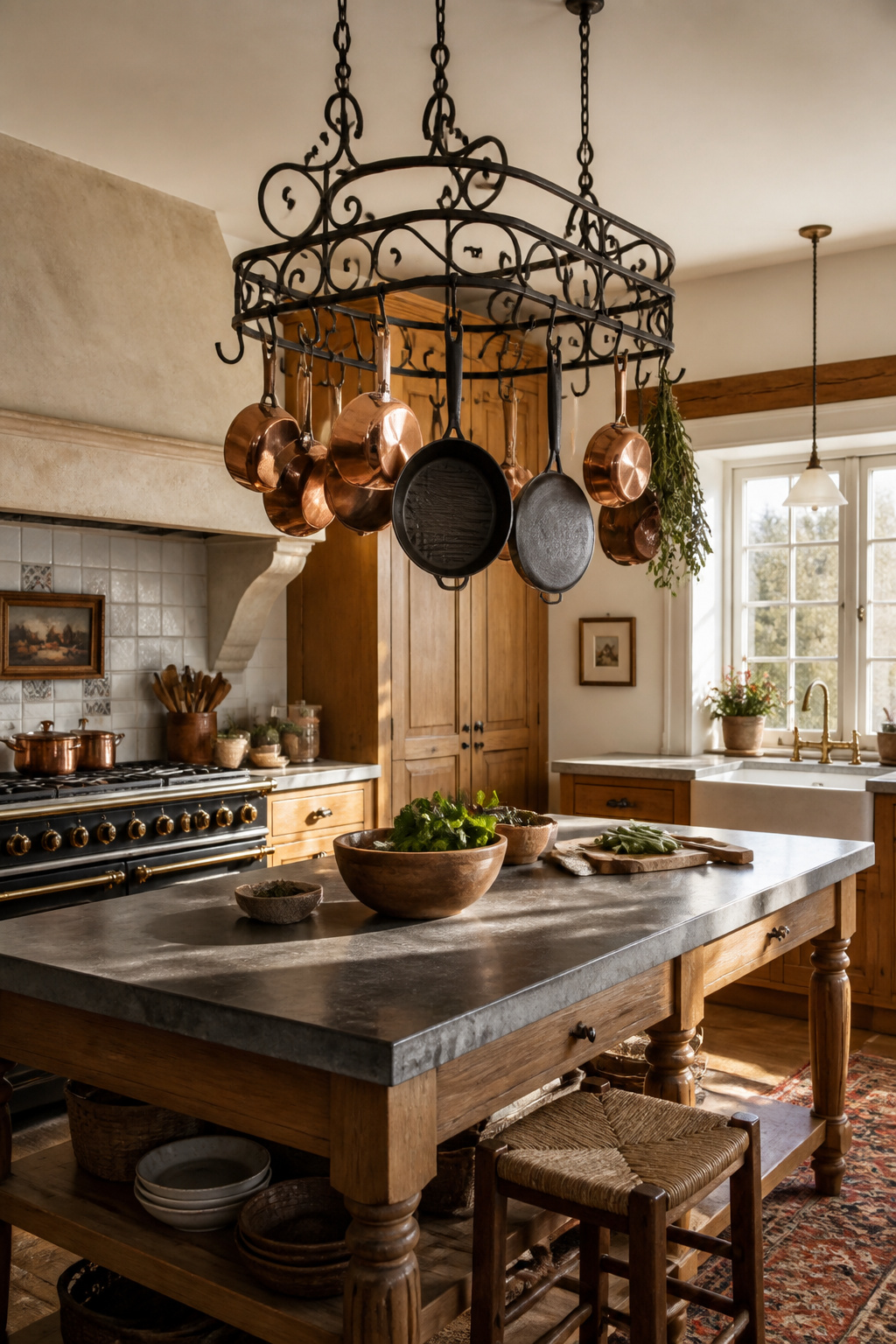
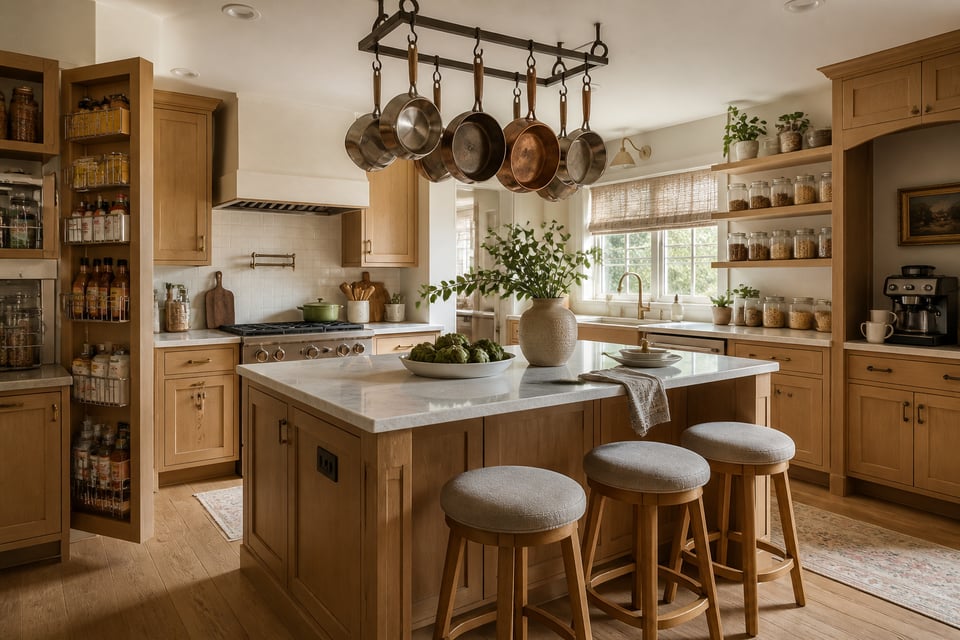
Like most ceiling-mounted kitchen storage solutions, the placement math is simple once you know it. Aim for 40 to 48 inches from the top of your counter or island to the bottom of the rack’s hooks. Also add 6 to 10 inches of comfortable reach to your own height. That gives you your working hanging height. Then plan for pots to hang at least 8 inches below the rack itself. If you’re hanging over an island, leave roughly 6 inches of clearance on all sides. That keeps the rack from becoming an obstacle course. A ceiling height of at least 7 feet is generally the minimum. Otherwise, the rack and its pans turn into a head-level hazard. In fact, that same height consideration matters for your overhead lighting too, since the two often compete for the same space.
No 7-foot ceiling to spare? Even so, a wall-mounted rail with S-hooks near the range gives you the same decluttering effect without needing the vertical room. It’s also a far easier weekend install, since you’re working with a single wall mount instead of a ceiling-rated anchor point.
6. Under-Sink Pull-Out Bins for Smart Kitchen Storage of Cleaning Supplies
The cabinet under your sink is treated, in most kitchens, as one open cavity. That’s exactly why cleaning supplies end up piled loose around the pipes instead of organized in any real way.
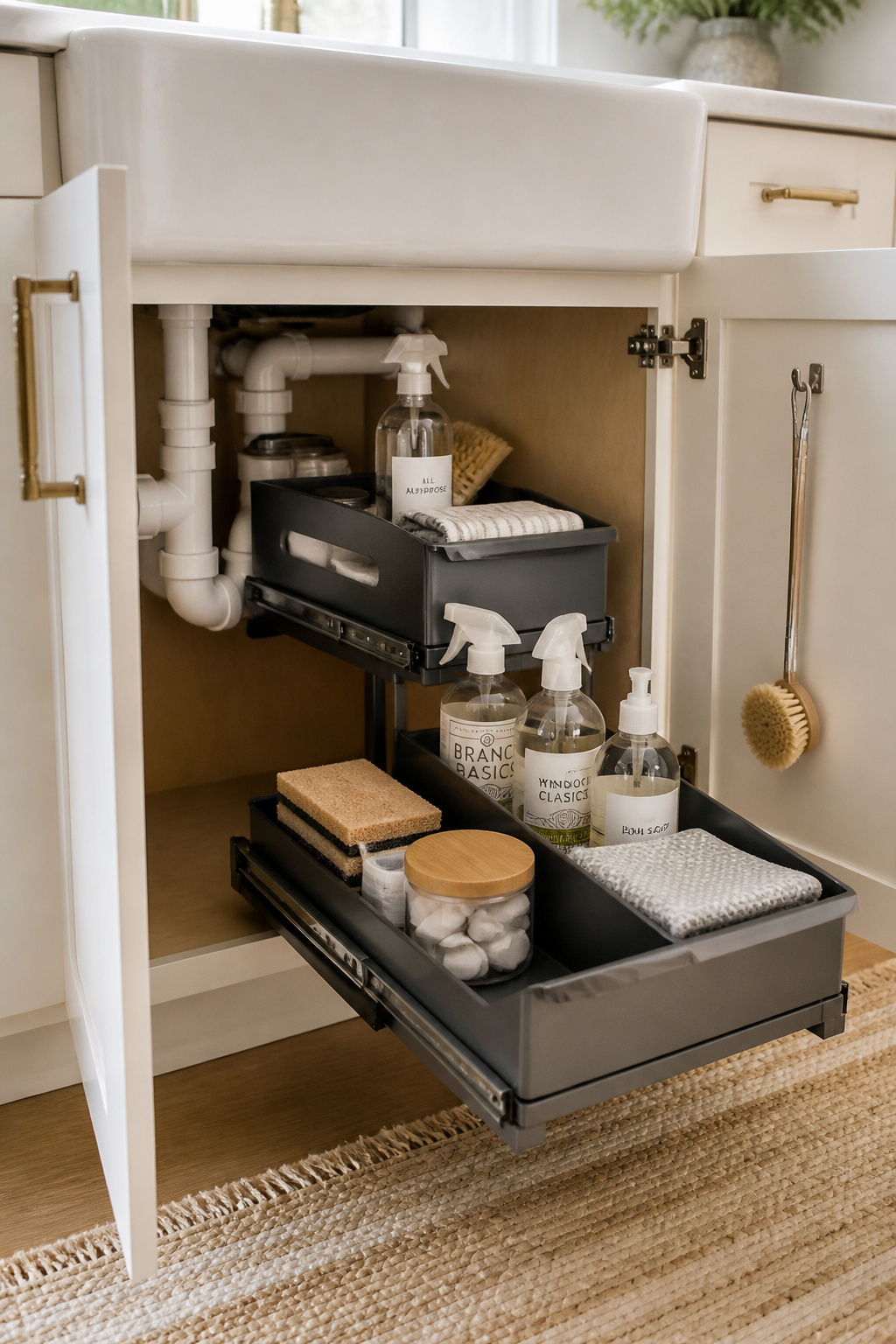
Modern under-sink organizers are some of the most practical kitchen storage solutions. That’s precisely because they’re built to work around that plumbing rather than fight it. For instance, L-shaped designs, with a narrow top and wider bottom, route around the supply lines and drain trap. Two-tier steel wire pullouts, like Rev-A-Shelf’s 548WB series, use that same L-shaped frame. As a result, they deliver two full shelves of usable space. Rolling caddy organizers, with wheels and built-in dividers, let you pull the entire unit toward you instead of reaching in blind. Splitting the cabinet into distinct zones for trash, recycling, and cleaning supplies helps too. That way, it keeps any one bin from turning into a catch-all again within a month.
Measure the distance between your supply lines and drain trap before buying anything fixed-width. That’s the single most common reason an under-sink organizer ends up not fitting. So an expandable model is the safer bet if you’re not entirely sure of those measurements yet.
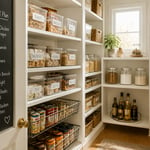
7. Open Shelving with Labeled Bins for Everyday Pantry Storage Solutions
Pantry design has moved on from loose bags and mismatched boxes. The current standard kitchen storage solution is a structured system. Open shelves, labeled zones, and layered storage tell you exactly where everything lives.
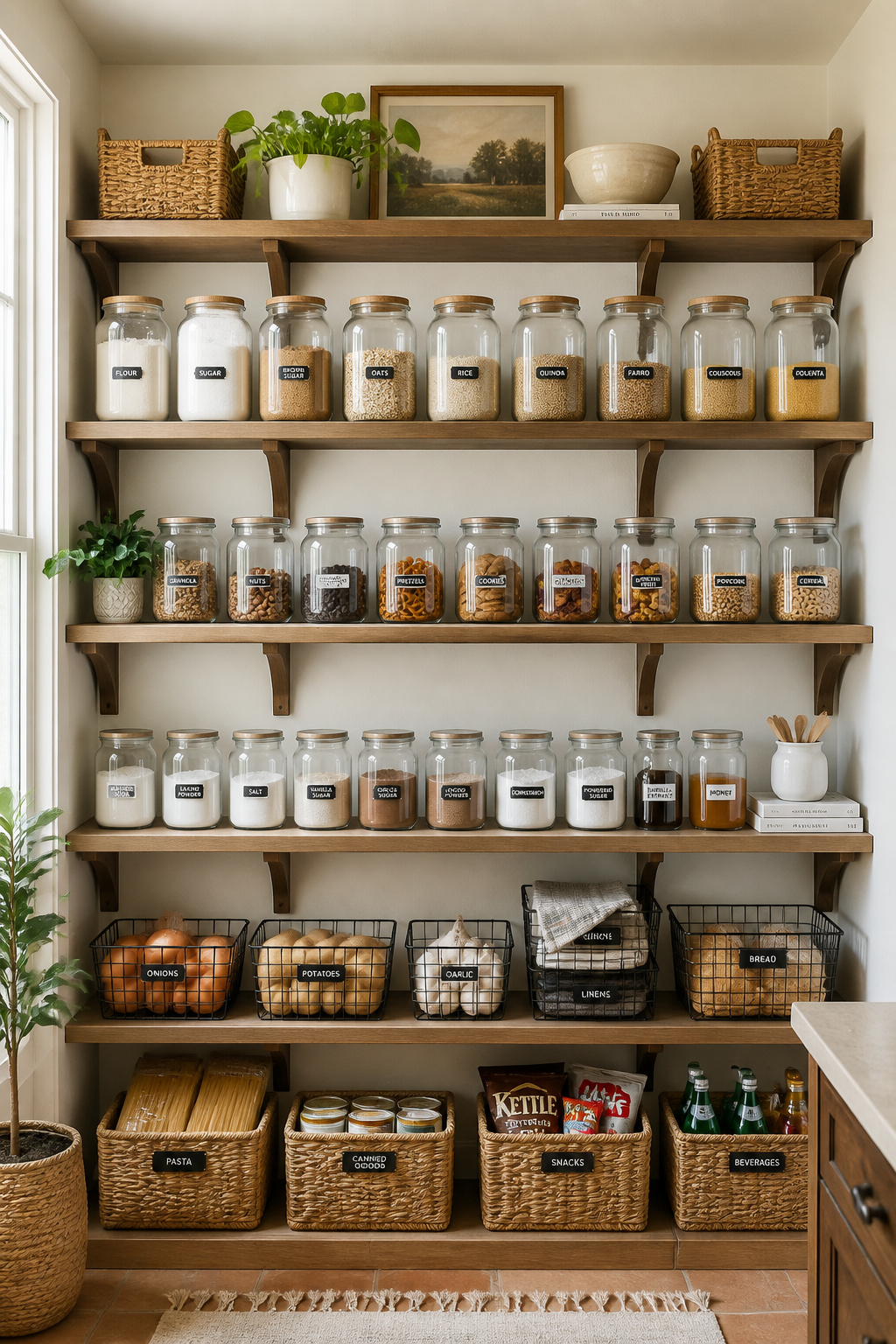
The shift driving this is mostly about containers. For example, matching, airtight rectangular containers for flour, sugar, rice, pasta, and cereal have replaced original packaging as the default. A label maker applied at eye level on every container, basket, and bin keeps the whole system navigable at a glance. Since open shelving puts every inconsistency on display, identical container sizes matter more here than in a closed cabinet. Wire baskets and rotating trays can also divide the shelves into functional zones, spices in one section, snacks in another, baking supplies in a third. That way nothing overlaps or drifts.
Reserve a closed cabinet or two for the bulkier, less photogenic items. Large bags of pet food and paper goods belong there, anything that would make even the best-organized open shelving look cluttered again the moment it’s set down. In fact, that mix of open and closed storage tends to age better than an all-open pantry, which can start to feel like a chore once the novelty wears off.
8. An Appliance Garage That Hides Countertop Clutter Behind Cabinet Doors
Small appliances have a way of colonizing countertops the moment you stop watching. An appliance garage is one of the more involved kitchen storage solutions on this list. Still, it gives the mixer, the toaster, and the coffee maker a dedicated home that’s within easy reach.
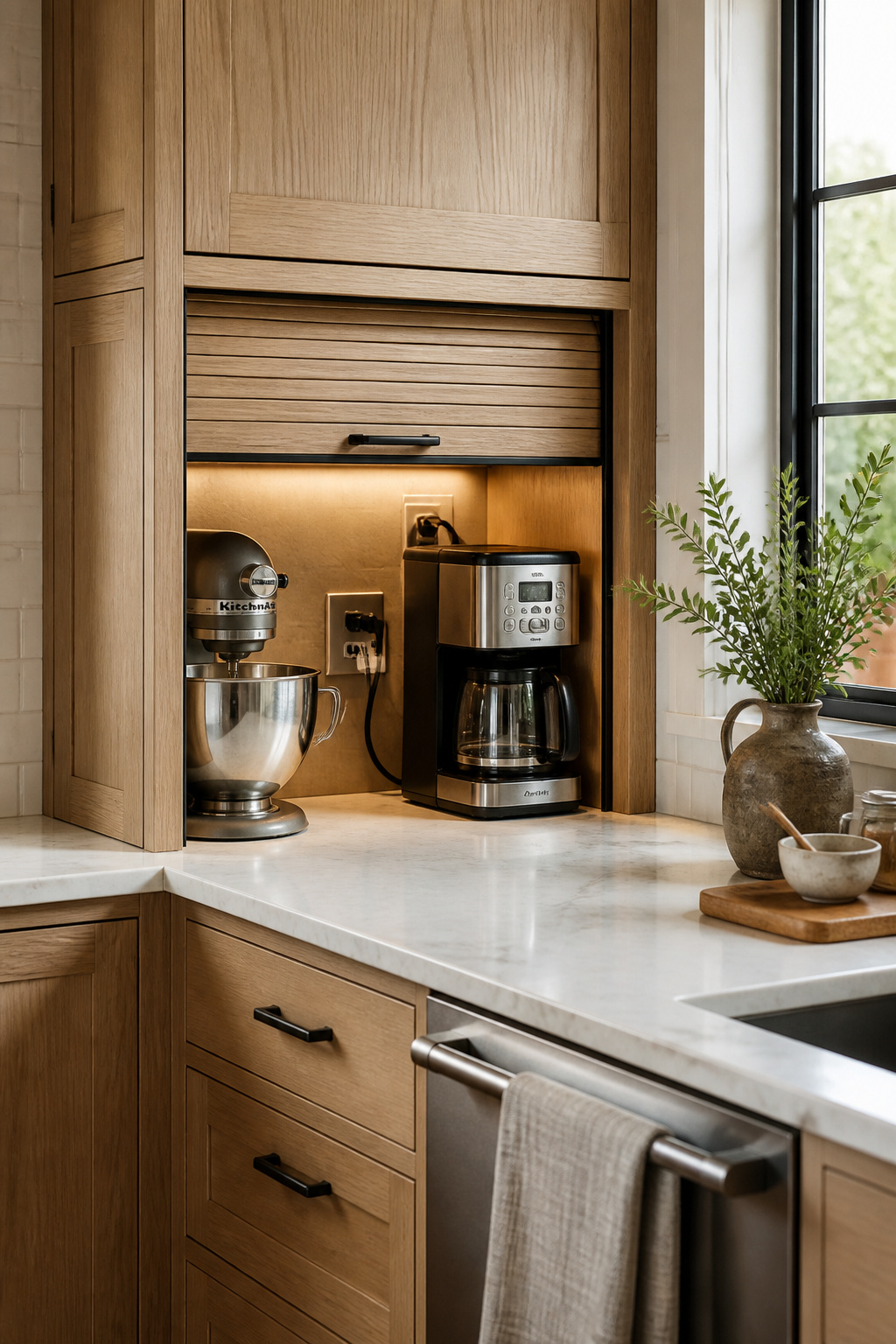
The detail that makes or breaks one of these is electrical. So plan an internal power outlet with an electrician, so appliances can stay plugged in inside the garage, ready to go. It’s worth knowing that, per NEC code, an outlet inside an appliance garage doesn’t count toward your kitchen’s required receptacles. So you may still need additional outlets elsewhere. Some setups pair a specialized lift mechanism with that in-cabinet outlet. As a result, this lets you raise a mixer into position without ever unplugging it. A strip of LED lighting inside also helps, making the whole space easier to see and use first thing in the morning. If a garage like this is part of a bigger overhaul, read through a full kitchen remodel that works for real life before finalizing the layout.
Size the garage with a little extra room. Building it for your current toaster and coffee maker only works until one needs replacing with something larger. After all, that’s a far cheaper problem to plan around now than to discover after the cabinetry is finished.
9. Drawer Inserts for Utensils That Maximize Kitchen Storage in Tight Drawers
Every junk drawer starts the same way: no dividers. So everything slides into one pile the first time the drawer gets opened in a hurry.
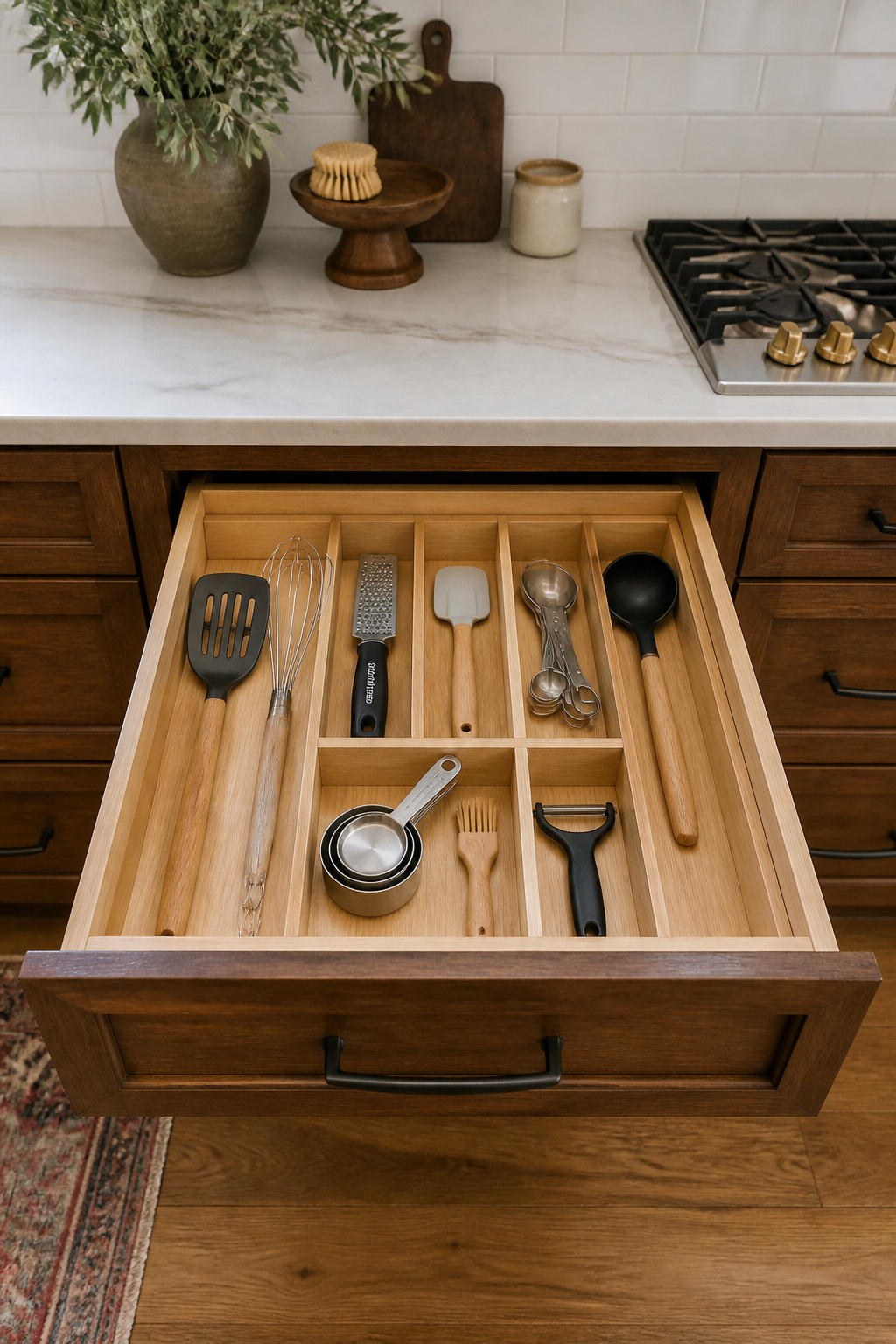
Trim-to-fit inserts are among the easiest kitchen storage solutions to add. They’re also a piece of kitchen organization that pays off daily. With up to ten static compartments and a couple of adjustable ones, they handle most standard utensil collections well. If your tools change often, adjustable divider kits flex with you in a way fixed inserts can’t. Most include up to six removable pieces you can angle or stand vertically. Fixed wood inserts in natural maple or walnut are the better call if your drawer has looked the same for years. Even so, it will probably keep looking that way. For especially deep drawers, a two-tier setup works best. Put a shallow tray on top for the tools you grab daily, with bulkier items stored below. Some systems even build in a separate knife block tray, typically around 18.5 by 22 inches.
Hold off on a fixed insert if you’re mid-renovation or still figuring out which tools actually earn drawer space. It’s a small purchase to get wrong, but an annoying one to redo. Instead, an adjustable insert costs only a little more for that flexibility.
10. Stackable Glass Canisters for Bulk Pantry Storage Solutions
Bags and boxes are the least efficient way to store bulk dry goods. They’re hard to stack, harder to seal, and nearly impossible to see into at a glance. Stackable canisters, by contrast, are one of the most satisfying kitchen storage solutions on this list, simply because they’re inexpensive, visible, and useful from the day they arrive.
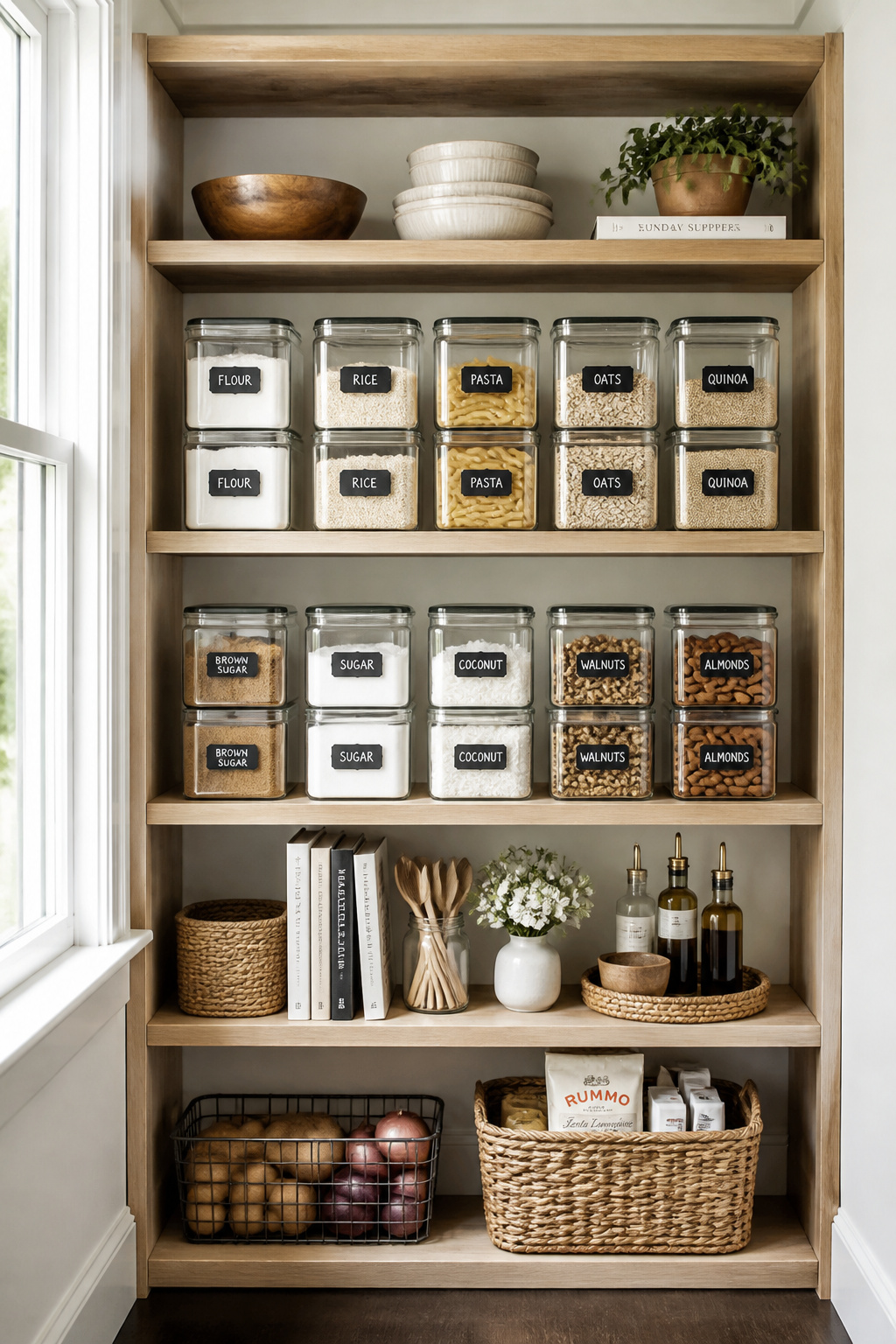
Four-side locking lids with silicone gaskets protect food from pests, moisture, and oxidation in a way no bag ever will. Also, square shapes fit more efficiently into tight cabinet shelves than round ones do, while still nesting securely when stacked. Sets typically scale from small jars around 3.4 cups up to extra-large containers near 12 cups. That range lets you match container size to how much of an ingredient you actually go through. Grooved lid-and-base designs let containers interlock when stacked, which keeps a fully loaded shelf stable instead of teetering. These work well for cereal, flour, sugar, coffee, rice, grains, beans, and nuts, essentially anything you buy in bulk. In fact, in a smaller kitchen, this kind of shelf-efficient storage matters even more.
Label each one with contents and a fill date, then rotate from the back forward. It’s a small habit that keeps bulk ingredients from going stale before you notice. Also, it’s what keeps a beautiful glass canister setup from quietly becoming a guessing game six months in.
11. A Rolling Kitchen Cart for Extra Storage in Small Kitchens
When there’s no room for a built-in island, a rolling cart does a surprising amount of the same job. It can disappear into a corner the moment you don’t need it. It’s also one of the only kitchen storage solutions on this list you can take with you if you move.
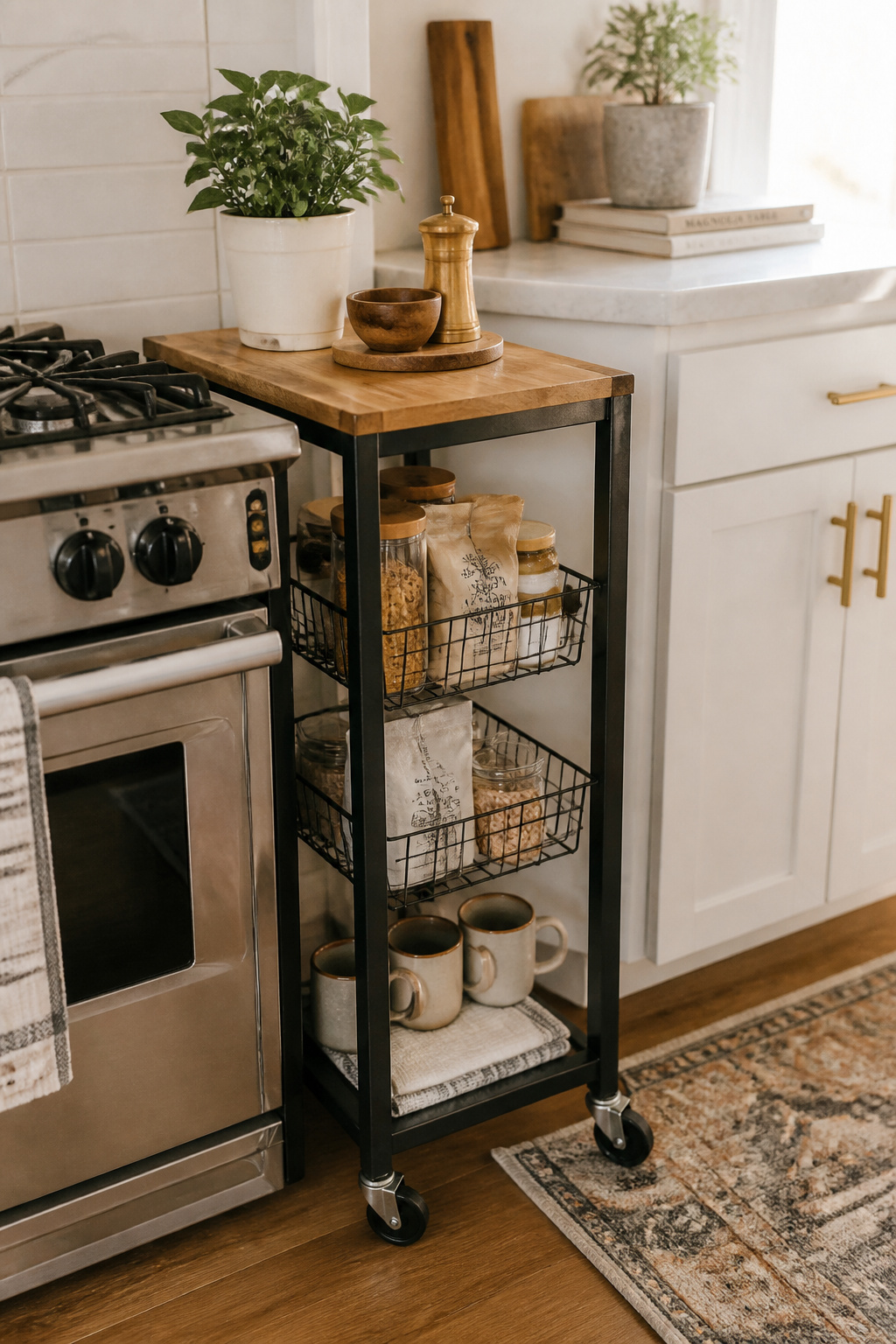
These carts work as an all-in-one solution for accessories, utensils, and food supplies. They come in sizes built for very specific gaps. For instance, narrow models slide into the slim space beside a stove. Larger ones, meanwhile, function almost like a small island in their own right. Look for four-caster construction with foot brakes on at least two wheels. That keeps the cart stable once you’ve rolled it into position. Also, a mix of shelves, drawers, and wire baskets lets it hold everything from mugs and glassware to dry goods. A few of these double as extra prep or bar space, with a butcher-block top that earns its footprint even when you’re not using it for storage. That’s handy for savvy small kitchen remodeling solutions, where every square foot has to multitask.
Measure the gap you’re hoping to fill before buying. The whole appeal of a cart is that it’s movable and unobtrusive. So a cart that’s even an inch too wide defeats that purpose entirely, and you’ll end up working around it instead of using it.
12. Magnetic Knife Strips That Clear Counter and Drawer Storage
A knife block claims permanent counter space. In-drawer knife storage claims an entire drawer. A magnetic strip, on the other hand, claims neither. So it’s one of the rare kitchen storage solutions that keeps every blade visible and within reach.
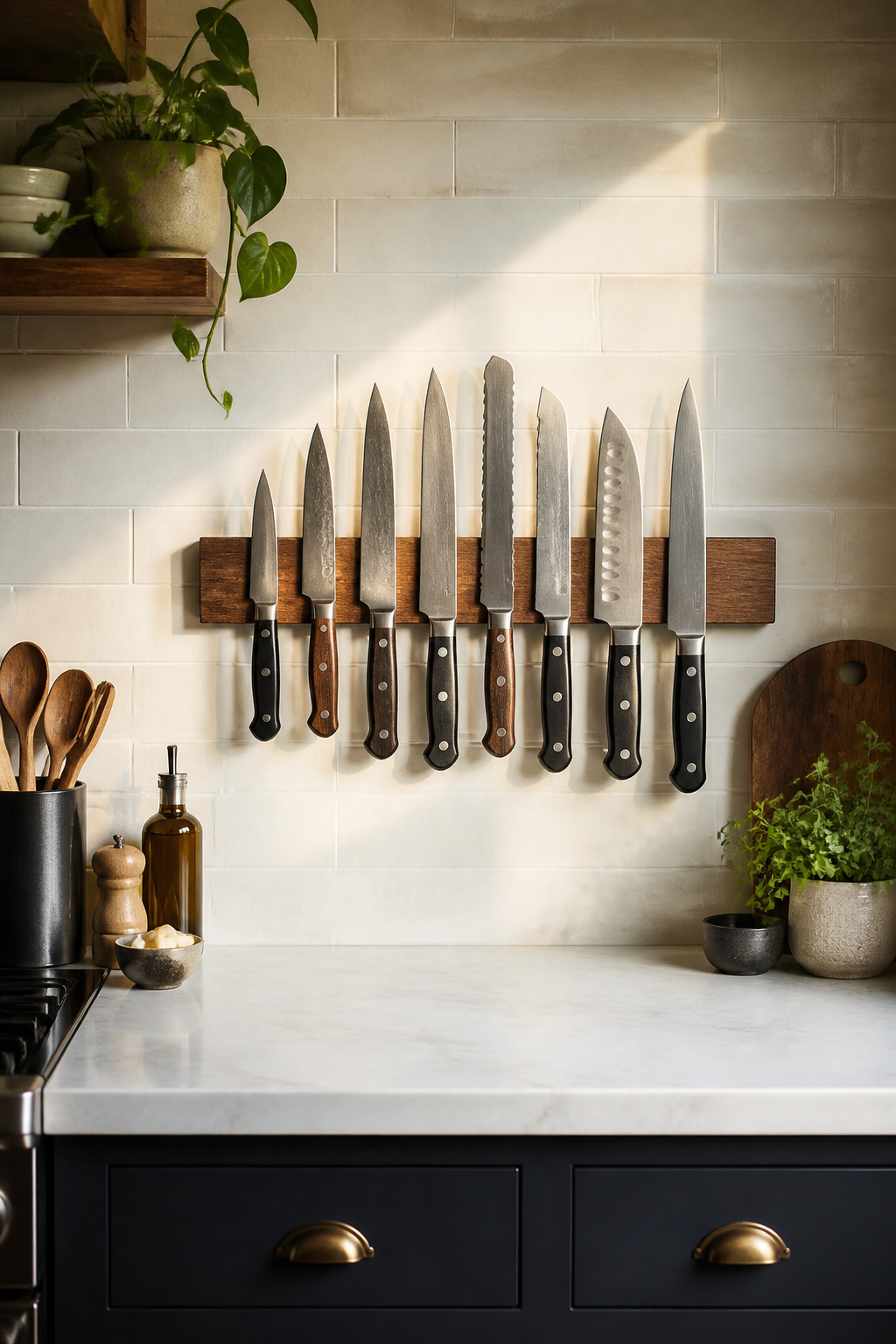
Mounting height matters more than most people realize. Aim for somewhere between 18 and 24 inches above the counter, generally landing around shoulder height for whoever cooks most often. Of course, go higher if there are young children in the house. Also, the strip itself needs solid wall substrate and heavy-duty anchors rated for more weight than your total knife load. Otherwise, drywall alone won’t hold securely once you’ve got six or seven knives hanging there. Place each knife with the tip facing up. Resting it any other way lets the handle’s weight pull it off-balance. Wood-backed strips also reduce the metal-on-metal contact that dulls an edge faster than a knife block would.
This is one upgrade that genuinely punishes shortcuts. A heavy strip mounted into drywall alone is a matter of when, not if, it pulls loose. So find a stud, or use anchors rated well above your knife set’s total weight.
13. Over-the-Cabinet Storage for Rarely Used Serveware and Platters
The dead air above your wall cabinets is one of the most underused kitchen storage solutions out there, and it costs nothing to use. After all, it’s perfectly suited to the things you only need a few times a year.
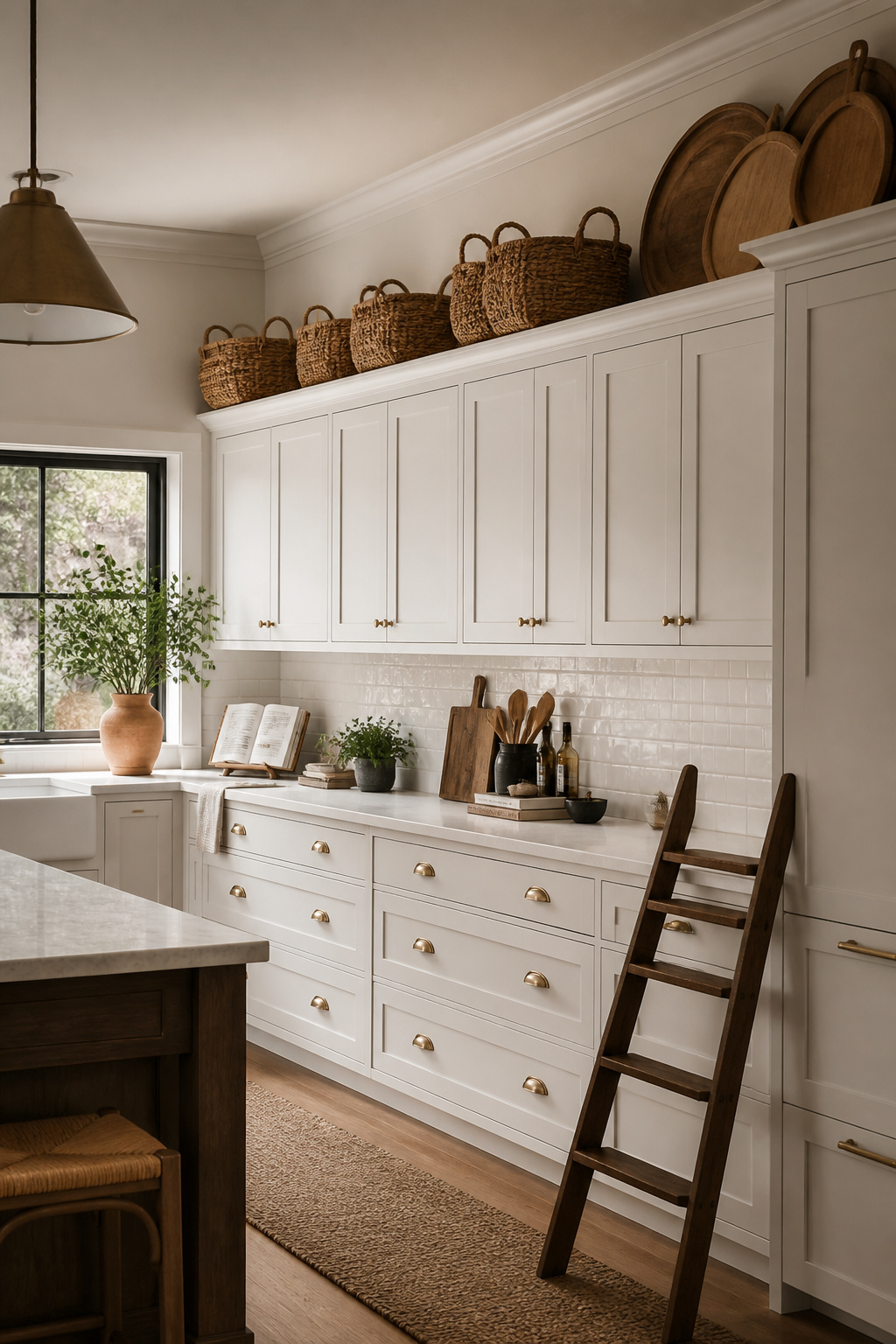
Cake stands, oversized serving boards, decorative pieces, even excess bulk goods if your pantry is tight, all of it has a logical home up there. Also, identical baskets or boxes placed along the top add a sense of visual order rather than looking like overflow. A sturdy step stool or sliding ladder kept nearby is the standard, sensible way to access this space. Shelf risers or tension rods also help, keeping stored items from shifting when a cabinet door below opens or closes. Still, it does collect dust faster than you’d expect. So fold it into a regular cleaning routine, rather than discovering a layer of it during the holidays. If you’re chasing storage room by room, storage solutions for another room in the house follow the same basic logic. Dead space comes first, and daily-use items come last.
Whatever you do, don’t put anything you reach for regularly up there. Since needing a stool every single time defeats the entire point of an efficient kitchen, save that prime overhead real estate for the truly occasional pieces.
14. A Built-In Spice Rack Inside the Cabinet Door for Kitchen Storage Solutions
Loose spice jars on a regular shelf have a way of sliding to the back and disappearing for months. Also, their short height wastes vertical space meant for taller items.
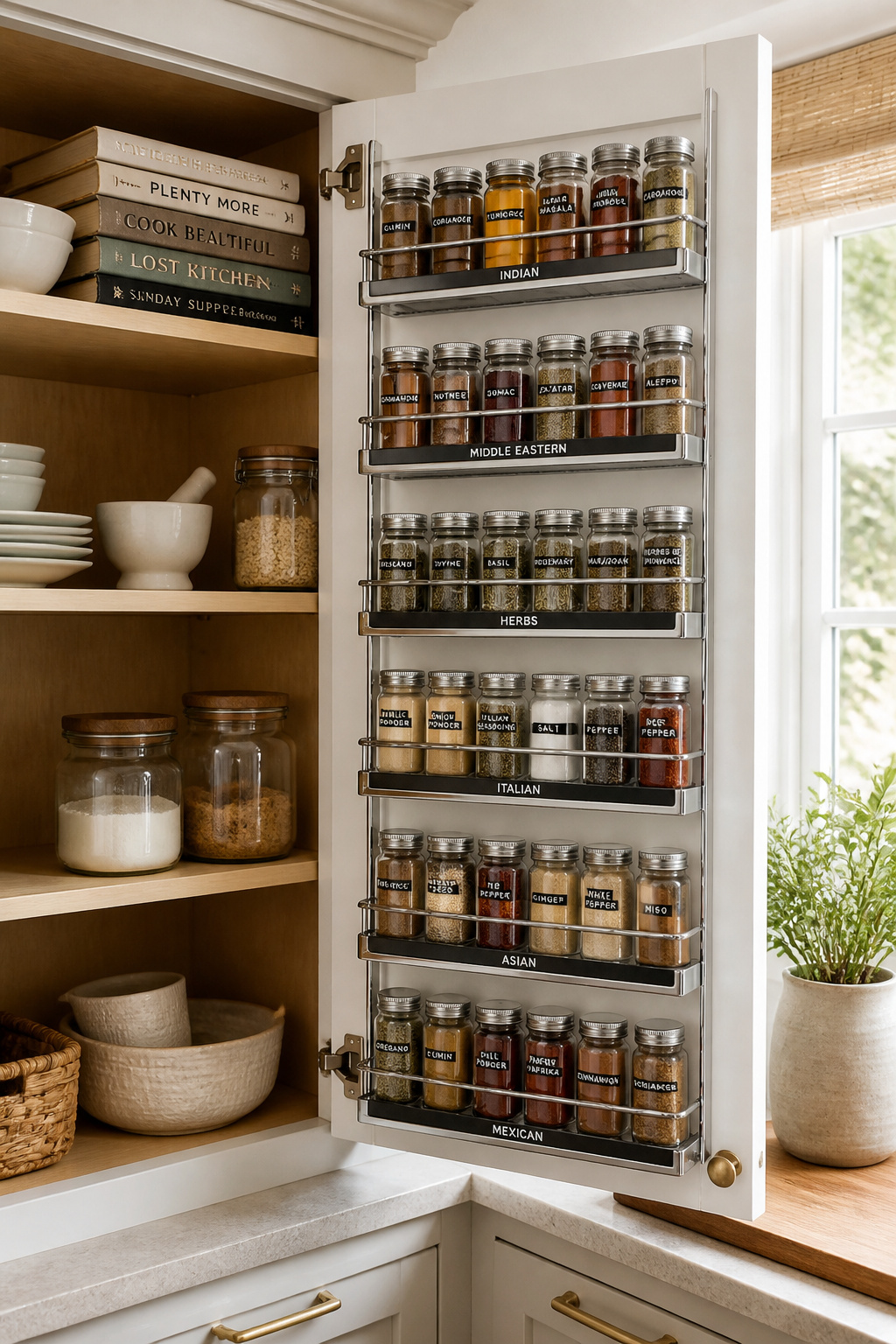
A door-mounted rack solves both problems. It uses space that would otherwise sit completely empty: the inside of the cabinet door itself. Standard widths run 9.625, 12.625, and 15.625 inches, built around a consistent height near 21.25 to 21.5 inches. Depth runs about 3.125 inches, sized specifically for a standard 30-inch wall cabinet. Before ordering, confirm your cabinet opening can accommodate it. As a rule of thumb, you’ll want at least 17.5 inches of width and 21.75 inches of height on a face-frame cabinet for everything to clear properly. Once it’s in, group spices by how often you reach for them, rather than strict alphabetical order, since that’s faster mid-recipe. Also, lean toward chrome rails over wood if the rack sits near steam from the stove. It’s a small change, but it pairs naturally with a fresh coat of paint if you’re refreshing the space at once.
Double-check that a fully loaded door can still close without hitting an adjacent cabinet or appliance. The widest rack available isn’t always the right one, so measure twice. After all, this is one return shipment you’d rather avoid.
15. Hanging Pot Lid Organizers That Solve a Common Kitchen Storage Headache
Lids never stack as neatly as the pots they belong to. So mismatched sizes guarantee a wobbly, sliding pile the moment you try to store more than two or three together.
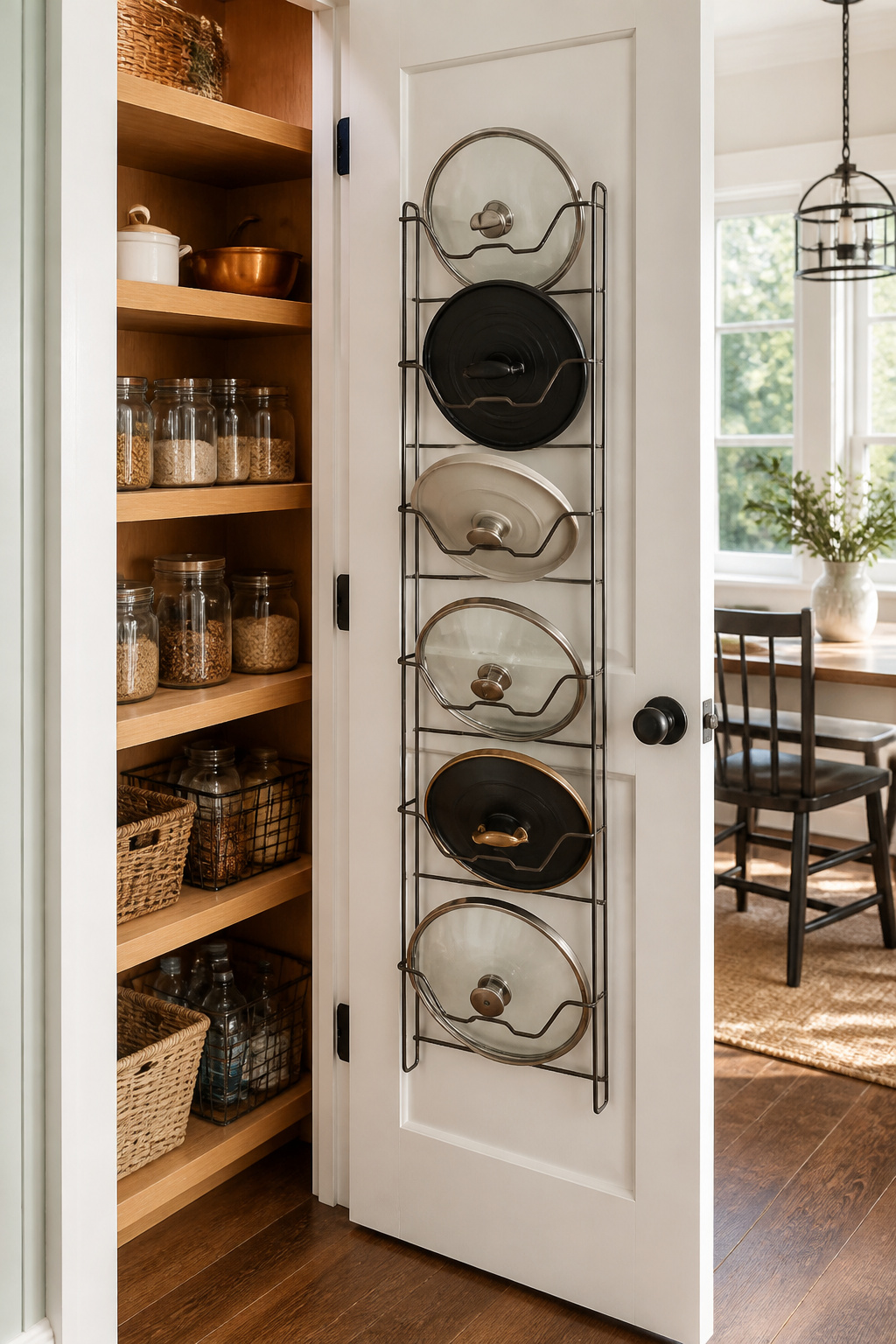
A lid organizer mounted inside a cabinet or pantry door ranks among the lowest-cost kitchen storage solutions out there. It uses space that would otherwise go entirely unused. Most racks hold up to six lids and use steel wire with a non-scratch coating to protect your cookware’s finish. You’ll find two installation styles: hanging over the door edge, or drilling directly into it. That distinction matters if you’re in a rental and can’t drill into the cabinetry. Padded hooks on the hanging-style versions also protect the door from scratches over time. Also, dividers with a small notch for the handle make it faster to grab the right lid. Adjustable-spacing wire racks handle a wider range of lid diameters than fixed-slot versions, which is worth paying for if your cookware is more mismatched than matched.
If you’re renting, stick to the hanging-style mount. It’s a small distinction, but it’s the difference between a weekend project and a deposit dispute. Even so, the padded hooks still protect the door either way.
16. A Dedicated Coffee Station with Storage Solutions for Mugs and Grounds
Morning routines spread clutter fast when there’s no single home for the coffee maker, the mugs, and the grounds. A dedicated coffee station follows the same logic as the other kitchen storage solutions here, just applied to one corner of the counter.
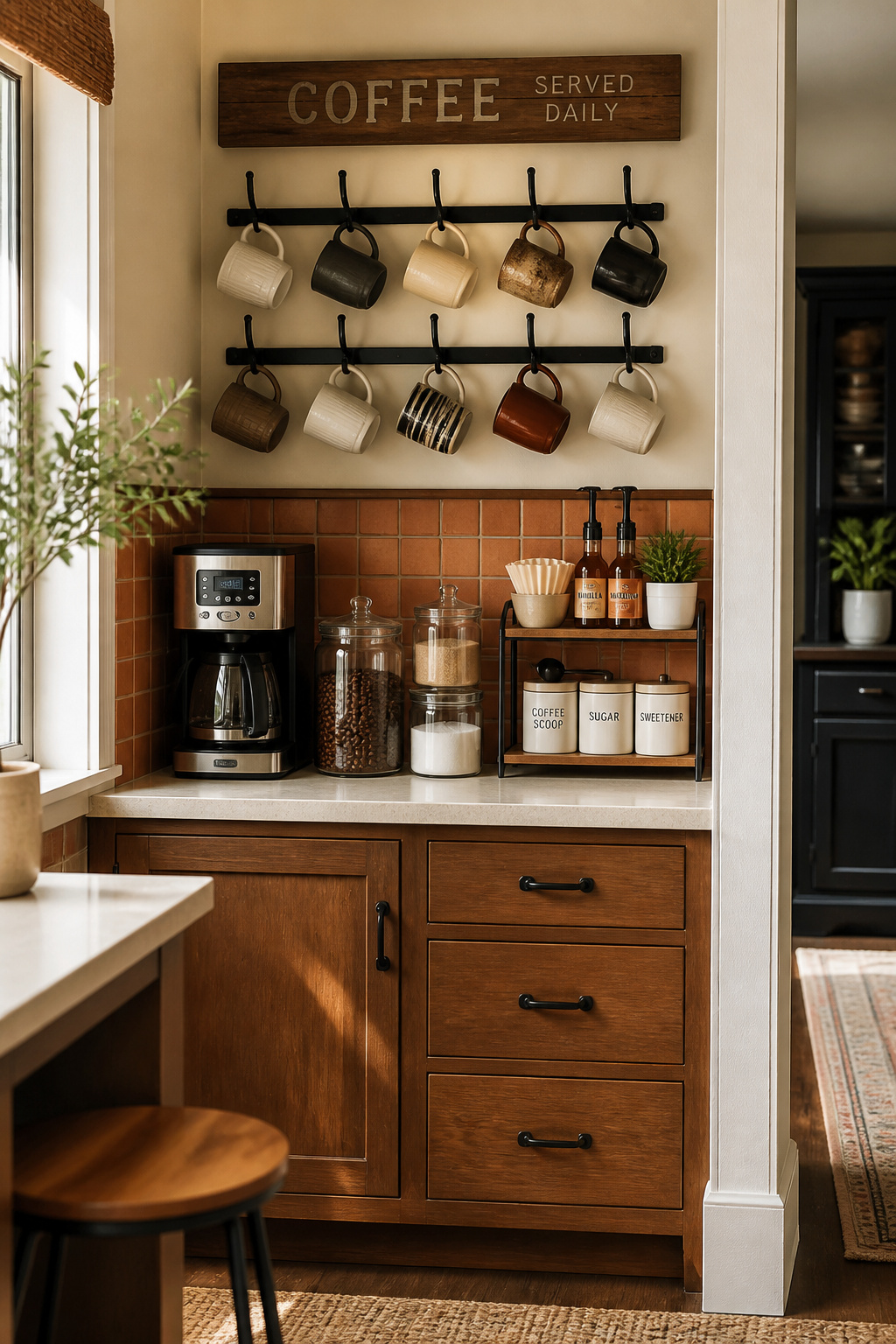
The fix is centralizing all of it: a counter nook, a repurposed cart, a corner of the pantry, or a dedicated cabinet. That way brewing equipment, mugs, and supplies live in exactly one place. A wall-mounted or tabletop mug rack keeps cups accessible without eating into shelf depth. Sealed coffee canisters, meanwhile, keep beans fresher than the original bag, especially when labeled with roast type or date. Also, tiered shelf risers let you see every item at a glance instead of digging behind taller bottles. Keeping the most-used items toward the front also helps. As a result, it naturally pushes backup supplies, like extra filters and spare pods, to a drawer or lower shelf. If the budget for any of this is tight, there’s real overlap with party-ready kitchen upgrades that don’t break the budget, since a coffee station really just applies the same organizing principles on a smaller scale.
Resist the urge to display every gadget and flavor syrup you own. That’s exactly the kind of clutter a dedicated station is supposed to solve. Also, a small mat under the machine to catch drips is worth adding from day one, rather than after the first ring stain shows up.
How to Choose the Right Kitchen Storage Solutions for Your Space
With sixteen kitchen storage ideas on the table, the real question is where to start. The answer is almost never “all of them at once.”
Begin by naming the actual problem, not the general feeling that your kitchen is cluttered. “I have nowhere to put cleaning supplies” or “I can never find a lid that matches” points you toward a specific fix. Vague frustration never will. Most of the small upgrades here, drawer dividers, a magnetic strip, an under-sink organizer, run $20 to $150 and take an afternoon. The bigger structural changes, like toe-kick drawers, an appliance garage, or built-in pull-out shelving, land closer to $150 to $1,000. So those bigger changes make far more sense to plan into a remodel that’s already underway, rather than retrofit later. If you’re not sure where to begin, vertical space is usually the cheapest win. For example, a wall rack, a door-mounted organizer, or the dead air above your cabinets adds real capacity without touching existing cabinetry.
Skill level matters too. Anything that mounts to a wall or slides into a cabinet, the knife strip, the drawer inserts, the under-sink bins, is a confident weekend project for most homeowners. Cutting into cabinetry or adding wiring, though, is worth a contractor’s input, even if you’re handy, since a mistake there costs far more to undo than a misjudged shelf bracket.
Pick one project, the one solving your most daily-felt frustration, and let it prove itself first. A kitchen that gets a little better every few months beats one that never gets started because the whole list felt like too much at once.