Your bathroom shelves are the most underestimated real estate in your home. They’re not just somewhere to park a shampoo bottle and a spare roll of toilet paper — they’re an opportunity to create something genuinely beautiful in a space you visit more times a day than any other room. Good bathroom shelf decor transforms a functional surface into something that makes you pause for a moment, breathe a little deeper, and feel like you’re somewhere intentional.
I’ve spent years helping clients realise that the principles guiding a well-designed kitchen — the right balance of function and beauty, storage that’s also a pleasure to look at, objects arranged with care rather than just set down — apply just as powerfully to a bathroom shelf. The scale is smaller, but the impact on daily life is enormous.
These 15 bathroom shelf decor ideas run from the effortlessly simple (a candle and a trailing plant) to the genuinely transformative (floating glass shelves that make a small bathroom feel twice as open). Whether your bathroom is a generous ensuite or a compact powder room, there’s an approach here that will make those shelves earn their place.
1. Layered Candles and Botanicals for Instant Bathroom Warmth
The best bathroom shelf decor often starts with something deeply simple: a candle and a living plant. Before you’ve drawn a single bath, a lit candle and a trailing plant signal to your nervous system that this is a space for rest. Psychologists call it sensory anchoring — the combined effect of warm flickering light, a considered scent, and living texture that shifts you into a slower gear the moment you walk in. The effect is more powerful than any single element alone.
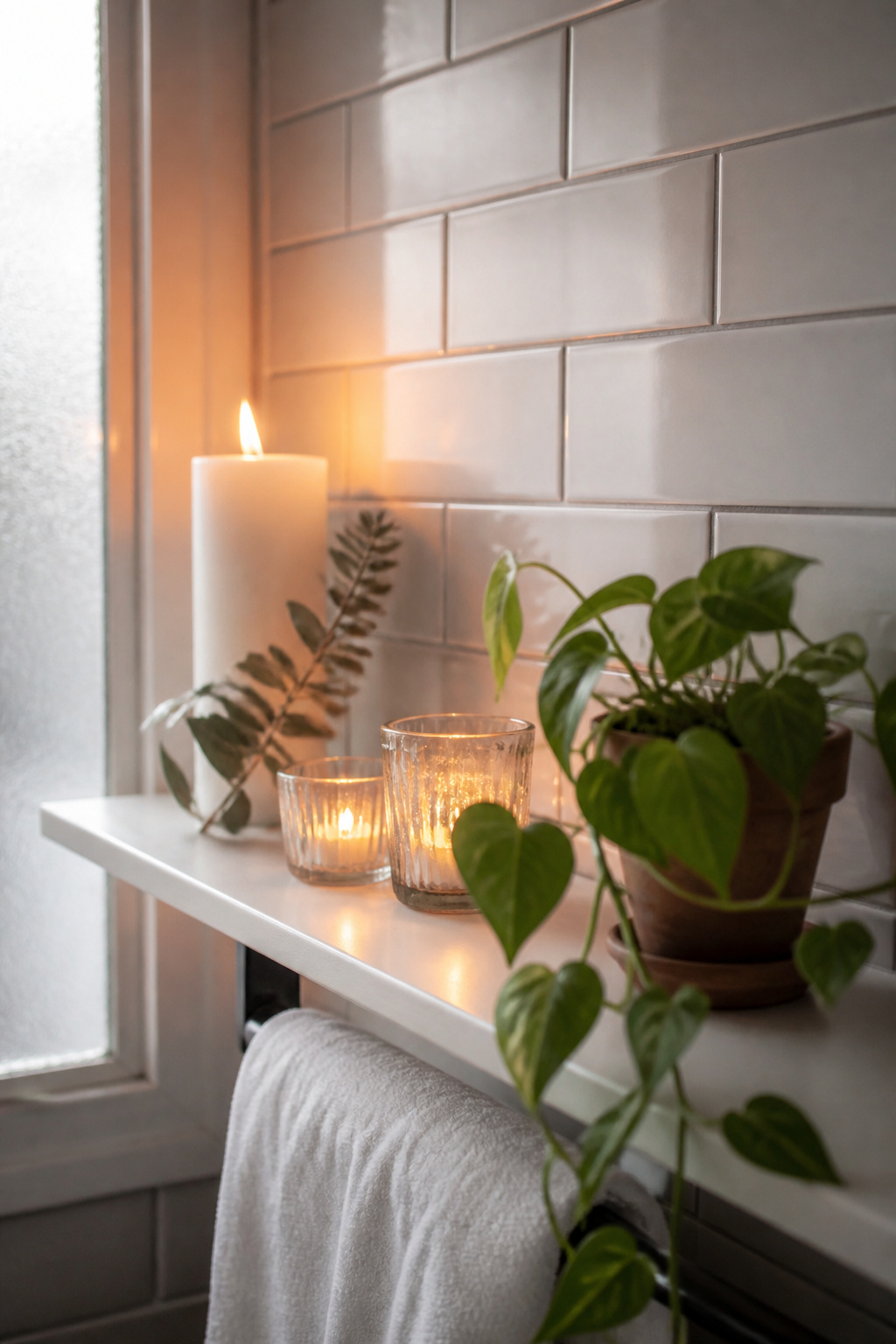
The arrangement itself doesn’t need to be complicated. Start with one tall pillar candle (8–10 inches) at the back of the shelf, one smaller votive cluster in front and slightly to one side, and a compact plant in a 4-inch pot on the other side. That asymmetric triangle is the vignette shape interior designers default to because it looks natural rather than staged. Keep at least 12 inches between any open flame and plant material; if your shelf is too narrow for that, flameless LED candles work just as well and are a sensible choice in a steamy bathroom.
For scent, match your candle to your bathroom’s light conditions rather than just personal preference. Low-light bathrooms pair well with eucalyptus or mint — both read as spa-fresh without being overpowering. Brighter bathrooms can carry floral or citrus notes. What to avoid: two different scented products on the same small shelf. A lavender candle beside a vanilla diffuser creates olfactory noise in a small space, not calm.
2. Bathroom Shelf Decor That Tells a Story With Found Objects
The most memorable bathroom shelves I’ve encountered weren’t filled with matching sets bought from a home goods store. They held a small piece of driftwood from a beach holiday, a smooth stone from a hiking trail, a grandmother’s crystal perfume bottle. Objects with history carry what designers call narrative weight — your eye lingers on them longer than on anything purpose-bought because they’re genuinely interesting. For anyone looking for further bathroom decor inspiration ideas, this personal approach is worth exploring beyond the shelf itself.
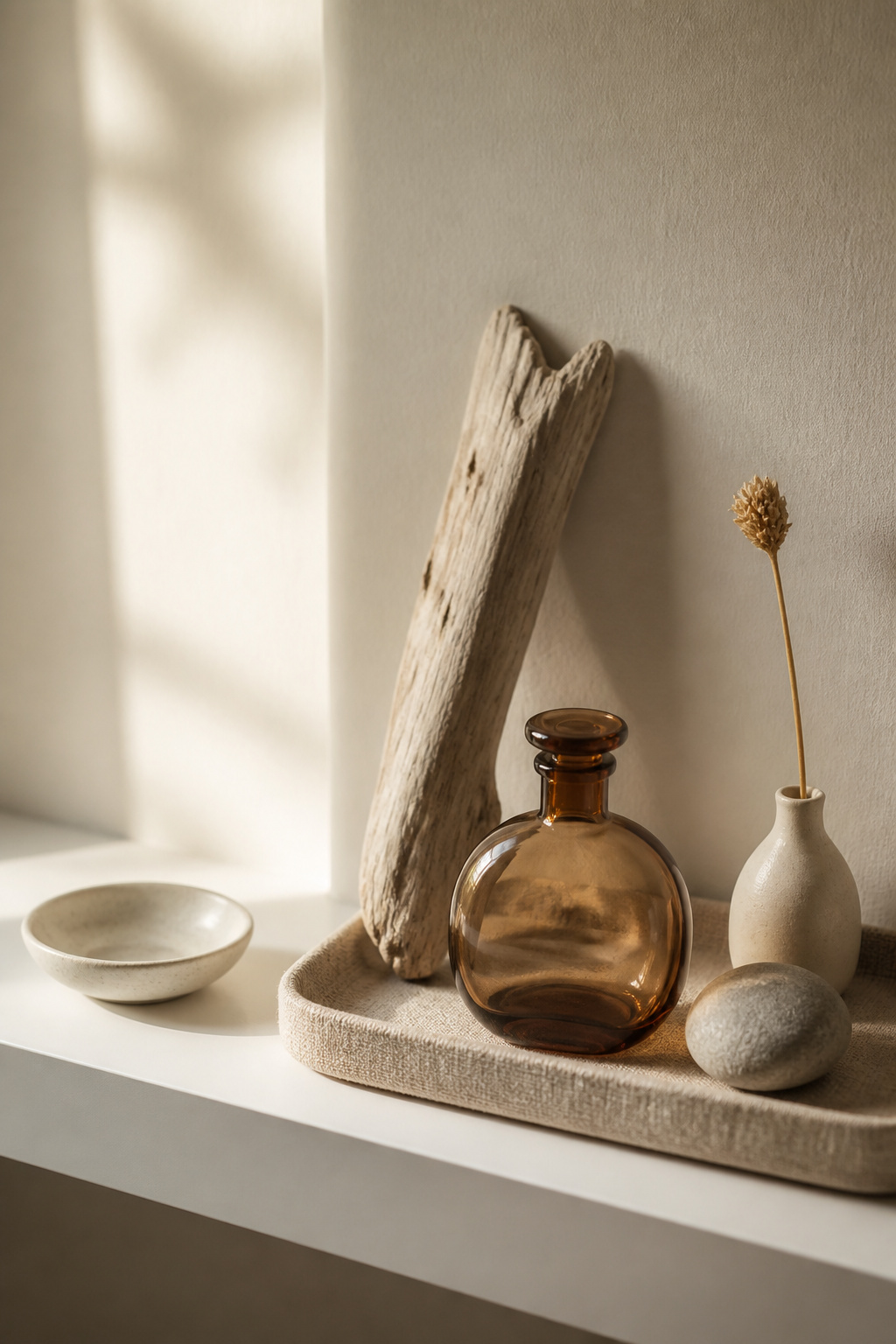
The challenge isn’t finding the objects; most of us have them scattered through the house already. The challenge is curation: presenting them so they read as a considered arrangement rather than a deposit of miscellany. The rule of odd numbers is your best tool here. Three objects almost always look composed; four or five can work on a wider shelf. Introduce height variation — one tall item (a vintage bottle), one mid-height piece (a small framed photo or decorative jar), one low horizontal element (a flat stone or small folded cloth). The eye travels between the three levels naturally.
What holds mismatched found objects together is a neutral anchor — a natural linen tray, a small whitewashed wooden board, a plain ceramic dish. Place your meaningful pieces within or around that anchor and the brain reads them as an intentional grouping. Aim to keep no more than 60% of the shelf as “story objects” and let the remaining 40% breathe as quiet neutrals. Edit ruthlessly: take everything off, place only the three objects that matter most, then add back only what genuinely improves the arrangement.
3. Woven Baskets and Organic Textures for Natural Bathroom Beauty
Bathrooms are almost exclusively hard surfaces: tile, glass, chrome, porcelain. Introduce a woven basket and you’ve placed the only organic texture in the room — which is exactly why the eye immediately gravitates to it as a visual rest point. When all the other bathroom shelf decor elements are smooth and reflective, a natural-fiber basket reads as warmth and relief. It’s the same reason a wooden chopping board transforms the look of a marble kitchen benchtop. Natural fiber in a hard-surface room has an outsized visual effect.
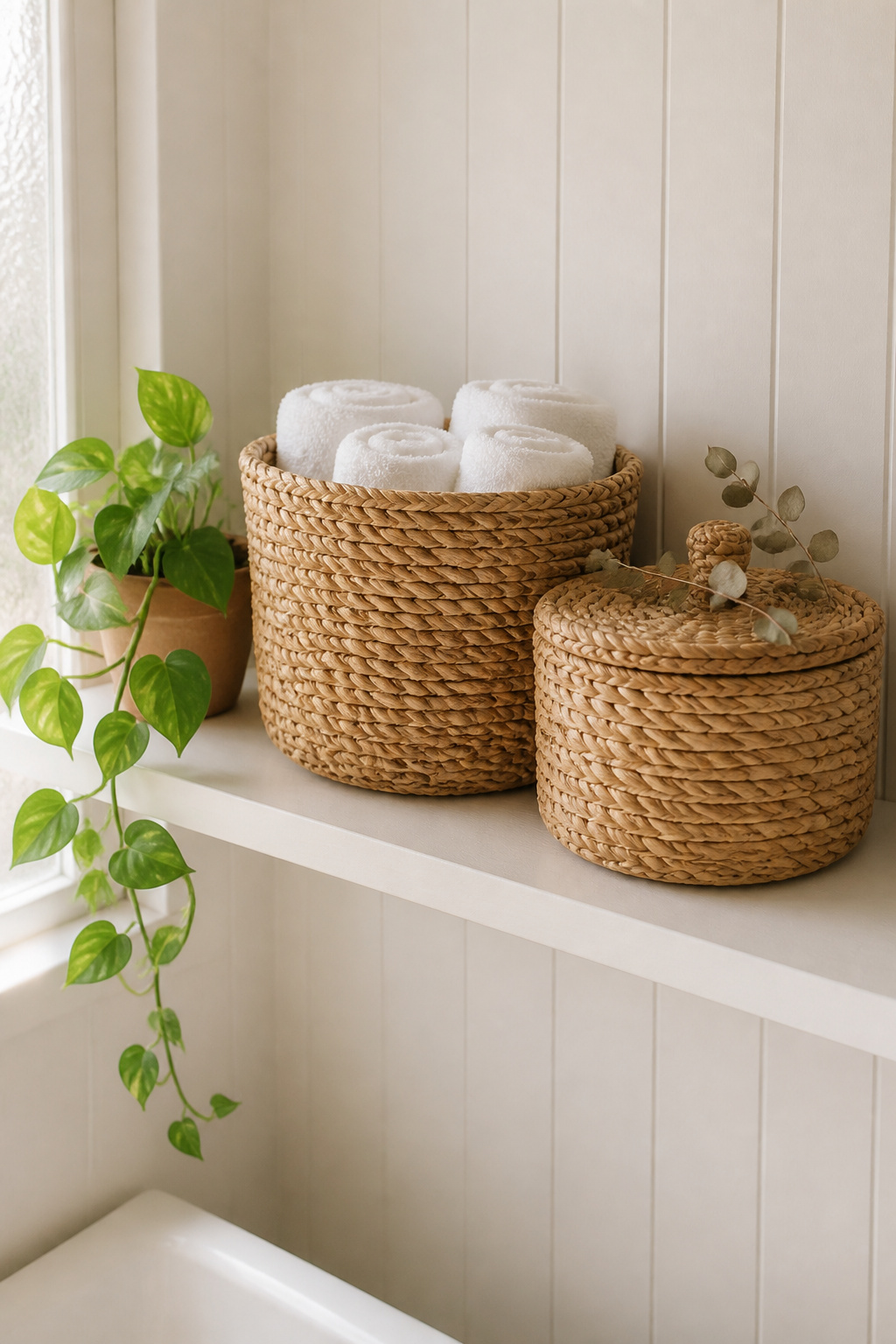
Seagrass and water hyacinth are the strongest choices for bathrooms with regular shower humidity. Both are woven from aquatic plants and carry natural antimicrobial properties that reduce mildew buildup compared to synthetic alternatives. Pure rattan can also work, but check whether it has been sealed — unsealed rattan in a poorly ventilated bathroom will develop a musty smell within months. If your bathroom runs hot and steamy, sealed synthetic rattan is a smarter long-term choice that looks nearly identical from a distance.
On a standard 12-inch deep shelf, keep baskets to 9 inches deep or less so they can be retrieved without the whole arrangement shifting forward. Stack two identical baskets vertically for an architectural look, or use a large base and smaller top for a more layered feel. Open-top baskets work best for things you want visible — rolled towels, toilet paper, bath bombs. Lidded baskets are better for items you’d prefer to keep out of sight. For anyone navigating a particularly compact bathroom, small bathroom storage solutions pair naturally with this kind of open shelving approach.
4. Mirrors and Metallics That Multiply Light on Any Shelf
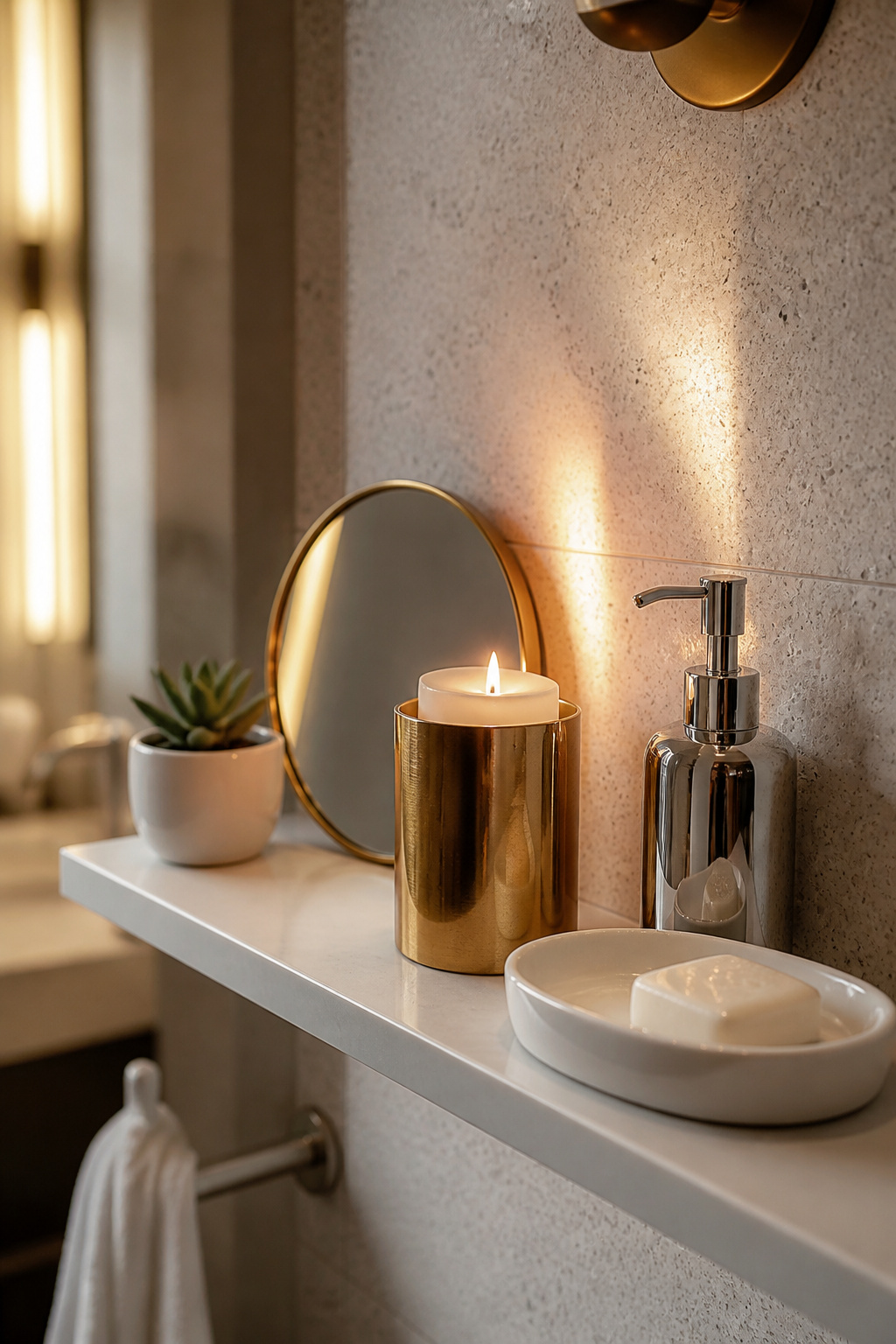
Ask any interior designer what the fastest way to make a small bathroom feel larger is, and they’ll say mirrors. Not just a big vanity mirror — small decorative mirrors positioned on shelves, angled to catch and scatter available light, can shift a bathroom from dim to luminous. Research from interior design programs cites positioning a mirror across from a light source as capable of making a room appear up to 30% more spacious by doubling the perceived light. On a shelf, this translates practically: lean a small circular or rectangular mirror (4–8 inches) at the back of the arrangement at a slight forward angle so it catches your vanity lighting and bounces it down across the other objects. The effect is a gentle glow that you notice the moment you walk in without immediately identifying its source.
Getting the Most From Metallic Accents
A mirrored or metallic tray beneath a shelf vignette works similarly from below — catching ambient light and creating a luminous halo around everything placed on it. When it comes to mixing metals — brass, chrome, matte black — the designer consensus is one dominant metal and one secondary, distributed roughly 70/30 across the shelf. Warm and cool pairings work best: brass with chrome, or matte black with gold. Each metal you introduce must appear at least twice to read as intentional rather than accidental. Two metals is the maximum on a small bathroom shelf; three reads as chaotic rather than curated. If you’re thinking bigger about the bathroom’s reflective surfaces, there are some genuinely beautiful bathroom mirror ideas that transform any space worth considering alongside your shelf styling.
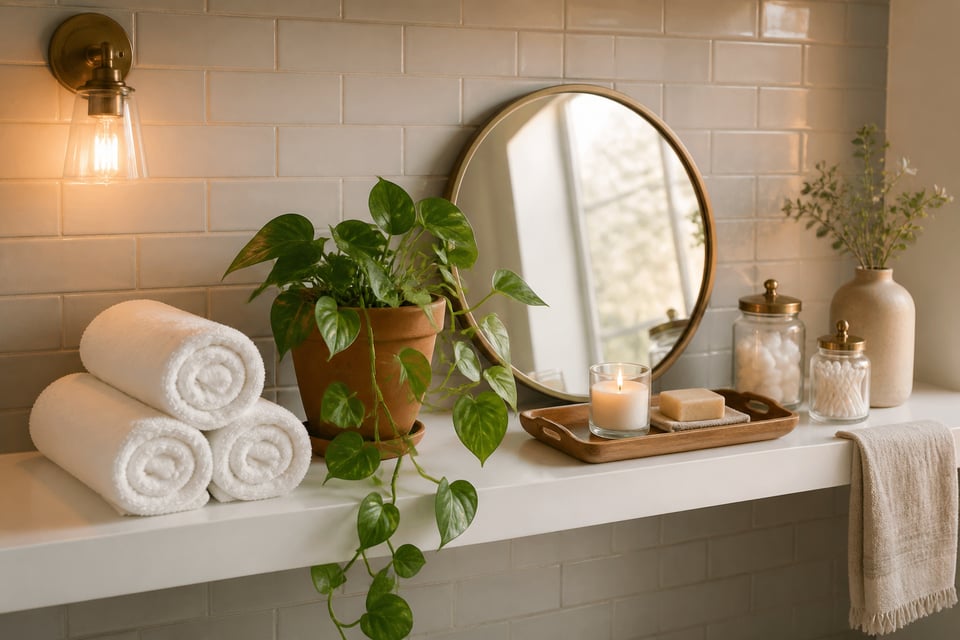
5. Spa-Style Bathroom Shelf Decor With Rolled Towels and Greenery
Five-star hotel spa designers worked out decades ago that visible towels create the luxury experience before a guest touches anything. The sight of plush, carefully arranged linens triggers a relaxation response — which is why the best hotel bathrooms display their towels rather than folding them away in a cabinet. This approach to bathroom shelf decor is entirely replicable at home, costs nothing if you already own towels, and creates one of the most immediately impactful shelf transformations available. Luxury bathroom organisation ideas take this principle further into the whole room — but the shelf is always the best place to start.
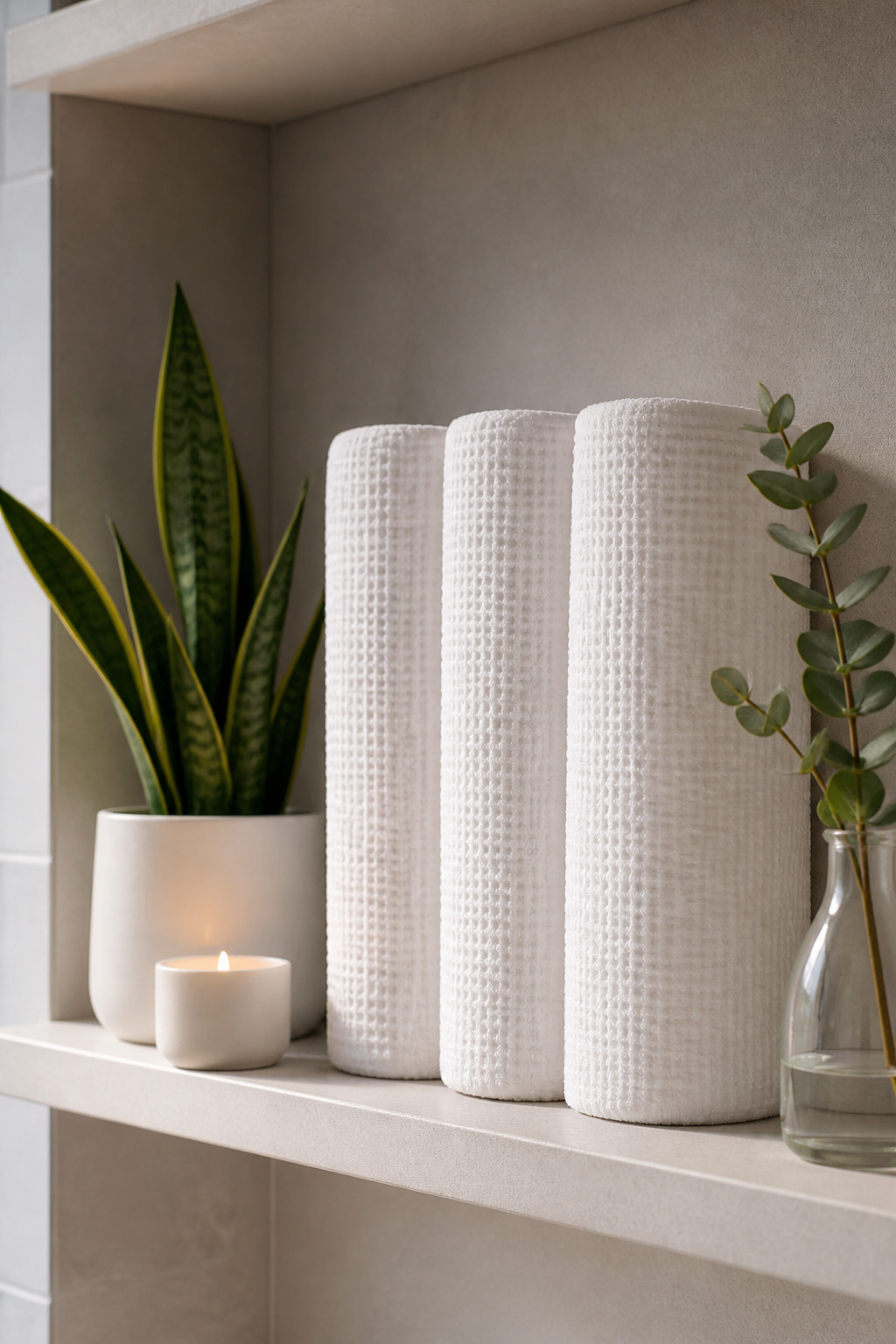
The technique: fold a standard bath towel lengthwise into thirds (creating a strip about 9 inches wide), then roll tightly from one short end and stand the roll on its flat cut end. Seamed edges should face outward to show texture depth. Stack three rolls side by side, alternating the direction of the seam to create subtle light variation across the group. Position them at eye level — 54 to 62 inches from the floor — because that’s where hotel designers place premium textiles since it’s the first thing you register walking in.
Add greenery beside or above the towel arrangement rather than in the middle of it — this protects the plant from being knocked during towel retrieval and creates a clear visual separation between functional and decorative zones. Colour discipline matters here: a maximum of two towel colours, ideally in the same family. Three different towel shades on an open shelf reads as a linen closet, not a spa.
6. Apothecary Jars and Vintage Bottles for an Artisan Feel
Decanting is the single most underestimated bathroom upgrade there is. Transfer a $3 bag of cotton balls into a clear glass apothecary jar with a cork lid, and what was an afterthought becomes an object you’re pleased to see every morning. The apothecary approach to bathroom shelf decor — heavy glass vessels in amber, cobalt, and clear flint, often with handwritten labels — makes everyday toiletries feel genuinely considered. It’s been enjoying a significant design resurgence precisely because it transforms the functional into the beautiful with minimal effort.
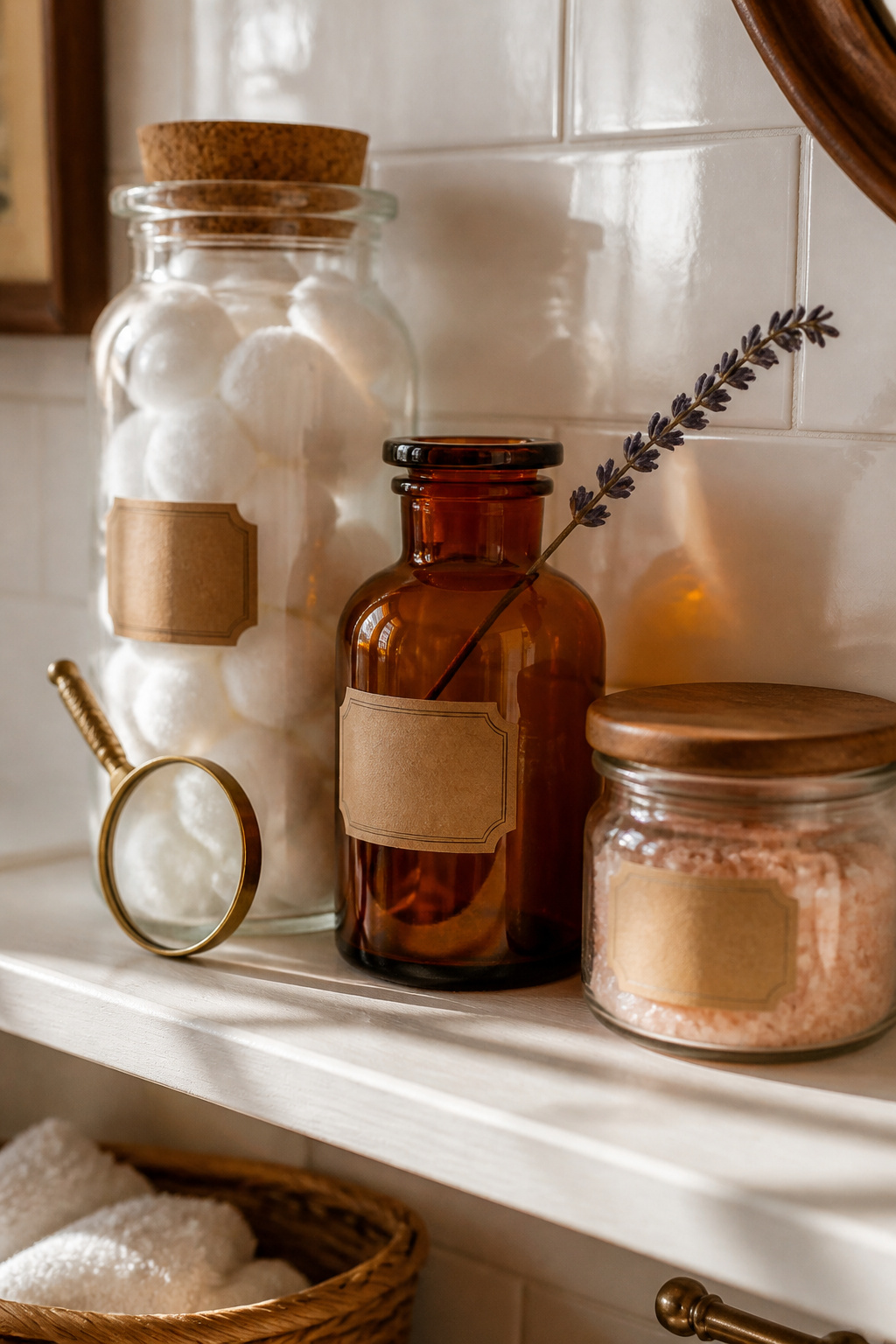
The items that benefit most from decanting, in order of visual impact: bath salts (layered colours look extraordinary through glass), cotton balls (white spheres in a clear wide-mouth jar is a classic spa move), artisan bar soaps arranged in a shallow dish, wooden cotton swabs in a tall narrow jar. Labels should be consistent across all jars — whether all handwritten in the same pen, all printed with the same font, or none at all. Inconsistent label styles undo the cohesion that decanting was meant to create.
For height variation, aim for at least three distinct levels: tall jars (8–10 inches), medium (4–6 inches), and short lidded dishes (2–3 inches). IKEA’s KORKEN line offers airtight glass jars with cork lids from under $2 each — genuinely difficult to distinguish from more expensive alternatives once filled and labeled.
7. Stacked Books and Objects for Sculptural Display Height
A stack of hardcover books on a bathroom shelf is a quiet statement: someone lives here, they’re interested in things, and they didn’t just buy the first shelf decor set they found online. Books introduce warm paper tones, typographic spines, and an organic flatness that creates a natural platform for elevating other objects — which solves one of the most common problems in bathroom shelf styling, the everything-at-the-same-height arrangement that reads as items placed down rather than objects displayed. This approach to bathroom shelf decor is remarkably easy to achieve well, and it transforms a simple shelf into something with genuine character.
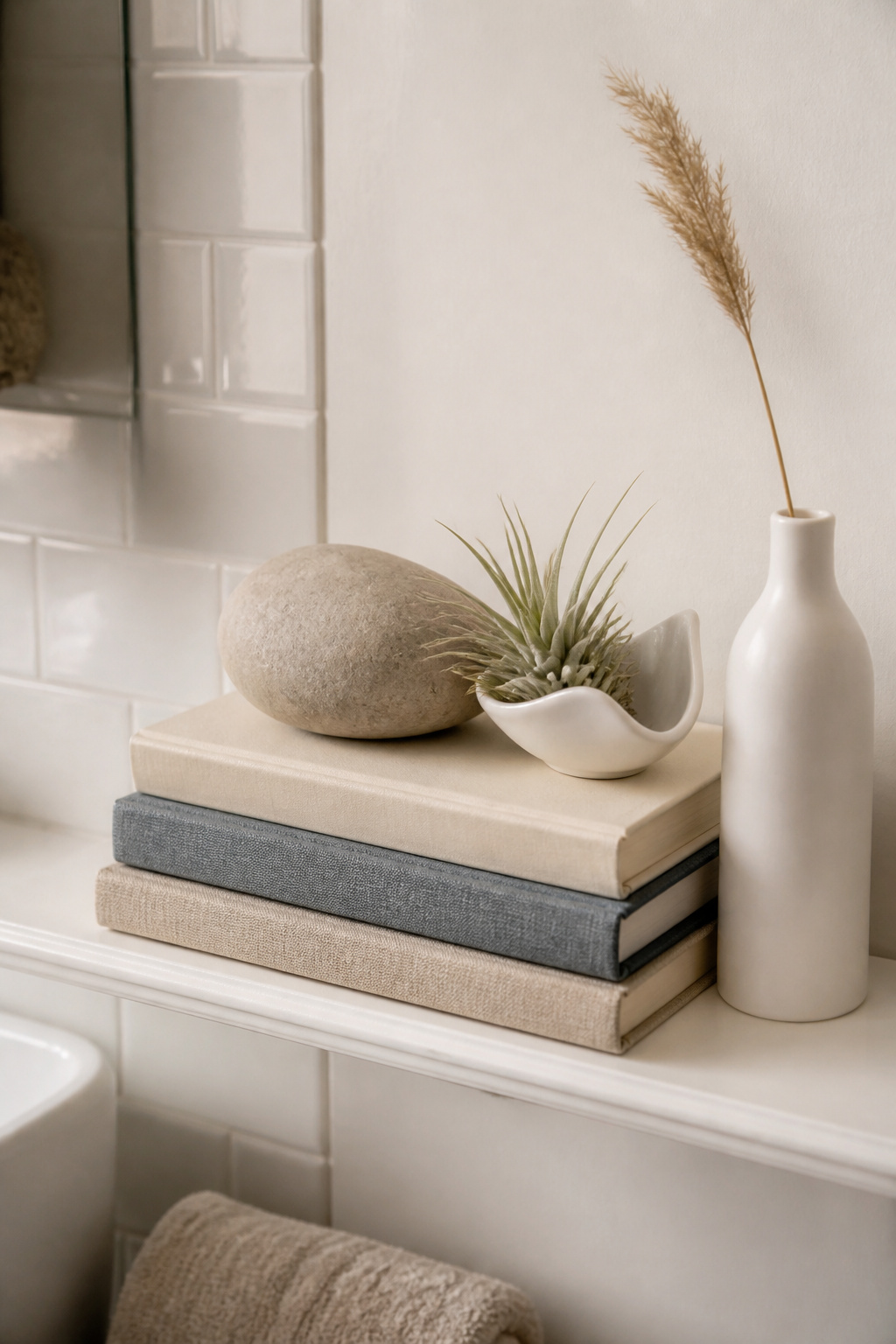
Horizontal stacking is the technique: two or three hardcovers laid flat create a plinth. Top them with a smooth river stone, a small ceramic figure, a 2-inch succulent in a terracotta pot, or a single dried floral stem. You get three distinct levels from one square foot of shelf space — the spine texture, the stack height, and the topper — and each level draws the eye upward through the composition in sequence.
Choose the books with intention. Art and photography books work best — their large formats create a substantial base and their spines are often beautifully designed. The one material rule that matters: hardcovers only. Paperbacks absorb bathroom humidity, curl, and develop a musty quality within weeks in a steamy room. Keep sentimental paperbacks and valuable first editions out of the bathroom entirely.
8. Seasonal Bathroom Shelf Decor to Refresh Your Space Year-Round
The bathroom is the last room most people think to decorate seasonally, and the first room where a seasonal swap has the most noticeable impact on daily life. Because you’re in there every morning and evening, a small change on the shelf creates the strongest before-and-after effect of any room in the house. Bathroom shelf decor at this scale is also the easiest seasonal decorating project there is — a complete refresh takes about 15 minutes and requires no tools.
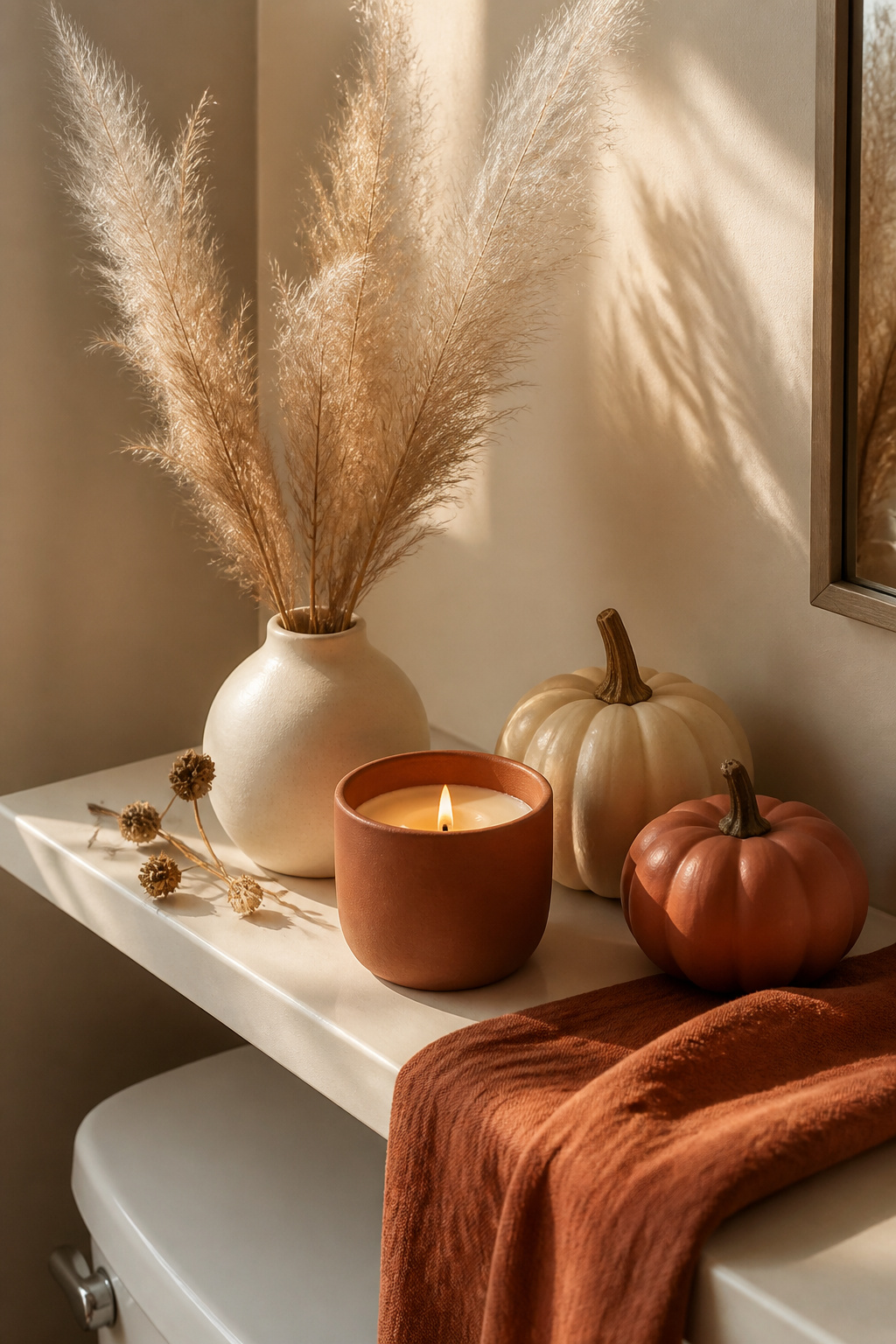
The approach that works long-term is a core-and-swap system. Keep two or three neutral anchors on the shelf year-round — a ceramic dish, a natural wood tray, a plain glass vessel. These never move. Then maintain a small labeled box for each season containing three swappable pieces: one candle or diffuser in a seasonal scent, one organic element (dried flowers, a botanical stem, a small decorative gourd), and one textile accent (a hand towel in a seasonal colour). The entire swap is lifting the neutral anchors, changing the three seasonal pieces, and replacing the anchors.
The seasonal palette guide: winter reaches for warm amber, forest green, and pine; spring is light pastels and fresh botanicals; summer goes coastal with driftwood and trailing plants; autumn turns earthy and textured with pampas grass, dried seedheads, and burnt-orange candles. This bathroom shelf decor rotation also ensures your space never feels stuck in a season that’s long passed — a detail that matters more than most people realise.
9. Trailing Plants and Air Plants That Bring Life to Any Shelf
Trailing plants are a distinct category of bathroom shelf decor — they do something no other element can, adding vertical presence by cascading downward from an upper shelf rather than occupying horizontal space. No other single addition changes the feel of a bathroom shelf as dramatically as a living plant that moves. The effect is partly visual (organic form against hard surfaces) and partly psychological — the presence of something growing creates a quiet signal of care that no ceramic object can replicate.
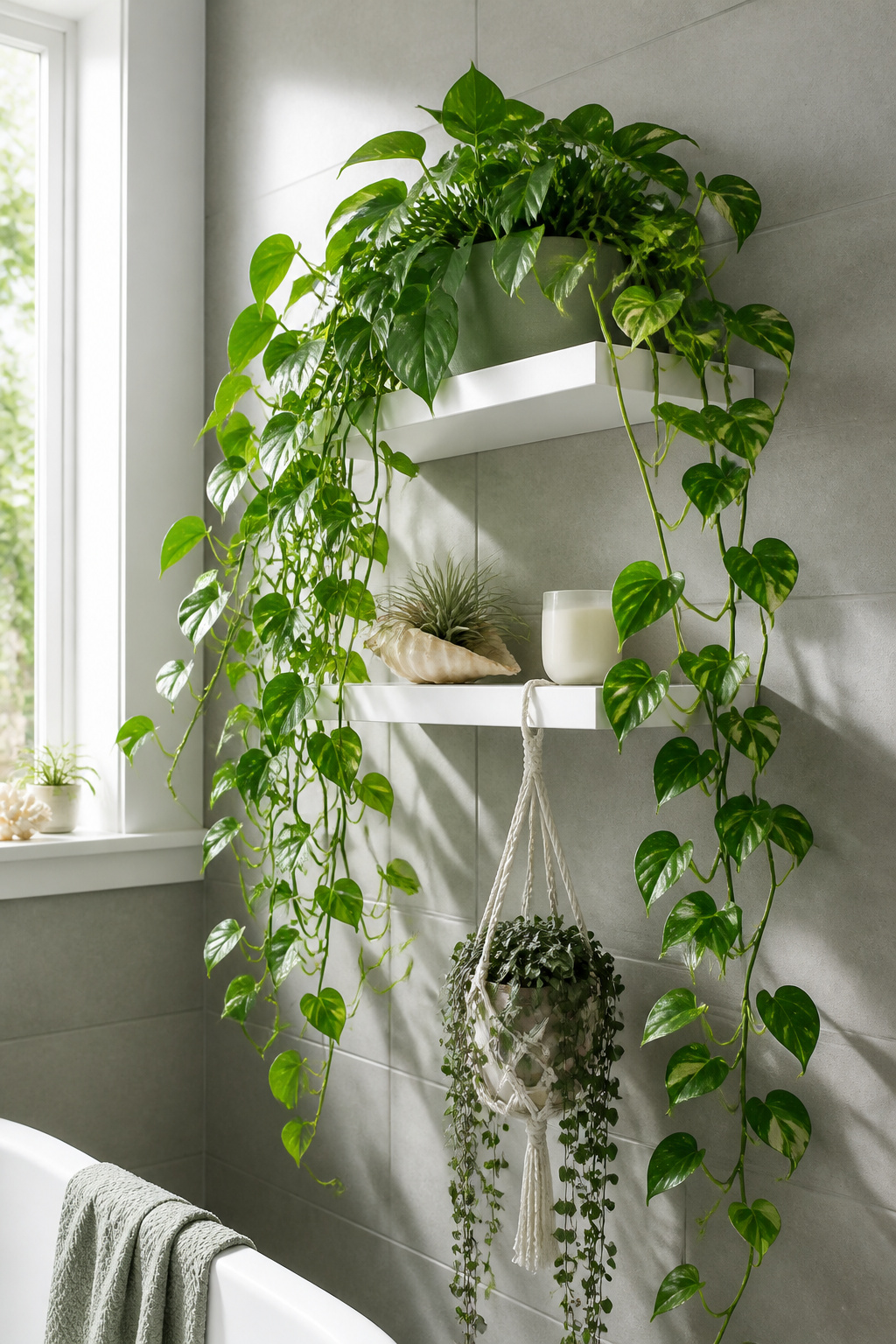
Pothos (Epipremnum aureum) is the most recommended trailing bathroom plant for good reason: it tolerates low light, thrives in humidity, and produces long glossy vines with minimal encouragement. Heartleaf philodendron offers a softer leaf and grows faster in high-humidity conditions — bathroom steam is an advantage for it rather than something to manage.
Air plants (tillandsia) require no soil, making them ideal for mounting in shells, driftwood hollows, or glass globes. In a bathroom with a daily shower, the humidity from regular use provides most of the moisture air plants need. After their periodic 20-minute soak, tilt them upside-down to drain completely — air plants left sitting wet at the base will rot. As a final practical note: place trailing plants on upper or middle shelves where their vines hang freely in clean air, not on lower shelves where they’ll trail onto the floor and collect bathroom grime.
10. Scent as Decor: Diffusers, Candles, and Aromatic Botanicals
A reed diffuser with dried flowers submerged in fragrance oil is one of the most efficiently designed bathroom shelf objects available. In a single piece, it combines a glass vessel, organic textile texture (the dried botanicals), and continuous ambient fragrance — three design elements, one object, zero maintenance beyond flipping the reeds occasionally. It’s the set-and-forget shelf accent that still looks considered six months in.
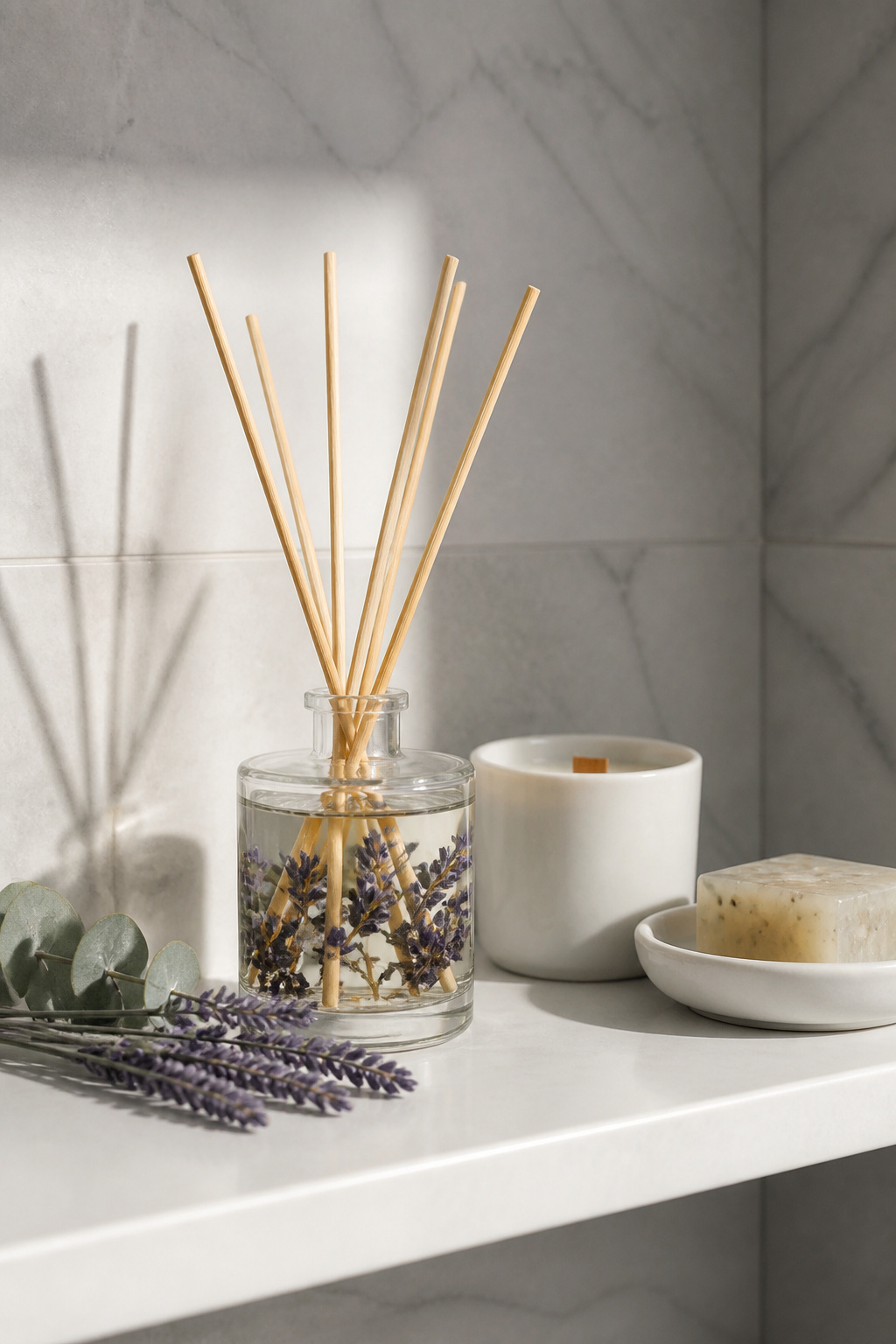
Group scent elements by material family rather than by function: a glass reed diffuser, a glass candle vessel, and a glass soap dish form a cohesive triptych even though they serve different purposes. Limit to one active scent source at a time. In a small room, two diffusers of different scent families create olfactory competition that most people experience as cloying rather than luxurious. Dried botanicals — eucalyptus stems, lavender sprigs, dried roses — add ambient scent without concentrated fragrance, so they can sit beside an active diffuser without conflict.
Scent families for bathrooms: green and herbal (eucalyptus, mint, green tea — clean and spa-like), soft floral (lavender, rose — calming), citrus (lemon verbena, grapefruit — energising, good for morning bathrooms), and woody (cedarwood, sandalwood — evening relaxation). One thing to avoid: sweet gourmand scents in bathrooms. Vanilla and bakery-adjacent fragrances create a cognitive mismatch in a room associated with cleanliness, and most people find them unsettling in this context even when they love them elsewhere.
11. Color-Coordinated Bathroom Display Shelves for a Polished Look
The fastest way to make a bathroom shelf look intentional is to limit its colour palette. Two or three coordinated colours — including neutrals — produces a polished, coherent arrangement from objects that might otherwise feel random. It’s the same principle that makes a well-plated dish look appetising: not because of how many ingredients are present, but because they’ve been selected and placed with an understanding of what belongs together.
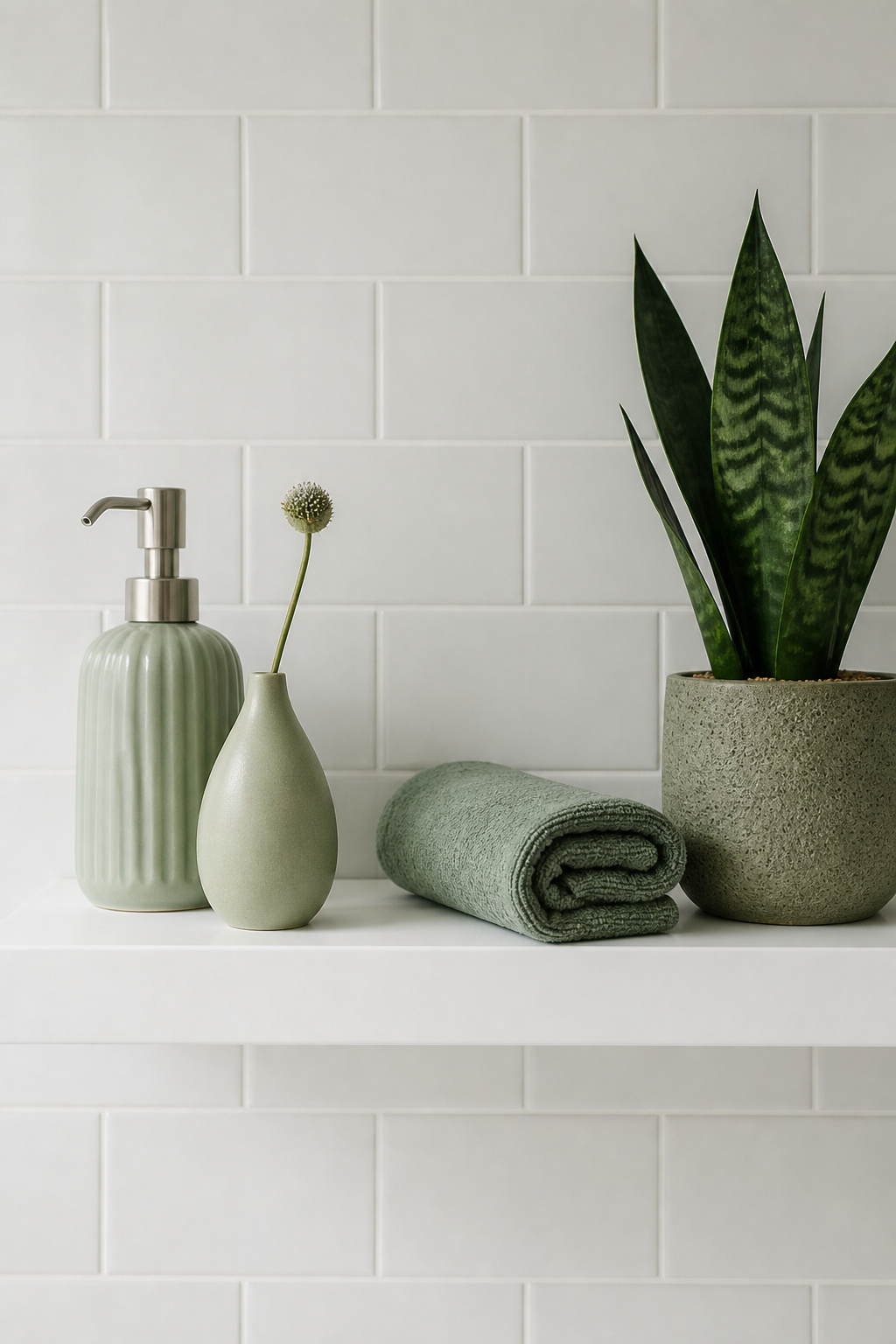
The 60-30-10 rule applied to a shelf: 60% neutral base (white ceramics, natural wood, linen-toned vessels), 30% one accent colour (sage, dusty blue, terracotta, blush), 10% a metallic or contrasting pop (a brass tray edge, a chrome dispenser lid). This creates visual balance without requiring everything to match. A monochromatic approach — all within a single colour family, using tonal variation from light to dark — is actually more sophisticated than multi-colour coordination, because it demonstrates restraint.
The single highest-impact move in this category requires no additional purchases: decant your toiletries into matching vessels. Removing the visual noise of competing branded packaging — the red-and-white shampoo bottle, the blue hand wash, the yellow moisturiser — and replacing it with two or three matching glass or ceramic dispensers immediately eliminates the colour chaos that makes most bathroom shelves look cluttered regardless of how many objects they hold. This is bathroom shelf decor at its most honest: the improvement comes not from adding, but from subtracting what was never working.
12. Wooden Trays and Catchalls for Organized Shelf Elegance
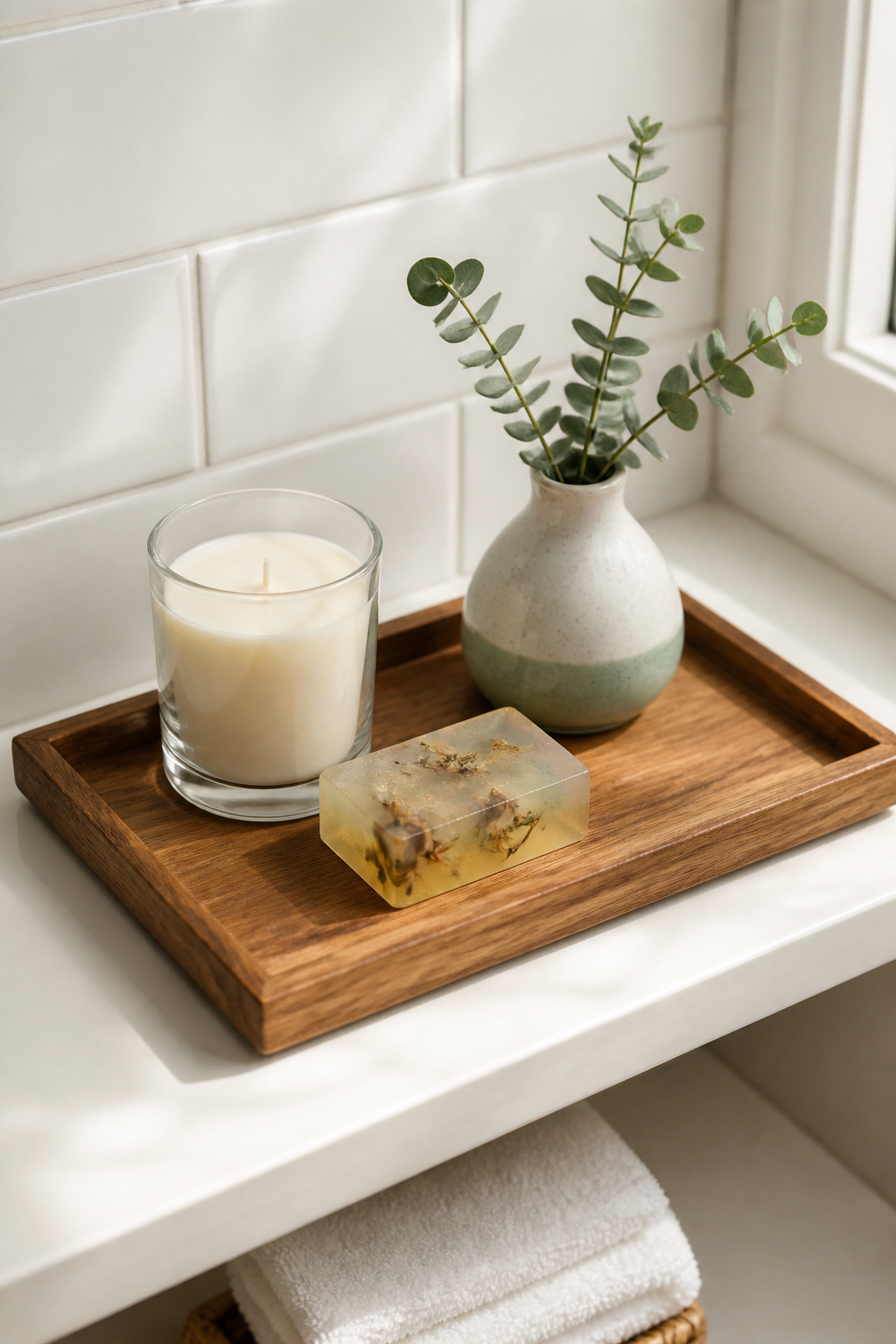
A tray is the most underrated tool in bathroom shelf styling. It creates a defined visual boundary — objects within it read as an intentional vignette even if they are simply functional products — and it transforms a shelf surface from “where things are placed” into “where things are displayed.” The tray is foundational to bathroom shelf decor that looks both organised and beautiful; it’s the thing that makes everyday items feel considered.
Choosing the Right Tray Material
Teak is the material of choice for humid bathrooms — it contains natural silica and oils that repel water and resist warping, cracking, and mildew indefinitely. Genuine teak trays run $25–$85 depending on size and age beautifully, developing a silvery patina over years that looks more interesting than new. Bamboo is a more affordable alternative ($10–$35) but can develop cracks in very high-humidity bathrooms over time. Marble is fully moisture-proof and looks extraordinary — HomeGoods and similar stores stock them for $20–$40. Acrylic trays are completely waterproof and nearly invisible, ideal for minimalist bathrooms where a solid tray would interrupt the visual lightness.
Inside the tray, the rule of three applies within its smaller frame: one tall item, one mid-height item, one low item, with 20–30% of the tray surface left empty. That negative space is not wasted — it’s what prevents the tray from reading as storage rather than styling.
13. Artwork and Prints That Transform Shelves Into Gallery Moments
The bathroom is the only room in most homes with no art on the walls — which makes the introduction of even a single small print on or behind a shelf feel unexpectedly significant. A small framed botanical illustration leaned against the wall at the back of a shelf arrangement does something no other object can: it adds a backdrop that contextualises everything in front of it, turning a shelf of objects into a composed scene. If you’re thinking beyond the shelf itself, bathroom wall art ideas that transform walls offer a full picture of what works across the whole room.
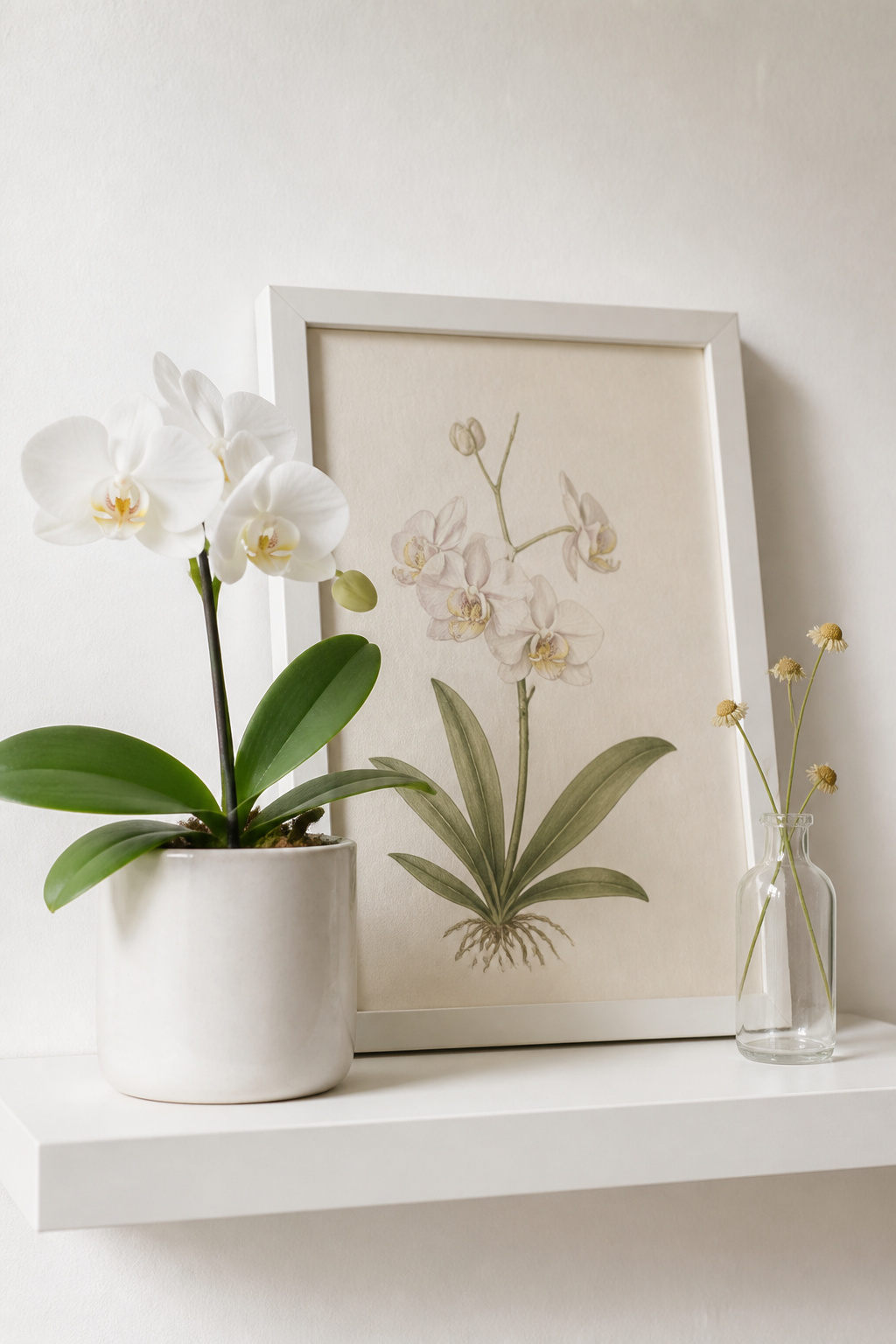
Small format is the right scale here: A5 to A4 (roughly 6×8 to 8×12 inches) reads correctly in proportion to a bathroom shelf and complements the objects in front of it. Lean the print rather than hanging it when it’s on the shelf itself — the slight forward angle creates the layered depth that makes the arrangement feel editorial.
Protecting Prints From Bathroom Humidity
Material matters as much as subject. Metal prints (dye-sublimation on aluminium) are humidity-proof and the safest long-term choice for bathrooms. Canvas gallery wraps are nearly as good. For framed paper prints, acrylic glazing (not glass) protects the print from condensation — and position at least 12 inches from any direct water source. Keep valuable originals and sentimental pieces in drier rooms. For subjects, botanical illustrations complement plants and organic textures beautifully; abstract colour washes add a palette accent without competing with other objects; simple typography adds words to a room that usually has none.
14. Bathroom Shelf Decor Ideas on a Budget That Look Expensive
The gap between an expensive-looking bathroom shelf and a budget one is almost entirely a function of curation and decanting, not spending. The most impactful upgrade you can make to any bathroom shelf decor costs between $10 and $25 and involves no new decorative purchases: take everything currently on the shelf, remove it, wipe the surface, then put back only the three to five pieces that genuinely add to the space. Most bathroom shelves immediately improve.
Budget Sources That Look Anything But
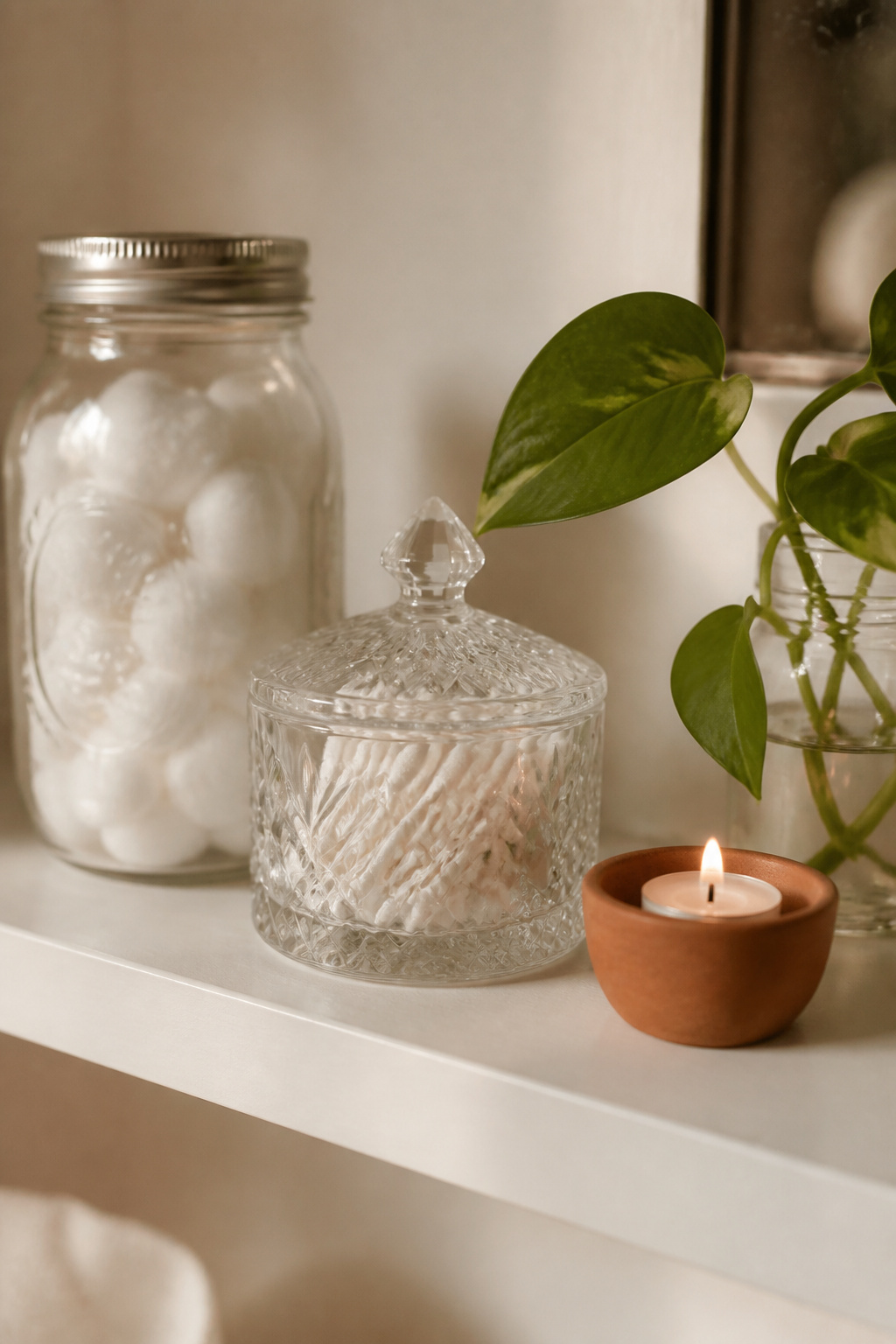
The decanting principle is where the real leverage lives. Transfer a generic bag of cotton balls into a $10 glass jar with a cork lid, and what was an afterthought looks like a boutique hotel amenity. IKEA’s KORKEN jars start at under $2 each. Thrift stores and estate sales reliably stock cut crystal candy dishes and sugar bowls with lids for $1–$5 — these make extraordinary vessels for cotton swabs and are more distinctive than anything in a matching set. Ball mason jars from any supermarket cost roughly $2.50 each and read as intentionally rustic with a simple kraft paper label.
For plants: pothos propagate freely from a single stem cutting placed in a glass of water — ask a friend with one before buying a new plant. For candles: Target’s Threshold range and ALDI’s Ambiano soy candles ($5–$8) photograph identically to $30 designer versions when placed in a ceramic or stone vessel you already own. The principle throughout: invest in the vessel, not the product inside it. The vessel is what you see.
15. Floating Glass Shelves for a Minimalist and Airy Bathroom Feel
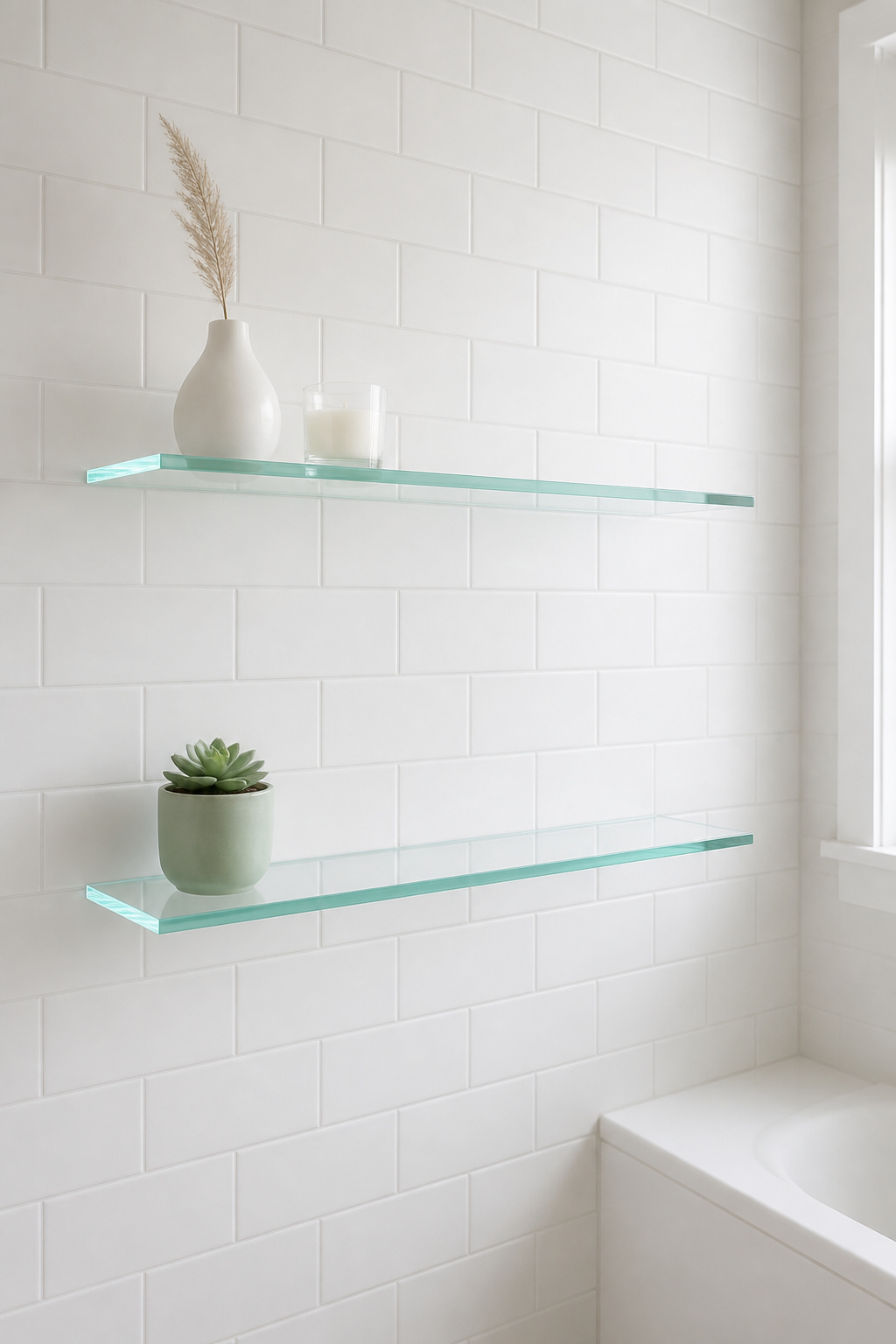
Of all the approaches in this list, floating glass shelves have the most structural impact on how a small bathroom feels. Glass is transparent — the eye passes through the shelf to the wall behind, preserving the perception of open wall area that a solid shelf would block. With concealed hardware (brackets that slot into the back edge of the glass so nothing visible holds them to the wall), the effect is objects floating in air against an uninterrupted wall surface. For anyone considering a full minimalist approach, minimalistic bathroom design ideas explore how this aesthetic works across the whole room.
Installation Considerations
On a glass shelf, everything is visible from multiple angles and in greater detail than on a wooden surface. So the styling rule for glass is simply: fewer objects, and better. A single ceramic bud vase and one candle vessel look more sophisticated on glass than five items crowded together. Clear and coloured glass vessels, white or neutral ceramics, and metallic objects all perform beautifully — they refract and reflect the transparency of the shelf. Wicker baskets, heavy branded packaging, and busy collections of small unrelated items read as clutter on glass in a way that wooden shelves can partially absorb.
Standard bathroom glass shelves use 6mm to 10mm tempered glass: 6mm handles light-duty loads (toiletries, small decor — up to about 20 lbs); 8–10mm handles heavier arrangements (towels, bottles, ceramics — up to 50 lbs with proper stud anchoring). For shelves over 24 inches, use three brackets minimum — two ends and one centre — to prevent the gentle bowing that occurs when glass is overloaded at the midpoint. In tile-covered walls, professional installation ($50–$150 for a pair of shelves) is genuinely worth it to avoid cracking expensive tile work.
Finding Your Bathroom Shelf Decor Style and Making It Last
Start with the three questions that actually determine which approach works for your bathroom: How much natural light does your shelf area receive? What is the dominant material in the room — cool tile, warm wood, neutral stone? And honestly, how many minutes per week will you spend maintaining the display?
Low-light bathrooms gain most from mirrors, metallics, and light-coloured ceramics that amplify available light. Small bathrooms benefit from floating glass shelves, a minimal colour-coordinated display, or the simplicity of a single tray arrangement — approaches that preserve visual openness rather than filling it. Larger ensuites can absorb more complexity: trailing plants alongside rolled towels, seasonal bathroom shelf decor that shifts with the months, a dedicated gallery shelf with art and meaningful objects layered together.
The maintenance question is the most honest one. A spa-style rolled-towel display looks extraordinary and takes about five minutes per week to maintain — but only if you’ll actually roll the towels. A trailing pothos is nearly indestructible, but it needs a shelf high enough for the vines to hang freely. Floating glass shelves look spectacular and require a squeegee twice a week. Choose the style that matches not just your bathroom but your actual daily habits.
The last practical suggestion: photograph your shelf when you’re happy with it. A quick image on your phone becomes a reference for the weekly two-minute reset — remove everything, wipe the shelf, replace deliberately. Over time any arrangement drifts if you don’t have something to return it to. That photograph is what keeps your bathroom shelf decor looking intentional six months from now rather than reverting to the overcrowded surface it was before you started.