I’ll be honest: for years I left my own bathroom walls completely bare. After a decade in gallery curation — obsessing over placement, lighting angles, and the invisible geometry of wall composition — I walked past my bathroom door each morning and didn’t think about it. The bathroom didn’t count, somehow.
Then I spent a week in a rented Lisbon apartment where the owner had hung a single large-format black-and-white photograph above the bath. A close-up of weathered Portuguese tile, cracked and layered. I thought about it every morning. It changed how the room felt entirely. When I got home, I finally paid attention to my own bathroom wall art — and that single decision changed the most-used room in the house.
This space is not a lesser category of home decor. You have a captive audience with time to look slowly, a private context that allows for more personal content, and a small surface area where one considered piece makes an outsized difference. These 17 bathroom wall art ideas range from free public domain downloads to permanent ceramic installations. I’ve also flagged which framing choices survive steamy environments, because the bathroom’s humidity is the one factor that genuinely changes your options.
1. Framed Botanical Prints for a Spa-Like Atmosphere
Plants and water belong together. That’s the simple logic behind one of the most reliably effective choices for bathroom wall art: botanical prints — whether vintage scientific engravings or contemporary macro-photography — feel immediately at home in a water-adjacent room. There’s no visual contradiction to resolve.
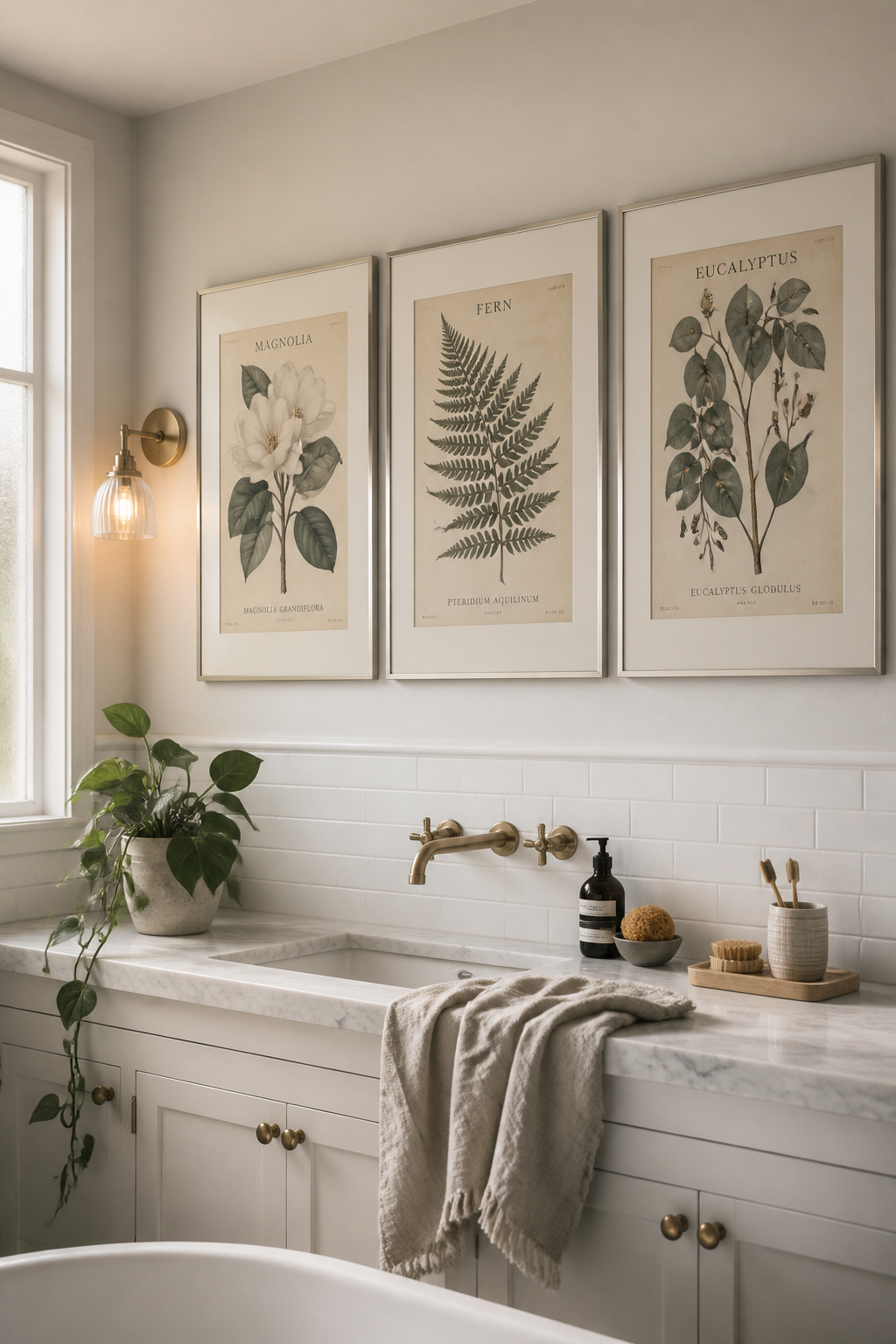
For the type of print, both directions work well. Vintage botanical illustration — the kind found in 18th-century Redouté plates, with precise line work and warm paper tones — suits traditional bathrooms with pedestal sinks and subway tile. Contemporary botanical photography, such as an extreme close-up of a monstera leaf’s venation, suits more modern spaces. The subject is the same; the visual register is quite different.
Framing that survives humidity
Framing matters more in a bathroom than almost anywhere else. Skip regular glass — it traps condensation against the print surface. Acrylic glazing is better because it allows minimal moisture exchange rather than sealing it in. Conservation-grade acrylic (Tru Vue Conservation Clear is the professional standard) also blocks up to 99% of UV rays, which is critical since strong bathroom lighting can bleach prints over months. Aluminium and sealed hardwood frames both work well; raw MDF will delaminate within a year.
For sizing: one print at 16×20 or larger makes a stronger statement than a cluster of small ones. In a triptych, keep frame gaps to 5 cm and use identical frames — it signals intention rather than accumulation. For broader styling approaches, bathroom wall decoration ideas show how botanical prints sit within layered wall schemes.
2. Black-and-White Photography as Timeless Bathroom Wall Art
Colour is usually the first thing we think about when choosing art — and in the bathroom, where towels, tiles, and accessories are already competing for palette attention, it’s also the thing most likely to go wrong. Black-and-white photography sidesteps the problem entirely. It works against white subway tile, dark slate, terracotta, blush pink, sage green — it works against everything, because monochrome removes itself from the colour conversation.
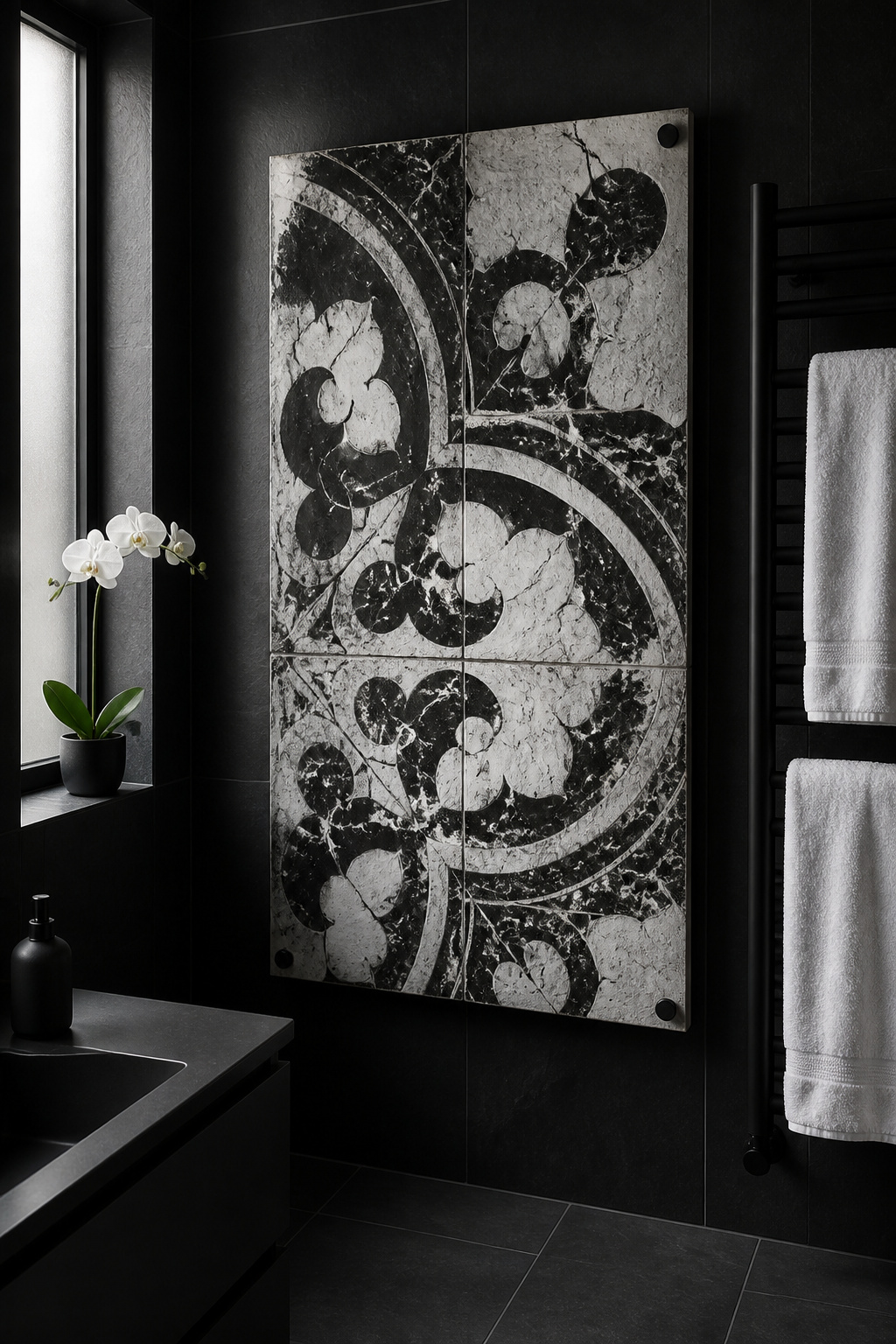
Subjects that resonate most in a bathroom context: close-up architectural texture, nature abstracts (water movement, leaf shadows, shell spirals), or quiet human moments. Strong tonal contrast — deep blacks, bright whites — works better under bathroom lighting than soft grey-on-grey photography.
The humidity-safe print formats
For the print medium itself, standard inkjet paper behind glass is the worst combination for steam exposure — condensation forms on the glass interior and damages the paper over time. Instead, consider two formats purpose-built for humid conditions. Metal prints — image fused directly into an aluminium surface via dye-sublimation — require no frame and are inherently moisture-proof. Bay Photo Lab and ArtisanHD both produce excellent metal prints. Acrylic face-mounted prints seal the image behind solid non-porous acrylic, with a luminous, gallery-quality result.
If you print your own photographs, Mpix and Nations Photo Lab both offer high-quality output. For sourcing existing work, Society6 has a large independent artist catalogue, and the bedroom wall art ideas guide covers print sourcing principles that apply equally to any room.
3. Abstract Watercolor Art to Soften Hard Bathroom Lines
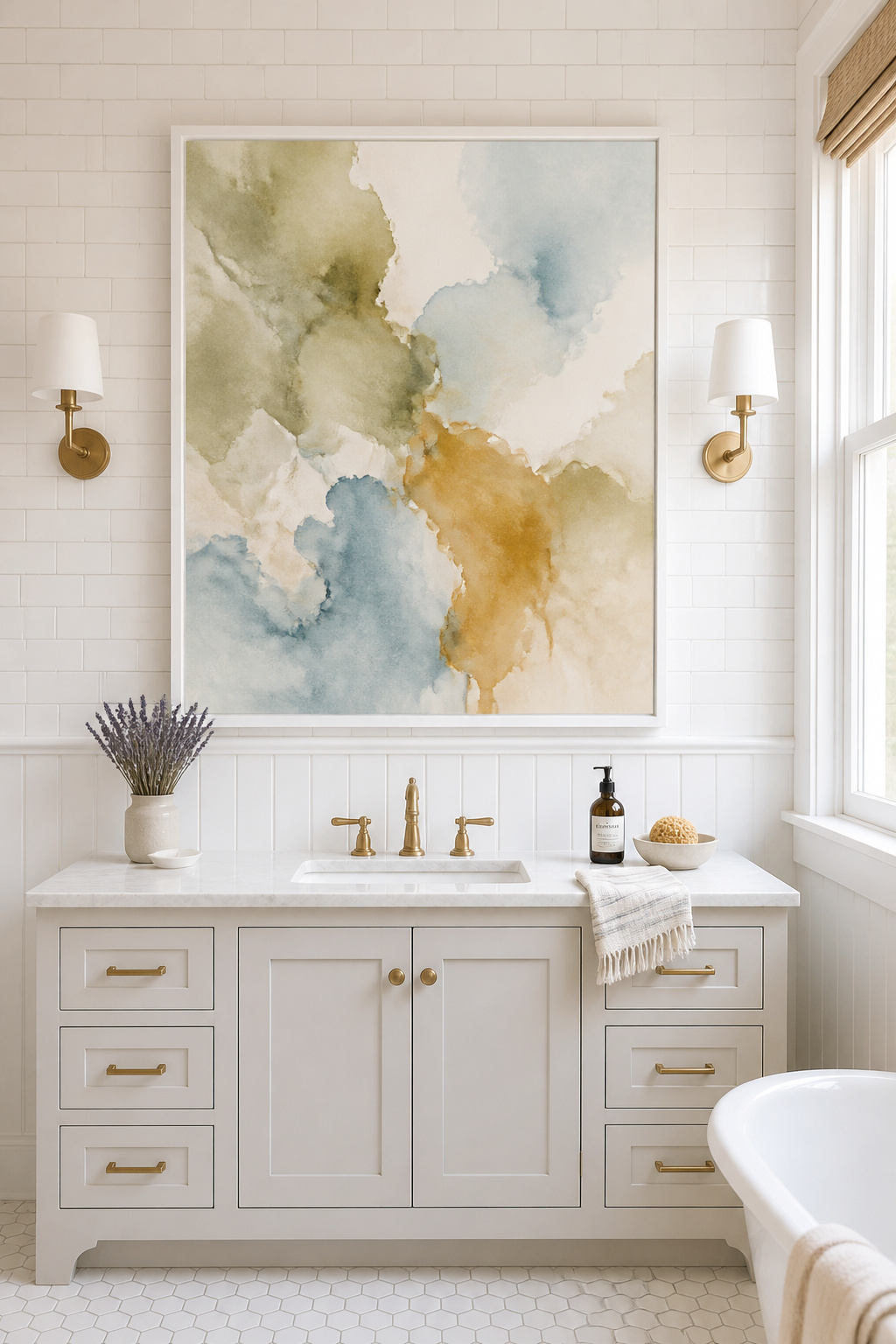
Stand in the average bathroom and take in what you’re looking at: grout lines running in a rigid grid, chrome fixtures gleaming hard-edged, porcelain surfaces catching light at sharp angles. Watercolor art’s inherent quality is the opposite — diffuse washes, soft-edged forms, colour that bleeds and blends. That visual tension is exactly why it works so well here.
Print quality markers
Giclée printing on 100% cotton rag paper at 300-315 gsm, using UltraChrome HDR pigment inks, is the gold standard for watercolor reproduction. At this specification — available from ArtisanHD, PrintKeg, and ABC Fine Art — a reproduction is hard to distinguish from an original at arm’s length. Standard inkjet printing on thin coated paper looks flat, and the thin paper will cockle visibly in a humid bathroom.
For palette choices: soft blue-green watercolors lean into the room’s water associations and amplify a spa feeling. Warm peach and ochre abstracts work well in all-white bathrooms where the colour contrast creates an intentional focal point. Original small-format watercolors on Etsy cost $80-$300 — worth considering for a piece you’ll want to see every day for the next decade.
4. 3D Sculptural Bathroom Wall Art for Textural Impact
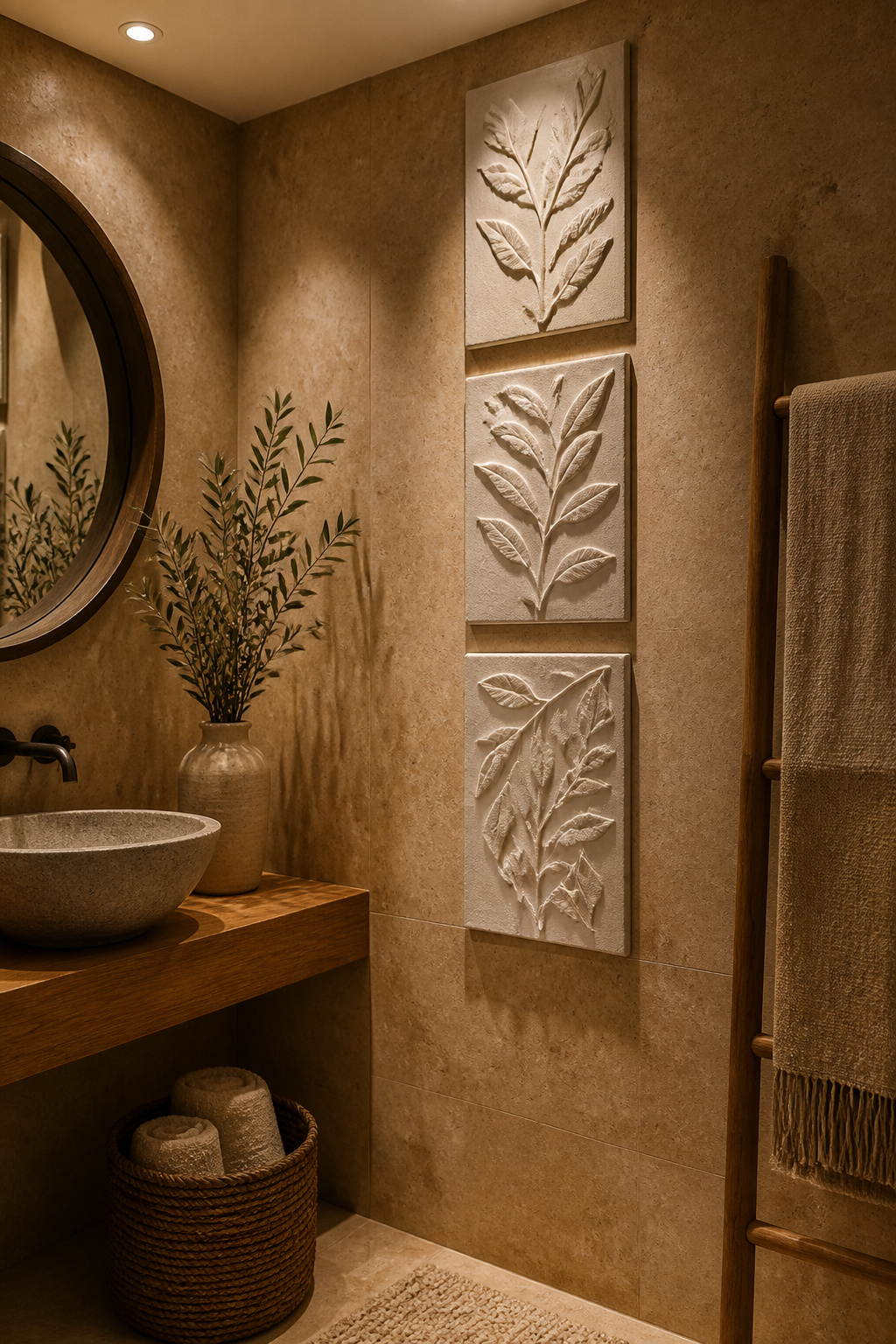
Every surface in the bathroom is flat, reflective, and hard. Tile, mirror, chrome, porcelain — there’s no textural relief anywhere. This is the problem that three-dimensional wall art solves better than any framed print: it introduces depth, shadow, and surface variation that gives the eye somewhere genuinely interesting to land.
Best materials for humid environments
For material selection in a bathroom, the hierarchy is clear. Ceramic is the most appropriate material — as a fired product, it already handles water and humidity comfortably, requiring only monthly mild soap cleaning to prevent mineral buildup. Marine-grade metals (stainless steel, powder-coated aluminium, treated iron) also work well and can develop appealing surface character over time; apply a clear metal sealant annually in high-steam bathrooms. Cured epoxy resin is a newer option — genuinely water-resistant, with quality pieces incorporating colour pigments or preserved botanicals now available at $40-$150.
Installation on tile walls
Installation on tile walls requires attention. Standard drywall anchors won’t grip reliably in grout joints, and careless drilling through tile risks cracking. For pieces under 5 lbs, Command strips rated for humid conditions work well. Above 10 lbs, use tile-specific anchors (ITW Tapcon for ceramic tile) or professional installation. Don’t let this put you off — the impact of a well-placed sculptural piece is worth the extra care, and the bathroom tile ideas guide covers anchor placement in the context of tile types.
5. Vintage Travel Maps and Antique Charts for Layered Storytelling
The bathroom is one of the few rooms where you have genuine reading time. Not skimming — looking. A map of a city that matters to you, hung at the right height, becomes a morning meditation: tracing a route walked years ago, finding a neighbourhood you once lived in, following a river from source to sea. No other category of art offers quite this quality of sustained engagement.
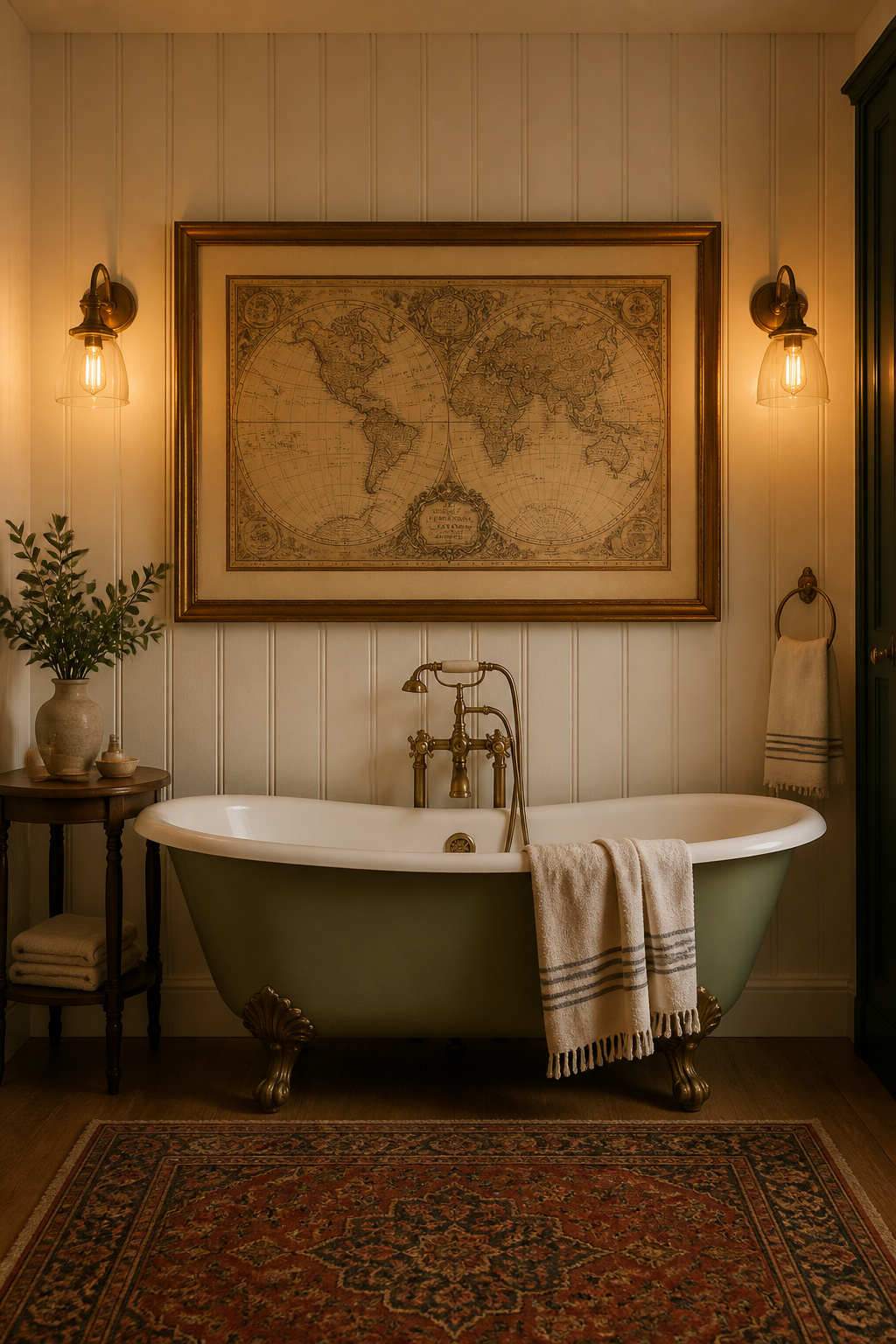
Beyond personal maps, antique celestial charts, anatomy plates, and natural history illustrations bring a scholarly quality that suits the bathroom’s private character. The aged warmth of these images — sepia tones, the slight irregularity of hand-engraved line work — adds what most bathrooms lack: visual warmth to counterbalance white tile, chrome, and cold porcelain.
Reproductions vs. originals
Quality reproduction prints on 200gsm+ textured paper are hard to distinguish from originals at bathroom viewing distances. Signs of quality: clearly defined fine line detail without pixelation, consistent ink density. Originals can be found at estate sales and specialist print galleries — expect $50-$400+ depending on age. For bathroom use, reproductions are often sensible; original antique prints can be damaged by humidity even behind conservation glazing. Frame selection completes the statement: gilt frames suit 18th-century cartography; dark walnut suits Victorian natural history; simple black with a wide white mat suits almost anything.
6. Woven Macramé and Textile Hangings for Bohemian Bathroom Warmth
Let me make the case directly: the bathroom is visually cold — all those flat, reflective, hard surfaces. A woven textile is the only art form that introduces genuine physical warmth, and in a bathroom committed to a natural, earthy aesthetic, macramé belongs on the wall as surely as botanical prints belong elsewhere.
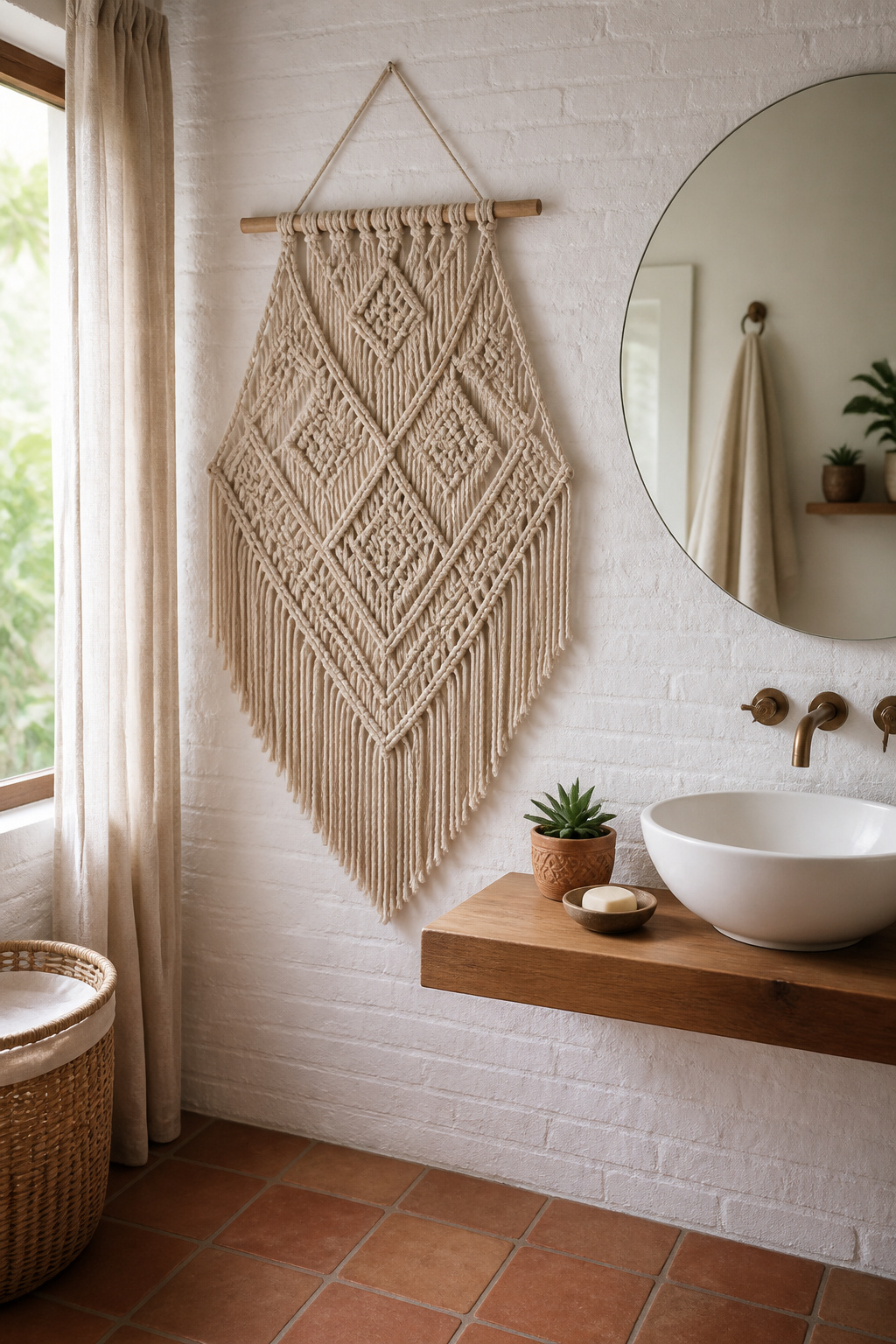
The humidity concern is real but manageable. Mercerized cotton is the best natural option: the mercerization process tightens the fibre structure, improving moisture resistance significantly. Linen is also suitable — naturally antimicrobial and resistant to mildew. Jute, despite its aesthetic appeal, is not suitable; it absorbs moisture readily and deteriorates over time. For the highest moisture tolerance, polypropylene macramé cord handles even close proximity to steam sources. Keep any textile piece at least 36 inches from direct steam sources, and ensure your exhaust fan actually gets used. Small pieces placed at eye level beside a mirror create quietly effective asymmetric arrangements; geometric forms suit contemporary bathrooms better than traditional fringed rectangles.
7. Minimalist Line Art: Simple Bathroom Wall Decor With Maximum Impact
The bathroom already has visual noise: grout lines, fixture hardware, product labels, towels, shower curtain. Art that adds to that complexity works against you. A single-line drawing — a figure, a flower, a face rendered in one continuous unbroken stroke — offers a point of calm within it.
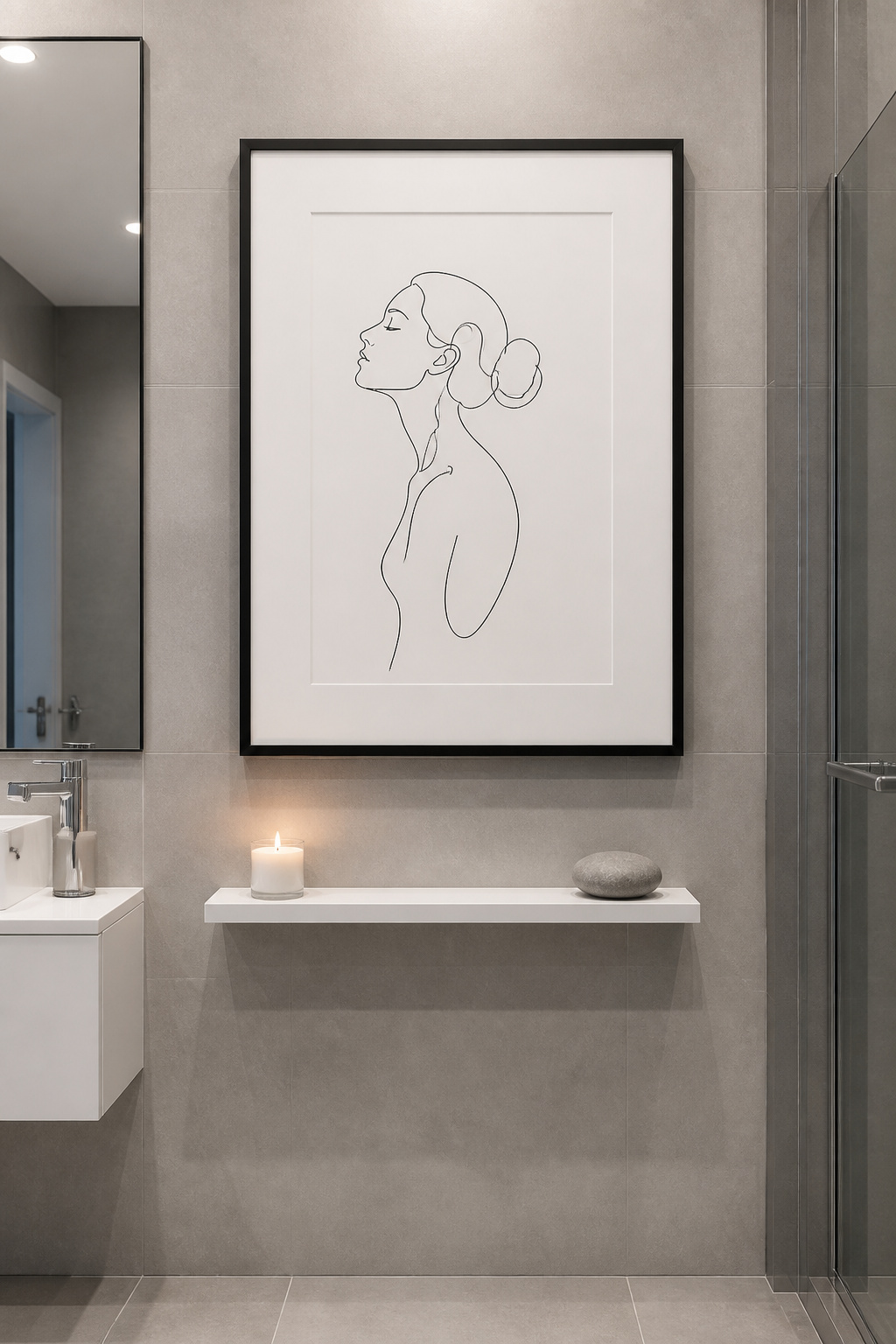
The appeal of continuous-line drawing is both aesthetic and philosophical: the art lies in what’s left out. A leaf rendered in one flowing, unbroken stroke requires more skill and intention than forty careful ones. That same quality of restraint suits bathroom wall decor specifically, because the room’s own visual complexity provides enough stimulation.
For sourcing: Society6 has an extensive one-line art collection from independent artists, starting at $18-$25 for unframed mini prints. Minted curates a more editorial selection with custom framing options. Pair this restrained approach with other simple bathroom decor ideas that share the same visual philosophy.
Framing that improves cheap prints
A mat at least 2 inches wide on all sides creates breathing room around the image — this is the gallery convention that lifts an affordable print. Float mounting (a small gap between print and mat) adds further depth. Heavyweight uncoated paper (200gsm+) gives line art a tactile quality that glossy photo paper cannot replicate. Black line on white paper, in a thin black aluminium frame with a white mat, suits any bathroom and requires no colour decisions.
8. Ceramic Tile Murals as Permanent Bathroom Wall Art Installations
Everything else on this list is reversible. A tile mural is not — and that distinction deserves your attention before anything else. A ceramic mural becomes part of the room’s architecture: as permanent as the plumbing, as integral as the tile layout around it.
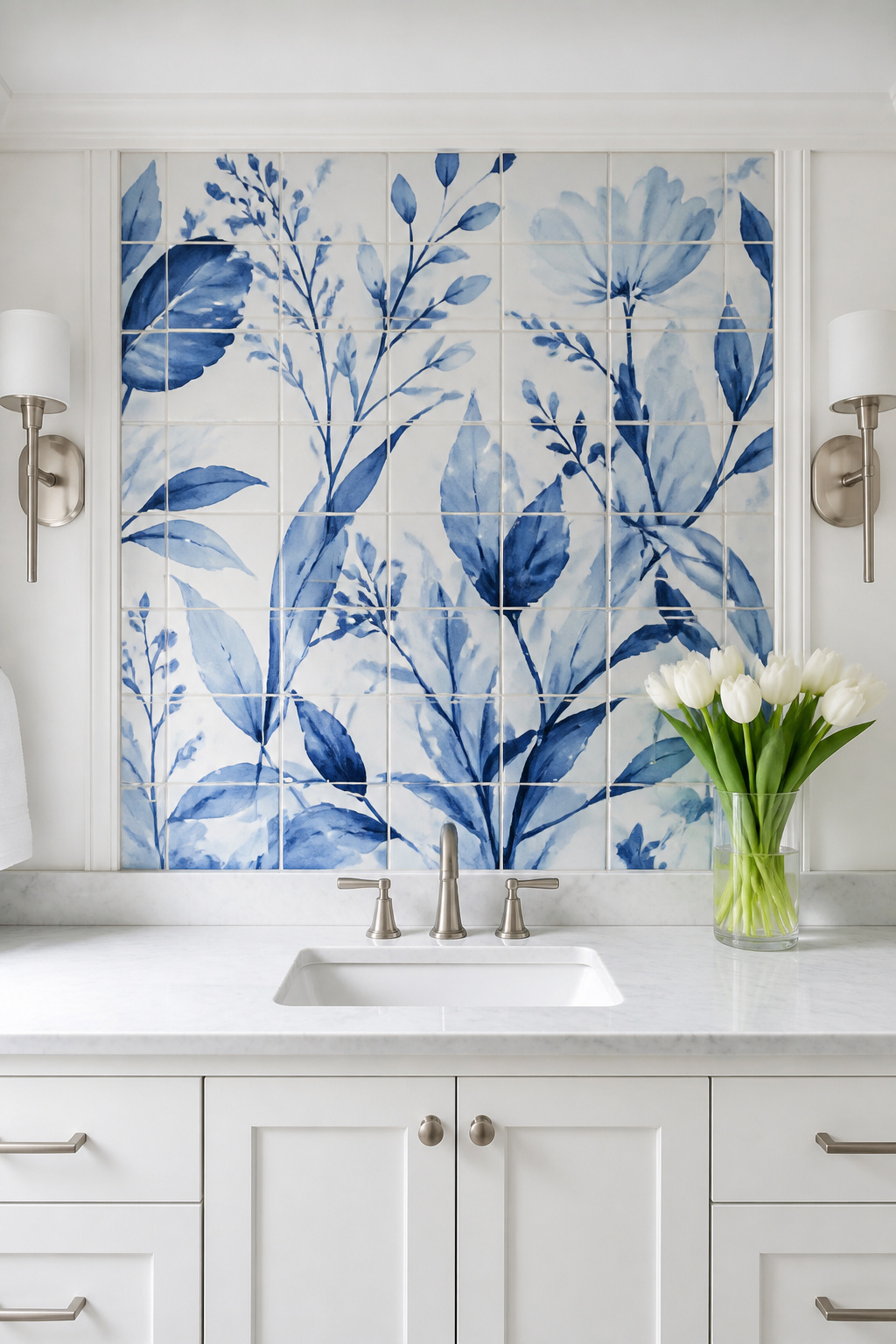
Digitally printed ceramic tile from suppliers like Custom Tiles and Artwork On Tile fires the image directly into the surface at high temperature, making it permanently waterproof and suitable for wet zones including inside the shower. These tiles cost approximately $20-$50 per square foot. For a 24×36-inch panel above the sink, the total tile cost runs $120-$300. Hand-painted ceramic murals commissioned from artists cost considerably more — $500-$3,000+ for a 2×3 foot piece, with 4-8 week lead times. This is planned art, not impulse art. The splashback zone behind the sink is the most practical starting point: a 24×36 panel centred there creates a strong focal point without affecting the shower or floor tile layouts.
9. Floating Canvas Prints for a Contemporary Gallery Look
A float frame holds the canvas slightly away from the frame’s inner edge, creating a shadow gap of 4-8mm. The canvas appears to hover in space rather than being clamped. It’s how commercial galleries mount canvas works — and it creates an unmistakably contemporary quality that standard frames cannot replicate.
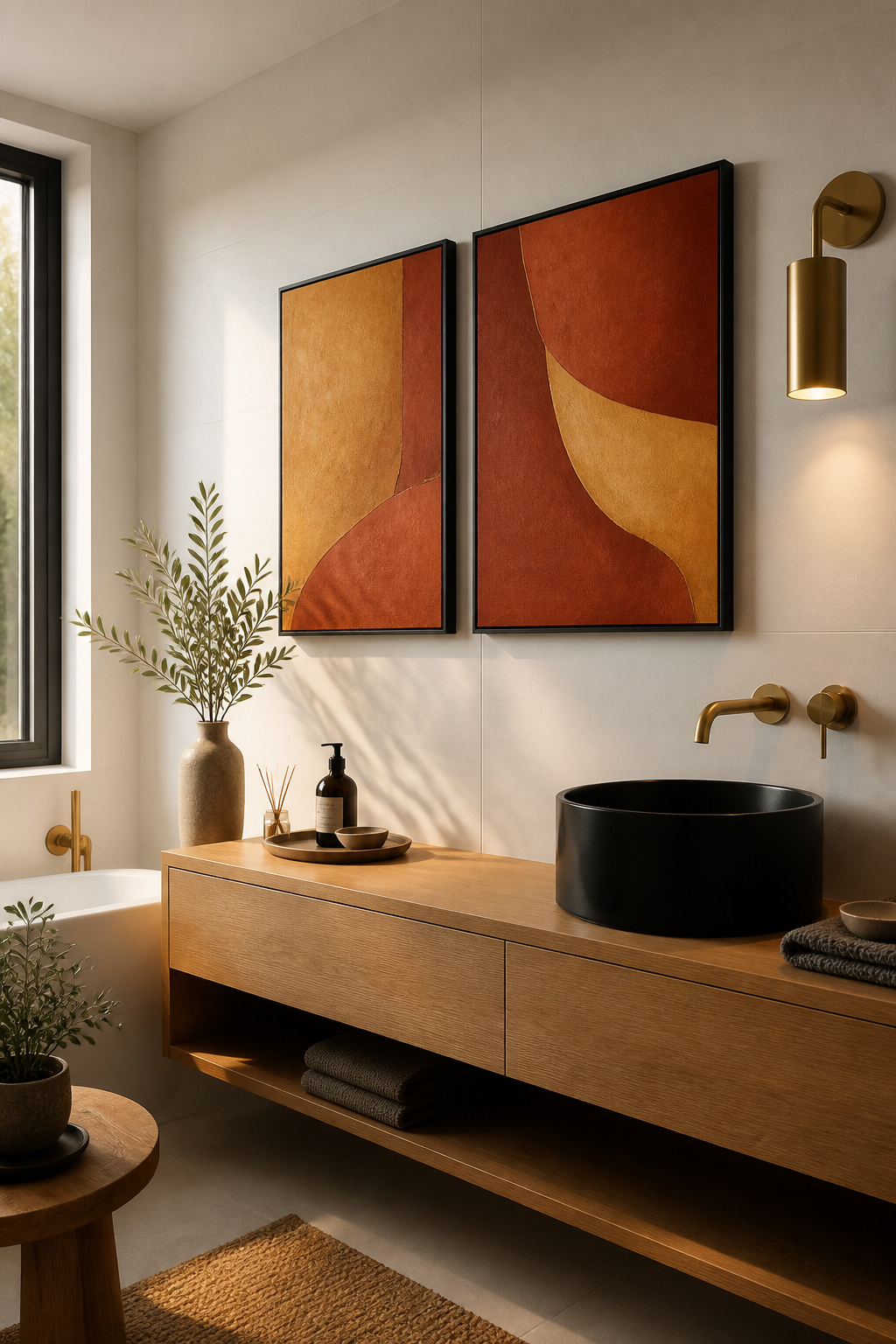
For bathroom use, choose aluminium float frames over wood. Wood float frames are beautiful in living rooms, but humidity cycles will eventually cause even lacquered wood to swell and distort. Aluminium frames are inert — they look identical in year one and year ten. Canvas fibres expand with humidity and contract when dry; repeated cycles can loosen the canvas over time. The practical rules: keep canvas at least two metres from the shower head, run the exhaust fan reliably, and maintain humidity below 60% if you can. Without adequate ventilation, mold can form on the back surface within months — this format needs a well-ventilated bathroom to survive. When ordering diptychs or triptychs, order all panels from the same service in the same session to guarantee consistent colour calibration. The multi-piece arrangement guide covers multi-piece arrangement principles that apply equally here.
10. Oversized Statement Pieces: Bold Bathroom Wall Art for Small Spaces
Here’s the counterintuitive principle that changes how most people approach small bathrooms: one large piece outperforms many small ones. Every time. The instinct is to scale the art down with the room — to use modest pieces in a modest space. But multiple small frames create visual fragmentation, and the room feels busier and more compressed as a result.
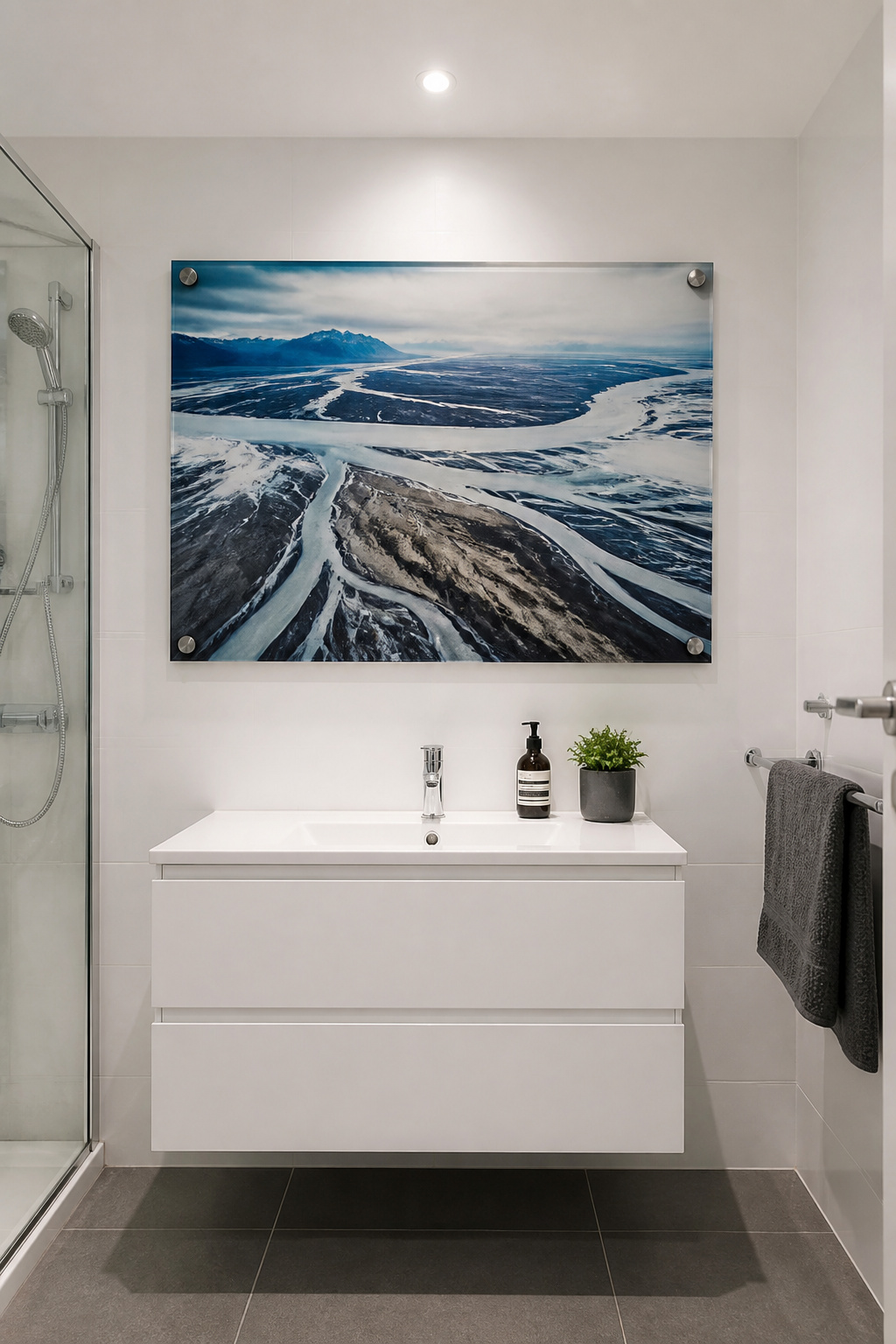
One dominant piece anchors the room. It gives the eye a destination rather than a series of competing stopping points. Interior designers apply the 60-75% rule: art width should occupy 60-75% of the available wall width. On a 60-inch bathroom wall, a 36-45-inch piece is correctly proportioned. Centre the art at 57-60 inches from the floor unless hung above furniture; above a toilet or vanity, place the bottom edge 6-8 inches above the fixture’s top edge.
Large-format printing is more accessible than most people realise. Posterjack and WhiteWall produce archival-quality prints up to 40×60 inches for well under $200. Acrylic face mounts in large formats are particularly effective — a 24×36 acrylic-mounted landscape photograph has depth and luminosity that is genuinely gallery-grade.
11. Mirror Clusters as Functional and Decorative Bathroom Wall Art
I want to make a case for mirrors as bathroom wall art, because the conversation about art often excludes them as though they’re a different category. They’re not. A thoughtfully arranged group of mirrors is as considered and visually sophisticated as any gallery wall — and it does things a gallery wall cannot.
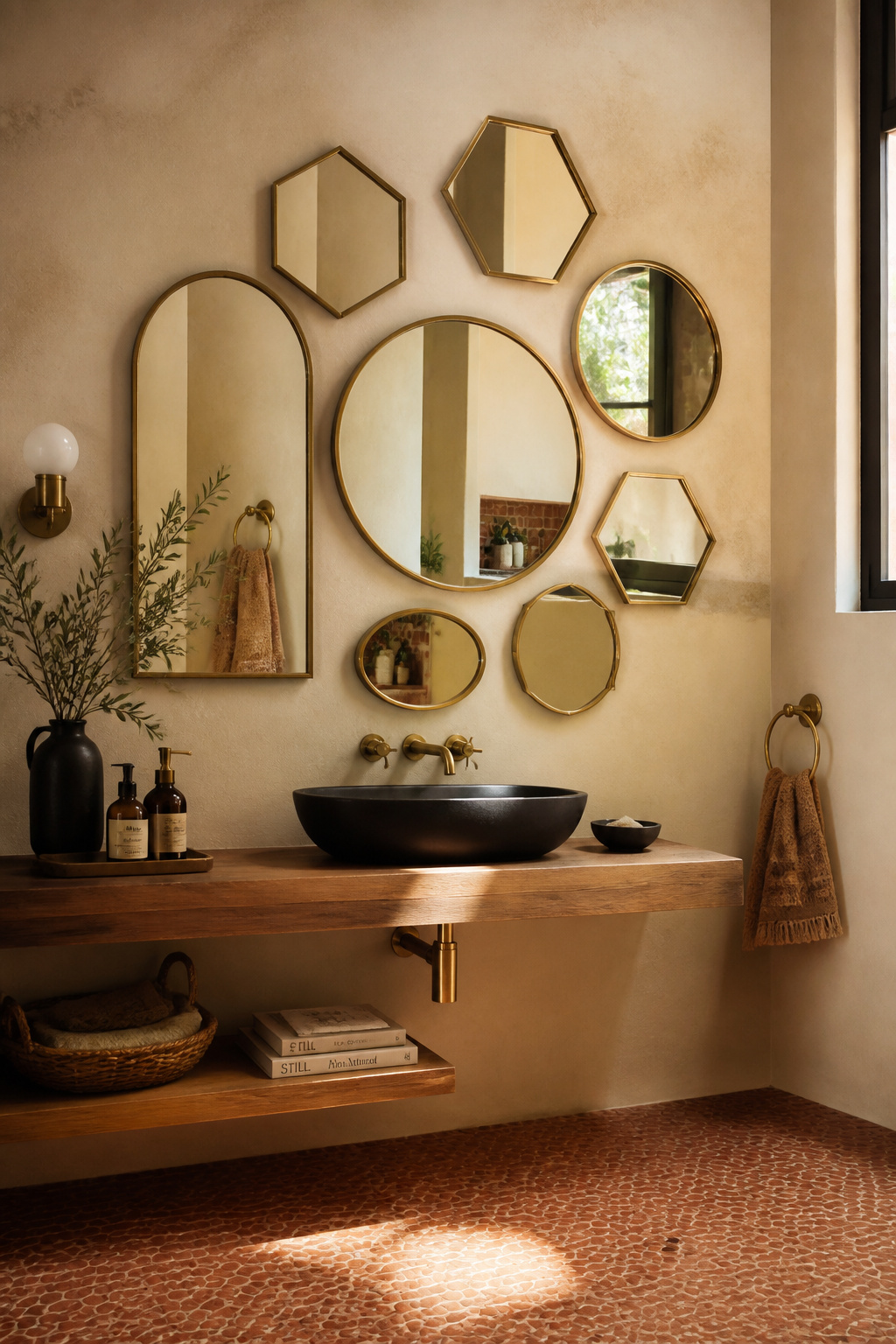
A thoughtful mirror cluster multiplies light, bouncing it across the room. It expands the apparent space. It creates a kinetic quality: each mirror reflects a different angle of the room as you move, so the composition changes with you. Hexagonal mirrors tessellate beautifully, creating a honeycomb pattern that feels architectural. Round mirrors in varied sizes (8-inch, 12-inch, 18-inch) in an asymmetric arrangement feel organic. Before committing to wall holes, arrange the grouping on the floor and photograph it — the fastest way to test visual balance without drilling. Keep frame finishes consistent: all brushed brass, or all black, or all natural metal. For specific guidance on sizing in tight spaces, best mirrors for small bathrooms covers the placement principles in detail.
12. Hand-Lettered Typography and Quotes for Personal Expression
The bathroom is the most private room in the home — the only room where you are reliably alone. That privacy makes it the right place for something genuinely personal, and nothing in wall art is more personal than words you’ve chosen.
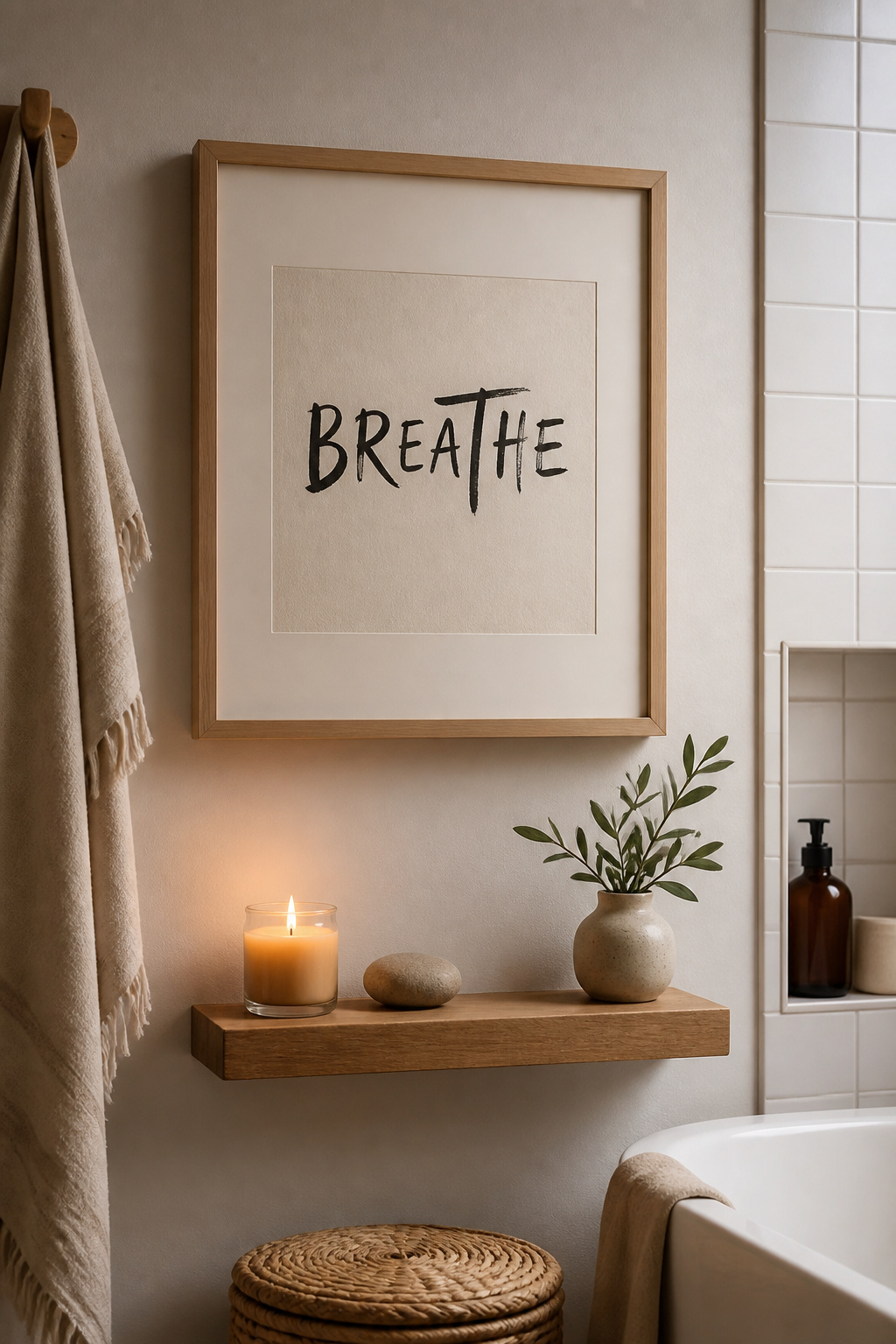
The distinction that matters: typography that is genuinely meaningful to you versus typography that simply fills wall space. A phrase from a poem you have memorised, a line from a conversation with someone you loved — this is what lifts bathroom typography above decoration to something closer to daily practice.
Hand-lettered originals carry something that printed typography cannot: the evidence of a hand. Brush pressure, ink variation, the slight imperfection of a line that was drawn rather than set — these qualities communicate intention in a way that a digital font, however beautiful, does not. Etsy is the best marketplace for custom hand-lettering commissions. Most artists deliver a high-resolution digital file within 3-5 days. Print this on 200gsm+ uncoated paper at a local professional lab ($8-$15 for A3) and frame it — the total for a unique piece is typically under $80. Script lettering suits romantic bathrooms; clean sans-serif lettering suits contemporary spaces.
13. Pressed Flower Art: Nature-Forward Bathroom Wall Decor
Pressed flower art has moved considerably beyond the craft-show aesthetic most people associate with it. Contemporary botanical preservation artists are creating genuinely gallery-quality work: tropical blooms pressed at peak colour, arranged with compositional skill, and sealed in UV-resistant frames or resin that maintains the colour for years.
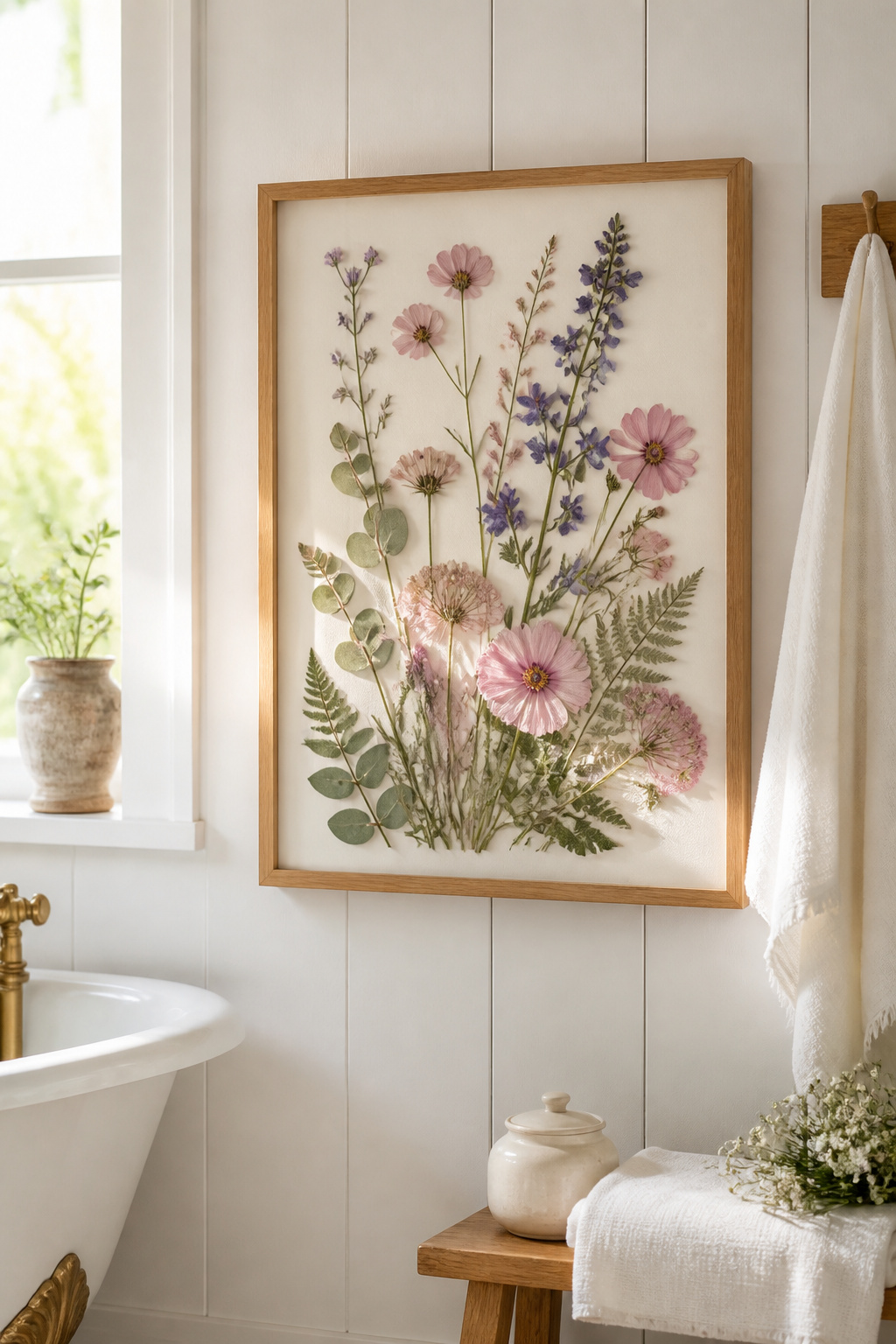
The revival is real. Studios like Wild Coast Flower Preservation and Eight Acorns offer to transform meaningful flowers — wedding bouquets, garden blooms — into permanent bathroom wall decor. An 8×10 pressed flower frame in natural or black wood costs approximately $80-$150; a larger 16×20 statement piece runs $200-$400.
For DIY pressing: place blooms between two sheets of blotting paper inside a heavy book, check after one week (replacing any damp paper), and allow 2-4 weeks total. Thin-petalled flowers (pansies, larkspur, cosmos) press in 1-2 weeks; thicker blooms need 3-4 weeks.
The UV glazing requirement
UV-protective glazing is not optional. Pressed flowers are highly sensitive to fading — a red poppy can bleach to salmon pink within 6-12 months behind standard glass. Art Glass 99 (99% UV protection) is available through specialist frame suppliers; premium preservation studios typically include it as standard. For bathrooms specifically, resin-encased pressed flower art is the most durable option — flowers are fully sealed in UV-resistant epoxy with no air exposure, dramatically slowing colour loss.
14. Underwater and Ocean Photography for a Coastal-Inspired Bathroom
The bathroom is, more than any other room, the room of water. You bathe in it, shower in it, hear it run. Extending that elemental connection into the wall art creates an immersive environment rather than a decorated room — and the difference in experience is tangible.
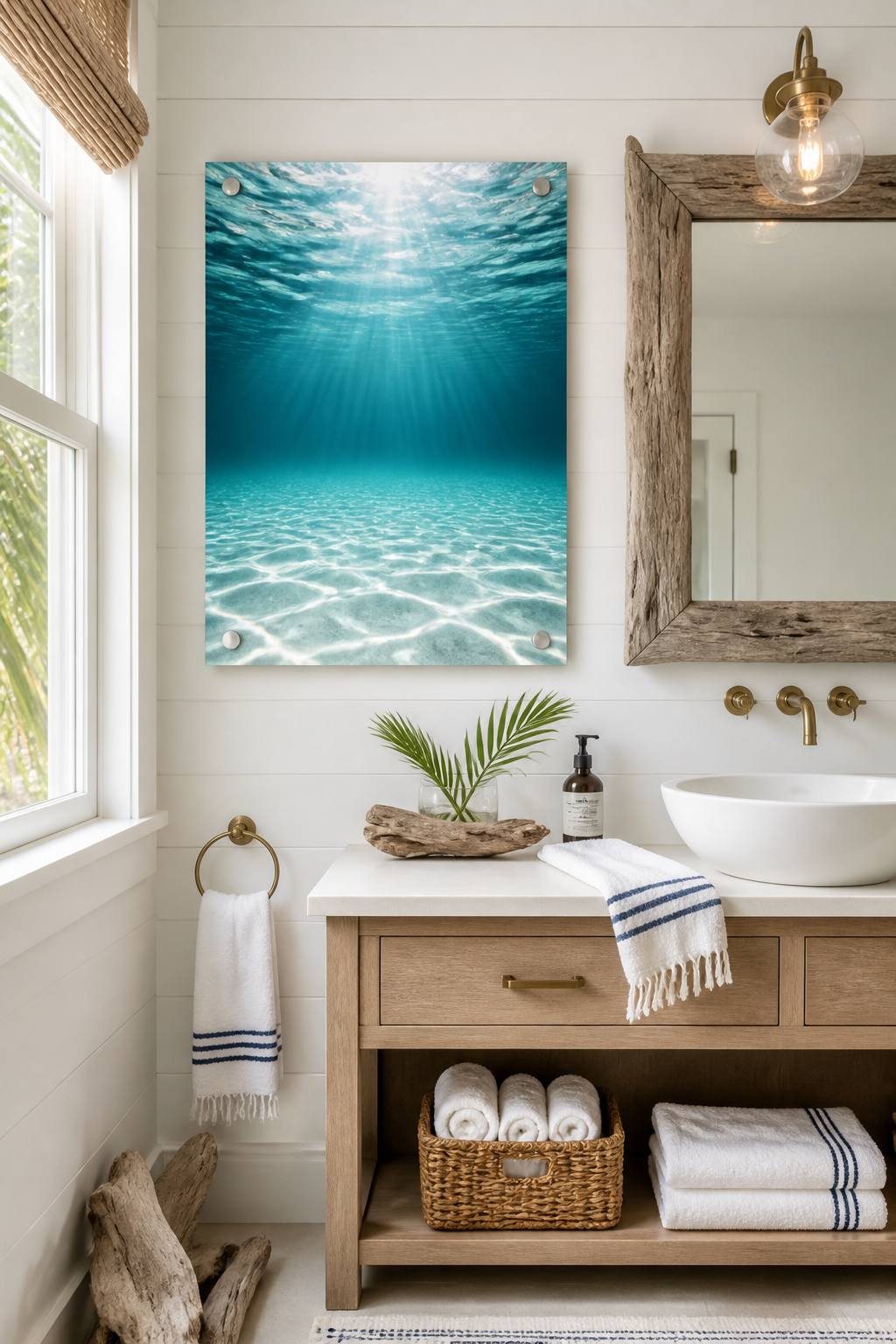
The risk — and it’s a real one — is tipping into generic coastal kitsch. There is an enormous category of beach bathroom art (illustrated anchors, script signs reading BEACH HOUSE, cartoon starfish) that reads immediately as mass-produced. The antidote is quality: genuine fine art ocean photography, taken by a photographer who understands light, composition, and the abstract qualities of water. Lars Gesing Fine Art and Jess Lee Photos specialise in ocean photography with fine art print options. For a complete coastal bathroom design, pairing fine art ocean photography with the right frame material deepens the effect: driftwood frames, whitewashed wood, or brushed brass each create a different register of coastal atmosphere.
Metal prints on aluminium work particularly well for ocean photography — the metallic surface gives water imagery an almost liquid quality that paper printing cannot achieve.
15. Vintage Illustration Prints for Timeless Bathroom Wall Art Appeal
Here’s a fact that every decorator who discovers it uses repeatedly: the world’s finest natural history illustration archives are free. The Biodiversity Heritage Library holds over 150,000 botanical and zoological illustrations available for free download under Creative Commons 0 licence. The New York Public Library’s Digital Collections offers more than 180,000 public domain images at high resolution. The Rijksmuseum’s Rijksstudio makes Dutch Golden Age artworks available for free at museum-quality resolution.
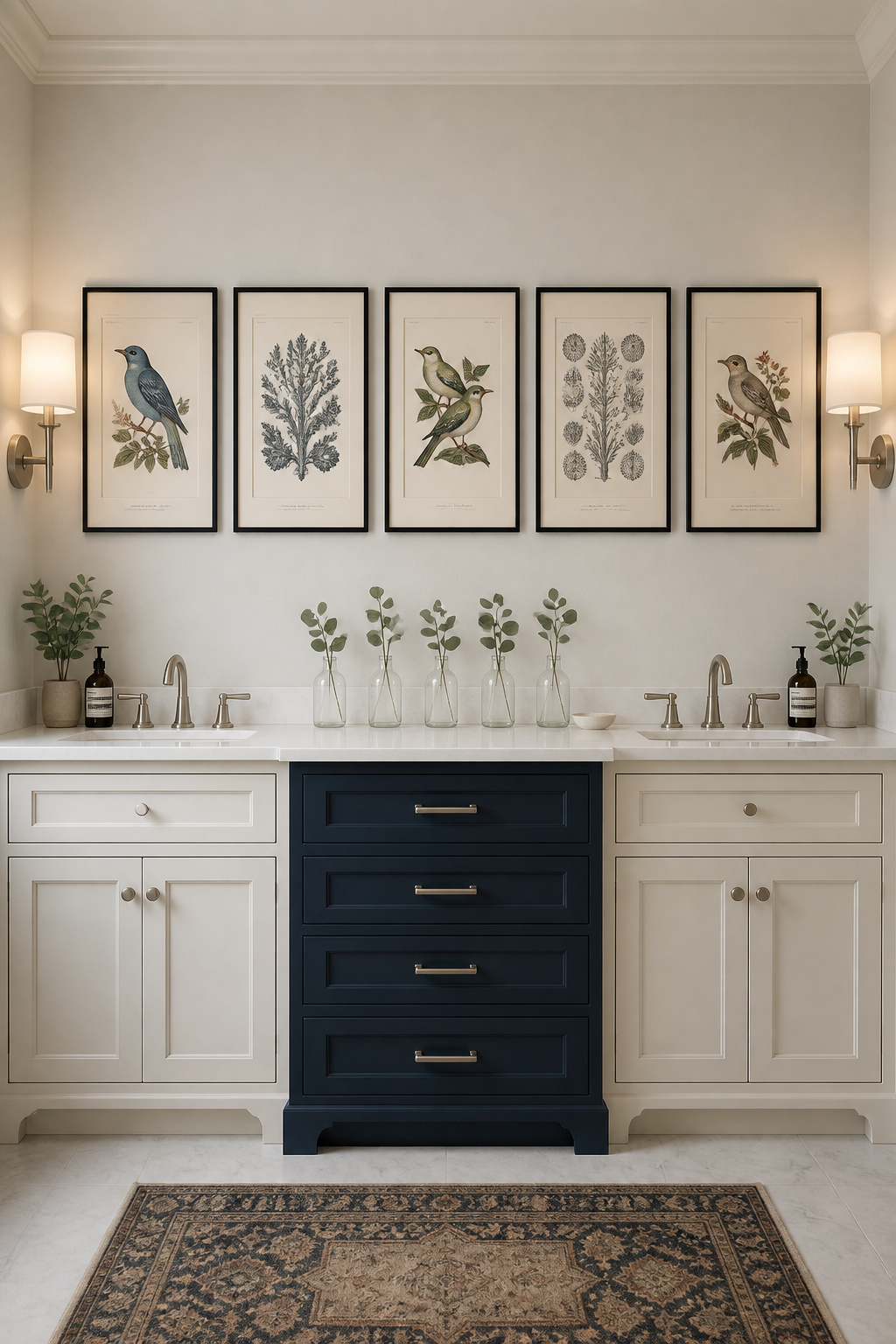
Download, order a giclée print from Mpix or Nations Photo Lab (approximately $25-$45 for A3), choose a frame, and hang. The total investment is under $70 for bathroom wall art that looks like it came from a carefully considered collector’s home.
The lasting appeal of vintage scientific illustration is its dual quality: rigorous precision and genuine beauty. Each plate is technically accurate and visually accomplished. In a bathroom, where you have both time and close proximity to look carefully, the fine detail of 19th-century engraving rewards that attention. Always download the highest-resolution file available — NYPL and Rijksstudio files are often 300 DPI or higher. Printing from a low-resolution web image at large scale shows pixelation.
16. Neon and LED Light Art as Contemporary Bathroom Wall Decor
The cultural conversation around neon has shifted. What was once associated primarily with commercial signage has become a legitimate interior design element — and in the bathroom specifically, it occupies an interesting position: it functions simultaneously as art and as ambient lighting, the kind of soft, directional glow that transforms the quality of a room at night.
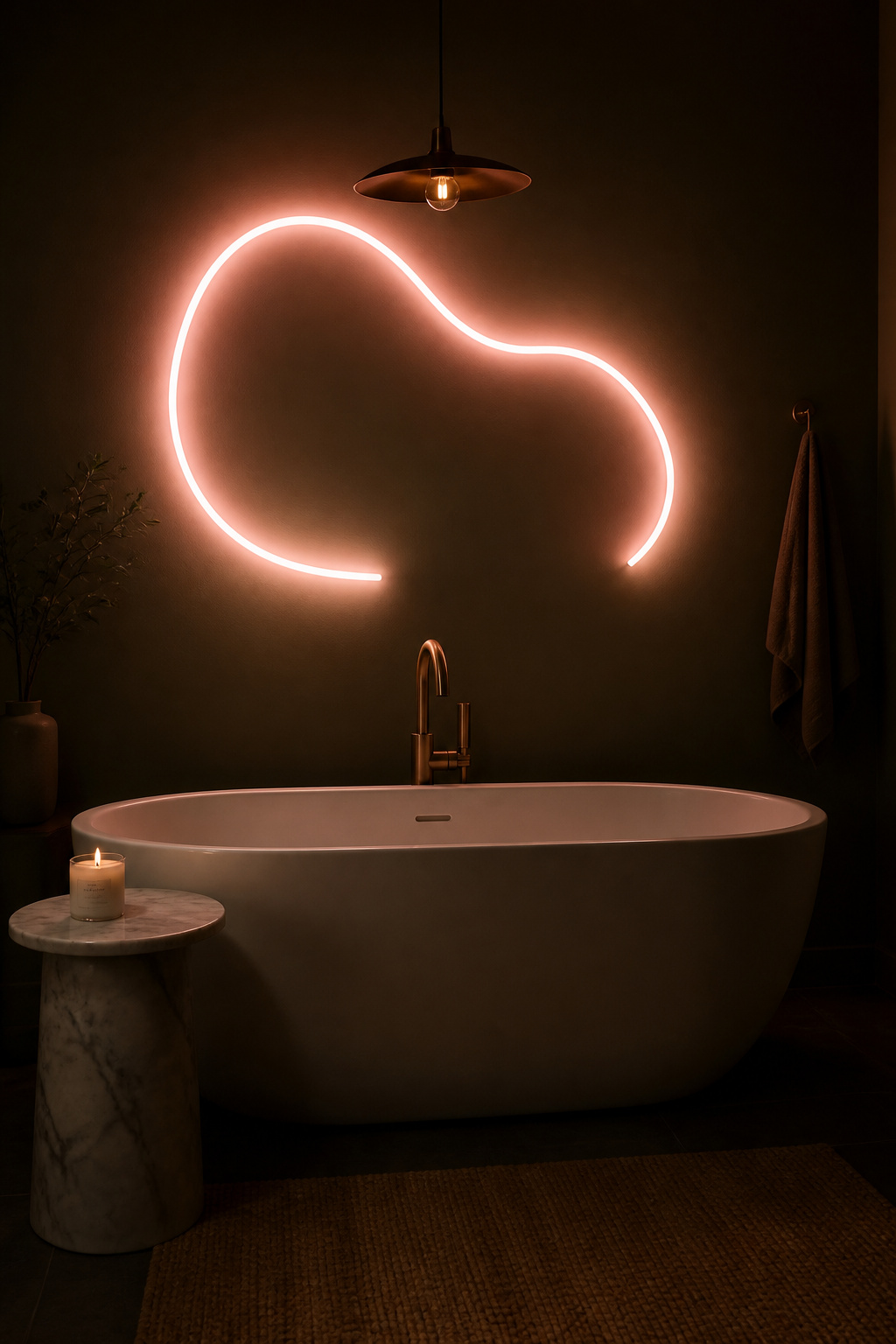
LED flex neon is the practical choice for bathrooms: the silicone jacket with embedded LED strips is shatterproof, lightweight, and available in IP65 and IP67 weatherproof ratings. IP65 is splash-resistant; IP67 is rated to withstand temporary immersion to 1 metre for 30 minutes. Both are appropriate for bathroom installation. The 12V power requirement means LED neon poses no meaningful electrical shock risk in a humid environment — it’s safer than most people assume.
LED vs. traditional glass neon
Traditional glass neon delivers a warmer, more organic glow that LED genuinely cannot replicate, but it’s heavier, fragile, produces some heat, and costs significantly more ($500-$2,000+ for custom pieces vs. $80-$400 for LED). For a bathroom, the practical advantages of LED flex neon are hard to argue against. The 2026 aesthetic for bathroom neon is decidedly quieter than its bar-signage ancestor: soft arches, abstract organic curves, single words in thin script, warm white and blush pink light temperatures. Custom Neon and Radikal Neon Signs both offer bathroom-specific pieces and custom commissions with 2-3 week lead times.
17. Custom Family Photo Gallery in Moisture-Resistant Frames
Photographs are the most personal category of wall art, and the bathroom’s privacy makes it an appropriate setting for the most meaningful ones. The distinction between a personal photo display and photo art, however, lies in editorial intent: choosing images that function as visual compositions, not just records of moments.
The practical tool for elevating personal photographs is editing consistency. Convert all photos to black and white, or apply the same warm film-style preset to all — this unifies images taken in different conditions into a cohesive visual series. Mixed colour temperatures make even beautiful photographs look like a random collection.
Printing formats that survive bathroom humidity
For printing in a bathroom environment, standard photographic paper behind glass is the wrong choice — humidity causes condensation on the glass interior, permanently damaging paper prints over time. Three formats handle bathroom conditions well. Metal prints (dye-sublimation on aluminium) are the most practical: inherently moisture-proof, requiring no glazing or frame. Acrylic face mounts deliver the most dramatic result — the print is sealed behind solid acrylic, with colours that appear deeper and more luminous than any framed print. C-prints with UV laminate allow framing in any chosen frame without glazing.
For arrangement: the salon-style cluster (asymmetric, mixed sizes, largest piece as anchor) feels most relaxed and personal. The clean grid (all frames the same size, evenly spaced) suits contemporary bathrooms with strong geometric tile. Five to seven pieces is usually the right number for bathroom walls.
How to Choose the Right Bathroom Wall Art for Your Space
The most useful filter is ventilation. Not style, not budget, not the art itself — ventilation determines which categories are genuinely available to you. A bathroom with no exhaust fan, or with one that doesn’t get reliably used, should stick to the most durable formats: metal prints, acrylic face mounts, ceramic or resin sculptural pieces, mirror clusters. Canvas, textile art, and pressed flower work in glass frames all need adequate air movement to survive steam exposure over the long term.
Once you’ve settled that, match the art type to the bathroom’s design language. Botanical prints and pressed flowers suit traditional or spa-adjacent schemes. Neon and acrylic face mounts belong in contemporary bathrooms with clean architectural lines. Macramé and ocean photography suit coastal or bohemian approaches. Vintage illustration is more versatile than it looks — it can read as scholarly, warm, or whimsical depending on the frame choice.
Finally: start with one piece and live with it before committing to a gallery arrangement. The instinct when a wall feels bare is to fill it. The better instinct is to place one considered piece, wait a month, and see what the room tells you. Tape a paper template of your planned bathroom wall art to the wall before ordering — this takes five minutes and tells you more about the right size and position than any size guide ever could. The bathroom is not the lesser room. It gets time and attention every single day. Give its walls the same consideration you’d give the living room, and it returns that investment every morning.