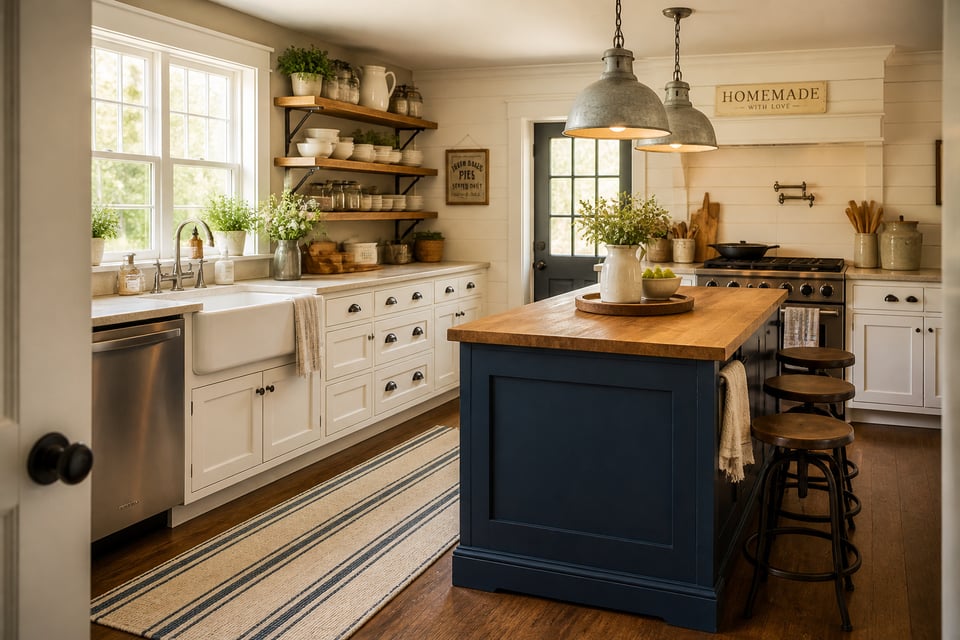
There’s a moment when you walk into a farmhouse kitchen that just works — and you feel it before you can name it. The natural wood catches morning light. Something is simmering on the range. A bunch of herbs sits in a terra cotta pot on the windowsill, and a row of cast iron pans hangs on the wall like earned medals. That feeling isn’t luck or a big budget. It’s the result of specific, intentional farmhouse kitchen decor choices — ones that prioritize warmth, authenticity, and the sense that real life happens here.
After twelve years designing kitchen spaces, I know farmhouse style is the most forgiving of all decorating approaches. It actively improves with imperfection, age, and evidence of cooking. You don’t need a gut renovation to get there. These 15 ideas range from architectural changes that anchor the whole room to small details that shift the atmosphere immediately. Start wherever your budget and timeline allow.
1. Shiplap Accent Walls That Ground the Whole Kitchen
Walk into a kitchen with horizontal wood planks on one wall, and the room suddenly has a backbone. Shiplap has been a farmhouse staple for generations because it solves an aesthetic problem most kitchens don’t know they have: flat, featureless walls that give the eye nowhere to rest. The horizontal lines draw the gaze across the room. Even a narrow kitchen feels wider.
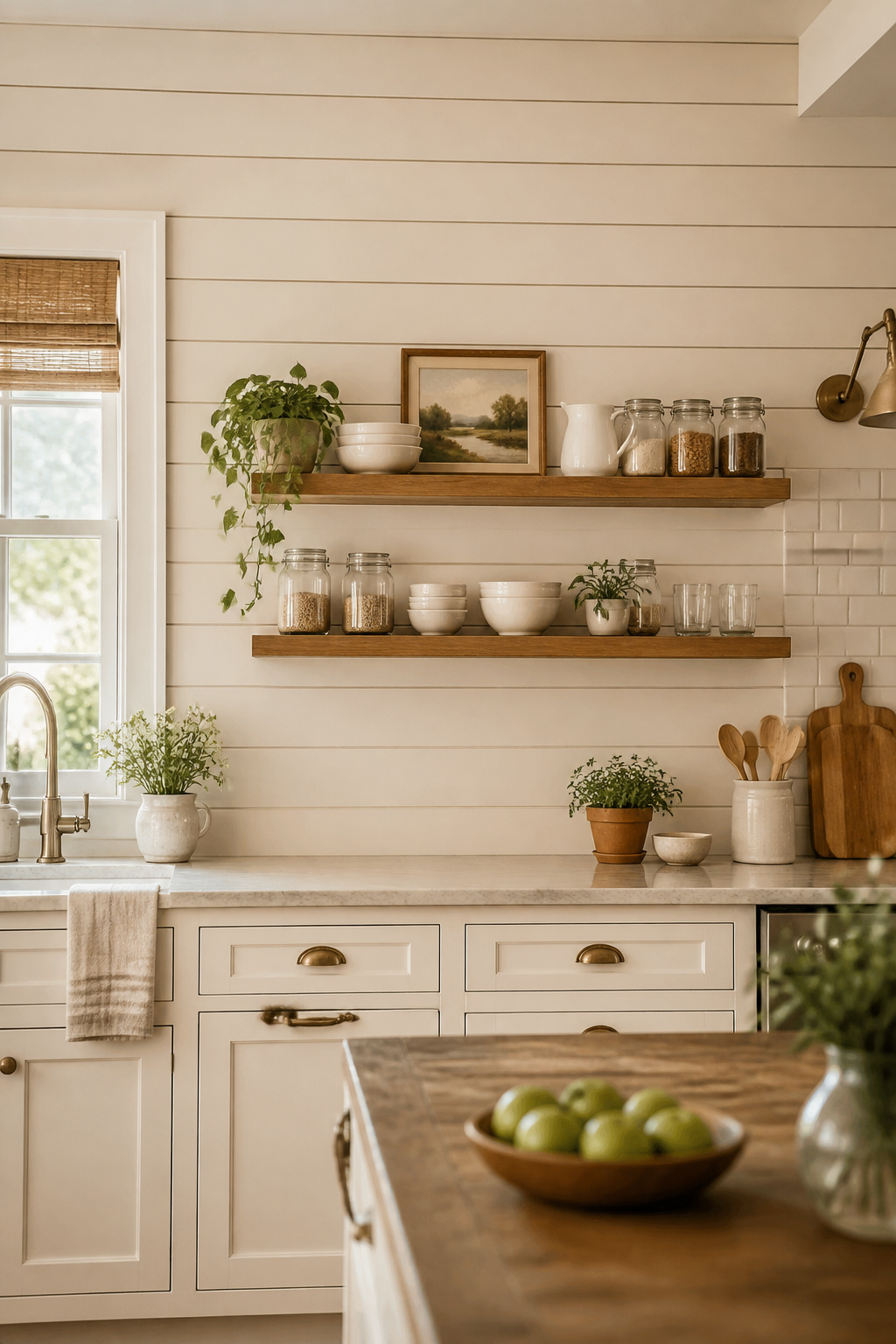
The most effective placement is an end wall visible from an adjoining living or dining space. It creates a visual anchor that bridges the two rooms and adds architectural weight without enclosing the kitchen. A full back wall behind open shelves is another strong move, turning the shelving display into something that feels built-in rather than tacked on.
Real shiplap — tongue-and-groove pine boards, typically 1×6 or 1×8 — costs $1.50–$4 per linear foot at lumber yards. Cedar runs $3–$7. The important detail nobody mentions first: kitchens are humid, and unsealed wood warps. Seal every board before installation, not after, and use a moisture-resistant primer if you’re painting. MDF V-groove paneling is a practical alternative at $30–$50 per 4×8 sheet. It takes paint beautifully and installs faster, though it won’t have the same grain variation as real wood.
On finish: the all-white shiplap wall has been done so thoroughly that it now reads as a cliché. In 2026, the farmhouse kitchens that feel freshest treat shiplap in warm cream, soft charcoal, or a deep sage — still clearly farmhouse, but with more personality. If you’re committed to white, a whitewash (diluted white paint wiped on and partially removed while wet) gives you wood texture and lightness simultaneously, without the painted-wall flatness.
2. Farmhouse Kitchen Decor With Open Shelving
Upper cabinets are practical. But they also close the kitchen off. Remove one section — or one entire wall — of upper cabinets, replace them with open shelves, and the room breathes differently. This is the farmhouse kitchen decor move that changes the atmosphere more than almost anything else, because it asks you to live with your kitchen items in full view, which changes what you keep and how you arrange it.
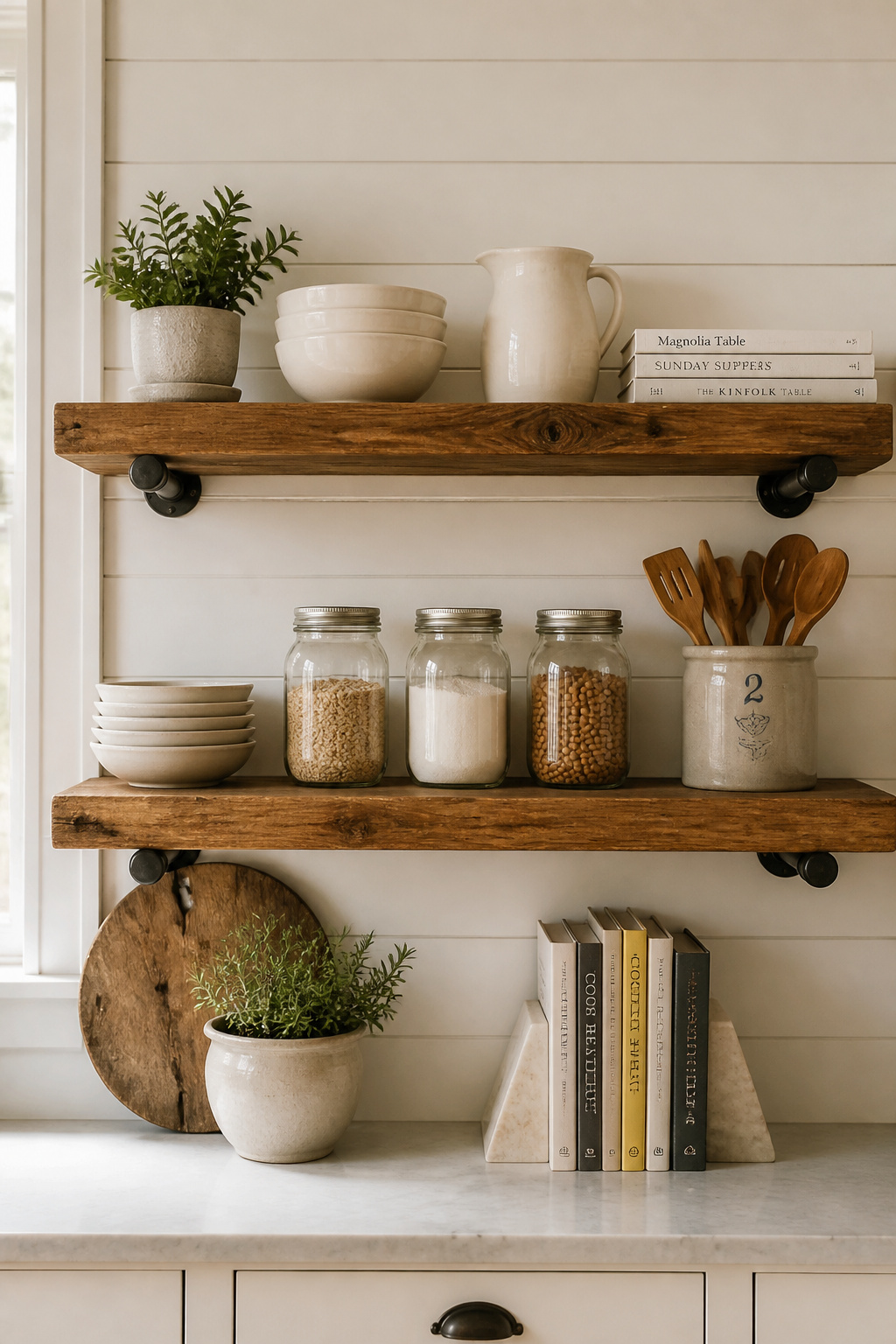
The styling principle that prevents open shelves from turning chaotic: odd numbers and a limited palette. Three items read as a vignette; four reads as a collection that needs editing. Stick to whites, creams, and natural wood tones across all shelf items. Then let one small detail — a single aqua mason jar, a terracotta pot — provide the accent. Mix roughly 70% functional items (white plates, everyday glasses, mason jars of dry goods) with 30% purely decorative objects. Fully decorative shelves look precious; purely functional ones look like a warehouse.
For brackets, black iron pipe brackets cost $10–$20 each and suit an industrial-farmhouse look. Corbels — ornate carved brackets — fit a more traditional farmhouse aesthetic and can be painted to match the wall or the shelf. For wood: knotty pine is the most rustic and affordable; white oak gives a cleaner, slightly more modern look; reclaimed barn wood is the most authentic choice if you can source it. For well-organized farmhouse kitchen storage beyond the shelves, there are kitchen storage and organization ideas worth exploring to make the most of every inch.
3. An Apron-Front Farmhouse Sink as the Focal Point
An apron-front sink announces itself. That exposed panel of ceramic or fireclay at the front of the base cabinet — typically 8–10 inches of visible face — references the deep, wide scullery sinks found in European farmhouses for centuries. It makes a statement that this kitchen is built for serious cooking, and it immediately draws the eye when you enter the room.
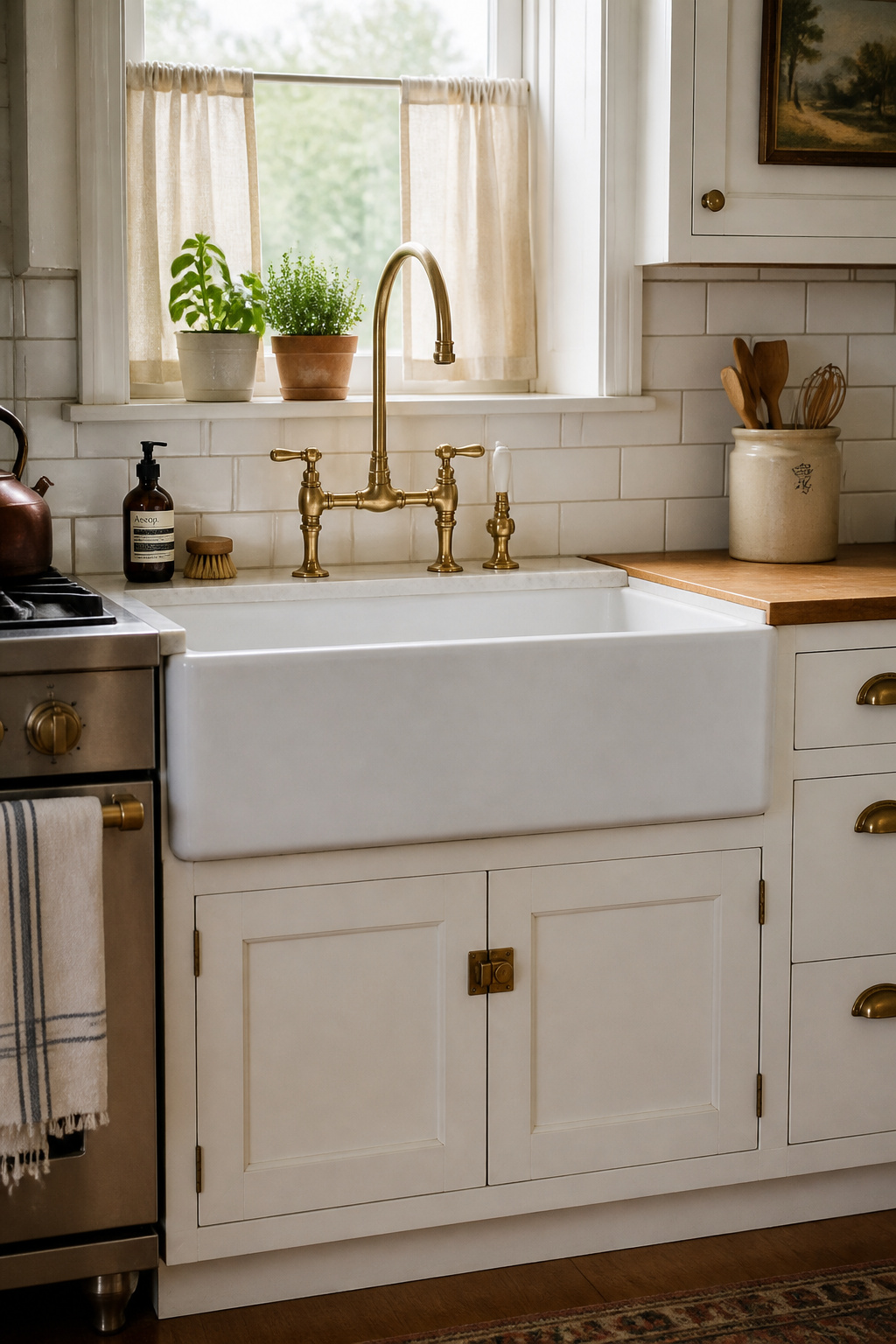
The practical choice for almost every budget is fireclay. It’s a ceramic fired at extreme temperatures with the glaze fused into the clay — not applied on top. So if it chips, the material underneath is the same color. No rust spots, unlike cast iron enamel, which exposes bare metal when damaged. Fireclay is also lighter than cast iron, which makes installation more straightforward. Top brands include Kohler Whitehaven, Shaw (imported from England, where farmhouse sinks have been standard since the 19th century), and Rohl. Quality fireclay sinks run $600–$1,800.
The one cost that catches people off guard is base cabinet modification. Your existing base cabinet has a face frame that must be cut away to allow the apron front to sit flush. Most carpenters charge $200–$500 for this work. Budget for it before you order the sink. Standard widths run 30–36 inches. A 33-inch single basin is the sweet spot for most kitchens — wide enough for sheet pans and large stockpots, but not so wide that surrounding counter space disappears.
4. Butcher Block Countertops for Warmth and Function
Stone countertops are beautiful. But stone can’t make a farmhouse kitchen feel like a farmhouse kitchen. Butcher block does — because wood grain against painted white cabinets and a ceramic sink reads as warm, lived-in, and genuinely domestic in a way that quartz simply doesn’t replicate.
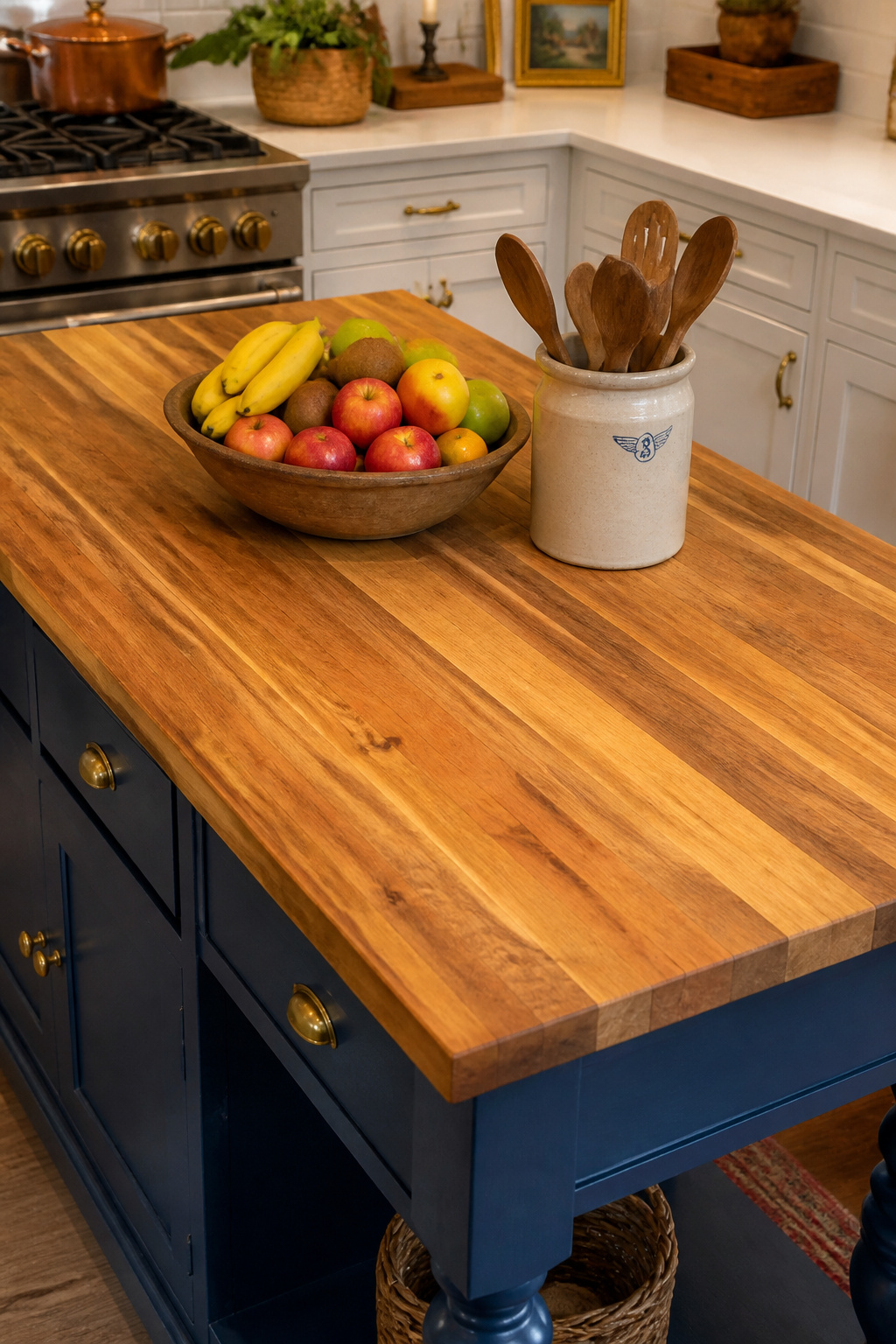
Hard maple is the most practical choice: it scores 1,450 on the Janka hardness scale, resists cutting damage well, and has a light, clean appearance that suits both traditional and modern farmhouse kitchens. Walnut scores lower at 1,010 Janka, which means it scratches more easily. That said, the rich chocolate-brown grain is stunning — best for islands where direct cutting is lighter. Both need regular maintenance: food-safe mineral oil applied monthly for the first year, then quarterly after.
The smartest approach in most kitchens is the mixed-material method — butcher block on the island only, with quartz or stone on the perimeter counters. You get the warmth of wood at the most visible surface without demanding maintenance on high-use zones around the sink and range. For more on making that decision, kitchen island countertop options worth considering covers the tradeoffs in depth. IKEA’s Badelunda butcher block worktop at roughly $100–$200 is a legitimate budget starting point. It cuts to size cleanly and accepts oil finishes well. One firm warning: avoid polyurethane on food-contact butcher block. It peels, isn’t food-safe when compromised, and blocks future oil treatments from penetrating.
5. Farmhouse Kitchen Decor: Mason Jar and Crock Collections
No piece of farmhouse kitchen decor works harder than a stoneware crock by the stove. A gallon crock holding wooden spoons, a flat spatula, a wire whisk, and a pair of tongs is simultaneously the most practical and most photographed element in a farmhouse kitchen. It keeps your most-used utensils within reach. It keeps the drawer clear. And it looks like it’s always been there.
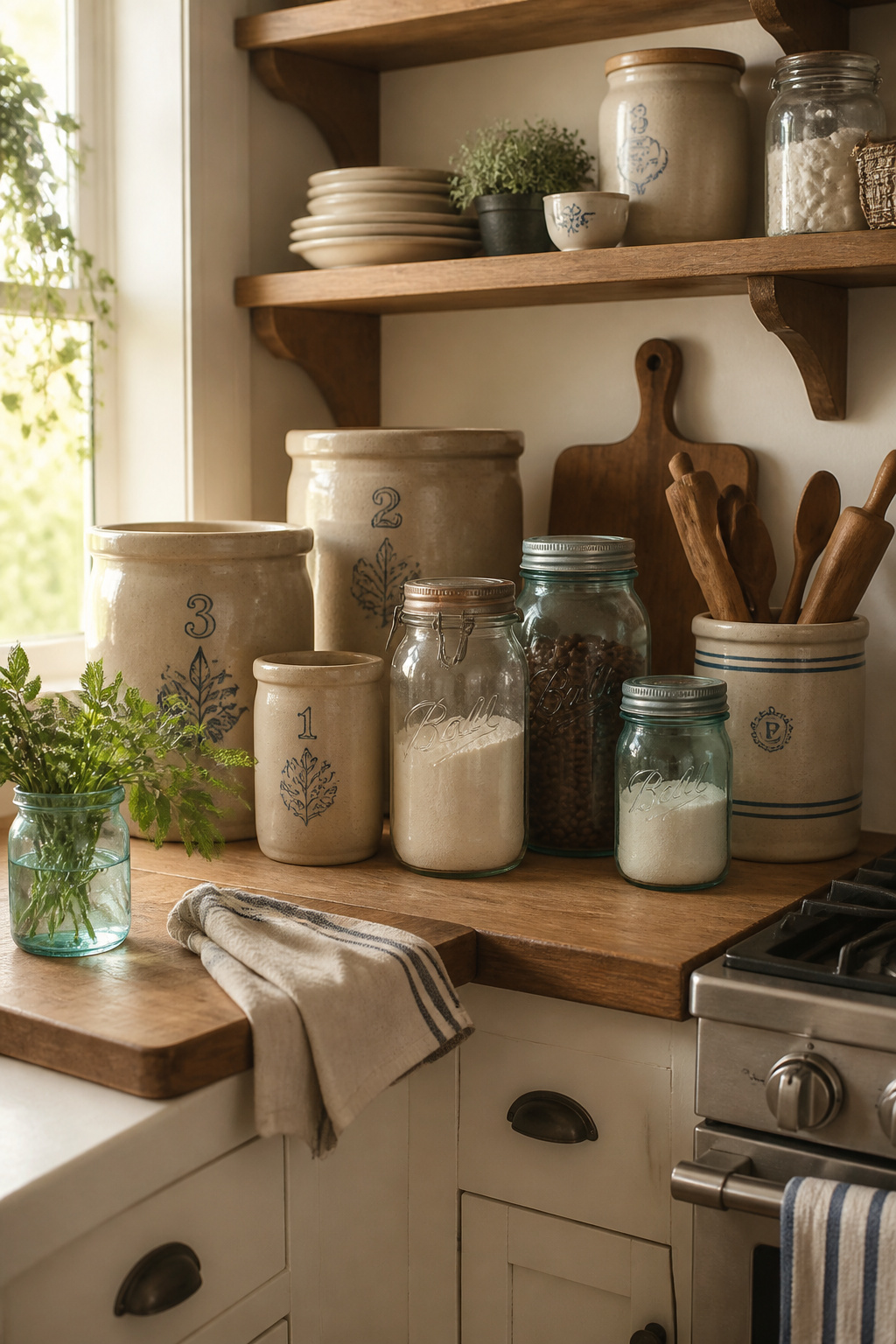
Ball mason jars in pint and quart sizes lined up on open shelves and filled with coffee, dried beans, oats, or flour transform pantry staples into display. The slight variation in fill levels and the layered colors of the contents — tan oats beside dark coffee beside red lentils — creates gentle visual interest with no styling effort required.
For the best display results, group crocks in threes at varying heights: one tall crock (8–10 inches), one medium piece (5–6 inches), and one small bowl or short jar. Avoid lining up identical sizes in a row — that reads like a product display, not a lived-in kitchen. Mixing aqua or cobalt blue vintage Ball jars with natural salt-glazed stoneware adds gentle color without fighting the neutral palette.
Estate sales are the best source for authentic vintage crocks — look for salt-glazed or blue-banded stoneware with maker’s marks from American potteries in Ohio, Pennsylvania, and New England. Etsy sellers who specialize in farmhouse antiques are reliable for shipping, with prices typically $15–$60 for usable pieces. If the hunt isn’t your thing, Red Wing Pottery and Lehman’s sell new American-made stoneware that looks and performs exactly right.
6. Exposed Wood Ceiling Beams for Rustic Drama
Three evenly spaced beams running the length of a kitchen ceiling will transform the room more completely than almost any other single change. They draw the eye upward. They make the space feel larger and more architecturally intentional. In an open-plan home, they define the kitchen zone without requiring walls.
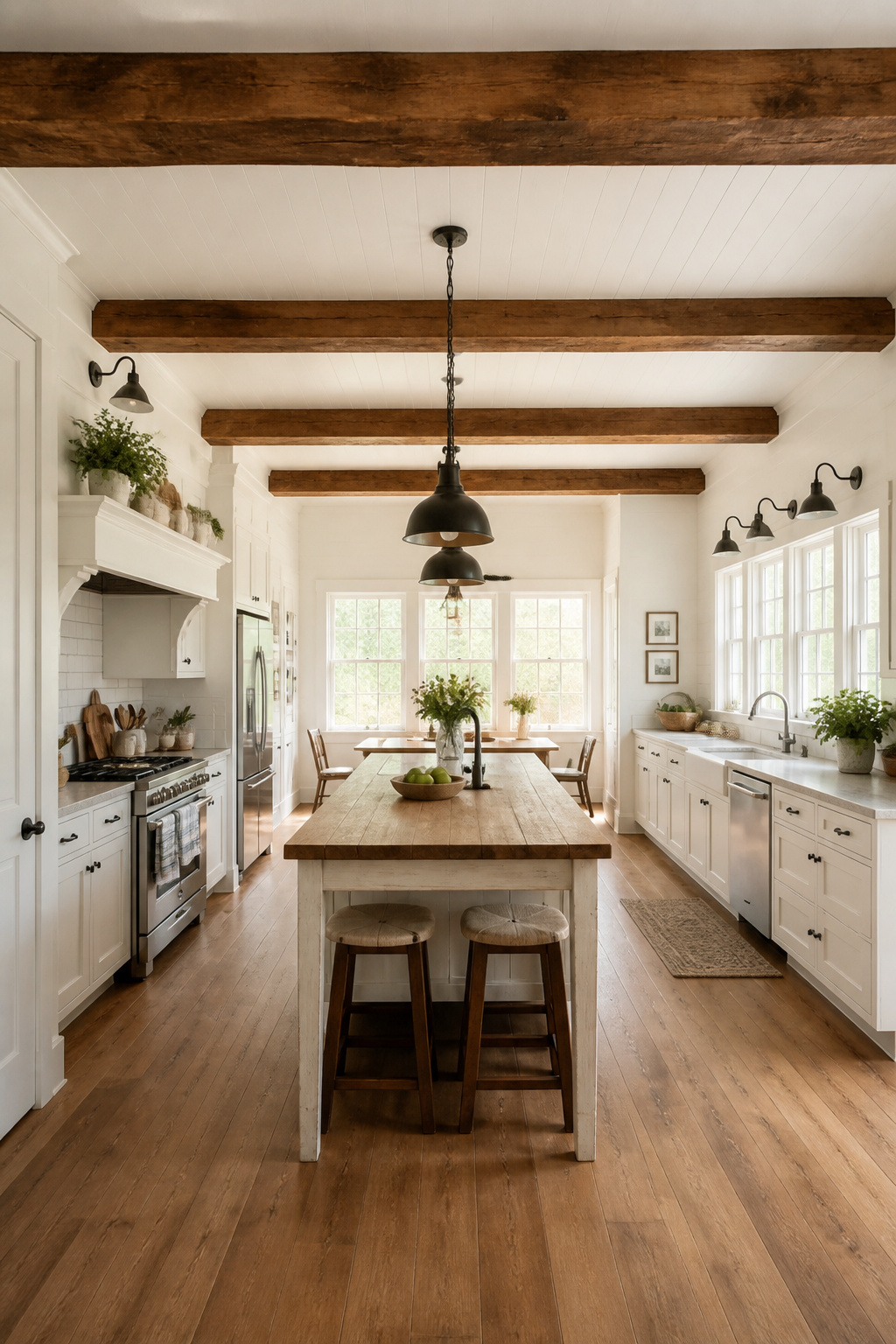
The practical question is real wood versus faux. Real reclaimed wood beams cost $15–$40 per linear foot for materials alone — before a structural engineer assessment ($300–$500, sometimes required) and heavy installation labor for beams that can weigh 200 pounds each. A three-beam kitchen can easily run $3,000–$8,000 total. Faux polyurethane beams from Barron Designs or Volterra cost $6–$12 per linear foot, weigh 5–10 pounds per 8-foot section, and mount to a 2×4 nailer screwed into the ceiling. The same kitchen project runs $500–$900 as a weekend DIY. For most homeowners, faux beams are the clear answer.
On finish: natural reclaimed-gray beams suit the most rustic farmhouse kitchens. Dark walnut stain gives drama and pairs beautifully with light cabinets. Whitewash keeps beams light — the right choice for smaller kitchens where dark beams would compress the space. Eight feet is the minimum viable ceiling height for beams. Anything lower and they feel oppressive rather than architectural.
7. Classic Subway Tile Backsplash Done the Farmhouse Way
Subway tile was designed for New York City’s subway stations in 1904. It has been a kitchen staple ever since — which is exactly why it suits farmhouse kitchens. Not because it’s trendy, but because it’s been around long enough to feel timeless. The standard 3×6 white ceramic tile in an offset (brick) pattern is the configuration that reads as farmhouse. Handmade ceramic versions with slight surface variation and irregular edges feel more artisanal and less manufactured — worth the modest price premium if you can find them.
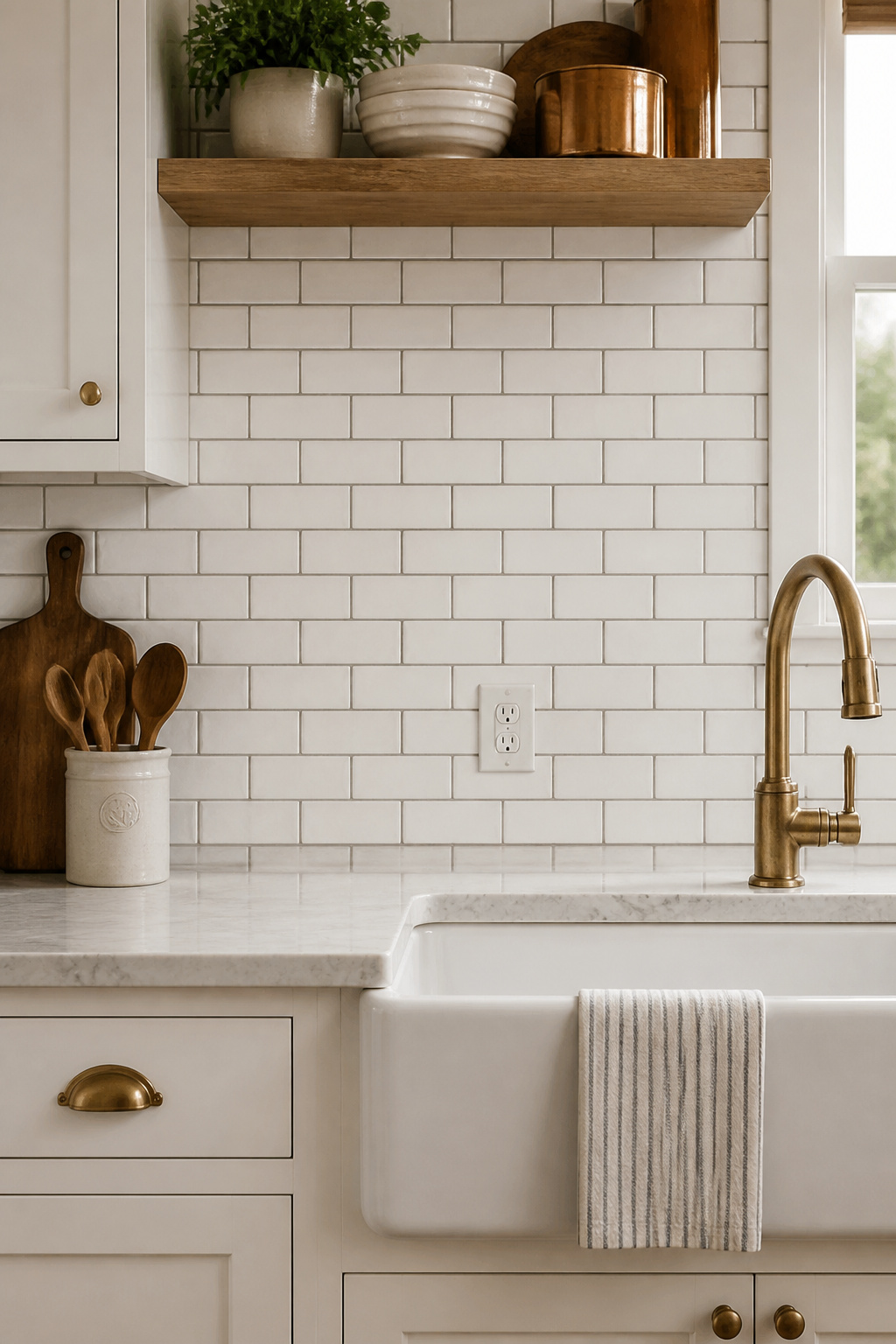
Grout color is where most decisions get made. White grout gives a seamless, monolithic surface — clean and bright, but it shows every splash in a working kitchen. Medium gray is the most practical farmhouse choice: it shows just enough pattern definition, doesn’t draw the eye the way black does, and hides kitchen grime far better than white. Black grout is graphic and dramatic — it works in modern-farmhouse kitchens with strong contrast, but it can feel too deliberately styled in a softer farmhouse context. For a full look at farmhouse kitchen backsplash designs that actually work, there’s a dedicated guide with more pattern and material options worth reviewing.
One installation tip worth paying for: extend the backsplash all the way to the bottom of the upper cabinets, or to the ceiling if you have open shelves. A full-height tile wall is dramatically more impactful than a standard 4–6-inch backsplash. The tile cost increase is modest; the labor is similar. If you’re doing it at all, go tall.
8. A Freestanding Kitchen Island With Painted Legs
A built-in island looks custom and permanent. A freestanding island with legs looks found — which is very much what farmhouse style is about. The implication is that the island arrived from somewhere else, was chosen rather than built, and could theoretically leave again, even if it never will. That slightly provisional quality is part of the farmhouse kitchen’s appeal.
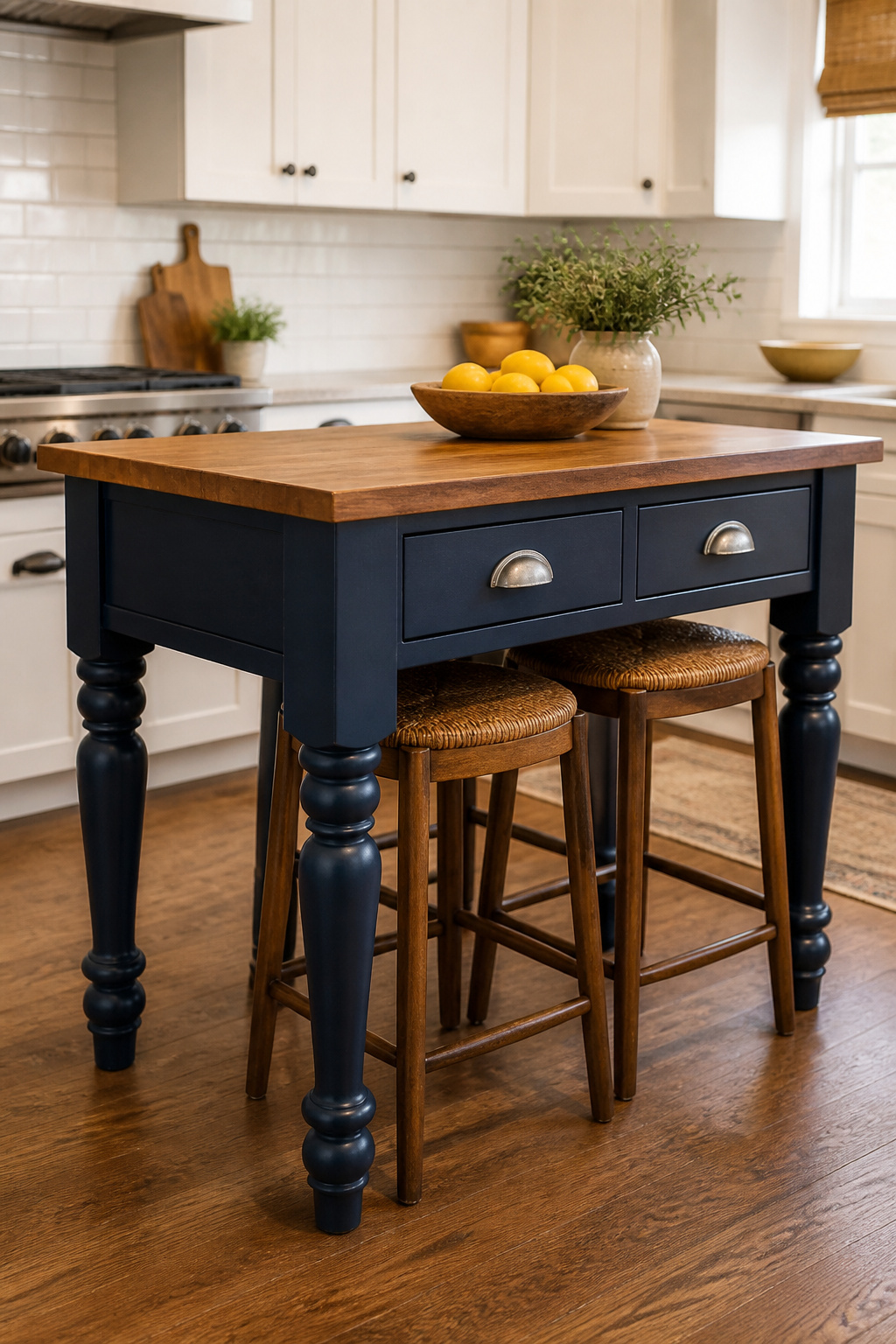
The simplest path to a freestanding island is converting an old piece of furniture. A sideboard, library table, or wide dresser can all become a kitchen island with the right modifications. Dressers sourced from estate sales or Craigslist for $50–$150 have been turned into stunning islands — painted, given new hardware, and topped with butcher block. The key measurement: standard counter height is 34–36 inches from finished floor. Most vintage furniture sits at 29–31 inches and needs legs or a riser to reach that height. Country table legs in a classic turned spindle profile run $20–$40 each. Attach four to the bottom of the case and you’re at counter height, with the furniture-like quality that makes the island feel right. For more approaches, rustic kitchen island ideas to inspire your design covers a range from rustic to refined.
Paint colors that suit a farmhouse island: Sherwin-Williams Naval and Benjamin Moore Hale Navy are the most reliably beautiful navy choices against white perimeter cabinets. Sage green (SW Retreat or BM Cushing Green) is a warmer, softer alternative. Cream or antique white keeps things light and suits kitchens where you don’t want the island competing visually with the farmhouse sink.
9. Farmhouse Kitchen Decor Using Vintage Signs and Chalkboards
Not everything in a farmhouse kitchen needs to be permanent. Vintage signs and chalkboard surfaces give the room personality, a sense of history, and — importantly — flexibility. A sign can be swapped. A chalkboard message can be changed on a Tuesday afternoon. In a room where everything else is fixed, that changeability matters.
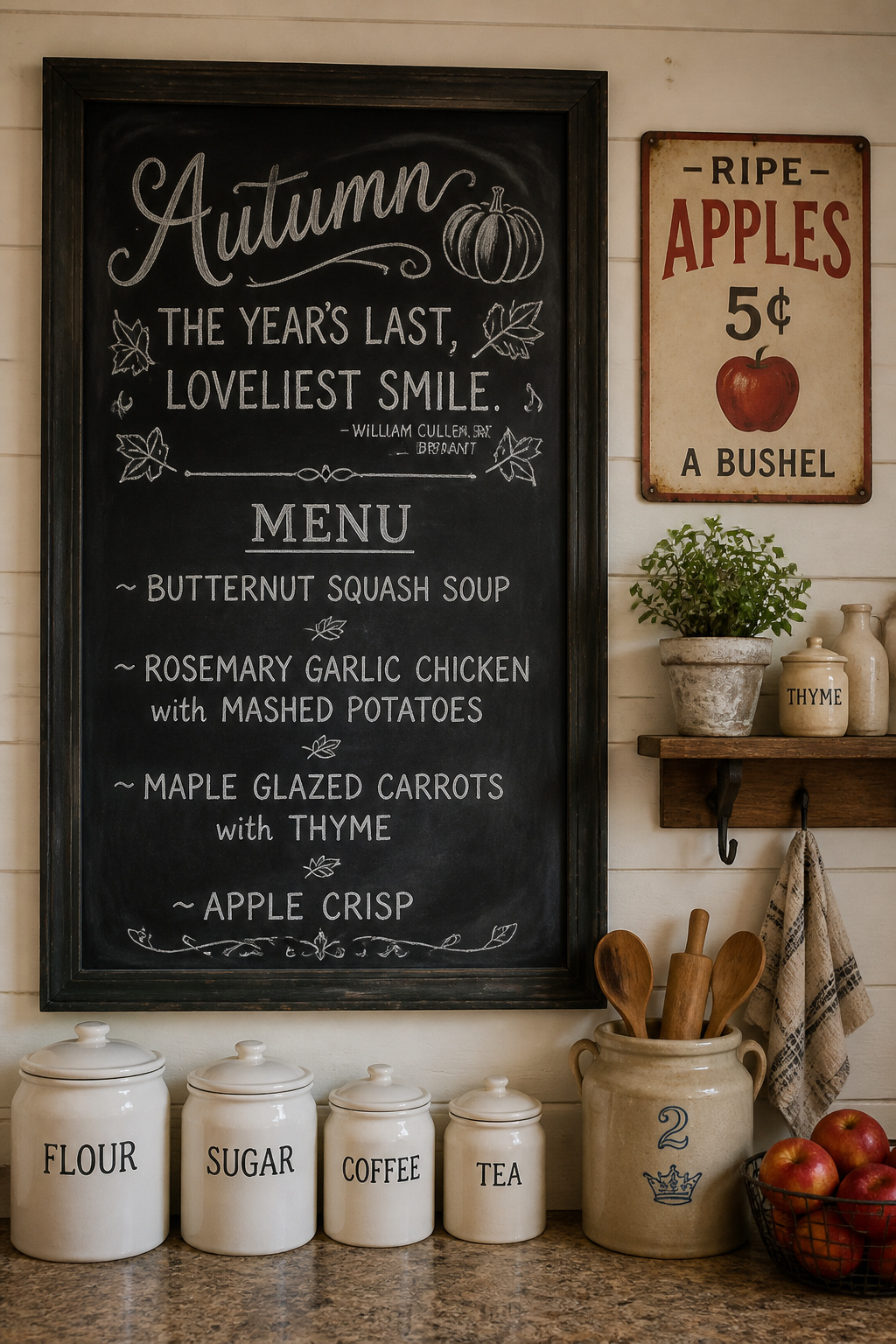
Genuine vintage enamel signs — old dairy signs, diner signs, product signs from the early 20th century — show their age through color fading and edge chips that no reproduction fully replicates. Find them at antique malls and estate sales; authentic pieces run $40–$300+ depending on age and rarity. Reproduction enamel signs and wooden signs from Etsy are more affordable ($15–$60) and entirely appropriate in a farmhouse kitchen that isn’t trying to be a museum — just warm and personal.
A chalkboard panel is the most versatile piece of farmhouse kitchen decor in this category. A large framed chalkboard (36×48 inches is a good working size) serves as a grocery list, a menu board, a kids’ drawing surface, and a seasonal display all at once. The critical detail most tutorials skip: before writing on a new chalkboard for the first time, condition it by rubbing the flat side of a piece of chalk all over the entire surface and then erasing it. Skip this step and your first written message will ghost permanently into the surface — visible even after erasing. Two to three coats of chalkboard paint with light sanding between coats produces the smoothest writing surface.
10. Galvanized Metal Accents and Pendant Lighting
Chrome is too bright. Polished nickel is too formal. Galvanized metal — steel coated in zinc, with a characteristic mottled gray-silver finish — sits in exactly the right place for farmhouse kitchens. It’s industrial without being cold, distressed without being precious, and it picks up the gray in subway tile and concrete countertops without competing with natural wood or white paint.
Galvanized drum or barn-shade pendants run $30–$200 depending on size and detail, with solid options from Amazon, Wayfair, and specialty farmhouse lighting retailers. Hang them at 30–36 inches above the countertop surface. For a complete approach to kitchen illumination, kitchen lighting design that works for every layout is worth reading alongside this. Beyond lighting, galvanized metal works as small utility pieces throughout the farmhouse kitchen: a galvanized tub holding dish towels near the sink, galvanized canisters on the counter, galvanized bin pulls on painted cabinets at $3–$8 per pull.
On mixing metals: limit yourself to three finishes maximum. One dominant (galvanized or matte black), one supporting accent (aged brass on the faucet), one tertiary that appears only in small hardware. Group metals by function — plumbing fixtures match each other; lighting is its own category; cabinet hardware is its own. This structure keeps a multi-metal kitchen looking intentional rather than accumulated by accident.
11. Woven Baskets and Natural Fiber Textiles
A kitchen dominated by tile floors, painted cabinets, stone countertops, and stainless appliances is almost entirely hard surfaces. Woven baskets, cotton runners, and linen dish towels don’t just add farmhouse kitchen decor — they absorb the visual and acoustic hardness of all those reflective planes, and they make the room feel genuinely softer. It’s a small change with a disproportionate effect.
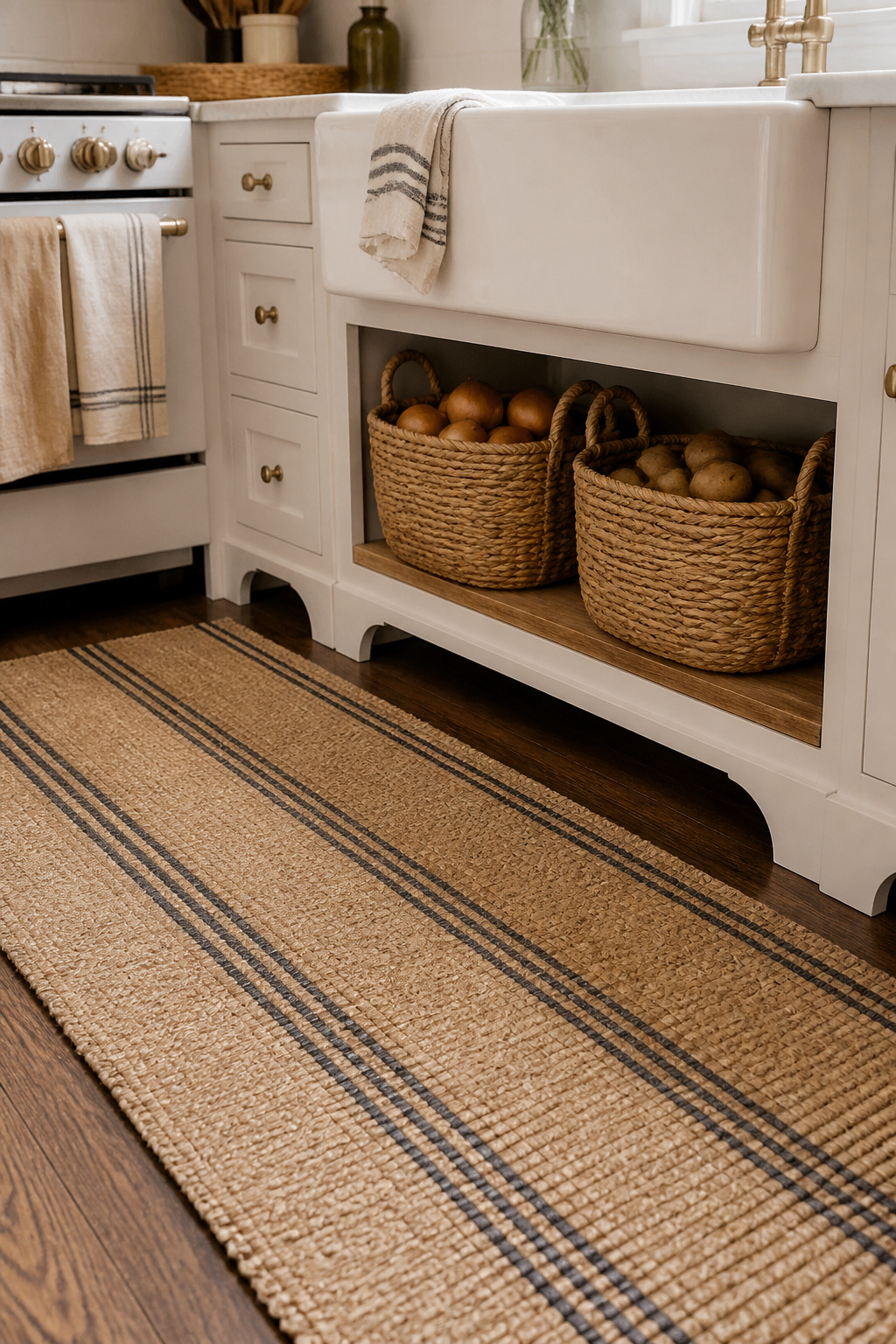
Seagrass and rattan baskets with rigid sides are ideal for storing onions, potatoes, and garlic on lower shelves or in an open pantry. Wicker baskets with handles work for bread, fresh fruit, and produce on the counter. Line baskets going inside cabinets with linen or cotton — they become tidy hidden storage for small appliances or pantry overflow.
For rugs: a cotton or jute runner in front of the sink — typically 24×72 inches — is the most practical farmhouse kitchen rug. Washability is non-negotiable for anything near the water source. Grain sack stripe fabric (neutral backgrounds with colored stripes in red, blue, or black) is the classic farmhouse textile pattern. It’s available as Roman shade kits or rod-pocket curtain panels for straightforward DIY projects. Linen dish towels hung from the oven handle or a towel rail add softness to the kitchen’s hardest-working wall. One sizing mistake to avoid: a 2×3 rug in front of the sink looks like a bath mat. The runner needs to extend past the sink area on both sides to feel proportionate.
12. Cast Iron Cookware Displayed as Kitchen Decor
A well-seasoned cast iron skillet hanging on the wall is the most honest piece of farmhouse kitchen decor you can own. It doesn’t pretend to be decoration — it’s a cooking tool, displayed in the open because it gets used constantly and because the dark, matte surface and worn handle are genuinely beautiful in a farmhouse context. It says this kitchen is for cooking.
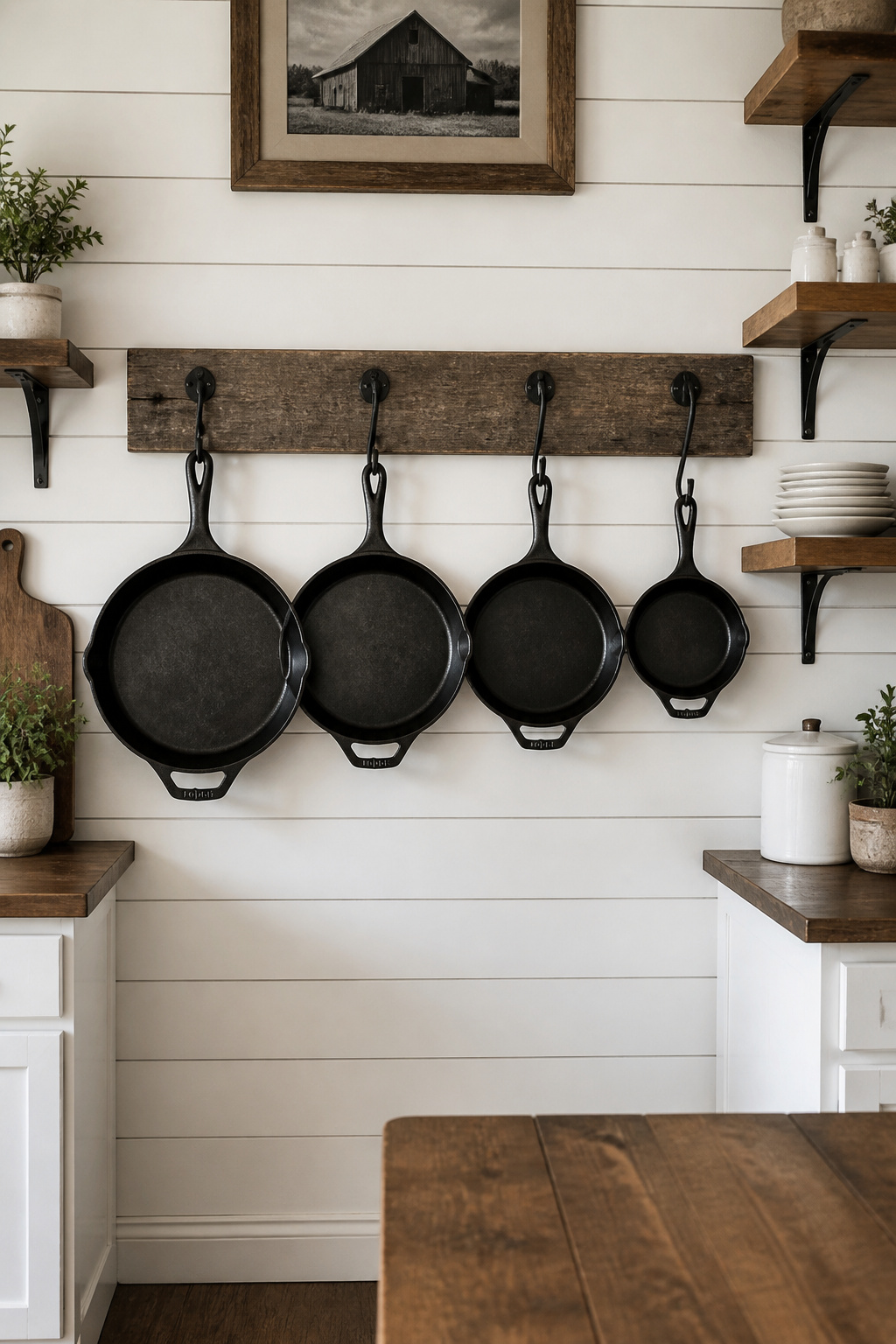
Wall mounting keeps cast iron accessible and promotes airflow that prevents rust. For the mounting: attach to studs whenever possible using heavy-duty hooks or lag screws rated for 50+ lbs each. If no studs fall where you want the display, 1/8-inch toggle bolts rated for 150 lbs each in standard drywall are sufficient for most skillets. The most flexible solution is a horizontal wooden rail — barn wood or painted 1×4 — screwed into the studs, with S-hooks that can be repositioned as your collection grows. Leave 4–6 inches between pan edges so the display doesn’t look cluttered.
Lodge is the most accessible brand: widely available, $20–$50 per skillet, and the factory seasoning looks right from day one. Vintage Griswold and Wagner skillets found at estate sales ($20–$150) have a smoother surface from older machining methods and make beautiful display pieces. A collection of three to five pans in varying sizes fills a wall section handsomely. Skip hanging Dutch ovens and large griddles — they’re too heavy for most wall setups and look better stored below the counter.
13. Country Kitchen Decor: Herb Gardens on the Windowsill
An herb garden on the kitchen windowsill does something no other piece of farmhouse kitchen decor can match: it signals that this kitchen is actively used for real cooking. And it smells like it. A pot of rosemary or basil warming in morning sun, releasing fragrance when you brush past it — that’s a sensory detail that no photograph captures and no reproduction replicates.
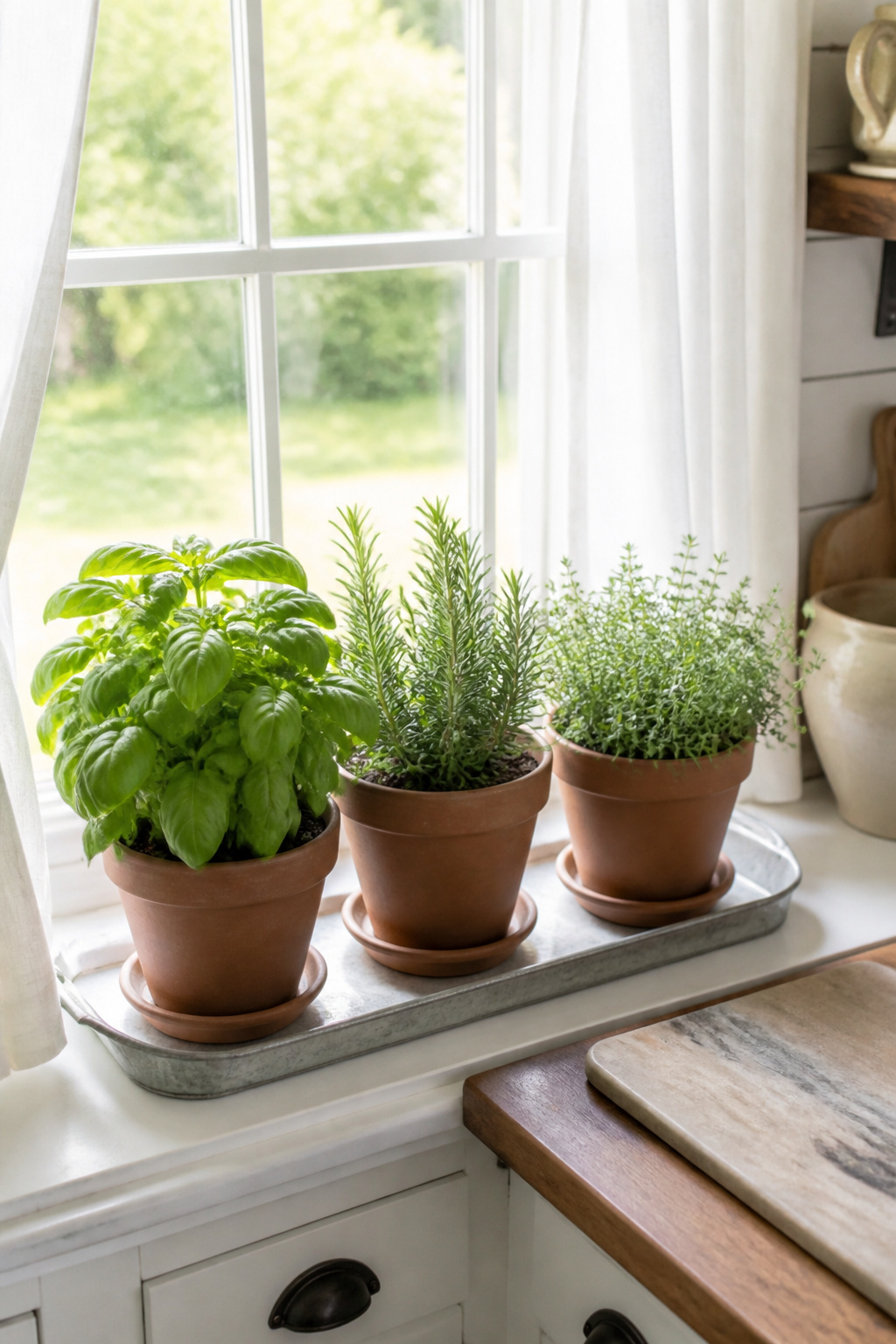
The herbs that perform most reliably depend on your window orientation. South-facing windows (6+ hours of direct sun) suit basil, rosemary, thyme, sage, and oregano — the sun-loving Mediterranean herbs that produce most prolifically when well-lit. East or west-facing windows work for chives, parsley, mint, and cilantro — more tolerant of moderate light, and often more useful in everyday cooking. Keep mint in its own pot; it spreads aggressively in mixed planters.
Terra cotta pots are the farmhouse-appropriate container. Porous sides regulate moisture naturally, which suits the drier conditions most herbs prefer between waterings. Standard 4-inch pots work for most herbs; use 6-inch for rosemary, which grows taller. Three matching terra cotta pots on a galvanized metal tray reads as an intentional display rather than a random collection. Mason jars work in a pinch — but add a layer of pebbles in the bottom to keep roots from sitting in standing water. That standing water is what kills indoor herb gardens more often than anything else.
14. A Farmhouse-Style Kitchen Color Palette That Gets It Right
Color is where many farmhouse kitchens go slightly wrong — not in the shade, but in the undertone. A white with pink or purple undertones will fight the warm wood, ceramic, and galvanized metal that farmhouse kitchens are built around. The palette needs to be warm throughout, from cabinets to walls to grout.
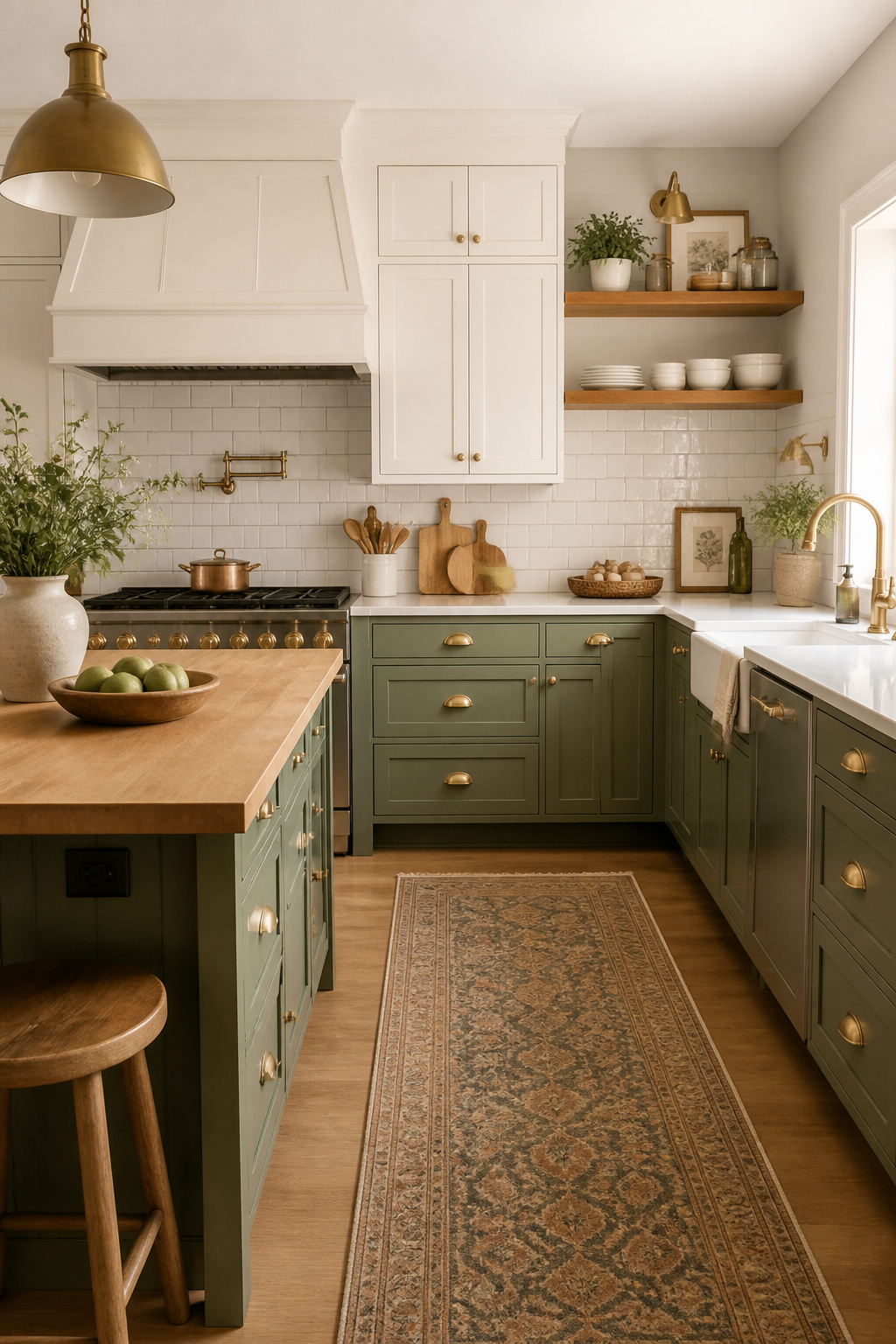
Benjamin Moore White Dove (OC-17) is the farmhouse kitchen white that design professionals return to most consistently. It has a warm yellow-green undertone that reads as cream in natural light and never feels clinical. Sherwin-Williams Alabaster (SW 7008) has a warm beige undertone that pairs beautifully with natural wood and aged brass hardware. In a south-facing kitchen with strong natural light, it reads as a rich cream rather than a pale yellow. Order the large peel-and-stick sample from each brand before committing to full cabinet painting.
For those ready to move beyond white: sage green is the strongest 2026 farmhouse choice. Sherwin-Williams Retreat and Benjamin Moore Cushing Green are both soft, nature-referenced shades that sit comfortably in a farmhouse palette without reading trendy. For green kitchen cabinet ideas that actually transform a space, there’s a full guide with practical application advice. Navy (SW Naval, BM Hale Navy) on island or lower cabinets with white uppers is a farmhouse combination that has outlasted multiple trend cycles. Two-tone cabinets — a bolder color on the lowers, white on the uppers — create a furniture-like quality that suits farmhouse kitchens better than matched-set cabinetry. Test every color in your specific kitchen before committing. Northern-exposure kitchens need warmer whites; the same shade that reads as cream facing south can look gray-blue facing north.
15. Farmhouse Kitchen Decor With Antique and Vintage Finds
There’s a quality in genuine vintage items that reproductions don’t capture — the evidence of actual use. The patina on a dough bowl from decades of flouring and wiping. The faded color on a Pyrex mixing bowl that was someone’s grandmother’s everyday kitchen piece. These imperfections are not flaws to correct. They are the point. And they’re what makes farmhouse kitchen decor look lived-in rather than styled.
At estate sales — the best source by far — look for Pyrex mixing bowls in the colored patterns from the 1950s through 1970s: Gooseberry, Butterprint, and Daisy patterns are the most commonly found and still affordable at $5–$50. For enamelware — the speckled or solid-colored pots, bowls, and mugs — look for pieces with minimal chipping. Chips expose bare metal that can harbor bacteria. Chipped enamelware is for display only, not active cooking. Wooden items — dough bowls, carved spoons, butter molds, chopping boards — can often be restored from rough condition with food-safe mineral oil. Surface cracks and staining are fine; structural splits are not.
The display principle: vintage items belong in full view. A Pyrex bowl on an open shelf is farmhouse kitchen decor; the same bowl in a closed cabinet is just storage. Pair vintage finds with modern appliances without apology — a gleaming range beside a dough bowl collection on open shelves creates the tension that makes farmhouse kitchens interesting rather than static. Keep vintage finds at about 20–30% of the kitchen’s visual content. When everything is antique, the room starts to feel like a shop. When a well-designed kitchen is accented with genuine vintage finds, it feels like someone real and interesting lives there.
Pulling Your Farmhouse Kitchen Decor Together
The temptation with farmhouse kitchen decor is to implement everything at once — the shiplap, the open shelves, the apron sink, the exposed beams, the mason jars — and end up with a room that feels theatrical rather than genuine. The farmhouse kitchens that feel most authentic are the ones built gradually, where each piece has a story and a reason.
Start with paint. It’s the highest-impact, most affordable change in any kitchen. Painting cabinets in a warm white or sage green and replacing the hardware with simple bin pulls in galvanized or aged brass will shift the entire atmosphere for a fraction of what any renovation costs. Add a cotton runner in a grain sack stripe and a trio of herb pots on the windowsill, and you’ve arrived somewhere that feels warm and intentional without spending much at all.
From there, let the farmhouse kitchen decor accumulate rather than arrive. Budget in this sequence: paint and hardware first, then textiles, then vintage finds from estate sales and markets, then lighting and small metal accents, then the larger investments like an apron sink or butcher block countertops when you’re ready. Small kitchens benefit most from ideas that add warmth without physical bulk — open shelving, subway tile, and a herb garden. Larger kitchens earn the architectural elements: beams, shiplap, a freestanding island.
The best farmhouse kitchens aren’t finished. They just keep getting better.