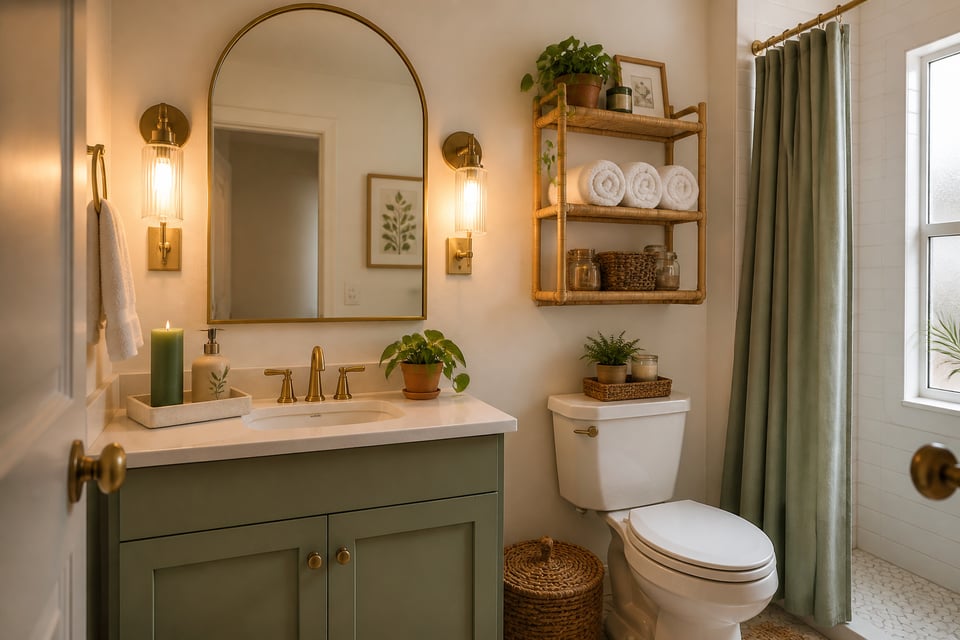
There’s a particular kind of resignation that sets in about two weeks after moving into a new apartment. You’ve unpacked everything, the kitchen looks like yours, the bedroom feels right — and then you catch your reflection in the builder-grade mirror above the builder-grade vanity under the builder-grade overhead light, and the bathroom still doesn’t feel like anyone lives there. As a color and design consultant who works with renters almost exclusively, I’ve watched this happen dozens of times. The good news is that the psychological gap between a bathroom you endure and one you actually want to be in is smaller than most people think — and the solutions are almost entirely renter-safe.
These 18 apartment bathroom decor ideas cover everything from five-minute, $10 fixes to weekend transformations that cost under $100. Each one is reversible. Each one works on the psychology of the space — not just the surface. Your landlord will get back exactly the bathroom they gave you. You, meanwhile, get to stop dreading it.
1. Peel-and-Stick Wallpaper for an Instant Apartment Bathroom Accent Wall
The wall behind the toilet or opposite the vanity is the least-noticed surface in most apartment bathrooms — which is exactly why covering it in something bold and beautiful creates such an outsized visual impact. Peel-and-stick wallpaper made from vinyl or PVC is genuinely moisture-resistant (note: not waterproof — keep it away from inside the shower or directly above the tub), and a single accent wall in a 5×8 ft bathroom typically costs less than $50 in materials.
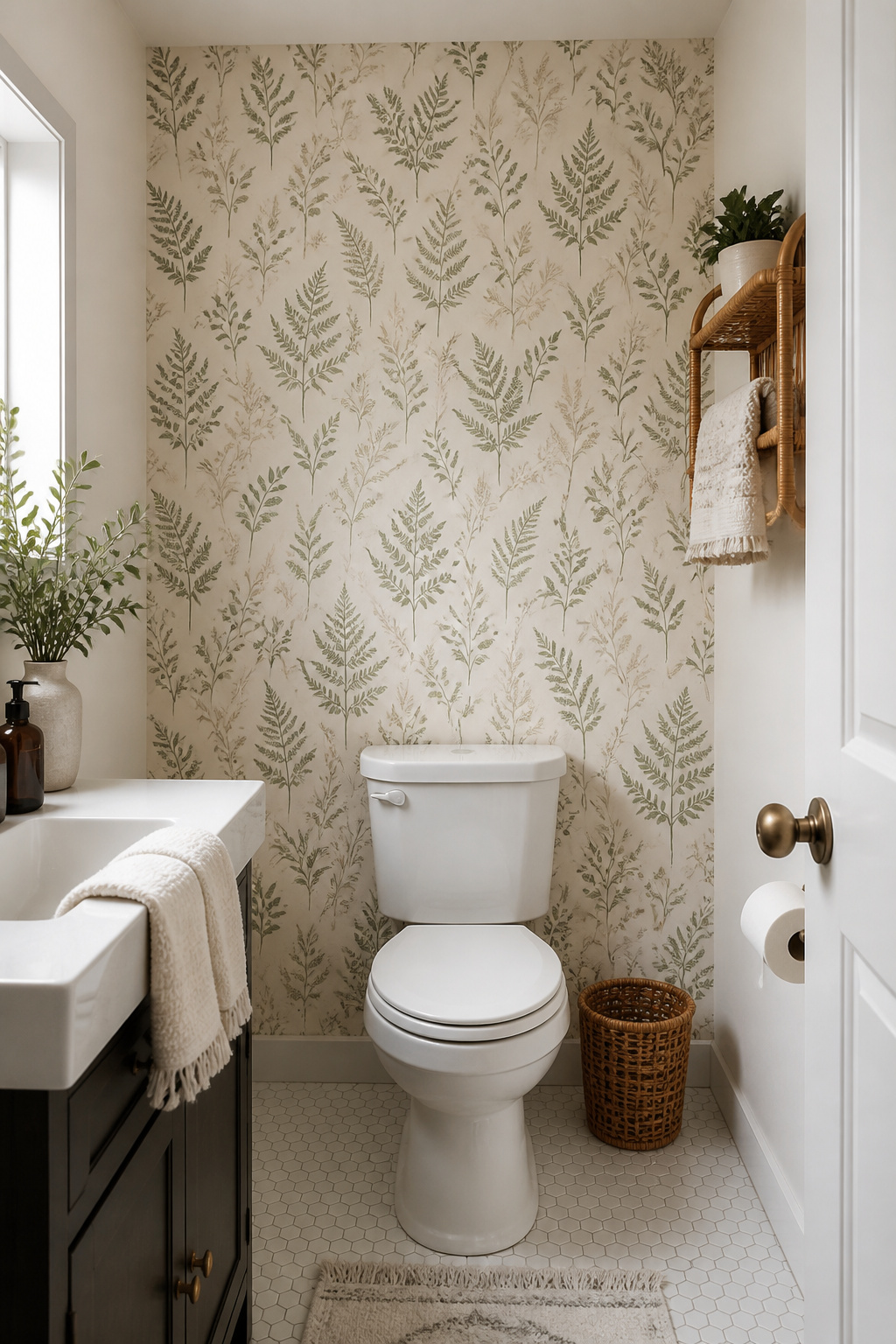
For apartment bathroom decor in a rental, pattern scale matters more than most people expect. Always choose matte finish over glossy — glossy vinyl reflects bathroom light in a way that immediately signals “contact paper,” while matte absorbs light the way real wallpaper does. Keep patterns small to medium; a large-repeat botanical print that works beautifully in a living room will close in a 6×6 space considerably. Vertical stripes and patterns with strong vertical movement are particularly good in apartments with low ceilings that typically come standard.
Application is straightforward but benefits from one step most people skip: clean the wall with a degreasing cleaner first. Soap residue or moisture will prevent proper adhesion and cause edges to lift within weeks. Apply from top to bottom, smooth out bubbles with a credit card or squeegee, and poke any stubborn ones with a pin. Finally, on removal day, pull slowly at a 45-degree angle rather than straight off — this lifts cleanly without pulling paint, and you’ll leave the wall exactly as you found it.
2. A Statement Mirror That Makes Your Bathroom Feel Twice as Large
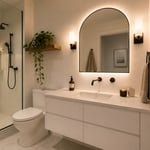
The builder-grade medicine cabinet or the narrow frameless mirror that comes in most apartment bathrooms isn’t a permanent fixture in your mind — replace it visually by leaning or hanging something better. Mirrors are the most optically powerful tool in a small bathroom: they double perceived space, amplify light, and — when properly framed — add architectural character that apartments almost never provide on their own.
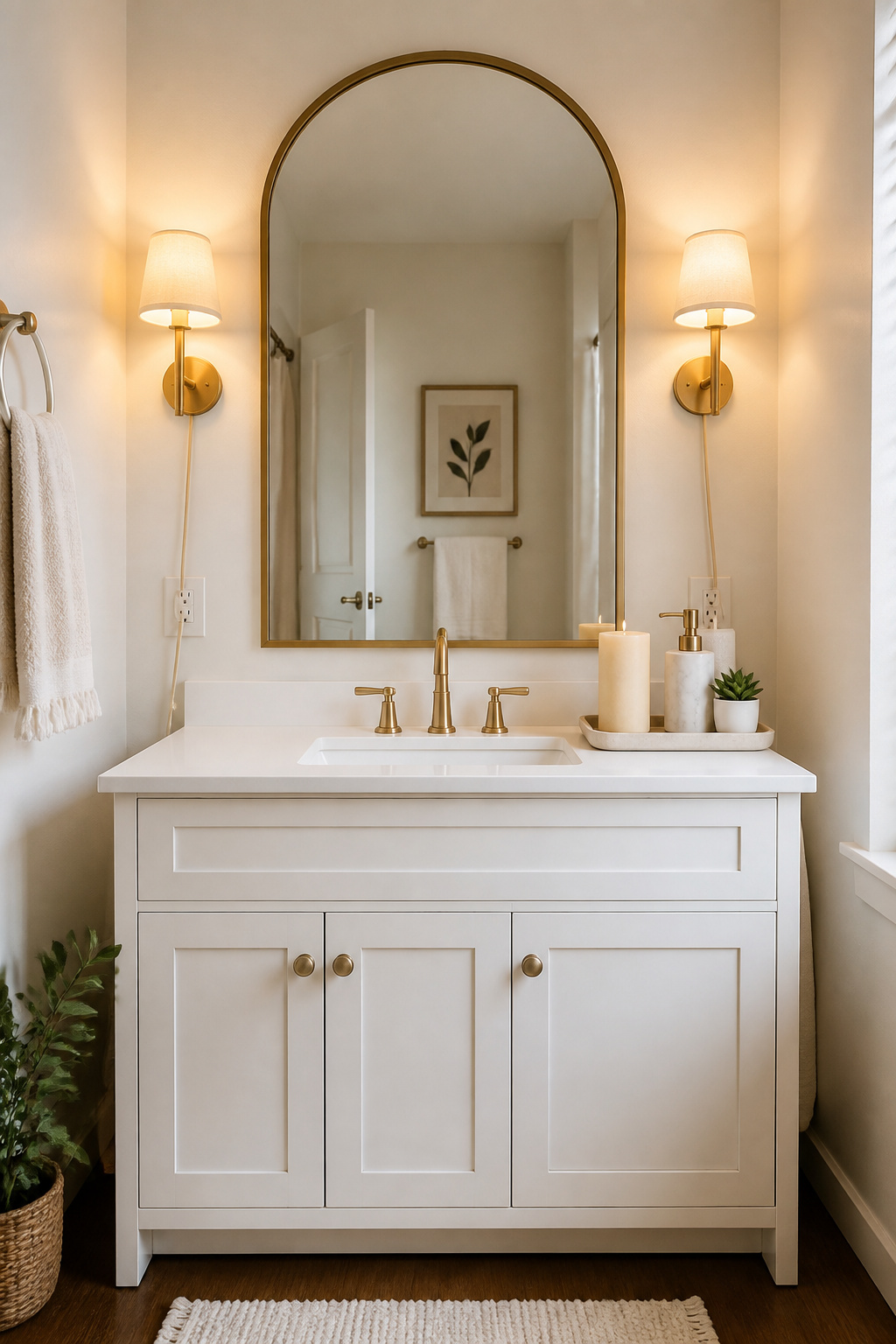
Size matters more than most people realize. A mirror should be at minimum 70% of the vanity width to properly balance the wall — a 24-inch vanity with an 18-inch mirror looks under-dressed regardless of how beautiful the frame is. Arched mirrors are the current workhorses of small bathroom design — the curved top reads as architectural interest in spaces that typically have nothing but right angles. Sunburst mirrors in matte black or brushed brass work in virtually every aesthetic from bohemian to minimal. For genuine character at low cost, vintage ornate gilt frames from thrift stores can be spray-painted — matte black, warm gold, or even soft terracotta — and a $15 thrift find suddenly looks like a $200 statement piece.
For hanging, Command large picture strips handle mirrors up to about 15 lbs on smooth painted walls. For heavier pieces, two small picture hooks make almost-invisible holes that a landlord’s spackle packet and 10 minutes handle on move-out day. Or lean a large framed mirror (anything 40 inches or under) against the wall on top of the vanity — no hardware required at all. There’s a whole world of bathroom mirror ideas that work in any size space worth exploring before you settle for what your lease came with.
3. A Shower Curtain That Does the Heavy Lifting in Your Rental Bathroom
As apartment bathroom decor goes, the shower curtain is the one element almost everyone underestimates. In a standard 5×8 foot bathroom, it covers roughly 25-30% of the room’s total visible surface area — the largest design element in the space by a wide margin. It sets the room’s color palette, establishes its visual weight, and communicates the aesthetic more immediately than any other single piece. Treat it accordingly.
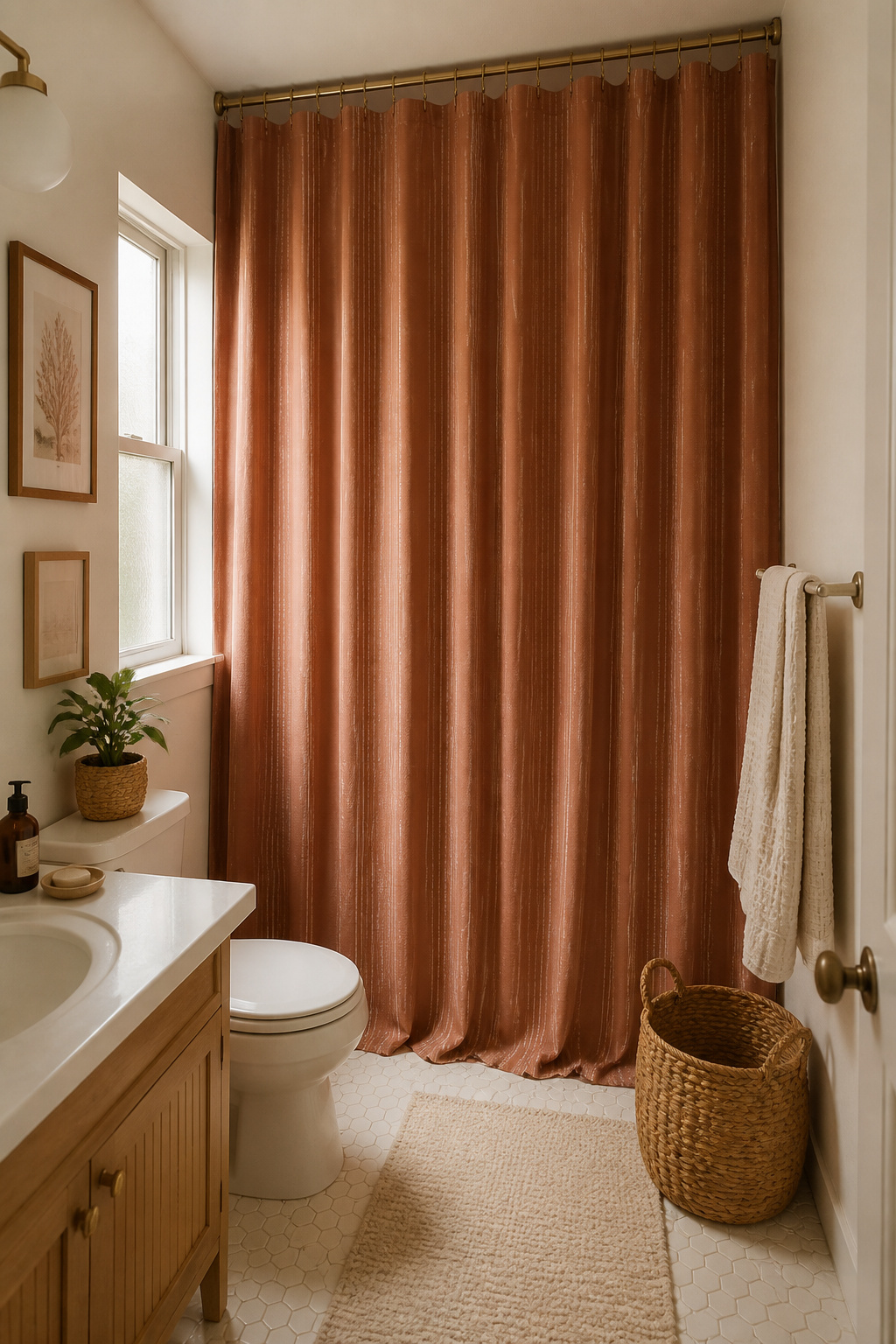
Hanging height is the most overlooked shower curtain variable. Most apartments have a curtain rod at 72 inches — standard height, but not necessarily the best one. Move the rod to 2-4 inches below the ceiling and pair it with an 84-inch curtain, and the room immediately feels taller. The visual trick is simple: the eye follows vertical lines upward, and a curtain that runs from near-ceiling to floor creates the illusion of significantly higher ceilings. This is one of those changes that looks like a renovation but takes under 30 minutes and costs only the price of a new curtain.
For pattern versus solid, the rule is contrast. A bold patterned curtain (geometric, botanical, striped) does its best work against a mostly neutral bathroom — white tiles, neutral mats, solid towels. A solid curtain in an interesting color (warm terracotta, deep sage, dusty blue) works better when you want to introduce other patterns elsewhere in the room. The one thing to resist is exact-matching the curtain to the towels — it reads as a hotel bathroom set rather than a home. Finally, spend $12 on new curtain rings in a metal finish that matches your other hardware. It’s the detail that ties the whole installation together.
4. Plug-In Sconces and Smart Bulbs to Fix Harsh Apartment Bathroom Lighting
Builder-grade bathroom lighting is almost universally a single overhead fixture with cool-white bulbs — usually somewhere in the 4000K-5000K range. That temperature is accurate for task lighting, but in a bathroom context it creates a clinical, slightly disorienting feel that makes the space harder to relax in. The color temperature of a light source activates different neurological pathways: cool white increases alertness (which is why it’s used in hospitals and offices), while warm white at 2700K-3000K mimics the tone of incandescent bulbs and triggers relaxation responses.
The $15 Fix That Changes Everything
The cheapest apartment bathroom decor upgrade you can make — genuinely under $15 — is swapping the overhead bulb to a warm white 2700K option with a CRI of 90 or above. CRI (Color Rendering Index) determines how accurately the bulb renders colors; a 90+ CRI is what makes skin tones look healthy and towels look their actual color rather than a slightly off version. This is the upgrade that makes almost everyone say “oh, this feels different” the next morning — before they’ve even identified why. In fact, the psychological impact of this single swap is disproportionate to its cost: the same room reads as a spa versus a clinic based almost entirely on bulb choice.
The Plug-In Sconce Solution
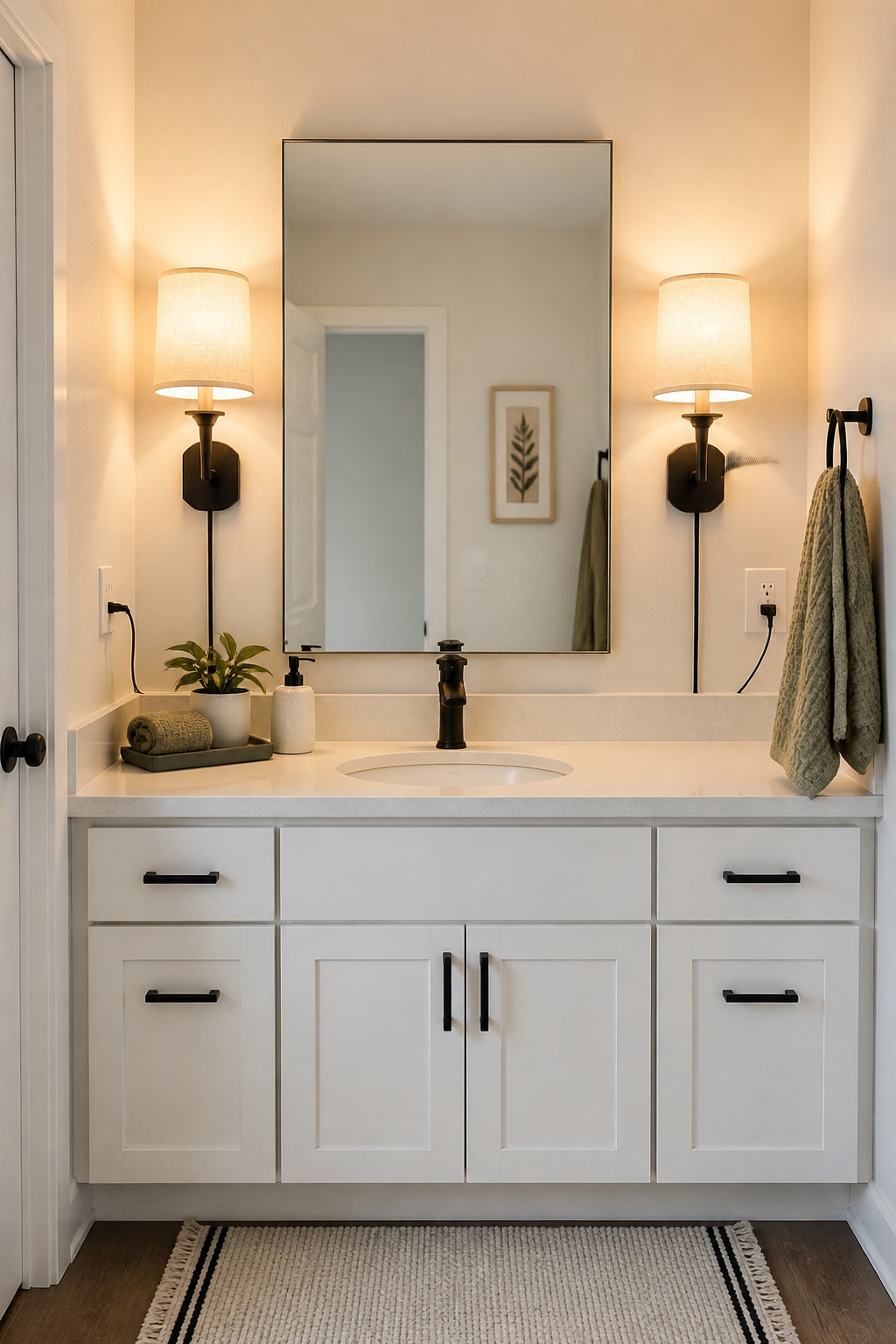
For a more significant upgrade that’s still renter-friendly, plug-in wall sconces flanking the mirror at eye level (roughly 60 inches from the floor) solve the shadow problem that overhead-only lighting creates for grooming. Brands like Wooj, Residence Supply, and Poplight make plug-in dimmable models rated for damp locations, requiring only two small screws and an outlet. The cord can be run along the wall in a paintable cable channel if you want a clean look. The small bathroom lighting secrets that interior designers use almost always come down to this: side lighting at eye level, warm temperature, high CRI. Everything else is secondary.
5. Over-the-Toilet Storage That Adds Style and Function Without Damage
The 24×30 inches of wall above a toilet is the most underused real estate in the average apartment bathroom — the equivalent of a small bookcase worth of storage and display space, sitting there doing nothing. Freestanding etagere units designed specifically for this spot straddle the toilet tank on floor legs, require zero wall hardware, and come with you when you leave.
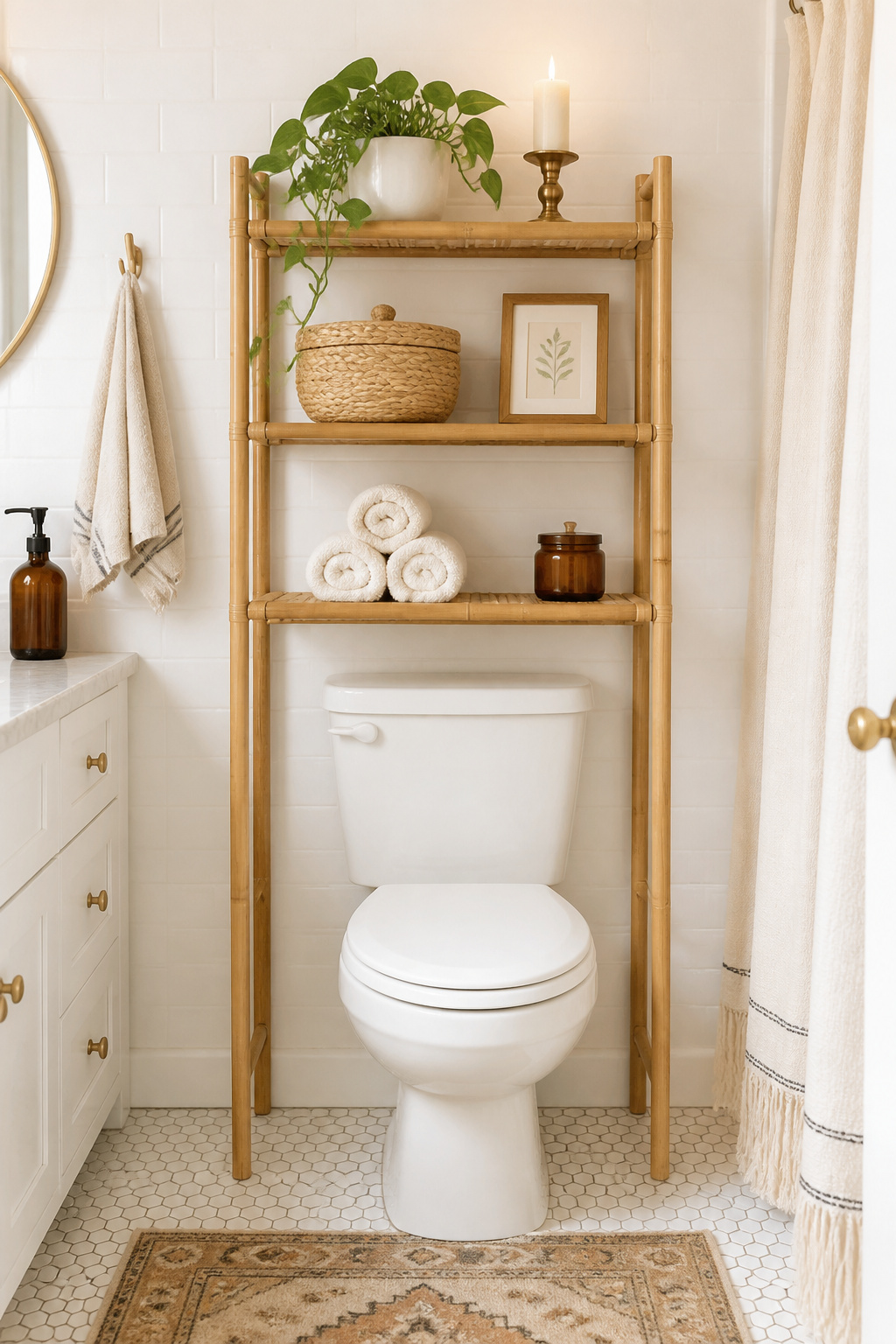
In practice, standard over-toilet etagere dimensions run approximately 24 inches wide by 65-67 inches tall, with the lowest shelf at 36 inches of clearance — enough to clear virtually any standard toilet tank. Bamboo and solid pine units outperform MDF in humid bathroom conditions, both for durability and for visual quality — the material reads as more intentional than particleboard. IKEA’s FRÖSJÖN unit is a good entry-level option at $49; Wayfair and Target carry slightly more decorative options in the $60-90 range.
The shelf styling determines whether the unit looks like a supply closet or a design choice. The top shelf earns its spot with only decorative items — a small plant, a candle, one framed piece of art or a sculptural object. Middle shelves hold woven baskets or lidded containers for toilet paper, skincare, and surplus supplies — concealed is always more interesting than visible product packaging. Lower shelves stay purely functional. Good apartment bathroom decor is never entirely utilitarian — every shelf should have at least one thing the eye wants to linger on.
6. Humidity-Loving Plants That Bring Life Into a Small Bathroom
Research in environmental psychology is fairly consistent: even a single plant in a small enclosed space measurably reduces stress response markers compared to an identical room without greenery. Apartment bathroom decor has a particular need for organic elements — the hard, reflective surfaces (tile, porcelain, chrome) that dominate most rentals create a visual coldness that no decor object replaces as effectively as something living.
Best Plants for Bathroom Conditions
The best plants for apartment bathrooms aren’t delicate or demanding — they’re the ones that evolved in tropical environments where humidity is constantly high and forest canopy keeps direct light low. Pothos trails elegantly from shelves or hanging baskets, handles near-dark conditions, and grows fast enough to feel rewarding. ZZ plants are effectively indestructible in even a windowless bathroom — their glossy dark leaves reflect available light and they require watering only every 2-3 weeks. Peace lilies actively signal when they need water by gently drooping before recovery, making them difficult to overwater or underwater accidentally. Boston ferns love shower steam and thrive when placed on a shelf near the shower area — their feathery fronds soften the space in a way that structured plants can’t.
That said, a bathroom without any window requires rotation. Move plants between the bathroom and a brighter location every 2-3 weeks — even ZZ plants and pothos benefit from occasional higher light to maintain healthy growth. For pot styling: terracotta reads rustic and warm, white ceramic is clean and contemporary, and woven seagrass covers read as natural and spa-like — all three work depending on your overall palette. The pot is part of the design, not just a vessel.
7. Cabinet Hardware Swaps for Rental Bathroom Decor That Costs Almost Nothing
Builder-grade bathroom vanities almost universally come with polished chrome pulls — and it’s that finish, more than the cabinet itself, that signals “rental” to anyone who spends time in design-conscious spaces. Swapping the hardware to matte black, brushed brass, or satin nickel changes the perceived quality of the same cabinet dramatically, for a cost of roughly $3-8 per knob and under 10 minutes of work with a screwdriver.
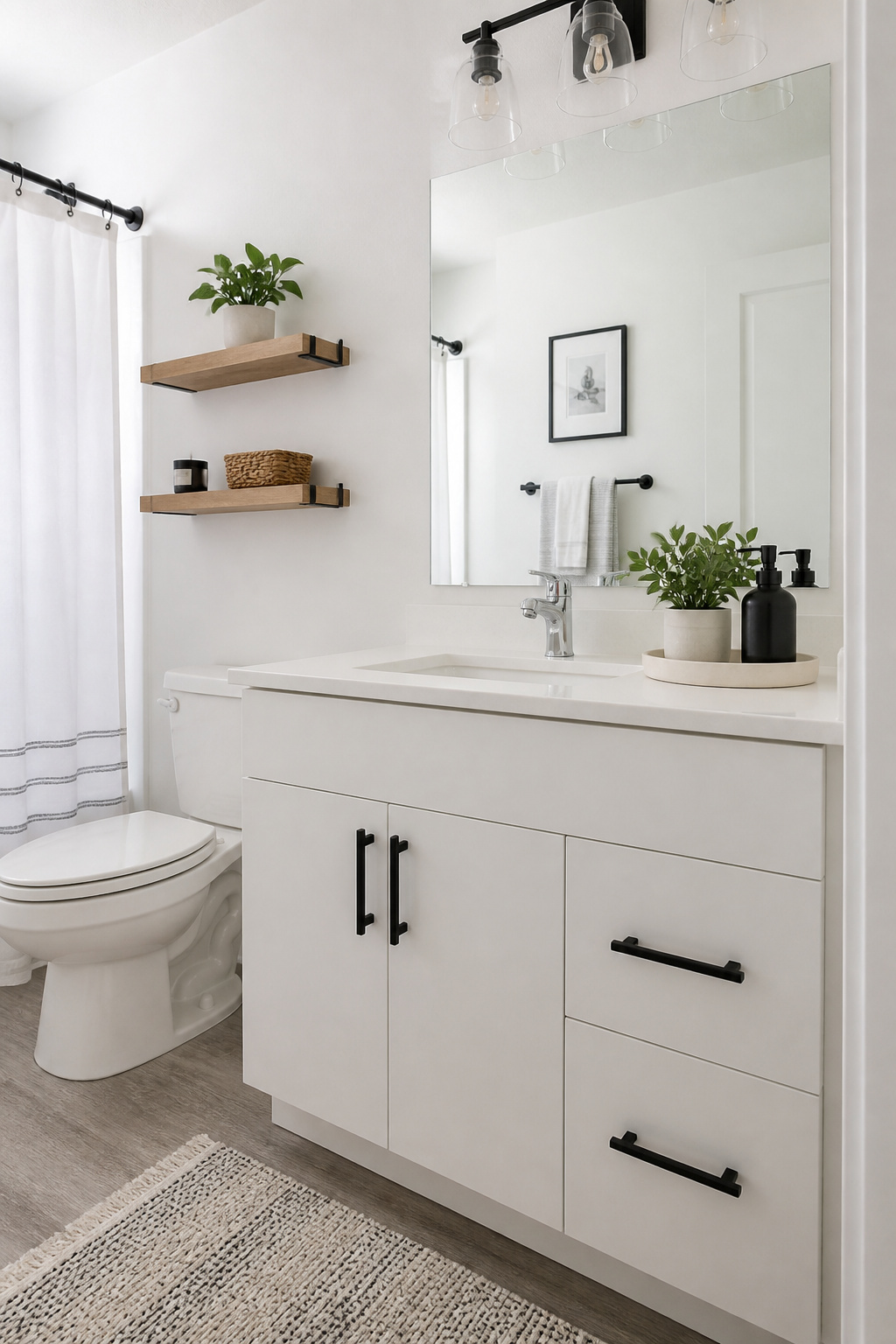
Before buying, measure the center-to-center distance of the existing pull holes — most standard bathroom vanity pulls use 96mm (3-3/4 inch) spacing. Match that measurement exactly when selecting replacements and the swap requires no drilling. For aesthetic guidance: matte black reads contemporary and pairs well with white or light wood-tone cabinets; brushed brass suits warm, eclectic, or vintage-inspired bathrooms and develops a pleasing patina over time; satin nickel is the most versatile neutral, playing well with both warm and cool palettes.
The critical renter step: store the original hardware in a labeled zip-lock bag taped inside the cabinet. This sounds obvious but gets skipped more often than not, and move-out day three years later is a bad time to realize the original chrome pulls are long gone. Keep them safe, reinstall them before handover, and no one needs to know about your upgrade. This is the kind of apartment decor idea that actually works precisely because it’s completely invisible to your landlord.
8. A Coordinated Textile Set That Anchors Your Bathroom Color Story
The textile layer — shower curtain, towels, and bath mat — is the fastest way to establish a deliberate color palette in a bathroom you can’t paint. In apartment bathroom decor, these three pieces carry somewhere around 60-70% of the room’s visible color, which means choosing them reactively (buying whichever towel set is on sale, grabbing whatever curtain fits the rod) means you’ve accidentally designed your bathroom with randomness as the organizing principle.
Apply the 60-30-10 rule directly: the shower curtain is your 60% dominant element and sets the palette; towels are the 30% secondary that reinforces or intentionally contrasts it; bath mat and small accessories carry the 10% accent. In practice, this means if your shower curtain is a warm linen with a subtle blue stripe, your towels might be solid warm white with a coordinating texture (waffle weave or ribbed cotton), and your bath mat adds the blue more solidly. Everything connects, nothing matches exactly.
For textile quality, GSM (grams per square meter) tells you most of what you need to know about towels — 400-600 GSM is the standard range, 600+ feels genuinely luxurious. Turkish cotton towels at 400-500 GSM have a flatter weave that dries quickly and photographs well — relevant if your bathroom ever appears on a social media story or real estate listing. One color note: avoid pure white towels. They look dingy within weeks and require bleaching to maintain, which shortens their life. Warm off-whites — cream, natural, soft oatmeal — age far more gracefully.
9. Contact Paper for a Vanity and Countertop Refresh
The honey oak laminate or country oak veneer vanity common in apartments built between 1985 and 2005 is probably the single most dated element in a rental bathroom — and it’s also entirely transformable without permanent modification. This is apartment bathroom decor that costs under $30 and, done well, is genuinely convincing: matte marble or concrete-look contact paper applied to the vanity doors and countertop edge reads, from across a small bathroom, close enough to real stone.
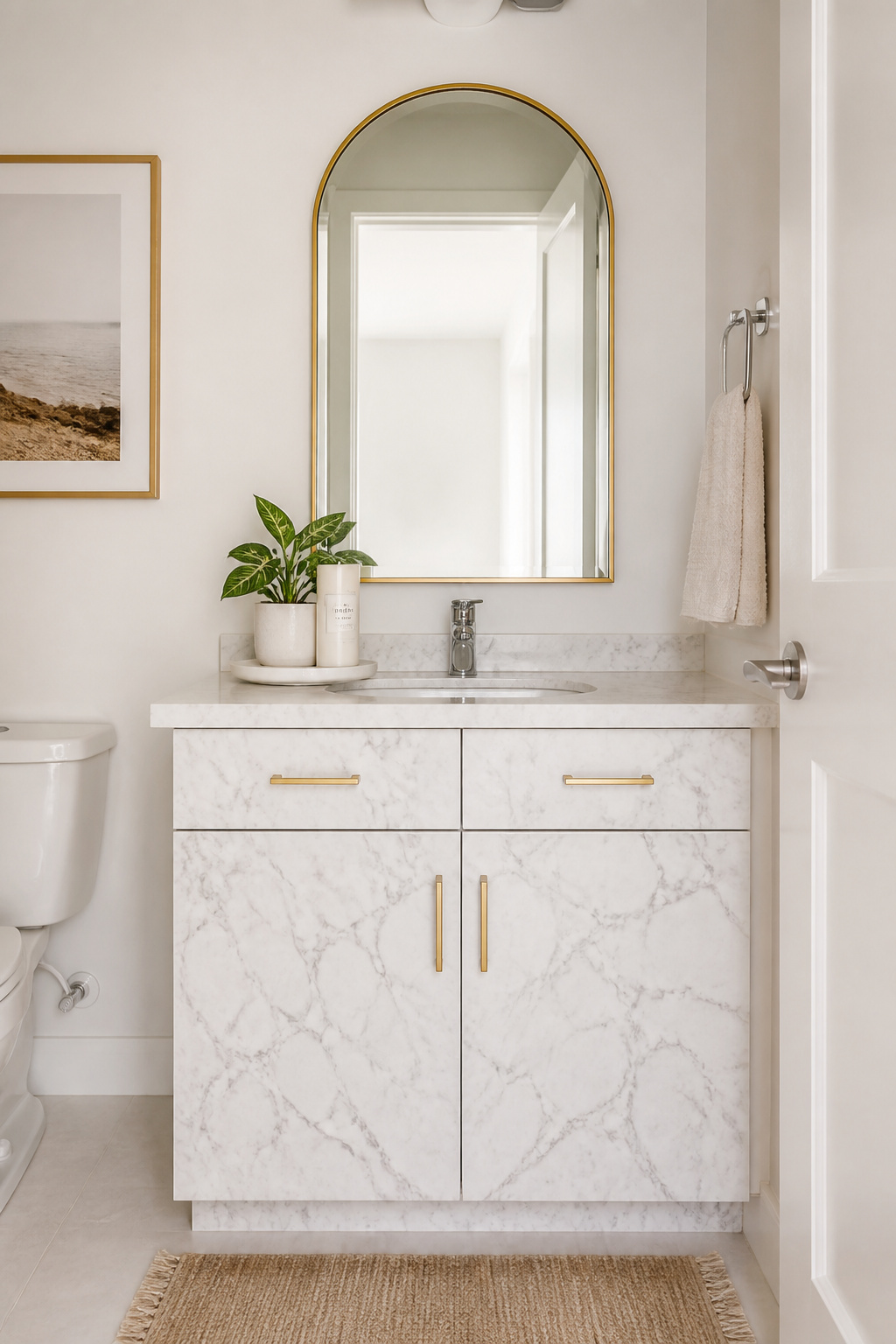
D-c-fix is the benchmark brand for this application — a German manufacturer with decades in the adhesive film category, and its marble patterns (the Marble Grey Levanto and White Marble are the most convincing) have the veining scale and matte finish that cheaper brands get wrong. Livelynine is a close second for quality at a slightly lower price point. Both are waterproof and hold up in bathroom humidity. Always choose matte over glossy — glossy vinyl reflects light artificially and looks obviously synthetic under bathroom lighting, especially the overhead kind. (Trust me on the matte finish — glossy contact paper fools exactly no one.)
Application requires one important preparation step: clean the surface with a degreasing cleaner and let it dry completely before touching the contact paper. For countertops, cut slightly oversized, smooth from one edge across using a credit card or rubber squeegee, trim the excess with a craft knife. For removal (whenever that day comes), a hair dryer or heat gun on the surface for 30-60 seconds before peeling lifts the adhesive cleanly. Any remaining sticky residue comes off with Goo Gone and a cloth.
10. A Bathroom Gallery Wall That Works for Apartment Bathroom Decor on Any Budget
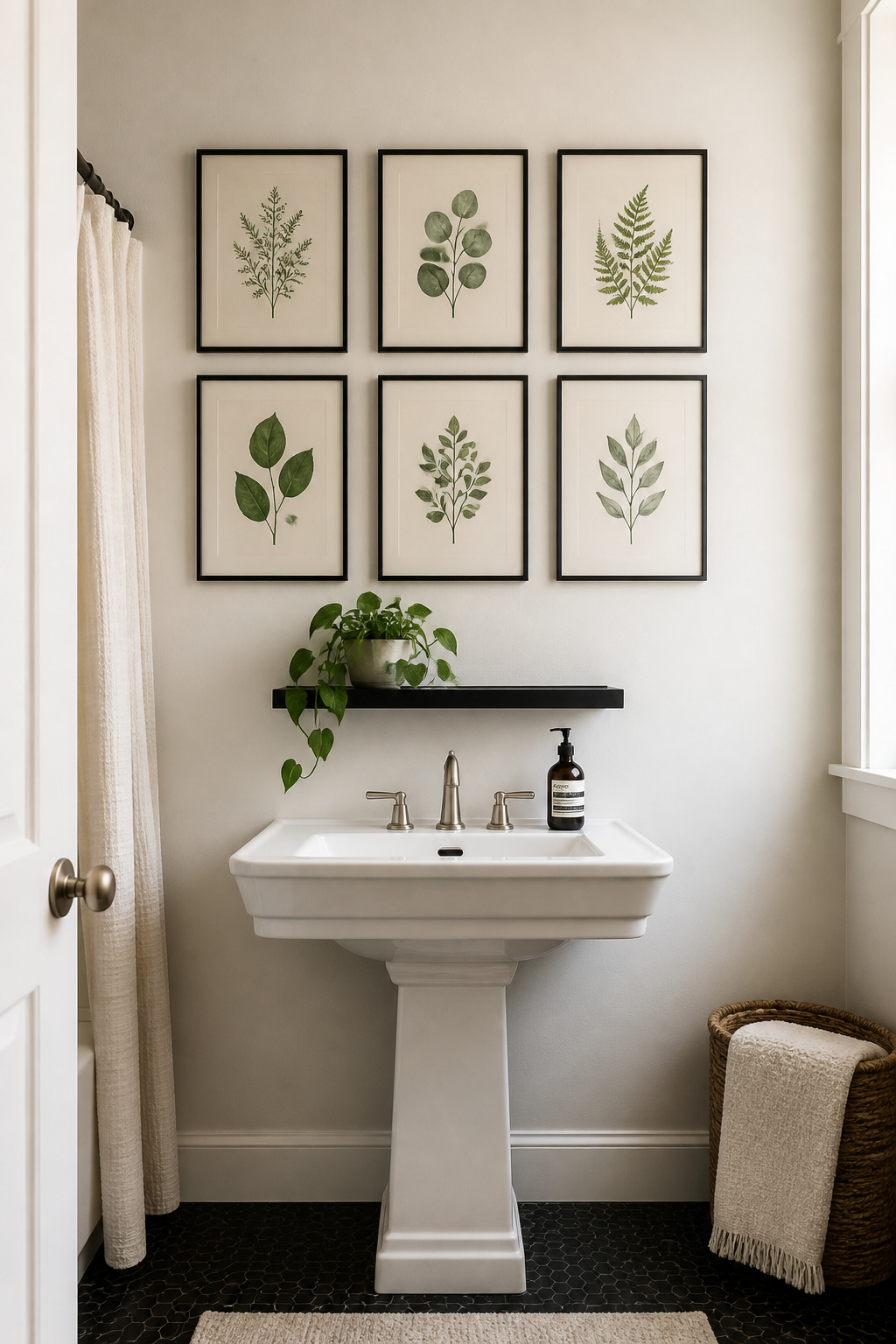
The wall opposite the bathroom door is the first thing you see when you enter — and in most apartments, it’s a blank expanse of contractor white. A gallery wall of 4-6 framed pieces in this location creates an immediate design impression that makes the entire bathroom feel intentional, regardless of what the fixtures look like. The wall above a towel bar is the second-best location: horizontal and at eye level, with natural boundaries provided by the bar itself.
Art That Survives Bathroom Humidity
Humidity-safe framing is the practical constraint that makes bathroom gallery walls different from those anywhere else in the apartment. Acrylic glass (plexiglass) is the standard recommendation over regular glass — it’s lighter, won’t shatter, and moisture can’t get between the frame and the print. Metal art prints on an aluminum substrate are the most humidity-proof option — brands like Desenio, Minted, and Artifact Uprising all offer them. Avoid paper-backed prints without sealed framing, original paintings, and anything irreplaceable. For frames, sealed wood or metal outperform unsealed wood and MDF, which swell.
Hanging Without Nail Holes
For hanging, Command large picture strips (rated to 16 lbs per pair) handle most framed prints cleanly on smooth painted walls. Map your layout on the floor first, photograph it, then transfer the measurements to the wall using painter’s tape markers before committing any adhesive. In a small bathroom specifically, a grid layout — matching frames in a 2×2 or 3×2 arrangement — looks cleaner and more deliberate than an organic salon-style spread. There are plenty of small bathroom decor ideas that maximize space if you want to see how other small-format wall arrangements can work.
11. Woven Baskets and Natural Textures That Add Warmth Without Visual Noise
Environmental psychology research supports what many people feel intuitively: organic textures — woven fiber, unfinished wood, natural stone — create warmth associations that hard, reflective surfaces don’t. Apartment bathroom decor that incorporates natural materials shifts the room’s felt temperature without changing a single fixture. Bathrooms are dominated by tile, porcelain, and chrome, which read as cool both literally and visually. Introducing one woven element immediately breaks that pattern.
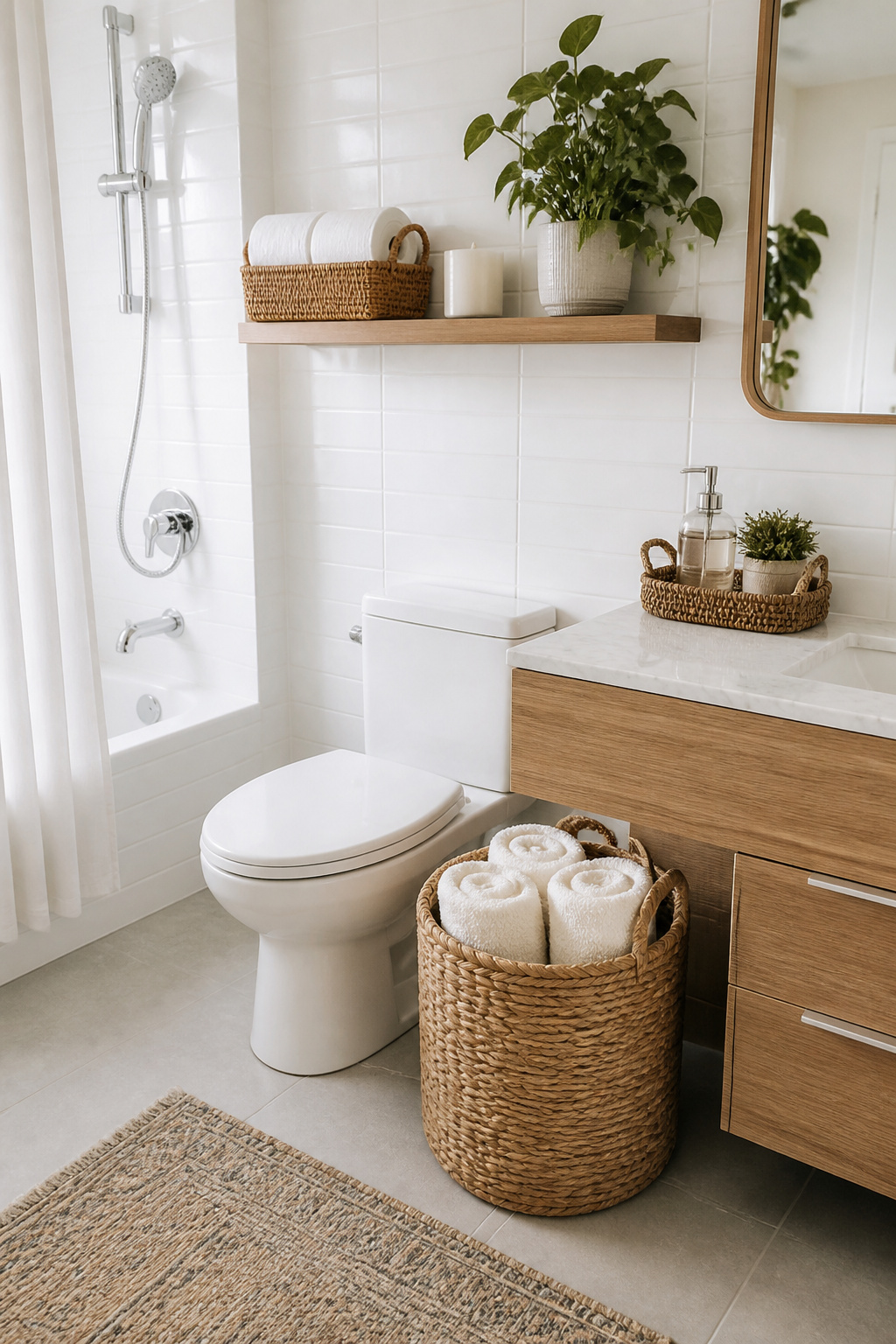
The format matters for placement. Tall seagrass floor baskets (12-16 inches in diameter, 18-24 inches tall) placed beside the vanity or toilet for rolled towel storage are the most visually impactful single piece — they read as both functional and decorative and draw the eye downward in a way that grounds the room. Rectangular shelf baskets in a 4×12 inch range fit on over-toilet etagere shelves and hide functional clutter behind a natural facade. On countertops, a small woven tray provides breathable organization that lets you access items quickly while still corralling them visually.
When mixing natural fiber materials, the unifying principle is color rather than weave type. Rattan, seagrass, jute, and wicker can coexist in the same room as long as they stay in the same warm beige-to-tan range — the eye reads this as a cohesive natural palette rather than a collection of mismatched objects. The only exception: avoid dark-stained wicker. The brown tone reads as dated, heavy, and 1990s. Natural undyed tones age well and photograph warmly.
12. Tray Styling: Turning Toiletries Into Apartment Bathroom Decor
There is a design principle at work in every beautiful bathroom countertop: objects inside a defined boundary — a tray, a board, a low dish — register to the eye as a single organized unit rather than individual items. The same four items sitting individually on a countertop look like clutter. On a tray, they look curated. This is not a subjective impression; it reflects how the brain processes visual boundaries and grouping. A $20 tray is doing genuine psychological work.
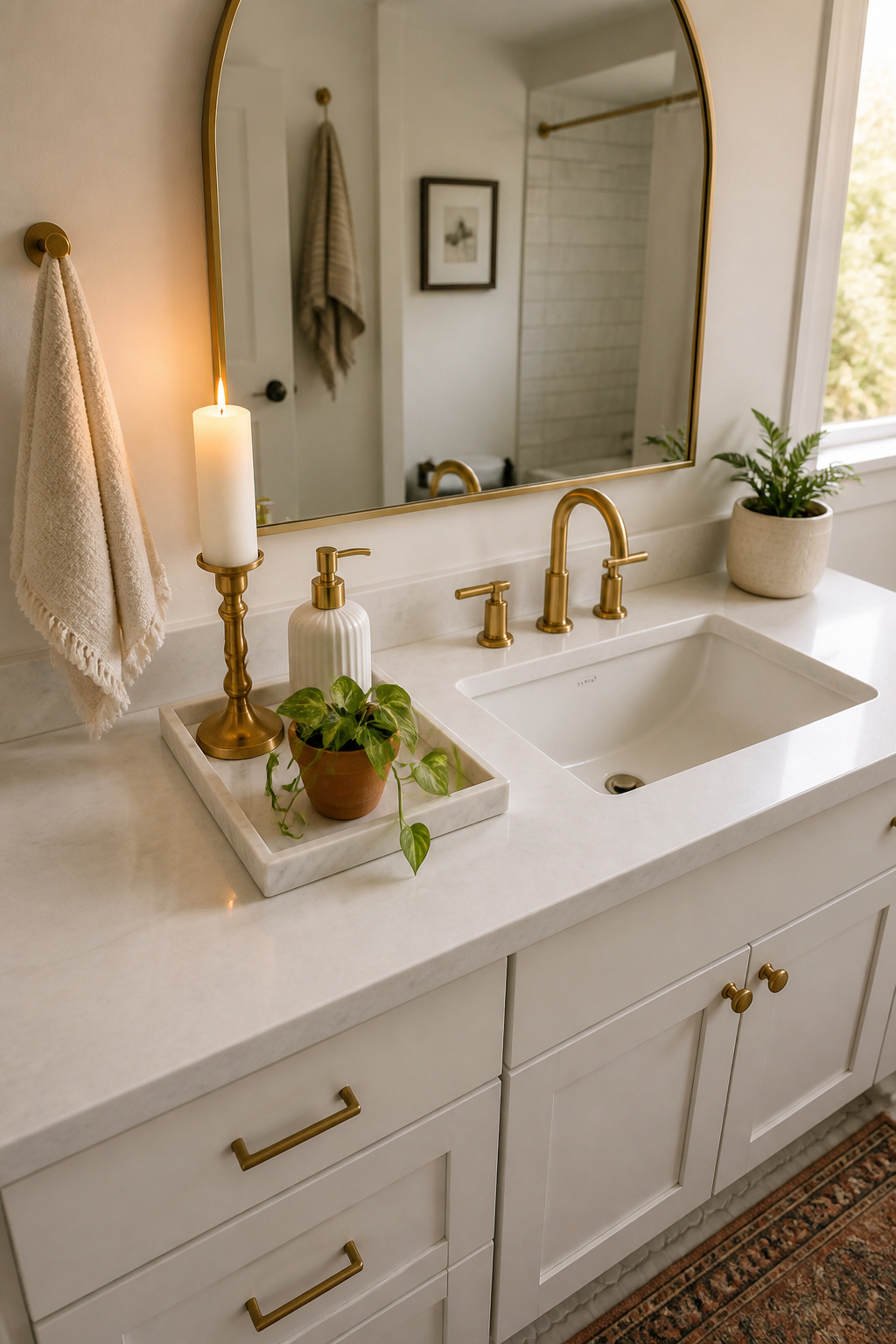
The rule of three applies directly to tray styling: one tall object, one medium, one low, with deliberate space between them. In practice, this might be a tall candle (fragrance and height), a beautiful pump dispenser or perfume bottle (medium, functional and visual), and a small ceramic ring dish or succulent (low, textural). The objects create a visual triangle that the eye finds naturally pleasing. For the tray itself: white ceramic or marble suits minimal and modern bathrooms; brass or warm gold metal suits eclectic and vintage-inspired spaces; natural wood or acacia adds organic warmth to any palette.
The discipline is the edit. On the tray: things you’re proud to display — a beautiful candle, a decanted soap, a plant or object you like looking at. Hidden in the cabinet: everything with ugly utilitarian packaging — the drugstore shampoo, the cleaning spray, the dental hygiene supplies. The display test is simple: if you’d put it away before a guest arrived, it shouldn’t be on the tray permanently.
13. Tension Rod Under-Sink Organizers That Double Your Storage Space
The under-sink cabinet is the most chaotic space in the typical apartment bathroom — a dark, shapeless cavity where cleaning products and spare toiletries pile up in an arrangement that can charitably be described as “provisional.” This is apartment bathroom decor and organization working in tandem: a tension rod installed horizontally 8-10 inches below the cabinet top rail, spanning the full interior width, costs less than $10 and takes under five minutes.
Trigger-grip spray bottles hang directly over the rod through their trigger mechanism, taking all that vertical space between the rod and the cabinet ceiling. The floor of the cabinet — previously inaccessible because it was covered in spray bottles — is now entirely free for flat-pack drawer bins, a pull-out organizer, or stacked product. Standard under-sink cabinets in apartments run 18-24 inches wide; an adjustable tension rod in the 18-26 inch range fits universally. Add a few S-hooks to the rod and you can also hang a scrub brush, a microfiber cloth, or small baskets with wire handles — essentially a second tier for free.
Combine the tension rod with two other tools for maximum effect: adhesive Command hooks on the inside of the cabinet doors (for a hair dryer, flat iron, or small bags) and a lazy Susan on the cabinet floor (for bottles and jars too wide to hang, with 360-degree spinning access that beats reaching to the back of a dark cabinet). These three tools together transform an unusable cavity into organized, accessible storage — and they’re all renter-safe. For more ideas in this vein, this collection of clever small bathroom storage solutions goes deeper on the organizational side.
14. The Color Psychology of Bathroom Decor Choices That Affect How You Start the Day
The bathroom is where most people spend the first 15-30 intentional minutes of their day, and the psychological research on environmental influence is consistent: the colors and light quality you’re surrounded by in the first half-hour set an emotional baseline that follows you. This isn’t a design philosophy argument — it’s neuroscience. The environment shapes mood before conscious choice does.
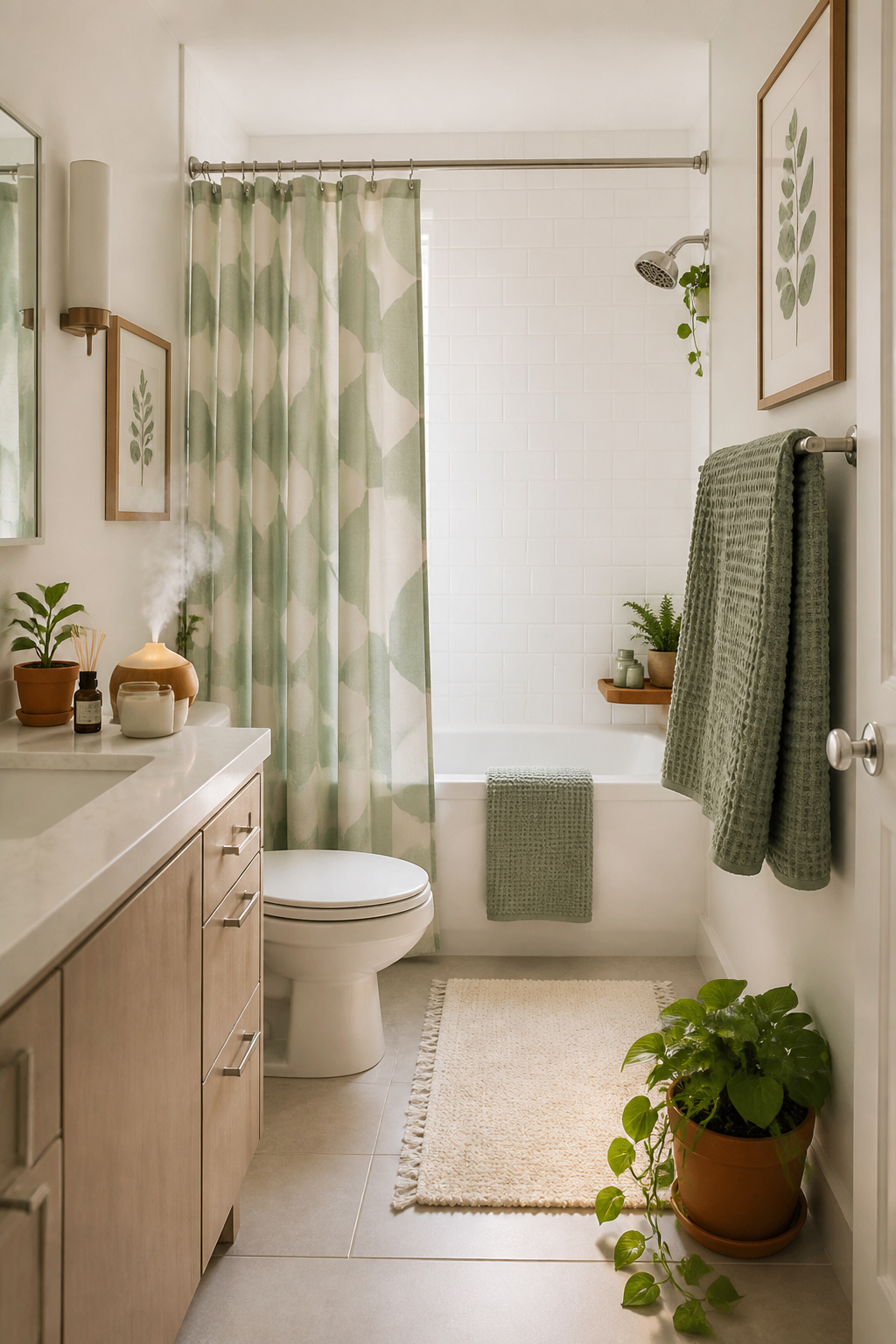
Cool blues and soft greens reduce stress response markers, lower perceived heart rate, and create associations with sky, water, and natural environments — this is why spa bathrooms are almost universally in these tones. Warm yellows, terracottas, and oranges stimulate serotonin production and increase alertness and optimism — they’re the better choice for people who struggle with morning energy and need an environmental nudge. The right palette for your bathroom depends on how you actually use the space: as a decompression zone in the evening (choose calming cool tones), as a morning launch pad (choose warm energizing tones), or as both (choose a calm neutral base with warm accent details).
The renter-safe delivery mechanism for all of this is textiles and accessories rather than paint. Research on color perception shows that 70% of color impression comes from vertical-surface elements — shower curtains, towels, wall art — rather than wall color. A sage green shower curtain and matching hand towels against white tile creates the same calming neurological association as sage green walls. A terracotta bath mat and warm brass accessories against a neutral tile background deliver morning energy without a single stroke of paint. The psychology works through the color, regardless of what object carries it.
15. Vintage and Thrifted Finds as Character Pieces in a Rental Bath
Matching sets from big-box retailers signal one thing clearly: the room was recently furnished, all at once, from a single source. This is fine for functionality but it reads as a starting point rather than a home — there’s no visual evidence of personality, history, or taste beyond “bought these together on a Tuesday.” One genuinely unusual vintage piece does more for a bathroom’s character than an entire coordinated collection from Target.
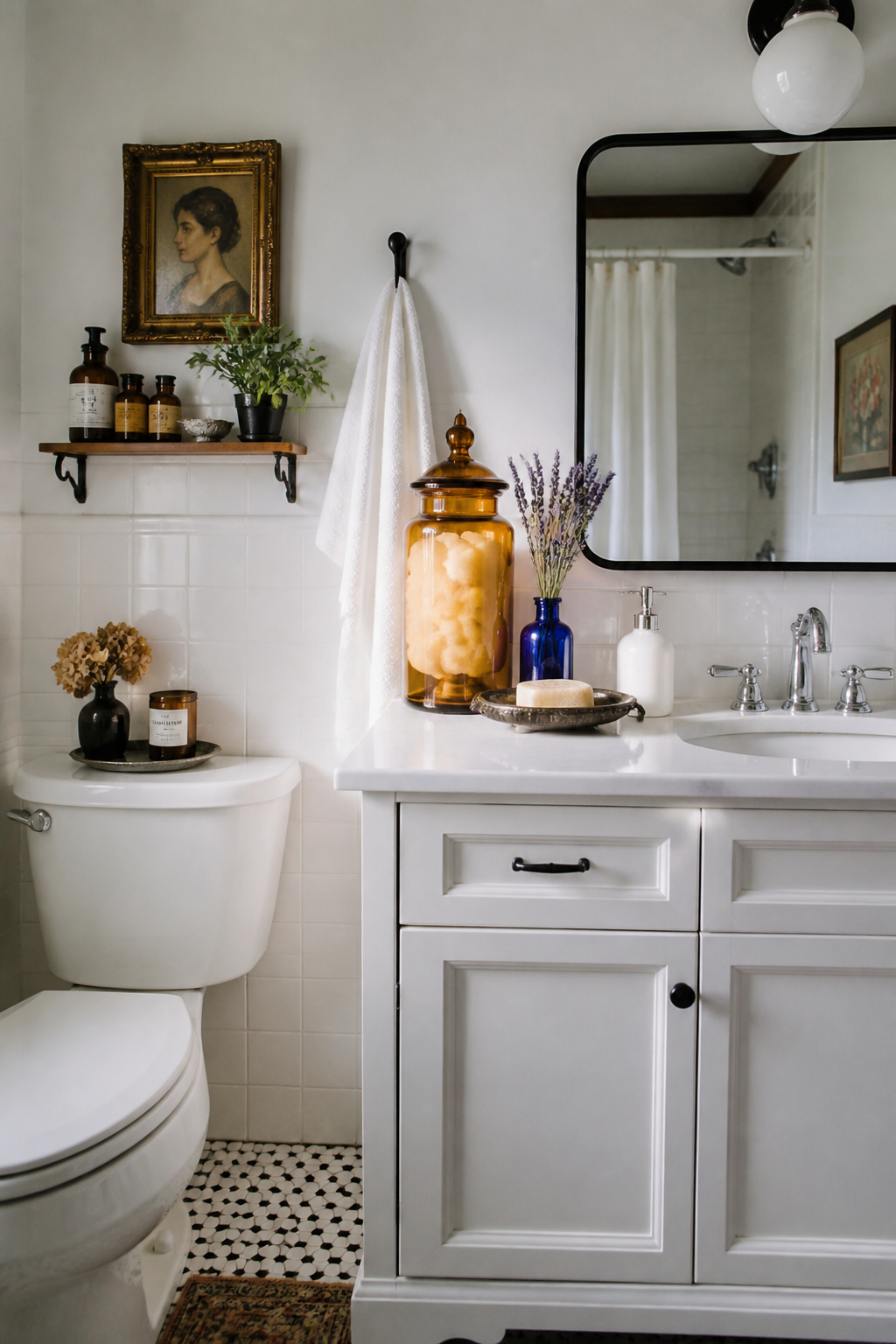
In apartment bathroom decor, thrifted character pieces punch well above their price. The apothecary aesthetic — jewel-toned glass, antique metal, amber-hued pharmaceutical glass, thick-cut crystal — translates directly from thrift store shelves to bathroom countertops. A cobalt blue glass apothecary jar (usually $3-5 at Goodwill) holds cotton rounds, Q-tips, or bath salts and looks like a deliberate design statement. An antique silver-plate soap dish with aged patina ($4-8 at estate sales) sits beside a modern pump dispenser and makes both pieces look more interesting. A small vintage perfume bottle repurposed as a reed diffuser or hair pin holder costs almost nothing and registers immediately as personal.
The mixing principle matters as much as the pieces themselves. Apply the 80/20 rule: 20% or fewer vintage pieces against 80% contemporary ensures intrigue without clutter. Group smaller vintage finds together on the countertop or tray rather than scattering them across the room — clustered objects read as a curated collection; scattered ones read as items that need to be put away. Always pair vintage pieces with very clean, contemporary neighbors: an amber apothecary jar looks more intentional next to a white ceramic soap pump than next to another vintage piece.
16. Candle and Fragrance Styling for an Elevated Bathroom Atmosphere
Scent is processed directly by the limbic system — the brain’s emotional center — which means it bypasses the conscious mind and creates an immediate atmospheric impression. Of all the tools in apartment bathroom decor, fragrance is the most underestimated: before you’ve noticed the artwork, the mirror, or the carefully chosen towels, you’ve already experienced the room through smell. A bathroom that greets you with eucalyptus or cedar registers as spa-like before the eye has processed anything.
Display Strategies
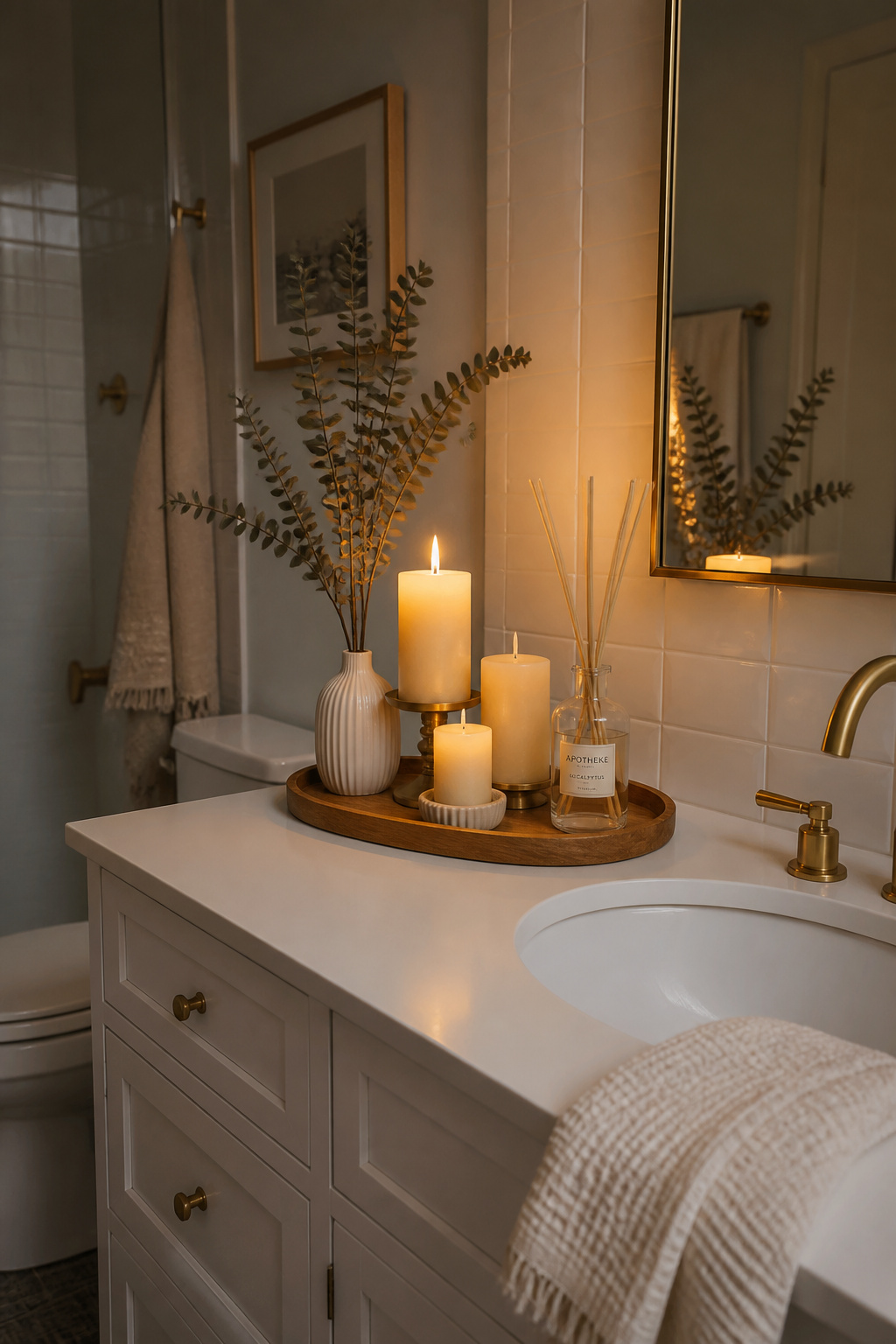
Reed diffusers are the most practical choice for continuous bathroom fragrance — no flame, no maintenance beyond a weekly flip of the reeds, and the glass vessel itself is a design object. Eucalyptus, cedar, lavender, and sandalwood are the most universally well-received bathroom scents; avoid food-adjacent fragrances (vanilla, caramel, baked goods) in bathrooms, where they land strangely. For displayed candles, group them in odd numbers at varying heights — a tall pillar, a medium vessel candle, a small tea light holder creates a naturally staggered arrangement that reads as styled rather than just placed. Dried botanicals (eucalyptus stems in a vase, preserved pampas grass) add visual texture and subtle ambient scent without flame.
Fire Safety in Small Bathrooms
For fire safety in a small bathroom: never position a burning candle within 12 inches of a towel, curtain, or toilet paper roll — these are the most common proximate causes of bathroom candle accidents. Flameless electric wax warmers produce identical scent to burning candles with zero flame risk and can be left on for hours. An ultrasonic essential oil diffuser provides the most controllable fragrance strength — 200ml running for 30 minutes before a shower will scent the space for hours and adds gentle humidity in very dry apartments.
17. Floating Shelves on Command Strips for Apartment Bathroom Display
A floating shelf mounted 6-8 inches above the toilet tank top is one of the most space-efficient display additions you can make to an apartment bathroom — at that height, objects are at natural viewing level when you’re in the space, and the shelf protrudes no more than 4-6 inches into the room, taking up essentially zero floor space. For renters, Command Bath series strips (the humidity-formulated version, not standard picture-hanging strips) hold up to 16 lbs on smooth painted drywall and remove cleanly without wall damage.
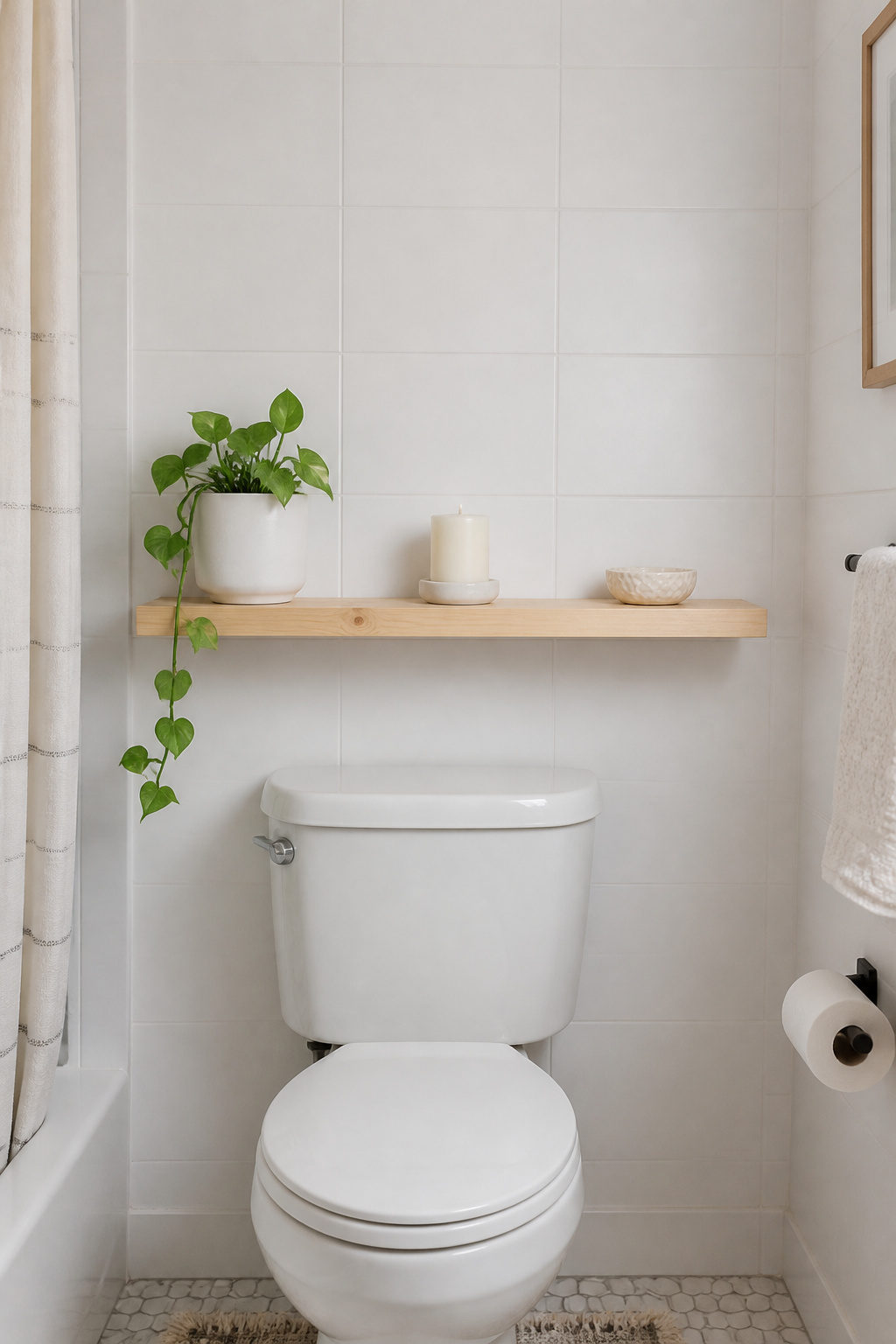
Shelf material communicates aesthetic immediately. White floating shelves read as a wall extension and make displayed objects appear to float independently — the minimal look. Natural wood-tone shelves in pine or oak add the warm organic contrast that bathrooms lack, and suit farmhouse, rustic, and biophilic aesthetics. Black metal bracket shelves make the structural element part of the design statement, which works in industrial and contemporary bathrooms. The bracket is visible — lean into it.
Styling a small bathroom shelf demands restraint. The 3-object rule: one tall, one medium, one low, with negative space deliberately left between them. A small pothos (height, living), a scented candle (medium, dual-purpose), a small ceramic piece or shell (low, texture). That’s it. The moment you start adding a fourth item “because there’s space,” the shelf tips from curated to cluttered. For more context on how these kinds of spatial decisions compound across a small room, there’s a well-assembled guide to small bathroom interior ideas that maximize your space worth reading before you start.
18. A Cohesive Color Story That Ties Every Apartment Bathroom Decor Element Together
Cohesion in a small bathroom isn’t about matching — it’s about a consistent visual language. A bathroom where the shower curtain, the towels, the mat, and the accessories all come from the same collection looks like a hotel room. A bathroom where different pieces share the same underlying palette, metal finish family, and visual weight reads as a home. The difference is intentionality in the framework, not uniformity in the objects.
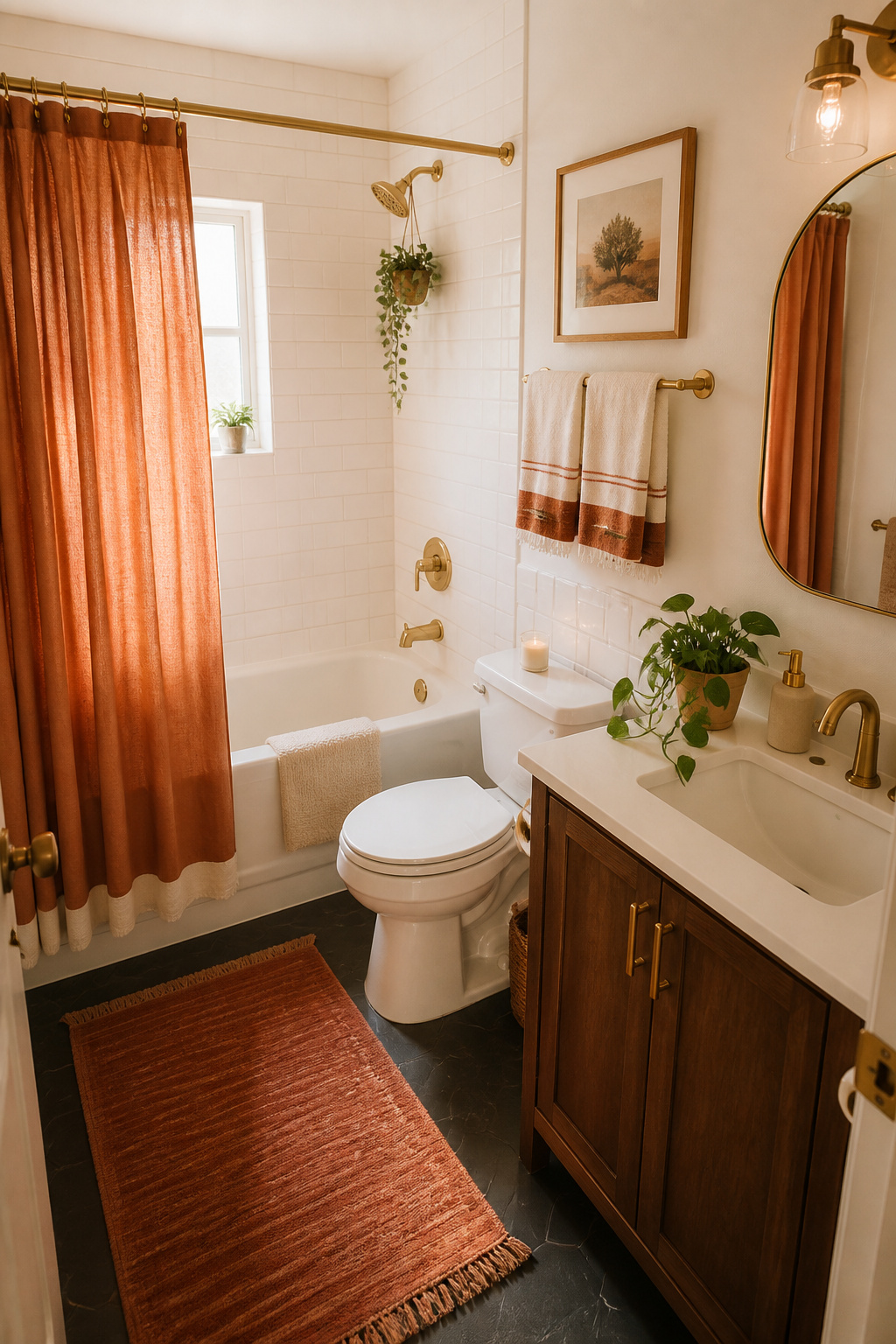
The 60-30-10 rule gives you the framework: 60% is the base color (in most apartments, whatever the tile and fixtures give you — white, beige, gray); 30% is carried by textiles — shower curtain, towels, bath mat — in a secondary color that either harmonizes (warm cream with warm terracotta) or creates deliberate contrast (cool sage against warm neutral tile); 10% is the accent delivered through accessories, hardware, and plants in the most saturated and interesting color in the room. The accent color is what makes a palette feel intentional rather than cautious. A small pop of deep navy, unexpected coral, or rich brass creates the visual energy that distinguishes a designed space from one that was merely decorated.
The most common color error in rental bathrooms is ignoring hardware finishes. A bathroom can have a beautifully coordinated textile palette and still feel visually discordant if the towel bar is chrome, the mirror frame is brushed nickel, and the cabinet pulls are matte black. Choose one metal family — warm (brass, bronze, unlacquered nickel) or cool (chrome, polished nickel, stainless) — and apply it consistently. Hardware that doesn’t match the chosen finish can often be unscrewed and stored with the original hardware for the duration of your tenancy. The fixtures belong to the landlord; the cohesion belongs to you.
Choosing the Right Apartment Bathroom Decor for Your Space, Budget, and Lease
Not every bathroom needs all 18 of these ideas. The better approach is to identify your specific pain points and prioritize the solutions that address them most directly. If your bathroom feels dark and clinical, start with the light bulb swap ($10-15, 5 minutes) and one warm textile upgrade — a new bath mat and a hand towel set in a warm tone — before doing anything else. The mood shift from these two changes alone is significant enough that many people stop there because the bathroom already feels dramatically better.
If the bathroom feels chaotic and cluttered, organize before you decorate. A countertop tray and one tension rod under the sink will do more for the space than any number of beautiful objects placed on top of existing disorder. If the room feels small and cramped, the two highest-impact spatial interventions are a properly sized statement mirror and a shower curtain hung at ceiling height — both create the illusion of more space without changing a single physical dimension.
The transformation doesn’t need to happen at once. A month of one intentional addition at a time — a mirror this week, hardware swaps next week, a plant when you’re near a nursery — results in a bathroom that feels genuinely evolved rather than purchased all at once. That’s the difference between a rental and a home, and it’s the heart of apartment bathroom decor that actually works: available to everyone with a good eye and a willingness to try.