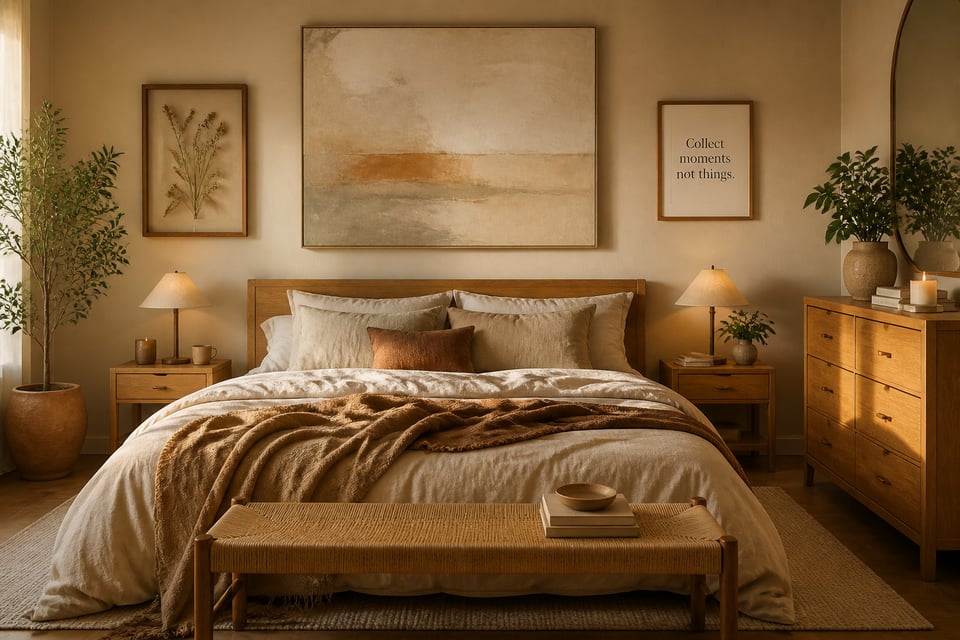
There’s a particular kind of restlessness that comes from staring at a blank bedroom wall. Not the discomfort of an empty room — you’ve done everything else right. The furniture is placed, the bedding is layered, the lighting is warm. But that wall remains unconvinced. I’ve spent years helping people move art from gallery contexts into home environments, and the bedroom wall is the one that matters most — and the one that causes the most paralysis.
It’s also where simple bedroom art does its best work. The bedroom doesn’t need to impress anyone but you. It doesn’t need to signal taste or curation-as-performance. It needs to feel like yours. That’s a wildly different brief from any other room in the house, and it’s the one most people ignore when searching for bedroom art ideas.
These sixteen ideas cover every budget, every aesthetic, and every level of creative involvement — from pressing flowers you walk past on your morning route to downloading four-hundred-year-old masterworks for free from Amsterdam. What they share is that they all put something genuine on your wall: not decoration, but presence.
1. Minimalist Line Art Prints for a Clean Bedroom Aesthetic
The best line art print for a bedroom is the one that takes the longest to stop looking at. That’s a counterintuitive claim about the simplest form of printed art — a single unbroken stroke on white paper — but it’s consistently true. The eye follows the contour, returns, follows it again, finds something it missed. That quality of quiet absorption is exactly what a bedroom wall should offer.
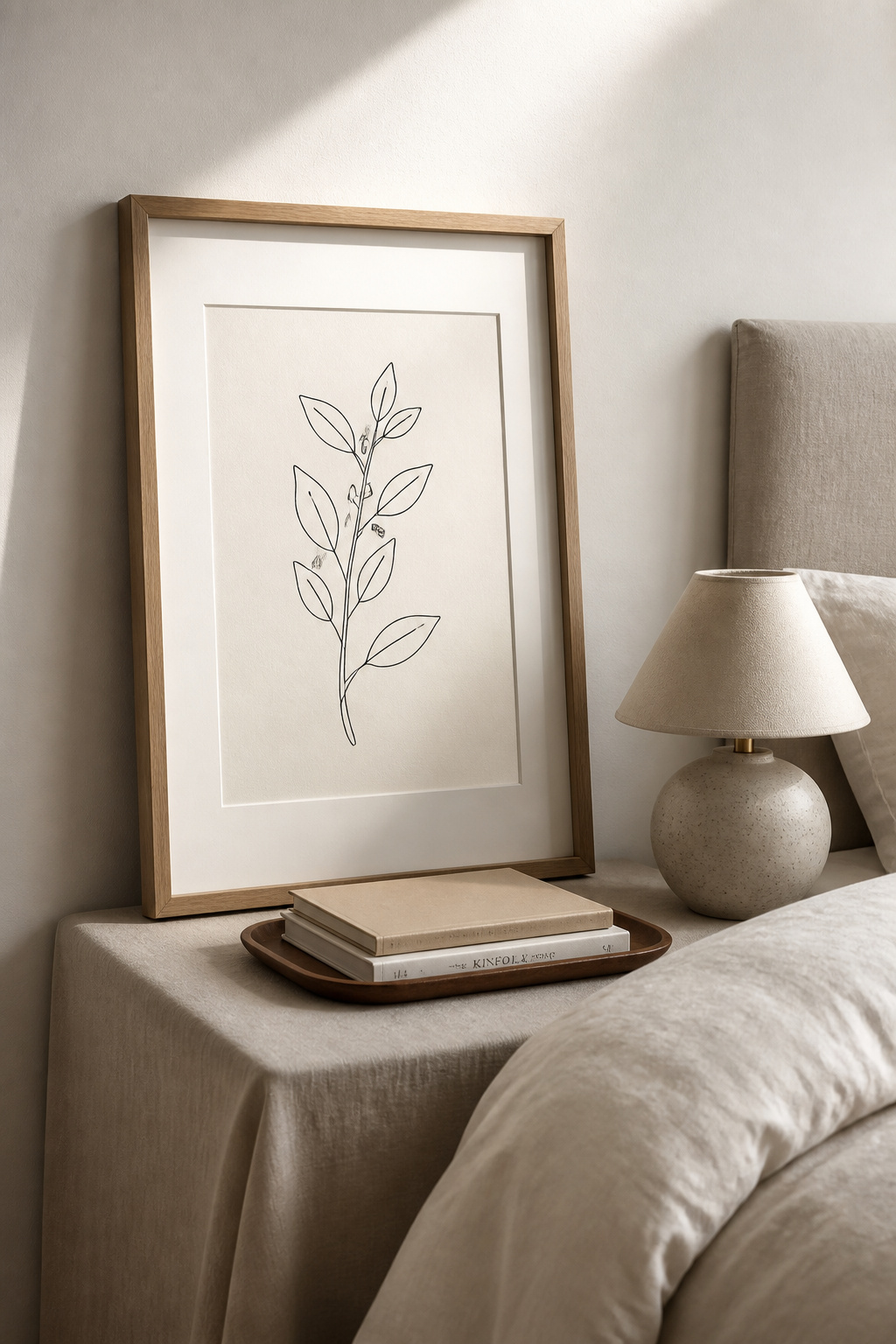
Line art in 2026 is having its most sustained moment in contemporary design. Matisse-inspired figure drawings, single-stem botanical contours, and architectural sketches appear across Japandi apartments and maximalist bedrooms alike. The style’s flexibility is its core strength: a fine black line on white paper doesn’t compete with your bedding, your curtains, or your paint colour. It occupies the wall without claiming the room.
The critical decision is framing, and most people get it wrong by undersizing. A 4-inch white mat around a modest 8×10 print creates gallery-level presence — the same technique used at the Tate and MoMA to make modestly-scaled works feel commanding. Choose your frame finish based on the room’s other materials: matte black for Scandi or contemporary spaces; natural ash or oak for Japandi; crisp white for coastal or traditional. Acrylic floating frames work particularly well with line art — their borderless quality lets the image breathe and makes tight bedrooms feel less enclosed.
For subject matter, stay personal. A single sprig of the herb growing in your kitchen. The silhouette of a city you lived in. A posture that reminds you of someone. Line art is the category where ‘meaningful to me’ outweighs ‘aesthetically correct’ every time.
2. Black-and-White Photography as Simple Bedroom Wall Art
There’s a reason every designer, when uncertain, recommends black-and-white photography as bedroom wall art: it solves nearly every room problem at once. It doesn’t clash with any colour palette. It reads as sophisticated regardless of subject. It carries emotional weight without visual noise. And unlike most art categories, it gets more compelling the longer you live with it.
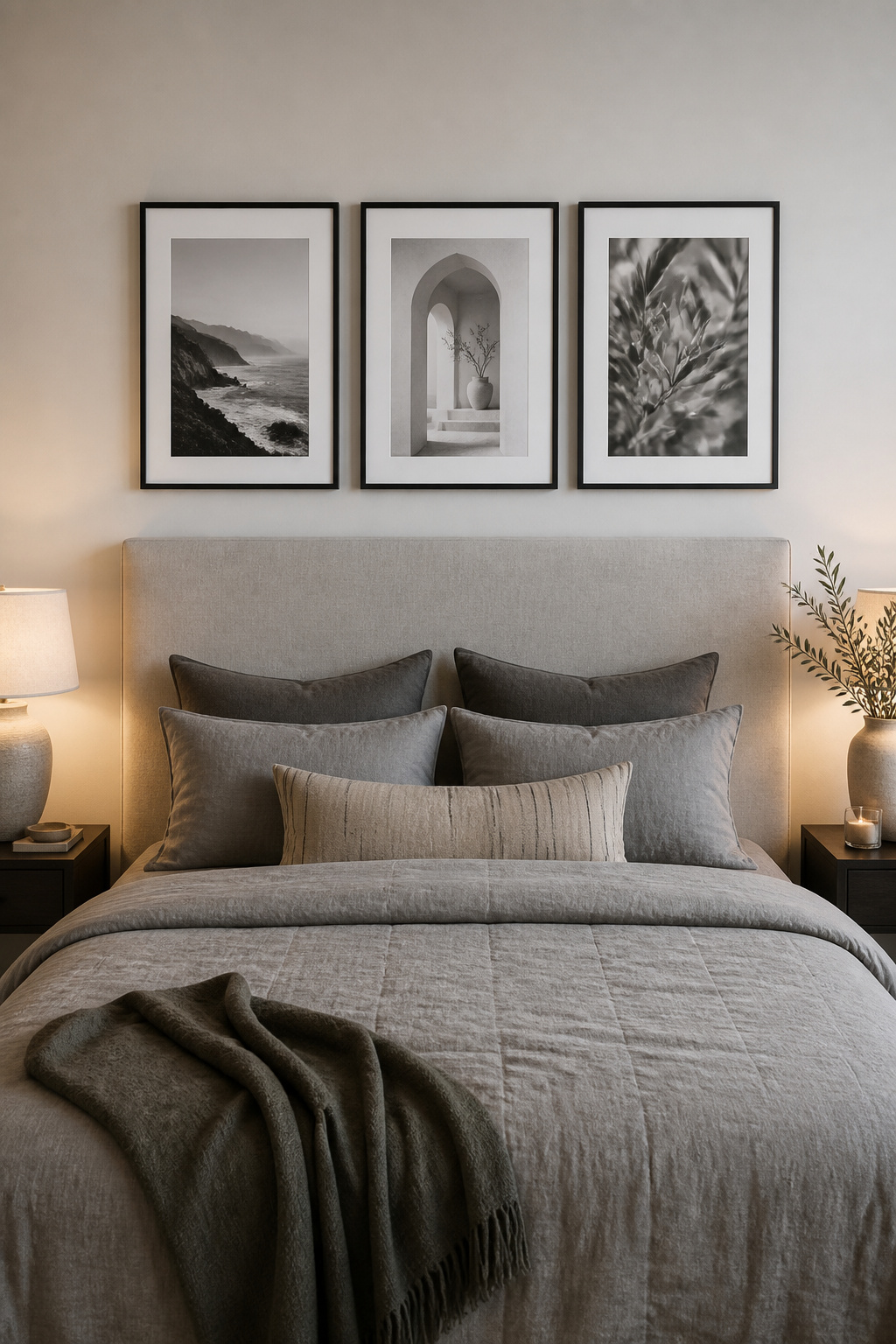
The science behind this choice is worth knowing. Environmental psychology research consistently links low-saturation, soft-contrast imagery — the defining characteristic of quality black-and-white photography — with measurably lower cortisol and heart rate. The bedroom is designed for rest, and the art in it should support that function. A single moody landscape or soft-focus architectural study above the bed is genuinely calming in a physiological sense, not just an aesthetic one. If you’re thinking through choosing bedroom wall decor for a tranquil atmosphere, monochrome photography is consistently the answer interior designers reach for first.
Choosing and Grouping Your Photographs
Subject selection matters enormously. The most effective bedroom photography subjects have personal narrative — a city you’ve walked through early in the morning, a coastline you return to, a doorway that stayed in your memory since you photographed it. These outperform any generic stock image because the bedroom is the room where biography belongs. Printing your own travel photography through services like WhiteWall or Printique — on archival fine art paper from around $30 for an 8×10 — produces results indistinguishable from purchased prints at normal viewing distance.
For a grouped arrangement, tone consistency is the secret. All high-key (light-dominant) or all low-key (dark, moody) — never mixed. Unify with consistent frame finishes: all black, or all natural wood. Two to three inches between frames gives a gallery feel; four to five produces the relaxed, collected-over-time look.
3. Botanical Illustration Prints That Bring Nature Into the Bedroom
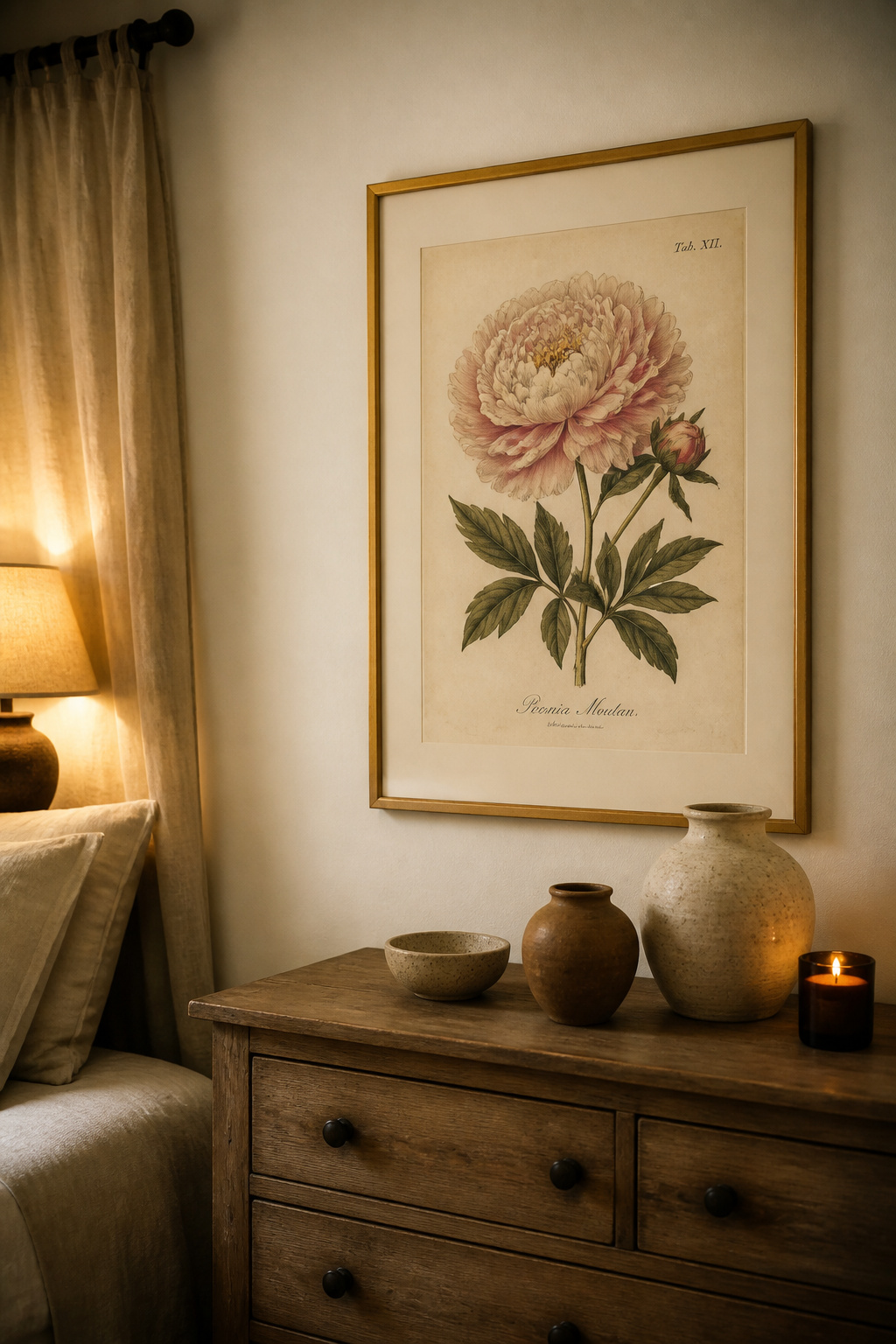
Botanical illustration has been on bedroom walls for four centuries, and the reason it keeps returning is simple: nothing else combines scientific precision with such evident, unhurried beauty. These images were made by people who spent weeks on a single leaf — who understood that attention to the natural world was among the highest artistic ambitions. That quality comes through regardless of whether you can name the genus or recognise the artist.
Free Public Domain Sources Worth Knowing
The design psychology is well-established. Images of plants and natural forms trigger what biophilic design researchers call a ‘restorative response’ — a measurable reduction in cognitive fatigue and ambient stress. More practically: the Biodiversity Heritage Library has released 150,000 botanical and natural history illustrations for free download. Rawpixel hosts tens of thousands more under CC0 licences. Ernst Haeckel’s Art Forms in Nature (1904), Pierre-Joseph Redouté’s rose illustrations, and the plates from Basilius Besler’s 1613 Hortus Eystettensis are all freely available. These are some of the most beautiful images ever made, printed on demand for the cost of an 8×10 photo.
When selecting prints, match the illustration era to your room’s colour story. Aged sepia Victorian engravings warm neutral and beige rooms without competing. Blue-toned Cyanotype prints suit cool or coastal bedrooms naturally. Full-colour Redouté-style rose prints bring warmth to earthy, terracotta spaces. For maximum sophistication, vary sizes — one large anchor print (16×20 or 18×24) surrounded by smaller specimens (5×7 and 8×10) — and keep frames consistent within the grouping.
4. DIY Watercolor Artwork for Personally Meaningful Bedroom Decor
Every other idea in this list involves acquiring something — downloading it, purchasing it, printing it, framing it. This one asks you to make it. In years of working with collectors, I’ve come to believe that original work made by the person who lives in a room carries a quality no purchased print can replicate. The bedroom, the most intimate room in any home, is where that quality matters most.
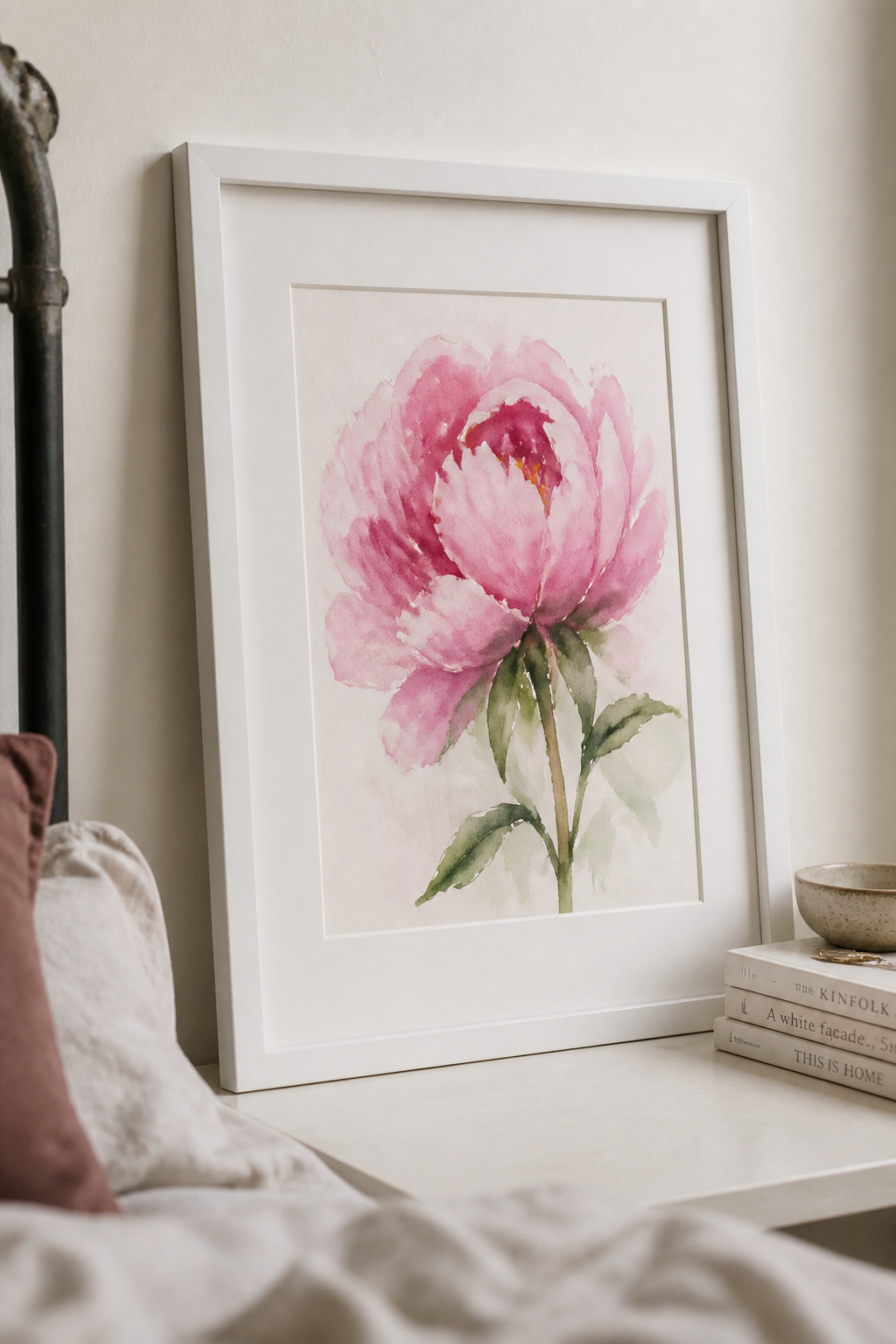
Watercolour is uniquely accessible to non-artists precisely because of its most intimidating quality — the way it moves and blends in wet washes. Those apparent ‘mistakes’ are what make beginner work look interesting rather than amateurish. The wet-on-wet technique requires no brush skill: wet the paper with clean water, drop paint onto the wet surface, and watch the pigment spread into organic, cloud-like forms. The result looks intentional because it is — just not in the way you planned it.
Three Starter Techniques and Materials
If you’ve never painted before, start with three techniques: (1) a wash background — one or two colours, wet-on-wet, let it do what it wants; (2) a single-stem flower, painted wet-on-wet with green pulled in at the base while still wet; (3) an abstract colour field using painter’s tape to mask a clean geometric shape. All three produce bedroom-worthy results on a first attempt. Materials: a Sakura Koi 24-pan watercolour set ($25), a pad of 140lb/300gsm watercolour paper ($15), and three brushes is genuinely everything needed.
Framing matters as much as the painting. Always mat original watercolour art — direct glass-to-paper contact causes condensation damage over time — and choose UV-protective glass (Museum Glass by TruVue, or similar) to prevent light-sensitive watercolour pigments from fading. The mat should be at least 3 inches of acid-free white board. For your first foray into budget-friendly bedroom wall decor projects, the total investment — painting, mat, and a simple frame — can come in under $50.
5. Vintage Poster Art That Gives Your Bedroom Walls a Story
A vintage travel poster above a bed is one of the most layered art choices you can make. Condensed into a single image is an entire era’s imagination of leisure, beauty, and the world worth visiting — a 1930s French Riviera lithograph communicates something about aspiration, colour, and design ambition that no contemporary print quite replicates. This is art that carries history in its composition, not just its subject matter.
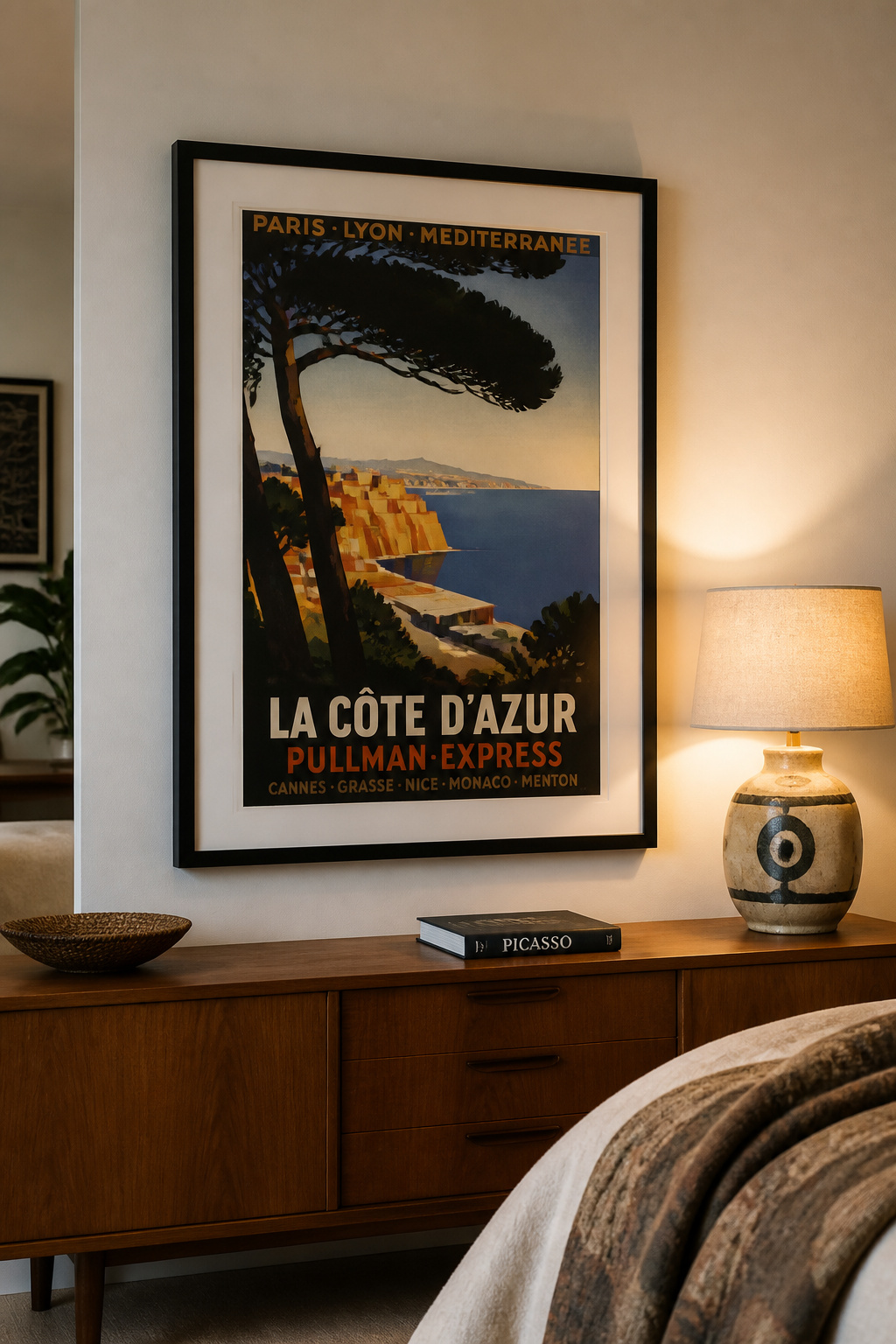
The five poster categories that work in bedrooms, in rough order of suitability: Art Nouveau exhibition posters (Mucha, Toulouse-Lautrec) — the most elegant, designed for extended looking; Art Deco travel (French and Italian Riviera, ocean liner advertisements) — graphically confident and genuinely calming in their soft palette; mid-century airline and tourism posters — bold and optimistic; classic cinema and film noir — moody and conversational; and bold advertising (the Campari and Pirelli category) — too visually assertive for most sleep spaces. Bedrooms suit the first three categories best.
Reproductions vs. Originals
On the authentic vs. reproduction question: a giclée reproduction on 200gsm archival paper with fade-resistant inks is, at normal bedroom viewing distance, indistinguishable from an authenticated original. Specialist sources like Classic Vintage Posters, Desenio, and Posterlounge produce high-quality reproductions from $20-60. Authenticated originals from Invaluable.com or specialist dealers like Posteritati run $150-$5,000+ depending on rarity. Worth it for serious collectors, but unnecessary if the goal is a beautiful wall.
One styling note: frame modernly. A 1930s Riviera poster in a simple matte black frame reads as contemporary art. The same poster in an ornate gold frame reads as period room. The frame is the bridge between eras. For more on building a calm, intentional bedroom environment from the ground up, creating a minimalist bedroom: a calming oasis in 5 simple steps covers the full approach well.
6. Abstract Prints That Add Expressive Color to Simple Bedroom Art
Abstract art belongs in bedrooms more than anywhere else in a home — and not for aesthetic reasons. The reasoning is psychological. Unlike representational work that anchors the mind to a specific subject, abstract forms allow the subconscious to project meaning freely. This is the mental mode that supports sleep onset: wandering, non-focused attention that precedes rest. Good abstract art as simple bedroom art creates exactly that space.
Colour Temperature and Sleep Quality
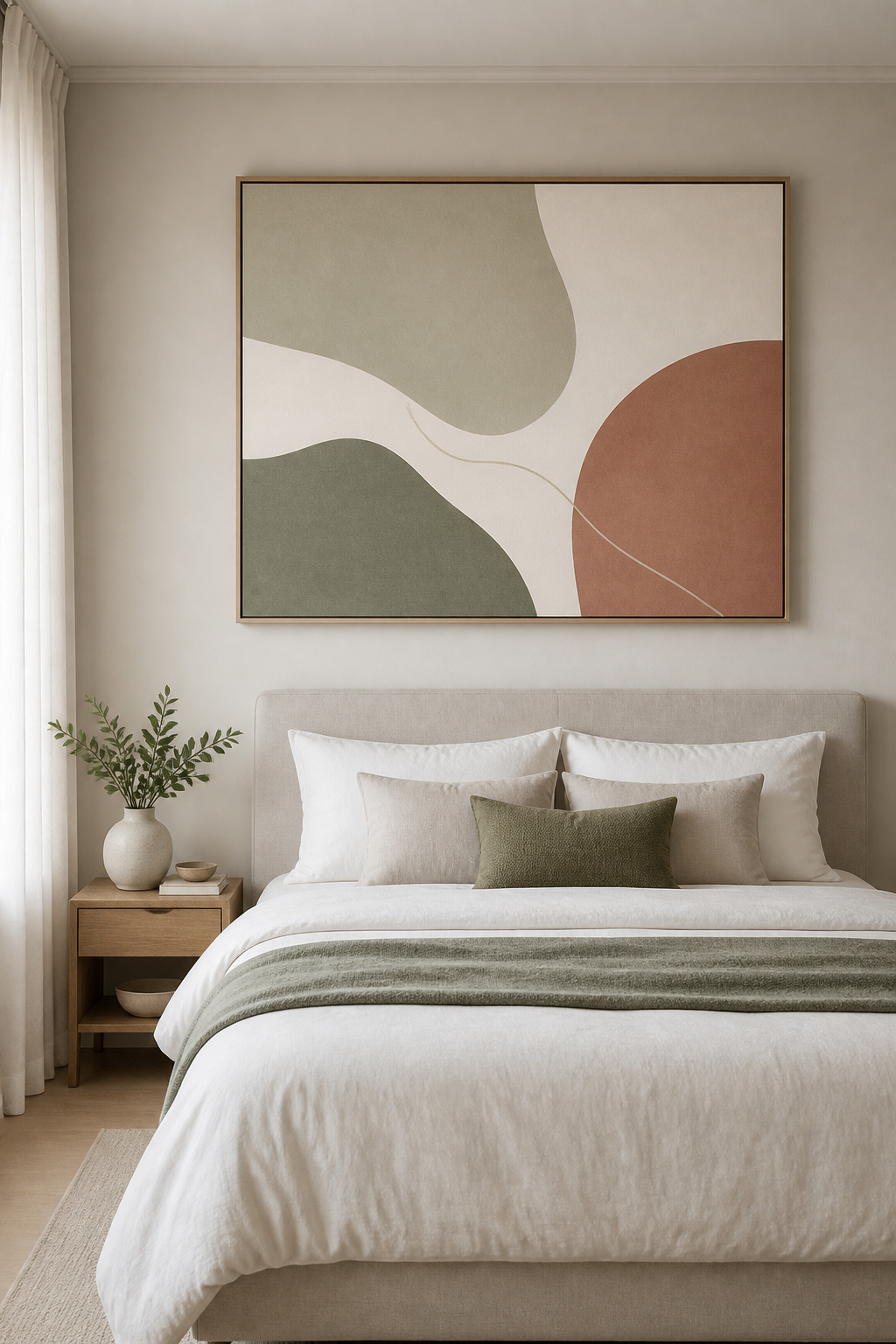
Environmental psychology research adds a useful selection criterion: abstract patterns with curved, organic lines promote relaxation measurably more effectively than angular, geometric designs. When choosing a bedroom abstract, reach for pieces with flowing forms rather than hard edges — even when colours are bold, the curvilinear quality softens the impact significantly.
Colour temperature is the other decisive variable. Cool-toned abstracts — soft blues, sage greens, quiet greys, muted lavenders — are associated with lower cortisol and work best in bedrooms where sleep quality is the primary priority. Warm abstracts in dusty rose, soft terracotta, or muted gold create cosy, intimate atmospheres. However, avoid saturated reds and oranges — these are physiologically stimulating in exactly the way you don’t want before sleep. Muted, desaturated versions of any colour are always safer choices. For placement: one large abstract (24×36 or bigger) above the headboard, spanning 60-75% of the headboard’s width, is the most impactful solo application.
7. Woven and Textile Wall Hangings as Bedroom Art Alternatives
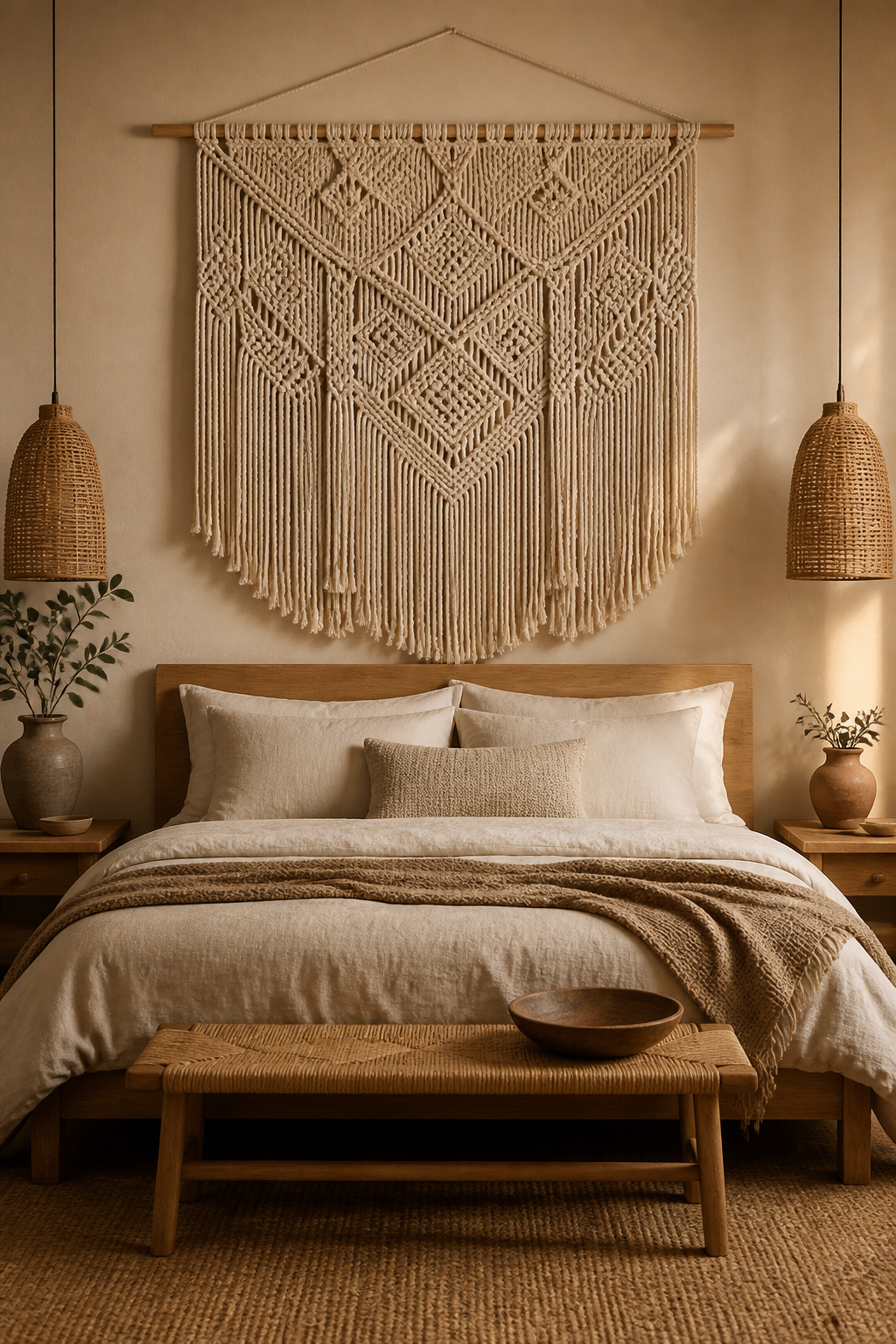
Woven wall hangings offer something no framed print can: acoustic benefit. The fibrous mass of a macramé or tapestry piece absorbs reflected sound rather than bouncing it off a flat, hard surface, making the room quieter and more intimate — a quality you notice most clearly in bedrooms that used to echo faintly and suddenly don’t. This is an art form that changes how a room sounds as well as how it looks.
Choosing and Layering Textile Art
The visual contribution of textile art is different in kind from printed art. Textile pieces have physical depth, textural warmth, and light-absorbing qualities that flat works cannot achieve — they move subtly with air currents, catch lamplight differently across their knots and woven surfaces, and add coziness through purely material means.
Choosing well: natural undyed cotton, bleached white, and oatmeal/ecru textiles work across any bedroom palette and are the safest choice if you’re uncertain about colour commitment. For above a queen bed, a piece of 36-48 inches wide is the appropriate scale for a solo statement. Sourcing: Wescover and Etsy have the deepest handmade selection from $40-400+. Wayfair’s hand-woven category offers machine-made alternatives from $25-150 for those who prioritise scale over artisanal character.
The most sophisticated application pairs textile art with framed work: a large woven piece above the headboard as the dominant element, and a small framed photograph or line art print on the adjacent wall in a complementary tone. Different media on the same wall creates the layered, collected quality that distinguishes designed bedrooms from decorated ones.
8. Simple Bedroom Art Using Typography and Meaningful Word Art
The test for whether typography belongs on a bedroom wall is sharp: would this quote appear on a motivational poster in a corporate break room? If yes, choose differently. Simple bedroom art using typography should be specific enough that it could only belong to the person who put it there — a line from the book you read the year everything changed, a phrase in the language you’re slowly learning, coordinates of somewhere that rewired how you see the world.
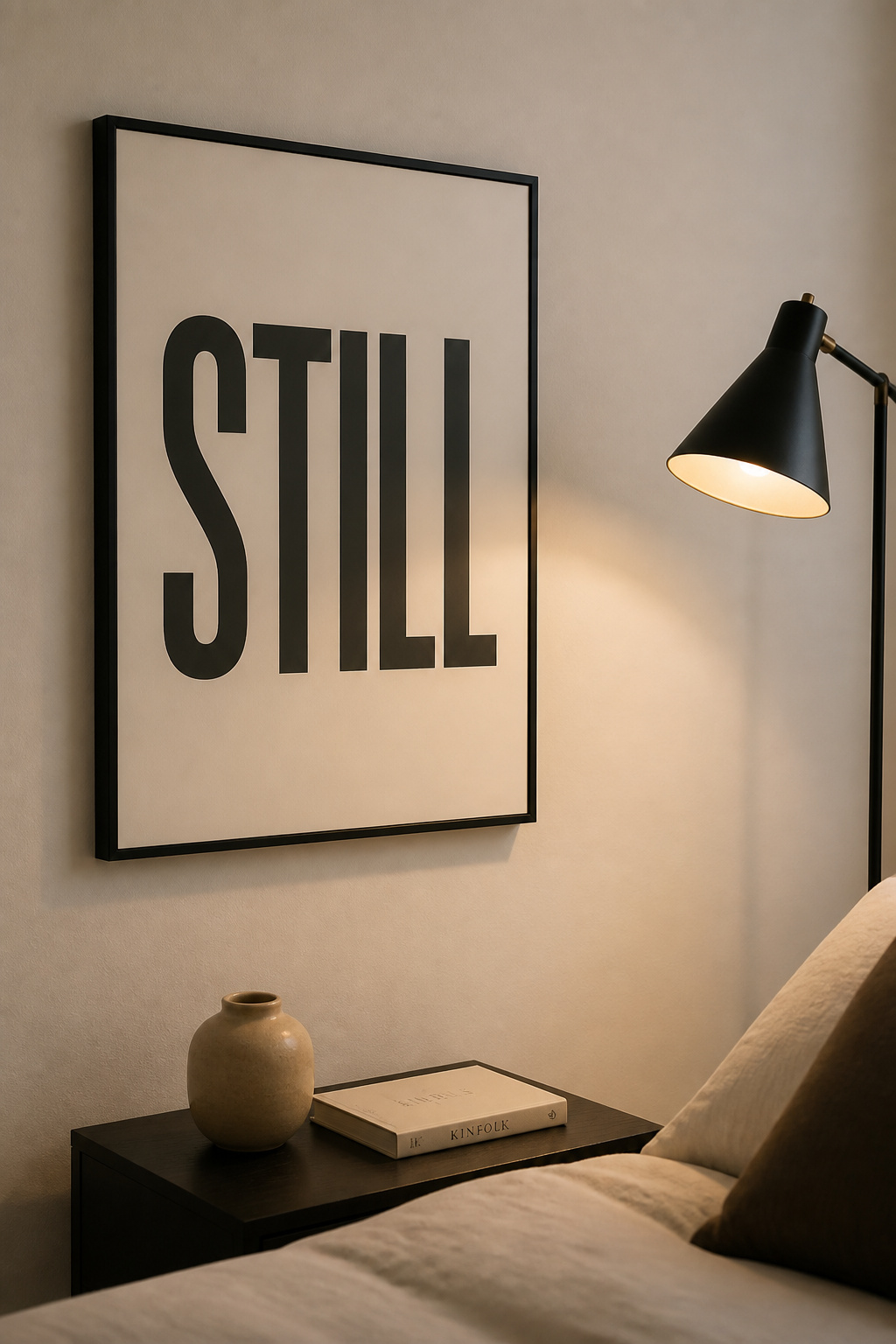
That specificity is the difference between simple bedroom art that adds depth and typography that makes a room feel like a self-help seminar. The 2026 design direction has moved decisively in this direction: typography is being celebrated for personality and idiosyncrasy rather than universal relatability. Imperfect, hand-lettered work and intentionally mismatched font scales are specific trends cited across multiple forecasters this year — the era of the generic script quote print is quietly ending.
Typography Styles and Sources
Typography style guides the mood significantly. Hand-lettered and calligraphic styles are warmest and most personal — they suit farmhouse, cottage, boho, and traditional bedroom aesthetics, and pair naturally with botanical and vintage poster art. Clean modernist sans-serif (a single word in Helvetica or Futura at large scale) suits minimalist and Japandi bedrooms where the font itself is the visual element. Mixed-scale expressive typography — words at varying sizes on one piece — is the most graphic and contemporary option, best for eclectic rooms.
For sourcing, Etsy lettering artists offer custom hand-calligraphy prints from your chosen text at $30-150. Canva’s free typographic templates, downloaded at high resolution and printed at a local print service, deliver satisfying results for $8-15 total. The key requirement: minimum 200gsm paper for any typography art displayed in a frame. Below that weight, the print reads as temporary.
9. Pressed and Dried Botanicals as Simple Bedroom Wall Art
The 1850s is when pressed botanical art became a domestic obsession — Victorian women walked gardens and countryside paths collecting specimens to press between the pages of heavy botanical books, building albums of carefully identified natural material. These collections were kept in bedrooms and sitting rooms, consulted like libraries of personal natural history. The practice fell away in the twentieth century and is back now, not as nostalgia but as a response to something genuine: the desire to put actual pieces of the physical world on bedroom walls rather than representations of them.
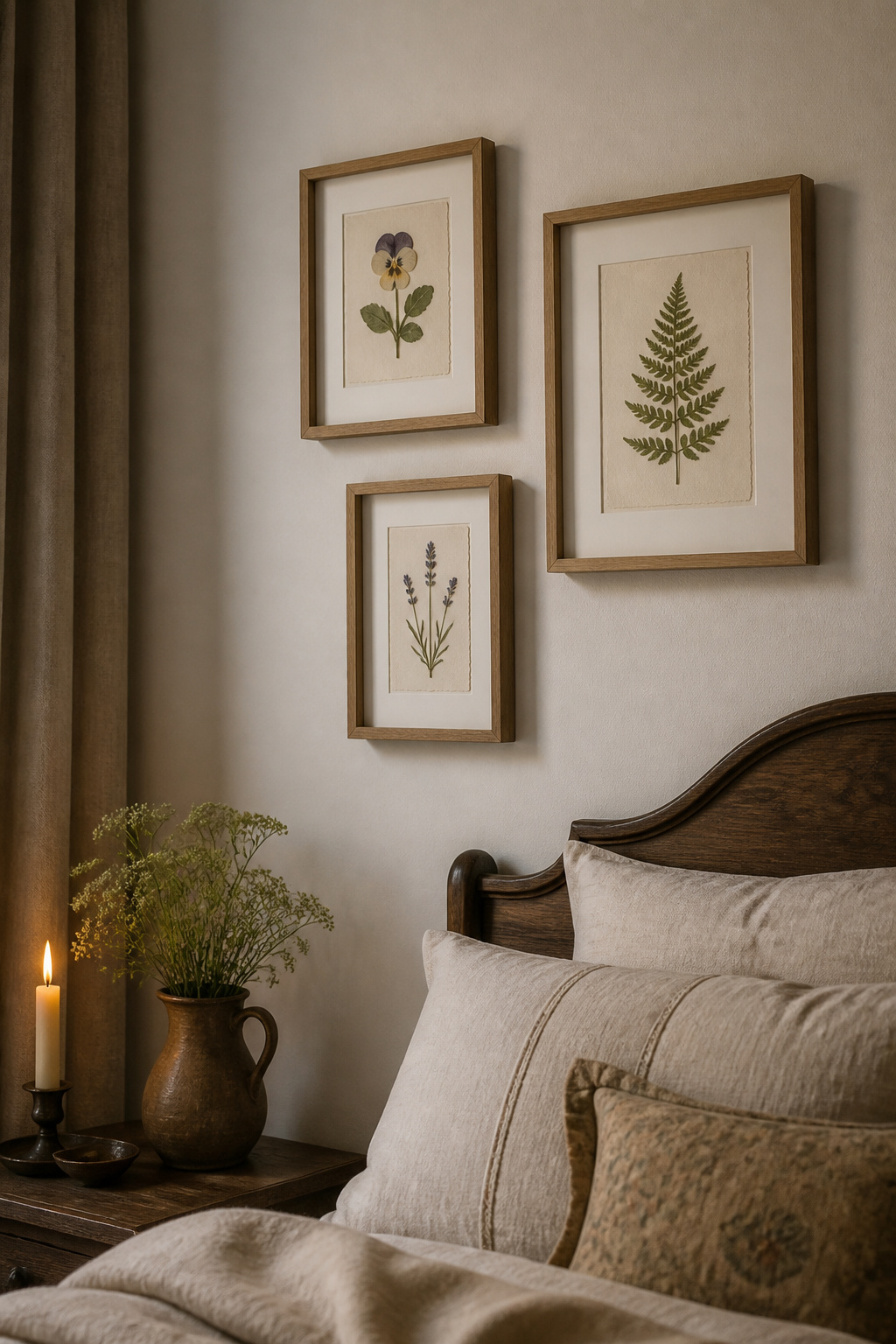
This is the only option in this list where the object on the wall is not a print, not a painting, not a textile, but an actual preserved living thing. A pressed viola or fern carries a different quality of presence than any photograph of a viola or fern. That difference is real, and it’s why this category keeps returning.
Pressing Technique and Display
The practical approach is more accessible than most people expect. Beginner-friendly plants: violas and pansies (already flat, press in 1-2 weeks, excellent colour retention); Queen Anne’s lace (presses into delicate lace-like structures); fern fronds (press in one week, ideal for backgrounds); lavender stems (press whole, fragrant even when dried). Pick specimens in mid-morning after dew has dried and before afternoon heat causes wilting — timing matters more than technique. Between parchment paper in a heavy book, with additional weight on top, 2-3 weeks produces clean results.
For display: mount on acid-free watercolour paper using PVA glue applied sparingly with a fine brush. Choose frames with depth — a box or shadow frame rather than flat glass directly on the specimen, which causes condensation damage over time. A single specimen centred on a large white mat is the most museum-quality approach; a grid of small matching frames each containing one specimen is the most graphic. Hang in indirect light — UV-protective glass extends colour life significantly, as pressed botanicals are sensitive to UV even at low intensities.
10. Gallery Wall Layouts for Simple Bedroom Art Collections
The bedroom gallery wall has evolved. The era of identical frames at perfectly measured intervals belongs to the mid-2010s. What design forecasters document in 2026 is something looser and more persuasive: arrangements that feel accumulated over years rather than installed on a single afternoon, mixing timber, matte black, and soft metal frames with varied sizes and instinctive rather than geometric spacing. The result looks like the wall of someone who genuinely lives with art.
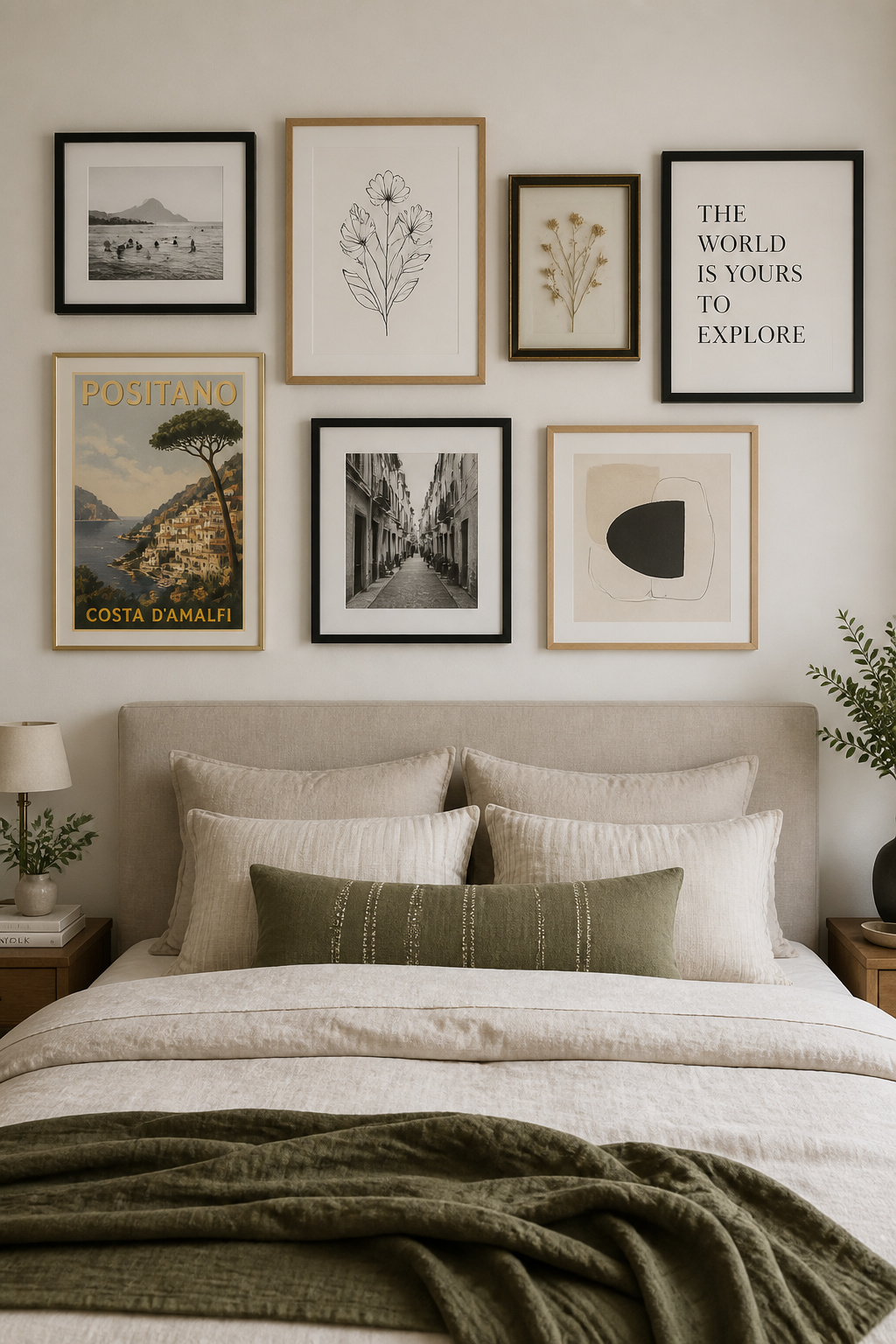
The most successful bedroom gallery wall format is horizontal, centred above the headboard, spanning 50-70% of the wall width. For a queen bed, this means a group roughly 50-65 inches wide. The lowest frame should sit 8-10 inches above the headboard — close enough to create visual connection between the bed and the art, distant enough that pillows don’t touch the bottom of the lowest frame. For a deeper dive into arrangement and execution, this guide to gallery wall magic for a stunning bedroom focal point covers the planning process in forensic detail.
Installation and Visual Weight
Structure within the apparent looseness: anchor the gallery with one large piece (16×20 or 20×24), surround it with medium pieces (8×10 or 11×14), and add small accents (4×6 or 5×7). Odd numbers — 3, 5, 7, or 9 pieces — feel more organic than even groupings. Maintain a consistent mat colour (all white or all off-white) even when frames vary; the shared mat colour is the invisible thread that holds a mixed-frame arrangement together.
For installation: trace each frame onto kraft paper, label it, tape the templates to the wall with painter’s tape, and live with the arrangement for 24 hours before driving a single nail. The paper mockup reveals scale issues and awkward gaps that are invisible until you see the full arrangement on the wall. Work from the centre piece outward, hanging at 57-60 inches from floor to the centre of the central piece.
11. One Large Statement Piece as the Simplest Bedroom Art Choice
The most decisive and often the most sophisticated bedroom art decision: choose one large piece and hang it alone. Interior designers consistently recommend this as the lowest-risk, highest-impact approach — it eliminates the planning complexity of gallery walls, the sourcing challenge of matching pieces, and the installation fuss of multiple hanging points. One excellent piece does more work than six adequate ones.
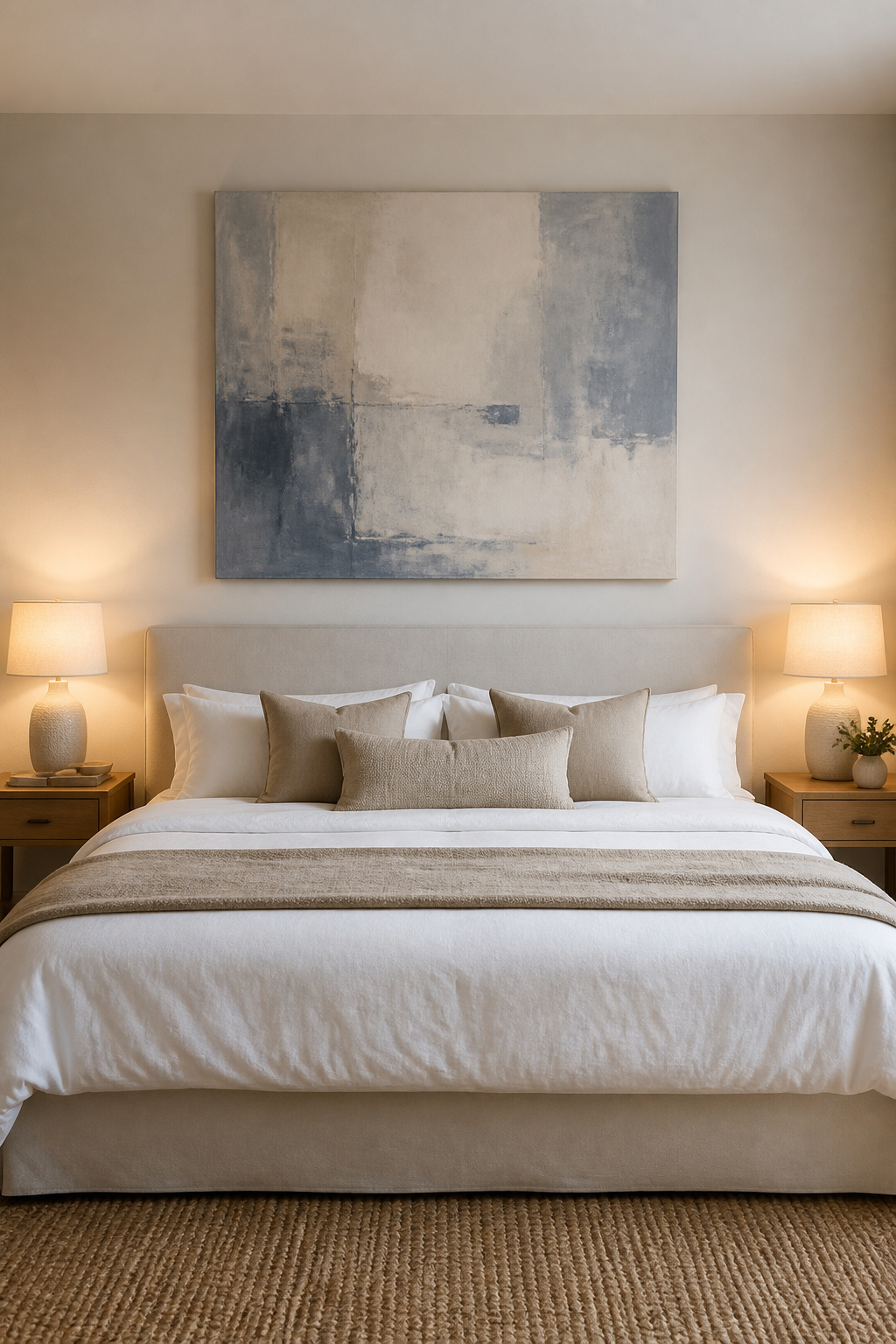
The scale rules are more specific than most people realise. Art above a bed should span 60-80% of the headboard width: above a queen (60-62 inch headboard), that means 40-45 inches wide minimum; above a king (76-80 inch headboard), 48-60 inches. Most people hang art that is too small and too high — the common result is a piece that looks like a postage stamp floating in the middle of the wall. When in doubt, go larger. The painter’s tape mockup test — taping out the intended dimensions on the wall and viewing it from the bed for 24 hours — reliably confirms that what looked large on a website looks modest in situ.
Two approaches to display are both equally valid. Hanging gives permanence and precise positioning. Leaning a large canvas or print against the wall behind a dresser or low console reads as confident rather than makeshift — it communicates that the art is there because you want to look at it, not because the wall needed filling. Use non-slip furniture pads between the frame and the surface it rests on; lean at approximately 5-10 degrees from vertical for stability.
12. Simple Bedroom Art on a Budget: Printable Digital Downloads
The art market for bedroom walls has been fundamentally democratised in the last decade, and most people don’t fully know it. The Rijksmuseum in Amsterdam has digitised 709,000 artworks — Rembrandt, Vermeer, and Van Gogh originals — and made them available for free download at print resolution via their Rijks Studio platform (free account required). The Smithsonian Institution has 4.5 million images under CC0 licences with no restrictions on use. The Metropolitan Museum of Art’s Open Access collection adds 406,000 more. These are the world’s most valuable artworks, available to print, frame, and hang in a bedroom for the cost of paper and ink.
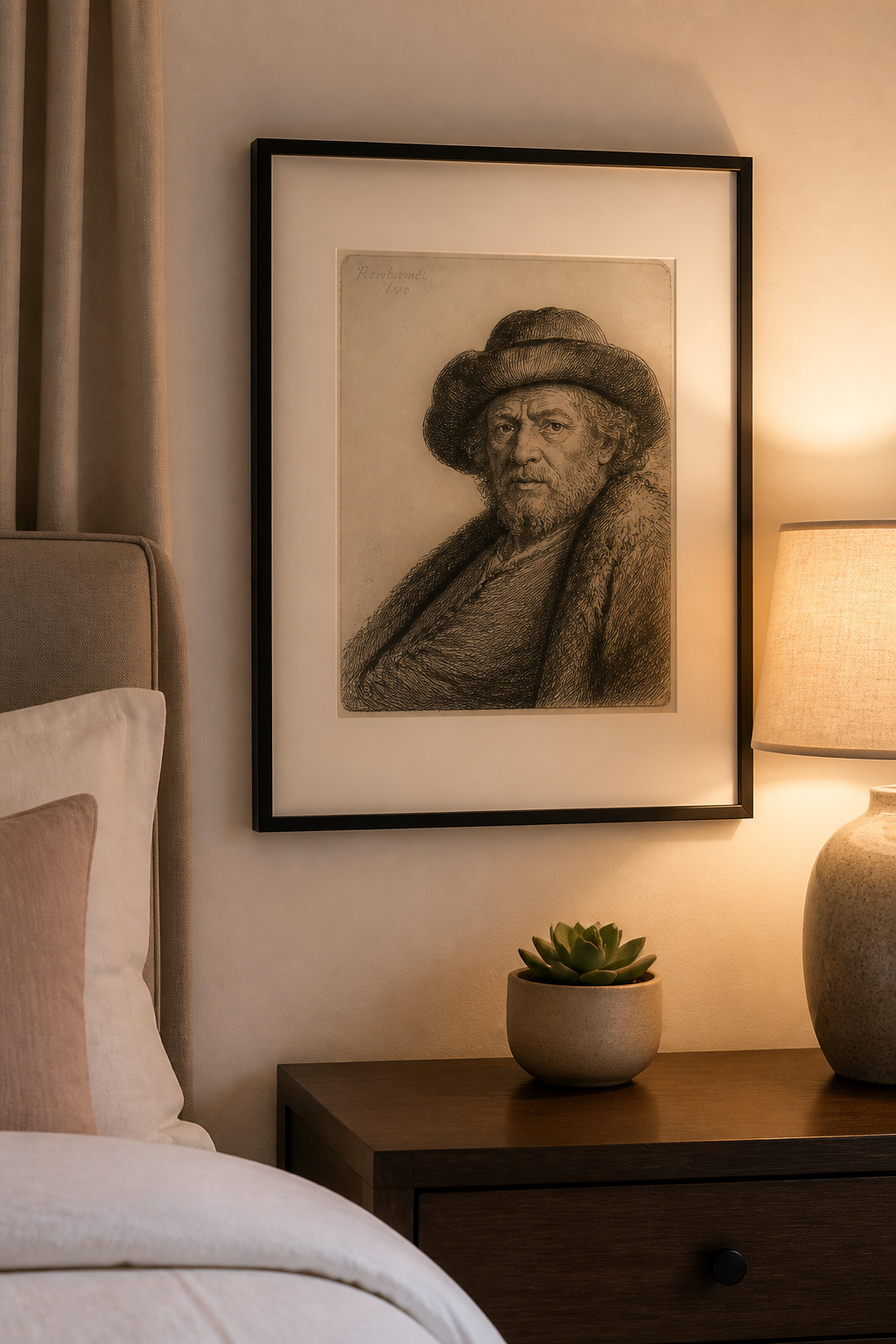
These resources make artistic hacks for bedroom decor on a budget more powerful than they’ve ever been. A seventeenth-century Dutch still life printed on fine art paper and framed with a white mat costs $8-15 in materials. The Biodiversity Heritage Library’s botanical collection adds 150,000 natural history illustrations. The NYPL Digital Collections adds historical photographs, maps, and ephemera. The range is effectively unlimited.
Resolution, Printing, and Paper
For purchased digital downloads: Etsy printable sellers typically charge $3-8 for a digital file that prints at any size unlimited times. Look for listings that specify ‘300 DPI minimum’ and ‘multiple size options included’ — these markers confirm the seller understands print requirements.
The critical technical point: print at 300 DPI, not 72 DPI (screen resolution). A 300 DPI file printed at 11×14 needs a source image of at least 3,300×4,200 pixels — check file dimensions before downloading. Beyond about 8×10, local print services (Mpix, Printique, or your local photo lab) deliver significantly sharper results than home printers at comparable cost. And choose matte or satin paper finish for bedroom display; glossy surfaces catch ambient bedroom lighting and create glare during the primary viewing times — lying in bed in the morning and evening.
13. Sculptural Wall Art That Adds Texture to Your Bedroom
Flat printed art is starting to feel insufficient in 2026, and the design world is saying so explicitly. Every major trend report from this year identifies the shift from flat-to-wall prints toward objects with physical presence — pieces that cast shadows, catch lamplight at changing angles, and reward the slow, close attention that bedrooms actually permit. A carved wood relief on a bedroom wall at 7am, with oblique light crossing it from one direction, is a different object than it is at midday or by lamplight in the evening. That temporal dimension is something no print offers.
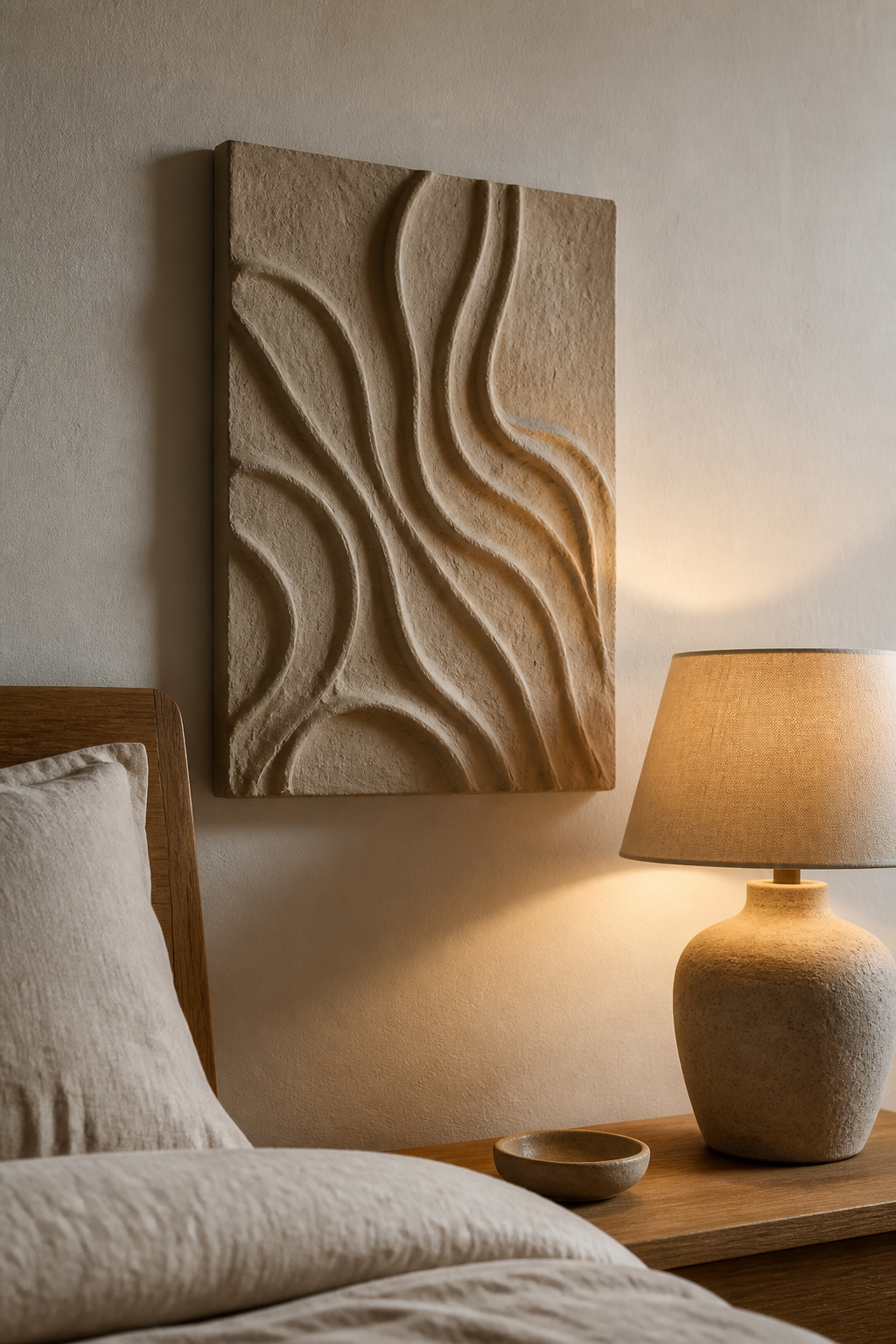
Materials for sculptural bedroom wall art divide along aesthetic lines. Wood is the warmest: carved reliefs and natural-edge wood panels suit farmhouse, Japandi, Scandi, and rustic bedrooms most naturally. Ceramic is the most artisanal: handbuilt ceramic wall tiles and sculptural relief pieces bring the warmth and irreducible irregularity of handcraft, and particularly suit boho, Mediterranean, and contemporary rooms. Metal adds shimmer and graphic precision: hammered copper and brass reliefs work in warm-toned bedrooms; matte black metal cut art sits cleanly in contemporary spaces. Sculptural paper art — folded, cut, or three-dimensional constructions — is the most accessible DIY option, with flat-pack origami-inspired kits producing genuinely impressive results from $20-60.
For ideas on what three-dimensional wall art can look like beyond the conventional framed-print approach, unexpected bedroom wall decor ideas with texture and depth explores the territory well. One practical note: always check actual piece weight before hanging; items over 5 lbs need appropriate wall anchors, not standard picture hooks.
14. Displaying Children’s Artwork as Simple Bedroom Art
The most personally meaningful art in any room has a story that only the owner can tell. By that criterion, a child’s painting displayed properly in the parental bedroom is among the most significant bedroom art decisions available — it places biography at the centre of the most biographical room in the house, without apology and without performance for guests who will never enter this room anyway.
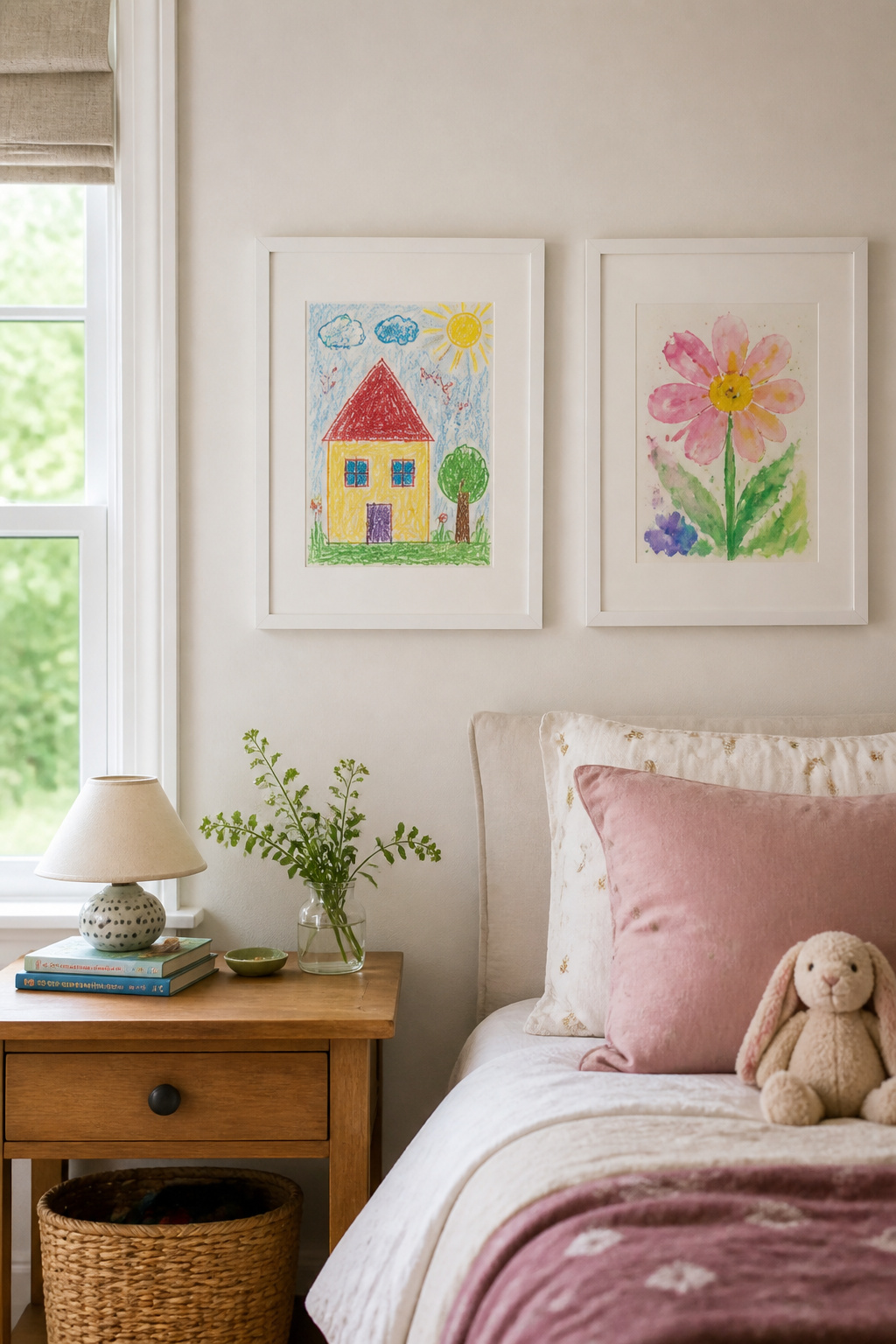
The elevation happens entirely through presentation. A child’s crayon drawing in a quality white frame with a 3-4 inch acid-free mat looks as considered and deliberate as any gallery print — the mat communicates that this piece is worth careful attention, and attention follows.
Archival Framing and Rotating Collections
Archival materials are worth the small additional investment. Acid-free, lignin-free matboard (Bainbridge or Crescent are the professional-standard brands) prevents yellowing that causes standard matboard to deteriorate the artwork it holds over 5-10 years. UV-protective glass is particularly important for children’s work, which is typically made with crayons, poster paint, and markers — all highly light-sensitive media that fade noticeably within a year or two under standard glass. Photograph or scan every piece at high resolution before framing — this creates a permanent digital archive that allows the physical piece to be rotated or stored while the record remains.
For a rotating collection: IKEA’s RIBBA and SANNAHED lines have easily removable backs that make content swapping a two-minute task. Keep the frames permanently on the wall; rotate only the matted art inside them on a seasonal basis. This maintains visual consistency while keeping the wall genuinely, continuously personal.
15. Travel Photography and Memory Displays as Personal Bedroom Art
A bedroom wall covered in personal travel photography is a biography of curiosity — it communicates something essential about who lives there that purchased prints, however beautiful, cannot. The city found on a wrong turn. The light on a particular morning. The doorway that stayed in memory for years before you understood why you’d photographed it. These images are irreplaceable precisely because no one else took them, and the bedroom is the ideal place for irreplaceable things.
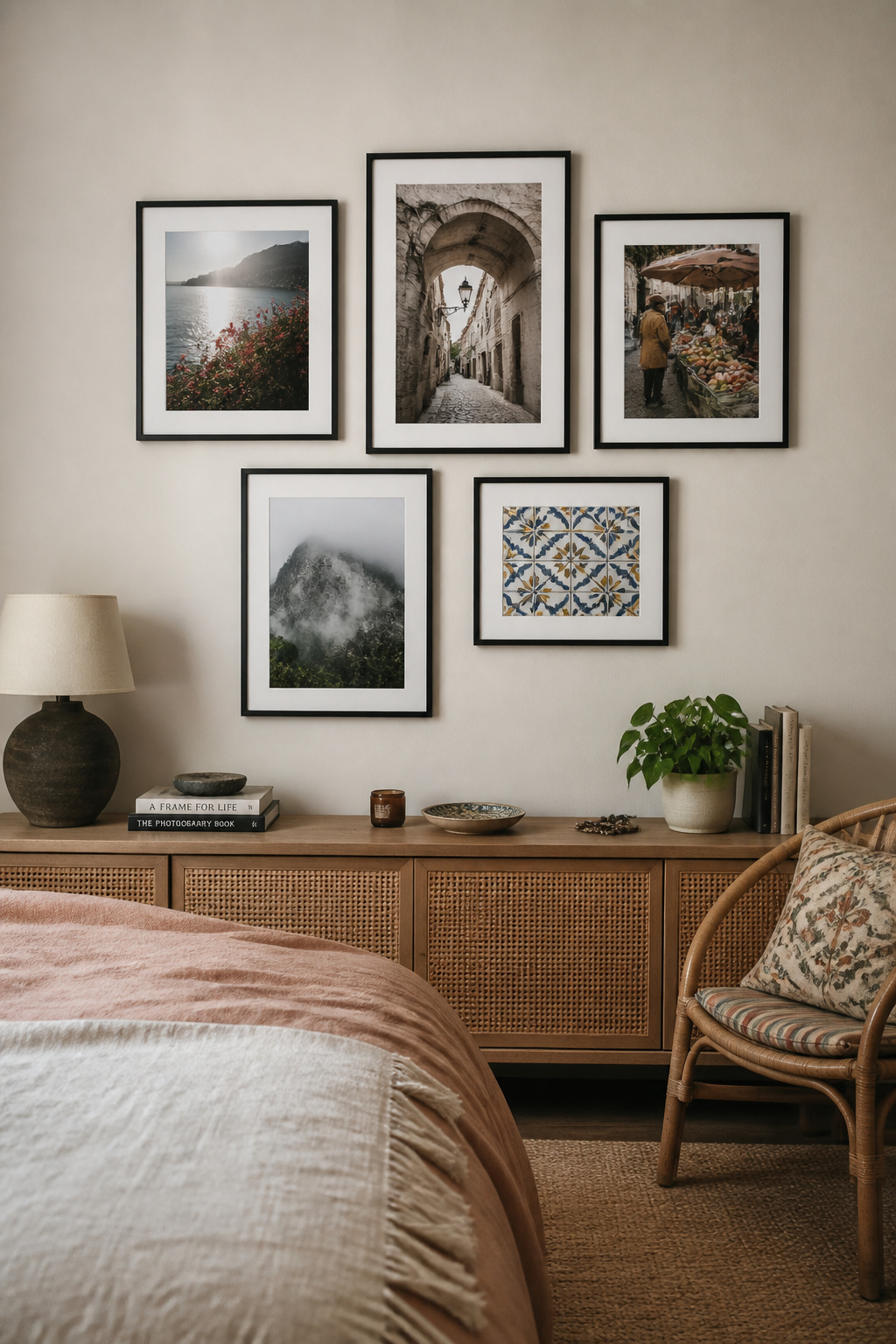
The challenge is execution, not sentiment. The gap between ‘phone photos stuck on a wall’ and ‘personal photography displayed as art’ is almost entirely about print quality and curation. For print quality: personal photography at bedroom display sizes (8×10 and larger) should go through a professional print service rather than a home printer. Mpix and Printique offer fine art paper options at print-lab quality for $8-20 per piece. Artifact Uprising produces the most gallery-like results for personal print collections. Choose matte or satin finish — glossy paper creates glare in ambient bedroom lighting.
Curation and Scale
For curation, apply one editing rule: consistent tone across everything displayed in a single grouping. All warm, golden-light shots together. All cool, overcast-light shots together. All black-and-white together. Mixing colour temperatures creates visual tension that makes a personal collection feel like a random assortment. Apply the same Lightroom preset to all images in a bedroom grouping — even a subtle consistent grade unifies wildly different subjects.
Scale hierarchy adds depth: one hero image (16×20 or 20×30) of the most meaningful place, with smaller companion prints (5×7 or 8×10) on adjacent walls, creates a memory landscape rather than a flat collage. The hierarchy tells a story about which places mattered most.
16. Seasonal Art Rotation: Keeping Your Simple Bedroom Art Fresh
There’s a well-documented perceptual phenomenon where familiar stimuli become genuinely invisible — not metaphorically unseen, but neurologically unprocessed, filtered out by a brain that treats them as irrelevant background. This is what happens to bedroom art after approximately three to six months. The piece that moved you when you first hung it is no longer being consciously experienced. Seasonal art rotation is the solution, and it’s one professional curators have understood for longer than home decorators have.
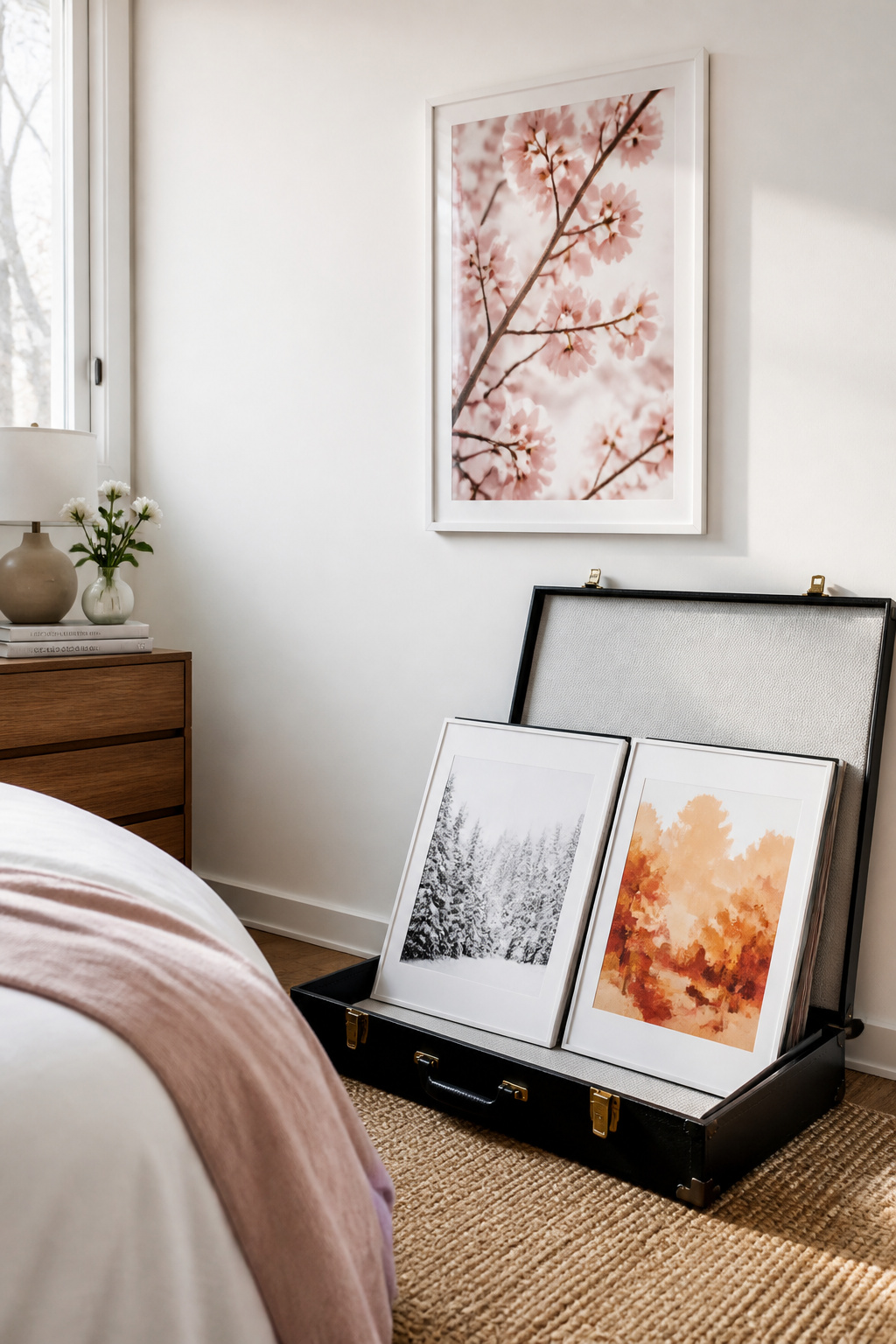
Building a rotating collection is a different investment logic from buying statement pieces. Instead of one significant purchase, the approach is 20-30 affordable prints ($15-50 each) across different seasons and moods — a winter grouping of soft monochrome photography and warm line art; a spring collection of fresh botanical prints; a summer rotation of travel photography and saturated colour; an autumn selection of warm watercolours and earthy-toned work. Rotated four times per year across 2-3 wall positions in the bedroom, this collection offers more total visual life than any single expensive piece.
Storage That Makes Rotation Easy
Storage is what makes rotation practical. Acid-free polypropylene archival sleeves (Print File and Archival Methods are the professional-standard brands) protect unframed prints from fingerprints and humidity damage. A rigid-backed portfolio case stores 20-40 prints flat and safely — never roll prints, even temporarily, as the tube memory makes reframing difficult. Interleave each print with acid-free glassine tissue to prevent surface transfer over months of contact. For bedroom storage solutions that accommodate an art collection alongside everything else a bedroom requires, the key is dedicating a specific shelf or box rather than storing prints loose among other items.
The frame swap system is the operational efficiency that makes rotation genuinely easy: keep consistent frames permanently on the wall; swap only the matted prints inside. The frames never move, the nails never change, and the rotation takes fifteen minutes rather than an afternoon.
Finding Your Own Simple Bedroom Art Style
The right place to start is not with which of these ideas appeals most — it’s with how you want to feel in the room when you wake up in the morning and when you’re lying in bed at night. Art that creates that feeling is the right simple bedroom art, regardless of how it compares to anyone else’s choices.
A practical framework: if you want the bedroom to feel calmer and more restful, reach for soft monochrome photography, muted botanical prints, or gentle abstract art in cool tones. If you want it to feel more personal and specific to your life, travel photography, children’s artwork, and DIY watercolour pieces will do that better than anything you could purchase. And if you want it to feel more curated and considered, a single large statement piece or a well-planned gallery wall — properly matted and framed — communicates aesthetic confidence more effectively than a full wall of smaller work.
The first step, if you’ve been staring at a blank wall for too long: download one botanical print from the Biodiversity Heritage Library or Rijksmuseum collection, order an 8×10 from your local photo lab for $8-12, and frame it in whatever simple frame is already in the house. Hang it above the bedside table rather than trying to plan the entire wall at once — the bedroom’s most intimate art relationship is with the person lying in it, and that corner is where simple bedroom art should start. Everything else follows from that first choice, made deliberately and at essentially no cost. Start there, live with it for a season, and let the room tell you what it wants next.