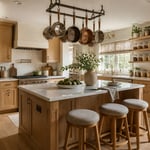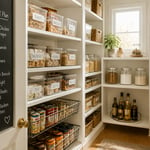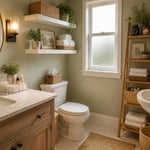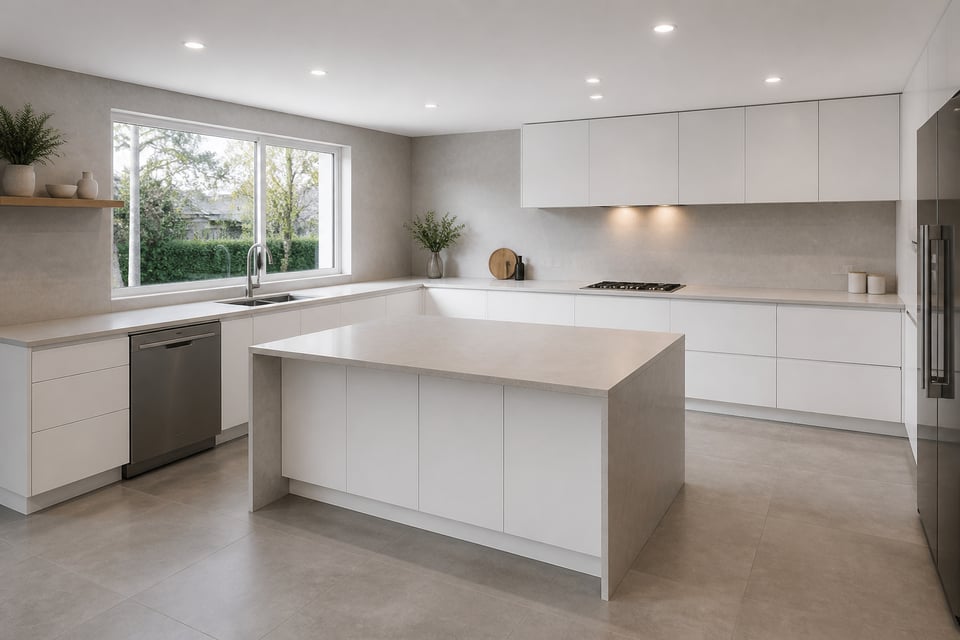
There’s a particular feeling you get walking into a kitchen where nothing fights for your attention. The counters are clear. Cabinet faces are uninterrupted. Colours sit quietly in the same family. You just feel calmer — and, oddly, more ready to cook. After twelve years helping families design kitchens that work as hard as they look good, one insight keeps returning. A minimalist kitchen isn’t about owning less. It’s about designing a space where every element has a purpose and nothing is there by accident. These minimalist kitchen ideas cover structural decisions — cabinet systems, flooring, appliance integration — and details small enough to overlook. Grout colour. Drawer hardware. All of them point toward the same goal: a kitchen that feels deliberately composed rather than gradually accumulated. Start with the elements that have the highest visual impact, and the rest follows.
1. 15 Minimalist Kitchen Ideas That Start With Handleless Cabinets
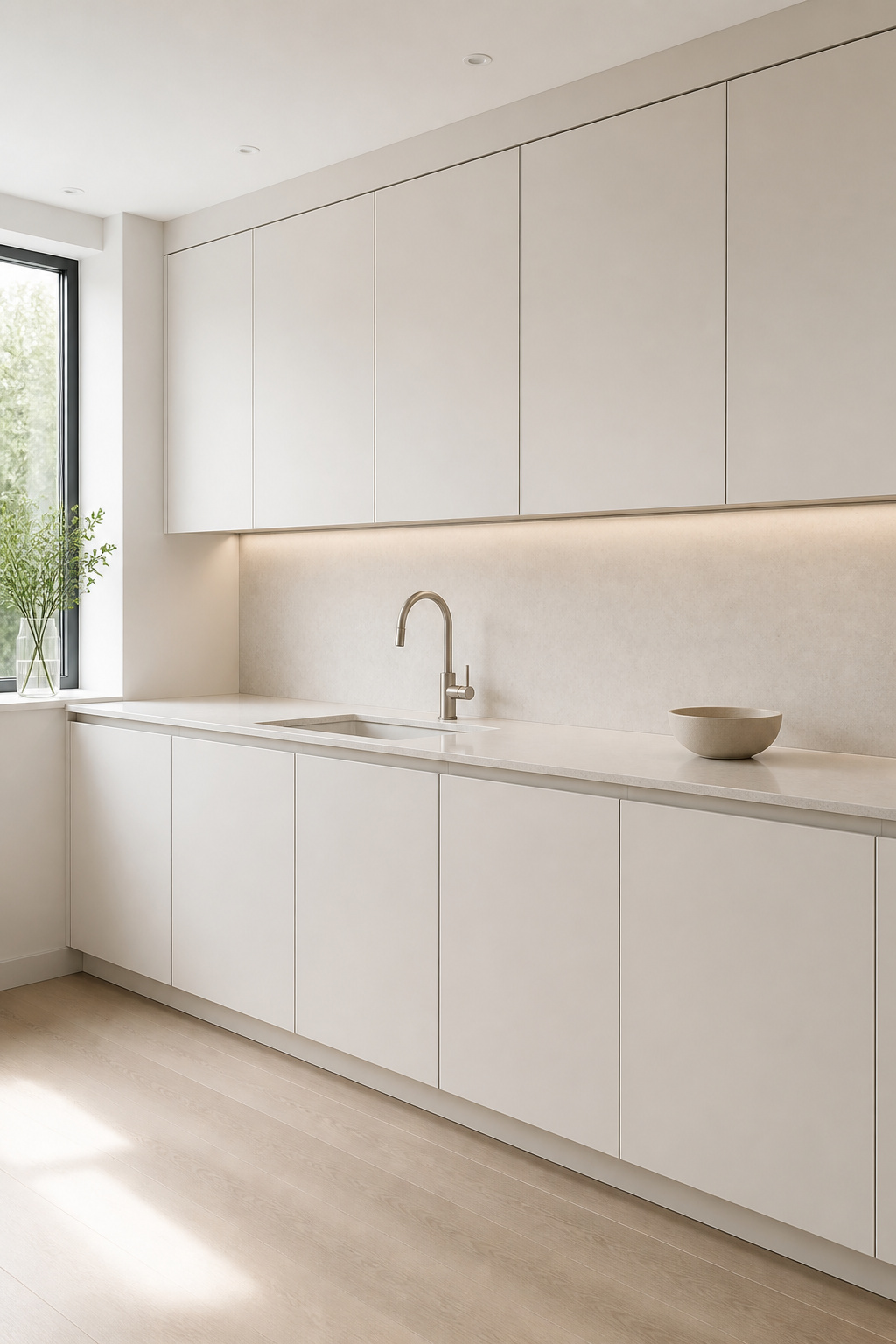
The most repeated visual element in any kitchen is its hardware. Think about it: twelve cabinet doors, eight drawer fronts, and you’re looking at twenty identical knobs or pulls marching across every surface in the room. Removing them is the single design decision that most transforms a kitchen’s character. It’s also why handleless cabinets have moved from trend to default specification in any kitchen aiming for genuine resolution.
Choosing the Right Opening Mechanism
Three systems make this work. Push-to-open uses a spring-loaded latch behind the door face. A light push releases it, which works well for wall cabinets where your hands might be full or damp. The Gola rail system is what designers mean by “true handleless.” An aluminium channel fixed to the cabinet carcass runs horizontally behind the door front. It creates a continuous grip channel with nothing visible on the door face itself. The J-pull sits between the two: a groove routed into the door edge gives a finger grip without any external component. A faint profile is visible in the door material, though — slightly less clean than Gola for strict minimalism.
Finish Options for a Working Kitchen
For a working kitchen, the finish choice matters as much as the mechanism. Matte lacquer in warm white or putty shows fewer fingerprints than gloss. Clean it with a microfibre cloth rather than a damp rag to avoid streaking. Solid oak veneer is the most durable long-term choice. It develops a natural patina and handles daily use for fifteen or more years. Foil-wrapped doors can peel at edges near the oven — oak doesn’t have that problem.
One note before committing: push-to-open mechanisms wear faster on base drawers, which get opened hundreds of times daily. For long-term durability, reserve push-to-open for wall cabinets. Use Gola rail or J-pull on all lower drawers.
2. Hidden Appliance Garages to Keep Every Countertop Clear
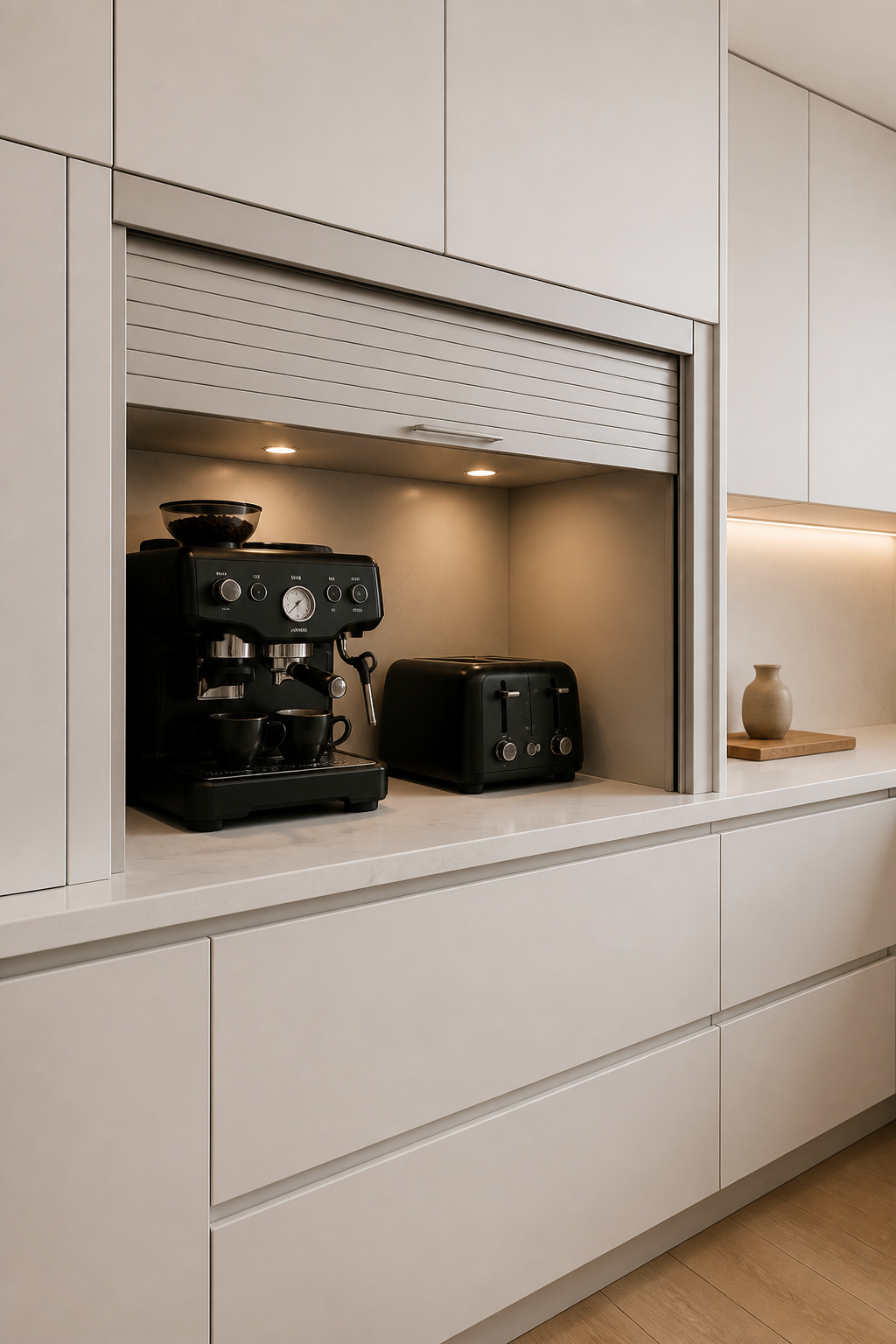
The clear counter is the foundation of every minimalist kitchen. The easiest way to lose it is having appliances sitting out because putting them away feels inconvenient. Appliance garages solve this without requiring willpower. They’re enclosed cabinets with a tambour roll-up or lift-up door. Everything stays hidden and plugged in — toaster, coffee machine, stand mixer — and ready to use in two seconds. Closed, they read as a section of standard cabinetry. Open, the entire appliance lineup is at counter height and accessible in two seconds.
Sizing and Electrical Planning
The planning detail most people miss is sizing. A standard KitchenAid 5-quart stand mixer is 14.5 inches deep, 13.9 inches wide, and 14 inches tall. That requires a minimum 24-inch-deep, 18-inch-wide garage with at least 15 inches of interior height. A full-size coffee machine runs 13 inches tall; an espresso machine can reach 17 inches. Measure every appliance you intend to store before a single cabinet is ordered.
Electrical must be built into the space. Four recessed outlets inside the cabinet keep everything plugged in with no cord management issues at the counter. Ventilation matters more than most people realise. A minimum of 31 square inches of ventilation at both inlet and outlet is required for heat-generating appliances. In practice, the garage doors need to be open while the toaster or espresso machine is running. For some households this is natural; others find it worth factoring in before committing to the design.
Match the garage door finish exactly to adjacent cabinet fronts and the result is a completely seamless wall. The visual payoff is immediate: an entirely clear counter. It’s one of the most striking transformations in these minimalist kitchen ideas.
3. A Single-Material Island That Anchors the Whole Room
A two-tone kitchen island — different cabinet colour, different countertop material, maybe a contrasting leg detail — can work beautifully in the right space. In a minimalist kitchen, though, it introduces multiple competing focal points where the goal is to have one quiet anchor. The monolithic island is built from a single material with a waterfall edge continuing down both sides. It’s architecturally the most resolved approach among these minimalist kitchen ideas.
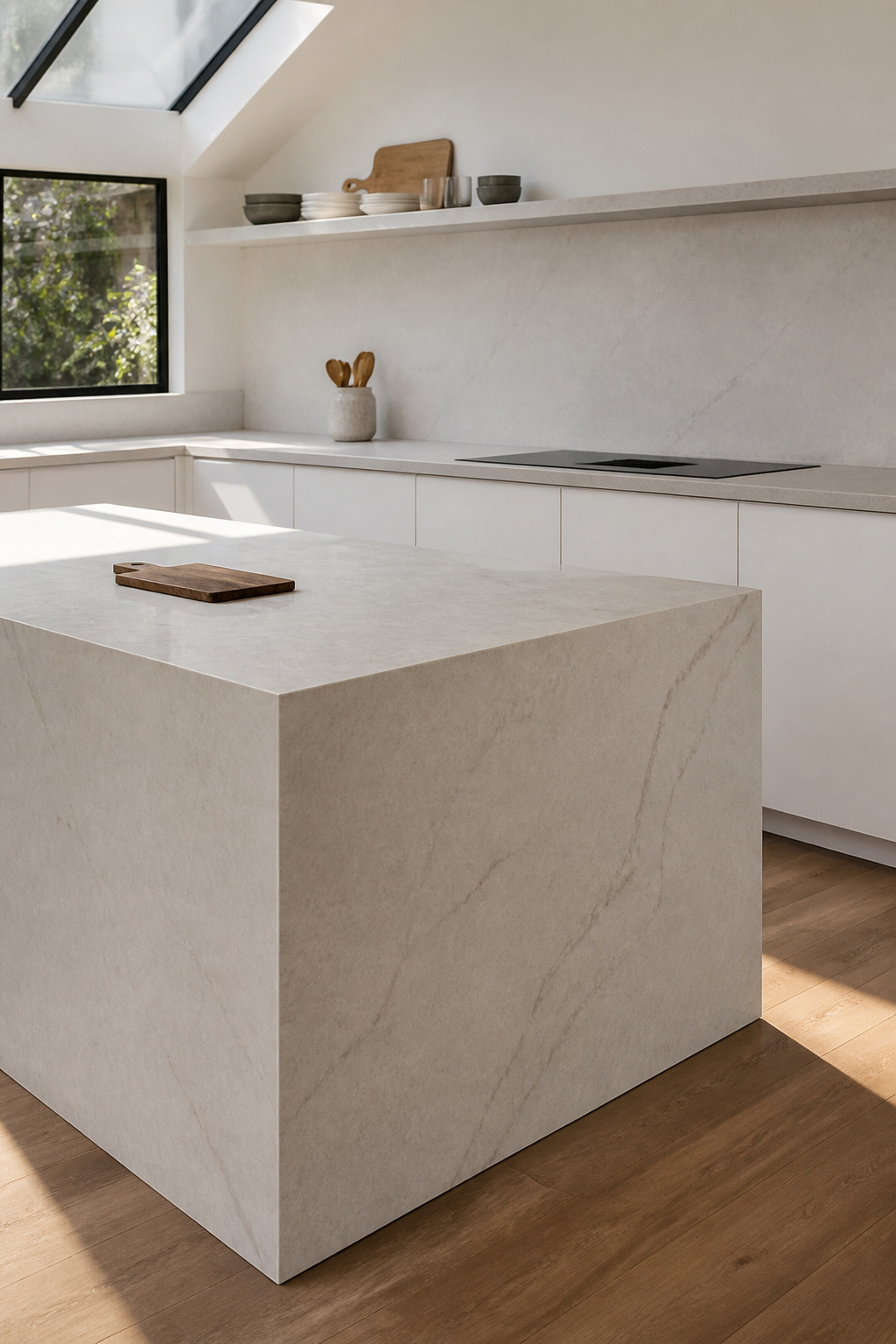
Quartz is the practical choice for a waterfall edge. It’s manufactured to ensure consistent veining from slab to slab. The pattern aligns across the 45-degree miter joint where top meets side panel. In quality fabrication, the vein appears to fold around the edge rather than terminate at it. Marble is more dramatic but higher risk. Matching the pattern across two consecutive natural stone cuts requires real expertise, and mismatched marble on a waterfall edge is expensive to correct.
Budget honestly. Waterfall fabrication adds $1,000–$2,000 above a standard edge profile. The cost covers CNC laser-cut miters and colour-matched epoxy — a seam tighter than a credit card’s width requires both. Full island materials and installation can reach $8,000–$12,000 for a premium quartz waterfall. Concrete is gaining attention as an alternative. Poured in place, it forms a true monolith with no seams at all — at around $150–$200 per square foot installed.
In a small kitchen, this is one of the minimalist kitchen ideas that earns its full cost. The monolithic approach earns its place. A waterfall island in the same colour as the perimeter cabinets recedes rather than demands attention. The space feels larger without sacrificing the island’s functional value.
4. Minimalist Kitchen Lighting: Why Recessed Fixtures Beat Pendants
Three pendants over a kitchen island look natural in every showroom. In a minimalist kitchen, though, each one introduces cord tops, shade tops, shade bottoms, canopies, and bulbs. That’s six visual termination points the eye tracks every time it moves across the room. Recessed LED downlights, installed flush with the ceiling, become effectively invisible in a pale ceiling when switched off. They also provide more even task lighting than pendants typically achieve.
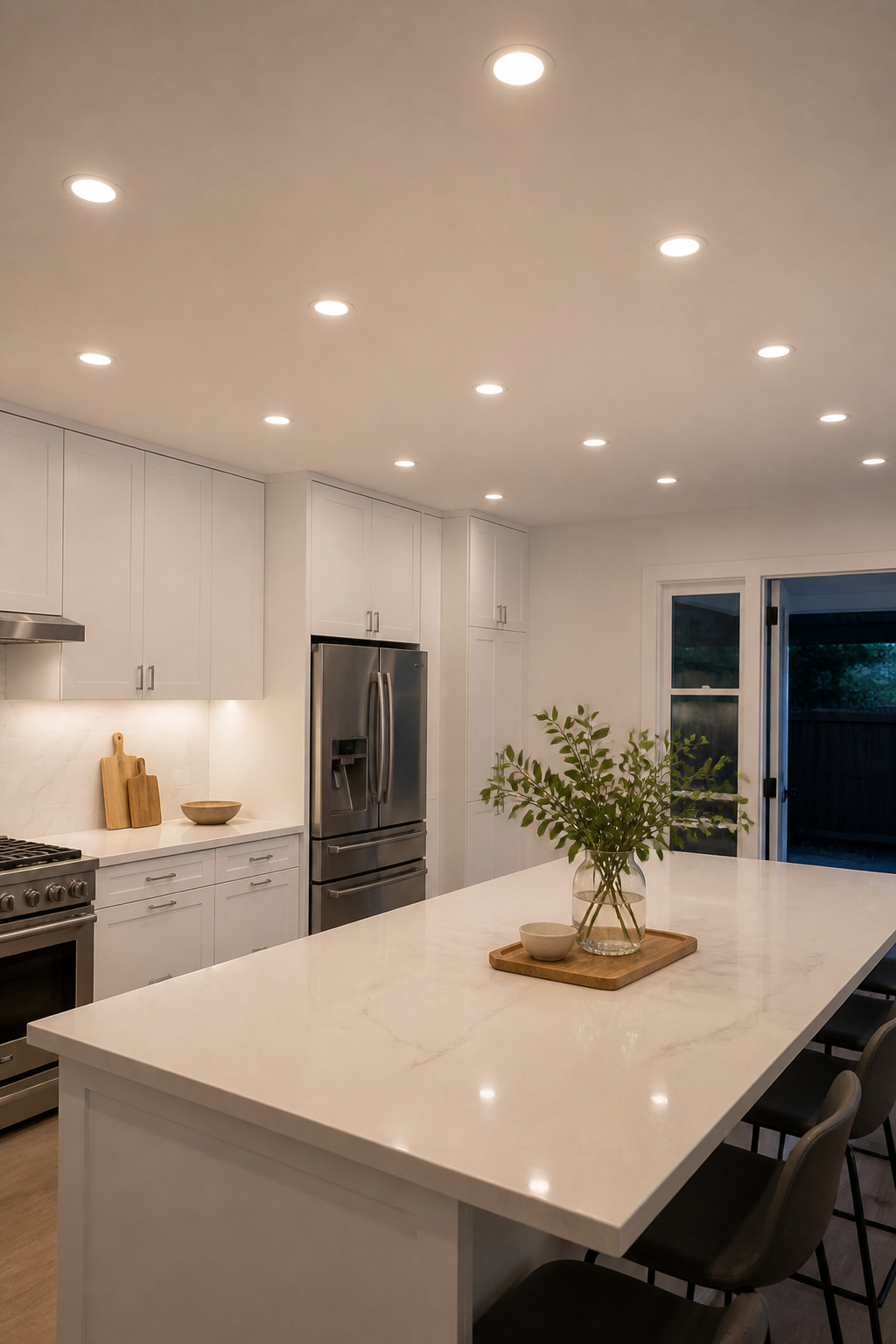
The spacing formula is simple: divide ceiling height by two to get the ideal distance between fixtures. For an 8-foot ceiling, space fixtures 4 feet apart; for 9 feet, 4.5 feet. Position recessed lights 18 inches from cabinet fronts. The beam then hits the countertop rather than the cabinet face, eliminating shadows at the work surface. Over an island, centre fixtures in the island’s footprint. Space them 24–36 inches apart — three for a 7-foot island, two for a 4-foot one. For lumen targets, circuit planning, and the full picture of kitchen zone lighting, kitchen lighting design ideas is worth a read before the electrician shows up.
Among minimalist kitchen ideas, recessed lighting is one where the specification details matter most. Kitchens need 50–70 lumens per square foot at task areas and 35–50 lumens per square foot for general ambience. Modern LED downlights with wide beam angles mean you can achieve this with fewer fixtures than older halogen calculations required. Dimmer switches on every circuit let the same kitchen serve prep lighting and dining ambience equally well.
When One Pendant Still Works
A single oversized drum or cone pendant over the island — rather than a cluster of three — can still work in a minimalist scheme. The single fixture reads as a deliberate design element rather than repetitive hardware. Choose it in a material that matches rather than contrasts with the island, and use recessed downlights for everything else. That’s the version of this minimalist kitchen idea that keeps simplicity intact.
5. Integrated Refrigerators That Vanish Into the Cabinetry
A standard refrigerator, however well-designed, is a large rectangular object in a finish that matches nothing else in the kitchen. In a tonal minimalist scheme, it’s a visual intrusion. An integrated or panel-ready refrigerator accepts a custom cabinet panel on its door so it matches the surrounding cabinetry exactly. Closed, it reads as more kitchen cabinets rather than as an appliance.
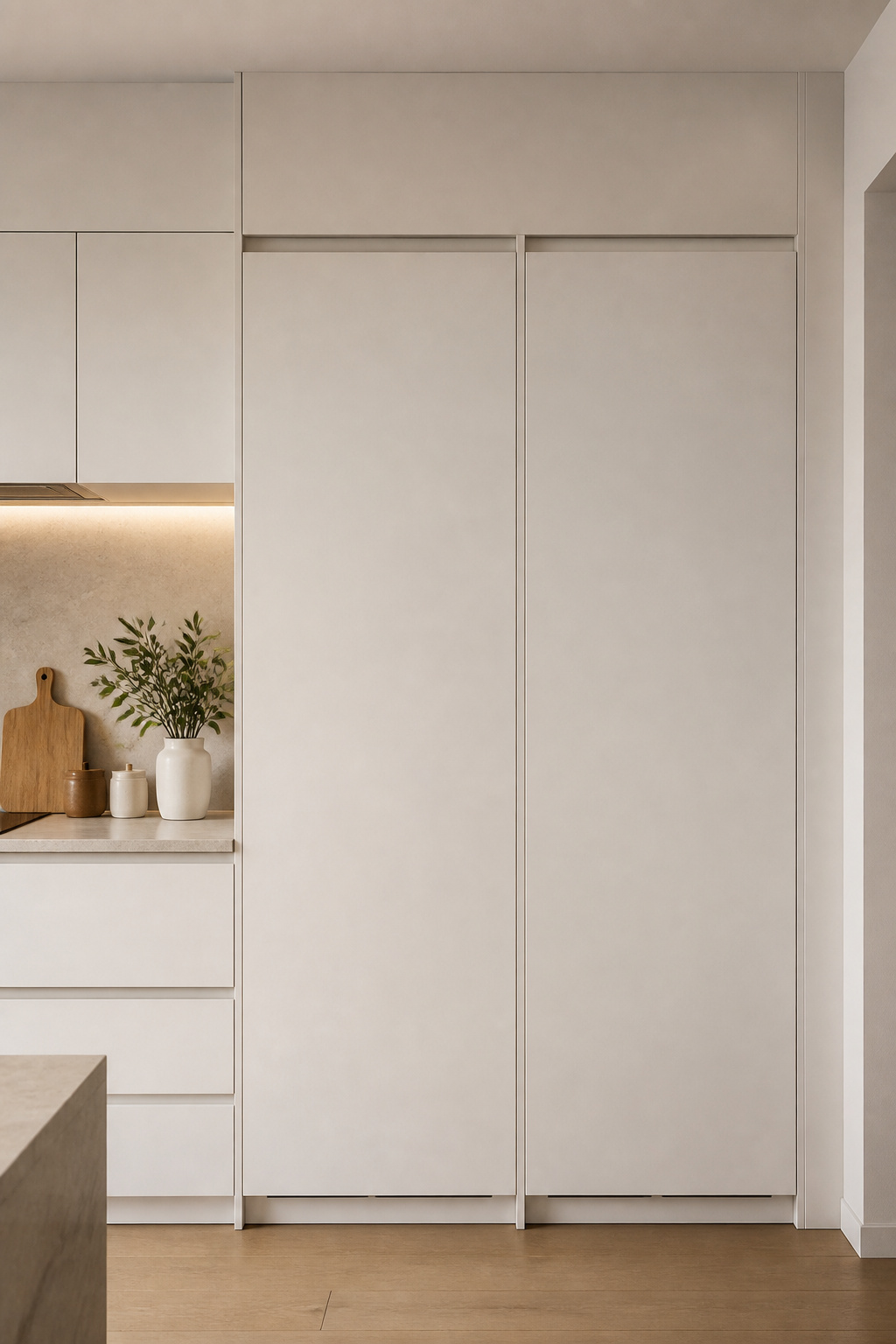
The distinction between counter-depth and fully integrated matters here. Counter-depth fridges sit flush with the cabinet face but show their own door finish. Fully integrated units sit entirely behind a custom-ordered panel in the same style and finish as every other door. The visual difference is significant in a tonal or all-white scheme.
Fisher & Paykel has become the accessible entry point. Their Series 7 at 36 inches wide, 16.8 cubic feet, runs approximately $4,200 — the practical option for a standard kitchen. Bosch panel-ready models in 24-inch width start around $3,500. Sub-Zero and Bosch full-integration models at $8,000–$11,000 offer quieter operation and longer warranties — the premium isn’t primarily visual.
Of all the minimalist kitchen ideas here, integrated refrigerators have the longest planning lead time. The planning catch: every integrated refrigerator needs a 1/8–1/4 inch gap on each side. Add 1 inch above for ventilation. The custom panel must come from the same manufacturer as the kitchen cabinet doors. A panel sourced from a different supplier will be detectably different in colour temperature or gloss level. It looks identical in isolation. Side by side, the difference shows. Get a physical sample match before ordering.
6. Open Shelving Done Right: Edit First, Display Second
Open shelving in a minimalist kitchen is not a storage decision — it’s a display decision. The moment open shelves become overflow storage, the kitchen stops reading as minimalist. Full stop. The difference is in the editing: a minimalist open shelf holds 3–5 items per linear metre at most. A stack of four matching plates, two mugs, and one small plant is a display. Fourteen mismatched pieces in the same space is a storage problem with good lighting.
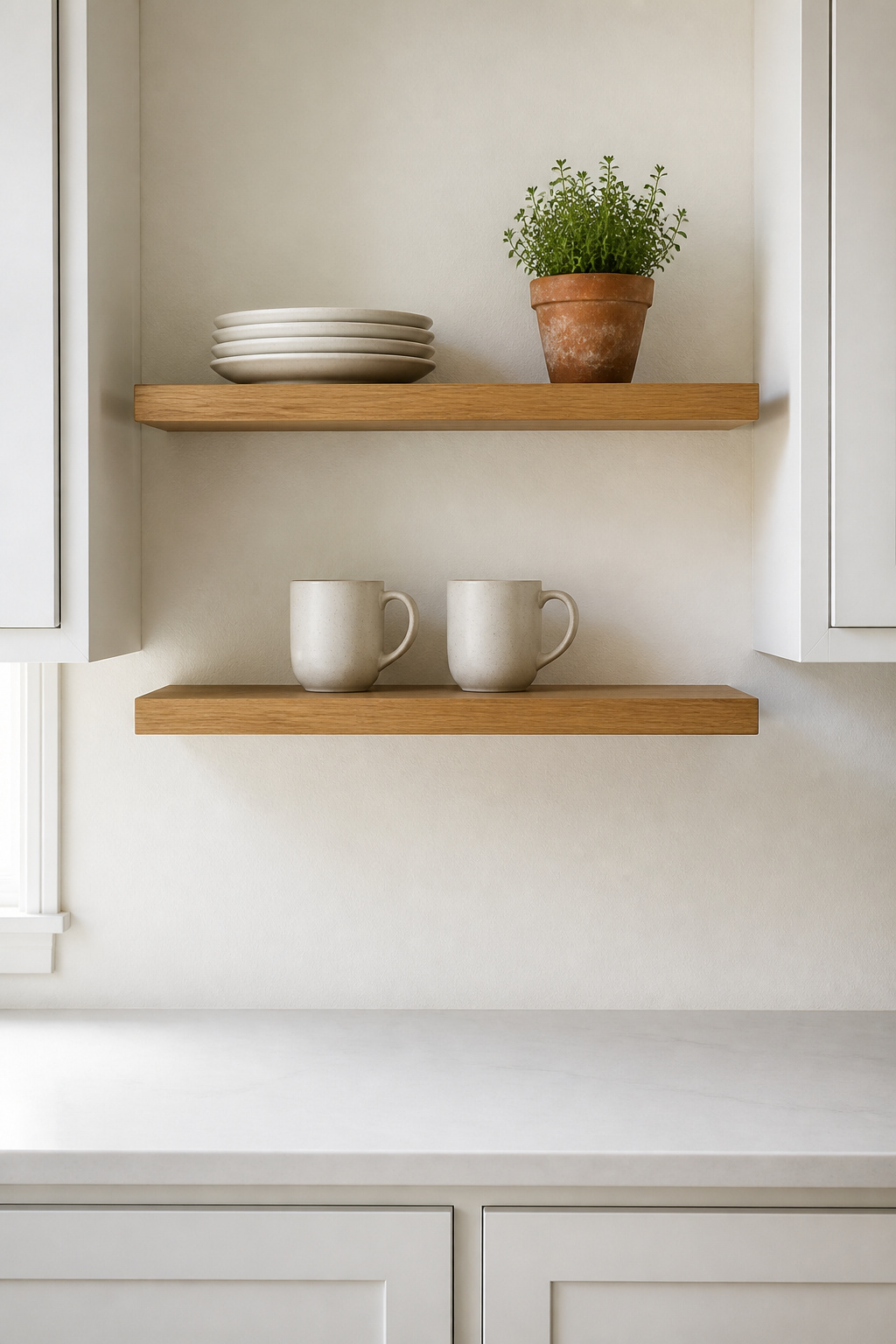
What earns wall space: a consistent dishware set in one colour, glassware in matching shapes, one ceramic canister set that fits the kitchen’s palette. What stays off open shelves in a working kitchen: anything used less than daily, anything that varies in size or colour. Anything stored near the hob should go behind a door — grease and steam deposit on open shelving within weeks. For practical guidance on making open shelves look curated rather than casually filled, creative ways to style open kitchen shelves is worth reading before placing a single item.
For the shelves themselves, solid white oak at 30mm or thicker is the premium choice. At this thickness, the shelf conceals a heavy-duty hidden steel bracket drilled into wall studs — nothing visible on the front face. Two studs hold 90–100 lbs: enough for a full set of ceramic dishware without any flex. MDF shelves painted to match the wall are a budget alternative that reads as nearly invisible in an all-white or all-grey scheme.
The honest caveat: open shelves in a cooking kitchen collect grease and dust faster than enclosed cabinets. Items near the hob will need wiping every few weeks. If that maintenance isn’t natural to your household, reserve open shelving for the wall furthest from active cooking — and close the rest.
7. Minimalist Kitchen Color: The Case for a Tonal Palette
The tonal kitchen — where cabinets, walls, and worktop sit within the same colour family rather than contrasting — is the most important palette decision among all minimalist kitchen ideas. When every surface reads as the same family, the eye travels continuously rather than stopping at every contrast edge. The room feels quieter and larger. This isn’t the same as monochrome. Tonal means using the same hue in three slightly different values, which creates depth without visual competition.
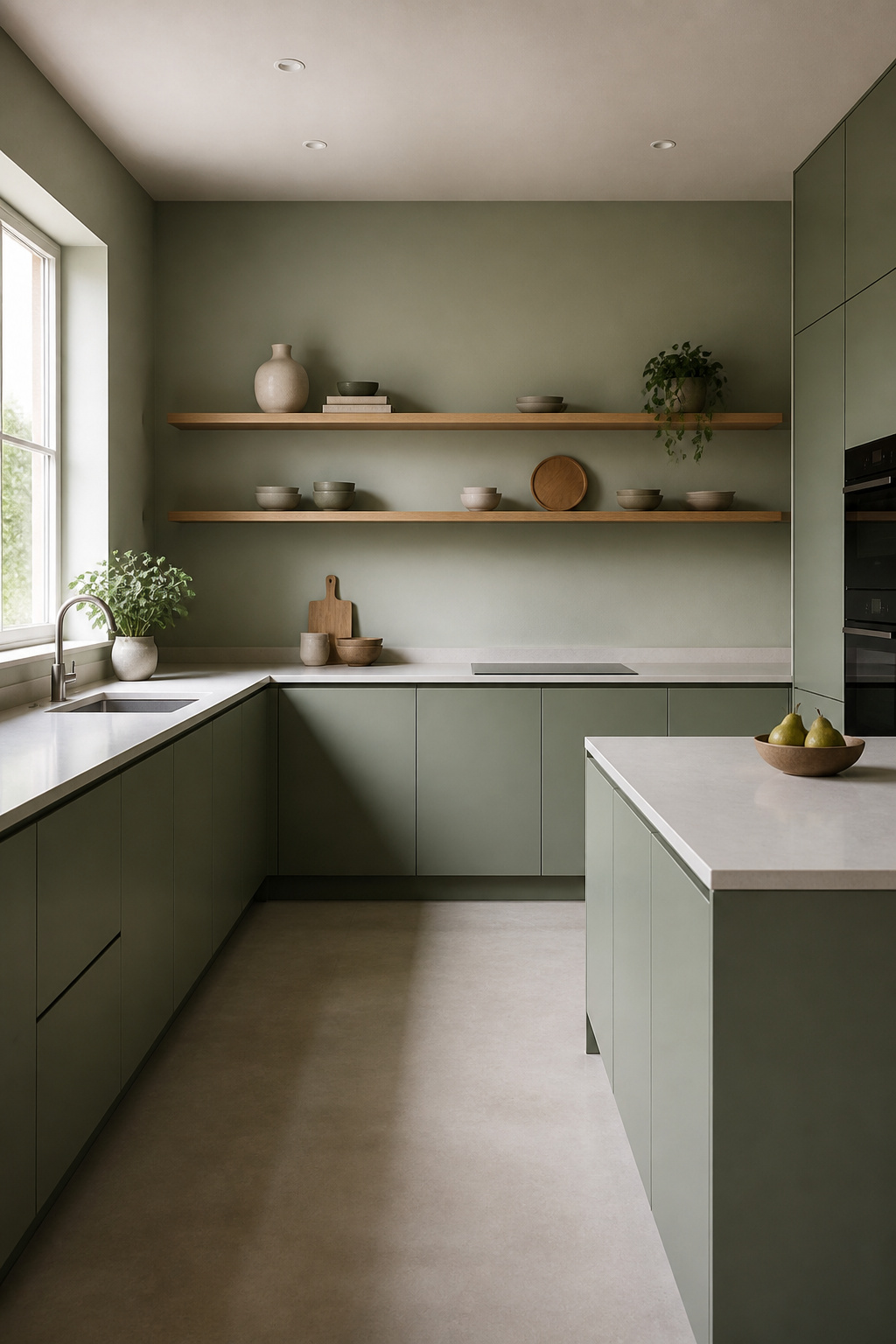
Cool greys are broadly out as of 2025–2026, replaced by warmer neutrals: greiges, putty tones, and muted greens. Farrow & Ball’s ‘Elephant’s Breath’ (warm greige) and ‘Mizzle’ (soft sage) are both popular right now. Benjamin Moore’s ‘Quiet Moments’ (sage green) and Dulux’s ‘Almond White’ work as full-kitchen tonal palettes. Pair a mid-tone cabinet with a slightly lighter wall in the same family. The room reads as deliberate rather than cautiously neutral. For the mechanics of choosing kitchen colour well, a good kitchen paint guide covers the decision process in detail.
Among minimalist kitchen ideas, the tonal sage green kitchen has become the strongest contemporary example. Sage green kitchens work particularly well with natural oak. A shelf, worktop detail, or floating oak surface ties into sage’s warm undertones without introducing a third competing colour. That combination (sage cabinet, slightly lighter sage-green wall, oak accents) is one of the most cohesive tonal minimalist schemes available right now.
One contrast pitfall: choosing white cabinets and a white wall in a different temperature. Cool-white cabinets alongside a warm-white wall look like a colour mistake rather than a design choice. Test both together in natural and artificial light before committing.
8. Quartz Countertops With No Visible Seams
Quartz has become the default worktop material for minimalist kitchens. It performs well — non-porous, scratch-resistant, no sealing required — and fabricates in large slabs that allow strategic seam management. A standard quartz slab (approximately 120 × 56 inches) covers most kitchen runs under ten feet in one piece. No seam required. In longer runs, seam placement can be controlled.
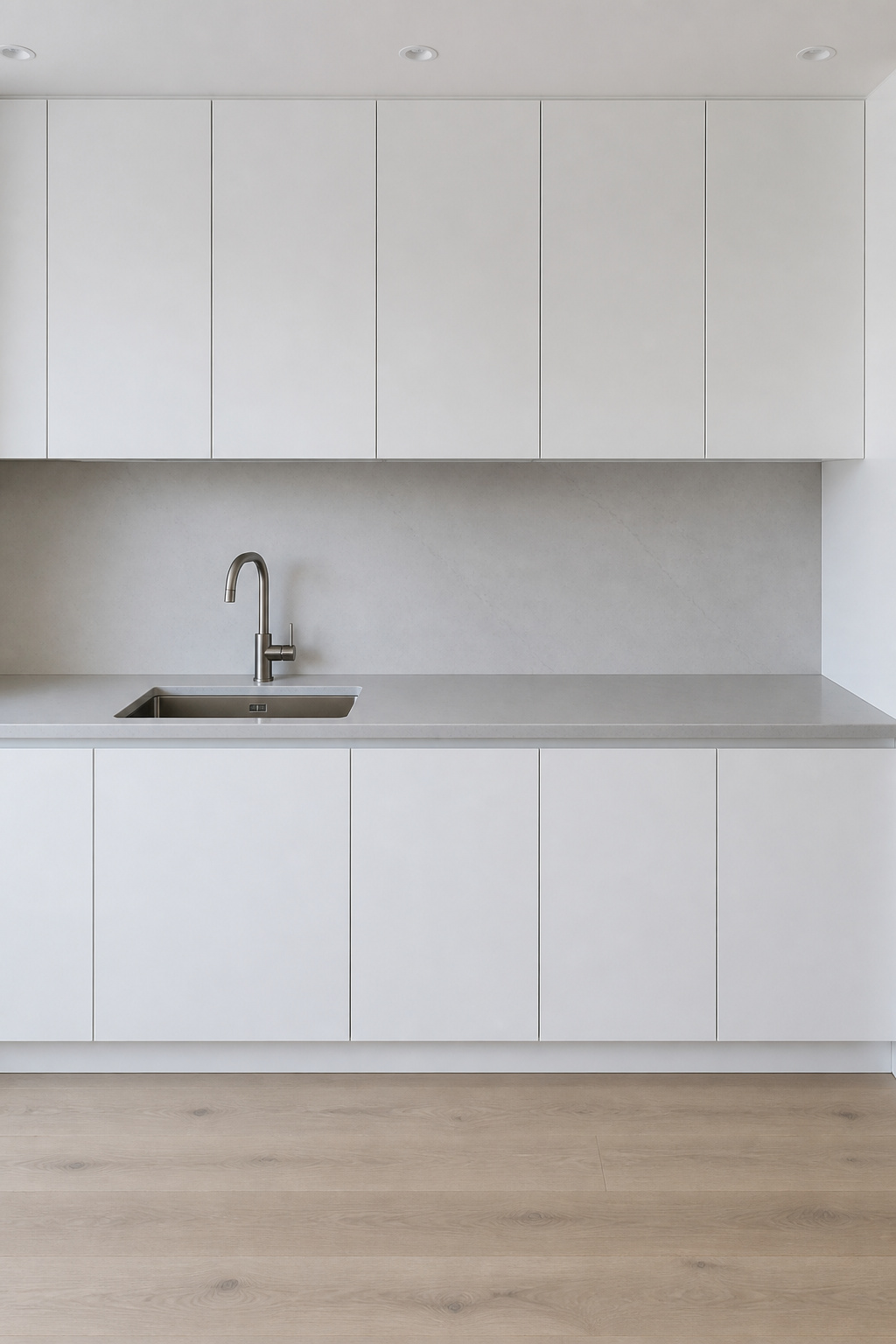
The 25-percent rule is the fabricator’s standard: seams within the first or last quarter of a countertop run are far less visible than seams centred in a long span. Best placement: near a sink or cooktop cutout, where the existing cutout gives the eye a natural break. Worst placement: a centred seam in an open counter run visible from the main living area. A professional-grade seam uses colour-matched epoxy, flush surfaces within 1/32-inch tolerance, and a joint no wider than a credit card.
Large-format porcelain slabs from Dekton, Atlas Plan, or Laminam come in panels up to 126 × 63 inches. That’s larger than standard quartz. A single porcelain panel can cover both worktop and backsplash as one continuous surface. Porcelain costs $90–$130 per square foot installed versus $70–$100 for quartz. The ability to bridge worktop to backsplash with no joint is its defining advantage for minimalist kitchens.
If matching worktop to splashback, order both from the same batch run of the same material. Batch-to-batch colour variation in quartz is real. Two slabs from the same colour shipped in different months can be detectably different side by side. Confirm batch consistency before cutting — this is one of the minimalist kitchen ideas where a single small specification error creates a problem that is visible every day.
9. Deep Drawers Below the Counter: The Minimalist Storage Strategy
A base cabinet with a door is a useful object. A deep drawer is a better one. Open the cabinet and you’re looking into a 24-inch-deep interior. Items at the back disappear — crouching is required to see them and reaching to retrieve them. Open a deep drawer, and the entire contents come to you at counter height in one smooth movement. For pots, plates, and dry goods, this isn’t a marginal improvement — it’s a fundamentally different experience of the kitchen.
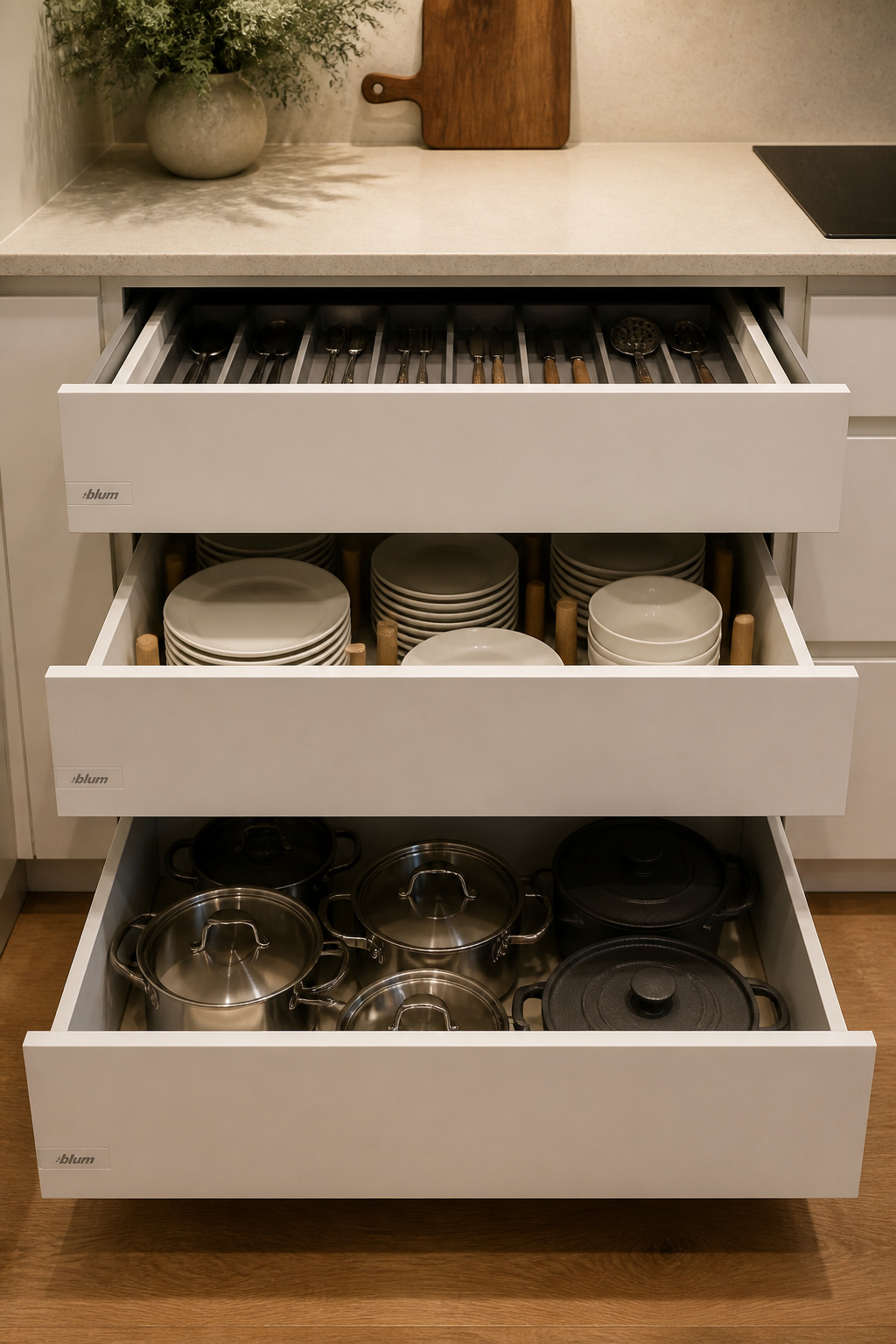
Three-tier drawer banks are the standard configuration. The top drawer (90–100mm) holds utensils and cutlery. A middle drawer handles plates and glasses. The deep bottom drawer (240mm+) holds pots and baking trays. This replaces an entire base cabinet section while keeping every item visible on a single pull. The flat fronts of a drawer bank are indistinguishable from a door cabinet in a handleless scheme. Of all the minimalist kitchen ideas in this guide, deep drawer storage creates the greatest day-to-day improvement in how the kitchen actually functions.
Blum LEGRABOX and the Minimalist Kitchen Drawer Standard
Blum’s LEGRABOX is the industry benchmark for drawer systems. The Series F (extra-deep, at 9.5 inches of drawer height, 125-lb load capacity) handles pots and stacked dinnerware without flex. The integrated BLUMOTION soft-close is guaranteed for 500,000 operating cycles — roughly 140 years of opening a drawer ten times a day. Hettich ArciTech is the main European competitor at slightly lower cost with equivalent quality. For how these systems fit into a broader kitchen storage strategy, smart kitchen storage organisation covers the full picture.
One planning note: when specifying pots and pans drawers, account for handle height. A pan with a long handle can prevent the drawer above from opening if heights aren’t calculated to accommodate it.
10. Simple Kitchen Sinks: Undermount and Flush-to-Counter Styles
The drop-in overmount sink quietly undermines a minimalist scheme. Its visible rim sits above the counter surface and collects grime in the joint. It breaks the clean horizontal plane of the worktop. An undermount sink bonds below the counter surface, eliminating the visible rim and making counter wiping seamless. Crumbs sweep directly into the bowl without any obstruction.
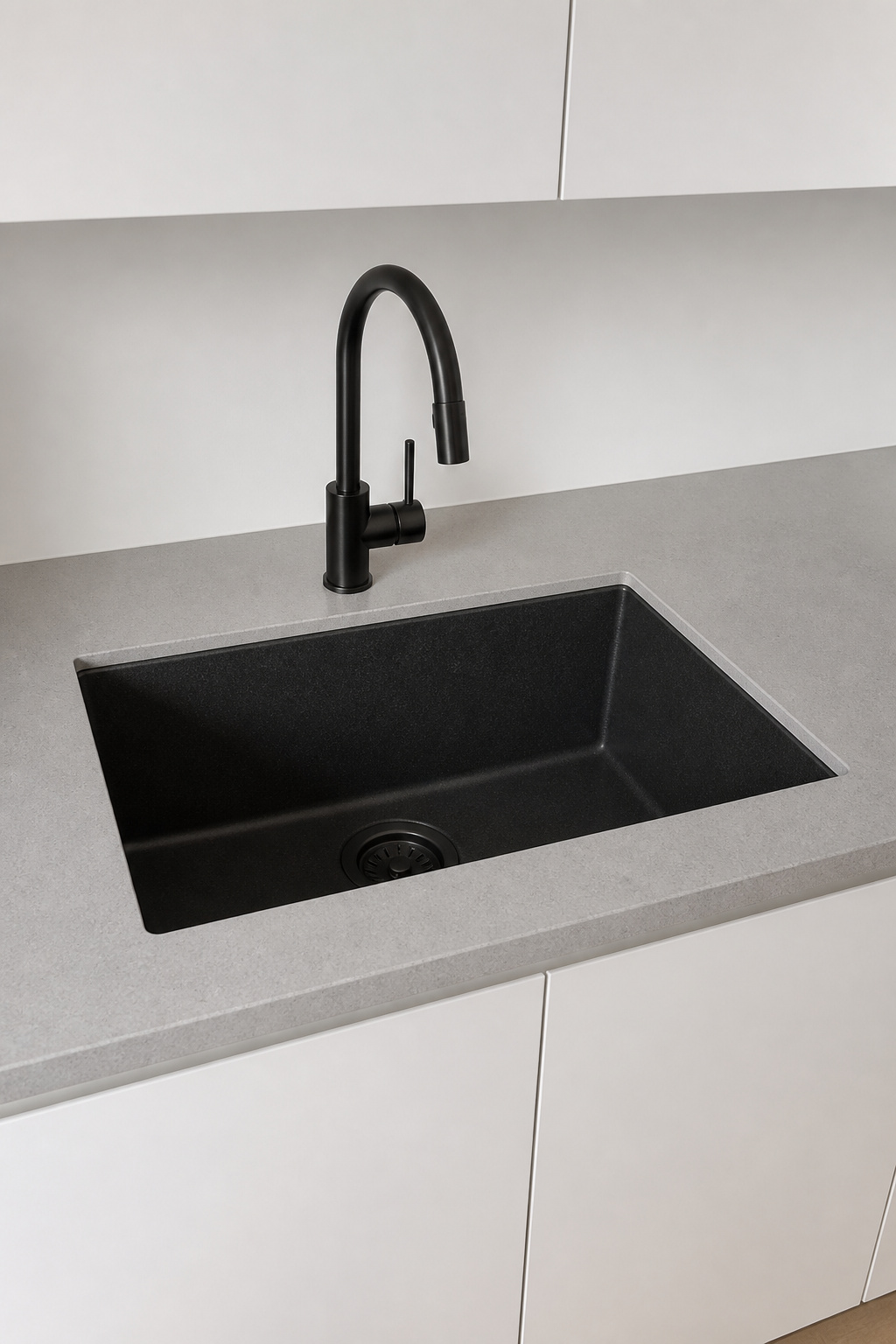
Undermount installation requires a solid countertop: quartz, granite, or porcelain slab. That constraint makes it naturally compatible with the worktop choices minimalist kitchens typically favour anyway.
Composite granite — granite stone mixed with acrylic resin — produces a hard matte surface in black, grey, or white. It resists scratches, chips, and noise. It’s the most visually harmonious choice for a tonal kitchen — the matte finish reads consistently with matte cabinet fronts. Prices run $250–$800. Fireclay has a beautiful glazed surface but chips if heavy cast iron is dropped into it. Best for kitchens where that’s not a daily risk, at $500–$1,200+. Brushed stainless is the most forgiving option. It hides scratches over time and costs 25–40% less than composite or fireclay. Specify brushed rather than polished to reduce fingerprint visibility significantly.
Workstation sinks — with integrated ledges for sliding cutting boards, colanders, and drying racks — add function to a limited-counter kitchen. They’re visually busier when accessories are in use, though. With adequate counter space, a standard single undermount bowl is the cleaner, more consistent choice.
11. Floating Shelves Instead of Upper Cabinets on One Wall
Removing one run of upper cabinets and replacing it with two or three floating shelves is the most accessible entry point into minimalist kitchen design. No full remodel required — and it’s one of the most cost-effective minimalist kitchen ideas available. The visual effect is immediate. The eye line opens, the ceiling reads higher, and the kitchen’s character shifts far beyond what the scope of work would suggest.
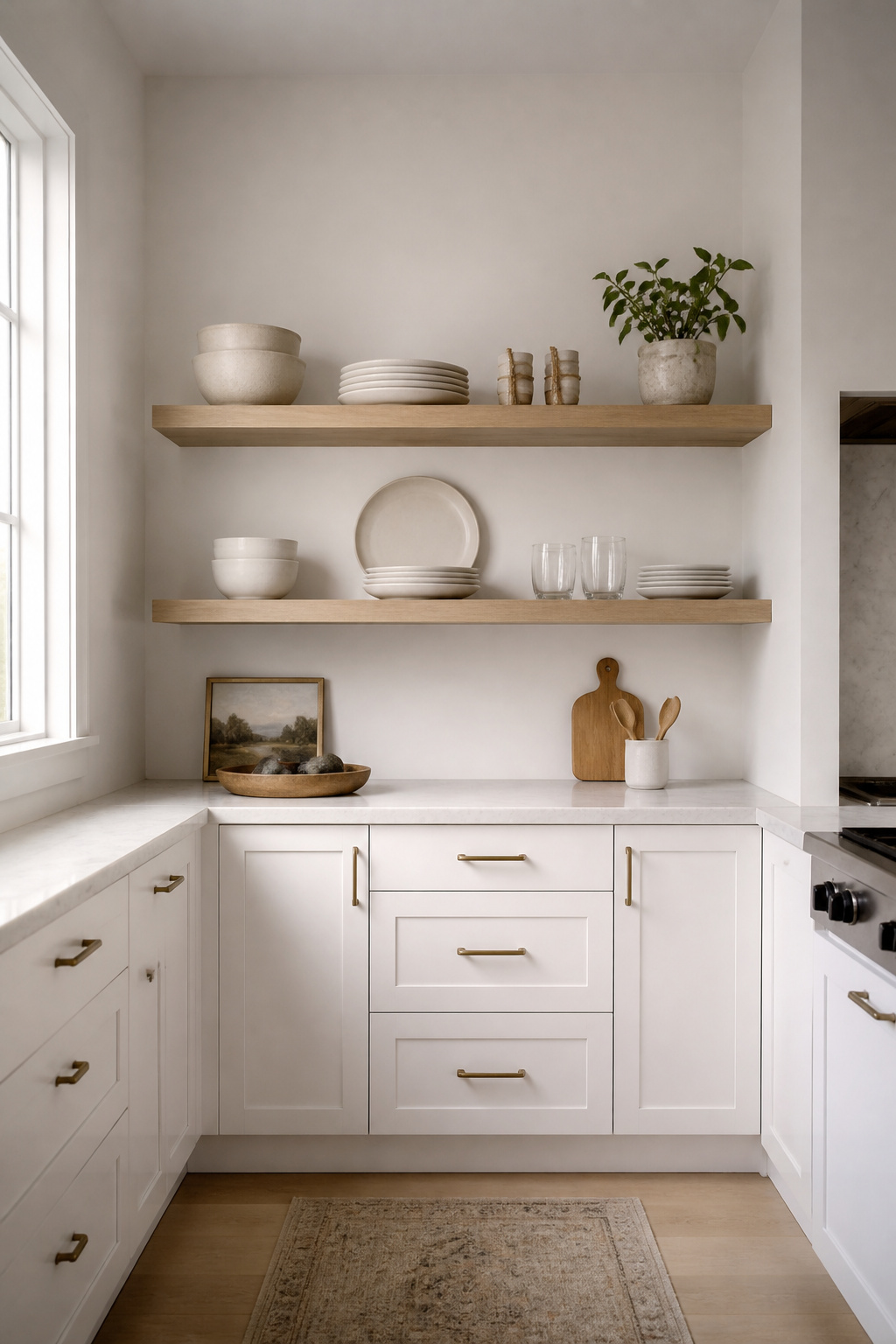
Upper cabinet boxes on all four walls of a small kitchen reduce the room to a series of opaque faces. Removing one run exposes the wall. That reads as space, even when shelves are mounted on it. The wall behind the shelves becomes part of the design. In a white kitchen, a limewash or contrasting paint behind the shelving adds character without complicating the scheme. For small kitchens, it’s worth thinking about the open-to-closed storage balance before a single bracket is ordered.
Structurally, removal is achievable as a weekend project in most homes. Standard upper cabinets fix to wall studs with screws. No structural work is required unless you’re dealing with a load-bearing configuration, which is rare for upper kitchen units. A properly installed floating shelf into two studs handles 90–100 lbs: enough for a full dishware set. Thicker shelves (38mm+ in solid oak) with hidden steel rods drilled into studs push the load capacity toward 150 lbs.
What Goes on Open Shelves vs. Behind Doors
The practical rule: only things that are both used daily and look good earn wall space. Items used less than once a week belong behind a door. The working compromise: open shelves on the window wall where upper cabinets would block light, full upper cabinets on the cooking and food-prep walls. That keeps visual breathing room without sacrificing the practical storage a working kitchen requires. Keep shelves away from the hob, where grease deposits from cooking will coat everything above the burners within weeks.
12. A Full-Height Backsplash That Reads as Part of the Wall
A standard tile backsplash in a 15-inch band creates two horizontal seams — one at the counter edge, one where tile meets wall. In a minimalist kitchen, those seams are visual interruptions. The full-height backsplash — running from counter to ceiling in a continuous panel — removes both.
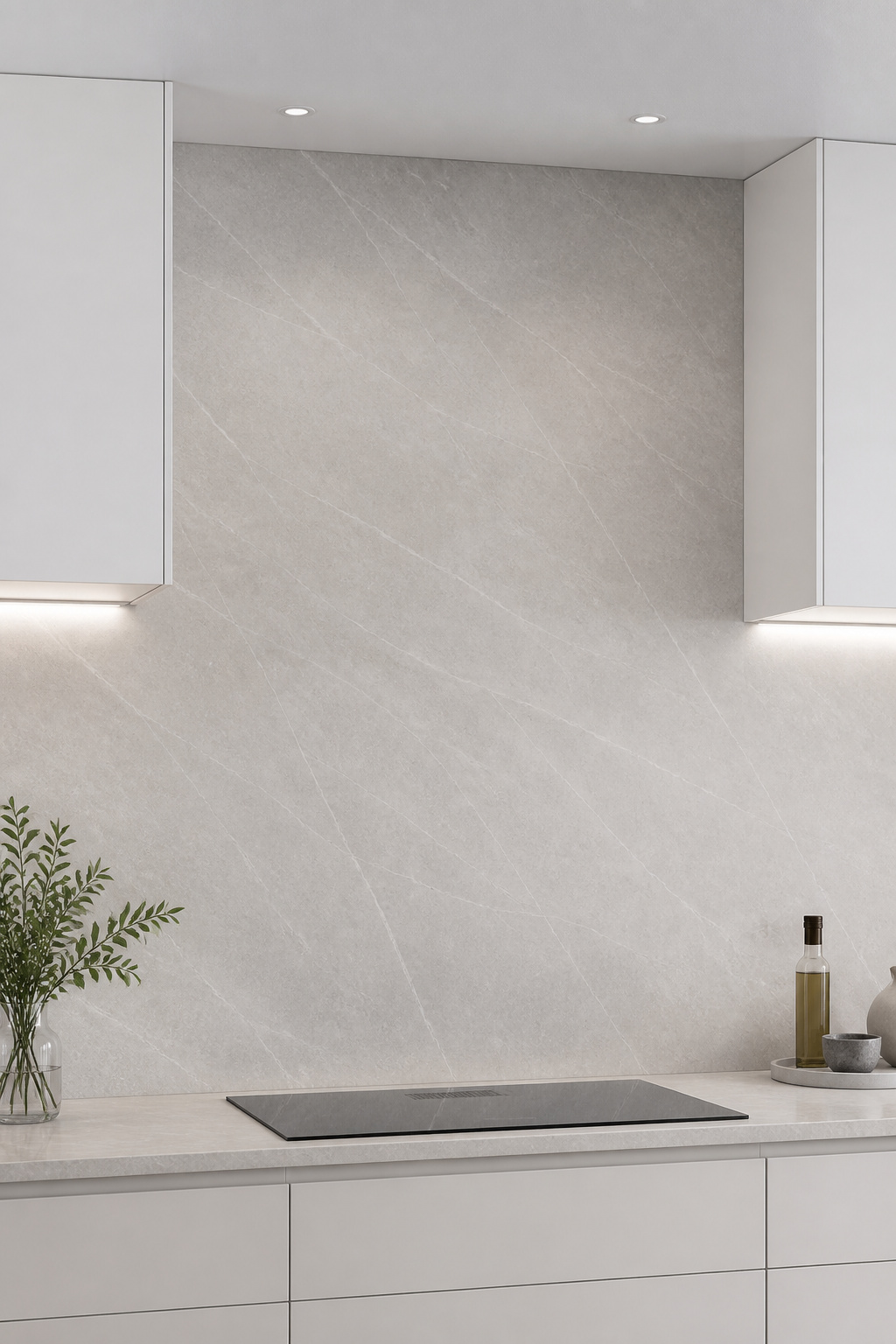
The most effective execution uses the same material as the worktop. A quartz or porcelain slab splashback matching the countertop creates a single vertical plane from work surface to ceiling with no visible joint at the back. For a full range of material options for this approach, modern kitchen backsplash ideas is the reference to reach for when comparing execution methods.
Large-format porcelain panels at 60 × 120 inches, installed from counter to ceiling, read as one unbroken surface. They’re the workhouse of this approach. Budget $40–$80 per square foot for material and installation versus $15–$30 for standard subway tile. Slab thickness at 12mm is the structural standard near the hob. Thinner 6mm panels are for walls only, away from direct heat.
Where grout lines are present — large-format tile rather than slab — use colour-matched grout. Grout that matches the tile exactly makes the joint nearly invisible from normal viewing distance. The minimum joint width for large tiles is 2mm; specify unsanded grout at this width for the tightest finish. Dark grout on light tiles creates a visible grid that directly contradicts the seamless goal. Always match.
13. Clean Kitchen Hardware: The Strong Case for Going Knob-Free
Kitchen hardware is often treated as the detail that comes after all the design decisions. In a minimalist kitchen, it deserves to be the first question. Twenty identical knobs across a kitchen face introduce twenty small visual interruptions — individually insignificant, cumulatively significant. Remove them, and the cabinet faces read as continuous planes. Of the minimalist kitchen ideas that cost the least to execute, going hardware-free has the most immediate visual effect. The result is quieter and more resolved than any colour change achieves.
When Minimal Hardware Is Still the Right Choice
A J-pull — a groove routed into the door or drawer edge — is the most accessible route to hardware-free cabinetry. The J-shape gives a secure finger grip with no external component and works on 18–25mm thick doors. Finger pulls — a shallow routed channel in the door face (typically 12mm deep × 60mm wide) — are slightly more visible than a J-pull. They’re easier to grip for heavy drawers or for anyone with limited hand strength. Both can be retrofitted onto existing kitchen doors if the material allows routing.
If hardware is used, the minimalist rule is one style, one finish, applied consistently to every door and every drawer. Thin bar pulls in matte black or brushed brass are the least disruptive option. Specify 5mm diameter at 96 or 128mm spacing. Matte black reads as a deliberate detail in a light kitchen. Polished chrome or polished nickel reflects light and draws the eye — avoid high-gloss finishes in a tonal minimalist scheme.
The relationship between door style and handle choice is worth thinking through before committing. They inform each other more than people expect. One technical note: finger pulls routed into doors thinner than 16mm can crack at the groove edge under daily use. Check door thickness first.
14. Built-In Pantry Cabinets With Flush Doors That Disappear
The freestanding pantry is a furniture piece. It has visual weight, sits proud of the adjacent cabinet run, and introduces a depth inconsistency the eye registers as a break in the design. The built-in pantry cabinet is effectively invisible when closed. Order it in the same door style, finish, and depth as the rest of the kitchen. It reads as more cabinetry until someone opens it and finds a floor-to-ceiling organised food store.
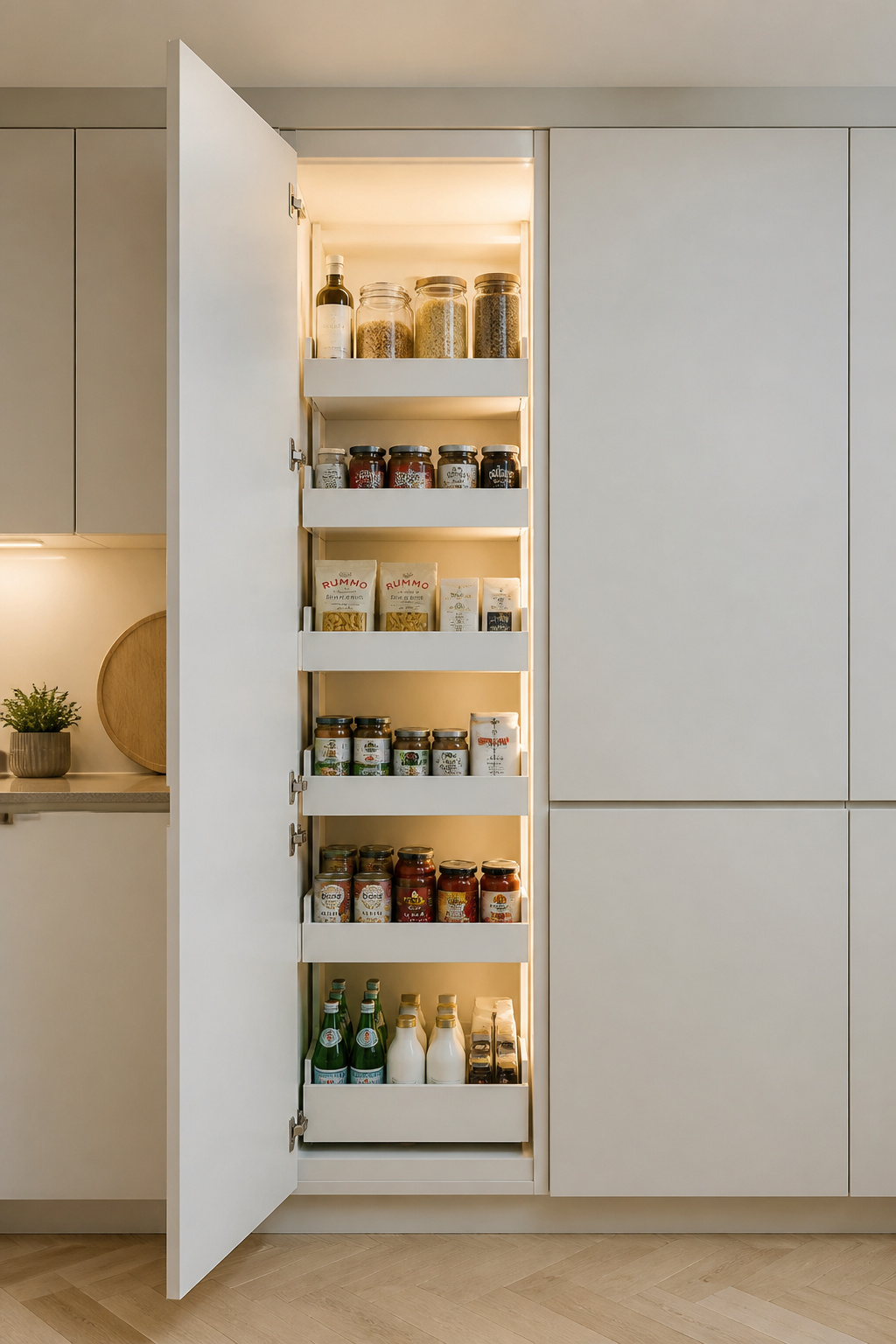
Standard built-in pantry cabinets run 15–36 inches wide, 84–96 inches tall, in 12 or 14-inch depths. At 84 inches, a full-height pantry spans floor to ceiling. It disappears into the cabinetry wall when the door style and finish match exactly. That last word matters: the pantry door must come from the same manufacturer as the kitchen doors. Any near-match from a different source will show a detectably different colour temperature or gloss level.
Interior Organisation Systems
For kitchen organisation pantry strategies that make a deep pantry genuinely usable, pull-out full-extension shelves (holding 75–100 lbs each) allow access to the back of an 18-inch-deep cabinet without emptying the front. Door-mounted racks on the inside face add the equivalent of two extra shelves worth of storage for spices and condiments. Blum, Häfele, and Hettich all produce retrofit interior systems designed for standard 24-inch pantry cabinets.
For handleless kitchens, the pantry doors need the same Gola rail or J-pull as every other door in the scheme. A pantry with a conventional pull handle breaks the logic of an otherwise hardware-free kitchen. It’s a detail that’s hard to unsee once noticed.
15. Minimalist Kitchen Flooring: Large-Format Tiles or Continuous Hardwood
The floor is the largest visible surface in any kitchen, and most kitchens under-think it. Small-format tiles — 100×100mm, 150×150mm — create a high-frequency visual grid that the eye reads as complex and busy. Large-format tiles at 600×600mm and above have 75% fewer grout lines across the same area. The room genuinely feels quieter — and that quieting effect is at the heart of all minimalist kitchen ideas. For open-plan spaces where the floor continues into a dining or living area, it also reads significantly larger.
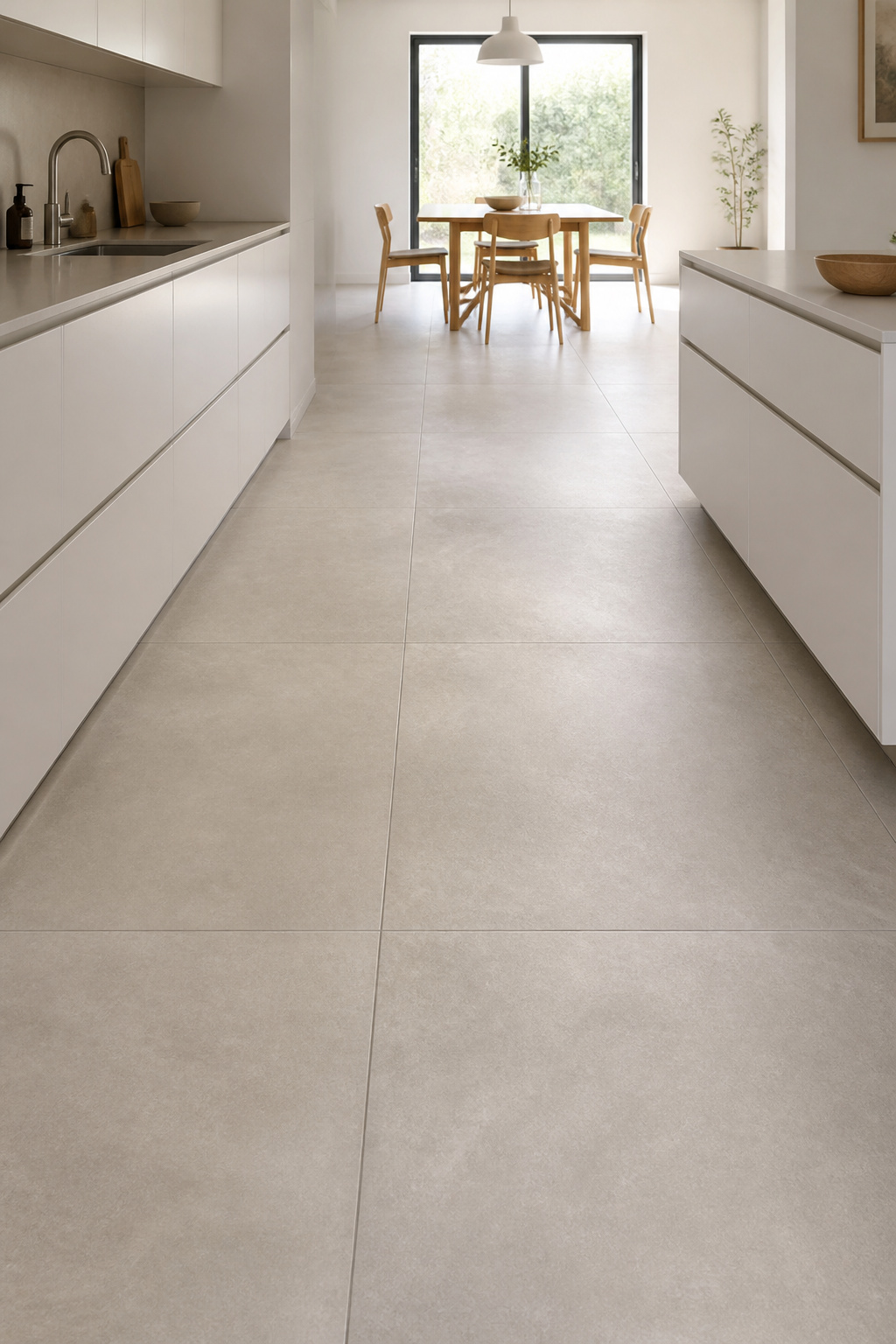
The key sizes for minimalist kitchen flooring: 600×600mm suits kitchens under 12 square metres. The 600×1200mm format is the sweet spot for most kitchens — long panels read as near-continuous in concrete-effect, stone-effect, and terrazzo looks. Slip rating R10 is standard in most large-format lines and is the minimum for kitchen floors. For open-plan spaces at 20+ square metres, 800×800mm or 1200×1200mm formats extend the eye dramatically. They do require a sub-floor flat to within 3mm per 2-metre span. Any more and large tiles will crack at corners.
Engineered Wood for Open-Plan Continuity
Running engineered wood from kitchen into dining or living space is the other route to minimalist flooring. It eliminates the threshold strip that visually divides spaces. For the practical decision between tile and wood, reviewing the full material comparison in depth is time well spent before committing. Engineered oak (real wood veneer over a stable plywood core) handles moisture fluctuation better than solid wood. Specify a minimum 15mm wear-layer thickness and a hardwax-oil or lacquered finish rated for kitchen use. Kahrs is the accessible option; Boen mid-market; Dinesen premium for long-plank continuity.
Long planks over 1,800mm reduce visible end joints significantly. The floor reads as a continuous plane — the same quieting effect as large-format tile, but with warmth underfoot that no porcelain fully replicates.
Choosing Your Minimalist Kitchen Direction
Not every minimalist kitchen idea here requires a full remodel. Often the highest-impact changes are the ones that don’t. Three changes transform an existing kitchen most efficiently. Handleless cabinet doors can be retrofitted onto existing carcasses without replacing the whole structure. A full-height backsplash replacing a standard tile band addresses the horizontal seams that fragment the back wall. Repainting walls in a tonal match to the cabinet colour family typically costs under $100 in paint — and reads as a different kitchen entirely.
Integrated appliances, slab countertops, and large-format flooring have the highest impact on kitchen quality — and the highest cost. Treat them as goals in a phased approach if a full remodel isn’t immediate. Phase 1 covers the surface changes: paint, removing excess counter items, swapping any drop-in sink accessories for cleaner alternatives. Hardware and storage come in Phase 2: handleless pulls, floating shelves on one wall, large-format tile replacing the existing backsplash. Phase 3 is the full remodel: handleless cabinetry, panel-ready appliances, continuous slab worktop and splashback, large-format floors.
The consistent thread across all fifteen minimalist kitchen ideas is the same. Reduce the number of competing elements, and what remains starts to work harder. A kitchen with one focal point and a quiet palette behind it doesn’t just look better — it cooks better. The thinking flows more freely when the room isn’t asking for attention.